



The Bid-Ask Spread
Overview #
The Bid-Ask Spread
The bid-ask spread is the most fundamental cost in futures trading — and most traders underestimate it. Every time you enter a trade with a market order, you pay the spread. Every time you exit with a market order, you pay it again. Two round trips a day on ES at one tick each way? That's $25 per contract per day in spread cost alone — before commissions, before slippage, before anything else.
Understanding the spread isn't optional. It's the foundation of every execution decision you make: whether to use limit orders or market orders, which contracts to trade, what time of day to enter, and how tight your edge needs to be to survive.
What the Spread Actually Is #
The bid-ask spread is the difference between the highest price a buyer is willing to pay (the bid) and the lowest price a seller is willing to accept (the offer, or ask). In any given moment, these two prices define the market.
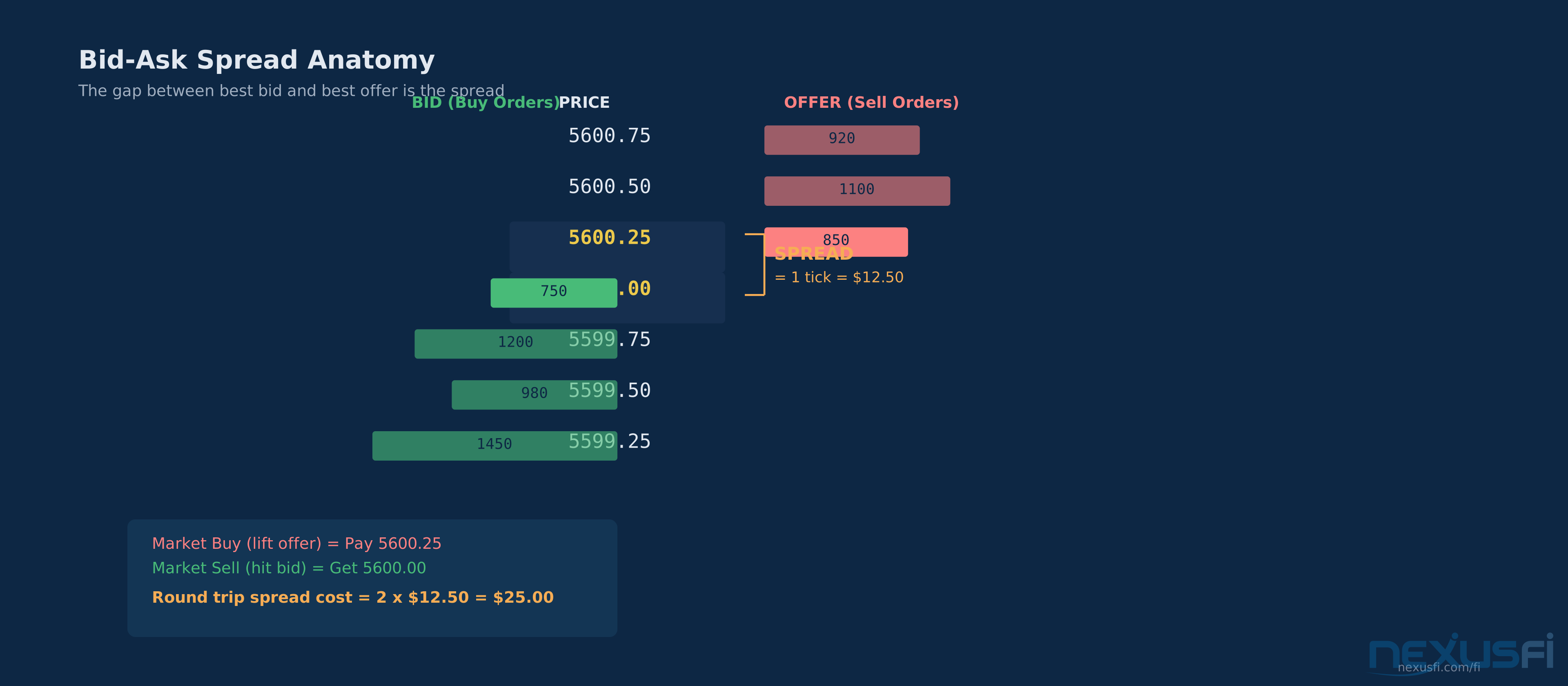
On ES, the bid might be 5600.00 and the offer might be 5600.25. That 0.25-point gap is the spread — one tick, $12.50. If you want to buy right now, you pay 5600.25. If you want to sell right now, you get 5600.00. The difference is the cost of immediacy.
This isn't a fee anyone charges you. It's the structural cost of demanding liquidity. Limit orders don't pay the spread — they provide it. Market orders consume liquidity and pay for the privilege.
"If you entered a market order you would buy immediately at the Ask/Offer or sell at the bid. On a futures platform you would be placing orders the other way round to ideally buy at the Bid and sell at the Ask."
-- [matthew28, Can I trade ZN Future with zero spread?] [1]
The Mechanics: Bid, Offer, and Execution #
Every futures market operates as a continuous double auction. Buyers submit bids. Sellers submit offers. The matching engine connects them.
The bid side contains limit buy orders — passive buyers waiting for the market to come to them. These traders are willing to buy, but only at their specified price or better.
The offer side contains limit sell orders — passive sellers providing liquidity above the current market. They'll sell, but only at their price or higher.
The spread is the gap between the best bid and best offer. In liquid markets like ES during regular trading hours (RTH), this gap is usually one tick — the minimum price increment. In less liquid markets or during off-hours, it can widen to multiple ticks.
When a buyer submits a market order, they "lift the offer" — buying at whatever price the lowest seller is willing to accept. When a seller submits a market order, they "hit the bid" — selling at whatever price the highest buyer is willing to pay. These are aggressive orders. They cross the spread and initiate transactions.
The Inside Market #
The "inside market" refers to the best bid and best offer — the tightest available prices. On a DOM (Depth of Market), this is the top level on each side.
At any given time, ES might show:
- Best bid: 5600.00 × 850 contracts
- Best offer: 5600.25 × 920 contracts
Those 850 contracts on the bid and 920 on the offer represent resting liquidity at the inside. Behind them sit deeper levels — 5599.75 × 1,200 on the bid, 5600.50 × 1,100 on the offer, and so on. The inside is the narrowest point. Everything beyond it is deeper liquidity that only gets accessed when the inside is consumed.
What Determines Spread Width #
The spread isn't fixed. It fluctuates based on several factors, and understanding these dynamics tells you a lot about market conditions.
1. Liquidity #
The single biggest driver. When many participants compete to provide liquidity, they tighten the spread to get filled first. ES during US trading hours has thousands of resting contracts at the inside bid and offer — the spread is one tick and rarely wider.
"Any time that ES ticks up, algos are immediately populating the inside bid. Watch it tick up — you'll see straight away that 90ish goes in, then 120, 150, 200 etc as the algos fill in the bid. It's not the 1000+ you see below the inside bid."
-- [Jigsaw Trading, Understanding Liquidity and Market Pullbacks] [2]
Thin markets — micro contracts after hours, agricultural futures during non-US sessions, exotic products — don't have this depth. Fewer participants means wider spreads.
2. Volatility #
When volatility spikes, liquidity providers pull back. Their risk increases — a resting limit order can get run over by a sudden move. So they widen their quotes or remove them entirely.
"You won't see the spread widen on most liquid markets because market makers are always stepping up first. The thing is — these market makers are just part of the picture and their liquidity alone is not enough to prop up the market."
-- [Jigsaw Trading, Understanding Liquidity and Market Pullbacks] [2]
During the 2020 flash crash, spreads on ES briefly blew out to multiple ticks as algos and market makers pulled their quotes simultaneously. During FOMC announcements, the book thins dramatically in the seconds before the release.
3. Time of Day #
Spreads follow a predictable daily cycle tied to participation:
- Pre-market (Globex overnight): Wider spreads, thinner book. Fewer participants, less competition to provide liquidity.
- US open (9:30 AM ET): Spreads tighten immediately as equity market participants flood in. ES hits peak liquidity.
- Midday: Liquidity eases slightly but spreads stay tight on major contracts.
- 3:00 PM ET: Bond market close — treasury futures spreads may widen.
- 4:00 PM ET (RTH close): Equity futures liquidity drops sharply. Spread may stay one tick on ES but the depth behind it thins dramatically.
- Overnight: Thinnest conditions. Even ES can see brief two-tick spreads during low-volume Asian session periods.
4. Contract and Instrument #
Different instruments have at the core different spread characteristics:
| Contract | Tick Size | Tick Value | Typical RTH Spread | Spread Cost RT |
|---|---|---|---|---|
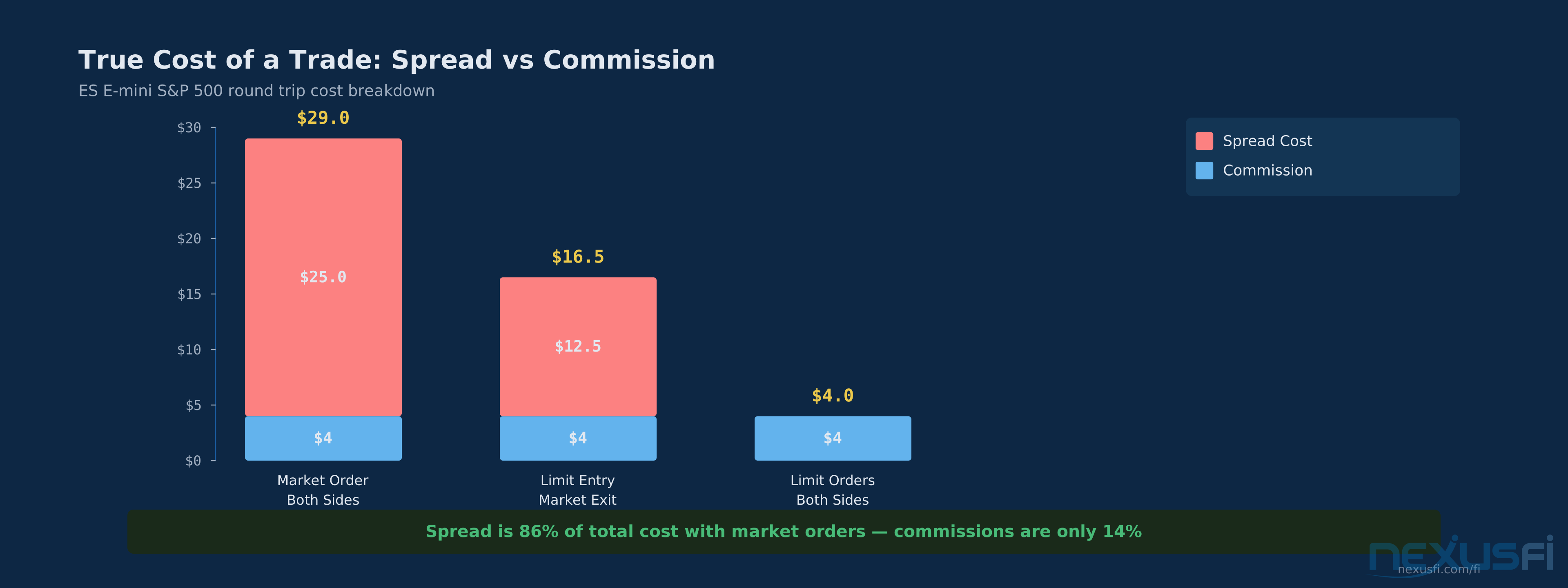
| ES (E-mini S&P 500) | 0.25 | $12.50 | 1 tick | $25.00 |
| NQ (E-mini Nasdaq 100) | 0.25 | $5.00 | 1 tick | $10.00 |
| CL (Crude Oil) | 0.01 | $10.00 | 1 tick | $20.00 |
| ZB (30-Year Treasury) | 1/32 | $31.25 | 1 tick | $62.50 |
| GC (Gold) | 0.10 | $10.00 | 1 tick | $20.00 |
| ZC (Corn) | 0.25 | $12.50 | 1 tick | $25.00 |
| 6E (Euro FX) | 0.00005 | $6.25 | 1 tick | $12.50 |
The spread cost in dollars varies enormously. ZB's one-tick spread costs $62.50 round trip — nearly five times NQ's $10. This matters when choosing what to trade. A scalper needs to overcome the spread on every trade. The wider the effective cost, the larger your edge needs to be.
"The commissions used for a trade were per roundturn, so it was 2 × 2.00 = 4.00. I just used the bundled commission model of Interactive Brokers."
-- [Fat Tails, Comparing Index Futures] [5]
Commissions are transparent. The spread cost is hidden — you don't see it on your statement, but it's in your fill prices every single time.
Market Makers and the Spread #
Market makers (MMs) are the primary providers of tight spreads. They continuously post both bids and offers, profiting from the spread when they successfully buy the bid and sell the offer.
"A local trader in a futures pit was basically a 'market-maker.' He made a 2-sided market, where he was willing to buy-the-bid and sell the offer. The MM's goal was to profit on the B/A spread when making a market. This was his compensation for the risk he assumed in making a market."
-- [tigertrader, Spoo-nalysis ES e-mini futures S&P 500] [3]
In modern electronic markets, HFT firms have replaced pit locals as the primary market makers. The mechanics are identical — buy bid, sell offer, capture the spread — but the speed is measured in microseconds rather than hand signals.
"There is very little difference between past MM practices in the pit and today's HFTs... No one was putting a gun to the MM's head — he could put his hands down, and not make a market anytime he perceived the market was 'toxic' and the risk was too high. HFTs pull liquidity in the very same way."
-- [tigertrader, Spoo-nalysis ES e-mini futures S&P 500] [3]
This is critical: market makers provide liquidity only when they can manage the risk. In calm conditions, they compete aggressively, tightening spreads. In volatile or uncertain conditions — before major data releases, during geopolitical shocks, at session boundaries — they widen quotes or disappear. The spread reflects their risk assessment of the current environment.
Designated vs. Natural Market Makers #
Some exchanges assign designated market makers (DMMs) with obligations to maintain quotes. CME's E-mini contracts don't require this — they're liquid enough that natural competition keeps spreads tight.
"I'm not sure of how it works with the CME, but I would guess that for the most liquid futures contract in the world, the ES, there are no market makers designated by the CME for this contract (why would there be, since it is already the most liquid futures contract in the world?)"
-- [josh, Is it profitable to scalp the spread in ES mini] [4]
Less liquid contracts — think small agricultural futures or exotic currency pairs — may have formal market-making arrangements where firms receive fee rebates in exchange for maintaining two-sided quotes within maximum spread parameters.
Crossing the Spread: The Cost of Immediacy #
Every market order crosses the spread. This is a real cost. Here's the math:
Scenario: ES day trader, 4 round trips per day
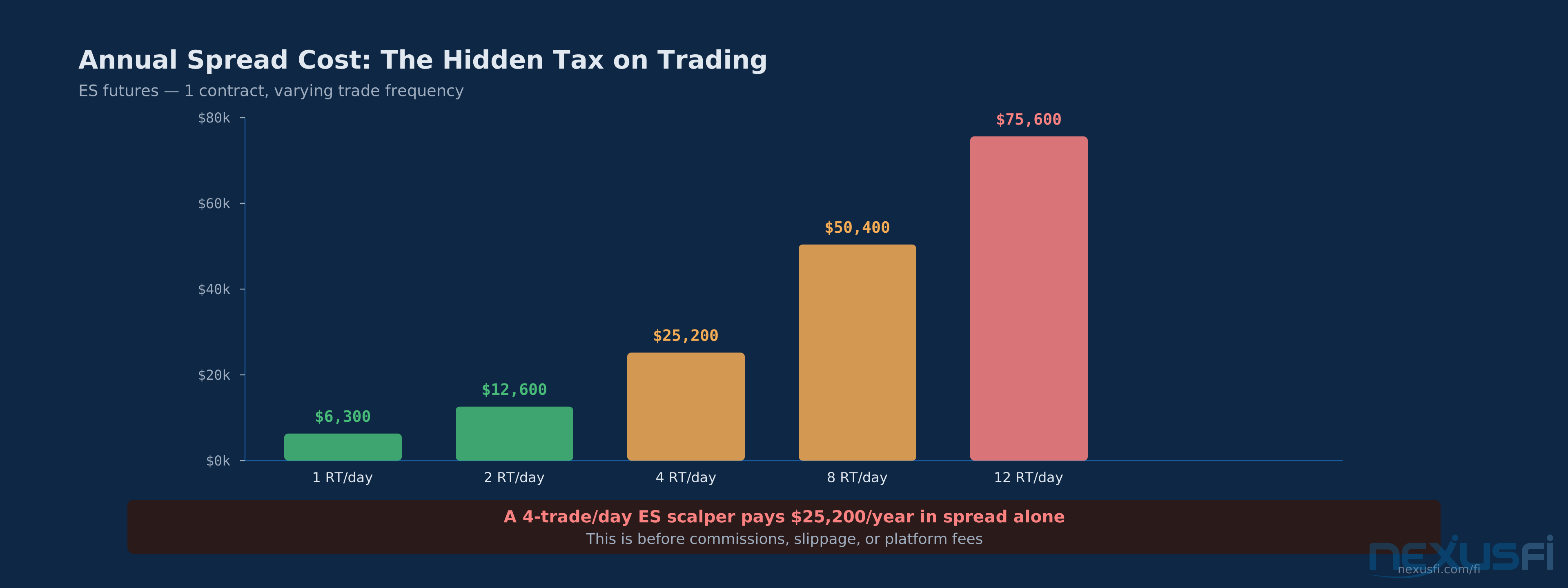
- Spread cost per round trip: 1 tick × 2 (entry + exit) = $25
- Daily spread cost: 4 × $25 = $100 per contract
- Monthly spread cost (21 trading days): $2,100 per contract
- Annual spread cost: $25,200 per contract
That's $25,200 per year in invisible costs before you make a single dollar. Trade 5 contracts? $126,000. This is the number most traders never calculate and the reason most scalping strategies fail in live markets despite looking profitable in backtests that ignore spread.
Limit Orders: Avoiding the Spread #
Using limit orders, you join the bid or offer instead of crossing it. Instead of buying at the offer (5600.25), you bid at 5600.00 and wait for the market to come to you.
The tradeoff: you might not get filled. The market might move away from your price. Opportunity cost vs. spread cost — the permanent tension of trade execution.
For patient traders with a structural edge at specific levels, limit orders eliminate the spread cost entirely. For traders who need to enter immediately — breakout entries, stop-loss exits, news-driven trades — market orders are unavoidable, and the spread is the price of speed.
The Breakeven Calculation #
Your strategy must overcome the total trading cost to be profitable:
Total cost per round trip = Commission + Spread cost
For ES with $4.00 RT commission and one-tick spread:
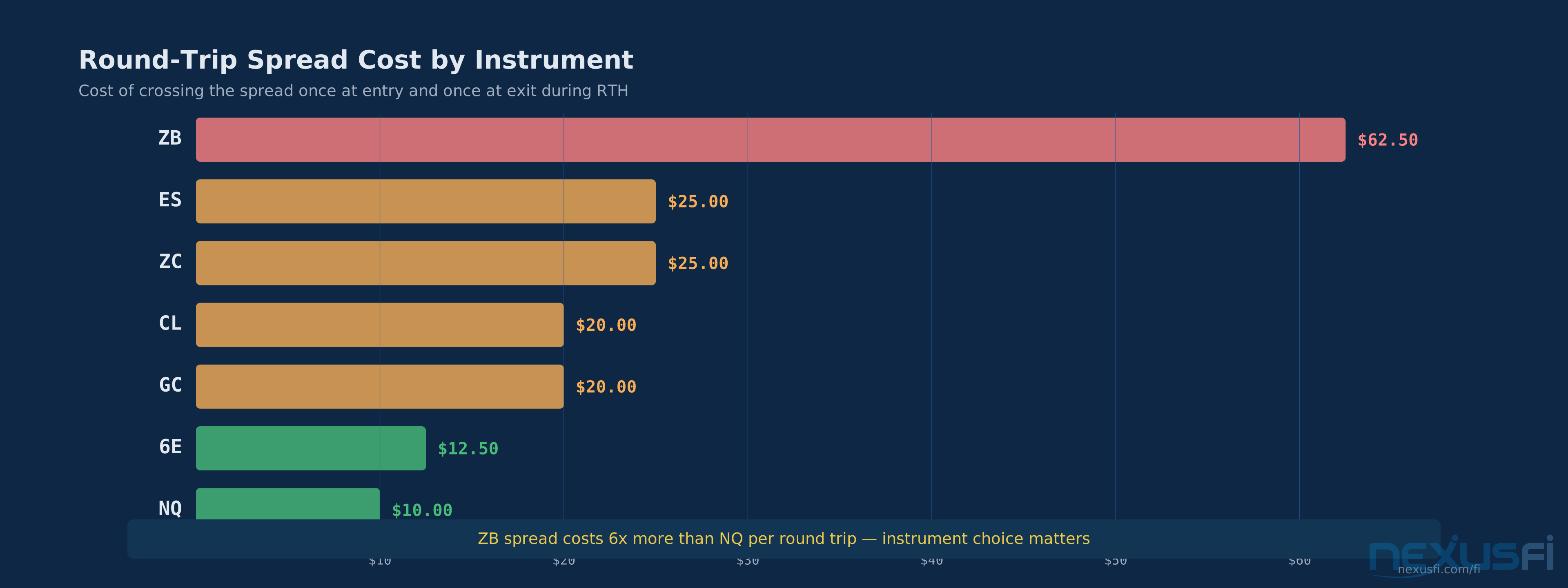
- Total cost = $4.00 + $25.00 = $29.00 per round trip
- In ticks: 2.32 ticks (of which 2 ticks is spread, 0.32 is commission)
Your average winning trade needs to exceed $29 per contract just to break even. If your average win is 3 ticks ($37.50) and your average loss is 3 ticks (−$37.50 minus $29 cost = −$66.50 effective loss), you need a win rate above 64% to be profitable.
The spread is 86% of that cost. Commissions, which traders obsess over, are only 14%.
Spread Dynamics in Order Flow #
Understanding the spread is foundational to reading order flow. Several spread-related patterns carry real information:
Spread Widening Under Pressure #
When the spread widens from one tick to two or more ticks, it signals liquidity withdrawal. Market makers are stepping back. This happens:
- Before major economic releases (FOMC, NFP, CPI)
- During sudden directional moves when one side of the book gets consumed
- At session transitions (RTH close to Globex)
- During circuit breaker events or flash crashes
A widening spread is a warning sign. It means the market's shock absorbers are gone, and the next aggressive order will move price further than normal.
Book Imbalance at the Inside #
When the bid shows 2,000 contracts and the offer shows 200, there's a visible imbalance at the inside market. This doesn't guarantee direction — resting orders can be pulled — but it indicates the relative willingness of passive participants to provide liquidity on each side.
The Spread as Confirmation #
In a strong trend, the spread stays tight because market makers are confident enough to quote aggressively. When a trend starts losing momentum, watch for brief spread widenings — moments where the inside thins out. It's the market's way of expressing uncertainty before price confirms the reversal.
Practical Implications #
For Scalpers #
The spread is your biggest enemy. At one tick per side, every round trip costs 2 ticks before you make anything. A scalping strategy targeting 2-tick wins is really targeting 4 ticks of gross movement just to hit a 2-tick net. This is why successful scalpers overwhelmingly use limit orders and trade only the most liquid instruments during peak hours.
For Swing Traders #
The spread matters less as holding periods increase. If your average trade captures 20 ticks on ES, the 2-tick spread cost is 10% of your gross profit. Annoying, but not lethal. Focus more on execution quality at entries and exits than on spread optimization.
For Position Traders #
Spread cost is negligible relative to the magnitude of moves you're capturing. A 200-tick ES swing trade doesn't notice a 2-tick spread. Use market orders freely — the cost is immaterial.
For Strategy Developers #
If your backtest doesn't account for the spread, it's fiction. Many strategies that show consistent profits on paper become losers in live trading because the backtest assumed execution at the mid-price (halfway between bid and offer) or at the last traded price. Real market orders execute at the bid or offer — never the mid.
Model spread cost as 1 tick per side for liquid instruments during RTH, 2+ ticks during Globex and around events. Then run your strategy again. If it still works, it might be real.
Common Spread Mistakes #
Ignoring spread in backtests. The single most common reason strategies fail in live trading. A strategy that makes 1 tick per trade on average is profitable in theory but loses money in practice after spread cost.
Using market orders exclusively. If your strategy allows for patient entry, use limit orders. Every limit fill saves you one tick — $12.50 per contract on ES. Over hundreds of trades, that adds up to thousands.
Trading illiquid instruments for "bigger moves." A thin market with a 3-tick spread and $15/tick means $90 per round trip in spread cost. The "bigger moves" need to be substantially bigger to justify that cost.
Trading during low-liquidity periods. Pre-market and overnight sessions have wider effective spreads. The quoted spread might still be one tick, but the depth behind it is shallow — your fill may slip multiple ticks on any meaningful size.
Knowledge Map
Prerequisites
Understand these firstGo Deeper
Build on this knowledgeReferences This Article
Articles that build on this topicCitations
- — Can I trade ZN Future with zero spread? (2021) 👍 3“Beware of sim trading success scalping because the simulated fills can be unrealistic and give optimistic fills ie. the platform fills you before your order in the queue would have traded if it was real and had been entered in to the exchange.”
- — Understanding Liquidity and Market Pullbacks (2012) 👍 5“I hear you, this vacuum is not an all or nothing thing though. It's a relative lack on one side. An imbalance that ends up getting corrected. Take the ES - any time that it ticks up, algos are immediately populating the inside bid.”
- — Spoo-nalysis ES e-mini futures S&P 500 (2012) 👍 7“Sunil, let's take a step backwards, to a time when trading was executed by humans. As a point of reference, I will use what I have first-hand experience in; pit based, open outcry, futures trading, and not the the equities specialist system.”
- — Is it profitable to scalp the spread in ES mini (2013) 👍 3“I am not sure of how it works with the CME, but I would guess that for the most liquid futures contract in the world, the ES, there are no market makers designated by the CME for this contract (why would there be, since it is liquid enough?).”
- — Comparing Index Futures (2010) 👍 8“The commissions used for a trade were per roundturn, so it was 2* € 2.00 = € 4.00. I just used the bundled commission model of Interactive Brokers. (2) I personally know successful FESX traders.”