



Automated Position Management in Futures Trading: Dynamic Sizing, Trailing Exits, and Real-Time Risk Scaling
Overview #
Most traders spend 80% of their time on entry signals and 20% on everything else. Professional automated systems invert that ratio. The edge in automated futures trading rarely comes from a brilliant entry signal — it comes from what happens after: how position size adapts to changing volatility, how exits are structured to capture trends without giving back gains, how the system recognizes when it's losing its edge and automatically reduces risk.
This is automated position management — the layer that sits between your entry logic and your account balance. Entry signals tell you when to be in a trade. Position management determines how much you put on, how you protect it, when you scale it, and when you walk away. Get the entry right but mismanage the position, and you'll bleed out slowly in ways that never show up cleanly in a backtest. Get position management right with even a mediocre entry signal, and you can build a system that survives.
This article covers the five interlocking pillars: dynamic volatility-adjusted sizing, automated exit architecture, scale-in rules, drawdown-triggered de-risking, and real-time risk scaling. Each pillar works differently in isolation. Together, they form a system that adapts to the market instead of fighting it.
We assume an entry signal exists — a technical breakout, a mean-reversion setup, a signal from your strategy. This article focuses on what happens to the resulting position's size, exits, and risk envelope from that point forward.
The Position Management Framework #
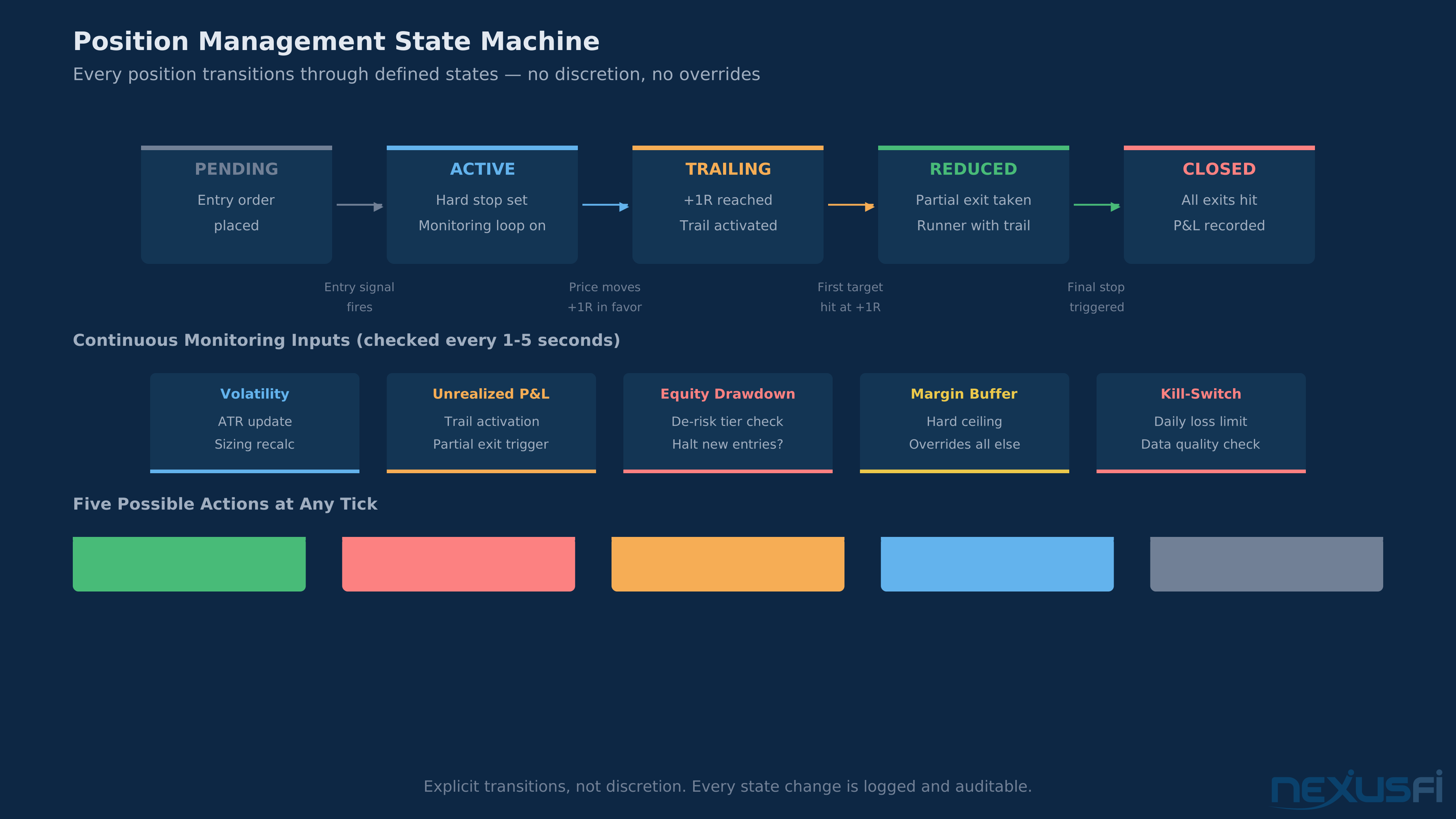
Think of position management as a continuous state machine with five possible actions at any given moment: size up, size down, tighten exit, loosen exit, or hold. Every tick in the market is a potential trigger for one of these actions, and the system must evaluate them consistently without emotional overrides.
The core inputs are:
- Current volatility — drives sizing and trailing stop distance
- Current unrealized P&L — determines if exits should activate or expand
- Current drawdown — gates whether new entries are permitted and at what size
- Current margin — hard constraint that can override everything else
These inputs feed into rules that govern each pillar. The rules must be explicit — not "reduce size during losing streaks" but "if equity drawdown from peak exceeds 5%, reduce size multiplier by 50%." Vague rules fail under live conditions because humans fill in the gaps differently under stress.
The state machine approach makes this concrete. A position might progress through these states: PENDING (entry order placed) → ACTIVE (position open, initial stop set) → TRAILING (price has moved 1R in your favor, trailing stop activated) → REDUCED (partial exit taken) → CLOSED (all exits triggered). Each transition is governed by explicit conditions, not vibes.
Dynamic Volatility-Adjusted Position Sizing #
The foundational rule of automated position management: position size is not fixed. It's a function of current market volatility, account equity, and risk parameters. Fix it, and you'll systematically over-trade in high-volatility conditions and under-trade in low-volatility ones.
The Core Formula #
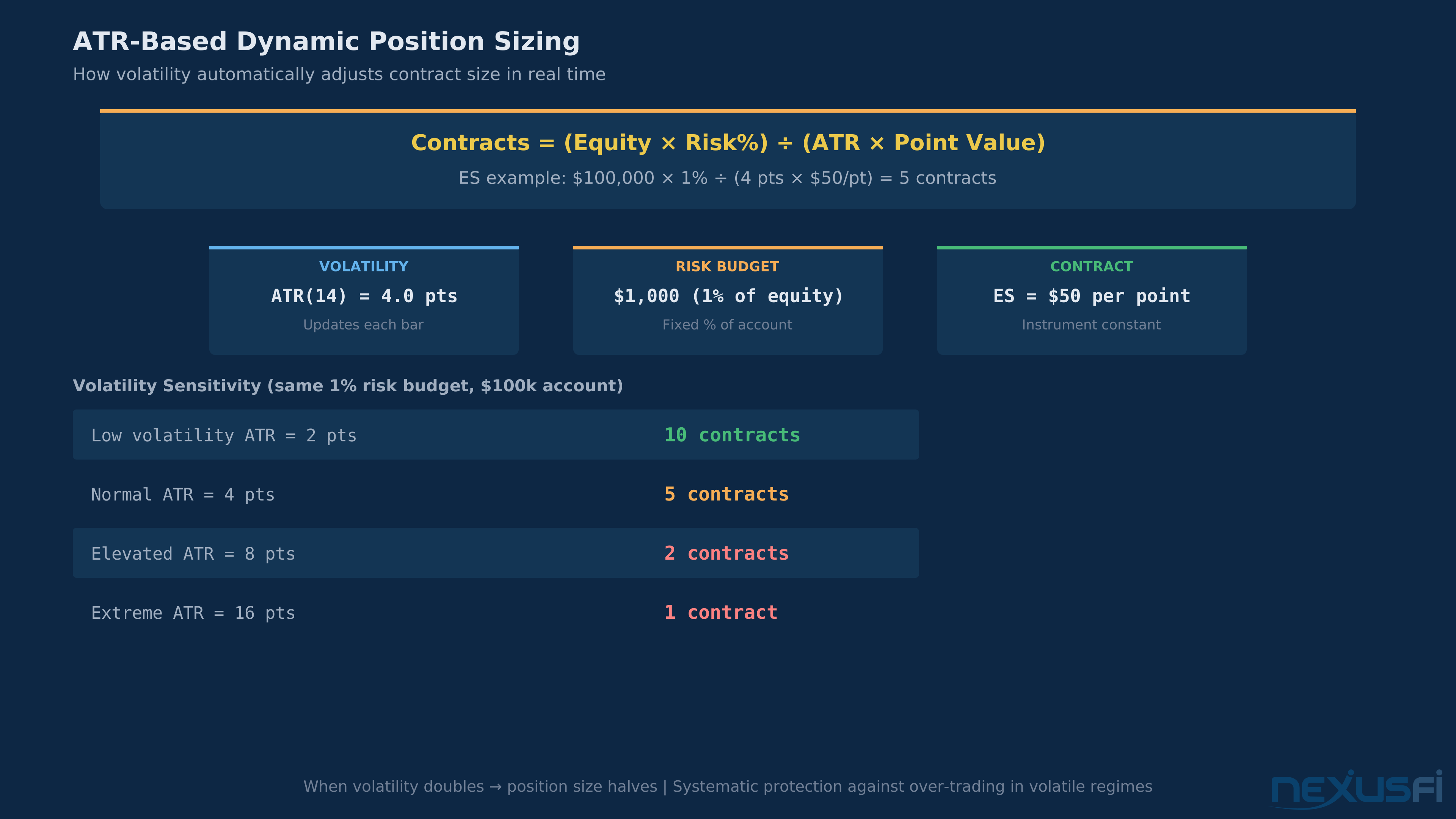
The ATR-based sizing formula used by most professional automated systems:
Contracts = (Account Equity x Risk%) / (ATR x Point Value)For ES (E-mini S&P 500):
- Account Equity: $100,000
- Risk per trade: 1% = $1,000
- ATR(14) on 5-min chart: 4 points
- Point value: $50
Contracts = $1,000 / (4 x $50) = $1,000 / $200 = 5 contractsIf volatility doubles (ATR goes to 8 points): contracts drop to 2.5, which rounds down to 2. The system automatically trades less during high-volatility conditions — exactly when novice traders make their worst sizing mistakes.
As @MXASJ describes it, the formula "looks at margin as well and gives you the lower number of the two (contracts tradeable under stop loss rules vs. margin rules)" — a critical guardrail that prevents the sizing calculation from blowing past actual buying power.
ATR Parameters: What Actually Matters #
ATR period selection depends on your trading timeframe:
- Scalpers (1-5 min charts): ATR(14) on the trading timeframe. Fast enough to capture intraday volatility shifts.
- Intraday swing (15-60 min): ATR(20) on 15-min or ATR(14) on hourly. More stable, avoids reacting to every noise spike.
- Overnight/multi-day: ATR(14) on daily. Covers full session volatility.
@Fat Tails, who built one of NexusFi's most-used position sizing tools, uses ATR(36) on a 5-minute chart as the stop-loss basis, calculating it from the "mean of minimum and maximum ATR plus spread" measured over the prior week's RTH sessions. Longer ATR periods smooth out noise, shorter periods adapt faster to volatility regime changes. The right choice depends on how quickly your strategy needs to react to regime shifts.
ATR Position Sizing Formula
Contracts = (Equity x Risk%) / (ATR x Point Value)
For ES with $100k equity, 1% risk, 4-point ATR: Contracts = $1,000 / ($50 x 4) = 5 contracts
Always clamp: min(atr_result, floor(available_margin / initial_margin), max_position_cap)
Volatility Warm-Up and Fallback #
Automated systems need to handle the ATR warm-up period at session open. If you're running ATR(36) on a 5-minute chart, you need 36 bars (3 hours of RTH) before the indicator is fully populated. Two options:
- Seed from prior session: Use the last ATR value from the previous session's close as the starting estimate. Reasonable for instruments with stable overnight conditions.
- No-trade zone: Block new entries until ATR is fully warmed up. Safer, but misses the first-hour high-momentum opportunities many systems target.
Also build a volatility spike handler. If ATR doubles suddenly — news event, flash crash, inventory report — the formula automatically cuts your size. But you need a hard minimum (1 contract) and a hard maximum (e.g., 10 contracts regardless of ATR) to prevent edge cases. If bar data hasn't updated in twice the expected interval, treat the current ATR as unreliable and block new entries.
Margin as a Hard Constraint #
The sizing formula gives you an ideal size. Margin gives you the hard ceiling. Before placing any order:
max_by_margin = floor(available_margin / initial_margin_per_contract)
final_size = min(atr_sized_contracts, max_by_margin)
In fast markets, margin requirements can change without warning. CME can and does raise initial margins on short notice around major events. Build in a 20% buffer: never use more than 80% of available buying power for a single position. The remaining 20% absorbs adverse price movement before your stop triggers.
Automated Exit Architecture #
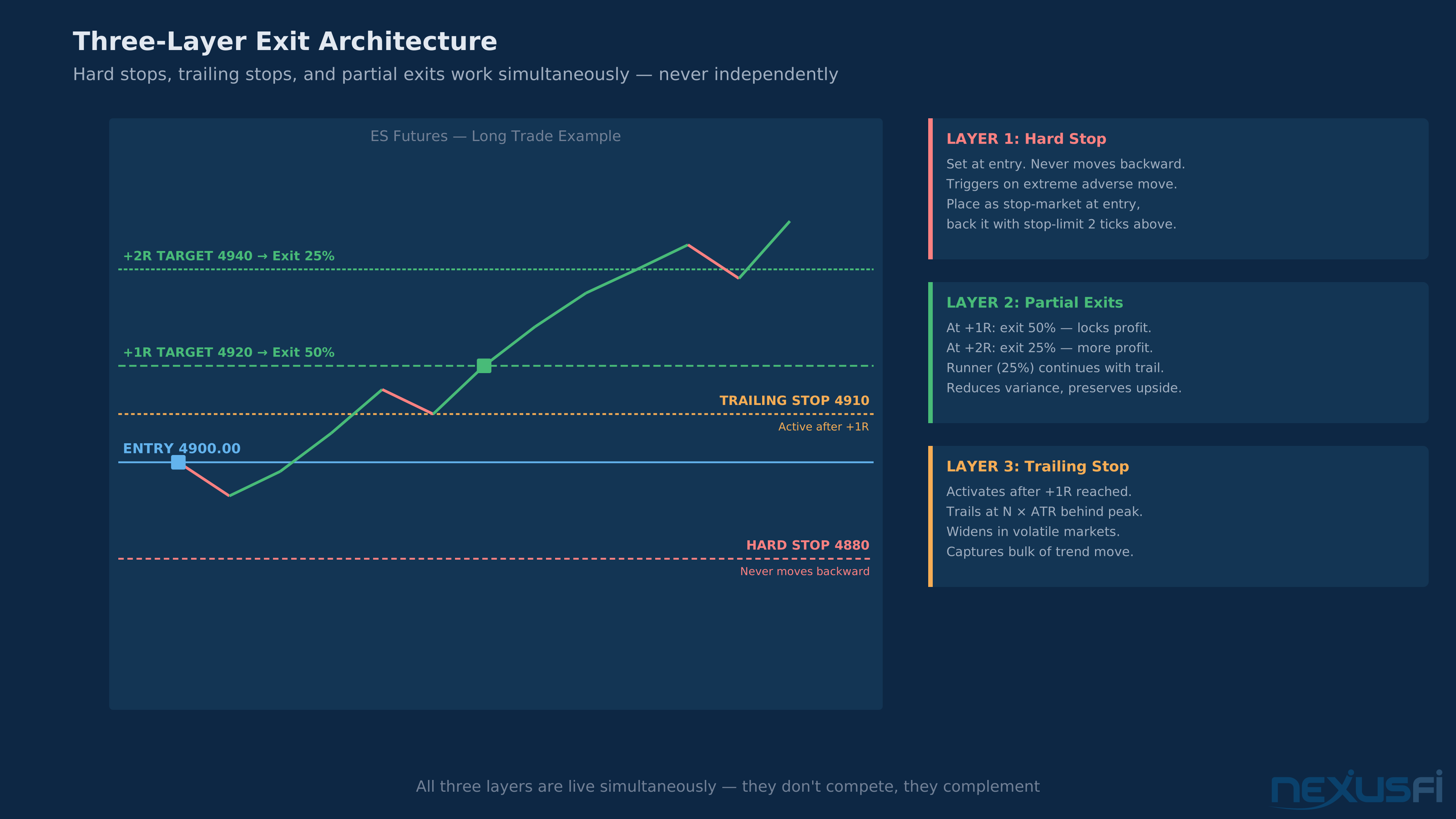
Entry gets you into a trade. Exit determines what you keep. The exit architecture is where most automated systems fail — either too tight and stopped out before the move develops, or too loose and giving back most of the gain. A robust exit system has three layers working simultaneously: hard stops, trailing stops, and partial exit triggers.
Hard Stops: The Non-Negotiable Floor #
Every position needs a hard stop that never moves backward. This is your maximum acceptable loss on the trade — set at entry based on the ATR sizing calculation, and it does not change regardless of what else happens. It's your catastrophic protection against data outages, system failures, and unexpected events.
Hard stop distance = ATR x stop multiplier
Typical multipliers by strategy type:
- Scalp systems: 1.5-2x ATR
- Intraday swing: 2-3x ATR
- Trend-following: 3-4x ATR
The hard stop is placed as a stop-market order at entry. It stays there until the position closes. Never cancel it. Never widen it. In fast futures markets — ES around FOMC, CL during EIA inventory reports — stop-market orders can fill several ticks through your intended price. For critical protection, some systems use two orders: a stop-limit set 2 ticks above the true stop level (attempts a better fill), backed by a stop-market 3 ticks below (guarantees execution if the limit misses).
Trailing Stops: Capturing the Move #
Once the trade is working, trailing stops take over from the hard stop. @PandaWarrior documented four distinct trailing approaches in practice — ranging from manual panic exits (the least effective) to swing-based trailing behind market structure (the most effective but hardest to automate):
- Panic mode: Manually closing when price stalls. "Rarely the correct thing to do."
- Break-even trail: Move stop to break-even after first target hit. "Works but not optimum."
- Hold-original-stop: Leave hard stop unchanged after first scale-out. "The overall best option as my win rate for this is very high."
- Swing-based trail: Trail stop behind market structure swings, only after a new high/low confirms the trend. "The hardest to do and the most effective."
For automated systems, methods 3 and 4 are the most implementable. Method 3 is simpler: after taking the first partial exit, the remaining contracts hold with the original stop, which effectively makes the overall trade risk-free. Method 4 — swing-based trailing — requires detecting swing highs/lows in real time, which is feasible but requires careful implementation.
ATR-based trailing is the standard automation approach: trail the stop at a distance of N x ATR from the highest favorable price reached. As the market moves in your favor, the stop follows. If volatility expands, the trail distance widens. If volatility contracts, it tightens.
Activation logic matters: Don't start trailing immediately. Start trailing only after the position reaches +1R from entry. Before that, you're still in "initial risk" territory and the original hard stop applies. This prevents the trailing stop from cutting winners short before they have room to develop. Most losing automated traders deploy trailing stops from the moment of entry — and then wonder why their "winning" positions keep getting stopped out for small gains.
The most common trailing stop mistake: setting the trail distance below 1x ATR. In liquid futures like ES and NQ, normal bid-ask noise and order book interaction eat through a sub-ATR trail even on a genuinely profitable trade. The stop gets hit, the runner gets cut, price resumes in your direction. If trailing stops are triggering on winning positions before they reach their primary target, the trail distance is too tight for the market's noise floor.
Partial Exits / Scale-Out Logic #
A partial exit strategy locks in profit while keeping a runner for the larger move. The standard automated approach uses R-multiples as exit triggers:
- First exit (50% of position): at +1R from entry
- Second exit (25% of position): at +2R from entry
- Runner (25% of position): trail with ATR-based method until stopped out
This structure changes the risk profile fundamentally. After the first partial exit, the remaining position's effective risk drops because the locked-in profit offsets the worst-case remaining loss. You're playing with "house money" on the runner — the correct mindset for letting it develop.
The mathematical reality: partial exits reduce raw expectancy compared to all-in/all-out at the full target. But they reduce variance significantly. For automated systems running continuously, lower variance means surviving drawdowns that would kill a high-variance all-in approach. The tradeoff is worth it for most continuous-running strategies.
Track the runner's risk separately from the original position's risk. After scaling out twice, your effective cost basis has moved. Consider each tranche separately: the runner's trailing stop should reference where you are relative to the first partial exit fill, not the original entry price. A runner that was entered at 4900 and has scaled out at 4910 and 4920 has an effective cost basis around 4910 — treating the trailing stop as if entry were 4900 understates how much profit is at risk.
Scale-In Automation: Pyramiding Rules #
Pyramiding — adding to a winning position — is the most powerful tool in a trend-following system and the fastest way to blow up an account if done wrong. The rules must be explicit, non-negotiable, and automated.
The Conditions for Pyramiding #
@Fat Tails, drawing on mathematical trading theory, states it directly: "pyramiding allows for trading size, but can only be done if both conditions are fulfilled: there is positive expectancy, and there is room to add relative to the stop."
That second condition is the one traders ignore. "Room to add" means the distance from the current price to the trailing stop is sufficient to justify the additional risk. If you add a unit when price is already close to the trailing stop, you're adding risk with almost no room for the position to develop.
Safe Scale-In Rules #
- Maximum 3 additional positions beyond the initial (4 units total). Beyond this, correlation risk becomes too high and position management complexity multiplies.
- Minimum spacing of 0.5-1x ATR between adds. Prevents clustering entries in a congestion zone where you're essentially loading up at the same price level with no directional confirmation.
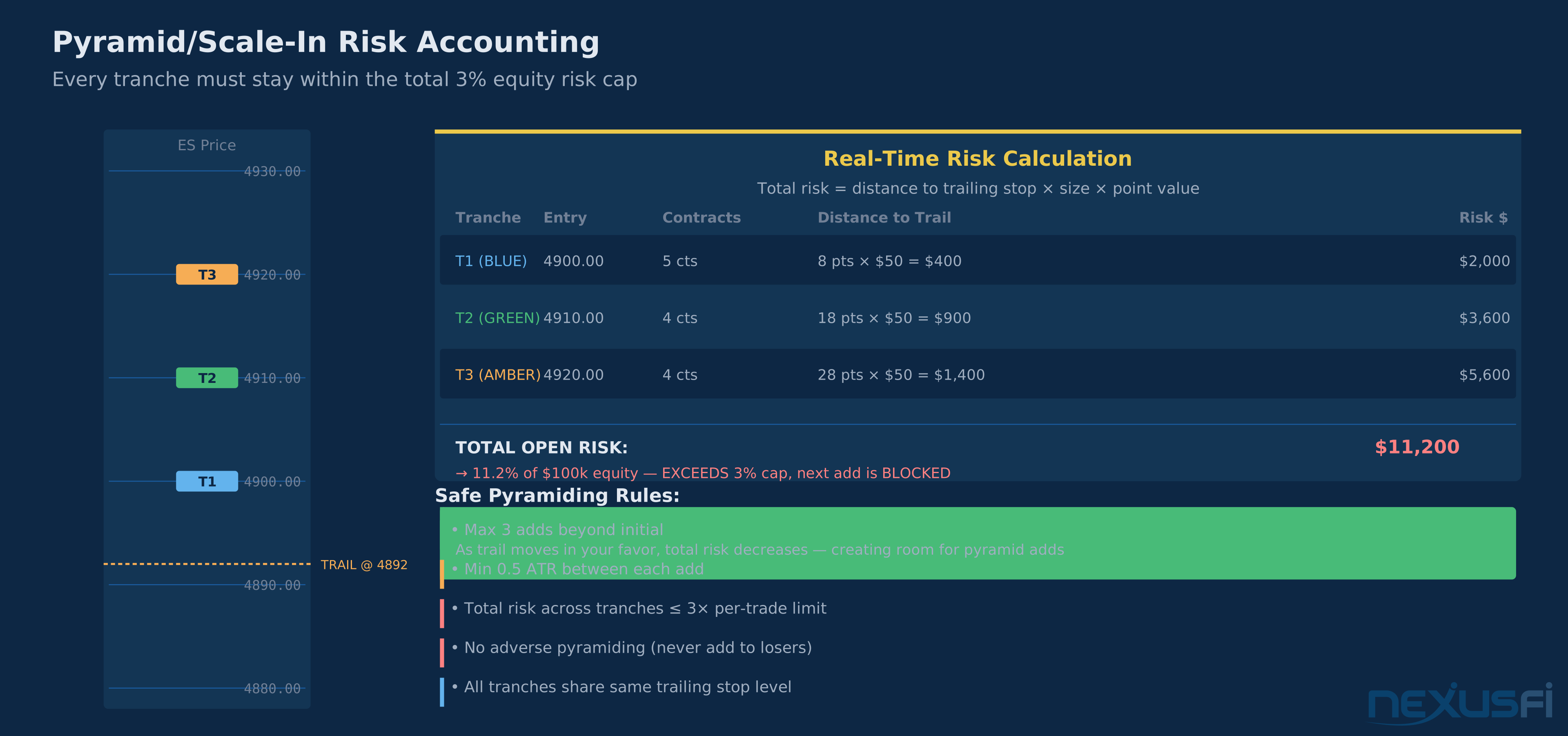
- Total risk cap across all tranches: total open risk (distance from each entry to current trailing stop times position size times point value) cannot exceed 3x the per-trade risk limit. If you risk 1% per trade, total pyramided risk cannot exceed 3% of equity.
- Unified trailing stop for all tranches. All tranches share the same trailing stop level. Simplifies order management — you're modifying one stop order, not four.
- No adverse pyramiding. Never add to a losing position. Explicit code check: if current price is below entry price for a long, disable scale-in logic entirely. Averaging down in an automated system is how you blow a small loss into an account-ending one.
Real-Time Risk Accounting for Pyramid Positions #
Before adding any pyramid unit, the system must calculate total current risk across all open tranches:
total_risk = sum(abs(entry_i - current_trailing_stop) x size_i x point_value
             for each tranche i)
if total_risk > max_allowed_risk: block this add
This calculation must happen at the current trailing stop level, not the original hard stop. As the position progresses and the trailing stop moves in your favor, total risk decreases — which creates room for additional units. Run this check immediately before each pyramid add.
Drawdown-Triggered De-Risking #
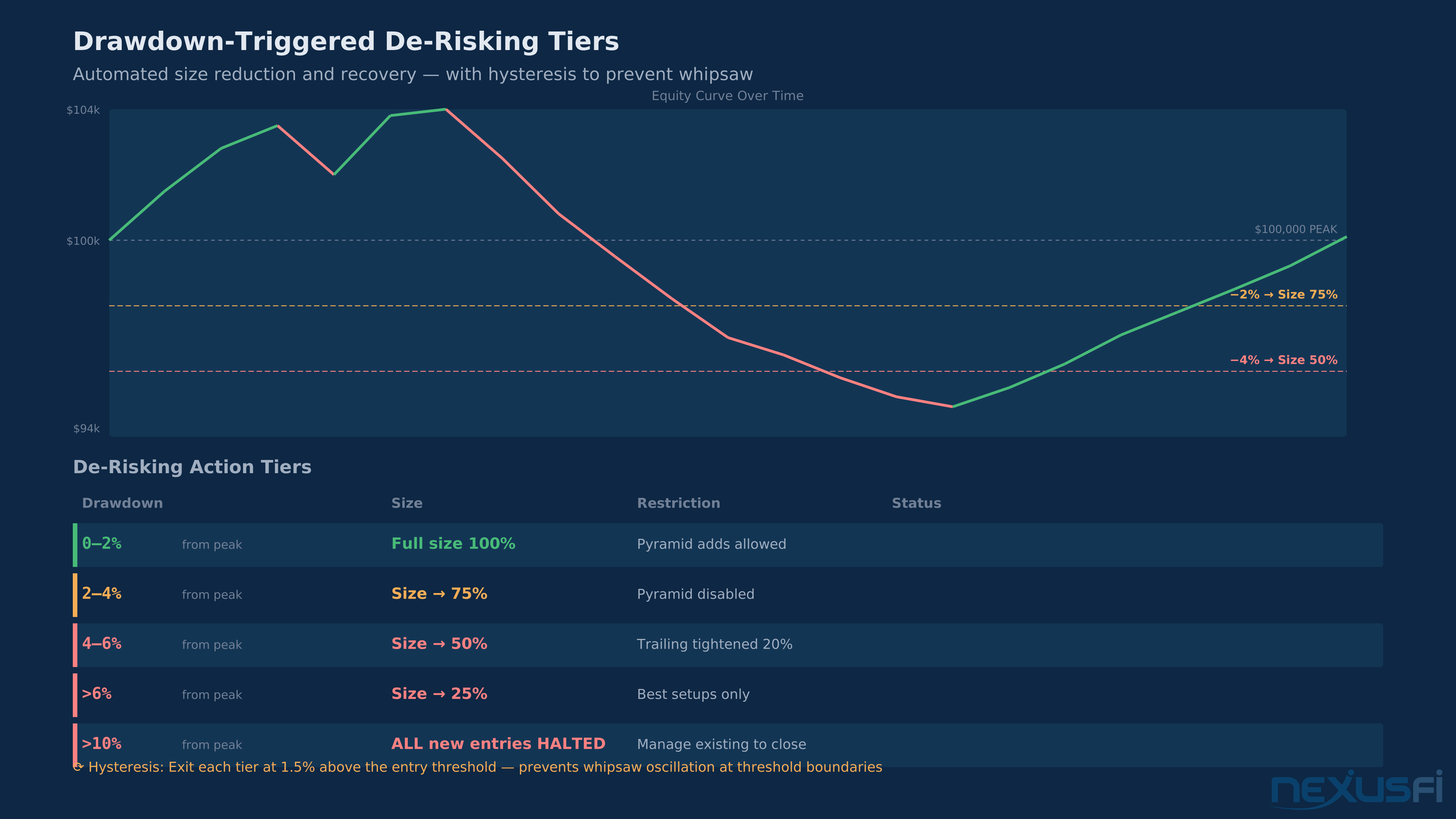
Here's where automated position management diverges most sharply from intuition. When the equity curve is pulling back, the system should automatically trade smaller. Not because of panic, but because a lower equity base means the fixed-percentage risk formula already demands it — and a secondary de-risking overlay provides an additional circuit breaker.
Defining the Drawdown Metric #
Three options, each with different tradeoffs:
Peak equity drawdown: peak_equity - current_equity. Simple, widely understood, but reacts slowly to recent deterioration if your peak is months old.
Rolling window drawdown: Max equity over the last 20 trades minus current equity. More sensitive to recent performance. A system that peaked 6 months ago but has been grinding sideways won't look like it's in drawdown on this metric even when it's consistently underperforming.
Session-based drawdown: Reset at each session open. Matches how most prop firm daily loss limits work. Best for systems with defined daily risk budgets, but misses multi-session bleeding.
Most professional automated systems use a combination: rolling 20-trade drawdown as the primary signal, with an absolute peak-equity drawdown as the backstop.
De-Risking Action Tiers #
| Drawdown Level | Automatic Action |
|---|---|
| 0-2% from peak | Normal operations — full size, pyramid allowed |
| 2-4% from peak | Size multiplier reduced to 75% — pyramid disabled |
| 4-6% from peak | Size multiplier reduced to 50% — trailing tightened 20% |
| >6% from peak | Size multiplier reduced to 25% — new entries to best setups only |
| >10% from peak | All new entries halted — existing positions managed to close |
Each threshold triggers a specific, measurable action. No discretion, no override. @shodson, who has been running live automated systems for over a decade, frames it simply: "Don't freak out. If you had been keeping your position sizes relatively small, then the draw down won't be so painful in the first place."
The automated version of that wisdom is the tier table above: small size during drawdowns means small drawdowns are manageable, large drawdowns get cut off before they become catastrophic.
Hysteresis: Preventing De-Risking Whipsaw #
Without hysteresis, a system at 3.9% drawdown will flip in and out of the 4% threshold repeatedly as equity oscillates. Size changes every few trades — which creates slippage costs, inconsistent risk, and a system that behaves unpredictably.
@kevinkdog implemented this explicitly: "I adjust the number of contracts down more slowly than I added them going up. The net impact of this is that I increase drawdown [slightly], and also increase median annual return. A fair tradeoff in my mind."
The implementation: when transitioning into a higher de-risking tier (more risk reduction), use the sharp threshold. When transitioning out (back toward full size), require a recovery buffer of 1-2% beyond the threshold before restoring the previous tier.
- Enter "50% size" tier when drawdown exceeds 4%
- Exit "50% size" tier (restore to 75%) only after recovering to 2.5% drawdown — not 4%
This 1.5% hysteresis band prevents whipsaw while still responding to genuine drawdowns. The asymmetry matters: getting into de-risking is easy, getting out requires demonstrated recovery.
Recovery Sizing #
Define explicitly how full size is restored. Two approaches:
Step function (recommended): At each recovery milestone, restore one tier. Simple, auditable, and explainable. The step function is standard in professional practice — choose it unless you have a specific reason for a smoother curve.
Linear interpolation: Size multiplier scales linearly between tiers. At 4% drawdown: 50% size. At 3%: 62.5% size. Smoother, but harder to explain in compliance contexts.
Real-Time Risk Scaling and Operational Guardrails #
The previous pillars handle the economics. This section covers the plumbing — the continuous monitoring loop and safety systems that keep the automated system from catastrophic failure.
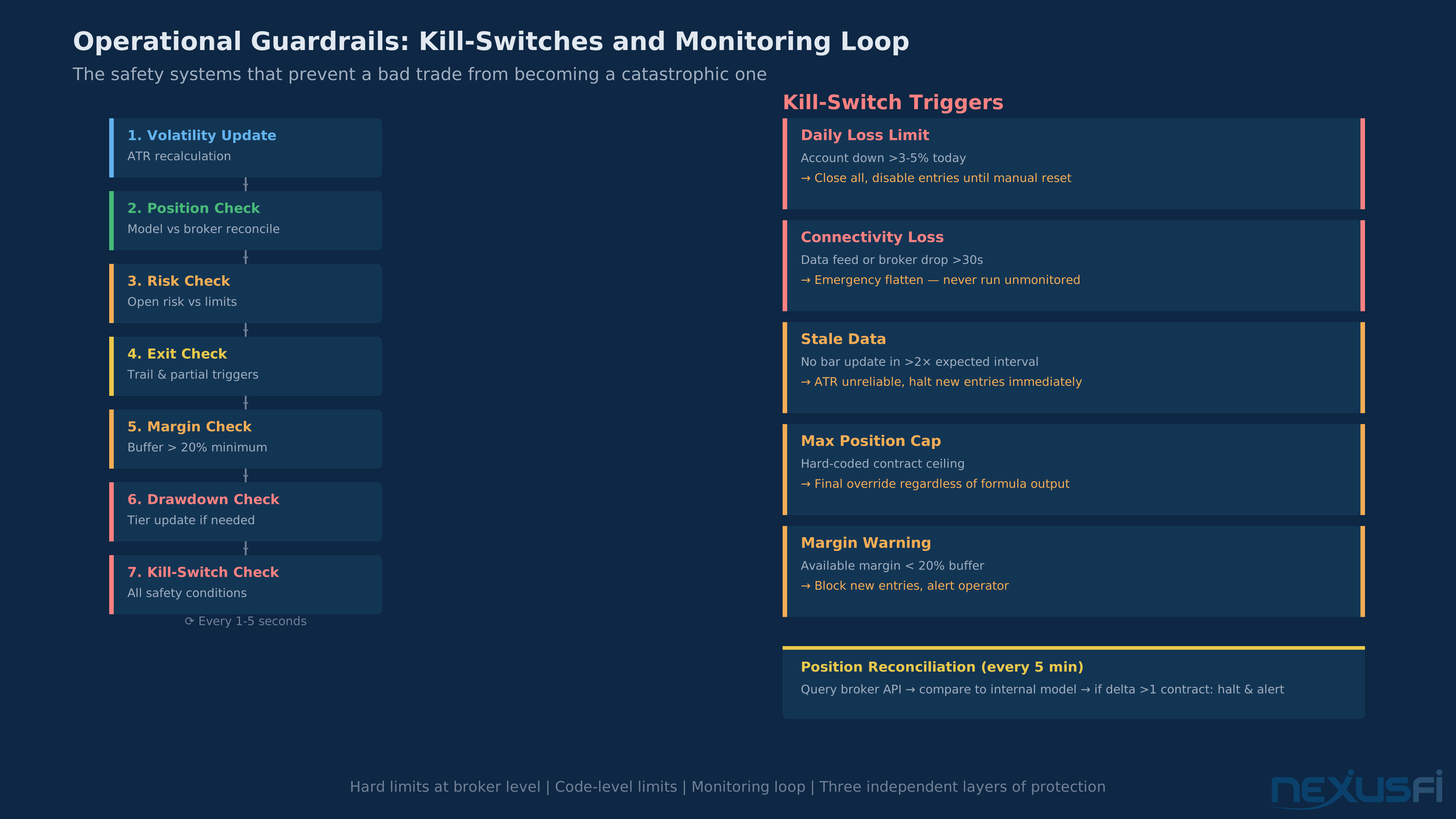
The Monitoring Loop #
Every 1-5 seconds, the system runs:
- Volatility update: Recalculate ATR from latest bar data
- Position check: Verify open positions match expected state (reconcile against broker)
- Risk check: Calculate total open risk vs. limits
- Exit check: Evaluate trailing stop and partial exit conditions
- Margin check: Verify available margin exceeds minimum buffer
- Drawdown check: Update equity, recalculate drawdown tier
- Kill-switch check: Evaluate all safety conditions
If any check fails, the system logs the failure and takes the predefined action. No exceptions, no overrides.
Kill-Switches: Hard Stops on the System Itself #
Daily loss limit: If the account loses more than X% today, close all positions and disable new entries until manually reset. Typical threshold: 3-5% of equity. This prevents the "I'm just down today, tomorrow will be better" death spiral that has destroyed more systematic traders than bad strategies.
Connectivity loss: If connection to the data feed or broker drops for more than 30 seconds, trigger an emergency flatten. Never let a position run unmonitored without confirmed connectivity.
Stale data detection: If bar data hasn't updated in twice the expected interval (e.g., more than 2 minutes on a 1-minute chart), treat ATR as unreliable and halt new entries. Stale data generates incorrect ATR calculations, which generates incorrect position sizes, which generates incorrect order sizes.
Max position cap: Regardless of what the sizing formula computes, the system will never hold more than N contracts. Hard-coded, not calculated — a final sanity check against runaway position sizes from calculation errors or data anomalies.
Order State Reconciliation #
The most common failure mode in live automated systems: the system's internal position model diverges from the broker's actual position. This happens due to partial fills, order rejections, connection interruptions, and rounding errors.
Build a reconciliation loop that runs every 5 minutes:
- Request actual positions from broker API
- Compare to internal position model
- If discrepancy: log it, alert operator
- If discrepancy exceeds 1 contract: trigger flatten and halt until manually reviewed
Never let the system trade on a stale position model. A system that believes it's flat but is actually long 10 contracts will continue sending "entry" orders that are actually additions. The result is an accidental 20-contract position that the original risk logic never anticipated.
Set a hard max-net-position limit at the broker level, not just in your code. Most FCMs and broker APIs support position limits that execute at the exchange level. If your code calculates 5 contracts but you end up 8 long due to a bug, the broker-level limit catches it before it becomes 15. This is the last line of defense — use it.
When Automated Position Management Fails #
Automated position management solves specific problems: sizing consistency, exit discipline, drawdown response. It creates new failure modes you should understand before deploying.
Volatility regime changes: ATR-based sizing works well in normal conditions. When volatility suddenly spikes 3x (major macro event, flash crash), the system cuts position size — but your initial fill before the cut may be at full pre-spike size. Build a pre-trade volatility check: if the current ATR has increased more than 50% from the prior session average, consider blocking new entries or reducing the size multiplier proactively.
Mean-reverting volatility with trend entries: ATR sizing is largest when volatility is low (the entry point for many trend signals) and smallest when volatility is high (when trends often accelerate). This is the opposite of what you want for trend exposure. Some systems add a trend strength multiplier that explicitly counteracts this dynamic: when a strong trend is confirmed, increase size toward the cap rather than letting low volatility dictate a small position.
Correlated instruments: Running the same system across ES and NQ simultaneously doesn't give you two independent positions — it gives you two highly correlated positions that amplify drawdowns. At 0.95 correlation, ES + NQ should be treated as approximately 1.95x a single ES position for risk purposes. Build a correlation-aware exposure cap: total notional across correlated instruments cannot exceed the single-instrument limit multiplied by a correlation discount factor.
The pyramiding timing failure: Pyramid adds are most tempting at the worst time — when a position has been running for a while, the profit has built false confidence, and the trailing stop is now many ticks from the current price. The risk math still checks out, but the behavioral reality is you're adding at the top. Most systematic pyramiding frameworks enforce a maximum time-in-position for adds: no new adds after the trade has been open more than X hours regardless of price action.
Drawdown de-risking that prevents recovery: If the de-risking rules reduce size too aggressively during a drawdown, the system trades so small it can't recover even when the strategy is generating winning signals. Recovery from a 10% drawdown at 25% normal size requires a 40% gain at reduced size before returning to full trading. Design the recovery path explicitly: at what equity level does each tier restore, and over how many trades?
@kevinkdog, after years of running live systematic futures systems, puts the core principle plainly: "Most mechanical traders, when faced with a drawdown, start to freak out and either change the strategy, change their position sizing, or do something else. Usually they make things worse. The key to surviving drawdowns is to keep trading to the plan."
The automated system's advantage: it doesn't freak out. But it can still fail if the plan itself wasn't stress-tested.
Practical Application: Building the System #
Phase 1: Define Parameters Before Writing Code #
Before writing a single line:
- Maximum risk per trade: typically 0.5-2% of equity
- Maximum daily loss limit: typically 3-5% of equity
- Maximum drawdown before halting: typically 8-15%
- ATR period and timeframe for each instrument
- Maximum position size (contract cap)
- Pyramiding: yes or no; if yes, max units and minimum spacing in ATR
- Drawdown tiers: thresholds, size multipliers, hysteresis bands
These parameters define the risk envelope. Get them wrong and no amount of clever exit logic saves you.
Phase 2: Build Sizing First, Exits Second #
Start with just the ATR-based sizing formula on paper. Does it behave correctly across different volatility regimes? Does it respect margin limits? Validate this before adding exit complexity.
Then add hard stops. Then trailing stops. Then partial exits. Then pyramiding. Never add the next layer before the previous one is validated. Each layer interaction creates new edge cases that only appear when tested against live-like conditions.
Phase 3: Deliberately Stress-Test Drawdown Behavior #
Take a period of 20 consecutive maximum losses in backtesting and observe the de-risking response. Does the tier logic fire correctly? Does hysteresis prevent whipsaw? Does the kill-switch halt trading at the right threshold? Does recovery restore sizing at the right pace?
Most traders stress-test their entry signals but skip position management logic independently. This is where the surprises are.
Phase 4: Paper Trade With Live Data #
Before risking real capital, run the full system against live market data with simulated execution for at least 20 trading sessions. Watch for: position model divergence from simulated fills, ATR miscalculations around session opens, kill-switch false positives, trailing stop orders not being placed or modified correctly. The transition from backtest to paper trading frequently reveals bugs that backtesting masked. Find them here, not with real capital.
Automated position management is not a plug-and-play addition to your entry strategy — it's a system with its own failure modes, edge cases, and validation requirements. The sizing formula is straightforward. The interactions between sizing, trailing, pyramiding, and de-risking are where complexity lives. Build each layer independently, validate it thoroughly, then integrate the next.
Knowledge Map
Go Deeper
Build on this knowledgeReferences This Article
Articles that build on this topicCitations
- — PositionSizer for ninjatrader (2010) 👍 12“Money Management Stop-Loss is calculated as ATR(36) plus Spread”
- — Position Sizing by Van Tharp (2009) 👍 15“looks at margin as well and gives you the lower number of the two (contracts tradeable under stop loss rules vs. margin rules)”
- — The PandaWarrior Chronicles (2012) 👍 16“Leave stop at original location once first target filled at 1XR. This seems to be the overall best option as my win rate for this is very high.”
- — Is Anyone Currently In A Drawdown? (2016) 👍 14“Don't freak out. If you had been keeping your positions sizes relatively small, then the draw down won't be so painful in the first place.”
- — Is Anyone Currently In A Drawdown? (2016) 👍 11“The problem is most mechanical traders don't have a solid plan for bad things happening before they start trading.”
- — Taking a Trading System Live (2014) 👍 8“I adjust the number of contracts down more slowly than I added them going up.”
- — How advanced mathematics and gaming theory can help you as a trader (2011) 👍 13“pyramiding allows for trading size, but can only be done if both conditions are fulfilled: there is positive expectancy and there is room to add relative to the stop”
- — The Program (2020) 👍 14“I risk a dollar in crude oil, $10 in gold, 20 points in es, and half a euro in the euro. I use a hard stop every time, no exceptions.”
- — And I thought systematic trading was supposed to remove emotion! (2012) 👍 2“just like you had a point where you were allowed to increase size, you also have a drawdown point which will require you to reduce size”
- — Webinar: A discussion with Raymond Deux, CEO of NinjaTrader - and the debut of NT8! (2019) 👍 2“[QUOTE=Zondor;285262]I sent the following message to NT Support.[/QUOTE] [MENTION=544]Zondor[/MENTION]. Thanks for following up on that. This is precisely my point about "prettiness" over functionality. As BigMike pointed out Sierra is the ugly duckling. Ninja is no supermodel but nothing to be as”
- — JPMorgan Pays $600,000 For Violating Cotton Futures Speculative Position Limits (2019) 👍 1“The U.S. Commodity Futures Trading Commission (CFTC) has announced that JP Morgan Chase Bank, N.A. (JPMCB) agreed to pay a $600,000 civil monetary penalty to settle CFTC charges that it exceeded speculative position limits in Cotton No. 2 futures contracts trading on the IntercontinentalExchange U.S”