



Monte Carlo Simulation for Futures Strategy Validation: Stress-Testing Your System Before It Stress-Tests Your Account
Overview #
Your backtest looks beautiful. The equity curve climbs steadily from left to right. Drawdowns are shallow and brief. The strategy has a Sharpe ratio of 1.4 and a profit factor of 1.8 over 600 trades. You're ready to go live.
But there's a problem with that single backtest: it shows you exactly one possible version of reality — the one where your trades happened to arrive in precisely the historical order they did. Change the sequence, and you might see a 40% drawdown in the first three months. Or you might have made 60% in the first year. The single equity curve you're looking at is one draw from a distribution of possible outcomes, and Monte Carlo simulation is how you see the whole distribution.
Monte Carlo simulation is the technique of running thousands of randomized versions of your backtest — scrambling the trade sequence, sampling with replacement, or stress-testing parameters — to generate a probabilistic picture of your strategy's behavior. Instead of "my strategy makes X per year with Y drawdown," Monte Carlo answers "what are the realistic bounds of what this strategy can produce, across the range of market sequences I might actually encounter?"
This article covers how Monte Carlo simulation works mechanically, how to interpret the outputs, how to use it as a pre-launch approval gate, and what to do when your strategy fails the test. For related context, see Walk-Forward Analysis, Overfitting and Curve-Fitting Detection, and Strategy Evaluation Metrics.
What Monte Carlo Actually Tests #
Monte Carlo simulation doesn't predict the future. It also doesn't tell you whether your strategy has genuine edge. What it does is answer a specific and critically important question: given that your backtest results are real, how stable are they across different trade sequences?
If you have 300 trades with a particular win rate, average win, and average loss, the sequence in which those trades arrive is largely unknowable in advance. Tomorrow's market doesn't know it's supposed to deliver your losses clustered gently between wins. A stretch of seven consecutive losers in month one is statistically possible for the same strategy that shows a comfortable 2.3-trade average losing streak in backtesting — especially if the strategy's historical losing streaks happened to be distributed across months rather than concentrated at the start.
As @kevinkdog explained in a NexusFi community discussion on strategy validation:
"You run a backtest, and you get a sequence of trades, and from that you build an equity curve. From that equity curve, you know your return, your max drawdown, etc. But, what if you had the same trades, but just in a different order? That is what Monte Carlo simulation does. It takes your trades, and scrambles them up, giving you many different equity curves. The theory is that going forward, any of those equity curves is possible, since they are all derived from your historical testing. If you run the simulator, it creates 2,500 different equity curves. It then calculates the statistics for the strategy, giving you probabilities of certain events occurring."
@kevinkdog, NexusFi - KJ Trading Systems AMA
This is the core insight. Your historical equity curve is one realization of a random process. Monte Carlo shows you the full range of realizations that the same trade distribution could produce. The worst-case path in 2,500 simulated equity curves is a realistic stress test, not a pessimistic fantasy — it's derived entirely from your own historical trade data.
Monte Carlo tests three things simultaneously:
- Sequence sensitivity: How much does the timing of wins and losses matter? A strategy where the sequence matters a lot is fragile -- its historical results depend heavily on a favorable ordering of trades that may not recur.
- Capital stability: What fraction of simulated paths experience drawdowns beyond your risk tolerance? This directly informs position sizing and account funding requirements.
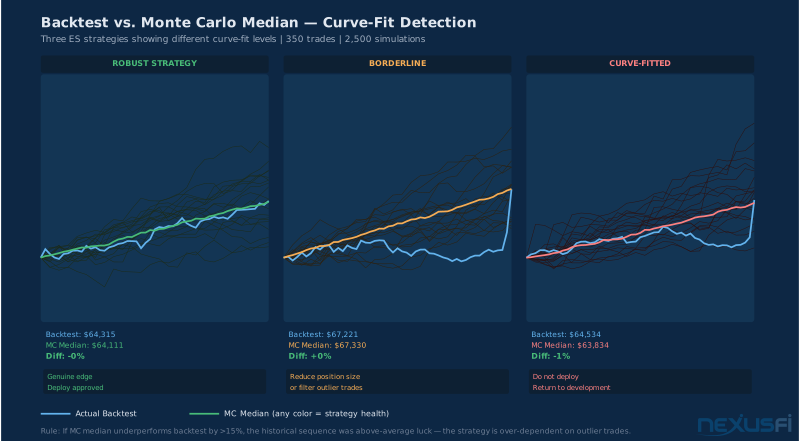
- Curve-fit detection: As @Fat Tails explained in a NexusFi NinjaTrader discussion, "If your strategy is curve-fitted, it is likely that it will not pass the Monte Carlo Simulation very well, as some of the N equity curves will not include the (probably few large) trades that the strategy has been fitted to. So it is a simple, but effective tool to avoid curve-fitting." Strategies that depend on a handful of standout trades to look good in backtesting fall apart when those trades are excluded from some simulation paths.
Trade-Shuffling Monte Carlo: The Core Mechanics #
The most common form of Monte Carlo simulation for trading strategies is trade-shuffling, also called bootstrapping. The mechanics are straightforward and worth understanding precisely, because the specific implementation details determine what the test is actually telling you.
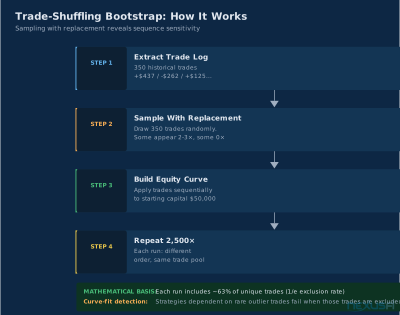
Step 1: Extract the trade log. Take your backtest's complete list of individual trade P&L values. For an ES strategy with 300 trades, you'd have something like: +$437.50, -$262.50, +$125.00, -$350.00, +$875.00... and so on, in the historical order they occurred.
Step 2: Sample with replacement (bootstrapping). Draw 300 trades at random from the pool, with replacement — meaning any trade can be drawn multiple times. This is the bootstrap: some historical trades appear 2-3 times in a given simulation, others not at all. On average, roughly 63% of unique trades appear in each bootstrap sample, since the probability of a single trade being excluded from 300 draws is (1 - 1/300)^300 ≈ 0.37.
Step 3: Build an equity curve. Starting from your initial capital (say $50,000), apply each sampled trade in sequence. Plot the resulting equity curve from trade 1 to trade 300.
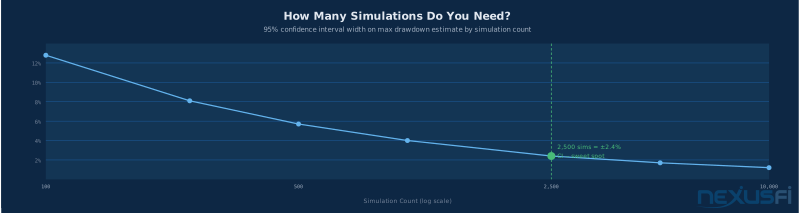
Step 4: Repeat thousands of times. NinjaTrader's built-in Monte Carlo runs 2,500 iterations by default. For tighter confidence intervals on tail events (1st percentile risk of ruin), 5,000-10,000 runs are preferable.
Step 5: Analyze the distribution of outcomes. From 2,500 equity curves, extract percentile statistics: the 90th percentile (top 10% of outcomes), the 50th percentile (median), the 10th percentile (bottom 10%), and the 1st percentile (catastrophic scenarios).
The mathematical intuition behind how this helps for curve-fit detection: if your strategy's profitability depends on a small subset of standout trades — say 8 "home run" trades that each generated $3,000+ while the remaining 292 trades averaged $45 — then each bootstrap simulation excludes roughly 37% of unique trades. In some simulations, several of those 8 standout trades will be excluded simultaneously. Those simulations reveal what your strategy looks like without its outlier trades, which is a realistic model of live performance where those specific setups may not recur.
Reading the Equity Curve Fan #
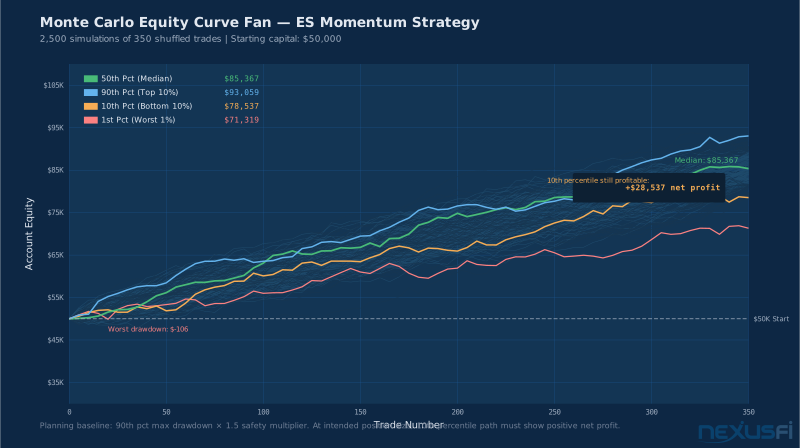
The primary visual output of Monte Carlo simulation is the equity curve fan — a chart overlaying hundreds or thousands of simulated equity curves, with percentile bands highlighting the distribution. Learning to read this chart correctly is the difference between actionable analysis and aesthetic appreciation.
@serac put the key insight plainly in a NexusFi walk-forward discussion: "The output of the NT Monte Carlo tool are CDFs — Cumulative Distribution Functions. The 10th and 90th percentile values are just reading off the CDF at specific probability levels." Reading the fan correctly means understanding you are looking at a probability distribution, not a prediction — the 10th percentile path is not a worst-case forecast, it is the bottom decile of a distribution derived entirely from your own historical trades.
@serac, NexusFi - Walk Forward Experiment
The key reference levels:
The median path (50th percentile): The equity curve sitting at the midpoint of all simulations — 50% of paths perform better, 50% worse. A properly calibrated simulation produces a median path that resembles your original backtest. If the median path differs dramatically from your backtest, check whether you've correctly implemented the simulation parameters (especially commission/slippage settings and capital assumptions).
The 90th percentile path: The top 10% of outcomes. This represents a "favorable sequence" scenario — an encouraging result but not your base case for planning purposes. Its primary use is validating that the strategy's upside is meaningful, not artificially capped.
The 10th percentile path: The bottom 10% of outcomes. This is your primary planning baseline. It represents what you should expect to experience 1 in every 10 times you trade this strategy through a full sample of trades.
(Note: "90th percentile" in the context of drawdown refers to the 90th percentile worst drawdown — i.e., what bad sequences look like.)
The 1st percentile path: The catastrophic scenario — the worst 1% of possible paths. For 2,500 simulations, this is roughly the 25 worst equity curves. This is the input for risk-of-ruin calculations: if the 1st percentile paths dip to zero before reaching your profit target, you have a genuine ruin risk at your intended position size.
What a healthy fan looks like:
- Upward drift across all percentile bands: Even the 10th percentile path trends upward over the full sample. If the bottom 10% of paths loses money, the strategy doesn't have strong edge.
- Tight convergence over long time horizons: The spread between 10th and 90th percentile shrinks relative to the total return as trade count increases -- demonstrating that the edge is real and compounds over time, not just a lucky short-term sequence.
- Clean separation between all paths and zero: No paths (or fewer than 1%) cross your ruin threshold throughout the simulation.
Red flags:
- Wide, non-converging spread: If the 90th and 10th percentile remain far apart even after 500+ trades, the outcomes are highly sequence-dependent. The edge may not be real, or the strategy's per-trade variance is so high that it requires enormous capital to stabilize.
- Median substantially below the original backtest: Indicates the historical equity curve captured a lucky sequence. The "true" performance, averaged across sequences, is much lower.
- Multiple paths crossing zero: If more than 1-2% of simulation paths experience ruin (account dropping to zero or below minimum viable capital), the strategy is dangerous at intended position size.
Drawdown Distributions: Planning for the Worst 10% #
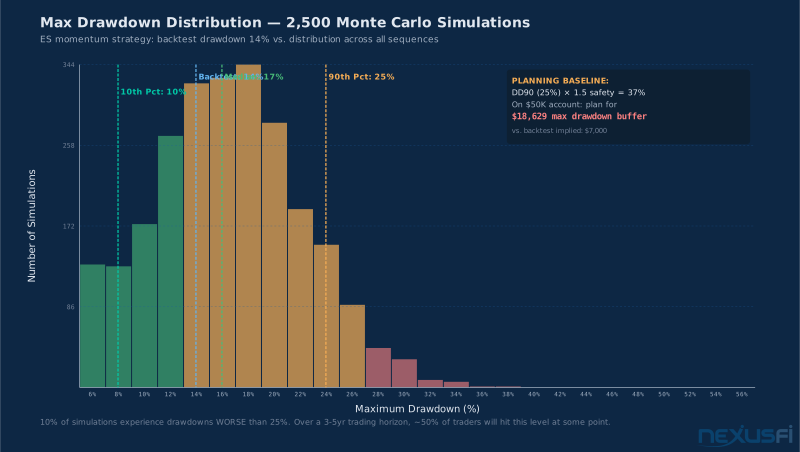
The equity curve fan is intuitive, but the most actionable Monte Carlo output is the drawdown distribution — a histogram of maximum drawdowns recorded across all simulated paths.
Your single backtest tells you "my maximum drawdown was 14% over 5 years." But that's one realization. The drawdown distribution tells you: "Across 2,500 simulations of this strategy, the median max drawdown is 16%, the 90th percentile max drawdown is 27%, and the 99th percentile max drawdown is 38%."
The key planning question is: what drawdown can you actually sustain without abandoning the strategy?
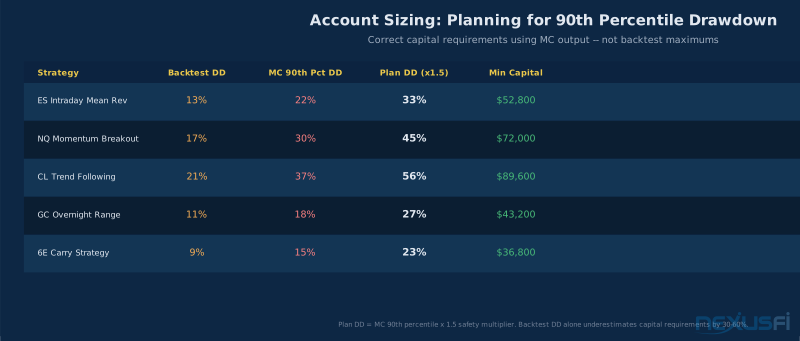
Most traders answer this wrong. They look at the backtest's 14% max drawdown, estimate they can stomach 20%, and size positions so. The correct reference point is the 90th percentile drawdown from Monte Carlo — because 10% of the time, drawdowns will exceed that number. With a 3-5 year trading horizon, the probability of experiencing a 10th percentile or worse drawdown at some point approaches 50-70%. Planning for the median drawdown means you're underprepared for what's actually coming roughly half the time.
The correct account sizing framework from Monte Carlo drawdown analysis:
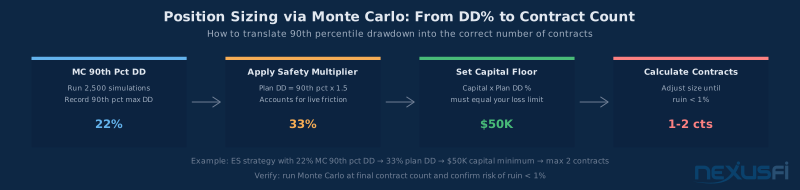
- Identify the 90th percentile max drawdown from Monte Carlo. Call this DD90.
- Apply a 1.5× safety multiplier for live market execution friction: DD_plan = DD90 × 1.5.
- Size positions so that DD_plan stays within your capital tolerance -- typically 20-30% of total account equity for professional traders, lower for retail accounts where psychological limits often hit before mathematical ruin.
Example: ES momentum strategy, 400 trades over 3 years. Backtest max drawdown: 12% ($6,000 on a $50,000 account). Monte Carlo 90th percentile max drawdown: 22% ($11,000). Planning drawdown with 1.5× safety: 33% ($16,500). If you can't sustain a $16,500 drawdown without blowing your strategy, you're trading it at 1.5× too large. Either reduce position size by 40% or fund the account to $82,500 so that a 33% strategy drawdown represents 20% of total capital.
@Fat Tails worked through this math in a NexusFi discussion on money management, demonstrating how to use Monte Carlo confidence intervals to set proper account capitalization: "if your risk appetite tells you that the drawdown should be less than 25% within a confidence interval of 5%, you can find out the drawdown characteristics from the Monte Carlo simulation and then adjust your position size so."
@Fat Tails, NexusFi - Money management help
Risk of Ruin: The Existential Test #
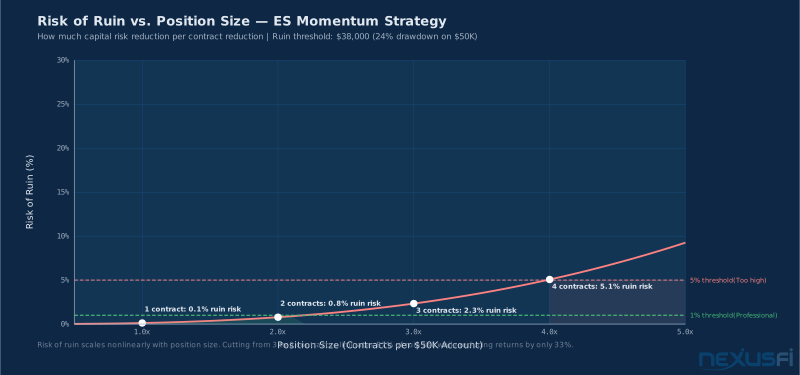
Risk of ruin is the probability that a strategy will draw down to zero (or to a capital level below which continued trading is not viable) before reaching a specified profit target. It's the single most important number Monte Carlo produces, and it's the one most traders skip.
A strategy with 3% risk of ruin sounds tolerable. But if you're running 8 strategies across your trading career, each with 3% risk of ruin, your probability of experiencing ruin at least once approaches 22%. Risk of ruin doesn't scale linearly — it compounds across strategies, across time, and across market environments.
Position sizing decisions made without Monte Carlo are, at best, educated guesses.
@kevinkdog, NexusFi - Taking a Trading System Live
The mechanism for adjusting risk of ruin is position size. If Monte Carlo shows 8% risk of ruin at 2 contracts, run the simulation at 1 contract — risk of ruin typically drops to 1-2%. The tradeoff is proportionally smaller returns, but you stay in the game long enough to benefit from the edge.
Five More Monte Carlo Tests Beyond Trade Shuffling #
Trade shuffling addresses sequence risk and curve-fit detection. Sophisticated practitioners run additional Monte Carlo variants to probe specific failure modes that pure trade shuffling misses.
If any simulation type shows the 95th percentile outcome involves the return-to-drawdown ratio declining by more than half, the strategy is too fragile to trade live.
The Block Bootstrap: When Trades Aren't Independent #
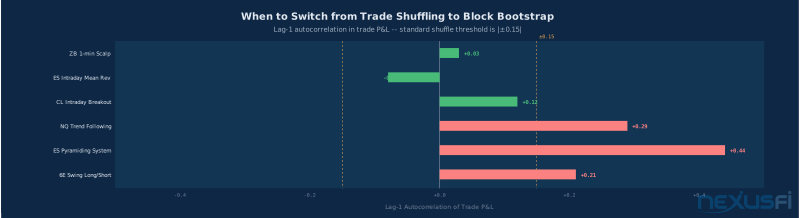
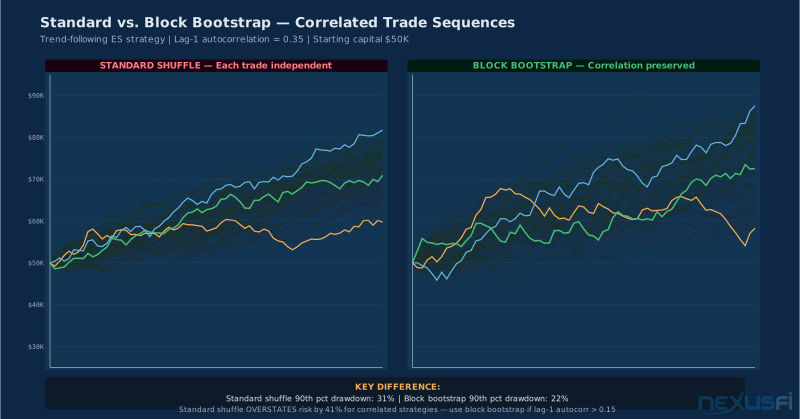
Standard Monte Carlo trade shuffling assumes each trade's outcome is statistically independent of every other trade. For many futures strategies — especially mean-reversion on 15-minute bars or momentum breakouts on daily bars — this independence assumption is approximately valid and trade shuffling works well.
But some strategies systematically violate independence, and running standard Monte Carlo on them produces misleading results:
- Pyramiding strategies: Each add-on trade builds on the prior position. If trade 1 fails, trade 2 is more likely to fail too (you're adding to a losing position). These trades are positively correlated by construction.
- Correlated exit strategies: Strategies using multiple timeframe trailing stops where all open positions share the same stop-out condition -- a single adverse tick can close multiple "trades" simultaneously.
- Trend-following in clustered markets: Trend-following strategies naturally cluster their winners in trending periods and their losers in choppy periods. Individual trade outcomes within a regime period are positively correlated -- knowing that trade 47 was a loser much increases the probability that trade 48 is also a loser.
The warning is specifically about standard trade shuffling; the solution is block bootstrapping.
The block bootstrap preserves within-block dependencies by shuffling groups of consecutive trades together rather than individual trades.
Choosing block size:
- Independent trades (low autocorrelation): Block size = 1. Equivalent to standard trade shuffling.
- Weakly correlated (autocorrelation 0.1-0.3): Block size = 3-5 trades.
- Strongly correlated (autocorrelation > 0.3): Block size = 10-20 trades, spanning a typical regime period.
To check: calculate the lag-1 autocorrelation of your trade P&L sequence (pd.Series(trade_pnl).autocorr(lag=1) in Python). If the result exceeds ±0.15, standard trade shuffling underestimates risk. NinjaTrader's built-in Monte Carlo doesn't support block bootstrapping natively — implement it in Python or R using your exported trade log.
Running Monte Carlo in NinjaTrader 8 #
NinjaTrader 8 includes Monte Carlo simulation in the Strategy Analyzer, making it the most accessible implementation for the majority of NexusFi members who develop automated strategies on NinjaTrader.
Complete walkthrough:
Step 1: Run the standard backtest. Set your historical data range (minimum 2-3 years recommended, 5+ preferred), commission per trade (round turn — typically $4-6 per contract for ES including exchange fees), and slippage (at least 1 tick per side for market orders). Run the backtest and verify the output looks as expected — correct trade count, reasonable P&L per trade, logical max drawdown.
Step 2: Work through to the Monte Carlo tab. In the Strategy Analyzer results pane, click the "Monte Carlo" tab. The simulation runs using the trade log from your most recent backtest.
Step 3: Configure simulation parameters.
- Number of simulations: 2,500 is appropriate for most analyses. Use 5,000 for tighter confidence intervals on tail statistics (1st percentile drawdown, risk of ruin).
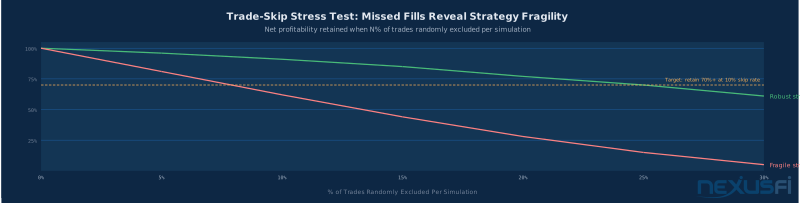
- Percent of trades: By default 100%. To run the "trade exclusion" stress test (traderlange's recommendation), set to 90% -- this randomly omits 10% of trades per simulation run.
- Minimum equity threshold: Set this to your ruin threshold -- the capital level below which you would stop trading the strategy. Any simulation path that crosses below this level counts toward risk of ruin.
Step 4: Analyze the output.
NinjaTrader displays the equity curve fan and a statistics summary showing 10th, 25th, 50th, 75th, and 90th percentile values for all major metrics. Key numbers to record:
- 10th percentile max drawdown (your conservative planning baseline)
- 90th percentile net profit (realistic upside ceiling)
- Percent of simulations crossing the minimum equity threshold (your risk of ruin estimate)
- Median net profit (comparison point against your original backtest -- should be similar)
@traderlange, who spent eight years refining his automated futures strategy workflow on NinjaTrader before reaching consistent profitability, ranked Monte Carlo as the critical inflection point in his process:
"If you are still happy — you MUST do Monte Carlo simulations. This is the most under utilized tool and prob the most important thing NT has for testing. You WANT your strategies to run in noisy unexpected markets and fail. Read everything you can about how this works behind the scenes so you do it properly. And ALWAYS remove at least 5-10% of your best and worst trades. If that probability curve is out of whack, go back to the drawing board."
@traderlange, NexusFi - Tip for Backtesting on Renko Charts
The instruction to explicitly remove best and worst trades (via the "percent of trades" setting) deserves emphasis. This tests robustness against two real-world execution failures: your best wins failing to materialize in live trading (due to slippage, partial fills, or data gaps at critical moments), and your worst losses being better than worst-case (early stops, reduced size). A strategy that only profits because of a handful of standout historical trades isn't a system — it's a lucky sequence.
In his landmark NexusFi thread on position sizing, @Fat Tails ran 1,000 simulations of a SuperTrend strategy on Gold futures to demonstrate the methodology: starting with $100,000, targeting $400,000, with a hard stop at 50% drawdown and 1% ruin tolerance. The Monte Carlo output pinned the correct position size without guesswork. "The approach deals with (a2), if you analyze the low point of the Monte Carlo simulation, you can set a level at which you would stop trading the strategy and then calculate the probability of hitting this stop level."
@Fat Tails, NexusFi - Why 7% is the Difference between Failure and Success
What Passes Monte Carlo: Pass/Fail Criteria #
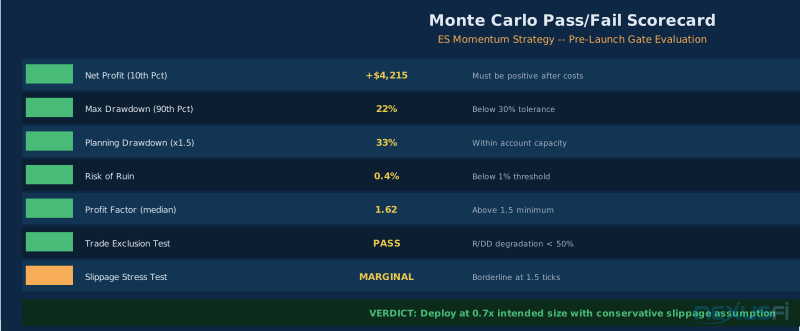
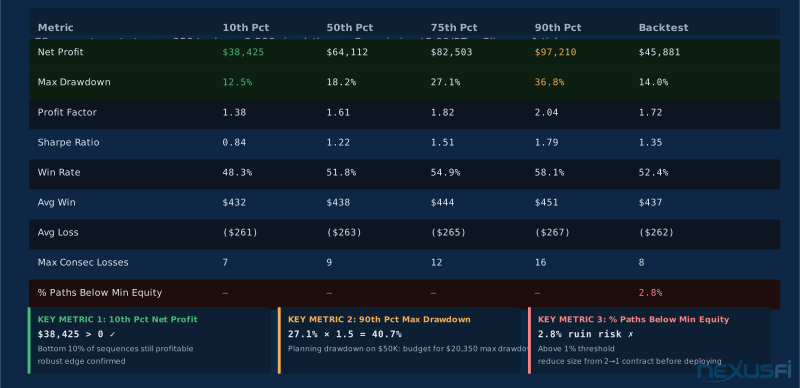
Monte Carlo analysis produces its most value when applied with specific, pre-defined pass/fail thresholds — rather than as a vague "stress test" with subjective interpretation after the fact. Define these thresholds before running simulations, not after seeing results.
Net Profit — 10th Percentile
- PASS: Positive after commission/slippage at the 10th percentile. 90% of simulated sequences are profitable.
- BORDERLINE: Slightly negative at 10th percentile, positive at 25th. Acceptable only at 0.5× intended size.
- FAIL: Negative at 10th percentile by more than 10% of starting capital. One in ten trading periods produces meaningful losses.
Maximum Drawdown — 90th Percentile
- PASS: 90th percentile max drawdown × 1.5 is within your risk tolerance.
- FAIL: Planning drawdown (90th × 1.5) exceeds 40% of trading capital, or exceeds the psychological maximum at which you'd abandon the strategy in live trading.
Risk of Ruin
- PASS: <1% of paths cross the ruin threshold. (<25 paths in 2,500 simulations.)
- CONDITIONAL PASS: 1-3% risk of ruin, only in a portfolio context where strategy failure ≠ total portfolio failure.
- FAIL: >3% risk of ruin at intended position size. Reduce size until passing.
Profit Factor — 50th Percentile
- PASS: Median profit factor >1.5 across simulations.
- FAIL: Median profit factor <1.3. Insufficient margin to absorb execution friction and market regime shifts.
Return/Drawdown Degradation Across Stress Tests (@Mabi's criterion)
- PASS: R/DD ratio degrades less than 50% at 95th percentile in any stress test type.
- FAIL: Any stress test shows >50% R/DD degradation at 95th percentile confidence.
When Monte Carlo fails, there are four paths forward:
- Reduce position size. Most pass/fail outcomes are capitalization decisions. Run Monte Carlo at half the intended position size. If it passes, you've found the correct size. Deploy at that level.
- Improve the strategy's underlying edge. If the 10th percentile equity curve is negative even at minimal size, the strategy doesn't have enough edge to survive sequence randomness. Review entry criteria, test market regime filters (see Regime Detection), and address overfitting if the failure is curve-fit driven.
- Check trade independence and switch to block bootstrapping. If standard Monte Carlo fails for a correlated strategy (pyramiding, trend-following with clustered results), block bootstrapping may show better-than-feared robustness. The standard test overstates risk for correlated strategies by artificially destroying the positive correlation between winner clusters.
- Accept the result and abandon the strategy. Sometimes Monte Carlo reveals that a backtest captured statistical noise -- a favorable run of a at the core random or overfit system. This is the correct outcome. Discovering this before live deployment is worth the development time spent on the strategy -- it prevented a capital loss that would have been far more costly.
The Pre-Launch Monte Carlo Decision Framework #
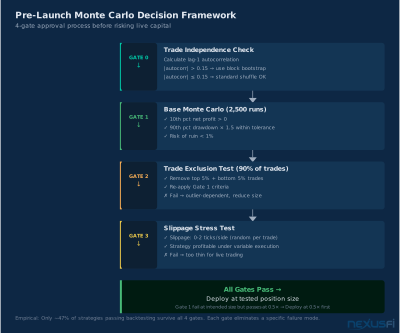
Monte Carlo simulation is most valuable when treated as a formal approval gate — a systematic checklist that every strategy must pass before live capital is committed. Running it ad hoc after you're already convinced the strategy works defeats its purpose.
Here is a complete pre-launch framework, sequenced in the order that catches problems most efficiently:
Gate 0: Trade Independence Check (Pre-Simulation)
Before running any simulation, calculate the lag-1 autocorrelation of your trade P&L sequence. If |autocorrelation| > 0.15, use block bootstrapping with block size proportional to the correlation window. If the autocorrelation is near zero, proceed with standard trade shuffling.
Gate 1: Base Monte Carlo (2,500 runs)
Run standard trade shuffling. Apply all four pass/fail criteria above simultaneously. All must pass. If any fail, do not proceed to gates 2-5 until the underlying issue is resolved (size reduction, strategy improvement, or block bootstrapping switch).
Gate 2: Trade Exclusion Stress Test
Rerun at 90% of trades (omitting 10% randomly per simulation). Failing this gate specifically (while passing Gate 1) indicates the strategy depends critically on outlier trades. The base edge may be real, but position sizing must be reduced to account for execution variance.
Gate 3: Slippage Distribution Stress Test
Rerun with slippage modeled as a uniform random variable across your realistic range. For ES futures: 0-2 ticks per side per trade (sampled independently per trade). Does profitability survive variable execution quality? If the strategy is marginally profitable at 1-tick average slippage but unprofitable at 1.5-tick average slippage, you're depending on consistently favorable fills that live trading won't always provide.
Gate 4: Final Decision
- Passes all gates → Deploy at the position size tested in Gate 1.
- Passes Gate 1, fails Gates 2-3 → Deploy at 0.7× intended size with more conservative slippage assumptions.
- Fails Gate 1 at intended size, passes at 0.5× → Deploy at 0.5× until live performance validates the edge.
- Fails Gate 1 at any tested size → Do not deploy. Return to strategy development.
The entire framework takes 30-60 minutes to execute properly — five to ten times the effort of the base backtest. Given that it can prevent years of live trading losses by catching fragile strategies before they meet real capital, it's the highest-leverage hour you'll spend in strategy development.
@traderlange's summary of what a proper validation workflow produces, after eight years of costly experience: "I do this for a living now." The explicit sequence — optimization, walk-forward, Monte Carlo, market replay — with Monte Carlo ranked as "the most under utilized tool and prob the most important thing NT has for testing" — is the protocol of someone who learned its importance the hard way. You don't have to.
Three numbers define whether a strategy is ready for live capital: the 10th percentile net profit (must be positive after costs), the 90th percentile max drawdown x 1.5 (your capital planning baseline), and the risk of ruin at intended position size (must be under 1%). Every other Monte Carlo metric is context for understanding these three. If all three pass, you have a system worth trading. Fix the underlying issue — almost always position sizing — before going live.
Knowledge Map
Prerequisites
Understand these firstReferences This Article
Articles that build on this topicCitations
- — KJ Trading Systems Kevin Davey - Ask Me Anything (AMA) (2017) 👍 2“But, what if you had the same trades, but just in a different order? That is what Monte Carlo simulation does.”
- — Ninja Trader Monte Carlo (2011) 👍 7“If your strategy is curve-fitted, it will not pass the Monte Carlo Simulation very well.”
- — Risk of Ruin (2012) 👍 7“1,000 Monte Carlo simulations of 200 trades from a 372-trade Gold futures sample.”
- — Tip for backtesting on Renko charts (2014) 👍 7“you MUST do Monte Carlo simulations. This is the most under utilized tool and prob the most important thing NT has for testing.”
- — KJ Trading Systems Kevin Davey - Ask Me Anything (AMA) (2017) 👍 1“A strategy that at 95% confidence has a Return/Drawdown change of more than 50% in any Montecarlo test I ditch.”
- — Alternatives to Monte Carlo testing (2013) 👍 2“a better way to shuffle returns is to shuffle blocks of returns, keeping consecutive return periods together”
- — Why 7% is the Difference between Failure and Success in Trading (2012) 👍 32“Using a Monte Carlo analysis for fixed fractional betting -- the model with lower drawdowns allows higher leverage and trades twice as many contracts.”
- — Money management help pls (2013) 👍 10“If your risk appetite tells you the drawdown should be less than 25% within a confidence interval of 5%, use Monte Carlo simulation to find the drawdown characteristics and adjust position size accordingly.”
- — Taking a Trading System Live (2013) 👍 10“To determine the position sizing scheme that is right for me, I use my Monte Carlo simulator. For a given trading system, it estimates probabilities of risk of ruin, median max drawdown, median annual return.”
- — Walk Forward Experiment (2012) 👍 10“The output of the NT Monte Carlo tool are CDFs -- Cumulative Distribution Functions. The 10th and 90th percentile values are reading off the CDF at specific probability levels.”
- — Monte Carlo Simulation (2010) 👍 3“Monte Carlo Simulation randomizes your trade results over and over in multiple simulations to provide a normal distribution of simulation performance.”