



Futures Customer Segregated Funds: How FCMs Hold Your Money and What Actually Protects You
Overview #
Every dollar you deposit into a futures trading account flows into something called the customer segregated fund. It doesn't sit in a private vault earmarked for you. It joins a pool with every other customer at that FCM, held at a bank or trust company in accounts that are legally separated from the firm's own money — but operationally commingled with every other client.
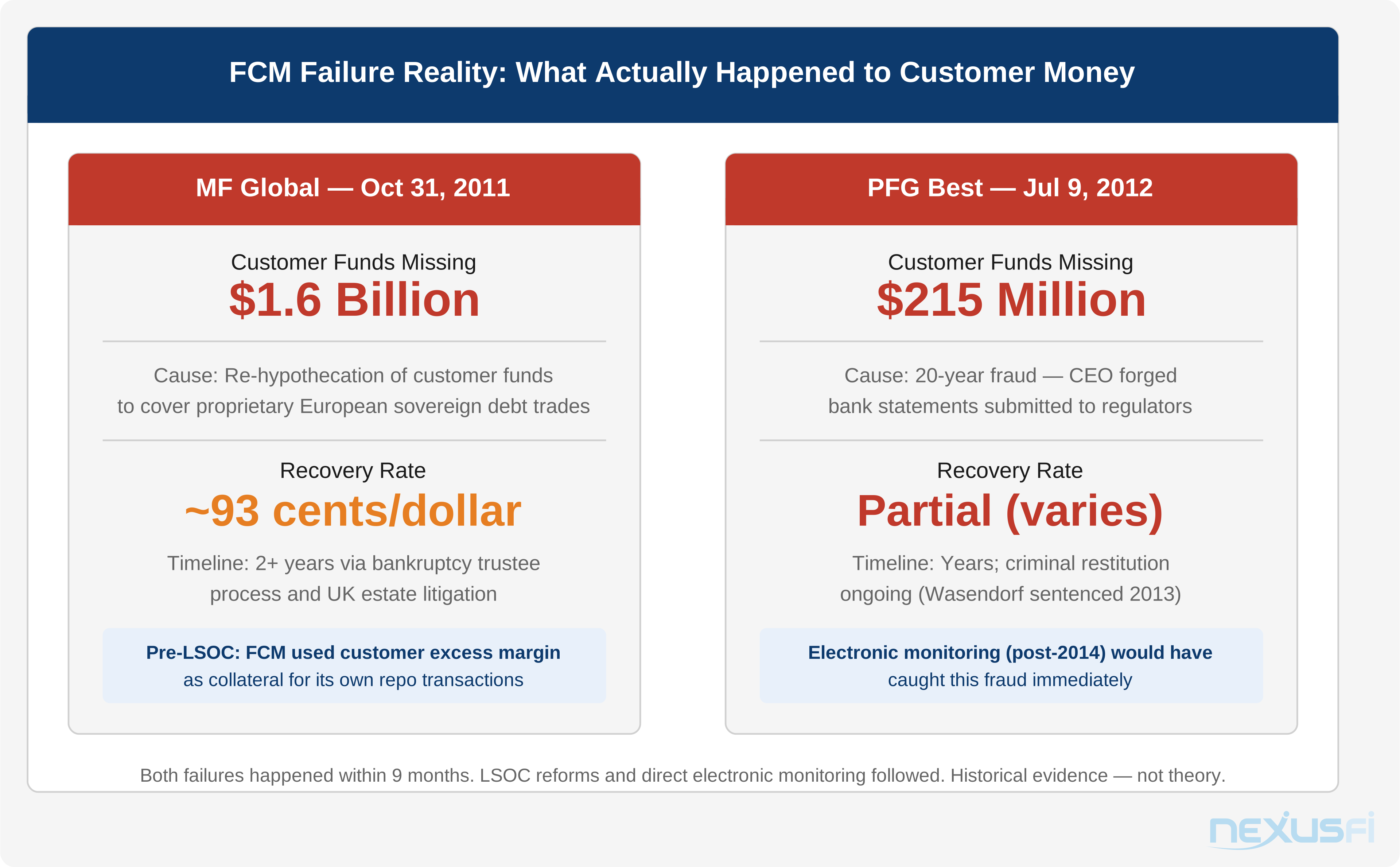
When MF Global collapsed in October 2011, $1.6 billion was missing from those pools. When Peregrine Financial Group (PFG Best) failed nine months later, $215 million had been stolen. In both cases, customers had received assurances that their funds were "segregated." Those assurances were accurate and meaningless at the same time. The funds were legally segregated. They were also gone.
Understanding the customer segregated fund framework is not an academic exercise for the compliance-minded. It's the operational knowledge that separates traders who know where their money actually is from those who find out the hard way. The futures industry has no FDIC, no SIPC for futures positions, no government insurance backstop. Protection comes from rules, capitalization requirements, and oversight — and all three have failed before. Knowing which safeguards are real and which are paper comfort lets you make intelligent decisions about FCM selection and account sizing.
In futures, "segregated funds" means your money is legally separated from the broker's money — not that it's physically isolated in your own account. You have a pro-rata claim against a commingled pool. That distinction became painfully real for MF Global customers who waited years for partial recovery.
The Legal Architecture: What "Segregated" Actually Means #
The legal foundation is CFTC Regulation 4d under the Commodity Exchange Act. Every registered Futures Commission Merchant must maintain customer funds separately from the firm's own operating capital. But "separately" has a precise legal meaning that surprises most traders.
Two types of pools. FCMs maintain at least two distinct fund pools under the segregation framework: customer segregated funds (for U.S.-domiciled customers trading on U.S. futures exchanges) and "secured amount" funds (for customers trading on foreign boards of trade). Within each pool, all customers are commingled — your $50,000 and the next trader's $200,000 are in the same account.
What you actually own. You don't own specific dollars in the segregated account. You have a legal claim against the pool proportional to your balance. In normal conditions, that's equivalent. In a failure or shortfall scenario, it isn't. If the pool is undersized — because of fraud, investment losses on permitted investments, or a large customer loss the FCM couldn't absorb — every claimant takes a proportional haircut.
Where the money sits. Segregated funds must be held at a "permitted depository" — a bank, trust company, or clearing organization that has signed an acknowledgement letter stating the funds are customer property, not available to the FCM's creditors. The FCM cannot use the segregated account as collateral for its own borrowing. The bank cannot sweep the funds to cover FCM debts.
In theory. Both MF Global and PFG Best violated these rules — MF Global through a complex re-hypothecation arrangement, PFG through outright fraud. Rules are constraints on honest actors. They're speed bumps for determined fraudsters.
The 8% figure matters. The CFTC minimum net capital requirement for an FCM is the greater of $1 million or 8% of total customer risk margin. For a large FCM holding $10 billion in customer funds with $2 billion in risk margin, the minimum equity buffer is $160 million. If customer losses exceeded the pool balance by more than that, other customers would be affected. This is the math that determined how far MF Global's shortfall propagated.

What FCMs Can Do With Your Money: Regulation 1.25 #
Segregation doesn't mean idle cash. CFTC Regulation 1.25 authorizes FCMs to invest customer segregated funds in a defined set of instruments:
- U.S. government securities — T-bills, T-notes, and T-bonds, the safest permitted assets
- U.S. agency securities — securities issued by government-sponsored enterprises
- Money market mutual funds — but only those investing exclusively in government securities
- Municipal securities — investment-grade, limited duration
- Certificates of deposit — from insured banks, with maturity limits
- Corporate notes and bonds — investment-grade, with maturity restrictions
- Commercial paper — highest-quality, short-duration only
The FCM earns all income from these investments. Your account receives zero interest on the cash portion of your futures margin. This is disclosed in your risk disclosure document and account agreement — in language you almost certainly skipped.
This framework creates an incentive structure worth understanding. FCMs with thin profit margins on commissions may be tempted to reach for yield in their Reg 1.25 investments — holding more corporate bonds and commercial paper than T-bills. In normal markets, this works fine. In stress events, investment-grade corporate debt can gap down and commercial paper markets can freeze. The 2008 credit crisis caused real stress for some FCMs holding money market funds that temporarily "broke the buck." Most survived, but the potential for investment losses within the customer pool is real and underappreciated.
Post-MF Global reforms tightened Regulation 1.25 to eliminate some of the riskier permitted investments that existed prior to 2012, especially in-house money market funds and certain repurchase agreement structures. The current framework is cleaner than it was — but it's not cash sitting in a box.
Your FCM keeps all interest earned on customer funds. An FCM aggressive in its Reg 1.25 investments — reaching for yield in corporate bonds rather than staying in T-bills — is effectively taking risk with your margin deposits to boost its own income. You see none of the upside. You absorb a portion of any downside through exposure to pool shortfalls.

The Capitalization Buffer: Excess Net Capital #
Beyond the segregation requirements, the FCM's own capitalization is the most meaningful safety variable you can assess before opening an account. Excess net capital is the amount of capital the firm holds above the regulatory minimum. This buffer is what gets drawn down first when something goes wrong.
The CFTC publishes monthly financial data for all registered FCMs at cftc.gov/MarketReports/financialfcmdata. This is public information, updated monthly, and almost nobody reads it. The report shows:
- Total customer segregated funds held (how much customer money is in the pool)
- Excess segregated funds (how much the pool exceeds the regulatory minimum)
- Excess net capital (how much the firm's own equity exceeds the minimum)
As @Big Mike compared directly from the CFTC data in the AMP Global thread: "IB has excess capital of $4 billion according to the latest CFTC FCM report. By comparison, AMP has $5 million. The average is $2 billion. There are only 8 FCMs that have lower excess capital than AMP, out of 64 FCMs in the report."[1]
That comparison isn't meant to single out one firm — small FCMs exist to serve small accounts, and for a retail trader putting in $5,000, the capitalization delta matters less. But for a trader depositing $500,000 in retirement savings, putting it at a firm whose entire excess capital buffer is $5 million concentrates 10% of their buffer in a single account. That's a meaningfully different risk profile than the same $500,000 at a firm with $4 billion in excess capital.
The CFTC financial data page is updated monthly. Check it before opening an account at any FCM. The two numbers that matter most: excess net capital (how much buffer the firm has) and excess customer segregated funds (how much buffer the pool has). Both should be solidly positive — and ideally large multiples of your intended deposit.

LSOC: The Post-MF Global Overhaul #
The MF Global collapse triggered the most significant overhaul of customer fund protections since the Commodity Exchange Act's original segregation rules. The centerpiece was LSOC — Legally Segregated, Operationally Commingled — a framework primarily applied to cleared swaps but with influence across the broader futures clearing infrastructure.
The core changes LSOC brought:
Individual tracking within the pool. FCMs must now account for each customer's position in the pool individually, rather than maintaining only a lump-sum pool balance. This creates a clear record of whose funds are where and eliminates certain types of commingling that existed before.
Daily reconciliation and reporting. FCMs must reconcile their customer segregated accounts to the required amount every business day and report any deficiency immediately. Pre-MF Global, reporting was less frequent and less granular.
Direct CFTC monitoring. The CFTC can now directly access FCM segregated account balances through electronic connections to the FCMs' depository banks. Regulators see the actual balance, not just the FCM's reported number. This eliminated the specific gap PFG Best exploited — fake bank statements can't fool direct electronic monitoring.
Transfer mechanisms in default. In a clearing member default, LSOC allows customer positions to be transferred directly to another FCM without going through a general bankruptcy proceeding. This means customers don't wait years for a bankruptcy trustee to determine what they get.
What LSOC didn't fix: the fundamental commingling reality. The pool is still a pool. A massive customer loss that exceeds the FCM's excess capital can still create a shortfall that affects other customers. LSOC made fraud much harder and transparency dramatically better — it didn't make it impossible for customers to lose money in an FCM failure.

When the System Failed: MF Global and PFG Best #
Understanding these failures isn't just historical context — it's the only concrete evidence we have about what actually happens when customer segregated funds fail. Both cases demonstrate different failure modes that could still occur under modified circumstances.
MF Global (October 31, 2011)
MF Global was one of the largest FCMs in the world, a primary dealer in U.S. government securities, and a major brokerage for institutional and retail futures traders. When it filed for bankruptcy on October 31, 2011, approximately $1.6 billion in customer segregated funds was missing.
The mechanism was complex. MF Global had been running a highly leveraged $6.3 billion bet on European sovereign debt. As European markets deteriorated through 2011, the firm faced increasing margin calls. In the final days, cash was moved from customer segregated accounts to cover those calls — effectively borrowing from the customer pool to maintain proprietary positions. MF Global had used customer assets as collateral for its own repo transactions, a practice known as re-hypothecation. The arrangement was complex enough to survive multiple internal and external reviews until it couldn't.
Recovery: customers ultimately received approximately 93 cents on the dollar — after years of litigation, a bankruptcy trustee process, and partial recoveries from the U.K. estate. Nobody received their money back quickly.
PFG Best / Peregrine Financial Group (July 2012)
Nine months after MF Global, another FCM failed — this one simpler and more disturbing. Russell Wasendorf Sr., founder and CEO of Peregrine Financial Group, had been stealing from customer segregated accounts for 20 years. He submitted a suicide attempt note the same day the CFTC discovered the fraud in July 2012. The missing amount was approximately $215 million.
The mechanism: Wasendorf had been physically intercepting paper bank statements, doctoring them, and submitting falsified documents to regulators and auditors for two decades. The NFA had conducted multiple audits during this period and relied on bank statements to confirm segregated fund balances — statements that were all fake.
The electronic monitoring program implemented after MF Global — where regulators can query bank balances directly without going through the FCM — would have caught this fraud immediately. It wasn't in place yet when PFG failed.
"Customer funds are segregated" is a legal description of where money is supposed to be — not a guarantee of where it actually is. The reforms since 2012 have made both types of fraud much harder. They haven't made them impossible. Read the CFTC reports. Don't take the FCM's word for it.
The broader lesson: two of the three biggest retail FCM failures in U.S. history happened within nine months of each other. The industry has gone more than a decade without a major failure since the LSOC rules and direct monitoring were implemented. But the structural vulnerabilities — commingled pools, minimum capital requirements, permitted investments that carry credit risk — still exist in diluted form for small, under-capitalized FCMs.
The SIPC Misconception: Futures Aren't Securities #
Most traders with equity market experience assume some equivalent of SIPC exists for futures. It doesn't.
SIPC — the Securities Investor Protection Corporation — covers securities accounts held at broker-dealers registered with the SEC. It provides up to $500,000 in protection (with a $250,000 cash sublimit) against broker failure. Futures and options on futures are explicitly excluded.
As @Pa Dax quoted directly from Interactive Brokers' account documentation: "Futures and options on futures are not covered. As with all securities firms, this coverage provides protection against failure of a broker-dealer, not against loss of market value of securities."[5]
This isn't a technicality — it's a structural feature of how futures are regulated. Futures are commodity contracts under the Commodity Exchange Act, regulated by the CFTC. Securities are regulated by the SEC under the Securities Exchange Act. Different regulatory regimes, different protection frameworks. SIPC is a securities-law creation. Futures have no equivalent.
What futures traders have instead:
- The segregation rules (your proportion of the pool is legally yours)
- The FCM's excess net capital (first buffer against shortfalls)
- CFTC oversight, NFA membership requirements, and direct monitoring
- The clearinghouse guarantee fund (protects positions at the exchange level — not your cash at the FCM)
The clearinghouse guarantee funds — contributed by clearing members — protect against clearing member default at the exchange level. If your FCM defaults but positions can be transferred to another FCM, the clearinghouse makes the transfers work. This is distinct from protecting your CASH at the FCM, which is what the segregation rules govern.
Some FCMs offer supplemental protection programs. Interactive Brokers, for example, maintains a program that sweeps excess cash above futures margin requirements into SIPC-protected securities accounts — effectively giving uninvested cash a securities wrapper. This isn't universal and requires opting in and understanding the mechanics.
Never assume SIPC covers your futures account. It doesn't. If a registered broker-dealer also operates an FCM (as some large firms do), you may have SIPC coverage for the securities side and zero insurance for the futures side — in the same institution. Always verify which entity holds which assets.

How to Protect Yourself: Practical Steps #
Given the framework — commingled pools, no insurance backstop, protections that depend on regulatory compliance that can be violated — what can a working trader actually do?
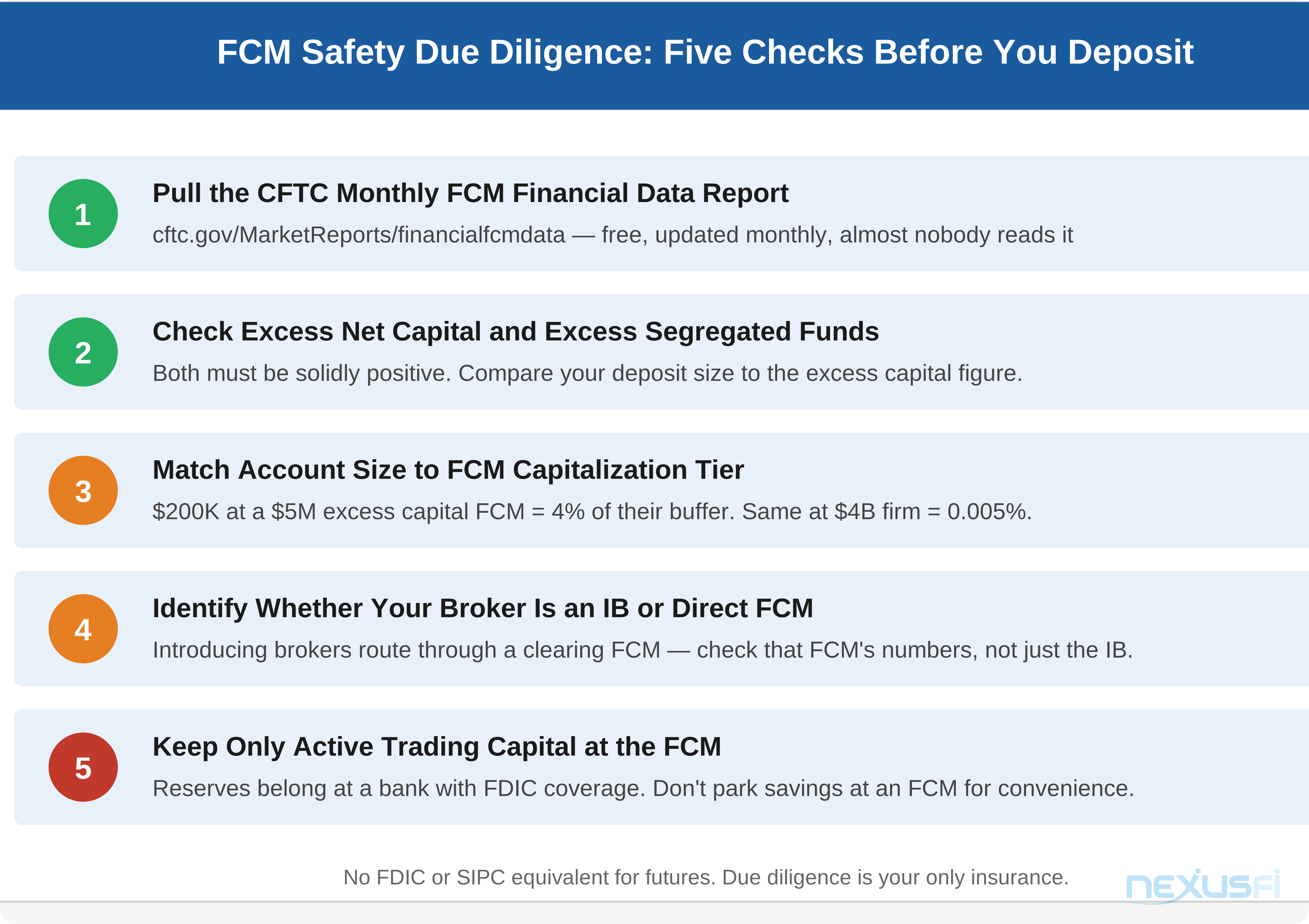
Pull the CFTC monthly FCM report before opening an account. The report is free and public at cftc.gov/MarketReports/financialfcmdata. For your target FCM, check excess net capital (the firm's own buffer) and excess segregated funds (the pool's buffer above requirements). Both should be positive. The size of those buffers relative to total customer funds tells you how much room exists before problems would affect customers. A firm running near minimum requirements is a firm with almost no margin for error.
Match account size to FCM capitalization. If you're putting $50,000 into a $4 billion firm, the ratio is negligible. If you're putting $200,000 into a firm with $5 million in excess capital, you're a meaningful fraction of their buffer. Scale your exposure to the FCM's actual size.
Separate working capital from reserves. Money you're not actively trading doesn't need to sit at the FCM. The risk-return of keeping $500,000 at a single FCM to trade $50,000 of margin is unfavorable. Keep working capital plus a buffer at the FCM — keep reserves at a bank.
Consider multiple FCMs for large accounts. Institutional traders spread risk across multiple clearing relationships. Retail traders can do the same, especially for accounts over $100,000. Splitting between two FCMs adds minimal friction and meaningfully reduces concentration risk given that FCM failures, while rare, are not theoretical.
Look for capitalization tier, not just brand recognition. Large brand recognition doesn't correlate perfectly with capitalization. A well-known discount FCM may have a fraction of the excess capital of a less-marketed institutional broker. The CFTC report cuts through marketing to the actual numbers.
Check whether your FCM also functions as the clearing member. Some brokers are introducing brokers (IBs) that route through a separate FCM for clearing. In that structure, your funds are held at the clearing FCM — check THAT firm's capitalization, not just the IB you interact with daily.
Your futures account has no insurance backstop equivalent to FDIC or SIPC. Protection comes from legal segregation rules, FCM capitalization, and CFTC oversight — all of which have failed before. The practical protection toolkit: choose well-capitalized FCMs, keep only active trading capital at the FCM, diversify across FCMs for large accounts, and check the CFTC monthly reports as part of annual due diligence.

Knowledge Map
References This Article
Articles that build on this topicCitations
- — Class Action Lawsuit: AMP Global Clearing LLC (2020) 👍 21“IB has excess capital of $4 billion according to the latest CFTC FCM report. By comparison, AMP has $5 million. The average is $2 billion.”
- — Is Amp at risk of going under? (2020) 👍 7“Don't let them tell you 'of course it's safe! Our funds are segregated!' That will NOT save you. Firms HAVE, WILL, and DO hide things from their accountants and the CFTC.”
- — NinjaTrader Clearing Risks (2024) 👍 5“The futures commission merchant may retain the interest and other earnings realized from its investment of customer funds.”
- — NinjaTrader Clearing Risks (2024) 👍 2“There is a single co-mingled customer segregated funds account that is separate from the firm's accounts. The broker does have to have equity capital backing up the account which would cover any losses first, but it's only 8% of the total margin requirement.”
- — Avoiding Broker Insolvency (2020) 👍 6“Futures and options on futures are not covered. As with all securities firms, this coverage provides protection against failure of a broker-dealer, not against loss of market value of securities.”
- — What if a broker declare bankruptcy (2022) 👍 6“In the US Customer Funds are required to be held in a separate segregated account to protect the customer from a situation like this. Unfortunately people still violate these laws as was seen in the PFG and MF Global failures.”
- CFTC — FCM Customer Segregation Funds -- Protection for Your Money (2024)
- — PFGBest Accounts Frozen (PFG scandal big thread) (2012) 👍 2“Customer segregated funds means something, just it doesn't mean anything when faced with someone that will commit fraud. These guys sent segregation reports showing the money was segregated and safe. The owner lied and stole the excess margin.”