



Futures vs ETFs: Capital Efficiency, Tax Treatment, and the Strategic Choice for Active Traders
Overview #
Every trader who looks at index futures eventually asks the same question: why bother with ES when SPY exists? Why trade NQ when QQQ is right there, commission-free, in the same brokerage account you've always used?
The honest answer is that for most retail investors — people building long-term portfolios, contributing to retirement accounts, buying and holding — futures offer no meaningful advantage. ETFs win that argument on simplicity alone.
But active traders are not investors. The distinction matters enormously. For someone who trades the S&P 500 index daily, holding positions for minutes to hours, the structural differences between futures and ETFs translate into real dollars: lower taxes, more capital freed up for other positions, access to overnight moves that ETFs can't capture, and execution advantages that compound across hundreds of trades per year.
This article examines those structural differences — the actual mechanics that determine whether ES or SPY makes more sense for your account, strategy, and situation.
What You're Actually Buying #
Before comparing them, it's worth being precise about what each instrument is.
A futures contract is a legally binding agreement to buy or sell an asset at a specified price on a future date. When you buy one ES (E-mini S&P 500) contract, you're entering an agreement to receive $50 times the S&P 500 index value at expiration. In practice, nearly all retail traders never take delivery — they close or roll their position before expiration. But the structure matters: you own a contract, not shares.
An ETF (Exchange-Traded Fund) is a security that holds a basket of assets and trades on a stock exchange. When you buy SPY, you're purchasing fractional ownership of a fund that holds all 500 stocks in the S&P 500. You own shares. Dividends flow through to you. Shares can be fractional. The fund has an expense ratio — a management fee deducted automatically.
These structural differences — contract vs. shares — drive every practical difference that follows.
Capital Efficiency: The Leverage Equation #
This is where the conversation usually starts, and where futures' advantage is most tangible.
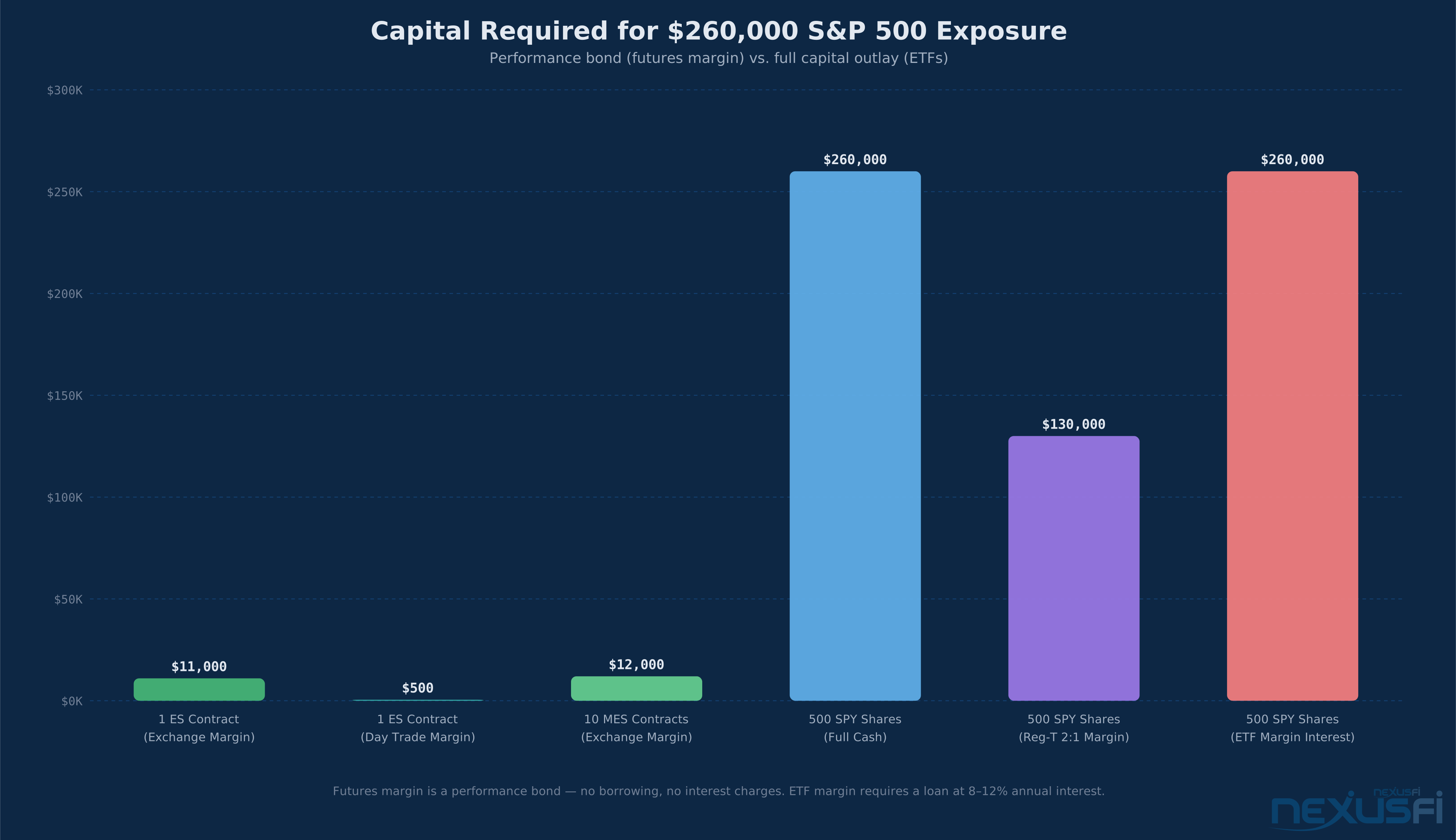
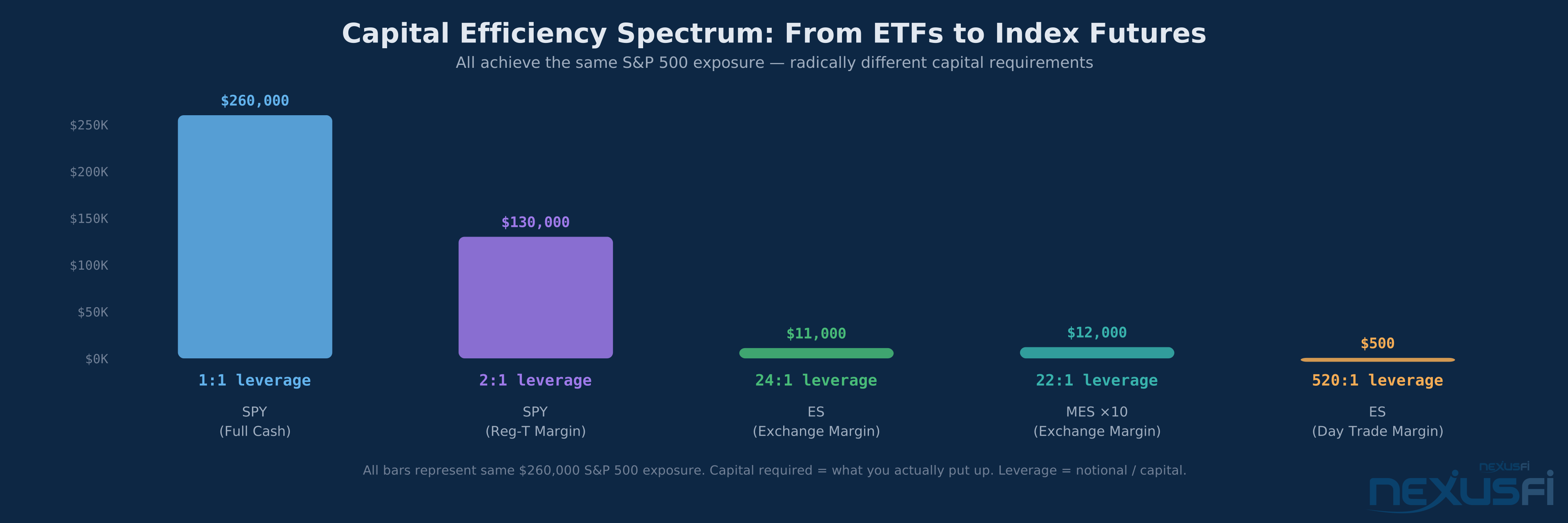
How ETF leverage works: To buy $200,000 worth of SPY, you need $200,000 (or $100,000 with standard Reg-T 2:1 margin, which incurs interest). If you're managing $1 million in capital and want $1 million of S&P 500 exposure, you need basically all of it tied up in SPY shares.
How futures leverage works: The same $200,000 worth of S&P 500 exposure (roughly 4 ES contracts at current prices) requires about $44,000 in exchange margin — 22% of the notional value. And that margin isn't borrowed capital. It's a performance bond. You're not paying interest on it the way you would on a margin loan from your broker.
The leverage ratio — roughly 18:1 for ES at standard exchange margins — sounds alarming until you understand what it means in practice. You're not forced to use all available leverage. A trader with $100,000 who wants $200,000 of S&P 500 exposure can achieve that with 4 ES contracts while keeping $56,000 in reserve. The same exposure in SPY requires the full $200,000. The futures trader has $56,000 working elsewhere, the ETF trader has nothing left.
@FredBell made this capital efficiency argument explicitly: [2]
"I used to have 1M to 2M invested in ETFs, now I can achieve the same returns simply by trading a few future contracts with only roughly 10% of capital invested compared to my investment in ETFs. For instance I can buy 10 ES contract and achieve similar results as with a $2M invested in an ETF...For the same notional value the risk are the same."
The critical caveat: Leverage amplifies losses just as it amplifies gains. A trader who uses all available futures margin is taking dramatically more risk than someone holding the equivalent SPY position. Capital efficiency is only an advantage when used with discipline — deploying enough contracts to match your desired exposure, not the maximum your account permits.
Intraday margins: Many futures brokers offer intraday margins as low as $500 per ES contract (versus the $12,000+ overnight exchange requirement). These ultra-low intraday margins are operational conveniences, not invitations to take on 400:1 leverage. Used sensibly, they allow traders to manage positions without having large amounts of capital locked in overnight margin while positions are closed.
Intraday margin rates offered by retail brokers ($500-$1,000 per ES) are NOT safe leverage targets — they're minimum capital requirements to hold a position open. Traders who size to these limits rather than to risk parameters get margin calls the moment the market moves 2-3 points against them. Size to your risk budget, not your broker's minimum.
Tax Treatment: The Section 1256 Structural Advantage #
If there is a single reason active traders in taxable accounts prefer futures over ETFs, it's this: Section 1256 of the US tax code.
For ETFs: Short-term capital gains — gains on positions held less than one year — are taxed at ordinary income rates. If you're in the 37% federal bracket and you make $100,000 trading SPY with an average holding period of 2 days, you owe $37,000 to the IRS. There is no shortcut here. Frequent trading in ETFs is tax-inefficient by definition.
For futures: Section 1256 contracts — which include regulated futures like ES, NQ, CL, GC, and most other standard futures — are taxed with a 60/40 split regardless of holding period. 60% of net gains are treated as long-term capital gains (taxed at 15% or 20% depending on bracket), and 40% are treated as short-term (taxed at ordinary income rates). This applies whether you held the position for 3 minutes or 3 months.
@Luger ran the math directly: [3]
"Tax rate on broad based index futures = (60% 15%) + (40% 25%) = 19%. Pay IRS $190 for every $1,000 made. Tax rate regular short term capital gains (equities, options, etc) = 25%. Pay IRS $250 for every $1,000 made. For those people in the higher brackets it is even more valuable: In the 35% bracket, broad based index futures gains are taxed at only 23% instead of 35% for equities, etc."
Using current brackets, a trader in the 37% federal bracket making $100,000 annually in futures profits would owe approximately:
- 60% long-term: $60,000 × 20% = $12,000
- 40% short-term: $40,000 × 37% = $14,800
- Total: $26,800
The same $100,000 in short-term ETF gains: $37,000.
That's a difference of $10,200 on $100,000 in profit — over 10% — simply from choosing the right instrument.
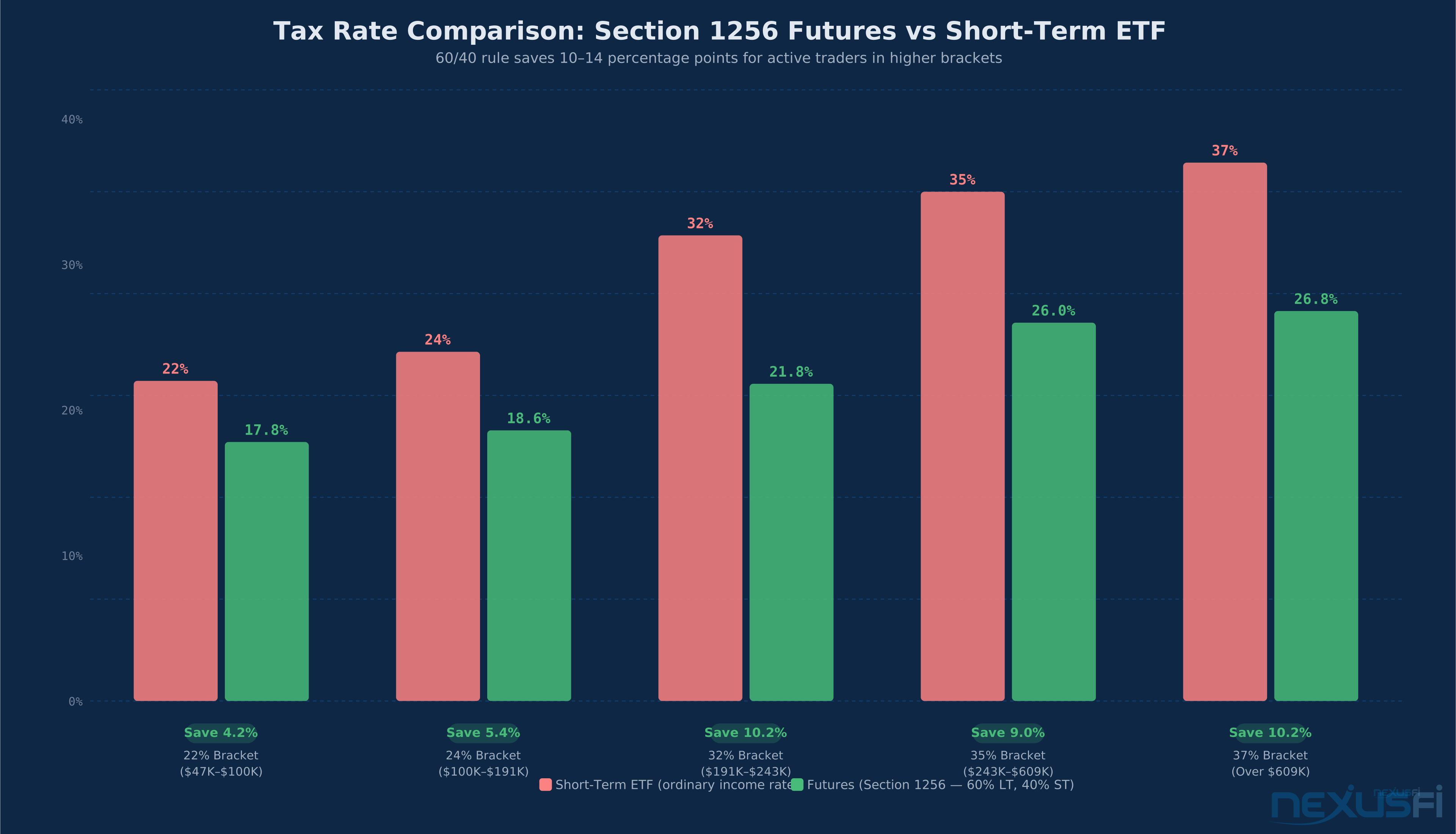
Section 1256 Effective Tax Rate: (60% × Long-Term Capital Gains Rate) + (40% × Ordinary Income Rate)
At the 37% bracket with 20% long-term rate: (0.60 × 20%) + (0.40 × 37%) = 26.8% effective rate vs. 37% for equivalent short-term ETF gains = 10.2 percentage points saved
Additional features of Section 1256 treatment:
Mark-to-market at year-end: Futures positions are marked to market on December 31st, meaning you're taxed on unrealized gains and losses at year-end. For a trader who closes positions daily, this is a non-issue. For someone holding a multi-week futures position into the new year, it creates a tax event on paper gains.
Loss carryback: Section 1256 losses can be carried back up to three years to offset prior 1256 gains, a flexibility not available with standard capital losses. This can be valuable in a down year.
When the tax advantage disappears:
- Tax-advantaged accounts (IRA, Roth IRA, 401k): Gains in these accounts are tax-deferred or tax-free regardless of instrument. The Section 1256 benefit is irrelevant here. Futures in a Roth IRA get no better treatment than ETFs. [4]
- Long-term ETF holders: If you hold SPY for more than one year, gains are already at the long-term capital gains rate (15% or 20%). The tax advantage of futures over ETFs narrows substantially. For positions held multiple years, qualified dividend treatment may further close the gap.
- State and local taxes: Not all states recognize the federal 60/40 treatment. Check your state's tax code before assuming the savings apply at the state level.
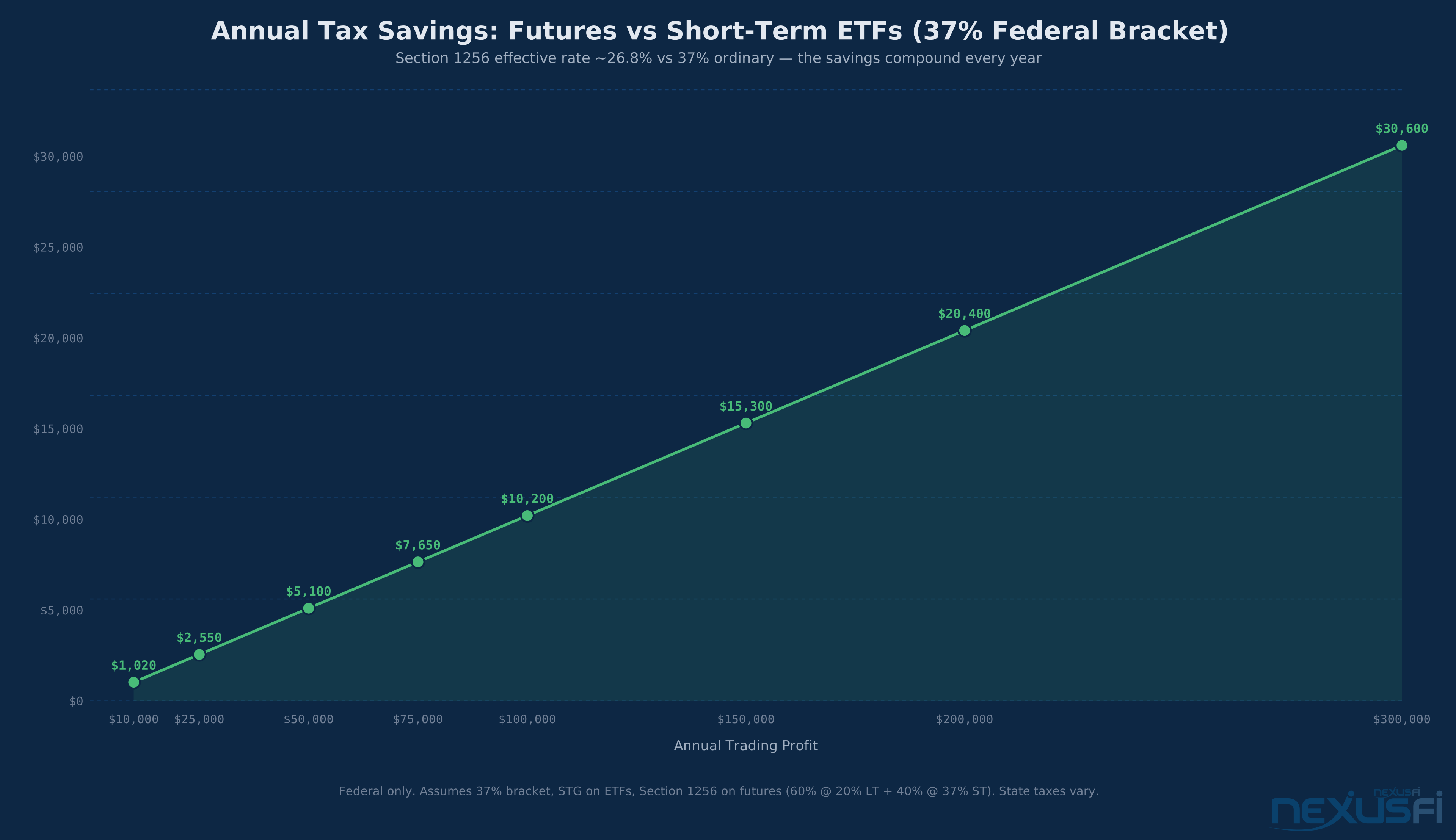
Section 1256 is the single biggest structural advantage futures hold over ETFs for active traders. At the 37% bracket, the effective futures tax rate is 26.8% — 10+ percentage points lower than ordinary income. That's $10,000 per $100,000 of profit, every single year, just from choosing the right instrument.
Market Hours and Global Access #
Regular US stock market hours run 9:30 AM to 4:00 PM Eastern. SPY trades during those hours, plus pre- and post-market sessions with limited liquidity. If the Bank of England raises rates unexpectedly at 8 AM Eastern, you watch your SPY position gap at the open and can do nothing.
Futures trade nearly continuously. ES trades from Sunday 6:00 PM through Friday 5:00 PM Eastern, with a brief 60-minute maintenance break each day. NQ has similar hours. This means:
Overnight risk management: A trader holding a futures position overnight can exit, hedge, or adjust during Asian and European sessions. A trader holding SPY must wait for the US open regardless of what happens overnight.
Reaction to global news: Central bank announcements, geopolitical events, earnings releases from major companies — these often move index futures during off-hours. Futures traders can respond in real time. ETF traders receive the consequences at 9:30 AM.
24-hour price discovery: The "fair value" of the S&P 500 at 3 AM is expressed in ES futures. There is no equivalent in SPY. When SPY opens, its price converges to where ES has been trading — which means the ETF is always catching up to futures pricing, not the other way around.
@josh summarized this advantage: [1]
"ES is available from 6pm to 4:15pm, and 4:30pm to 5:00pm. Liquidity is of course less than in the core cash hours, but for any retail trader it is more than sufficient. This gives near 24 hour exposure, and is available while all world markets are trading."
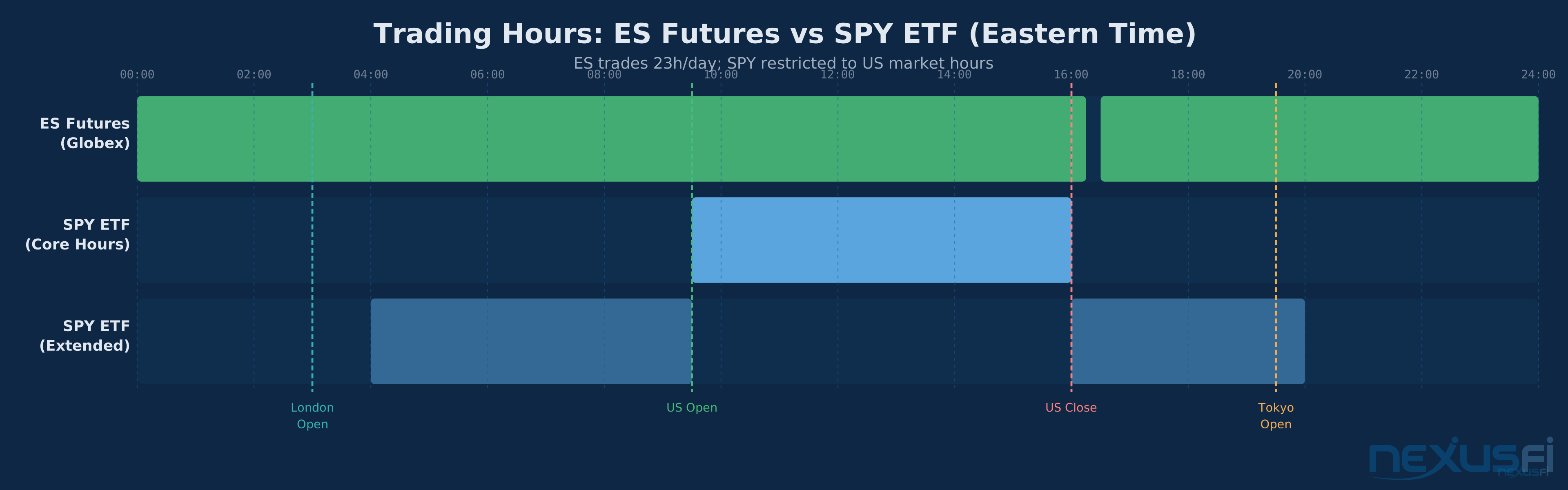
The overnight access advantage isn't just about trading more hours — it's about risk management. An ES trader can cut a losing position at 3 AM when European news hits. An SPY trader is forced to hold through the gap and take whatever price the US open delivers. For swing traders, this asymmetry matters enormously over time.
ES vs SPY, NQ vs QQQ: Direct Comparisons #
These pairs are the most common substitutes active traders choose between.
ES (E-mini S&P 500) vs SPY:
Both track the S&P 500 index. Intraday price correlation is extremely high — 99%+ on a normal day. For most directional trading purposes, they're interchangeable in terms of what market exposure you're getting.
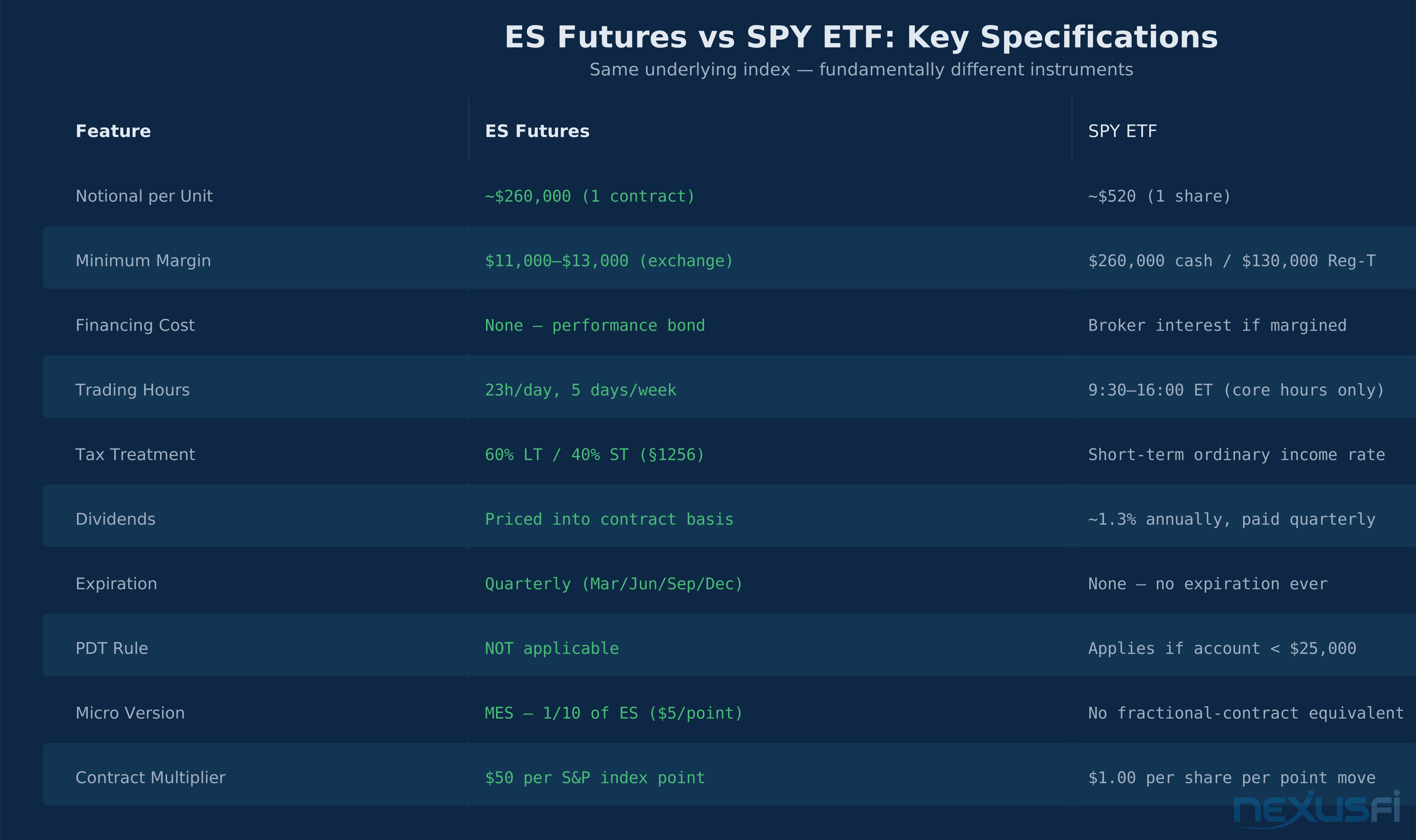
Key differences:
- ES notional: ~$260,000/contract (ES at 5200 × $50)
- SPY equivalent: ~500 shares at ~$520
- ES contract multiplier: $50 per index point, each tick (0.25 points) = $12.50
- SPY: $0.01 minimum tick, 100 shares = $1/point move
- ES dividend: Zero — cash dividends are priced into futures contract pricing via the implied fair value calculation
- SPY dividend: ~1.3% annually, paid quarterly
- ES expiration: Quarterly (March, June, September, December), with a brief maintenance window
- SPY: No expiration
For positions held more than a few days, the absence of dividends in futures is often misunderstood. ES futures don't "miss" dividends in the sense that their price already reflects the expected dividend during the contract period. A trader buying ES and holding to expiration receives the same economic exposure as holding SPY — dividends are embedded in the basis of the futures price relative to cash.
NQ (E-mini Nasdaq-100) vs QQQ:
The same structural relationship holds. NQ tracks the Nasdaq-100 index, QQQ is an ETF tracking the same index. Both trade the same underlying — Apple, Microsoft, Nvidia, Amazon, Meta are the top positions in each.
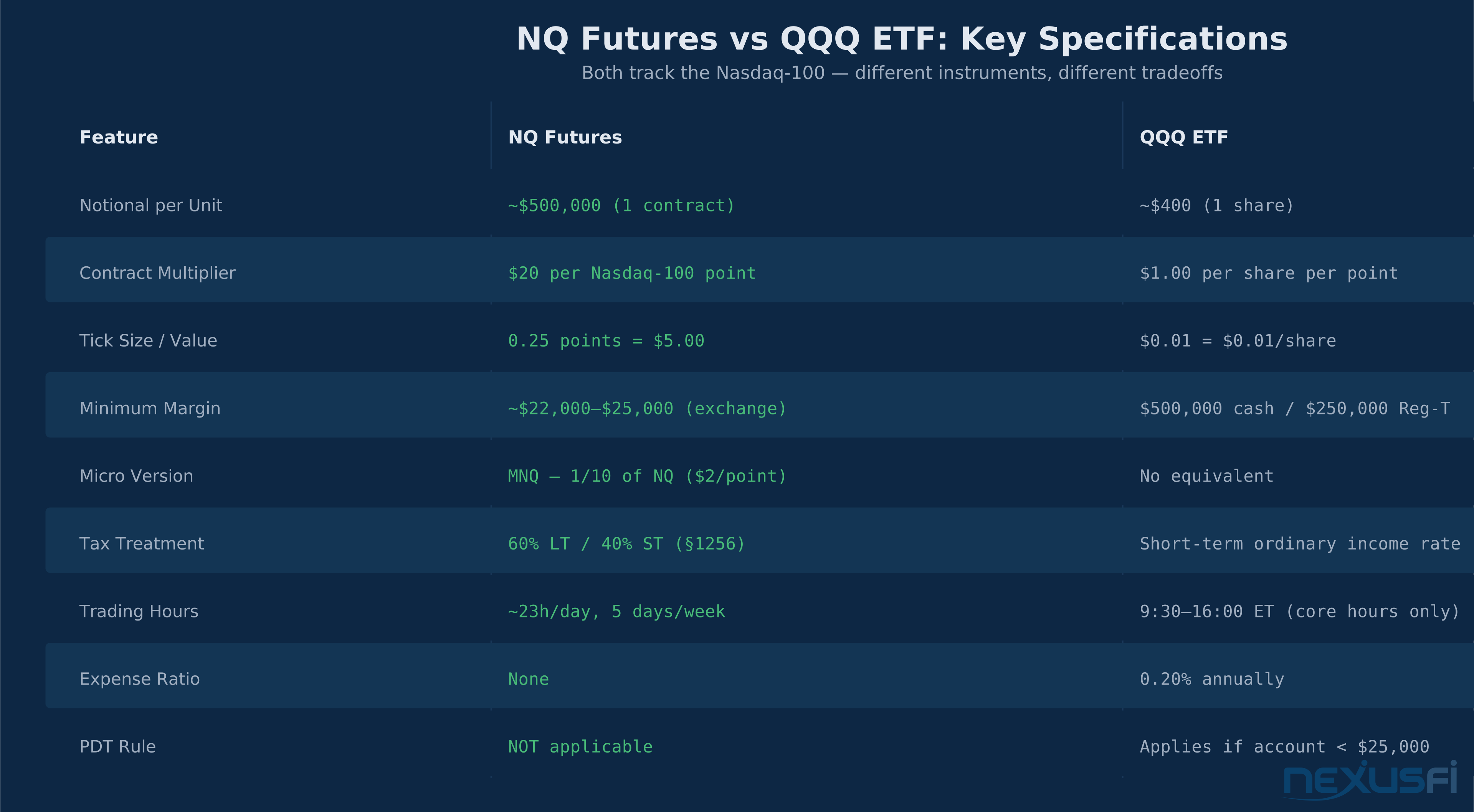
Key differences:
- NQ notional: ~$500,000/contract (NQ at 25000 × $20)
- QQQ equivalent: ~1,250 shares at ~$400
- NQ contract multiplier: $20 per index point, each tick (0.25 points) = $5
- MNQ (Micro NQ): $2 per index point, each tick = $0.50 (1/10 of NQ)
- QQQ dividend: ~0.6% annually, paid quarterly
NQ is considerably more volatile than ES on a per-contract basis — both in absolute dollar terms and in terms of typical daily range. Traders who find ES comfortable often find NQ requires better sizing discipline given its larger tick value relative to margin requirements.
Micro contracts: The introduction of MES (Micro E-mini S&P 500) and MNQ (Micro Nasdaq-100) has largely resolved the minimum-size problem that made ETFs attractive to smaller accounts. 1 MES = 1/10 of ES, tracking 50 shares of SPY equivalent. These contracts maintain all the tax, leverage, and hours advantages of standard futures while accommodating accounts of any size.
Contract Rolls and Expiration: The Operational Reality #
One legitimate operational disadvantage of futures over ETFs is expiration management.
Equity index futures expire quarterly on the third Friday of March, June, September, and December. As expiration approaches, traders must roll their position from the expiring contract to the next one. The standard roll in ES typically happens during the first week of the expiration month, when volume in the new contract surpasses the expiring one.
@Fat Tails documented the roll mechanics thoroughly in rollover discussions on NexusFi. [5]

What rolling involves:
- Identifying when the new contract becomes the dominant contract (by volume)
- Closing your position in the expiring contract
- Opening an equivalent position in the new contract
- Accounting for the "roll spread" — the difference in price between the two contracts
For active traders who close positions daily, this is a non-event — you simply switch to the new contract when it becomes dominant, which most platforms handle automatically or with a single setting change.
For traders holding multi-week positions, the roll requires attention:
- The new contract typically trades at a slight premium or discount to the expiring one (basis)
- The spread between contracts represents the embedded carry cost (financing + dividends)
- Rolling during wide bid-ask spreads (overnight, low-liquidity periods) costs more than rolling during peak liquidity
ETF advantage here is real: SPY and QQQ never expire. You can hold a position for years without touching it. Futures traders must manage quarterly rolls, and while the mechanics are straightforward once learned, they add an operational layer that pure ETF traders don't face.
For multi-year trend-following strategies, this quarterly maintenance cost — typically 1-2 ticks per roll, done four times per year — may add up enough to matter. For traders operating intraday or on short holding periods, it's genuinely irrelevant.
Futures in Retirement Accounts: When the Advantage Evaporates #
Trading futures in an IRA is possible but structurally constrained, and the core tax advantage — Section 1256 — provides no benefit.
In a tax-deferred traditional IRA, gains are taxed as ordinary income at withdrawal regardless of whether you earned them through futures, ETFs, or anything else. In a Roth IRA, gains are tax-free at withdrawal regardless of instrument. The 60/40 rule is already baked into retirement account math.
What remains of the futures advantage in an IRA:
- 23-hour access for overnight moves
- Capital efficiency (you can hold a larger position for the same capital)
- No PDT rule (the $25,000 pattern day trader minimum applies to equity margin accounts, not futures)
What becomes more complicated:
- IRA futures accounts typically require higher margin than standard accounts (often 2× exchange minimums)
- Fewer brokers support futures in IRAs
- No tax-loss harvesting strategies apply
@josh covered the IRA mechanics in the "Futures in a Roth and a path to retirement" thread, noting that "many of the resources you will find on the web are talking about margin on securities" and that futures margin works at the core differently from equity margin. [4]
Practical recommendation: If you're trading in a taxable account, futures' Section 1256 treatment is a genuine structural advantage worth capturing. If you're trading in a retirement account, the choice between futures and ETFs comes down to operational factors — hours access, capital efficiency, PDT applicability — not tax treatment.
When Futures Are Clearly the Better Choice #
1. Active intraday trader in a taxable account This is the core use case for futures. The 60/40 tax treatment, combined with capital efficiency and 23-hour access, creates compounding structural advantages. Every year you trade futures instead of ETFs in a taxable account with short holding periods, you pay meaningfully less tax on the same profits.
2. Overnight and global macro strategies Any strategy that reacts to news during Asian or European sessions has no equivalent ETF vehicle. Futures are the only way to trade US equity index exposure during these windows with meaningful liquidity.
3. Avoiding the Pattern Day Trader rule The PDT rule requires a $25,000 minimum equity balance to day-trade stocks or ETFs more than three times in a rolling five-day window. Futures accounts have no such restriction. A trader with $10,000 can day-trade ES contracts as frequently as they want without triggering PDT.
4. Position sizing with capital freed up A trader who allocates 10% of account equity to futures margin while gaining full index exposure can deploy the remaining 90% elsewhere — in other strategies, as a reserve buffer, or simply not at risk. ETF traders tying up full notional have no such flexibility.
5. Spread trading with margin offsets Futures exchanges recognize hedging relationships between correlated contracts and apply margin offsets. Trading long ES / short NQ (betting on S&P outperformance over Nasdaq) costs much less margin than the sum of two separate positions. The equivalent in ETFs — long SPY / short QQQ — requires full capital for each leg without any margin credit.
When ETFs Are Clearly the Better Choice #
1. Long-term investors and swing traders If your holding period is measured in weeks or months and you're targeting the long-term capital gains rate naturally, ETFs offer a simpler vehicle with no operational overhead. Quarterly rolls, expiration dates, and margin management disappear. You buy SPY, you hold SPY.
2. Retirement and tax-advantaged accounts As discussed, Section 1256 benefits don't apply in IRAs or 401ks. The tax advantage of futures — the primary structural argument — is neutralized. ETFs offer simpler operation for the same economic exposure.
3. Fractional share sizing and dollar-based allocation Futures don't offer fractional contracts. The smallest ES position is 1 contract (~$260,000 notional), MES brings this down to 1/10 ($26,000), but there's still a minimum size floor. Traders running dollar-based allocation models or managing very small accounts benefit from ETFs' fractional-share capability.
4. Dividend capture strategies Futures don't pay dividends — the cash return is embedded in the futures price, but it can't be extracted as a quarterly cash payment. Traders specifically harvesting dividend income from index ETFs need the ETF vehicle.
5. Equity-only compliance or account restrictions Some institutional accounts, compliance programs, or regulatory mandates restrict trading to equities and exclude derivatives. Futures are unavailable to these participants regardless of their advantages.
6. When you don't have futures account approval Futures trading requires additional account approval (a separate application and risk disclosure process at most brokers) and in some cases a dedicated futures broker. For a new trader who hasn't navigated this process, ETFs offer immediate access.
The Decision Framework: A Practical Checklist #
Answer these five questions to determine which instrument fits your situation:
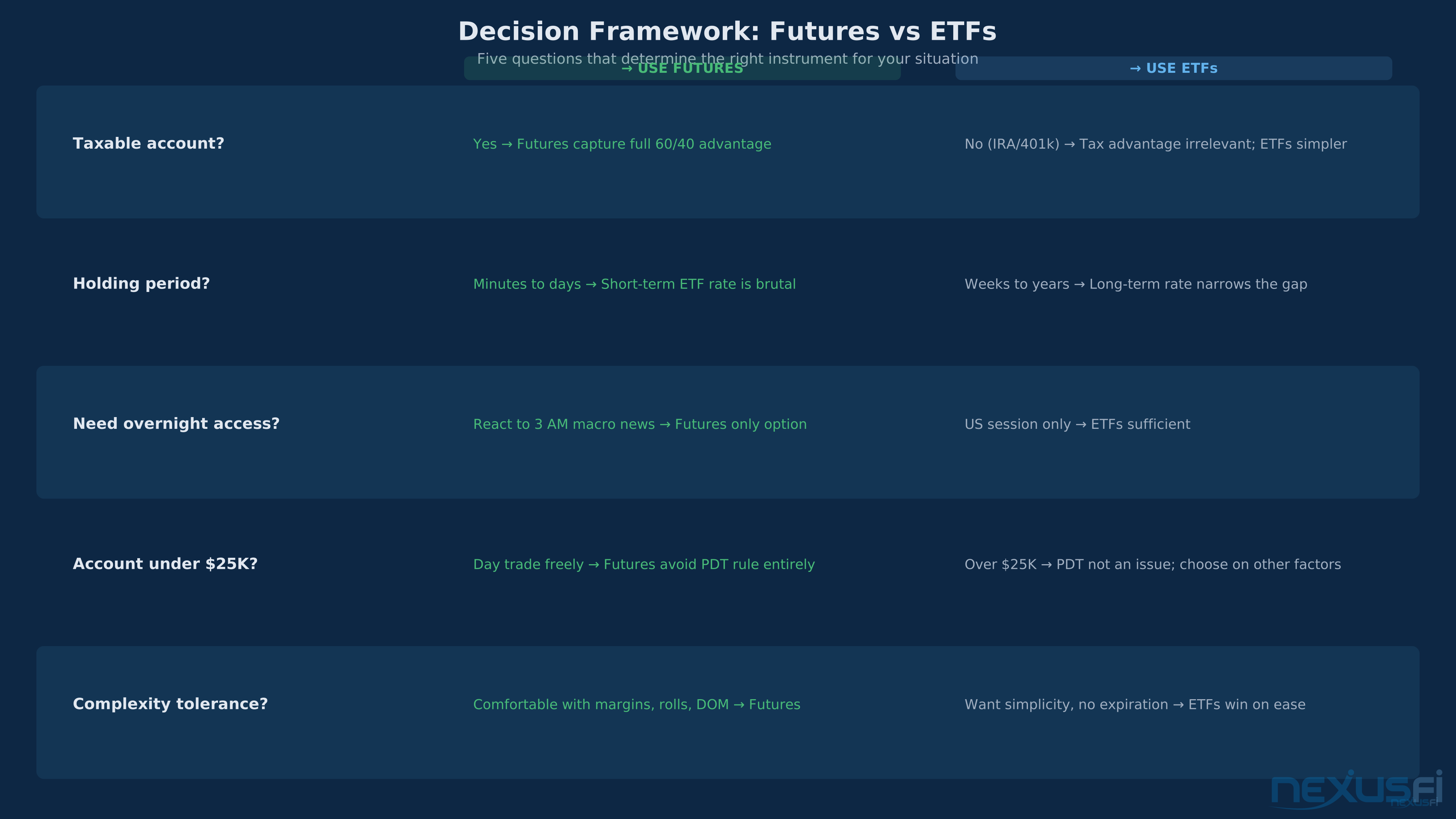
Question 1: Is your account taxable?
- Yes → Futures' Section 1256 treatment applies, a real dollar advantage
- No (IRA, 401k, Roth) → Tax advantage gone, choose based on other factors
Question 2: What is your typical holding period?
- Minutes to days → Futures win on tax (you'd otherwise pay full short-term rate on ETFs)
- Weeks to months → Advantage narrows, consider both options
- Years → ETFs likely better, long-term capital gains rate applies naturally
Question 3: Do you need access to overnight markets?
- Yes → Futures only, ETFs can't capture moves during Asian/European sessions
- No → ETFs are sufficient for US-session-only strategies
Question 4: What is your account size?
- Under $25,000 → Consider futures to avoid PDT restrictions on day trading
- Over $25,000 with capital to spare → Futures' leverage advantage frees up capital for other uses
- Very small accounts → MES/MNQ micro contracts may work, but position sizing is still constrained
Question 5: How much operational complexity can you manage?
- Comfortable with platforms, margins, expiration management → Futures are viable
- Prefer simplicity → ETFs are lower-maintenance
The Real Comparison: All-In Cost at Your Trade Size #
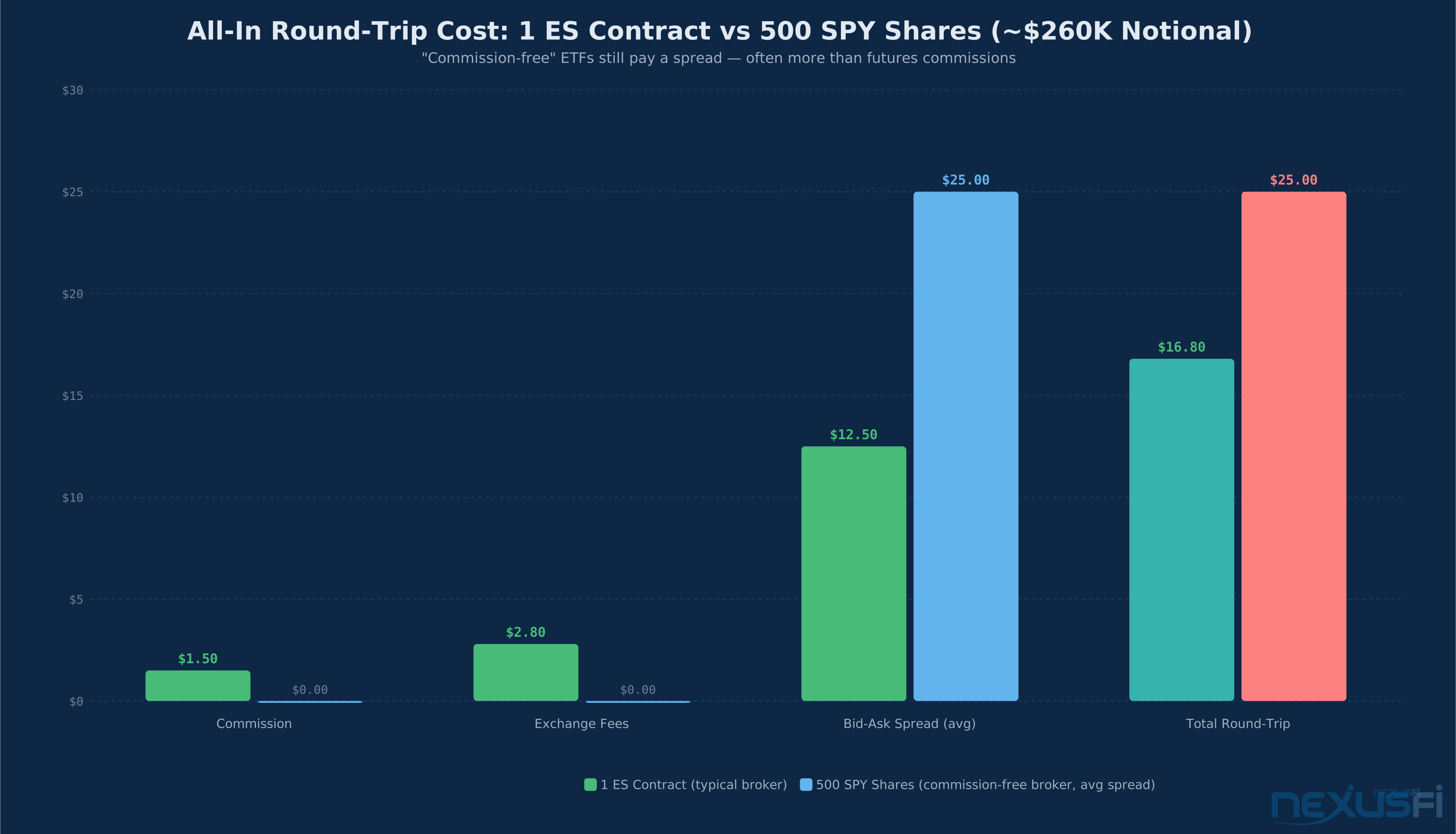
One final warning before concluding: headline cost comparisons (commission per trade, expense ratio) are almost always misleading. The right comparison is all-in cost at your specific trade size, with your strategy's actual execution pattern.
For a trader who makes 50 round-trip trades per week in ES, the comparison is:
- Futures commission: 50 × 2 × $0.75/side = $75/week in commissions
- Plus exchange fees: 50 × 2 × $1.40 = $140/week
- Total: ~$215/week, or ~$11,000/year
- Tax savings (35% vs 19% effective rate, on $100K profit): ~$16,000/year
- Net advantage: ~$5,000/year in favor of futures — before considering capital efficiency
For a swing trader who makes 5 round-trip trades per month, the math looks completely different. Run your own numbers with your own trade volume, account size, tax bracket, and typical holding period.
The structural advantages of futures — tax treatment, capital efficiency, overnight access, lower real transaction costs — are real and quantifiable. For active traders in taxable accounts making dozens of short-term trades annually, futures are almost always the better vehicle. ETF advantages — simplicity, no expiration, fractional sizing, clear superiority in tax-advantaged accounts — are equally real. The right answer depends on who you are, how you trade, and where your capital lives.
Knowledge Map
Go Deeper
Build on this knowledgeReferences This Article
Articles that build on this topicCitations
- — Differences between SPY and ES Intraday Trading (2021) 👍 45“ES notional value per contract is 4134*50 = $206,700. SPY's notional equivalent is thus 206,700/413 = 500 [shares]... you only need $11K to take the equivalent trade in ES.”
- — Why futures instead of equities/ETFs/spot forex? (2021) 👍 12“I used to have 1M to 2M invested in ETFs, now I can achieve the same returns simply by trading a few future contracts with only roughly 10% of capital invested.”
- — Why futures instead of equities/ETFs/spot forex? (2012) 👍 38“Tax rate on broad based index futures = (60% * 15%) + (40% * 25%) = 19%. Pay IRS $190 for every $1,000 made vs 25% for equities.”
- — Futures in a Roth and a path to retirement (2021) 👍 23“Many of the resources you will find on the web are talking about margin on securities -- futures margin works fundamentally differently.”
- — ES vs SPY: quarterly rollover and expiration mechanics (2012) 👍 67“The roll spread represents the embedded carry cost -- financing plus dividends -- between the expiring and new contracts.”
- — Newbie Question about Day Trading (2014) 👍 3“The 25,000 req and the pattern day trading rule (Reg T) as they apply to equities do not apply in the futures markets.”
- — SPY vs ES - commission and tax implications (2019) 👍 1“You can add in the Pattern Day Trader Rule: to day trade stocks and ETFs you are going to need a minimum margin of $25,000. Also, there is leverage.”
- — Rank your Futures vs Stocks trading priority (2021) 👍 3“The Pattern Day Trader Rule. Basically, you are going to need to keep at least $25,000 in a margin account if you trade in and out during the day. Unlike futures, where the funds for a closed position are immediately available.”
- — switch from spy to e-mini? (2014) 👍 8“The notional value of 1 emini contract: $1767 (current price) x $50 per dollar = $88,350. So, with your $10K, you can control about $176,700, or about 17X leverage, since the initial margin is $4,758 per contract.”
- — Rollover Days - some Quick Facts about (2009) 👍 22“Rollover is 8 days before expiration. Expiration is the third Friday of each quarter month (March, June, September, December). Volume shifts to the new contract at market open (09:30 EST) on Rollover day.”