



Index Arbitrage and Fair Value: How Program Trading Keeps ES Futures in Step with the S&P 500
Overview #
Every weekday morning, financial media quotes a "fair value" number for S&P 500 futures before the cash market opens. CNBC's futures reporters cite it. Bloomberg displays it. Traders in ES watch whether the market is "above fair value" or "below fair value" as a directional cue for the open. But what actually is fair value? And what happens when futures drift away from it?
The answer involves one of the most important mechanisms in modern financial markets: index arbitrage. This is the machine--an invisible, high-speed institutional engine--that keeps S&P 500 futures and the underlying cash index in near-perfect alignment. Understanding how it works doesn't make you an arbitrageur. But it at the core changes how you read ES price behavior, interpret pre-market action, and understand why futures and stocks track each other so precisely during regular trading hours.
What Fair Value Is--and Is Not #
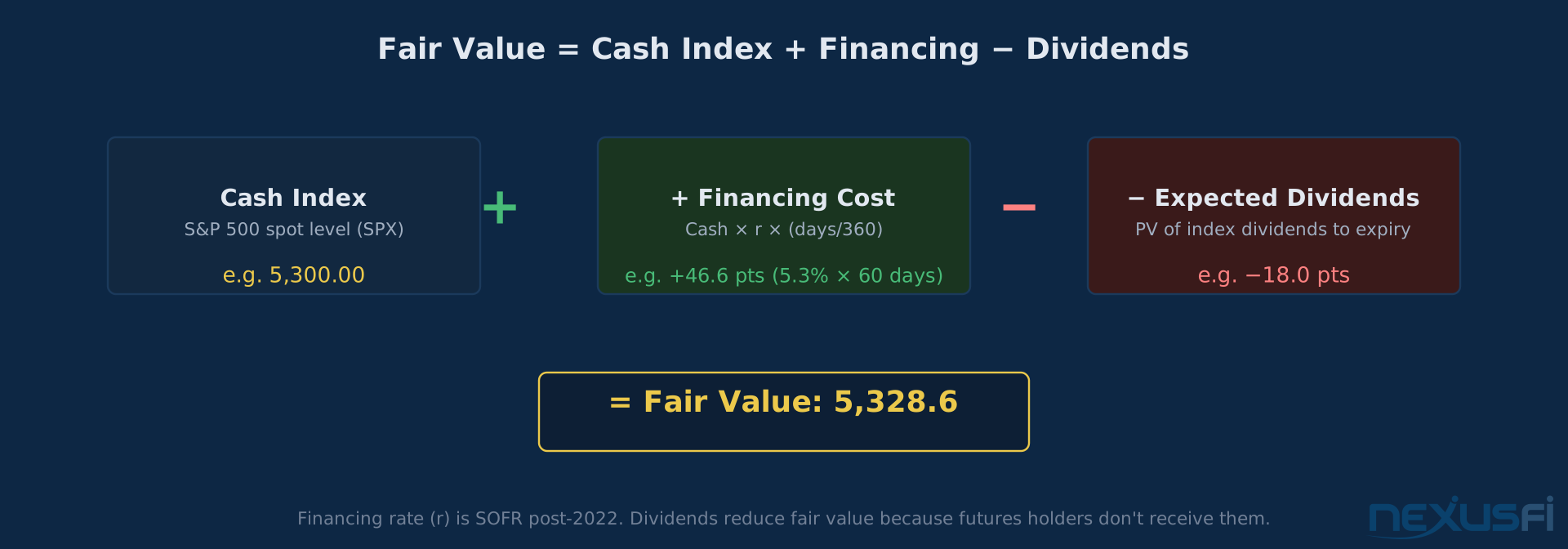
Fair value is the theoretical price at which S&P 500 futures should trade, given current market conditions. It is derived from the cash index level adjusted for the cost of financing a stock portfolio minus the dividends that portfolio would earn before the futures contract expires.
The CME Group defines it plainly: "Fair value is the theoretical assumption of where a futures contract should be priced given such things as the current index level, index dividends, days to expiration and interest rates. The actual futures price will not necessarily trade at the theoretical price, as short-term supply and demand will cause price to fluctuate around fair value. Price discrepancies above or below fair value should cause arbitrageurs to return the market closer to its fair value."
@bobwest | Newbie Question - ES E-Mini Contracts | https://nexusfi.com/showthread.php?t=39956&p=583670#post583670
Two things are key in that definition. First, fair value is a theoretical number--not what the market is trading, but what it should trade given a specific formula. Second, "price discrepancies above or below fair value should cause arbitrageurs to return the market closer to its fair value." Arbitrageurs--not some automatic correction--enforce the relationship. And they only enforce it when the profit opportunity is large enough to justify the cost of action.
This distinction between the theoretical fair value and the observable market price is the entire mechanism. The gap between them--called the basis--is what drives one of the largest institutional trading activities in global equity markets.
The Cost-of-Carry Model: The Math Behind Fair Value #
To understand fair value, you need to understand why futures prices differ from the cash index at all.
When you buy an ES contract instead of buying the equivalent basket of 500 stocks, you give up something and gain something. What you give up: dividends. The stocks in the S&P 500 pay dividends quarterly, and futures holders do not receive those dividends. What you gain: you are not required to finance the full notional value of the position. Buying one ES contract (~$265,000 notional at 5300 index level) requires roughly $12,000 in overnight margin--not $265,000. The stock buyer needs to either pay $265,000 in cash or borrow $265,000 and pay interest on it.
The fair value formula captures this exchange precisely:
Fair Value = Cash Index + Financing Cost − Expected Dividends
Or in the form most commonly written by traders:
FV = Cash × [1 + r × (days/360)] − Dividends
Where:
- Cash = Current S&P 500 index level (SPX)
- r = Risk-free financing rate (SOFR, roughly the overnight interest rate)
- days = Calendar days until futures contract expiration
- Dividends = Expected aggregate S&P 500 dividends between now and expiration, in index points
@Fat Tails, one of NexusFi's most respected market structure educators, derived this from first principles:
"fair value (ES) = index value (S&P 500) + interest paid by stock holder - expected dividends received by stock holder"
@Fat Tails | How do the prices of derivatives relate to prices of their underlyings? | https://nexusfi.com/showthread.php?t=10552&p=118375#post118375
A Worked Example #
Suppose:
- S&P 500 cash index (SPX) = 5,300
- SOFR (financing rate) = 5.3% annual
- Days to ES expiration = 60 days
- Expected dividends over 60 days = 18 index points
Fair Value:
- Financing cost = 5,300 × 0.053 × (60/360) = 46.6 index points
- Fair Value = 5,300 + 46.6 − 18 = 5,328.6
If ES futures are trading at 5,335, they are trading 6.4 points above fair value. If they are trading at 5,318, they are 10.6 points below fair value.
These differences have names: a positive difference is called a premium (futures are trading rich to cash), and a negative difference is called a discount (futures are trading cheap to cash).
Why Fair Value Changes Throughout the Day #
The fair value number you see quoted pre-market is not static--it changes every second as its inputs change. As the trading day progresses:
- Interest rates move: If short-term rates rise, fair value increases (financing is more expensive)
- Dividends become certain: As stocks go ex-dividend, those dividends drop out of the calculation
- Time passes: As expiration approaches, financing costs decrease because there's less time left
- The spot index moves: As SPX rises or falls, the fair value calculation resets
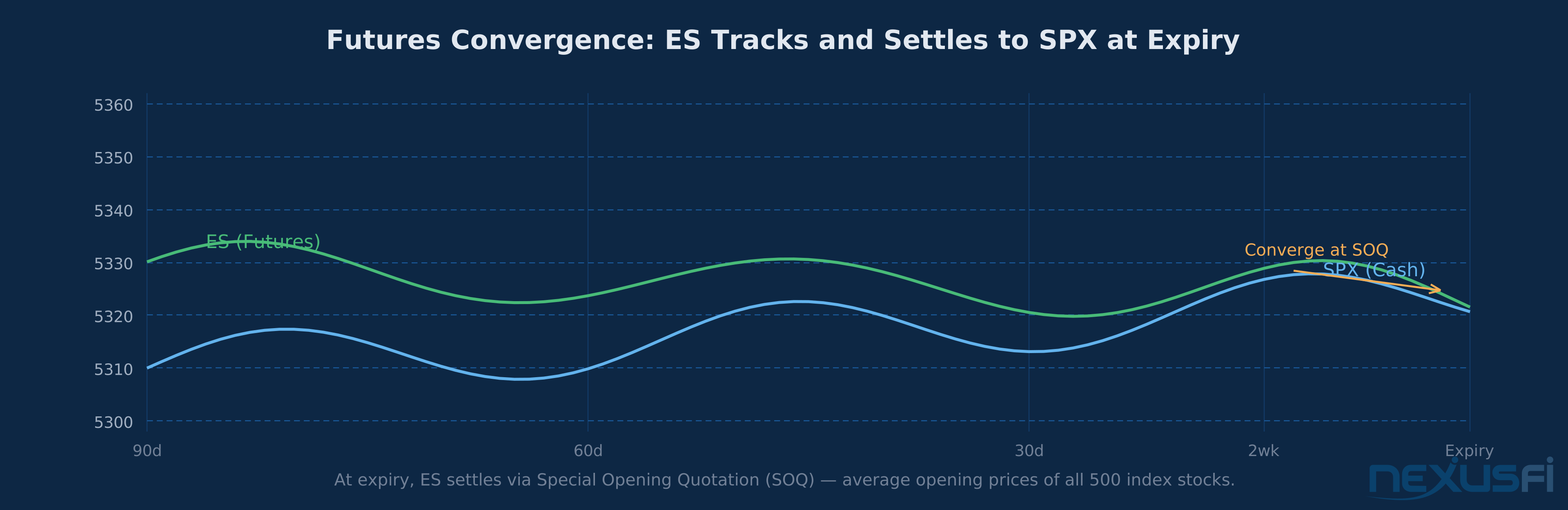
By expiration, the convergence is complete: the futures price must settle to the cash index value. There are no more financing costs, no more expected dividends. This convergence is guaranteed by contract mechanics--and it is what makes arbitrage possible.
The Basis: The Observable Signal #
The basis is simply the difference between the actual futures price and the theoretical fair value:
Basis = Futures Price − Fair Value
When the basis is positive (futures above fair value), the market is saying futures are temporarily expensive relative to the cash index. When the basis is negative (futures below fair value), futures are temporarily cheap.
@gomi described what this looks like in practice by showing an intraday premium chart:
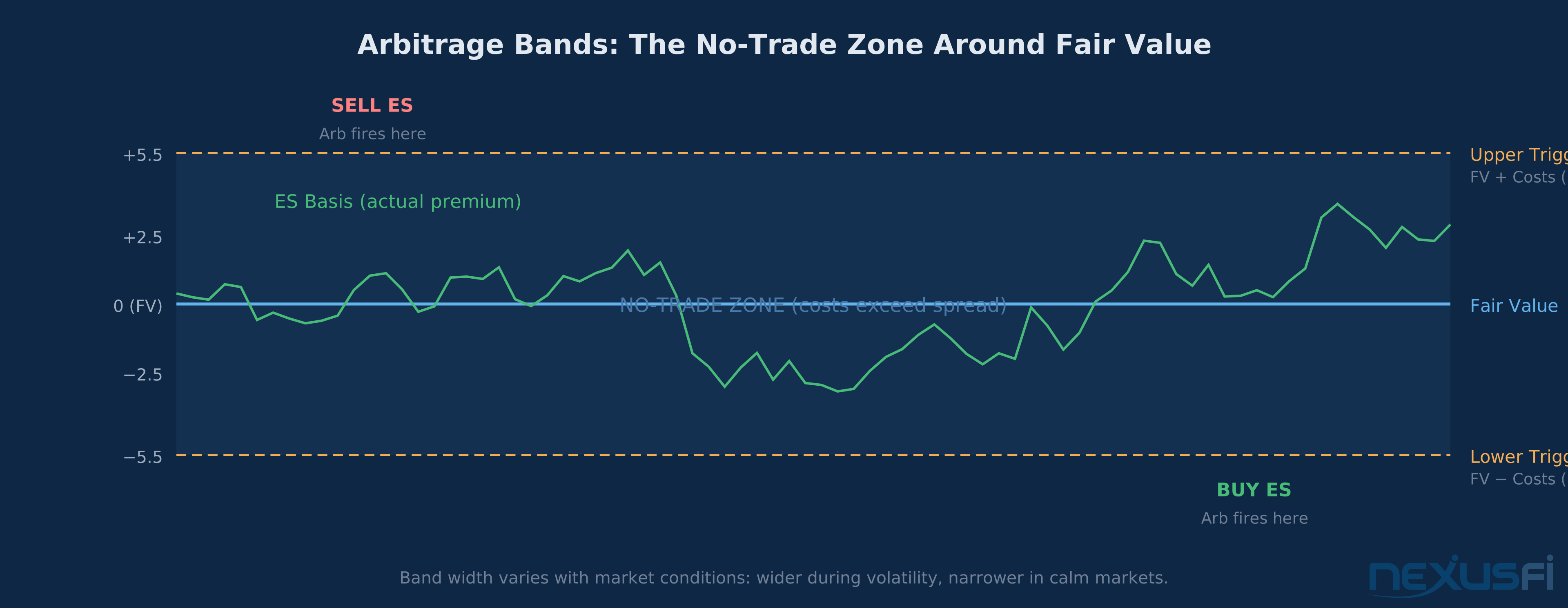
"Here's the evolution of the premium during the day, it's eSignal EPREM A0 symbol. It tracks SP500 index - ES. You can see the values oscillates around the fair value of the day, approx -5 points. Oscillation today was +/- 0.5 point during the day, +/- 1 point after FOMC."
@gomi | S&P500 index and S&P500 index futures correlation | https://nexusfi.com/showthread.php?t=5509&p=62633#post62633
This is the normal behavior: the basis oscillates around fair value throughout the day, typically within a narrow band of a point or two. Large deviations--anything beyond 3--4 points in normal market conditions--signal unusual pressure that will attract institutional response.
The premium index that @gomi references (and similar data from indexArb.com and programtrading.com) tracks this in real time. Many professional ES traders monitor the premium as a secondary indicator to confirm whether unusual directional price pressure in futures is real demand or just a temporary dislocation that will revert.
Arbitrage Bands: Why Futures Can Trade Above Fair Value Without Anyone Profiting #
If futures are 6 points above fair value, why doesn't every participant immediately sell futures and buy the cash basket to capture the profit?
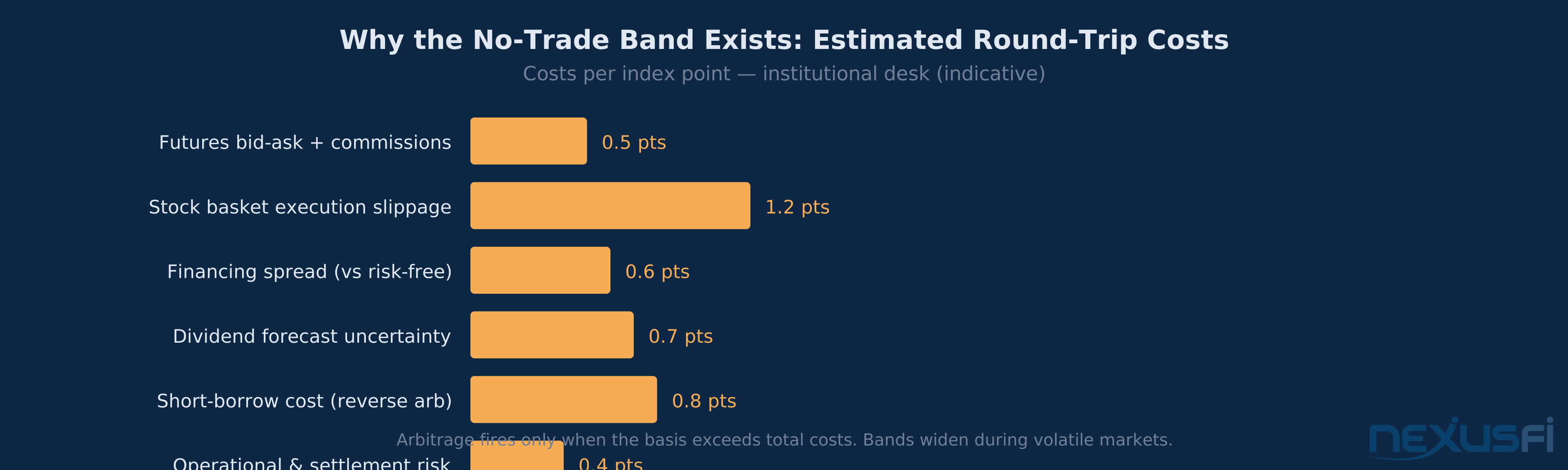
The answer: transaction costs. In practice, executing the arbitrage requires:
- Selling ES contracts on CME Globex--incurring bid-ask spread and commission
- Buying a basket of S&P 500 stocks--incurring bid-ask spreads on 500 individual stocks plus commission
- Financing the stock purchase at current repo/lending rates
- Forecasting dividends accurately--errors here directly affect P&L
- Managing execution risk--the two legs don't fill simultaneously, creating brief basis risk
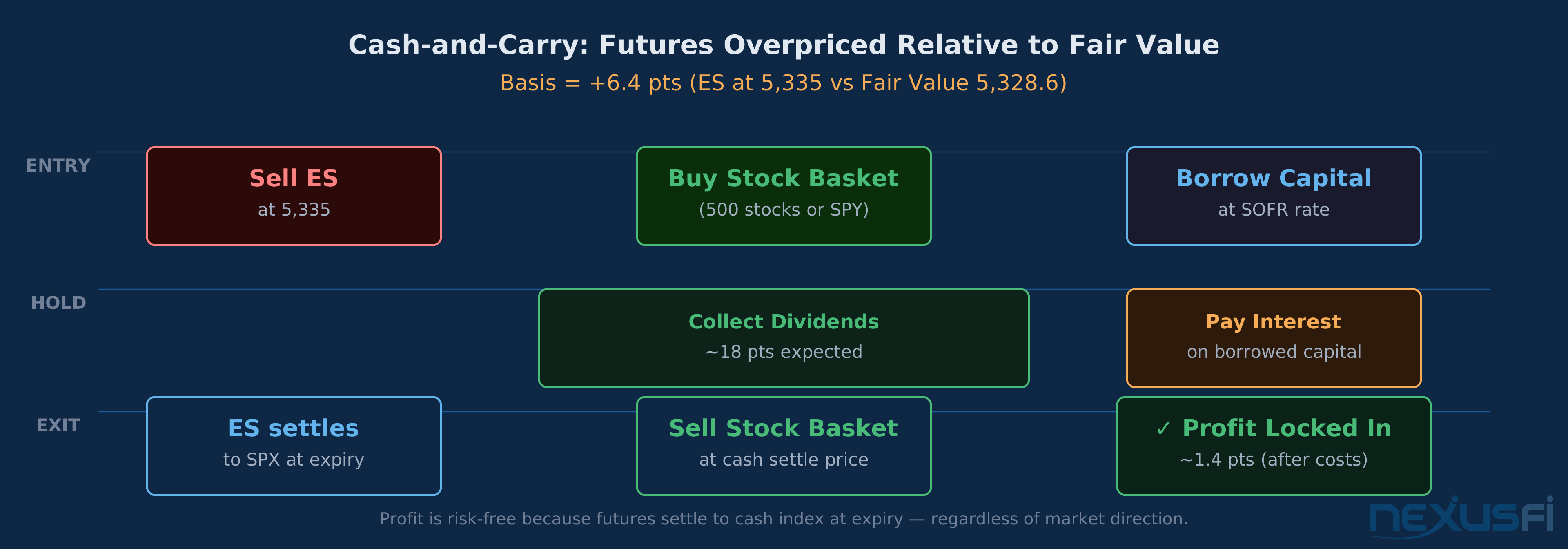
The total all-in cost of executing the arbitrage round-trip--selling futures, buying cash, holding to expiration, and closing--ranges from roughly 1.5 to 5 index points depending on size, market conditions, and execution quality.
This creates what's called the arbitrage band: a zone around fair value within which no arbitrage is profitable. The upper band is fair value plus total costs; the lower band is fair value minus total costs. Only when the basis moves outside this band does institutional program trading fire.
@Fat Tails explained the threshold principle:
"Arb specialists know the formulae for the current day and the daily readjustment rules, so they will buy shares and sell the ES, if the futures is above its fair value by a minimum threshold which is required to cover trading costs and the risks associated with trading."
@Fat Tails | What makes an index like the S&P 500 tick | https://nexusfi.com/showthread.php?t=5637&p=64017#post64017
The band is not fixed. During volatile or illiquid markets, execution costs rise, the band widens, and futures can deviate further from fair value before arbitrage fires. During calm, liquid markets, the band compresses, and the relationship stays extremely tight.
This explains something every ES trader eventually notices: futures can trade "above fair value" or "below fair value" for extended periods, especially pre-market or overnight, without any immediate correction. The band gives the relationship room to breathe.
Cash-and-Carry Arbitrage: When Futures Are Too Expensive #
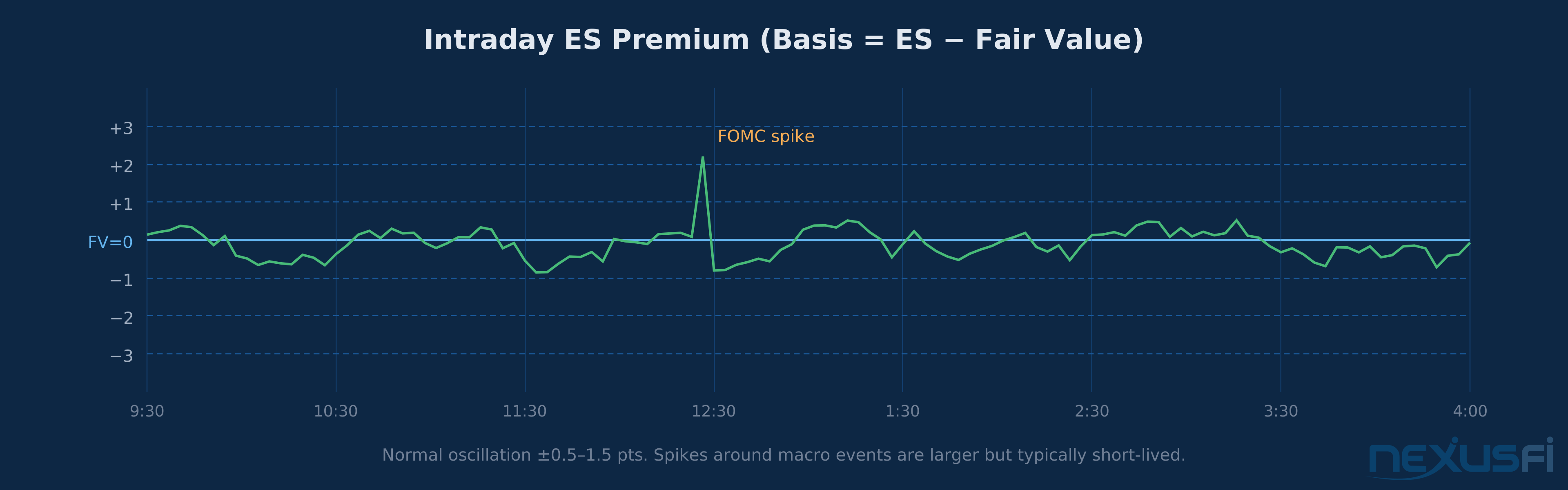
When the basis exceeds the upper band--when ES trades much above fair value--the trade that captures the profit is called cash-and-carry arbitrage:
- Sell ES futures (lock in the high futures price)
- Buy the S&P 500 stock basket (typically SPY as a liquid proxy, or a replication basket)
- Finance the stock purchase (borrow at current rates or use existing capital)
- Collect dividends while holding the stock position
- At expiration, futures settle to the cash index. Close both legs; collect the spread
The arbitrage is described as "risk-free" because the profit is locked in at entry. The futures will converge to cash at expiration no matter what the market does in between--up, down, or sideways. As long as the costs stay lower than the spread captured, the arbitrageur profits regardless of market direction.
@Fat Tails was precise on this point:
"Of course it is arbitrage. If the futures contract deviates from the fair value you can make a risk-free profit. Let us say ES trades 1 point (4 ticks) above its fair value. Sell ES and buy the stocks, and you have made 1 point of profit. The profit is guaranteed by the price adjustment at expiry."
@Fat Tails | S&P500 index and S&P500 index futures correlation | https://nexusfi.com/showthread.php?t=5509&p=62603#post62603
Why retail traders cannot do this: The arbitrage profit in normal markets is measured in index points--fractions of a percent on large notional positions. To make the trade economical, you need:
- Extremely low transaction costs (exchange membership fees, prime brokerage rates)
- Capital large enough to justify the overhead (typically hundreds of millions in the cash leg)
- Co-location on CME Globex for fast execution
- Sophisticated fair value models running in real time
- Infrastructure to manage hundreds of individual stock orders simultaneously
Retail traders lack all of these. The arbitrage desks doing this work are institutional: hedge funds, banks' proprietary trading desks, and specialist firms. The important implication: when you watch ES correct back toward fair value after deviating sharply, you are watching these desks act.
Reverse Cash-and-Carry: When Futures Are Too Cheap #
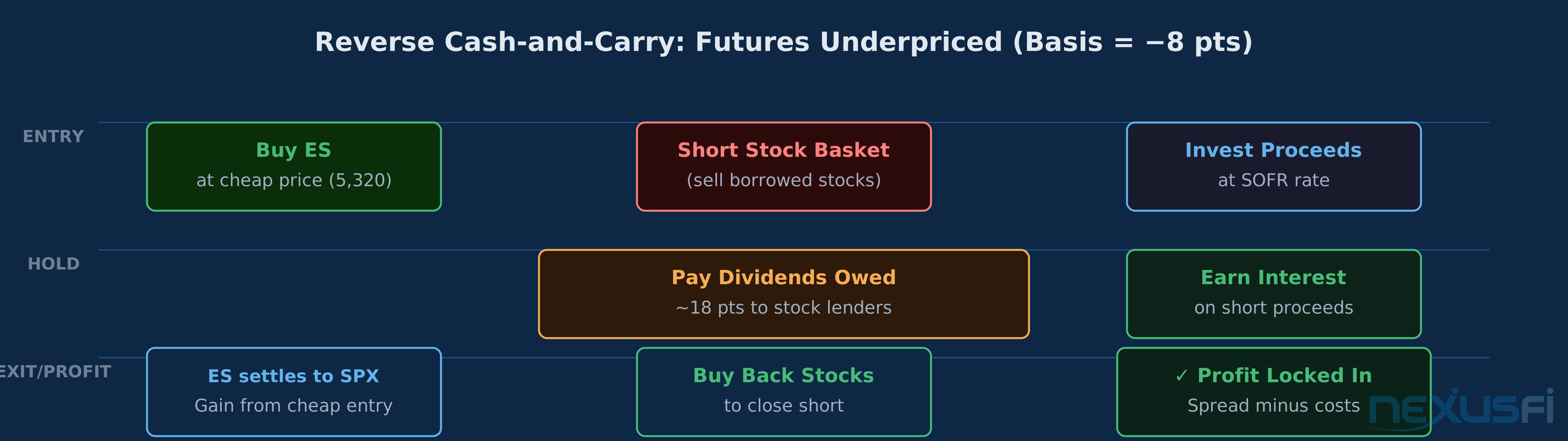
When the basis falls below the lower band--when ES trades much below fair value--the opposite trade fires:
- Buy ES futures (at the cheap price)
- Short-sell the S&P 500 stock basket (borrow and sell the stock basket)
- Invest the short proceeds at the risk-free rate while holding
- Pay dividends owed to the shares' original owners
- At expiration, close both legs; collect the spread
Reverse cash-and-carry is structurally the mirror image of cash-and-carry, but practically it's somewhat harder to execute:
- Short-selling 500 stocks requires locating shares to borrow, which has its own cost
- Dividend payments must be made to the original stock lenders--these must be accurately forecast
- Execution timing is more complex because selling 500 stocks simultaneously creates visible market impact
In normal markets, both directions of arbitrage fire with roughly equal frequency, keeping the basis oscillating symmetrically around fair value. During market stress or unusual flows, one direction may be more active--which is why the premium sometimes shows sustained deviations in one direction before mean-reverting.
Program Trading: How the Legs Get Executed #
The actual mechanism of index arbitrage involves coordinated trades across two separate markets--futures and equities--executed as a simultaneous basket trade. This is the formal definition of "program trading": a coordinated basket of 15+ stocks with a total value exceeding $1 million, executed as a single strategy.
The workflow for a large index arbitrage firm:
1. Continuous monitoring: Automated systems compute fair value every millisecond using real-time spot index, dividend forecasts, and current financing rates. The computed fair value updates continuously as any input changes.
2. Basis calculation: The system compares the live ES quote to the computed fair value. The basis is recalculated on every tick.
3. Band breach detection: When the basis crosses the upper or lower trigger--meaning the spread is wide enough to cover all estimated costs plus a profit margin--the system flags a trade opportunity.
4. Simultaneous execution:
- The futures leg (ES) is executed on CME Globex, typically in large size with algorithmic order management to minimize impact
- The cash leg is executed via:
- SPY as the most liquid single-name proxy (common for mid-size trades)
- Index constituent basket (all 500 stocks, weighted by index weight) for larger programs
- Equity swaps for institutional-scale positions (moves the exposure off-exchange)
5. Position management: The combined position--long cash, short futures (or vice versa)--is monitored throughout its life. Most positions are closed before expiration when the basis has normalized, freeing capital for the next opportunity.
@bobwest described the market-level effect of this mechanism:
"If either the basket of stocks representing the S&P or the ES futures gets out of whack compared to the other, even by a small amount, then it pays for the arbitrageurs to buy one (the lower) and sell the other (the higher), which locks in a small but sure profit based on the spread, and which also has the effect of moving them back together again. The amount of money in arbitrage is large enough, and it is a good profit source if a firm has (very) deep pockets and is (very) nimble."
@bobwest | Do stocks in SPX Index drive the price of S&P 500 Futures lead contract during RTH? | https://nexusfi.com/showthread.php?t=59274&p=878044#post878044
The Speed Requirement #
This is executed in milliseconds. Multiple arbitrage firms compete for the same spread simultaneously--if the opportunity is real and large enough to be profitable, many desks see it at the same time. The first to execute captures the best prices; late arrivals may find the spread has already compressed.
This competition is self-defeating in a valuable way: the more arbitrage firms compete for the same spread, the faster the spread closes, and the tighter the market stays around fair value. The participants' competition is the mechanism that keeps prices efficient.
What Breaks the Relationship: Flash Crashes and Liquidity Crises #
The arbitrage relationship between ES futures and the S&P 500 cash index is not guaranteed. It requires that both legs can be executed simultaneously and that the prices of individual stocks can be accessed in real time.
During the May 6, 2010 Flash Crash, this assumption broke down. @Fat Tails documented what happened:
"During a crash however--see flash crash--execution of transactions and dissemination of price quotes may suffer from a significant delay. In that case arbitrage becomes impossible, and the price differential between cash market and futures markets may increase."
@Fat Tails | What is the influence of the ES to the actual index in terms of order flow influence? | https://nexusfi.com/showthread.php?t=34109&p=456652#post456652
In the Flash Crash, the feedback loop briefly reversed: as ES fell rapidly, arbitrageurs who would normally buy cheap futures and short overpriced stocks found that:
- Stock quotes from individual NYSE companies were delayed by seconds (circuit breaker logic)
- Bid-ask spreads on individual stocks ballooned from pennies to dollars
- The "risk-free" arbitrage suddenly carried enormous execution risk--if the futures leg filled but the stock leg couldn't, the arbitrageur would be holding a naked long in a crashing market
When this execution risk exceeds the potential spread profit, arbitrage desks stand aside. The enforcing mechanism withdraws. Prices can diverge from fair value by many times the normal band--ES traded at extreme discounts to SPX as individual stocks quoted fictitious prices during the crash.
This is why
@Fat Tails | How do the prices of derivatives relate to prices of their underlyings? | https://nexusfi.com/showthread.php?t=10552&p=118375#post118375
For active ES traders, this is critical: the ES-SPX relationship can be temporarily broken. During extreme market conditions, futures can dislocate much from fair value without any immediate correction. Watching ES during the COVID selloff in March 2020 or the circuit-breaker opens in early March 2020 showed this: overnight ES futures pricing reflected genuine uncertainty about where the cash market would open, not a temporary arbitrage deviation.
What Non-Institutional Traders Should Do With This #
You cannot execute index arbitrage. Your transaction costs are too high, your capital too limited, your execution infrastructure too slow. But understanding the mechanism gives you several practical advantages.
1. Interpret Pre-Market Fair Value Commentary Correctly #
When CNBC says "S&P 500 futures are trading 8 points above fair value," that means ES is trading approximately 8 points more than the formula calculates it should. This suggests:
- When the cash market opens, selling pressure may come from arbitrage desks selling futures and buying stocks
- The cash market open may be lower than the ES price implies
- OR the cash stocks will open higher to close the gap--the opening direction depends on which leg of the arbitrage moves
The key insight: an ES reading much above or below fair value is not a forecast of where stocks will go. It is a description of a temporary dislocation that will be closed by arbitrage activity at or around the cash market open.
2. Understand Opening Volatility #
The first 15--30 minutes of the regular trading session are often the most volatile in the entire day. Part of this volatility comes from arbitrage trades firing as the cash market opens. When ES has been trading at a significant premium to fair value overnight, institutional desks are waiting to sell ES and buy stocks when liquidity allows. This creates systematic selling pressure in futures and buying pressure in individual stocks simultaneously at 9:30 AM.
Market-on-open (MOO) orders by index funds rebalancing also interact with arbitrage flows. Understanding that opening volatility is partly a mechanical repricing of the ES-SPX relationship--not purely directional sentiment--helps contextualize the early trading behavior.
3. Watch the Premium as a Supplemental Indicator #
The premium chart (the real-time basis) can function as a confirmation tool. When ES is rallying but the premium is elevated (futures are running well ahead of fair value), it suggests the rally may be a temporary overshoot that will be partially reversed when arbitrage corrects it. When ES is falling but the premium is compressed or negative, similar caution applies in the opposite direction.
This doesn't make the premium a reliable signal on its own--it can stay elevated for extended periods if genuine demand keeps buying futures faster than arbitrage can correct. But extreme premium readings often precede short-term mean reversion.
4. Recognize Overnight Hours Differently #
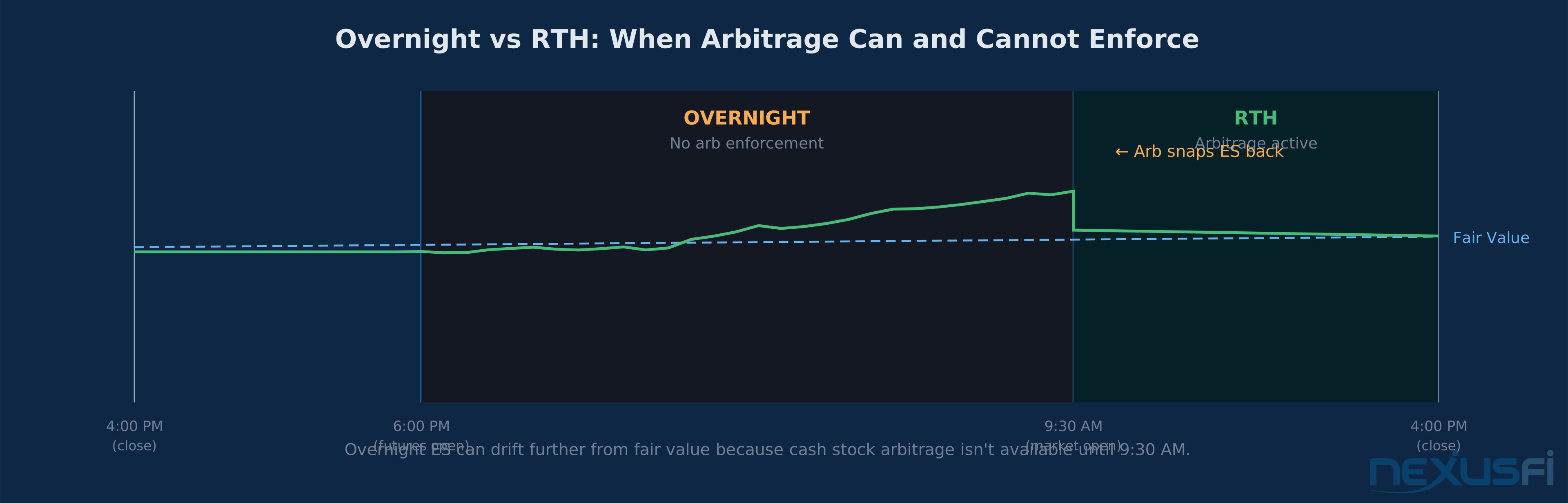
During overnight trading (6 PM to 9:30 AM Eastern), there are no US equities trading. Arbitrage between ES and the cash index is impossible--there are no cash stocks to buy or sell. Fair value still exists as a calculation, but there is no mechanical enforcement.
This is why ES overnight can occasionally print large moves that are partially reversed at the cash open: overnight participants can push ES away from fair value without triggering arbitrage, because the arbitrage isn't executable. When the cash market opens, the snap back to fair value involves program trading, but it may take 15--30 minutes to fully execute.
@bobwest explained this simply:
"During non-stock-trading hours, the price of ES is purely due to buying and selling in ES itself."
@bobwest | Newbie Question - ES E-Mini Contracts | https://nexusfi.com/showthread.php?t=39956&p=583670#post583670
The Role of SPY: ETF Arbitrage #
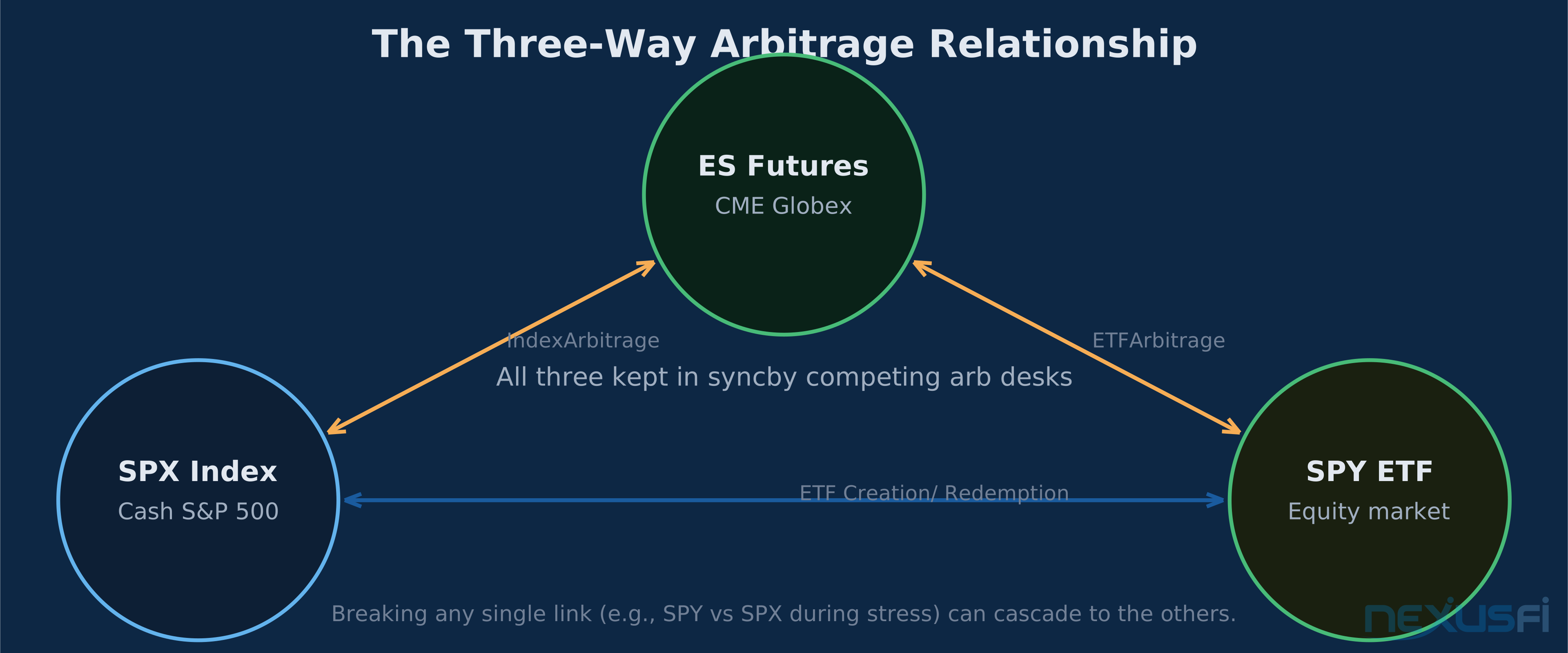
Modern index arbitrage often bypasses the 500-stock basket entirely and uses SPY--the SPDR S&P 500 ETF--as the cash leg proxy. SPY tracks the S&P 500 with extremely low tracking error and trades with tight spreads in enormous volume.
SPY arbitrage works basically identically to basket arbitrage:
- When ES is expensive relative to fair value, sell ES and buy SPY
- When ES is cheap relative to fair value, buy ES and sell SPY
- SPY's price must stay in alignment with SPX (the fund's NAV) through its own arbitrage mechanism involving authorized participants and ETF creation/redemption
This creates a three-way relationship: ES → SPY → SPX cash index. All three are linked by separate but interacting arbitrage mechanisms. ES and SPY are the most directly accessible, which is why the ES-SPY spread is one of the most commonly cited comparisons in institutional trading.
For retail traders, this also means: when you see ES and SPY trading at slightly different "implied S&P 500 levels," you are seeing temporary basis movements between them that institutional desks will close. The fair value relationship applies to both.
Contract Expiration: When Arbitrage Is Perfect #
Near contract expiration, the ES fair value and the cash index converge. As expiration approaches:
- Financing costs approach zero (no time left to finance)
- Expected dividends approach zero (most have already been paid)
- The fair value formula approaches: FV ≈ Cash Index
On expiration day itself, ES settles via the Special Opening Quotation (SOQ): a special calculation using the official opening prices of all 500 S&P 500 constituent stocks on the third Friday of the expiration month (March, June, September, December). This is not the same as the regular cash open--it's a distinct process that can produce opening prints different from where individual stocks were trading in pre-market.
The SOQ is significant because it's the exact price at which futures are settled. Arbitrageurs who have held cash-and-carry positions through to expiration receive their spread at this price. For retail ES traders, expiration morning can be unusually volatile as institutional positions unwind, so many traders roll their exposure to the next contract a week or more early.
Key Takeaways #
The index arbitrage mechanism between ES futures and the S&P 500 cash index is one of the most important and least understood forces in daily market behavior:
Fair value = Cash + Financing Costs − Expected Dividends. This single formula determines the theoretical relationship between ES futures and SPX at any moment.
The basis oscillates, it doesn't disappear. Normal daily variation keeps ES within a narrow band around fair value. Extreme deviations attract institutional program trading that closes the gap.
Arbitrage only fires outside the cost bands. Transaction costs, execution costs, and model risk create a zone around fair value within which no arbitrage trade is profitable. Futures can trade "above fair value" without correction as long as the deviation stays within the band.
Cash-and-carry fires when futures are rich. Sell expensive futures, buy cheap cash stocks--locking in the spread until expiration convergence.
Reverse cash-and-carry fires when futures are cheap. Buy cheap futures, short expensive cash stocks--same convergence logic in the opposite direction.
The relationship can break. During liquidity crises and flash crashes, execution risk prevents arbitrage from functioning. ES can deviate much from fair value when both legs cannot be executed simultaneously.
Overnight ES is unconstrained. Without the cash stock market open, there is no enforcement of fair value. Overnight moves reflect pure futures market sentiment without the mechanical correction that applies during RTH.
Knowledge Map
Go Deeper
Build on this knowledgeCitations
- — Newbie Question - ES E-Mini Contracts (2016) 👍 4“Fair value is the theoretical assumption of where a futures contract should be priced given such things as the current index level, index dividends, days to expiration and interest rates.”
- — How do the prices of derivatives relate to prices of their underlyings? (2011) 👍 3“fair value (ES) = index value (S&P 500) + interest paid by stock holder - expected dividends received by stock holder”
- — S&P500 index and S&P500 index futures correlation (2010) 👍 6“Here's the evolution of the premium during the day. You can see the values oscillates around the fair value of the day.”
- — What makes an index like the S&P 500 tick (2010) 👍 3“Arb specialists know the formulae for the current day. If the futures is above its fair value by a minimum threshold which is required to cover trading costs and the risks associated with trading.”
- — S&P500 index and S&P500 index futures correlation (2010) 👍 5“If the futures contract deviates from the fair value you can make a risk-free profit. Let us say ES trades 1 point (4 ticks) above its fair value. Sell ES and buy the stocks.”
- — Do stocks in SPX Index drive the price of S&P 500 Futures lead contract during RTH? (2023) 👍 2“Arbitrage between S&P stocks and the ES futures is possible because large holders of stock can have a portfolio of stocks that resemble the entire S&P in their movements.”
- — What is the influence of the ES to the actual index in terms of order flow influence? (2014) 👍 5“Once the fair value of the futures contract has been calculated, this will attract arbitrageurs as soon as the price quote of the futures contract is above or below the fair value by a minimum amount.”
- — Spoo-nalysis ES e-mini futures S&P 500 (2014) 👍 12“In the index arb world traders want to know how futures are trading relative to their fair value. The fair value of the futures vs. the cash index is the difference in cash flows between holding one or the other.”
- — S&P500 index and S&P500 index futures correlation (2013) 👍 6“If there is a big buyer in ES futures, the arbitrage guys will sell futures and buy the cash to bring it back to fair value. Participants in the ES futures market can easily manipulate or lead prices of the cash index.”