



Option Greeks for Futures Traders: Delta, Gamma, Theta, Vega, and the Risk Architecture of Premium Selling
Overview #
Option Greeks for Futures Traders: Delta, Gamma, Theta, Vega, and the Risk Architecture of Premium Selling
Every futures options trader eventually arrives at the same realization: the option pricing model is not your friend — it's your map. Delta, Gamma, Theta, Vega, and Rho aren't abstract academic concepts. They're the live risk gauges on your position, each telling you something different about how much damage the market can do to you right now, how fast that damage can accelerate, and what it'll cost you to hold on. Ignore them and you're trading blind. Understand them and you can structure positions that are genuinely hard to destroy.
This article covers the five Greeks in the context of futures options specifically — which behave differently from equity options in ways that matter. The focus throughout is practical: what does each Greek actually tell you, how does it manifest in real positions, and what do the numbers mean when a trade starts going sideways?
Key Concepts #
Option Greek: A sensitivity measure describing how the price of an option changes in response to a change in one underlying factor (futures price, time, volatility, or interest rates).
Futures option: An option whose underlying asset is a futures contract (e.g., ES, NQ, CL, GC, ZN). Delta hedging uses the futures contract itself.
Delta (Δ): The rate of change of option price relative to a 1-point move in the underlying futures contract.
Gamma (Γ): The rate of change of Delta relative to a 1-point move in the futures. Measures how fast your directional exposure shifts.
Theta (Θ): Daily time decay. How much of the option's extrinsic value erodes with each passing day, holding other factors constant.
Vega: Sensitivity of option price to a 1-point change in implied volatility. (Not a Greek letter — named by convention.)
Rho (ρ): Sensitivity to changes in interest rates. Largely irrelevant in futures options for most strategies.
Premium seller: A trader who sells options (calls, puts, strangles, condors) to collect the time value, expecting options to expire worthless or at reduced value.
Short premium: A net options-selling position. Positive Theta, negative Gamma, negative Vega.
Implied Volatility (IV): The market's forward estimate of annualized volatility, expressed as a percentage, derived from current option prices.
DTE: Days to expiration. The number of calendar days remaining until the option's expiration date.
ATM: At-the-money. The option whose strike price is closest to the current futures price.
OTM: Out-of-the-money. Call strikes above current futures price; put strikes below it.
ITM: In-the-money. Call strikes below the current futures price; put strikes above it.
Why Futures Options Are Different #
In equity options, the underlying is a spot stock or ETF — the model must account for dividends, borrow costs, and cost-of-carry. In futures options, the underlying is the futures contract itself, a price that already reflects the market's consensus on carry, dividends, and financing. This cleans up the mathematics considerably. As the CME Group Options on Futures Guide [11] details, this structural simplification is why futures options span every major asset class — interest rates, equity indexes, energy, agriculture, and metals — with a uniform pricing framework rooted in the futures contract itself.
The practical consequences:
Rho becomes nearly irrelevant. In equity options, Rho matters because a change in interest rates changes the cost of holding the underlying stock and thus the option's fair value. In futures options, that carry is already embedded in the futures price. Rho doesn't go to zero, but for most short-to-medium-term futures strategies, it's a rounding error.
Delta hedging is cleaner. If you're short a futures call and need to delta-hedge, you buy futures. There's no dividend adjustment, no borrow cost, no corporate action risk. You're just working with two directly related instruments in the same exchange ecosystem. The margining itself is different too — futures options use SPAN margin, a portfolio-based risk engine that offsets hedged positions far more efficiently than Reg-T equity margin.
Volatility surface behavior is more macro-driven. Futures options IV spikes around inventory reports (crude, natural gas), government releases (USDA crop reports, FOMC), geopolitical events, and exchange settlement mechanics. The volatility events are different from earnings-driven equity vol spikes, but they're often more violent and more predictable in their timing.
Delta: Your Directional Exposure #
Delta is the first Greek every trader learns because it directly answers the question: "How much money do I make or lose if the futures moves one point?"
A long call with Delta 0.50 makes $50 per contract (on a $100/point instrument) for every 1-point rally in the futures. A short call with Delta 0.50 loses $50 for every 1-point rally. That's it. Delta is your position's directional slope.
How Delta Behaves Across Strikes #
Deep OTM options have deltas near zero. They barely respond to futures price movement — they're too far from the money to be affected much. Deep ITM options have deltas near ±1.00. They move almost in lockstep with the futures contract. ATM options land at roughly ±0.50 — the classic coin-flip probability of finishing in the money.

The S-curve above shows this relationship for calls and puts. Notice how the call delta smoothly transitions from 0 (deep OTM) through 0.50 (ATM) to 1.0 (deep ITM). The put delta mirrors it on the negative side, moving from 0 (deep OTM puts) through -0.50 (ATM) to -1.0 (deep ITM puts).
For premium sellers, Delta tells you your current directional bias. A short strangle on ES with strikes 200 points apart might have near-zero net delta at initiation. But as the market drifts toward one leg, that net delta will increase — and your position starts behaving more like a short futures position. Managing delta is the first-line risk management task.
Delta Hedging: What It Does and What It Doesn't #
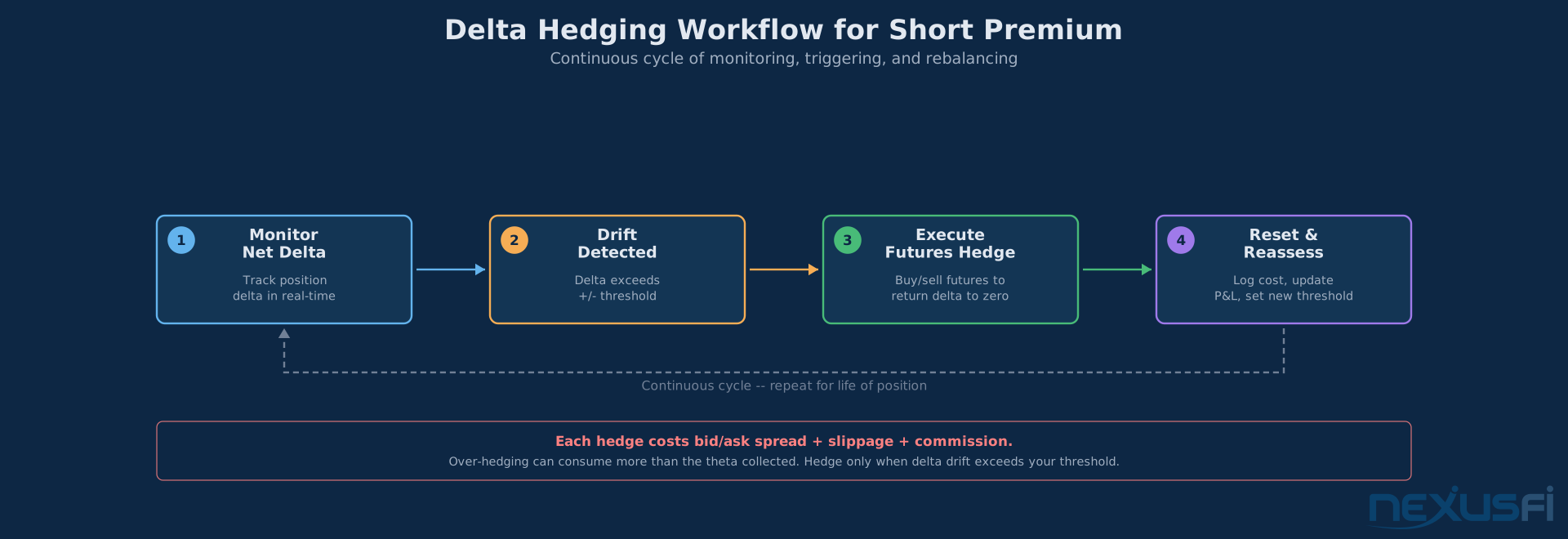
Delta hedging means buying or selling futures contracts to bring your net position delta back to zero. This eliminates first-order directional risk — your P&L won't move much on small futures price changes.
What it doesn't do: protect you against large moves, volatility expansion, or neutralize Gamma or Vega. As @PeterOhlson explained in the [1]: "If you buy calls you expose yourself to vega, theta, gamma risks of the call. The underlyer only carries delta-risk thus it's a more 'pure' delta hedge to use underlyer."
Delta hedging converts a static short premium trade into a dynamic rebalancing game. Every adjustment costs bid/ask spread and slippage — aggressive hedging can consume more than the theta collected. Market makers run it professionally, but it requires infrastructure and capital efficiency most retail futures options traders don't have.
Gamma: The Risk That Accelerates #
If Delta is the slope of your P&L curve, Gamma is the curvature. It tells you how fast that slope changes as the futures moves.
Short options are short Gamma. That means: when the market moves against you, your negative delta increases. You lose money, and then you lose money faster. That's the convexity problem that every premium seller has to manage.
The Gamma Math #
Formally: Gamma = ∂²V/∂F² — the second derivative of option value with respect to futures price. If you're short an ATM ES option with Gamma 0.002 and ES rallies 10 points, your Delta increases by approximately 0.02 (0.002 × 10). Carry 50 contracts and your directional exposure just shifted by 1 full contract equivalent.
Why Gamma Concentrates Near Expiration #
This is the critical behavior that catches traders who haven't lived through an expiration blow-up.
Gamma is highest for ATM options. And as expiration approaches, the ATM Gamma spike becomes sharper and taller. A 10-point move in ES at 60 DTE barely shifts your delta. The same 10-point move at 3 DTE can swing your ATM delta from 0.50 to near 1.0. Your position just went from mildly directional to fully directional in minutes, with no chance to adjust in real time.

The chart shows four Gamma profiles at different DTEs. Notice how the 60-DTE curve is smooth and spread out — manageable. The 3-DTE curve is a spike directly above the ATM strike that towers over everything else. That's not a minor quantitative difference. That's a qualitative change in risk profile.
@SMCJB identified this risk clearly in the thread that remains NexusFi's most-engaged options discussion, noting that traders need to understand how greeks like Delta, Gamma, Vega, Theta, and Charm interact with portfolio risk — especially the [2] as the position approaches expiration.
Gamma Risk at Expiration: The Three Danger Scenarios #
Scenario 1: Short ATM call near expiry — market rallies. Your delta was -0.50. The market moves up 15 points. Your delta is now -0.80 to -0.95 depending on how far it moved. You're holding a position that's gaining negative delta rapidly with no ability to hedge fast enough in a fast-moving market.
Scenario 2: Pin risk. The futures price settles exactly at your strike at expiration. Your option could finish ITM or OTM by a tick. If you're carrying a large position, the uncertainty itself is the problem — you don't know whether to delta-hedge or not. Some traders flatten before expiration specifically to avoid this.
Scenario 3: News gamma. A USDA crop report hits at 8:30 AM. Corn futures gap 15 cents. Your short option goes from OTM to ITM in the first tick. Your Gamma-driven loss happened before you could do anything. This is especially brutal in commodity futures where release events are scheduled and well-known but the direction is uncertain.
Theta: The Compensation for Carrying Those Risks #
Theta is the reason premium sellers exist. It's the mechanism by which options lose value simply through the passage of time.
If you sell an ATM ES option with Theta -15, the option buyer loses approximately $15 per day in time value, holding everything else constant. You, as the seller, collect that $15. Do that across 30 trading days with a portfolio of positions and the math can look compelling — on paper.
Here's the thing: Theta is compensation for carrying Gamma and Vega risk. It is not income in any clean sense. It's an expected payoff weighted against the probability and cost of adverse moves. Treating it as guaranteed daily income is the most common conceptual mistake in retail options selling.
The Theta Decay Curve: Non-Linear and Dangerous #
Theta does not accrue in equal daily amounts. The decay curve follows something close to the square root of time — slow at first, accelerating toward expiration.

This non-linearity creates a trap. A 90-DTE option loses maybe 15% of its time value in the first 30 days. It loses the final 40% in the last 14 days. The theta per day looks attractive near expiration because it's large in dollar terms. But near expiration, Gamma has also spiked — the same period where theta collection is richest is the period where gamma risk is most dangerous.
— [3] that taking the position far from expiration captures significant time value while avoiding the gamma spike zone entirely.
The "sweet spot" for many premium-selling strategies sits between 30 and 45 DTE. This isn't dogma — it's a balance point. There's meaningful theta to collect, but ATM Gamma is still at a moderate level that can be managed with position sizing and occasional delta hedges.
What Theta Doesn't Tell You #
Daily theta assumes a static world: futures price flat, IV unchanged, rates unchanged. None of that is true. A premium seller's actual P&L is theta collected minus losses from adverse gamma and vega exposure. On a quiet day, you win as expected. On a day when CL gaps 3% on an inventory surprise, the gamma loss can dwarf a week's worth of theta.
Vega: The Silent Killer #
Vega is the Greek that most retail premium sellers underestimate until it destroys a position.
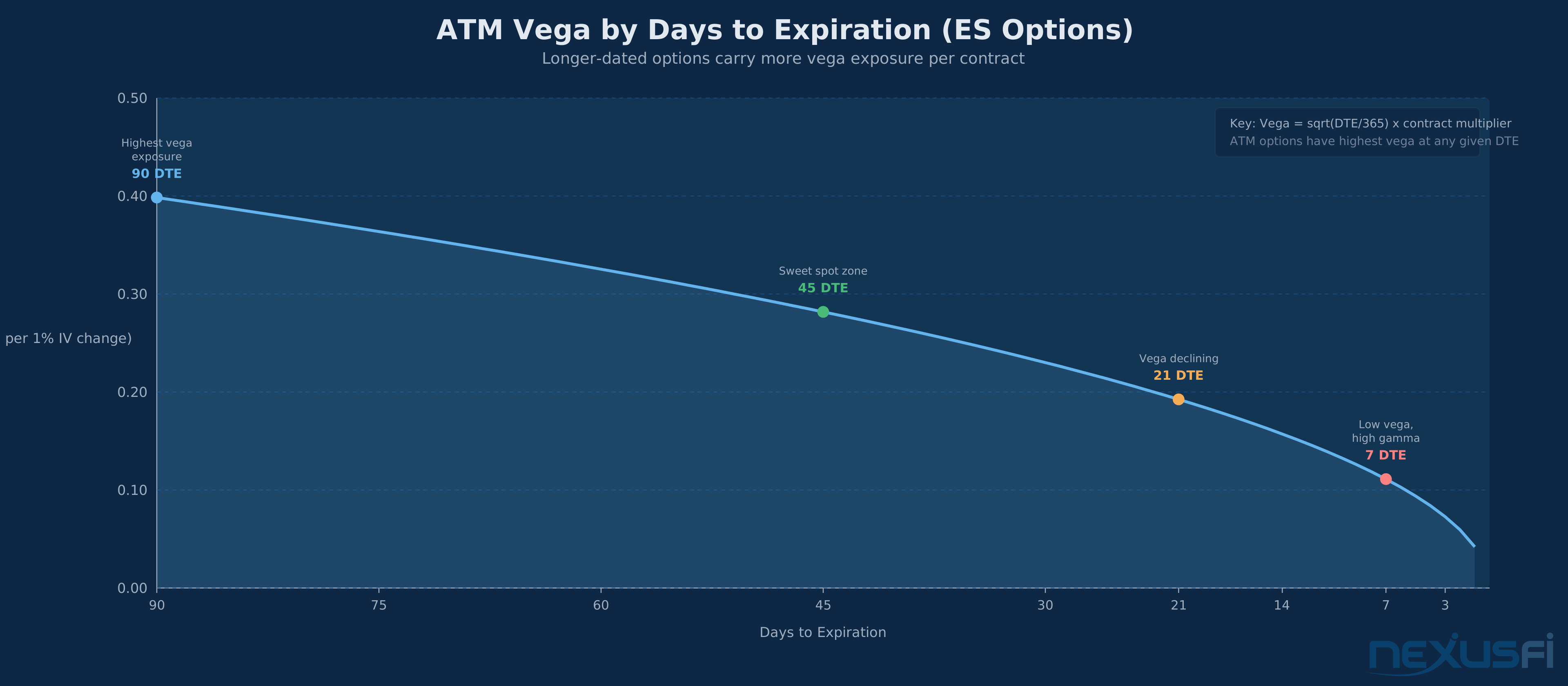
Vega measures how much your option's value changes for a 1-percentage-point change in implied volatility. Short options are short Vega — if implied volatility rises, your short options increase in value against you, creating mark-to-market losses even if the futures price hasn't moved.
The Vega-IV Relationship #
Higher implied volatility means higher option premiums — more extrinsic value in every strike. When you sell options, you collect that extrinsic value. When IV subsequently rises, those options are now worth more, and your short position shows losses.
— [4] how a relatively modest volatility expansion can create position losses that dwarf the original premium collected.
That 216% figure deserves attention. It means that if you collected $500 in premium on a position, a 5% IV expansion can create $1,080 in mark-to-market losses — even if the futures price hasn't moved a tick. The position isn't wrong directionally. It's wrong on volatility.
A 5% increase in implied volatility can create a 216% increase in position losses — even with zero movement in the underlying futures price. If you collected $500 in premium, that modest IV expansion generates $1,080 in mark-to-market losses before the futures move a single tick.
Why Premium Sellers Are Short Vega #
When you sell a strangle, you're selling implied volatility at whatever level IV is trading. You benefit if realized volatility ends up lower than implied — the options expire worthless or reduced. You lose if realized volatility ends up higher than implied, OR if implied volatility simply expands from its current level before expiration.
This is the subtle killer. You can be right about realized volatility being lower than implied, but still lose money if IV expands after you enter the trade. The position mark-to-market moves against you. If you get margined out before expiration, being "right eventually" doesn't help.

Reading the Volatility Environment Before Selling #
The right question is not "Is IV high?" The right question is:
- Is IV elevated relative to recent realized volatility?
- Is there a known upcoming event that could drive IV higher (FOMC, USDA, CPI, OPEC)?
- Can the position survive an IV expansion and directional move simultaneously?
— [5] that selling into a volatility spike can be extremely profitable, but requires the judgment to identify when IV is genuinely elevated relative to forward expectations.
Futures-Specific Vega Events #
Each futures market has predictable vol catalysts: energy (CL, NG) spikes on weekly EIA inventory reports, OPEC meetings, and supply disruptions; agriculture (ZW, ZC, ZS) on monthly USDA WASDE reports and weather events; index (ES, NQ) on FOMC, CPI/PCE, and earnings seasons; rates (ZN, ZB) on Fed policy shifts and major economic releases.
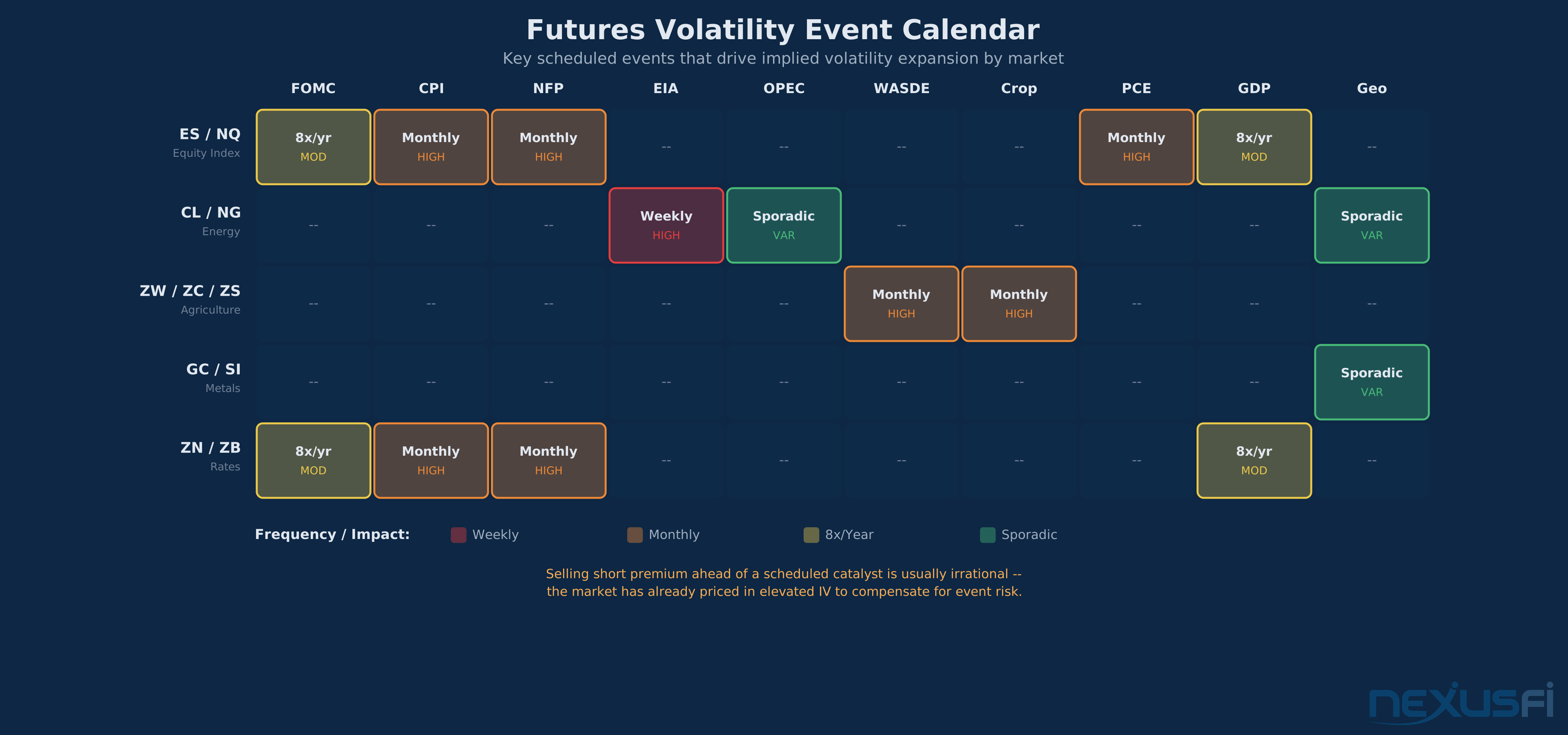
Entering a short Vega position ahead of a known trigger is often irrational. The market has already priced in elevated IV — you're selling appropriately priced uncertainty, not "rich" volatility.
Rho: The Greek You Can Mostly Ignore #
Rho measures sensitivity to changes in interest rates. In equity options, rate changes affect cost-of-carry and thus option pricing through put-call parity. In futures options, Rho is nearly irrelevant — the futures price already incorporates rate expectations, so a fed funds change shows up in the futures price directly, not as a separate Rho adjustment.
Where Rho does matter:
Very long-dated options (6+ months to expiration): the discount rate over a long horizon becomes meaningful for structured income strategies.
Interest rate futures options (ZN, ZB): the underlying is interest rates, so Rho connects option pricing to the underlying more directly — though most practitioners model this through the volatility surface rather than as isolated Rho risk.
For the vast majority of short-to-medium-term futures options strategies — 30 to 90 DTE — Rho is a footnote.
The Full Greeks Summary for Premium Sellers #

The table captures the five Greeks in one view. But the table doesn't convey the dynamics. Here's how they interact in a live position:
You sell an ES strangle: short the 5400 call, short the 4700 put, with 45 DTE. ES is at 5050.
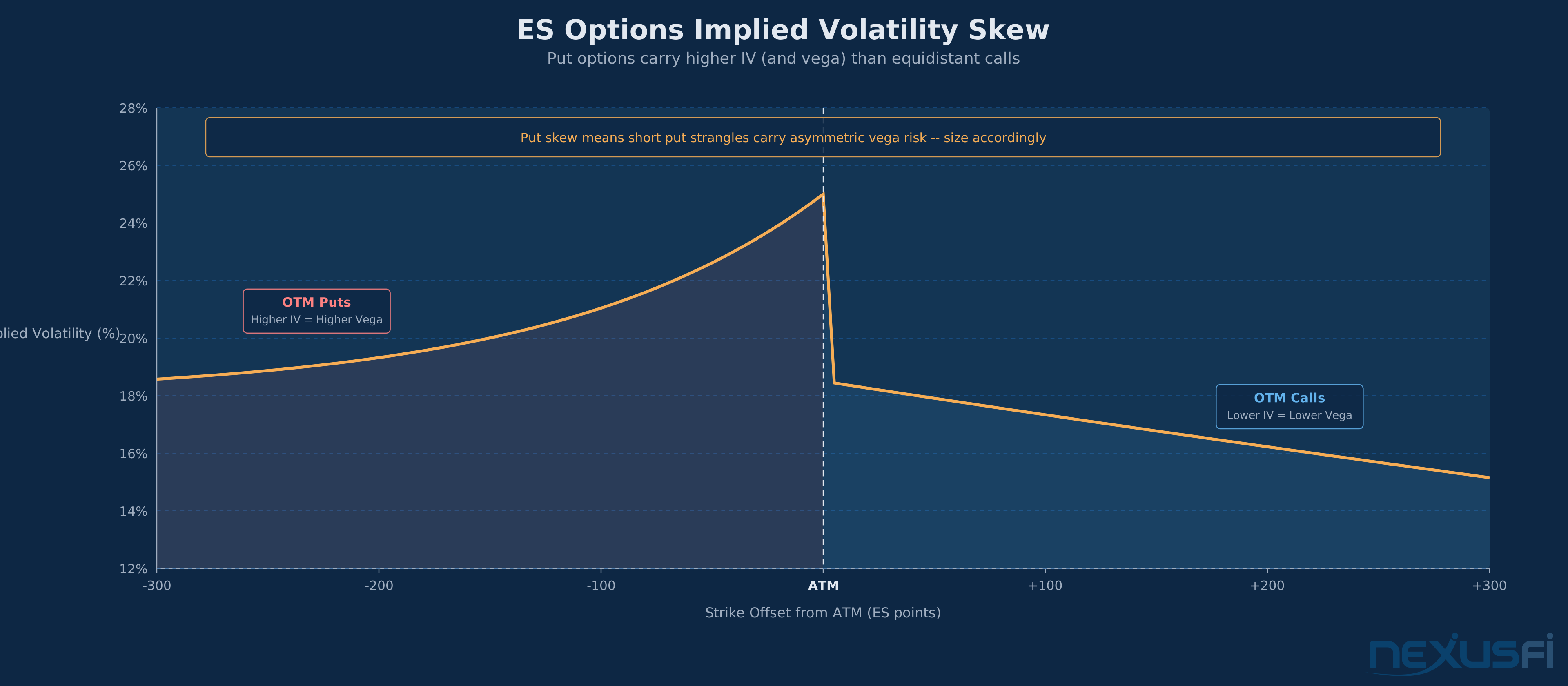
At initiation: Delta is near zero (slightly negative, since puts usually have higher absolute delta than equidistant calls due to skew). Theta is positive — you're collecting roughly $50/day in time value across both legs. Gamma is moderate. Vega is short — your position loses if IV rises.
10 days in, ES has rallied 100 points to 5150. Your short call is now closer to ATM. Its Delta has increased from maybe -0.15 to -0.30. Your net position delta has shifted negative. Gamma has increased because you're now ATM on one leg. Theta is still working for you, but the pace of gain needs to cover an adverse delta shift.
20 days in, VIX spikes 5 points on CPI data. ES barely moves, but implied volatility jumps. Your short vega position just took a hit. Both legs of the strangle are now worth more (marked against you) despite no directional movement. This is pure Vega loss.
35 days in, approaching expiration. Gamma has accelerated. Any 1% move in ES will swing your net delta by a meaningful amount. The theta you're collecting is at its highest daily rate — but so is the risk of that gamma accelerating further. Smart sellers either close the position here or roll out to a new cycle.
The DTE Sweet Spot #

The chart shows three quantities normalized for comparison: daily theta, ATM Gamma, and the ratio of theta-to-gamma across different DTEs. The sweet spot — where the theta-per-unit-of-gamma-risk is highest — tends to fall in the 25-45 DTE range for most strategies.
This isn't a universal law. It shifts with volatility regime, instrument, and strategy design. But the intuition holds: sell premium when there's enough time for theta to accrue meaningfully, but not so close to expiration that gamma risk dominates every tick of price movement.
The 25-45 DTE window offers the best Theta-to-Gamma ratio for most premium-selling strategies. Far enough from expiration that Gamma stays manageable, close enough that daily Theta collection is meaningful. Outside this window, you're either starved for income (too far out) or sitting on a Gamma landmine (too close in).
— [6] how professional premium sellers use a consistent DTE range and delta selection to stay in the sweet spot across multiple markets simultaneously.
The 0.10 delta selection isn't arbitrary. A 0.10-delta short strike means you're estimating a roughly 10% probability of the futures touching that level before expiration (the exact probability depends on modeling assumptions). You've sold enough premium to make the trade worthwhile while maintaining a 5:1 buffer between your strike and current price.
Short Strangle Risk Architecture #

The P&L diagram captures the core asymmetry of premium selling: maximum gain is the premium collected, maximum loss is theoretically unlimited. The profit zone sits between your breakeven points. Within it, you collect the full premium. Outside it, every point costs you more than you're making in theta.
This asymmetry is the structural trade for collecting income. You're paid to accept the tails. The business of premium selling is managing those tails well enough that win rate and position sizing keep total P&L positive over time.
— noting that the [7] was understanding the Greeks deeply enough to size positions that could survive adverse moves rather than trying to pick directions.
That sizing discipline — knowing the maximum drawdown you can sustain from a gamma/vega blow-up — separates premium sellers who stay in business for years from those blown out on a single event. The short premium playbook covers the full position construction and management mechanics in depth.
Delta Hedging as Gamma Management #
— [8] that sophisticated premium selling involves optimizing how much theta you collect relative to the gamma and vega risk you carry, not just maximizing theta in isolation.
Delta hedging addresses the first but not the second. It keeps your directional exposure neutral, but it doesn't reduce your gamma (the risk that your delta will shoot away from zero) or your vega (the risk that IV expansion destroys your mark-to-market).
Hedge when: large ATM exposure near expiration, market trending toward a strike, or converting a directional position back to neutral. Don't hedge when: hedging costs exceed the gamma risk you're offsetting, the position is well OTM with ample DTE, or you hold a defined-risk structure that caps gamma naturally.
Risk Management Framework for Premium Sellers #
This is where the Greeks become operational rather than theoretical.
Position Sizing as the First Line of Defense #
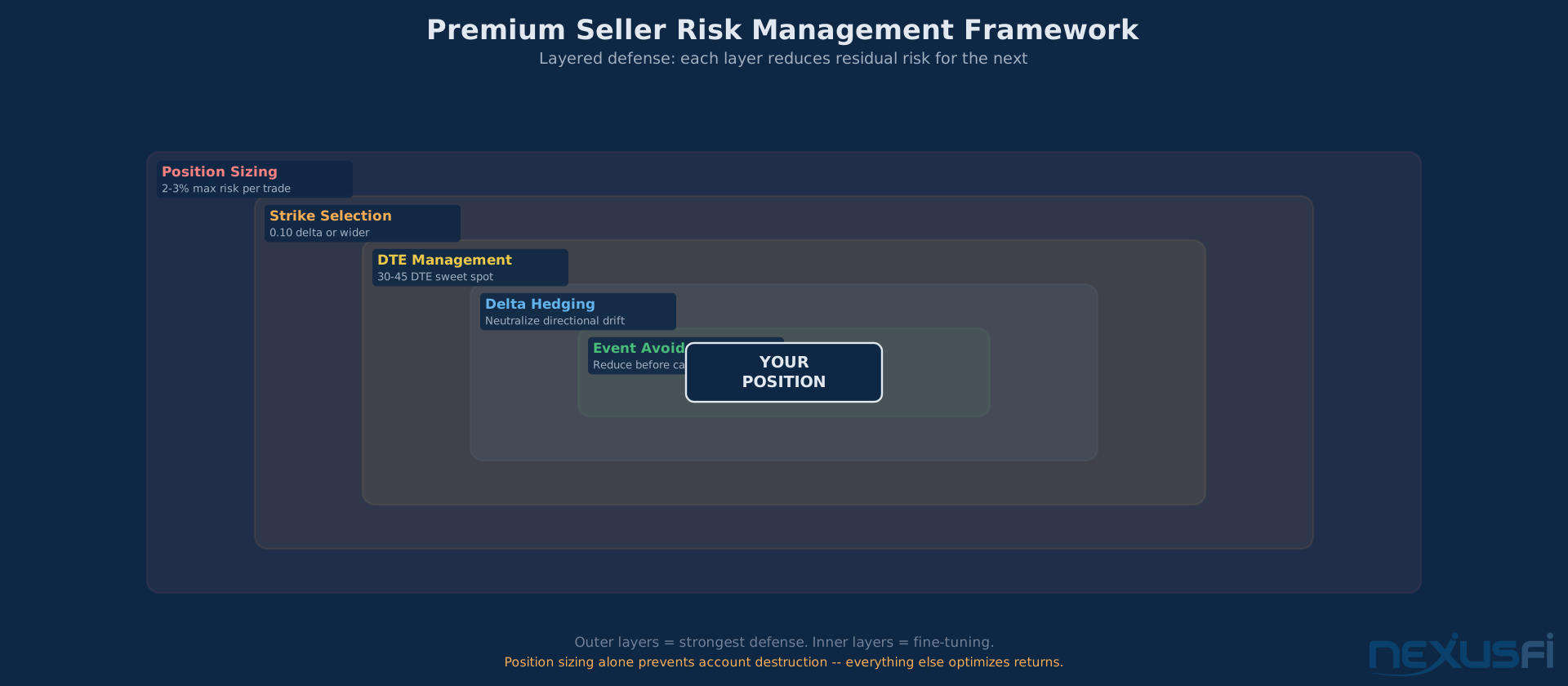
The Greeks tell you about unit risk per contract. Position sizing determines total portfolio risk. An ES short strangle at 0.10 delta might have a maximum theoretical loss of $50,000 if the futures moves 500 points through your strike. Sizing that position at 2% of capital means no single trade can threaten your account. CME Group's SPAN margin system [12] calculates these requirements by simulating 16 "what-if" scenarios — combining reasonable price and volatility shifts across your entire portfolio — and setting your performance bond at the largest projected one-day loss. Understanding SPAN means your margin isn't static: it shifts with the market's own assessment of risk.
— [9] that each approach involves different trade-offs between capital efficiency and tail protection.
Monitoring the Live Greeks Continuously #
Delta shifts throughout the day. Vega exposure changes as the IV term structure evolves. Gamma accelerates as DTE decreases. Modern platforms (NinjaTrader, ThinkorSwim, IBKR TWS, Sierra Chart) provide live Greek dashboards — use them. Know your net delta, total vega exposure relative to account size, and DTE on each position at all times.
The Pre-Event Protocol #
Before any known macro release: reduce position size if vega exposure is large, roll to farther strikes if near ATM, widen short strikes if affordable, and accept reduced theta to survive the vol spike. Selling into elevated IV after the event is almost always the better play. @Opstar observed that smaller-delta positions in larger quantities can be more aggressive than fewer higher-delta positions — [10] because smaller delta options have lower vega per contract, giving more flexibility in sizing.
Connecting the Greeks: The Short Premium Trade-Off #
The five Greeks aren't independent metrics. They're linked through the options market in three compensation pairs that define every short premium position:
Theta is compensation for Gamma. A short ATM option has high theta because it also carries high gamma. No structure isolates one from the other — collecting "free" theta doesn't exist.
Theta is not free income — it is compensation for carrying Gamma and Vega risk. Every dollar of daily time decay you collect comes paired with exposure to adverse moves and volatility expansion. Accept the trade-off or don't sell premium.
Vega is compensation for event risk. High IV means more premium to collect, but the market has already identified the uncertainty driving those prices higher.
Delta is managed, not eliminated. Hedging keeps delta near zero, but every adjustment costs spread and slippage — converting static risk into dynamic cost.
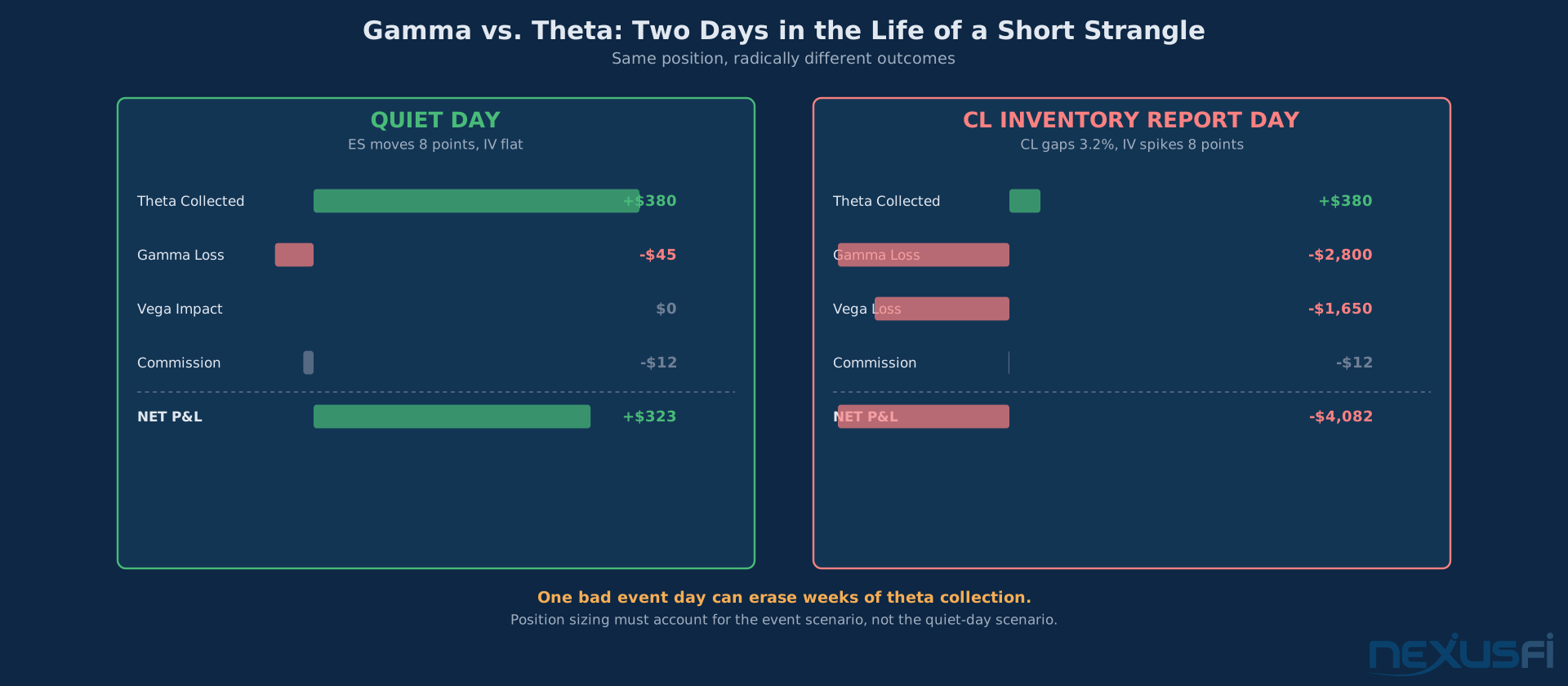
These pairs determine which Greek demands your attention at each stage of a trade's lifecycle:
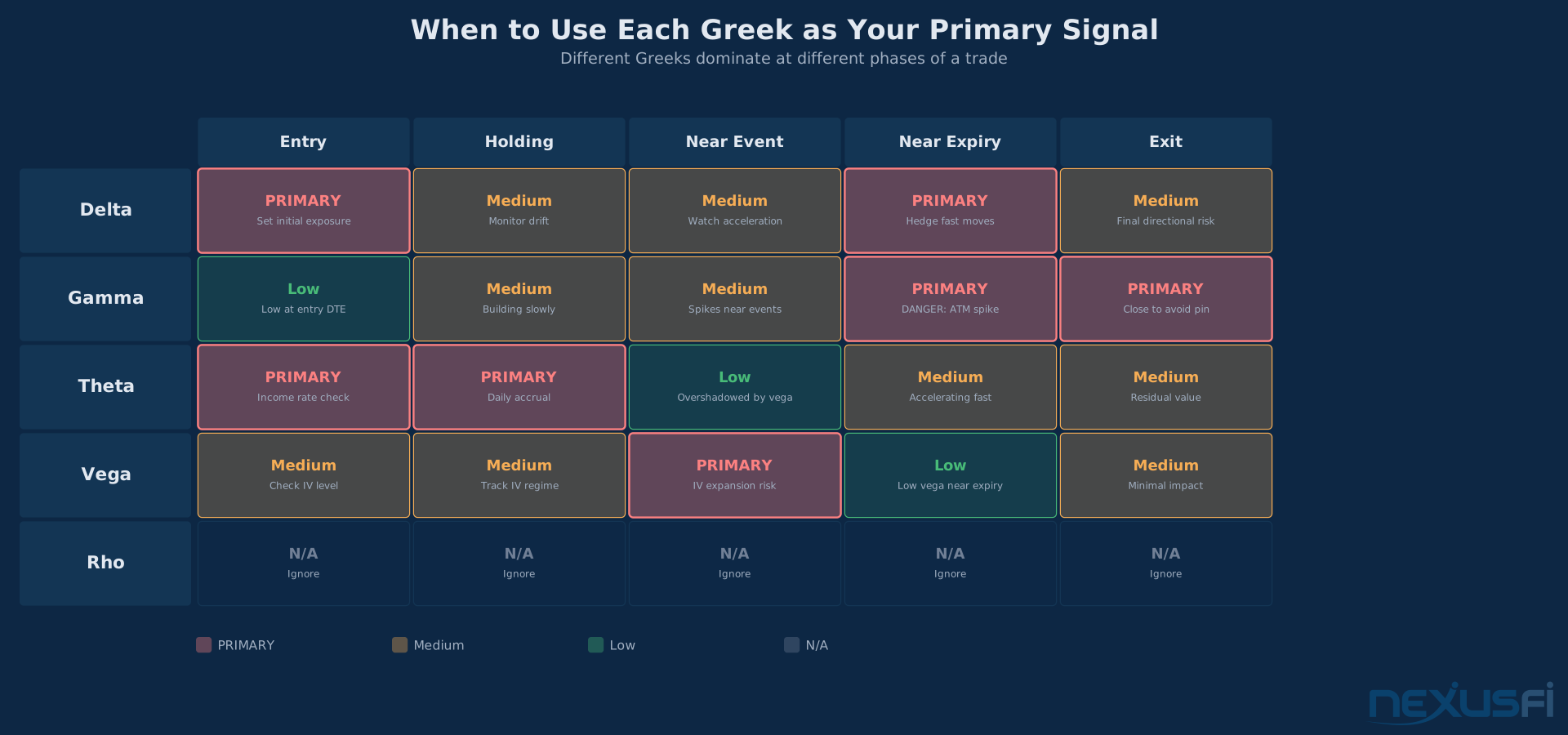
At entry, Vega dominates — the IV environment determines whether the premium adequately compensates for risks ahead. During the hold, Theta and Gamma compete: theta accrues daily while gamma quietly increases directional vulnerability. Near expiration (< 14 DTE), Gamma becomes primary — it can swing delta from neutral to fully directional in a single session. On event days (FOMC, USDA, CPI), Vega reasserts regardless of DTE because a vol spike can overwhelm weeks of theta in hours. Rho is almost never the primary signal for short-to-medium-term futures strategies.
Understanding these linkages — and knowing which Greek to prioritize when — is the difference between knowing what the Greeks are and knowing what they mean for your position management.
Practical Applications: Examples by Instrument #
ES Futures Options (Equity Index)
- ATM strangles with 30-45 DTE are the most common structure
- Key gamma events: FOMC (8x/year), CPI (monthly), major earnings (Q1/Q2/Q3/Q4)
- Persistent put skew means put vega is often higher than equivalent call vega — account for this in your sizing
- Tracking dealer gamma exposure can reveal where hedging flows create support and resistance levels that affect short premium positioning
- Delta hedging is practical given tight ES spreads
CL Futures Options (Crude Oil)
- Weekly inventory reports (Wednesdays) create predictable vega events
- Higher ATR than equity index futures means wider strike selection is needed for the same delta targets
- Gamma risk in energy is especially dangerous during geopolitical events — positions can gap through stops
Agricultural Futures (ZW, ZC, ZS)
- WASDE report months (Jan, Mar, May, Jul, Aug, Sep, Oct, Nov, Dec) are primary vega events
- Seasonality affects both direction and volatility structure — summer crop stress creates different vol surface than harvest
- @dynoweb's approach of selling 0.10-delta strangles 30-60 DTE is well-adapted to these markets
GC Futures Options (Gold)
- Dollar/rate sensitivity creates directional correlation with other markets
- FOMC meetings and CPI prints are primary vega catalysts
- Gold vol often spikes in flight-to-safety events where equity vol also spikes — useful for constructing cross-market premium portfolios
Common Greek Mistakes and How to Avoid Them #
Mistake 1: Treating theta as guaranteed income. Frame theta as expected statistical gain per day — know the variance from gamma and vega exposure.
Mistake 2: Ignoring vega near macro events. Check the economic calendar before initiating short premium. Don't sell into pre-event IV without sizing for further expansion.
Mistake 3: Holding short gamma into expiration. Define close-out rules before entry: close at 50% profit or 14 DTE, whichever comes first.
Mistake 4: Delta hedging without gamma awareness. Delta hedging doesn't cap your loss. Know your gamma to understand how much delta can shift before your hedge fails.
Mistake 5: Trading too large. Size so maximum credible loss (based on potential gamma/vega blow-up) stays below 2-3% of account equity.
Size every short premium position so that the maximum credible loss is under 2-3% of total account equity. Maximum credible loss is not the premium collected — it is a multiple of that premium based on your worst-case Gamma acceleration and Vega expansion scenario. This single rule separates premium sellers who survive multi-year drawdowns from those who blow up on one event.
Knowledge Map
References This Article
Articles that build on this topicCitations
- — Selling Options on Futures? (2013) 👍 4“If you buy calls you expose yourself to vega, theta, gamma risks of the call. The underlyer only carries delta-risk thus it's a more 'pure' delta hedge to use underlyer.”
- — Selling Options on Futures? (2018) 👍 4“A presentation that showed what the option greeks (Delta, Gamma, Vega, Theta, and Charm specifically) are, and how they can be used to calculate exposure of portfolios might help people better understand the risks of option positions they put on.”
- — Selling Options on Futures? (2021) 👍 4“I only sell strangles at high implicit volatility, and I always sell both legs at the same time. Usually I sell approx. 100 DTE. I exit in case the strangle has doubled in value.”
- — Selling Options on Futures? (2016) 👍 1“VEGA is negative for the put seller, and is the killer in a spike in IV as we all know. For a 5% increase in IV the VEGA increases in some exponential manner.”
- — Selling Options on Futures? (2018) 👍 5“I'm personally trading naked future options with a similar stop loss. I tend to trade strangles with higher deltas (0.10 to 0.20) and a shorter DTE (45-70 days) with a variety of underlyings (ES, CL, NG, 6E, ZS, etc.).”
- — Selling Options on Futures? (2019) 👍 8“I usually sell strangles in /6E, /CL, /GC, /ZW, /ZC, /ZS, /NG. Typically they are 30-60 DTE with short strikes around the 20 delta.”
- — Selling Options on Futures? (2013) 👍 15“My option selling style has evolved over the years. Much of my earlier options selling was influenced by The Complete Guide to Option Selling.”
- — Selling Options on Futures? (2013) 👍 8“The best way to make a highest possible risk-adjusted return with options is isolating whatever risk you're trying to make profit off. You will notice that if you look at the theta/gamma ratio and theta/vega ratio, the better structured your theta-portfolio is.”
- — Selling Options on Futures? (2020) 👍 6“I sell mostly strangles/straddles given a positive VRP. The standard options for reducing gamma risk typically are: gamma scalping in the underlying, defined risk strategies, and relative value trades.”
- — Selling Options on Futures? (2015) 👍 7“If we sell 10 lower-delta puts versus 1 higher-delta put at the same notional, the smaller-delta positions in larger quantities can be more aggressive than fewer higher-delta positions.”
- — CME Group Options on Futures Guide
- — CME Group Futures and Options Margin Model