



Selling Options on Futures: The Short Premium Playbook for Theta, SPAN Margin, and Portfolio Construction
Overview #
Selling options on futures is a profession, not a hobby. The traders who do it for a living — and the NexusFi thread Selling Options on Futures with 7,370 replies is basically their clubhouse — share one insight above everything else: the edge isn't in picking the right strikes. It's in the structural advantages of the instrument itself, and in the discipline to not blow up the account when those advantages temporarily disappear.
This guide covers that profession systematically. Not options trading broadly — that's covered in Futures Options Trading: The Complete Strategy Guide. This is specifically about the short premium approach: selling time value, collecting theta, and managing the risks that come with it.
Why Futures Options Are the Professional's Choice for Selling Premium #
Professional option sellers overwhelmingly prefer futures options over equity options. Three structural advantages explain why.
SPAN Margin Changes the Math #
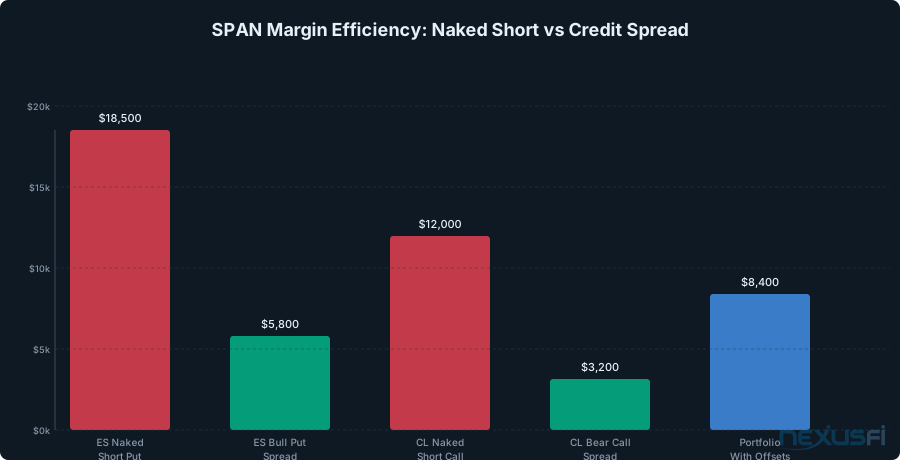
The single biggest advantage of selling options on futures is the margin system. Futures options use SPAN — Standard Portfolio Analysis of Risk — which evaluates your entire portfolio's risk exposure across defined scenarios rather than calculating margin on each position independently.
The practical consequence: a diversified short premium portfolio across multiple CME products can require 40-90% less capital than equivalent positions under equity Reg-T margining. Selling an ES strangle might require $8,000-12,000 in SPAN margin while requiring $30,000+ for comparable SPY options.
More importantly, SPAN recognizes offsets. Short ES puts and short ZB calls are partially offsetting risks — a severe equity sell-off tends to drive bonds up (flight to quality), which means the bond short call position benefits while the equity short put gets hurt. SPAN credits this correlation and reduces the combined margin requirement below what each position would require individually.
60/40 Tax Treatment #
In the United States, futures contracts and options on futures qualify for 60/40 blended tax treatment: 60% of gains are taxed at long-term capital gains rates, and 40% at short-term rates, regardless of how long you held the position. For active traders in high income brackets, this creates a material tax advantage over equity options, which are taxed at ordinary income rates for short-term trades.
This isn't a minor benefit. For a trader generating $100,000 annually from short premium, the 60/40 treatment can save $10,000-20,000 in taxes depending on bracket. Over a trading career, this compounds much.
Settlement Into Futures, Not Shares #
When a futures option is exercised against you (assignment), you receive or take delivery of a futures position at the strike price. This is operationally cleaner than equity option assignment, which delivers or requires shares, introduces dividend timing complications, and creates corporate action risk (splits, mergers, etc.).
For premium sellers who manage positions mechanically, the clean futures-settlement linkage means you're never dealing with unexpected early assignment due to dividends or corporate events. The underlying is always the same standardized futures contract.
Credit Spreads vs. Naked Short Options: The Professional Debate #
The most important decision for any futures option seller: naked options or credit spreads? Both approaches have real practitioners on NexusFi, and both can work. The choice depends on account size, risk tolerance, and discipline.
The Case for Credit Spreads #
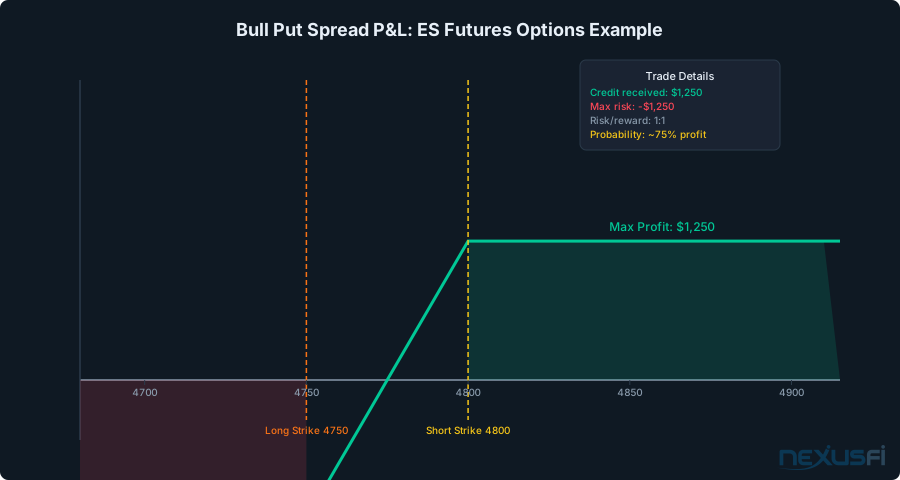
Defined maximum loss. A bull put spread (short higher-strike put, long lower-strike put) has a maximum loss equal to the spread width minus the credit received. You know exactly what you can lose before entering the trade. This makes position sizing mechanical and prevents the catastrophic outcomes that kill naked option sellers.
SPAN efficiency. The long leg of a credit spread dramatically reduces SPAN margin requirements. A short ES put might require $15,000 in margin. A bull put spread 50 points wide might require $4,000. Same probability of profit, 73% less capital at risk.
Portfolio scalability. With defined risk per position, you can run a larger number of positions simultaneously without concentrating too much portfolio risk in any single trade. A $100,000 account can run 8-10 credit spreads across multiple products, providing genuine diversification.
The Case for Naked Options #
More premium. A naked short put collects 100% of the premium available at that strike. A credit spread shares that premium. A naked position with tight stop management can much outperform a credit spread on pure premium collected.
Simplicity. One-legged positions are easier to enter, monitor, and exit than spreads. In fast markets, complex multi-leg orders can partially fill, creating accidental risk profiles.
Deep OTM naked positions. Some experienced sellers focus on deep OTM options — 3-4 standard deviations out — where spreads don't make economic sense. A 0.05 delta crude oil call with a $500 spread width might leave only $100 credit after the long leg cost. Naked at that strike with SPAN-based margin makes more sense.
@ron99 tests both rigorously: "Backtest comparison of naked vs. credit spread: the credit spread consistently shows better risk-adjusted returns per dollar of capital deployed in volatile conditions, though naked wins in calm markets when the stops aren't triggered." [5]
The professional synthesis: Most experienced practitioners use both, context-dependent. Deep OTM naked options where spreads don't pencil out. Credit spreads for higher-delta positions where the defined risk justifies the premium sacrifice. Iron condors for range-bound regimes where income from both sides with defined risk is optimal.
SPAN Margin: Your Edge and Your Trap #
SPAN is simultaneously your biggest advantage and your biggest danger. Understanding it deeply prevents both underutilization and over-leverage.
How SPAN Works #
SPAN calculates margin by evaluating your portfolio across 16 scenarios: price moves up/down at multiple volatility levels, plus extreme tail scenarios. The margin requirement equals the worst-case loss across those scenarios, with credits for positions that offset each other.
For a short ES strangle, SPAN considers: what happens if ES moves up 8%? Down 8%? With vol up 10%? The short call suffers on the upside scenario; the short put suffers on the downside. But they can't both be the worst case simultaneously — so SPAN doesn't charge full margin for both.
This scenario-netting is why cross-asset portfolios achieve massive SPAN efficiencies. Short ES puts and short ZB calls are negatively correlated in most regimes — equity sell-offs drive bond rallies, so the bond short call benefits when the equity short put is being tested.
SPAN Does Not Capture Tail Risk #
The critical limitation: SPAN's scenarios are calibrated to recent realized volatility. During a genuine tail event — March 2020, the 2020 crude oil negative price event, the 2022 rate shock — volatility explodes well beyond any recent historical experience. SPAN margin requirements spike intraday as exchanges reset parameters, creating margin calls at exactly the worst time.
The professional solution: never use more than 50-60% of your margin capacity. Keep enough headroom that a SPAN parameter reset — which can double or triple requirements overnight during a crisis — doesn't immediately force position liquidation.
@ron99 learned this lesson: "The margin cushion below SPAN requirement became critical during the August 2015 correction — accounts that were fully margined got margin calls; accounts with 40%+ headroom had time to manage the position and exit at a reasonable loss rather than forced liquidation at the worst price." [6]
Building the Portfolio: Diversification Across CME Products #
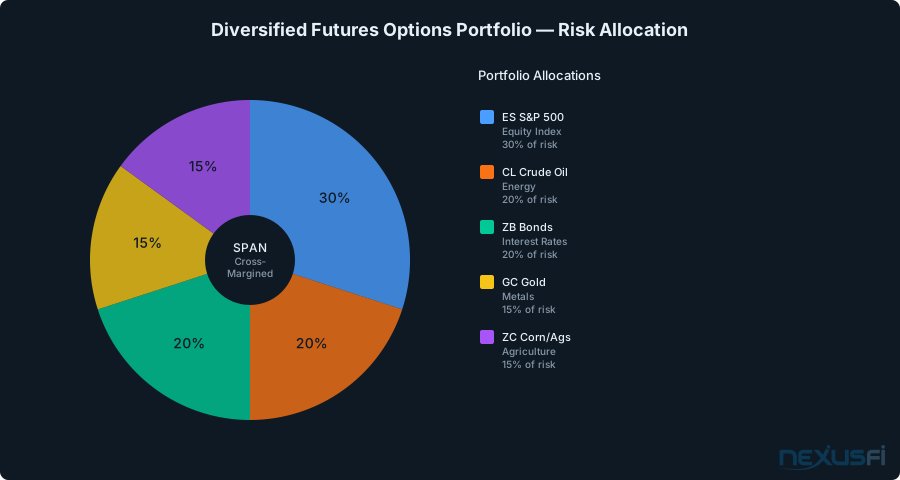
A single-product option seller is exposed to every idiosyncratic risk in that market — an OPEC announcement wipes out six months of CL premium income, or a surprise Fed pivot destroys a year of ZB short call income. Portfolio diversification across uncorrelated futures markets is the structural defense.
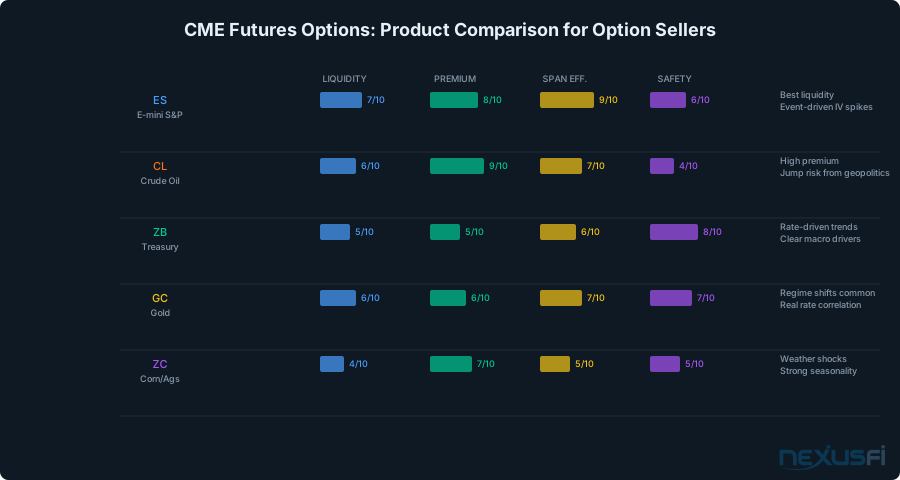
The Five-Product Professional Portfolio #
ES (E-mini S&P 500): The highest-liquidity futures options market, deeply connected to the broader derivatives ecosystem via SPX/SPY hedging flows. The volatility risk premium has historically been positive in ES, making it the backbone of most professional portfolios. Risk: macro event sensitivity and systematic gamma hedging flows can create non-linear moves. Related reading: Options Flow Analysis and Gamma Exposure.
CL (Crude Oil): High baseline implied volatility creates attractive premium. Risk: geopolitical jump risk is the highest of any major futures market — a single OPEC statement can move CL 5-10% intraday. Credit spreads mandatory; never naked CL in geopolitically active periods. Related reading: Geopolitical Risk and Futures Trading.
ZB (Treasury Bond): Interest rate futures options provide genuine macro diversification from equities. Risk: rate trending regimes can sustain directional pressure that overwhelms short premium income — don't sell ZB options during active Fed hiking or cutting cycles.
GC (Gold): Distinct macro drivers (real rates, USD, safe-haven demand) create periods of elevated IV attractive to sellers. Risk: gold can simultaneously spike with equity volatility during risk-off events, reducing its diversification benefit at the worst time.
ZC (Corn/Agricultural Futures): Genuine non-correlation with financial markets — agricultural volatility is driven by weather and crop reports entirely independent of equity or rate volatility. Risk: USDA report dates create 3-8% single-day moves. Never hold through major scheduled crop reports.
@dynoweb runs exactly this kind of diversified book: "I usually sell strangles in /6E, /CL, /GC, /ZW, /ZC, /ZS, /NG. Typically 30-60 DTE with short strikes around the 20 delta. Profit target is usually around 50% of credit." [7]
Position Sizing Within the Portfolio #
Size by risk budget, not by margin or notional exposure:
- Define total portfolio risk capacity: maximum loss you can absorb (typically 15-25% of account)
- Divide by number of target positions: 8-10 positions gives each a 1.5-3% risk budget
- Size each position so its defined maximum loss equals the per-position risk budget
- Apply volatility adjustment: higher current IV = smaller position size
The correlation trap: SPAN recognizes correlations at normal market levels. But during genuine market stress — the kind of event that tests your short option portfolio — correlations spike toward 1 across all risk assets. Reserve 20-30% of your margin capacity as a crisis buffer.
@myrrdin has traded a diversified option selling portfolio for many years: "I strive for diversification — holding at least 5-6 different markets simultaneously. The positions are always small relative to account size. In crisis periods, I reduce all positions immediately rather than trying to manage individual legs through the chaos." [8]
Volatility Regime Selection: The Meta-Strategy #
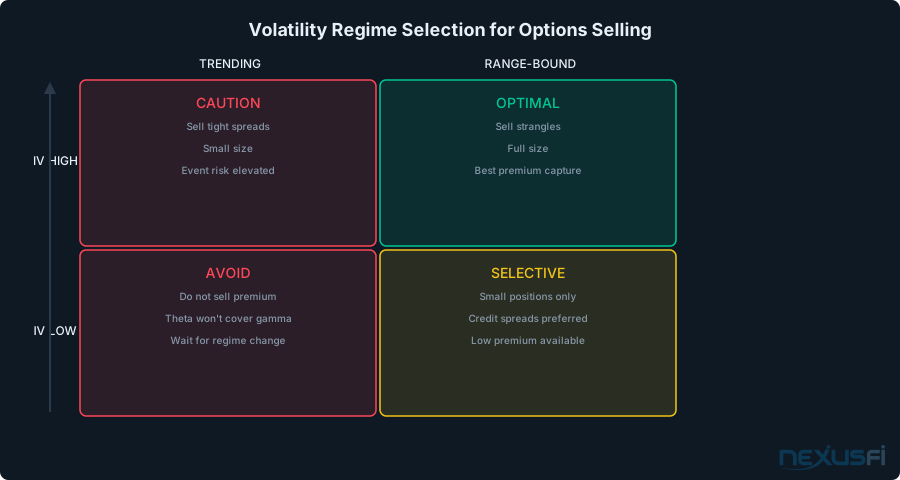
Position selection matters much less than regime selection. The most important decision as a premium seller is when to be in the market at all.
Short premium strategies generate positive expected value when:
- Implied volatility exceeds realized volatility (the volatility risk premium is positive)
- IV rank is elevated (above 40th-50th percentile historically — you're collecting above-average premium)
- The market is range-bound rather than trending
- No major event risk is imminent for the duration of your planned position
Short premium generates negative expected value when:
- VIX term structure is inverted — this signals near-term stress
- The market is in a strong trend — directional moves will blow through option strikes
- A major scheduled event falls within your DTE window — FOMC, CPI, NFP, OPEC, USDA crop report
The IV percentile tool: Calculate where current implied volatility sits relative to the past year. IV at the 80th percentile means you're selling into elevated premium — favorable. IV at the 20th percentile means you're selling cheap options for meager premium — unfavorable. Use 40th percentile as your floor for new position initiation.
The contango filter: When the VIX futures curve is in contango (later months more expensive than front months), it signals market expectation of stability — favorable for sellers who expect volatility to mean-revert lower. When the curve is inverted, wait.
The trend filter: Don't initiate new short premium positions when the underlying is more than 2 ATR away from its 20-day average in either direction. You're fighting a trend with a position designed for range conditions.
Rolling Losers: The Decision That Separates Professionals from Amateurs #
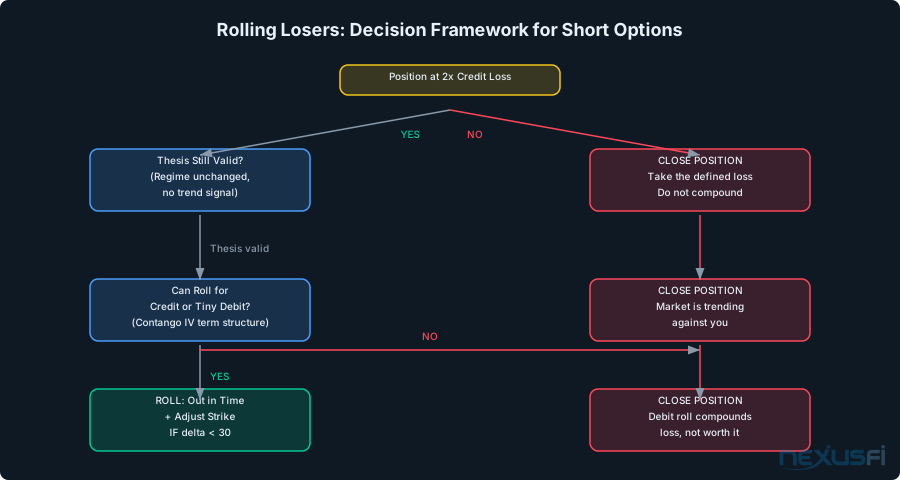
Rolling a losing position — buying back the current short and selling a further-dated, adjusted strike position — is the most misunderstood technique in short premium trading. Done well, it can transform a losing position into a breakeven. Done wrong, it converts a manageable loss into a catastrophic one.
When Rolling Is Justified #
Rolling makes sense only when all three conditions are simultaneously true:
1. The original thesis still holds. If you sold a CL put spread because you believed oil would stay range-bound, but geopolitical escalation has changed the supply picture, the thesis is broken. Rolling doesn't fix a broken thesis — it extends exposure to a market that's moved against your analysis.
2. The roll can be executed for a credit or small debit. Rolling for a significant debit means buying back your current short at full price and selling the next month's options at smaller premium. Only roll when the term structure allows collecting more premium than you pay to close the current position.
3. The adjustment doesn't increase risk. A good roll moves the short strike further OTM and rolls further in time. A bad roll adds contracts or moves strikes closer to current price to collect more premium. Never add risk to save a loser.
The Stop-Loss Rule: Non-Negotiable #
Define your exit rules before you enter the trade. Most professionals use one of two approaches:
Multiple of credit: Close when the position has lost 2-3x the original credit received. Simple, objective, prevents rationalization.
Delta threshold: Close when the short option's delta reaches 30-40 (for an initially 20-delta position). At 30+ delta, the short option is acting like a futures position with futures-level risk but without futures-level premium.
Product-Specific Playbooks #
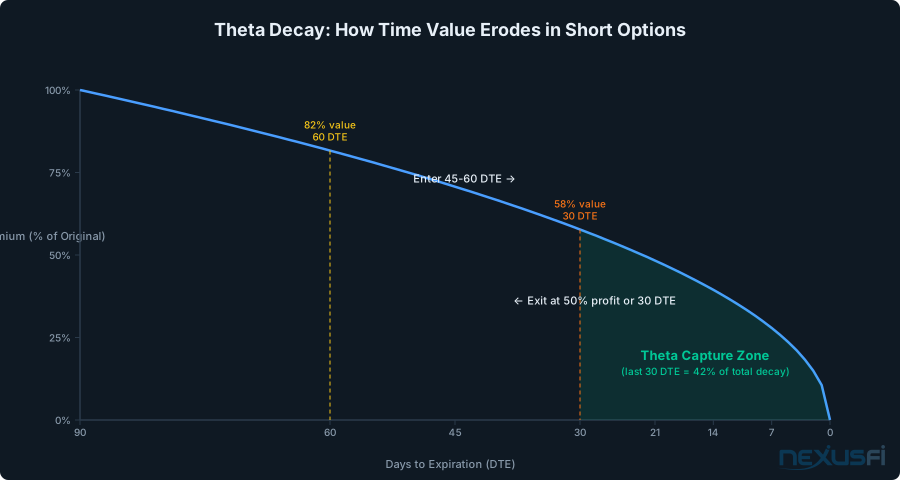
ES Playbook: Bull put spreads or short strangles at 20-25 delta, 30-45 DTE. During VIX spikes above 25, size up. Below VIX 15, reduce. Event filter: avoid FOMC and CPI releases with short-dated positions.
CL Playbook: Credit spreads mandatory — never naked CL short calls during geopolitical tension. Event filter: EIA weekly petroleum inventory reports (Wednesdays 10:30 AM ET), OPEC meetings. Never hold through EIA with positions inside 2 ATR of the expected move.
ZB Playbook: Short strangles only in rate-on-hold regimes. Reduce to cash in active hiking/cutting cycles. The 2022-2023 rate hiking cycle saw ZB fall 30% — option sellers who ignored the trend paid dearly.
GC Playbook: Short strangles at 20 delta during low-real-rate-volatility periods. Iron condors to define risk during geopolitical uncertainty. Note: gold can spike with equity volatility simultaneously, reducing portfolio diversification at the worst moment.
ZC/Agricultural Playbook: Short strangles outside major USDA report windows. Seasonal high-IV periods (spring planting, summer weather) provide the best premium. The critical rule: don't hold through USDA WASDE reports or crop condition reports with short-dated positions.
Getting Started: A Structured Learning Path #
Month 1 — Paper trade one credit spread. Choose ES, sell a bull put spread 50 points wide at 20 delta, 45 DTE. Track it daily, observe theta decay and delta changes, close at 21 DTE or 50% profit. Read through the NexusFi Selling Options on Futures thread — thousands of posts from practitioners at every experience level.
Month 2 — Add a second uncorrelated product. Paper trade a CL spread or GC strangle alongside your ES position. Observe when they move together and when they diverge.
Month 3 — Simulate a loss and the rolling decision. Work through the rolling decision framework on a challenging historical scenario: is the thesis valid? Can you roll for credit? Does the adjustment increase risk?
Month 4 — Move to small live trading. Use 10-25% of intended position sizes. The difference between paper and live is emotional discipline. When a real-money position is tested, you'll feel pressure to deviate from rules. That's exactly what paper trading has prepared you for.
The Community #
Thousands of posts from active premium sellers sharing real trades, real losses, and hard-won insights live in the NexusFi Options forum. The Selling Options on Futures thread and the Diversified Option Selling Portfolio thread are essential reading alongside any theoretical study.
The honest conclusion from that community: short premium on futures works as a long-term strategy, but only with disciplined position sizing, genuine diversification across truly uncorrelated products, and non-negotiable stop-loss rules. Managing the losers is more important than picking the winners. The traders who are still doing it after a decade understand this. The traders who disappeared learned it the hard way.