



Implied Volatility Rank (IVR) and IV Percentile for Futures Options: The Volatility Regime Filter Every Premium Seller Needs
Overview #
Implied volatility rank sits at the center of every serious options seller's workflow on futures. Before you sell a strangle on crude oil or an iron condor on the E-mini, you need one piece of information above all others: is the premium I'm collecting rich relative to history, or am I selling cheap protection when I should be watching from the sidelines?
IV Rank and its companion metric, IV Percentile, answer that question. They transform the abstract number of implied volatility into something actionable — a relative reading that tells you where today's pricing sits within its own history. Understanding these metrics is not optional for futures options traders. The NexusFi community has spent over a decade refining how to use them, and the most consistent premium sellers treat elevated IV rank as the first gate any position must pass before they commit capital.

What Implied Volatility Actually Measures #
Implied volatility (IV) is extracted backwards from an option's market price. Rather than calculating what an option should be worth, you take the option's actual price and solve for the volatility input that justifies it. The result is the market's consensus estimate of expected future price movement over the option's remaining life, expressed as an annualized percentage.
When ES options are trading with 25% implied volatility, the market is pricing in approximately 1.57% daily moves (25% / √252). When IV spikes to 60% after a major event, the market expects roughly 3.78% daily swings. Options become dramatically more expensive during these periods — the same 30-delta put that cost $500 at 25% IV might cost $1,200 at 60% IV.
For sellers, this matters because of what happens to implied volatility over time: it has a pronounced tendency to mean-revert. Markets price in fear and uncertainty that frequently exceeds what actually occurs. When volatility returns to normal levels — the "IV crush" — sellers who entered positions at elevated premiums benefit from both theta decay and the collapse of implied volatility. This mean-reversion tendency is not guaranteed. The skill lies in distinguishing elevated IV that overshoots expected volatility from IV that correctly anticipates continued turbulence — and IV Rank gives you the first filter for that distinction.
IV Rank: Measuring Position Within the Range #
IV Rank is a normalized measure of where current implied volatility sits relative to its historical range over a lookback period, typically 52 weeks (252 trading days).
The formula:
IV Rank = (Current IV − 52-Week Low IV) ÷ (52-Week High IV − 52-Week Low IV) × 100
If ES implied volatility sits at 28%, the 52-week low is 12%, and the 52-week high is 55%, then:
IV Rank = (28 − 12) ÷ (55 − 12) × 100 = 16 ÷ 43 × 100 = 37
An IVR of 37 means current implied volatility is 37% of the way between its historical low and high. At IVR 0, you are at the lowest volatility observed in the past year. At IVR 100, you are at the highest.
Interpreting IV Rank thresholds:
| IV Rank | Market Context | Selling Attractiveness |
|---|---|---|
| 0--30 | Historically cheap premium | Avoid premium selling — credits too thin for the risk carried |
| 30--60 | Neutral zone | Selective selling; other factors must compensate |
| 60--80 | Elevated premium | Favorable — standard sizing, check event calendar |
| 80--100 | High premium | Strong candidate — but realized risk is also elevated |
The 60 threshold is practical, not mystical. Below 60, premium sellers are often fighting the math: the credit collected frequently fails to justify the gamma exposure and potential gap risk in futures. Above 60, the probability of IV mean-reversion creates a structural tailwind for sellers.
The critical weakness of IV Rank: A single extreme volatility spike within the lookback window inflates the high-water mark, compressing all subsequent readings toward zero. If crude oil hit IVR 100 during a geopolitical shock three months ago, today's genuinely elevated 40% IV might show up as an IVR of only 35 — misleadingly suggesting cheap premium when it is actually historically elevated. This is where IV Percentile provides essential correction.
IV Percentile: Measuring Position Within the Distribution #

IV Percentile answers a different question from IV Rank. Rather than asking where today's IV sits within the range, it asks: what percentage of trading days over the past year had lower implied volatility than today?
The calculation:
Count the number of trading days in the lookback period where IV was lower than today's IV. Divide by the total number of trading days. Multiply by 100.
If today's ES implied volatility of 32% was lower than IV on 215 of the past 252 trading days, IV Percentile = 215 ÷ 252 × 100 = 85th percentile.
An 85th percentile reading means IV was lower than today on 85% of days over the past year. The current level is genuinely unusual compared to recent history — not just elevated relative to the min-max range.
How IV Percentile corrects IV Rank distortion:
| Scenario | IV Rank | IV Percentile | What It Means |
|---|---|---|---|
| Steady gradual rise, no spikes | 75 | 80% | Both confirm: premium is rich |
| Single extreme spike in lookback | 38 | 78% | IV Rank depressed by outlier; IV Percentile correctly flags elevated premium |
| Recent spike, now declining | 85 | 60% | IV Rank still elevated; Percentile shows it's less unusual than IVR implies |
| Both metrics agree at extreme | 92 | 91% | Strongest signal — confirmed elevated premium from two independent methods |
The practical rule: use IV Rank for quick scanning; use IV Percentile for confirmation. When they diverge much (more than 20--25 points), trust IV Percentile. It uses the full distribution of volatility outcomes rather than just the endpoints of the range.
NexusFi community member @HardSwap3 documented this dynamic directly: "implied volatility fell to 62%, IV Rank declined to 82%, and these positions are still profitable" — demonstrating how IV Rank and actual selling opportunity don't always move in lockstep with underlying price action.
The IV Crush: Why Elevated IV Rank Creates the Setup #

The most profitable single setup for premium sellers occurs immediately after a volatility spike when IV Rank is elevated and a known trigger has just resolved. This is the IV crush.
When a major event approaches — a Federal Reserve announcement, an OPEC meeting, a critical USDA report — the options market prices in uncertainty. IV Rank can spike from 40 to 90 within days. The moment the event resolves, that uncertainty premium collapses. Regardless of which direction the underlying moves, the uncertainty is gone. Traders who sold options when IV was still elevated capture this collapse as pure profit.
Understanding the mechanics:
- Vega is the measure of how much an option's price changes per 1% move in implied volatility
- A short option position has negative vega — you profit when IV falls
- When IV drops from 75% to 35% after an event, a short ES strangle might generate $800--$1,200 in profit from vega alone, on top of theta decay
- This vega windfall can represent 40--60% of total potential profit on the position
The critical discipline: selling into an approaching event carries the most gamma risk. A Fed announcement that genuinely surprises can gap ES by 40--60 points in seconds, overwhelming any premium advantage. Experienced futures options sellers often prefer to wait for the event to pass, then sell into the elevated IV that lingers for 24--72 hours afterwards — capturing the crush without the directional gap risk.
@jokertrader described this thinking in the NexusFi selling options thread: "Sold the March ES 3300/3025 strangle on 2/25 (Tue) — Why: Vol was high, close or at 100% from a IV rank."
Futures-Specific Considerations: Why IV Rank Behaves Differently #

Futures options traders face complications that equity options traders don't encounter. Understanding these distinctions prevents misapplication of IV Rank signals.
Seasonality Distorts "Normal" IV #
Agricultural and energy futures have deeply embedded seasonal volatility patterns. Natural gas (NG) options routinely trade at IVR 85--95 every October and November because cold-season demand uncertainty creates structural volatility year after year. Corn options spike during May--July planting and growing season weather markets. This matters for IV Rank because a one-year lookback captures these seasonal patterns. An October NG reading of IVR 85 may be completely normal seasonal behavior rather than a genuine selling opportunity.
For seasonal commodities (NG, ZC, ZW, ZS, CL): Use 3--5 year lookback periods when available, or compare current-month IV to the historical average for the same calendar month. @myrrdin, one of the most cited options sellers on NexusFi, explicitly avoids this: "I avoid well-known weather markets, e.g. NG options from Z to H, and C as well as S during late spring."
Contract Roll Periods Create Artificial Spikes #
During futures contract rolls, liquidity in the front contract drops sharply. This liquidity transition can cause implied volatility readings to spike artificially — not because the market expects more volatility, but because the pricing mechanism is degraded. Always measure IV from the most liquid option series, which during roll periods means the back-month rather than the expiring front-month.
Event-Driven vs. Regime IV #
The most critical distinction: whether elevated IV represents a specific trigger approaching (event-driven) or a new volatility regime where elevated uncertainty is structural (regime-shift). Event-driven IV crushes predictably after the trigger. Regime-shift IV can remain elevated for weeks while realized volatility also expands. IV Rank cannot tell you which scenario you are in — that distinction requires reading market context and the RV/IV spread.
Implied Volatility vs. Realized Volatility: Your Structural Edge #

The theoretical basis for premium selling is the volatility risk premium: over long periods, implied volatility has consistently exceeded realized volatility across major futures markets. The options market systematically overprices uncertainty because buyers are paying for tail risk protection at above-fair-value rates — and options sellers harvest that spread. Research from Cboe quantifies the magnitude of this edge: analysis by Professor Oleg Bondarenko covering over 32 years of S&P 500 data (1986--2018) found that average implied volatility (measured by VIX) was 19.3% while average realized volatility was 15.1% — a persistent VRP of 4.2 percentage points. The Cboe PutWrite Index, which systematically harvests this premium, delivered higher risk-adjusted returns than five other major benchmark indexes.
When IVR is high, this spread is typically at its widest, creating the best conditions for premium selling.
The practical implementation:
- Calculate 30-day implied volatility from ATM options in your preferred expiration
- Calculate 30-day historical (realized) volatility from the underlying futures price
- Sell premium when: IV Rank > 60 AND implied > realized by a meaningful margin
When the spread compresses — when realized volatility approaches or exceeds implied — the premium seller's edge deteriorates. This is a warning signal even when IV Rank reads elevated. The market may be correctly pricing volatility that will actually materialize. If realized volatility has been trending higher over the past 10--20 sessions, wait for it to stabilize before selling.
Term Structure: Front Month vs. Back Month Dynamics #

Options at different expiration dates carry different implied volatilities — the term structure. Understanding how term structure shapes your selling decisions is essential in futures markets where events create predictable distortions. CME Group's CVOL Index methodology uses variance estimation to aggregate implied volatility across the full options chain at each expiration, providing a more systematic way to compare volatility expectations across the term structure.
Normal backwardation (front > back): Front-month IV exceeds back-month IV. The most common pattern in index futures like ES and NQ. Front-month options are more sensitive to near-term events, commanding higher premium.
Inverted term structure (front >> back): An extreme case where an imminent known event drives front-month IV dramatically above back months. When the Fed meets in 5 days, front-month ES options might trade at 55% IV while 60-day options trade at 32%. After the event, front-month IV collapses toward back-month levels — an IV crush of potentially 15--20 volatility points.
Flat structure: All expirations trade similar IV levels. Appears in low-volatility environments. Avoid selling unless IVR is high by absolute standards.
For premium sellers: inverted structure means sell front-month (post-event) to capture the coming crush with defined-risk structures; normal backwardation means target 30--60 day expirations; flat structure offers no structural kink to exploit. The classic error: selling back-month options because IVR reads as elevated, without noticing that front-month elevation is driven by a single isolated event.
Strategy Selection by IV Environment #

IV Rank doesn't just tell you whether to sell premium — it shapes how to structure your position and how much capital to commit.
High IV Rank (80--100): Elevated Premium, Elevated Risk #
This is simultaneously the best and most dangerous selling environment. Premium is richest here, but realized volatility is typically at its highest.
For range-bound markets at IVR 80+: Short strangles and straddles are defensible. Use conservative sizing (half normal notional) and strike selection well out-of-the-money (5--15 delta).
For trending markets at IVR 80+: Avoid undefined-risk selling. Use credit spreads in the trend direction to capture elevated premium while bounding directional loss.
Post-event at IVR 80+: The sweet spot. Sell immediately after a major trigger resolves while IV remains elevated. The first 24--72 hours after Fed announcements, USDA reports, or major events often offer the best risk-adjusted premium opportunities of the month.
As NexusFi community member @PeterOhlson noted about the mechanics behind this approach: "There is inflated IV, thus he makes more profit than what he would do selling the straight ATM straddle. He is in reality just selling delta-neutral volatility." That insight cuts to the core of premium selling at high IVR — you are not predicting direction, you are harvesting the market's overpriced uncertainty.
Favorable IV Rank (60--80): Standard Selling Environment #
The majority of productive premium-selling occurs here. Standard position sizing, 45--60 DTE (days to expiration) for theta decay optimization. Strangles, iron condors, and credit spreads all perform in this range. Confirm realized volatility is not expanding.
Neutral IV Rank (30--60): Selective Selling Only #
Premium selling requires additional justification beyond IV rank alone. The credit collected may not compensate adequately for gamma exposure in futures markets where gaps are common. Preferred alternatives: directional credit spreads, calendar spreads exploiting term structure.
Low IV Rank (0--30): Stay Out of Short Volatility #
The consensus across NexusFi's options community is unambiguous: below IVR 30, premium selling is structurally unattractive. @myrrdin explicitly states he only sells strangles "at times of high volatility" — waiting for conditions rather than manufacturing reasons to deploy capital.
The Multi-Factor Entry Framework #

IV Rank is the first gate, not the only gate. Before selling futures options, verify multiple conditions simultaneously. Passing on trades where conditions are mixed is how sustainable premium selling programs survive multi-year vol regimes.
The eight-point checklist:
1. IV Rank > 60 AND IV Percentile > 70% — Both metrics confirm elevated premium. When they diverge, IV Percentile is more reliable.
2. Implied Volatility > Realized Volatility — Calculate the IV-minus-RV spread. If realized vol is approaching or exceeding implied, the structural edge has eroded.
3. Event Calendar Clear — Scan for every major trigger within your DTE window: FOMC, CPI, NFP, USDA reports, OPEC meetings. Naked premium selling into known catalysts requires defined-risk structures or explicit event risk acceptance.
4. Realized Volatility Stable or Declining — If realized vol has expanded 30%+ over two weeks while IV has also risen, you may be entering at the peak of a volatility expansion rather than at a favorable mean-reversion level.
5. Market Range-Bound (or Trend Works For You) — Trending markets punish naked short options in the trend direction. In trending environments, sell in the trend direction (credit put spreads in uptrends) rather than attempting delta-neutral exposure that fights momentum.
6. Term Structure Favorable — Confirm that front-month IV elevation is structural rather than event-specific. Selling 45-day options when elevated IV is driven by a 10-day event may be targeting the wrong maturity.
7. Adequate Liquidity — Check bid-ask spreads for the specific strikes and expirations you intend to trade. Wide spreads cost you on initial entry and on every adjustment, hedge, or exit.
8. Strategy Matches Risk Profile — When 2+ checklist items are uncertain, shift from undefined-risk to defined-risk structures. Defined-risk reduces capital efficiency but eliminates catastrophic loss scenarios.
Risk Management: The Other Side of the Premium Seller's Ledger #
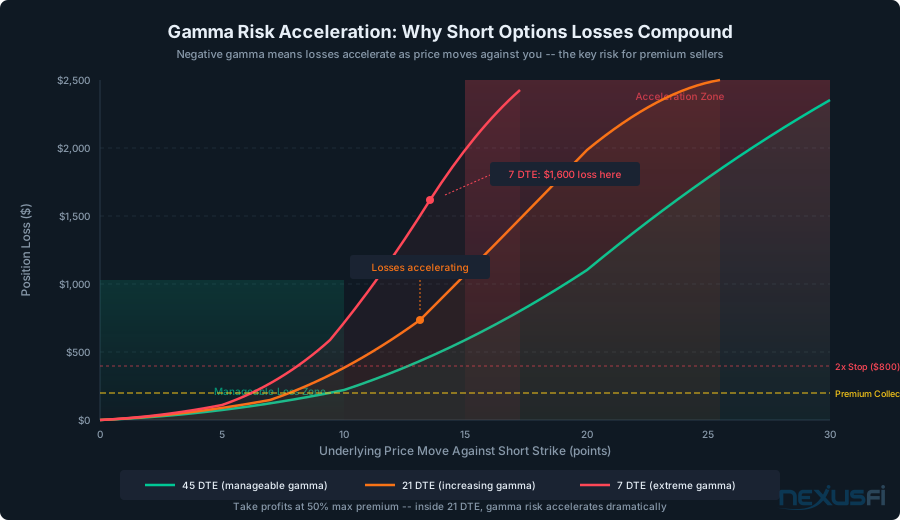
Understanding when to sell is only half the framework. Controlling losses when the trade moves against you determines whether a premium selling program is profitable over multi-year periods.
Gamma is the primary operational risk. Short options have negative gamma — losses accelerate as the underlying moves against you. In futures, where limit moves and overnight gaps are possible, a short strangle that appeared safe on paper can face catastrophic losses in a single session.
SPAN Margin and Capital Buffer #
SPAN margin mechanics matter. During volatility spikes, SPAN margin requirements can double or triple overnight, creating margin calls even when underlying prices haven't moved against your strike levels. Maintain at least 4--6x your SPAN margin requirement in available capital — the buffer that experienced sellers like @ron99 documented as essential for surviving volatility events like 2018's vol spike.
Position Sizing and Exit Discipline #
Position sizing by worst case, not average. Size so that your worst-case single-trade loss represents an acceptable drawdown relative to your full account. Premium selling has a positively skewed distribution of trade outcomes (many small wins) but negatively skewed tail risk (occasional catastrophic losses) — sizing based on average expected P&L ignores the tail entirely.
- Take profits at 50% of maximum premium collected — gamma risk increases dramatically inside 21 DTE
- Hard stop at 2x premium — if the position reaches 2x the premium collected as a loss, exit immediately
- Roll when directional — if a short put moves from 10-delta to 30-delta, the risk profile has transformed into an effectively short futures position
- Close before catalysts — exit before major known catalysts if inside 14 DTE with significant premium remaining
Divergence Signals: When IV Rank and Percentile Tell Different Stories #
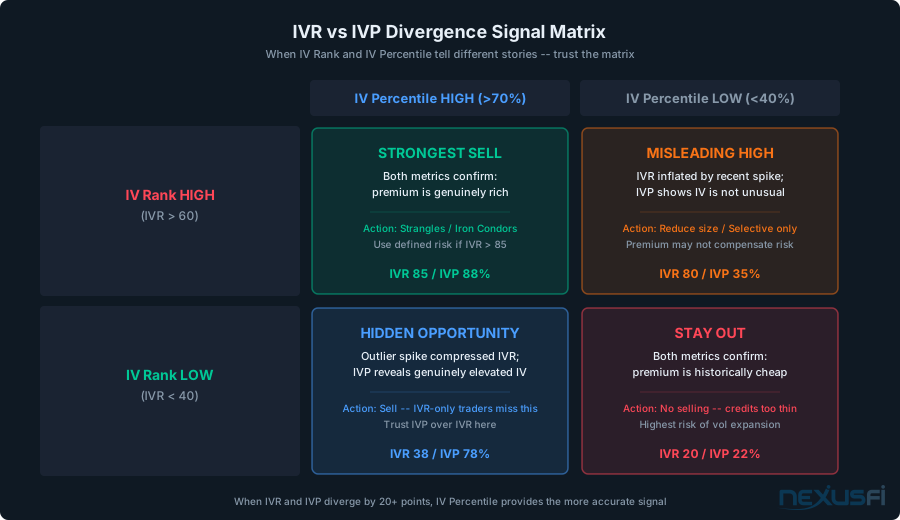
High IV Rank, Moderate IV Percentile (e.g., IVR 80, IVP 55%): One extreme spike in the lookback window inflated the range. The real signal is closer to IV Percentile — conditions are elevated but not at an extreme. Standard sizing, no urgency premium.
Moderate IV Rank, High IV Percentile (e.g., IVR 45, IVP 80%): The classic outlier-distortion case. A spike inflated the high-water mark, making today's objectively elevated IV look moderate by IVR arithmetic. IV Percentile tells the accurate story: premium is genuinely expensive. This is an underappreciated selling opportunity that IVR-only traders miss.
Both High (IVR 85+, IVP 85%+): The clearest signal. This configuration occurs during genuine stress events. Use defined-risk structures and reduce size from your normal program.
Both Low (IVR < 30, IVP < 30%): Maximum consensus to stay out. Historically the worst-performing environment for premium sellers, and the period most likely to see a mean-reversion volatility expansion that punishes anyone who sold.
Conclusion: IV Rank as the Starting Gate, Not the Finish Line #
IV Rank and IV Percentile are the most important volatility context tools for futures options sellers. They transform the raw number of implied volatility into a relative signal that enables comparison across time and across different market environments.
Used correctly, these metrics serve as the entry gate for premium selling decisions — a filter that prevents selling cheap premium when risk/reward is unfavorable, and that identifies when elevated volatility creates structural opportunity for sellers. The NexusFi community has refined these applications over more than a decade of active premium selling across ES, CL, ZB, GC, NG, and the full range of futures markets.
But the gate is not the destination. IV Rank tells you when conditions may be favorable. The realized-vs-implied spread confirms that your structural edge exists. The event calendar determines whether to use defined or undefined-risk structures. Term structure tells you which expiration to target. Market regime tells you whether directional risk is manageable. And gamma risk management determines whether your account survives the tail events that occur even in the most favorable setups.
For deeper exploration of specific selling strategies, see Selling Options on Futures. For the margin mechanics that govern how much capital these positions tie up, see SPAN Margin for Futures Options. The combination of elevated IV rank, favorable term structure, and disciplined SPAN buffer management is the framework that the most consistent premium sellers on NexusFi have converged on through years of documented live trading.
The question is never "is IV high?" — implied volatility is always changing. The question is "is IV high relative to its own history, and do all the other conditions align?" That is what IV Rank and IV Percentile help you answer.
Knowledge Map
Go Deeper
Build on this knowledgeReferences This Article
Articles that build on this topicCitations
- — Selling Options on Futures? (2016) 👍 2“With just the choppiness on Friday 1/29, implied volatility fell to 62%, IV Rank declined to 82%, and these positions are still profitable”
- — Selling Options on Futures? (2020) 👍 2“Sold the March ES 3300/3025 strangle on 2/25 (Tue). Why: Vol was high, close or at 100% from a IV rank (rank of IV based on history)”
- — Selling Options on Futures? (2021) 👍 4“When selling strangles I usually proceed as follows: I only sell strangles at high implicit volatility, and I always sell both legs at the same time. Usually I sell approx. 100 DTE.”
- — Selling Options on Futures? (2021) 👍 5“I avoid well-known weather markets, e.g. NG options from Z to H, and C as well as S during late spring. A good example were NGJ, NGK, and NGM strangles.”
- — Selling Options on Futures? (2015) 👍 27“The further out in time options are further OTM. Thus IV increases slower on them even though their IV was higher to start.”
- — Selling Options on Futures? (2013) 👍 21“There is inflated IV, thus he makes more profit than what he would do selling the straight ATM straddle. He is in reality just selling delta-neutral volatility.”
- — Historical Performance of Put-Writing Strategies (Bondarenko, 2019)
- — Understanding the CVOL Index