



Building a Diversified Options Selling Portfolio on Futures: The Complete Framework for Multi-Market Short Premium Trading
Overview #
You've been selling ES puts. Maybe 16-delta strangles, 45 DTE, taking them off at 50%. The math works. The win rate is good. And then August 2015 happened, or February 2018, or March 2020 — and your entire options book got destroyed in 48 hours.
A diversified futures options portfolio is the answer to that problem. Not the theoretical answer. The practical one. This is a complete framework for building a multi-market short premium book across ES, CL, GC, ZC, NG, and other futures markets — one that survives the crashes that blow up single-market sellers.
The core idea is simple: sell premium in markets that aren't correlated. When your ES puts get hammered, your ZC calls are unaffected because corn doesn't care about Fed minutes. Your GC strangle might even help you. Real diversification — by risk driver, not by ticker — changes the shape of your drawdown curve from cliff-like to manageable.
This article covers the full construction and management framework: how to select markets, normalize exposure across disparate contract sizes, allocate capital, govern Greeks at the portfolio level, select strikes across different volatility surfaces, manage rolls without cascade risk, and stress-test for the scenario that kills everyone: correlation breakdown.
Prerequisites: You should already be selling options in one market and understand SPAN margin basics, single-market Greeks, and how to roll a position. If you're newer to short premium strategies, read Selling Options on Futures first.
Why One Market Isn't Enough #
Here's what happens to the single-market options seller in a crisis. August 2015: ES gaps down 7% in three days, volatility explodes, and your 16-delta ES puts are suddenly 40-delta options worth five times what you sold them for. You either cover at a massive loss or watch the gamma eat you alive.
@kevinkdog, an Elite Member who was running options across multiple markets that month, described it clearly:
That's the whole argument right there. The options book bled 15%. The broader portfolio — running multiple uncorrelated strategies and markets — ended positive. The key: position concentration in any one market was capped at 8-10% for major markets like ES and CL, and 5% for smaller markets like cattle and cocoa.
The single-market seller faces a structural problem. When you sell only ES options, you're implicitly running a concentrated bet on equity market volatility. If IV spikes in equities, your entire book suffers simultaneously. There's no hedge within the book. You're either right about vol, or you're taking a major hit.
Diversification by risk driver changes this. Your ES position suffers because equity vol spiked. But your ZC (corn) position is driven by USDA crop reports and weather patterns — it doesn't know or care that the S&P is down 5%. Your NG (natural gas) positions respond to storage inventory data and winter temperature forecasts. These are genuinely different economic forces.
The practical outcome: instead of the entire book moving against you in one move, only a subset of positions takes heat at any given time. Your aggregate losses are bounded.
The Five Risk-Driver Clusters #
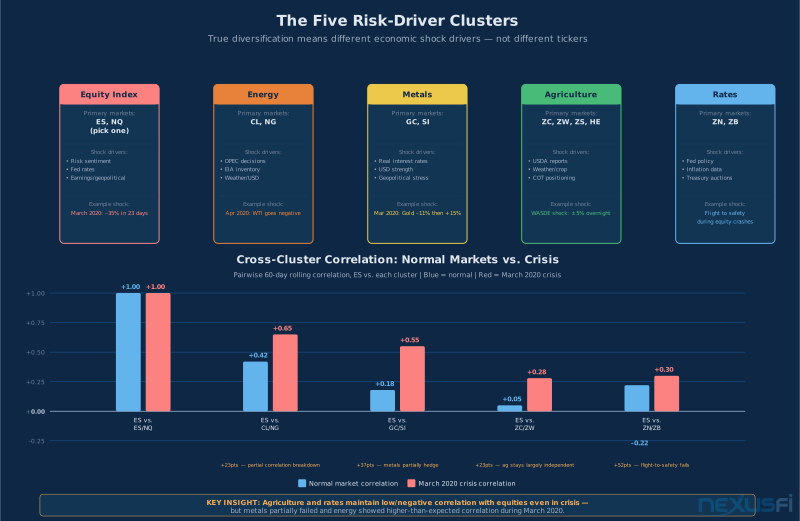
The first mistake is thinking "different symbols = diversification." ES, NQ, and YM are three different instruments. They're also one risk driver: US equity market sentiment. They move together 85%+ of the time. Selling strangles on all three is not diversification — it's concentration with extra steps.
True diversification means selecting markets from different risk-driver clusters:
| Cluster | Primary Markets | Main Shock Sources |
|---|---|---|
| Equity Index | ES, NQ (pick one, not both) | Global risk sentiment, Fed rates, earnings, geopolitical |
| Energy | CL (crude), NG (natural gas) | OPEC, EIA inventory, weather, USD, geopolitics |
| Metals | GC (gold), SI (silver) | Real interest rates, USD strength, geopolitical stress |
| Agriculture | ZC (corn), ZW (wheat), ZS (soybeans), HE (hogs) | USDA reports, weather/crop, COT positioning, seasonals |
| Rates | ZN (10-year), ZB (30-year) | Fed policy, inflation data, Treasury auctions |
Your starting framework: one market from at least three different clusters. The minimum viable diversified book is ES + CL + ZC. Better is ES + CL + ZC + GC + NG — five markets from five distinct clusters.
@myrrdin, who has traded a diversified futures options portfolio for years and runs one of the most-followed threads on NexusFi on this subject, gave his market selection logic:
"If I had to make a choice today, I would take ES, CL, W [wheat], and KC [coffee]. Among the softs, I prefer coffee. Option prices — namely for calls — for very far OTM strikes often are high. Live cattle recently showed some tendency to correlate with the Indices. I stopped selling options in the currencies, and I rarely sell options in the metals."
https://nexusfi.com/showthread.php?t=36932&p=593553#post593553
His reasoning on cattle is instructive: the moment cattle starts correlating with equity indices, it loses its diversification value. You need to monitor these correlations continuously — more on that in the Correlation section.
What makes a market suitable for options selling? Sufficient OTM open interest (100+ contracts at your strike), liquid bid-ask spreads, defined fundamental drivers you follow, premium that justifies the margin, and a manageable event calendar. Currencies (6E, 6J) have been largely abandoned by portfolio sellers — too correlated with equity risk-on/risk-off, erasing their diversification value.
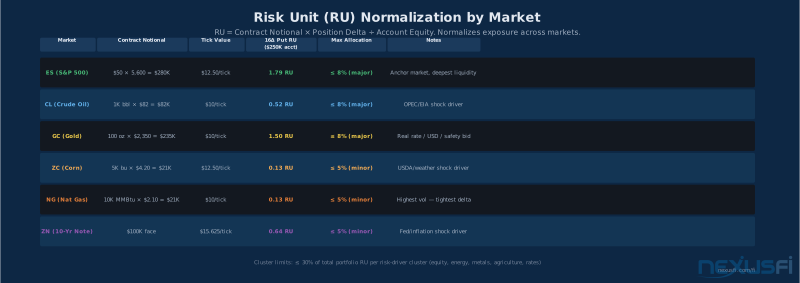
Contract Normalization: Comparing Apples to Apples #
A 1-contract short strangle on ES is not the same economic exposure as a 1-contract short strangle on ZC. The raw contract count is meaningless across markets with wildly different specifications:
- ES: $50 per point, daily range of 40-80 points → $2,000-$4,000 notional daily move per contract
- CL: $1,000 per point (each $1 move), $10 per tick → $1,000 daily move per $1 price change
- ZC: $50 per contract (each 1 cent = $50), so $1 price change = $5,000 → different scale entirely
- NG: $100 per contract (each 0.001 = $10)
To manage a portfolio across these markets, you need a common unit of risk. Use Risk Units (RU):
RU = (Multiplier × Current Price × 0.01) / $100,000For ES at 5,900: RU = ($50 × 5,900 × 0.01) / $100,000 = 0.0295 per 1% move, or approximately 0.5 RU per contract. CL ≈ 0.1 RU per contract at $60 crude. ZC ≈ 0.125 RU per contract.
Why this matters: 3 ES contracts is 10x the exposure of 3 ZC contracts in real dollar terms. Risk Units let you enforce consistent limits across the entire book.
Position sizing in practice:
- Total portfolio RU: 1.0-2.0 for a $100k account
- No single market > 30% of total portfolio RU
- Recalculate RU when markets move significantly (10% price move = 10% RU change)
Building the Capital Allocation System #
You need two independent budgets running simultaneously. They both constrain every new position, and they don't talk to each other — you can't violate the margin budget because the theta budget is fine.
Budget #1: Theta Target
Set a daily theta target of 0.3-0.5% of account equity. For a $300,000 account, that's $900-$1,500/day in theta. This is your income engine. The goal is to maintain this level consistently, across markets, throughout the year.
The reason for the percentage-based approach: it scales with account size as you compound, and it forces you to add positions proportionally rather than loading up after a good run.
Budget #2: SPAN Margin Budget
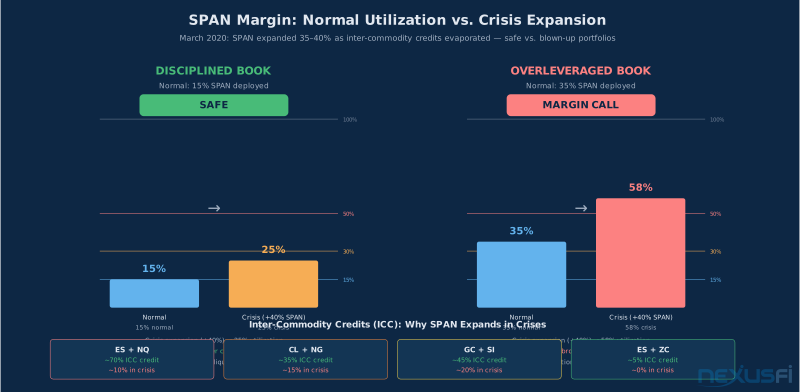
Cap total SPAN margin usage at 15-20% of account equity. At $300,000, that's $45,000-$60,000 in SPAN margin deployed. This sounds conservative — and it is. But here's why it matters: in a crisis, SPAN margin can expand 35-40% as inter-commodity credits evaporate. At 15% deployment normally, a 40% SPAN expansion still leaves you at 21% — below most broker margin calls. At 40% deployment, a 40% SPAN expansion puts you at 56% — margin call territory.
Position size limits (consensus from multi-year practitioners):
| Market Type | Max % of Margin Budget | Example at $60k budget |
|---|---|---|
| Major (ES, CL, GC, ZN) | 8-10% | $4,800-$6,000 per market |
| Minor/volatile (NG, ZC, ZW, HE) | 5% | $3,000 per market |
| Per risk-driver cluster | 20-30% | $12,000-$18,000 per cluster |
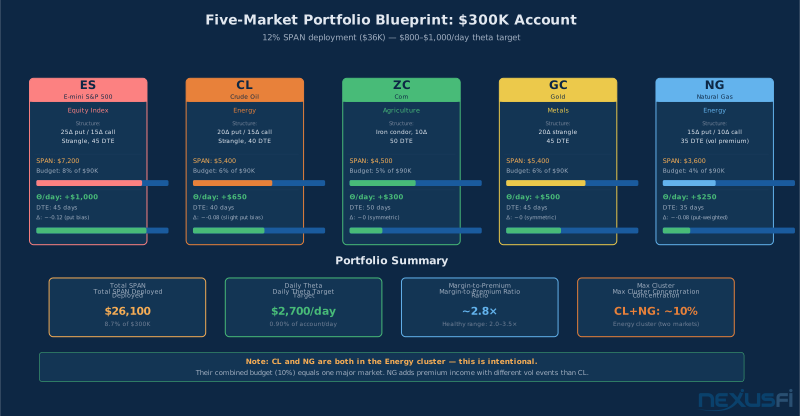
@myrrdin sized positions at 3% of total portfolio per option, occasionally going to 6% for double positions. For a $300k account at 15% SPAN deployment, that's $4,500 normal / $9,000 double position per option.
When both budgets are satisfied: Add the position. When either budget would be violated: reject it regardless of how good the setup looks.
SPAN Margin as the Portfolio Truth #
This section is the most misunderstood part of multi-market options selling. Every trader knows about SPAN margin. Very few understand how it actually works at portfolio level.
SPAN calculates margin based on simulated scenarios — it moves the underlying up, down, or keeps it flat, and calculates your worst-case loss across those scenarios. (For the full mechanics of how SPAN works, see SPAN Margin Mechanics.) The resulting initial margin (IM) is your margin requirement.
Here's the critical point: portfolio SPAN is not the sum of individual margins. SPAN recognizes offsetting positions and grants inter-commodity credits (ICC) when positions reduce overall portfolio risk.
Approximate ICC values for common pairs:
- ES + NQ (both long/short volatility): ~70% offset credit
- CL + NG (both energy sector): ~30-40% offset credit
- GC + SI (metals): ~40-50% offset credit
- ES + CL: ~15% credit (modest relationship)
- ZC + ZW (grains): ~25-30% credit
So if your standalone ES strangle requires $5,000 SPAN and your standalone ZC strangle requires $3,000 SPAN, the portfolio SPAN might be closer to $7,000 than $8,000, because of the modest negative correlation benefit.
The trap: These credits evaporate during crises. When correlations break down and everything moves together, SPAN scenarios all trigger simultaneously. A book that was running at 60% SPAN utilization can hit 85%+ in 24 hours.
Three operational rules for SPAN:
1. Always run a what-if before adding a position. Most broker platforms let you calculate projected SPAN impact of a hypothetical trade. If the marginal SPAN increase is more than 10-15% of your current initial margin, reject the trade — it's outsizing the position.
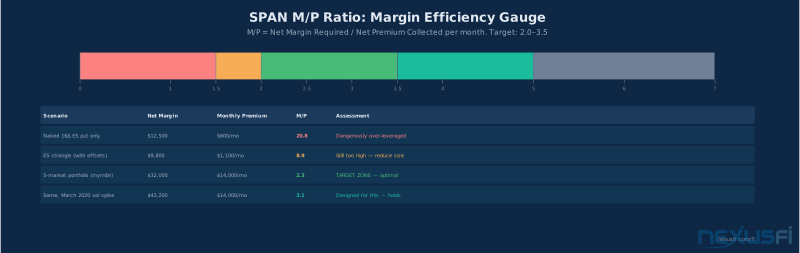
2. Watch the Margin-to-Premium ratio (M/P).
M/P = Total SPAN Deployed / Total Premium CollectedTarget M/P: 2.0-3.5. Below 2.0 means you're collecting efficiently. Above 4.0 means you're too far OTM or in a low-IV environment — a warning sign.
3. Never size based on mark-to-market. After a vol crush, your options show a paper profit and the margin temporarily looks better than it should. Don't add contracts based on this temporary relief. Margin calculations reset with the next significant move.
The strangle structure — selling both sides — is partly a SPAN efficiency play, because the put and call on the same underlying often get partial ICC credit.
https://nexusfi.com/showthread.php?t=12309&p=308416#post308416
Portfolio Greeks Governance #
Managing Greeks at the individual position level is easy. Managing them at the portfolio level across five markets — with different contract sizes, different volatility surfaces, and different event calendars — requires explicit governance rules.
First, normalize everything to your Risk Unit base. Your ES strangle might show delta of -0.15, but that's -0.15 ES delta. To compare it to your CL strangle's -0.20 CL delta, you need to convert both to dollar terms per 1 RU of exposure. Then you can aggregate them.
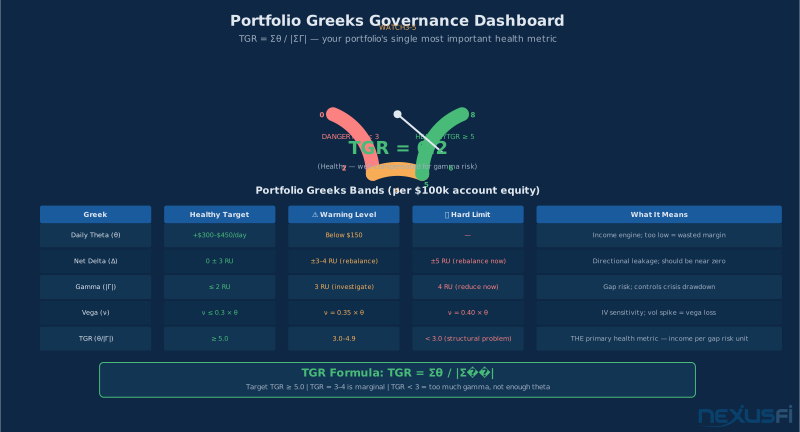
Target Greeks bands (per $100k of account equity):
| Greek | Target | Warning Level | Hard Limit | ||||||
|---|---|---|---|---|---|---|---|---|---|
| Daily Theta (θ) | +$300-450 | Below $150 (too little income) | -- | ||||||
| Net Delta (Δ) | 0 ± 5 RU | ±3-4 RU (rebalance soon) | ±5 RU (rebalance now) | ||||||
| Gamma (Γ) | Γ | ≤ 2 RU | Γ | = 3 RU | Γ | = 4 RU | |||
| Vega (ν) | ν ≤ 0.3 × θ | ν = 0.35 × θ | ν = 0.40 × θ |
What these mean in practice:
Delta is directional leakage — at ±5 RU you're running a directional bet on top of your theta trade. Close or hedge. Gamma is gap risk — keep it low enough that a 2-sigma move can't threaten more than 1-2% of equity. Vega is your IV sensitivity across all markets — a 1-vol-point expansion shouldn't cost more than 30-35% of one day's theta.
Event-risk management: Before FOMC, CPI, OPEC, or USDA WASDE events within your option's lifetime, check projected gamma. If it would push |Γ| above warning levels, close or roll at least 5 days out.
The Theta-to-Gamma Ratio: Your Primary Health Metric #
@PeterOhlson, an Elite Member who approaches options from a quantitative framework, articulated the key health metric clearly:
The Theta-to-Gamma Ratio (TGR) is your portfolio's single most important health indicator:
TGR = Σθ (daily portfolio theta) / |ΣΓ| (absolute aggregate gamma)What TGR measures: how much theta income you're earning per unit of convexity (gamma) risk. A high TGR means you're collecting a lot of premium per unit of gap risk. A low TGR means you're holding dangerous gamma exposure for relatively little daily decay.
TGR interpretation:
- TGR ≥ 5: Healthy book, gamma risk is well-compensated
- TGR = 3-4: Acceptable, but watch for approaching events or vol regime shifts
- TGR < 3: Gamma-heavy relative to theta — investigate. Either reduce gamma positions or add farther OTM premium
Why spreads hurt TGR: Buying the far wing reduces theta more than gamma — the ratio drops. Naked OTM options have structurally better TGR than defined-risk spreads. Not a reason to always go naked, but explains why TGR deteriorates when you add protective wings.
The practical target: maintain TGR ≥ 5 as a portfolio-level constraint. Before rolling any position, check whether the roll improves or hurts TGR.
Before every roll, ask: does this improve or hurt TGR? Calculate new theta vs marginal gamma increase. A roll that collects extra premium but spikes gamma isn't a good roll — find a strike that earns more premium for the same or less gamma exposure.
Correlation and the Dependence Trap #
This is where diversified option selling either works beautifully or fails catastrophically.
March 2020. Stocks crash. Oil crashes. Gold initially falls (liquidation). Commodities broadly sell off. Everything moves together. All the "uncorrelated" markets you carefully selected are suddenly running 90%+ correlation with equity indices. Your short ES puts are losing money. Your short CL calls are losing money. Your GC strangle has a margin call. Your grain options spiked because panic affects even disconnected markets.
@treydog999 described this precisely in May 2020, reflecting on what happened:
"Either through diversification (things went to 1, with precious metals and energy are playing follow the leader with SP500 or vice versa), and most products had a massive vol spike then crush which leaves you in a kind of no man's land..."
This is the correlation breakdown problem. Normal-market correlations evaporate in crises, replaced by near-universal positive correlation. Everything sells off together.
Correlation breakdown is the scenario that kills diversified options books. March 2020: all five major market clusters moved to near-1.0 correlation simultaneously. The only defense is conservative SPAN utilization (15-18%) so that a 40% margin expansion doesn't trigger forced liquidation. There is no diversification benefit when correlations go to 1.
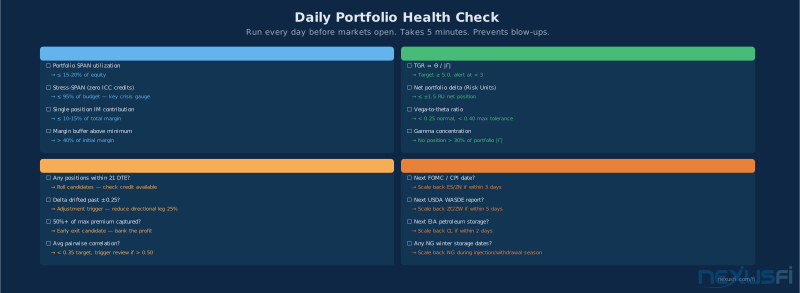
Three-layer correlation monitoring (run daily) — intermarket correlation data tools can help automate this:
| Metric | Calculation | Warning Threshold |
|---|---|---|
| Price correlation | 30-day Pearson of log-returns | > 0.6 between any pair |
| Vol correlation | 10-day realized vol correlation | > 0.5 between markets |
| Tail dependence | Co-VaR at 5% quantile | > 0.4 | It looks like this for a normal market environment:
         ES    CL    GC    ZC    NG
ES      1.00   0.18  0.05  0.08  0.10
CL      0.18  1.00   0.25  0.15  0.30
GC      0.05  0.25  1.00   0.10  0.12
ZC      0.08  0.15  0.10  1.00   0.08
NG      0.10  0.30  0.12  0.08  1.00
In this matrix, no pair exceeds 0.3 correlation — ideal for a diversified short premium book. When that matrix starts showing values above 0.6, you're in a correlation regime where your diversification assumptions break down.
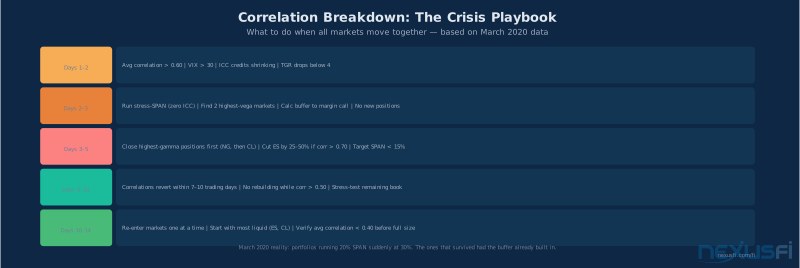
Crisis protocol: When any pair's 30-day correlation jumps from below 0.3 to above 0.7 in a 2-week period, reduce the larger of the two positions by 15-20% immediately. Don't wait to see where it goes.
Bucket concentration rule: No single risk-driver cluster may exceed 30% of your total portfolio Risk Units. ES by itself might be 20% of your total book. Adding NQ puts you at 40% in equity cluster exposure — that violates the rule, even though they're "different" contracts.
The correlation-break buffer: Keep your SPAN utilization at 15-18% during normal markets so that if SPAN expands 35-40% during a crisis (as it did in March 2020), you're still within manageable limits. If you're at 25% SPAN utilization normally and SPAN expands 40%, you're looking at 35% SPAN — approaching margin call territory.
@myrrdin stopped selling currencies when they correlated too closely with equity risk-on/risk-off, and reduced live cattle when it started tracking indices. The portfolio is never static — the correlation matrix is a living map.
Strike Selection Across Different Vol Surfaces #
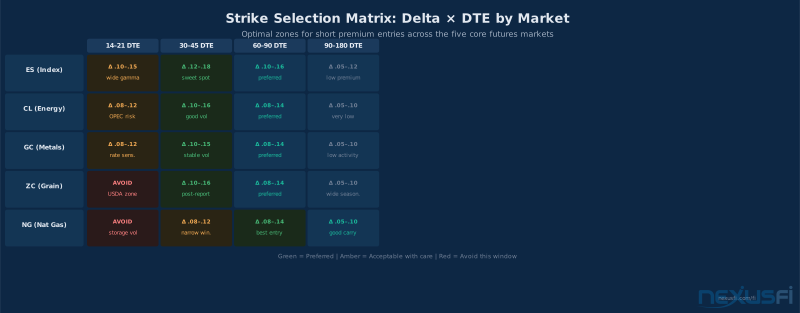
Selling the 16-delta put everywhere doesn't work. Each market has a different volatility surface — different skew, different term structure, different implied distribution shape. A 16-delta ES put carries very different risk characteristics than a 16-delta ZC put, because the underlying vol surfaces are shaped by fundamentally different economic forces.
Equity index options (ES, NQ): Steep downside skew
ES options have substantial negative skew — out-of-the-money puts are priced at significantly higher implied vol than equivalent-delta calls. A 16-delta ES put might carry 22% IV while a 16-delta ES call might carry 18% IV. The market is pricing in fat left-tail risk (crashes happen faster than rallies).
For ES: Sell 20-25 delta puts (puts are expensive, so you can get paid well at lower deltas) and 15-20 delta calls (calls are cheaper, so you need to go closer to the money to collect meaningful premium). This reflects the surface asymmetry — asymmetric strikes, not symmetric.
Energy options (CL): Mild upside skew from supply shocks
Crude oil has moderate positive skew — supply disruptions can spike crude quickly, so calls are somewhat more expensive than puts. Historical patterns: OPEC surprises, pipeline disruptions, Middle East events. The market prices the possibility of rapid upside moves.
For CL: Consider selling 15-20 delta calls and 20-25 delta puts. Study the COT (Commitment of Traders) report before positioning — managed money positioning extremes often indicate directional asymmetry. If commercials are heavily short and speculators heavily long, the supply-side view suggests downside risk may be larger than the options market is pricing.
Metals options (GC): Relatively flat skew
Gold has a more balanced vol surface. Neither puts nor calls are dramatically more expensive than the other, making the symmetric strangle (25 delta calls + 25 delta puts) a reasonable starting point. Adjust based on IVR — if IV rank is above 75%, you can afford to go further OTM (15-20 delta); if IV rank is below 30%, move closer to the money to collect meaningful premium.
Agriculture options (ZC, ZW, ZS): Strong seasonal skew
Grain options have time-varying skew from the crop calendar — spring planting and summer growing seasons can double IV in 2-3 weeks. Use probability-ITM (target 8-12%) rather than delta as your strike criterion — this handles seasonal skew better. Only sell grains when you have a view on the fundamental setup: USDA reports, COT data, and weather forecasts matter.
Natural gas options (NG): Weather-driven upside volatility
NG can double or triple IV during cold weather events. Short calls are the danger: unexpected cold snaps spike prices fast. Keep NG at the low end of your size limits (4-5% of margin budget). Target 10-15 delta on calls (accept less premium for the risk reduction), 15-20 delta on puts. March contract specifically has a history of enormous spikes.
The three-step strike selection process:
- Check IVR. If IV rank > 75%, sell further OTM (reduce delta targets by 15-20%). If IVR < 30%, bring deltas in by 15-20% to collect meaningful premium.
- Adjust for skew. Calculate the "skew factor" for each side:
SF = (current side IV) / (ATM IV). Adjust your delta target by the SF. For ES puts with SF = 1.25 (puts 25% more expensive than ATM), you can afford to go further OTM while collecting the same premium.
- Check fundamentals. For commodity markets, a strong fundamental view should inform which side you weight. Selling calls in a supply-constrained commodity is dangerous even at low delta. COT positioning extremes and seasonal tendencies should flag when to be cautious on a particular side.
The Management Playbook: Rolling, Adjusting, and Exiting #
Managing a multi-market options portfolio is an ongoing operational process, not a set-it-and-forget-it trade. Here's the systematic protocol.
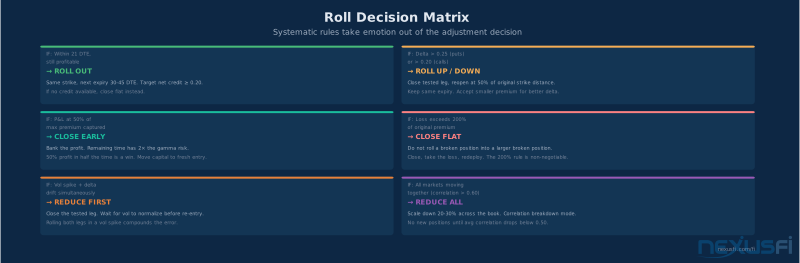
Systematic roll triggers:
| Trigger | Threshold | Action |
|---|---|---|
| Moneyness drift | Delta moves > 0.03 from target | Roll to restore target delta |
| Vol regime shift | IVR changes > 0.15 in 2 days | Adjust strike farther OTM (if IV spikes) |
| Event window | Macro event ≤ 5 days away | Close nearest-ATM leg, reduce gamma |
| Profit target | Premium ≥ 40-50% collected | Close, take profit |
| Max loss | Position value > 200-300% of credit received | Close, take loss |
@myrrdin's exit rule is straightforward: "If profitable, I exit at 10-50% of the entry price. Otherwise, I exit at approx. double the entry price." The profit target range reflects that farther-OTM options often decay faster in percentage terms near expiry, allowing earlier take-profit. The 2x loss rule forces discipline on losers.
The roll cascade problem:
When vol spikes, multiple positions simultaneously hit their rolling triggers. If you try to roll everything at once, you're doing large-scale transactions during peak volatility — terrible execution, high slippage, and the risk of oversizing while in a panic.
Prevent this with staggered roll schedules: Assign each risk-driver cluster a different default roll day. Example: equity index cluster rolls on the 2nd Friday of the month, energy cluster on the 3rd Thursday, metals on the 1st Wednesday. This spreads your transaction activity over time under normal conditions.
Rule: No more than 30% of total portfolio RU rolled in a single day, unless you're in emergency reduction mode.
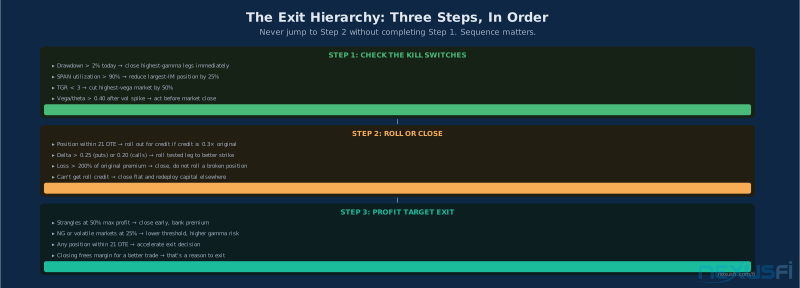
The exit hierarchy — in order:
Step 1: Reduce gamma. Whatever is causing your gamma to spike, close those positions first. Gamma kills. A gamma-heavy book during an adverse move can lose money faster than you can react. Identify your highest-gamma positions (closest to ATM, nearest to expiry) and cut them first.
Step 2: Cap worst-case loss. If SPAN utilization exceeds 85-90% of your budget, start closing positions — even if they're still profitable on paper. Margin calls during a crisis are forced sellers at the worst prices. Stay ahead of the margin call by self-managing your exit.
Step 3: Re-improve theta. Only after gamma is controlled and margin is back within limits do you start thinking about re-entering new premium positions. Don't chase lost theta by entering new positions while the fire is still burning.
Hard exits (non-negotiable):
- Drawdown > 2% of account equity in a single day: close riskiest positions immediately
- SPAN utilization > 90% of budget: scale down largest-IM position by 20-30%
- Vega-to-theta ratio > 0.40 after vol spike: close highest-vega market
Soft exits (systematic reduction):
- Delta drifts past ±3 RU: scale down the directional leg by 25%
- TGR drops below 3: reduce gamma-heavy positions until TGR returns to 4+
Stress Testing Your Portfolio #
Most options sellers stress-test informally — they think "what if ES drops 10%?" Run that scenario, not quarterly, but monthly. And run the scenarios that matter for multi-market books specifically.
Monthly stress test matrix:
| Scenario | Assumptions | Key Metric to Check |
|---|---|---|
| Correlation breakdown | All market correlations → 1.0 | Total SPAN after ICC credits evaporate (expect +35-40%) |
| IV shock | +30% IV across all markets simultaneously | Vega P&L, M/P ratio post-shock |
| Gap event | 4σ price jump in one market | Worst-case MTM loss, margin impact |
| Margin expansion | SPAN credits drop 50%, all IMs increase 40% | Post-expansion utilization vs budget |
| Liquidity crunch | Bid-ask widens 3x | Execution cost of emergency exit |
The correlation breakdown scenario is the most important. Run it by calculating your SPAN assuming all inter-commodity credits are zero. If that SPAN exceeds your margin budget, you're overleveraged — reduce positions until the no-credit SPAN stays within budget.
The March 2020 data point: SPAN margins expanded 35-40% across multiple asset classes in a single week. Inter-commodity credits dropped much. Books running at 20% SPAN utilization were suddenly at 30%. Books running at 35% were in trouble.
@MJ888's 2008 experience: "I had eleven consecutive losers. But when things calmed down, I was able to recoup the losses rather quickly." That's actually the good-news version of correlation breakdown — a diversified book survived and recovered. The bad-news version is James Cordier's OptionSellers.com blow-up in 2018, where concentrated short natural gas calls wiped out the entire fund in one move.
The Go/No-Go Gate: Adding New Positions #
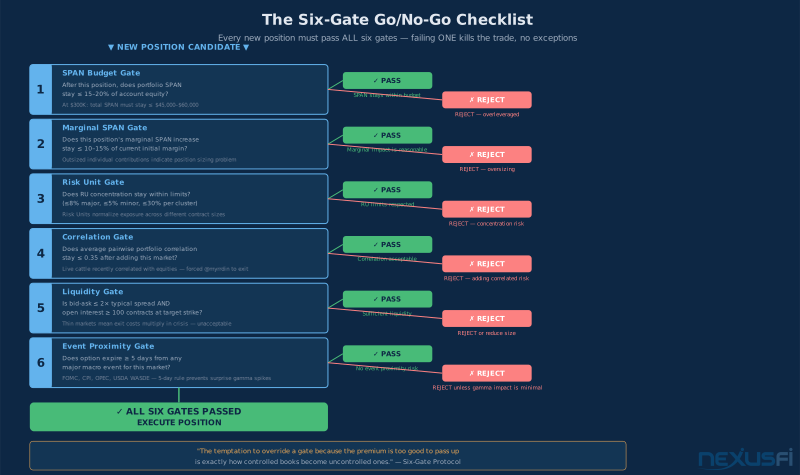
Every new position — every single one — must pass all six gates before execution. No exceptions for "great-looking" setups. The discipline of the gate is what keeps the portfolio healthy.
Six-gate checklist for new positions:
Gate 1: SPAN budget. After adding this position, does portfolio SPAN stay ≤ 15-20% of account equity? If not: reject.
Gate 2: Marginal SPAN impact. Does this position's marginal SPAN contribution stay ≤ 10-15% of current initial margin? Larger additions need explicit approval. If not: reject.
Gate 3: Risk Unit concentration. Does this position keep the market's RU contribution within limits (≤ 8% for major, ≤ 5% for minor markets)? Does the risk-driver cluster stay ≤ 30% of total portfolio RU? If not: reject.
Gate 4: Correlation impact. After adding this position, does the average pairwise price correlation of the portfolio stay ≤ 0.35? If the new market bumps average correlation above 0.40: reject.
Gate 5: Liquidity check. Is the bid-ask spread on the target option ≤ 2x the typical spread for that expiry? Are there at least 100+ contracts of open interest at the target strike? If not: reject (or reduce size much).
Gate 6: Event proximity. Does this option expire within 5 days of a scheduled major macro event for this market (FOMC, CPI, OPEC meeting, USDA WASDE, etc.)? If yes: only proceed if the position's gamma contribution keeps portfolio |Γ| well below the 0.2θ threshold. Otherwise: reject.
Any single failed gate kills the trade. The temptation to override a gate because "the premium is too good to pass up" is exactly how controlled books become uncontrolled ones.
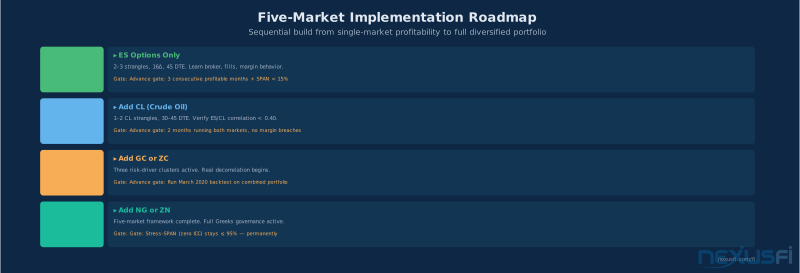
The Five-Market Implementation Framework #
Here's a concrete starting portfolio structure and daily management routine. This is a real framework, not a hypothetical.
Core portfolio: ES + CL + ZC + GC + NG
Why these five? Each comes from a different risk-driver cluster, each has sufficient liquidity in OTM strikes, and the combination has historically shown low pairwise correlations in normal markets.
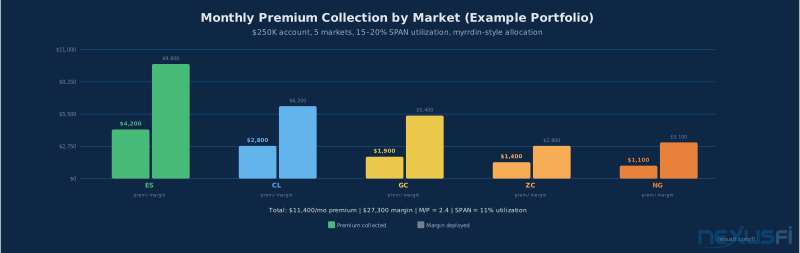
Typical position structure (sample, $300k account at 12% SPAN deployment):
| Market | Structure | DTE | Approx. Delta | Target Premium |
|---|---|---|---|---|
| ES | 25Δ put / 15Δ call (strangle) | 45 days | Asymmetric | $800-1,200 credit |
| CL | 20Δ put / 15Δ call | 40 days | Slight put bias | $500-800 credit |
| ZC | Iron condor (10Δ each side) | 50 days | Symmetric | $200-400 credit |
| GC | 20Δ strangle | 45 days | Symmetric | $400-600 credit |
| NG | 15Δ put / 10Δ call | 35 days | Put-weighted | $200-350 credit |
Total daily theta at this structure: approximately $800-1,000/day for a $300k account — within the 0.3-0.5% target.
Daily monitoring checklist (5 min each morning):
- Correlation matrix: flag any pair > 0.5
- SPAN utilization: flag if > 80% of budget
- Portfolio Greeks: flag |Γ| > 2 RU or ν > 0.30 × θ
- IVR per market: roll farther OTM if > 0.75, wait if < 0.25
- Event calendar: identify macro events within option lifetimes
- Zero-ICC stress SPAN: flag if > 85% of budget
@myrrdin's full framework summary, which he's shared across hundreds of posts in his thread:
That last line is the core principle. Reduced position size per market is not leaving money on the table — it's preserving your ability to trade tomorrow. The diversified portfolio, run with discipline, earns consistent premium income without the cliff-edge drawdowns that define single-market option sellers.
The portfolio lives or dies by the checklist. Run it every day. The day you skip it is the day you have a position approaching ATM and you didn't notice.
Knowledge Map
Prerequisites
Understand these firstGo Deeper
Build on this knowledgeReferences This Article
Articles that build on this topicCitations
- — Diversified Option Selling Portfolio (2023) 👍 12“Original diversified portfolio framework: 8-15 positions, 90-180 DTE, delta 0.02-0.2”
- — Selling Options on Futures? (2015) 👍 28“August 2015 stress test: survived via diversification, options book -15% but overall +9%”
- — Diversified Option Selling Portfolio (2019) 👍 15“Market selection framework: ES, CL, W, KC as starting multi-market book”
- — Selling Options on Futures? (2020) 👍 18“March 2020 correlation breakdown: everything went to 1, diversification limits”
- — Selling Options on Futures? (2016) 👍 22“Evolution of options selling: strangles on ES/CL/GC/SI, SPAN efficiency, 2008 survival”
- — Selling Options on Futures? (2017) 👍 34“Portfolio health metric: theta/gamma ratio theory and delta hedging”
- — Selling Options on Futures? (2021) 👍 19“Why diversification: small drawdown, decent profits, good sleep”
- CME Group — Cmegroup.com (2023)
- Reuters — Reuters.com (2018)
- CBOE — Cboe.com (2023)