



Pre-Market Data and Overnight Session Analysis
Overview #
Most day traders spend their pre-market prep reviewing yesterday's chart, maybe checking the economic calendar, and glancing at the current futures quote. That's the minimum. The traders who consistently outperform aren't working harder — they're working smarter, and a big part of that edge comes from what the market communicated during the overnight session while everyone else was asleep.
The overnight Globex session for US index futures runs from 5:00 PM Central to 8:30 AM Central — that's 15.5 hours of trading activity before the regular session opens. During that window, Asian institutions trade their domestic news, European traders execute around ECB data and macroeconomic releases, and the futures market prices in everything the US cash market can't yet absorb. By the time your alarm goes off, the market has already left you a roadmap. The question is whether you know how to read it.
This article covers the data generated during the overnight session, why it matters, and exactly how professional day traders use it to build their game plan before the 9:30 AM open. The core tool is the overnight high and low (ONH/ONL) — two of the most predictively powerful price levels you can put on a chart — along with overnight volume profile data, gap analysis, international market context, and a pre-market preparation framework that turns raw data into actionable intelligence.
The overnight session generates data that defines the boundaries of the next day's auction. Ignoring it means walking into RTH blind to the levels where institutional capital entered, defended, or broke through overnight — levels the market has already validated.
The Overnight Session Defined #
The overnight session has a precise definition that traders sometimes get wrong.
— when CME extended the trading day for index futures from the old 3:15 PM close to the current 4:15 PM close.[4]
In practical terms for equity index futures:
CME Globex trading hours (ES, NQ, RTY, YM):
- Full session: Sunday 5:00 PM CT through Friday 4:00 PM CT (with a 15-minute halt from 3:15-3:30 PM CT each weekday)
- RTH (Regular Trading Hours): 8:30 AM CT through 3:15 PM CT (Monday-Friday)
- Overnight session: 5:00 PM CT (Monday-Thursday) through 8:29:59 AM CT the following morning
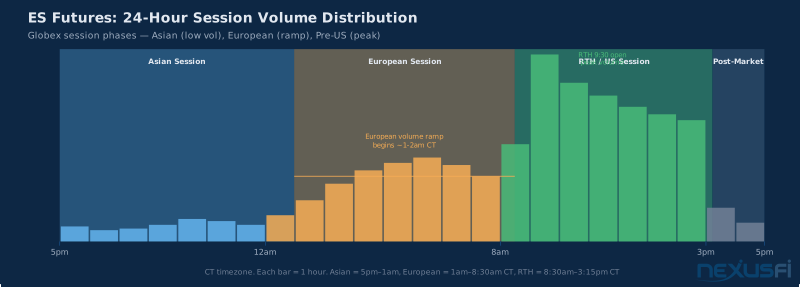
The overnight session is not a single homogeneous block of activity. It breaks into three distinct phases, each dominated by different market participants with different agendas:
Phase 1 — Asian Session (5:00 PM - 1:00 AM CT) Tokyo Stock Exchange opens at 7:00 PM CT. The Hang Seng opens around 8:00 PM CT. ES and NQ futures follow Asian equity markets during this window. The overnight range during the Asia-only period averages 7 points on ES compared to the 15-20 point average full overnight range — it's slow, deliberate movement driven by Asian institutional flow and any post-US-close news events.
Phase 2 — European Open (1:00 AM - 2:30 AM CT) The Frankfurt/DAX open begins at 2:00 AM CT (1:00 AM CT for DAX futures).
[3] ES volume noticeably increases from around 2:30-3:00 AM CT as European participation ramps up.
Phase 3 — European Active + Pre-US (2:30 AM - 8:30 AM CT) Peak overnight volume. European economic data releases typically hit between 3:00-5:00 AM CT. Most European news that can move US markets gets processed during this window. This is where the overnight session earns its reputation for setting genuine directional bias.
Overnight High and Low: The Most Important Levels on the Chart #
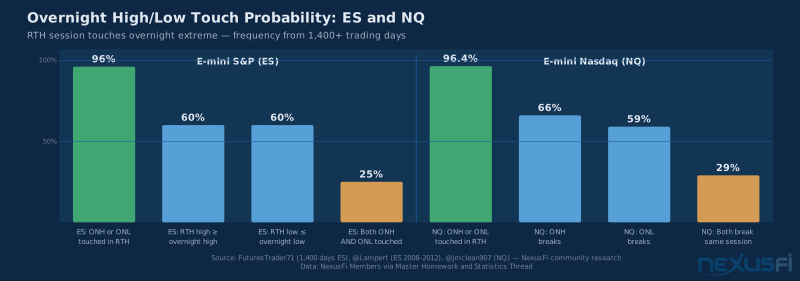
The overnight high (ONH) and overnight low (ONL) are the most statistically significant pre-market price levels for US equity index futures. Not because traders worship them, but because the market itself repeatedly returns to test them.
This was independently corroborated by @Lampert using ES data from 2008-2012: "60% of the time, the RTH high is >= overnight high. 60% of the time, the RTH low is <= overnight low. 25% of the time, both conditions occur in the same session. 95% of the time, either condition or both conditions occur."[2]
For NQ,
The practical trading implication: put the ONH and ONL on your chart every morning, because the RTH session will almost certainly interact with at least one of them. The question isn't whether price will reach the overnight extremes — it usually does. The question is which extreme gets hit first, and whether the break is sustained or reversed.
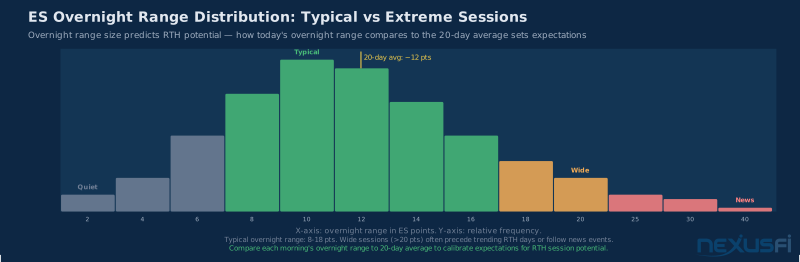
@arnie analyzed 1,207 trading days and found "70% of the time the overnight range runs between 6 and 19 handles. The most common range is 10 handles" — independent confirmation that the 8-18 point range is the standard expectation zone.[10]
ONH/ONL as Trading Levels: Not Just Lines #
The ONH and ONL aren't magic — they work because of what they represent. The ONH marks where sellers entered and held during the overnight session. The ONL marks where buyers held. If the overnight range was built on thin volume (typical Asian session), those levels carry less structural significance. If the range was carved out during the European session on elevated volume, those levels represent institutional positioning that will get tested when US liquidity enters.
Directional context matters:
- Overnight higher than prior RTH close: Buyers used the overnight session to push price above the day session's final print. This is bullish positioning — Asian/European institutions accumulated at higher prices, which means there's a structural base below the ONH.
- Overnight lower than prior RTH close: Sellers dominated overnight. The ONH may act as resistance on the first RTH test.
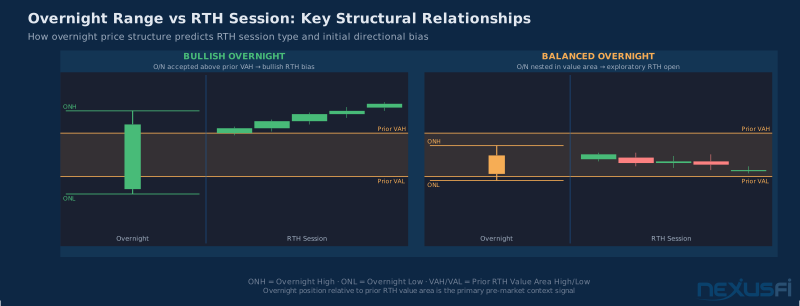
- Overnight range contained within prior RTH value area: The market is in balance — overnight participants accepted the prior day's prices as fair value. Balanced opens tend to be exploratory and can go either direction.
The relationship between the ONH/ONL and the prior day's RTH high/low is a quick gap classification tool. Prior RTH high < ONH = overnight buyers were aggressive. Prior RTH low > ONL = overnight sellers were aggressive. Prior RTH range contains the ONH and ONL = overnight was a non-event.
When ONH/ONL Don't Hold #
On trend days — identifiable by strong directional openings, expanding single prints in the volume profile, and sustained directional delta — the market blows through both overnight extremes. Fading ONH or ONL on a trend day is one of the most reliable ways to get on the wrong side of a 20-30 point ES move.
The overnight range is a low-volume structural reference, not a hard barrier. Its predictive value is highest in balanced, mean-reverting conditions — exactly the most common day type (roughly 65-70% of sessions). On the 30-35% of sessions that trend, the ONH and ONL become launchpads for extensions, not reversal points.
Overnight Volume Profile: The VPOC and Value Area #
The overnight session's volume profile provides depth beyond the raw high/low extremes. Every overnight session generates its own:
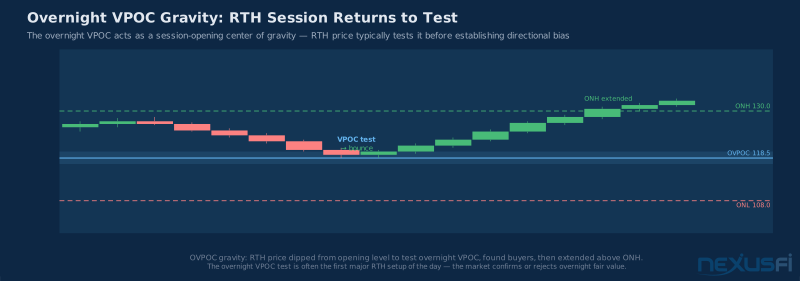
- Overnight VPOC (Volume Point of Control): The price where the most volume traded during the overnight session. Acts as an overnight magnet — price tends to return to the overnight VPOC before breaking away
- Overnight Value Area: The price range containing 70% of overnight volume. Typically spans 60-70% of the overnight range
- Low Volume Nodes (LVNs): Price zones where the overnight market transacted minimally — these gaps in overnight activity become fast-moving areas in the RTH session
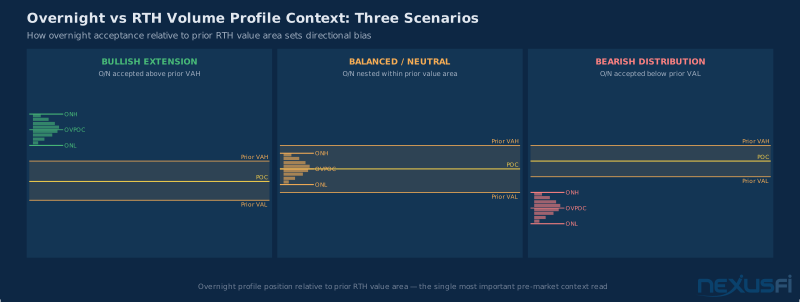
The most important composite to track is how the overnight profile relates to the prior day's RTH profile. Three key relationships:
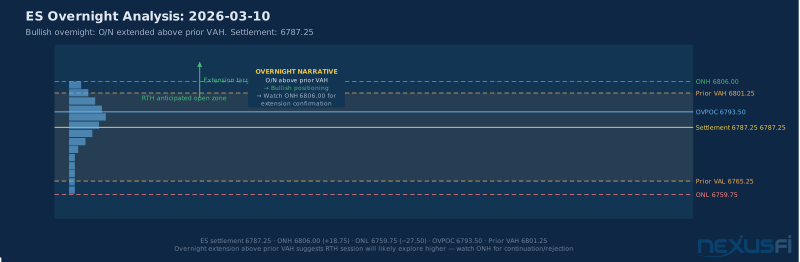
1. Overnight acceptance above prior RTH VAH (Value Area High): Overnight buyers accepted prices above where the prior RTH session agreed value exists. Bullish positioning — overnight PA suggests RTH will likely explore higher.
2. Overnight acceptance below prior RTH VAL (Value Area Low): Bearish positioning — overnight sellers pushed price into new territory below prior RTH value, suggesting continued selling in RTH.
3. Overnight profile nested within prior RTH value area: Range trade environment — overnight participants stayed inside the day session's accepted value zone. RTH often opens to a balanced, exploratory session.
The Opening Gap: Statistics and Strategy #
An opening gap in futures occurs when the 9:30 AM RTH open price differs from the prior day's 4:15 PM RTH close price. Gaps form during the overnight session — they're not random events but the direct result of overnight price discovery that US cash market participants haven't yet processed.
Gap fill rates for ES are frequently cited but rarely backed with rigor. The published community research suggests:
- Small gaps (< 5 points on ES): Fill within the same session approximately 75-80% of the time
- Medium gaps (5-10 points): Fill rates drop to 55-65%
- Large gaps (> 10 points): Often trend continuation rather than reversion — fill rates below 50%
- News-driven gaps on high overnight volume: Much lower fill probability regardless of size — the market is pricing in new information, not reverting to prior equilibrium
The gap fill determination comes from the overnight data itself:
- High overnight volume with directional conviction: Follow — the overnight session built a case for continuation
- Low overnight volume with a drift gap: Fade — no institutional backing behind the gap, likely to fill as US participants push back
- Gap into a prior day's key level (ONH of last week, settlement price, major VPOC): Favor reversal — the gap is filling in structural space, not breaking new ground
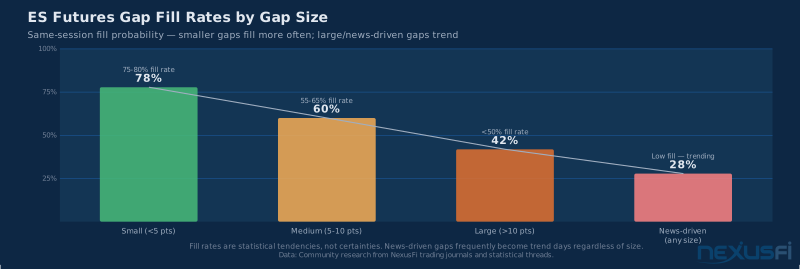
The gap fill "rule" is one of the most misused statistics in retail trading. It's a population-level tendency, not a session-level prediction. The 75% fill rate for small gaps means 25% of the time you're wrong — and wrong at the open against institutional momentum is expensive. Always confirm gap fade setups with the overnight volume profile: if overnight sellers pushed price down on building volume into a level, the gap is directional, not noise.
The Overnight/RTH Correlation Puzzle #
Here's a counterintuitive finding that matters for strategy: overnight price direction and RTH price direction have a mild negative correlation. @tigertrader cited research from Cliff, Cooper, and Gulen: "Between overnight and subsequent daytime changes the correlation is approximately -7.2%."[8]
The same research found that from 1993-2008, the US equity premium was almost entirely generated during the overnight session — daytime returns were flat to negative on average. In other words, institutional accumulation happened while retail slept.
This -7% correlation doesn't mean "always fade the overnight direction." It means:
- Don't assume overnight trend continuation into RTH — a strong overnight rally doesn't mean RTH will extend it. If anything, strong overnight moves often exhaust the near-term demand, leaving RTH to absorb supply
- The overnight session processes macro risk; RTH processes execution risk — these are different mechanics that don't have to align directionally
- Large overnight ranges often compress in RTH — the auction theory principle: after a strong directional move, participants need to test whether the new price level is accepted. RTH often opens with balance-seeking behavior after big overnight trends
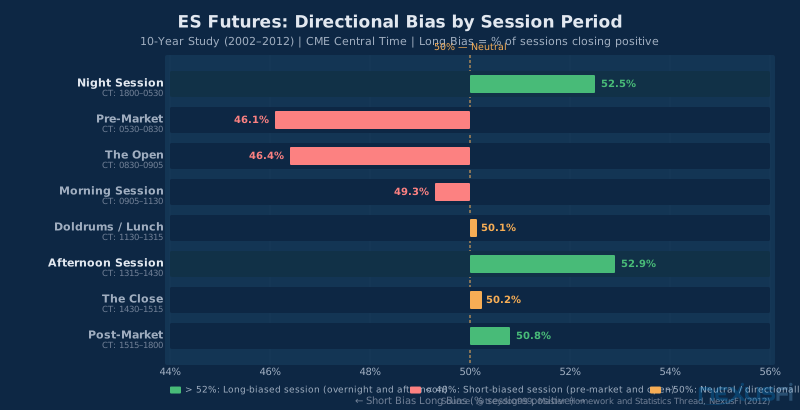
@treydog999 studied this at session-granularity level — 10 years of ES data (2002-2012), measuring the directional bias of each intraday period. His results confirm the overnight long bias and the morning mean-reversion tendency: "A majority of the returns of the ES come from the afternoon and overnight session."[11] The night session ran 52.5% long-biased; the pre-market and opening hour both leaned slightly short — the same -7.2% correlation playing out at the intraday level.
Initial Balance Integration #
The Initial Balance (IB) — typically defined as the first 30-60 minutes of RTH trading (8:30-9:00 AM CT, or 8:30-9:30 AM CT depending on your methodology) — is the bridge between overnight data and the day's developing structure.
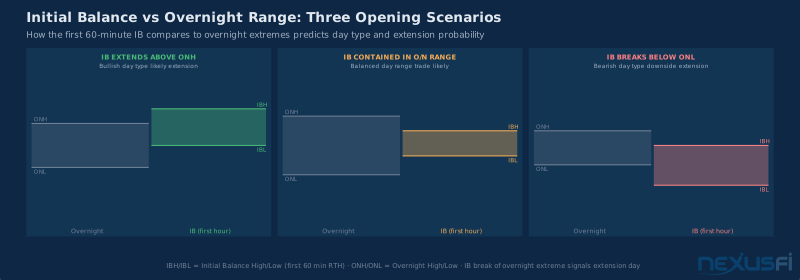
@Lampert's research found that the relationship between the overnight range and the Initial Balance range is a leading indicator of RTH direction: "The difference between the overnight high and the Initial Balance high appears to be a leading indicator of the RTH high. The same observation applies to the lows."[2]
The key IB/overnight relationships:
IB High > ONH: The RTH session opened above the overnight high and the first hour accepted these higher prices. Strong bullish structure — buyers are validating the overnight move. Target 1.5-2x IB extension above
IB Low < ONL: RTH opened below or near the overnight low and the first hour validated lower. Bearish structure — sellers are confirming overnight distribution
IB contained within overnight range: The RTH session is negotiating within the established overnight boundaries. Classic balance-seeking behavior — expect range-bound first hour with a potential breakout above/below overnight extremes later in session
ONH/ONL within IB: The overnight extreme was tested and held within the first hour — a clear reference point for the rest of the session. If ONH held during IB, it's now a tested resistance. If ONL held, it's tested support.
Data Sources for Pre-Market Analysis #
The quality of your overnight data depends on your feed and the tools you use to visualize it.
Primary data feeds for overnight Globex data:
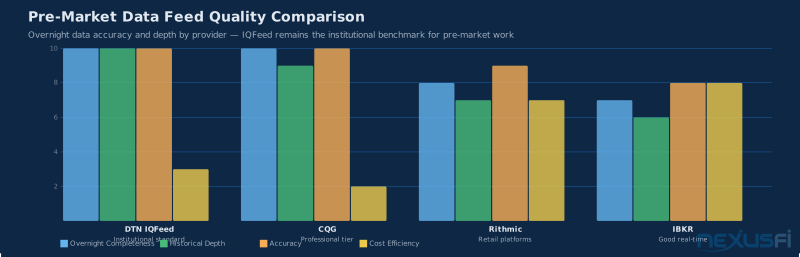
DTN IQFeed: The institutional standard for continuous overnight data. Full tick history from the overnight session, no delays, correct session timestamps. IQFeed's continuous contract data handles roll adjustments properly — critical if you're building overnight range databases across multiple years. For pre-market data work, IQFeed at the broker-level subscription ($75-100/month) is the baseline.
CQG: Higher-end institutional feed. Superior data quality verification tools, better handling of overnight session breaks, used by most professional trading firms for pre-market analysis. Access typically comes through clearing brokers.
Rithmic: Comes standard with many retail futures platforms (Tradovate, NinjaTrader, APEX). Solid for real-time overnight monitoring but can have issues with historical overnight data completeness.
Interactive Brokers / IBKR: Market data at retail price. Good enough for monitoring overnight price action in real-time. Historical overnight data is adequate for basic level analysis but doesn't match IQFeed depth for systematic research.
Platform display for overnight levels:
The overnight high, low, and VPOC need to be automatically drawn on your chart each morning. Key platform configurations:
- NinjaTrader: Session templates — create an "Overnight" session from 5:00 PM to 8:29:59 AM, and RTH session from 8:30 AM to 3:15 PM. This allows the platform to automatically calculate and display overnight ranges and volume profiles.
- Sierra Chart: Session range indicator — set to overnight session dates and the platform auto-draws. Sierra Chart's market data for 24-hour Globex sessions is among the best implementations for overnight analysis.
- TradeStation: Custom sessions for continuous contract overnight data. Less flexible than NinjaTrader or Sierra Chart for session-specific analysis.
The Pre-Market Preparation Framework #
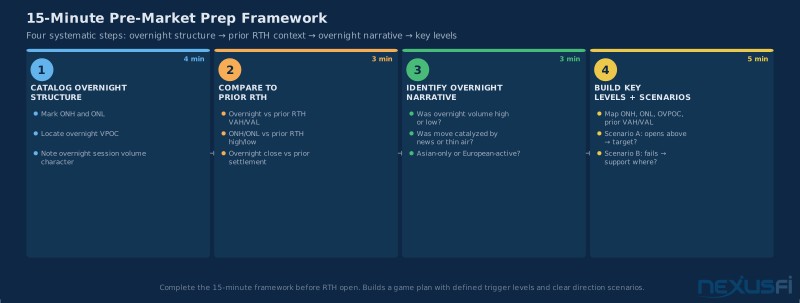
Here's how professional ES and NQ day traders build their pre-market game plan using overnight data. This is the 15-20 minute process that replaces the "check the quote and read Twitter" routine.
Step 1: Catalog the overnight session structure (5 minutes)
- Note the ONH, ONL, and overnight range size (ONH - ONL). How does today's overnight range compare to the 20-day average overnight range? Wider overnight range = larger potential RTH move.
- Identify the overnight session phase where the range was established. European session break? Asian session low-volume drift? This determines structural significance.
- Mark the overnight VPOC on your chart. This is where you'll expect price to gravitate before directional extension.
- Note the overnight close relative to ONH and ONL. Overnight closing in the upper third = buyers controlled the close. Lower third = sellers. Midrange = balance.
Step 2: Compare to prior RTH session levels (3 minutes)
- Is the current price (overnight close / pre-market quote) above or below prior RTH settlement price? This determines the gap size and direction.
- Is current price above prior RTH VAH, within prior RTH value, or below prior RTH VAL? This is your starting context: extension, rotation, or breakout attempt.
- Note any significant overnight tests of prior day's RTH high/low. Did the market accept those levels (build time/volume there) or reject them (touch and reverse)?
Step 3: Identify the overnight narrative (3 minutes)
- What drove the overnight move? Check: Asian equity performance (Nikkei, Hang Seng), European economic data releases (ECB, Eurozone PMI, German CPI), Fed speak, US economic surprises from after-hours. The narrative tells you whether the overnight move has structural backing.
- High overnight volume + news trigger = directional bias worth respecting. Low overnight volume + no clear trigger = noise likely to revert.
Step 4: Construct key levels and directional scenarios (5 minutes)
- Map your day's key levels: ONH, ONL, overnight VPOC, prior RTH VAH, prior RTH VAL, prior RTH settlement, any weekly/monthly reference levels that price is approaching.
- Define two scenarios: "Scenario A: Price opens above ONH / overnight VPOC and accepts there — what's the target?" and "Scenario B: Price fails at ONH / tests ONL — where does it find support?"
- Identify the directional trigger: which level breaks first confirms which scenario is playing out.
The pre-market prep framework turns overnight data from noise into signal. ONH/ONL define the boundaries. Overnight VPOC defines the center of gravity. Prior RTH levels define the structural context. And the overnight volume tells you which boundaries were built by institutions vs which were built by thin air.
International Market Context: What to Watch and When #
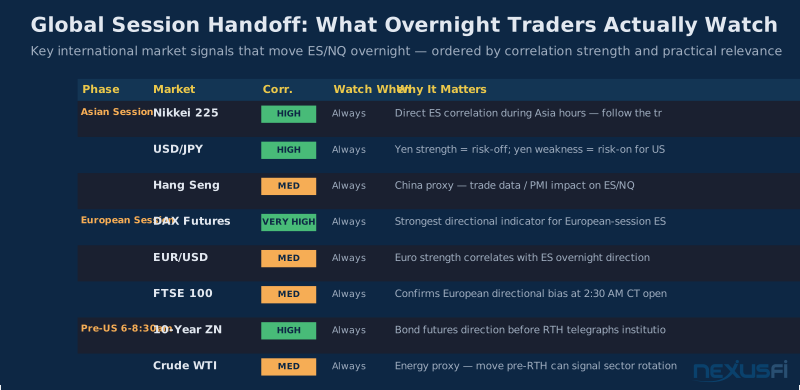
The overnight session's three market phases each have their own intelligence:
Asian session watch list:
- Nikkei 225 performance (strong positive correlation to ES/NQ during Asia hours)
- Hang Seng / Hong Kong markets (China PMI and trade data proxies)
- USD/JPY (yen strength/weakness is a major risk-on/risk-off indicator overnight)
- Overnight crude oil pricing (WTI futures follow Asian demand data)
European session watch list:
- DAX futures (Germany's DAX is the strongest directional indicator for European session ES movement)
- EUR/USD: European currency strength often correlates with ES overnight direction
- European economic data: ECB rate decisions, German GDP, Eurozone CPI, PMIs (all hit 3:00-5:00 AM CT)
- UK markets: FTSE 100 open (2:30 AM CT) often provides directional confirmation
Post-European / Pre-US session watch list (6:00-8:30 AM CT):
- US equity futures are often in a drift state — major directional moves less common
- Any Fed speeches or US early economic data releases (Jobless Claims hit 7:30 AM CT on Thursdays)
- Bonds (ZN, ZB) direction: 10-year note futures moving before RTH often telegraphs institutional interest rate positioning
- Pre-market SPY/QQQ activity: while less informative than futures for ES/NQ traders, extreme pre-market moves in single stocks can telegraph sector rotation
When Overnight Data Fails #
The overnight/RTH relationship breaks down in two key scenarios:
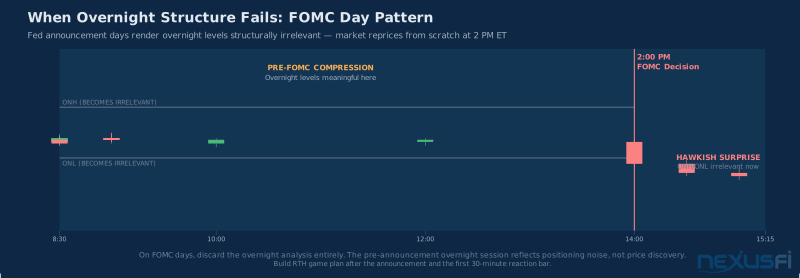
Major scheduled announcements: FOMC days, CPI/PPI releases, Non-Farm Payrolls — any event that at the core reprices risk makes the overnight structure irrelevant. On FOMC days, the ONH and ONL have no predictive value for the post-announcement RTH session. The market needs to discover new equilibrium from scratch.
Liquidity events and flash crashes: Overnight liquidity is structurally thin — typically 10-15% of RTH volume in the ES. Large single orders, forced liquidations, or circuit breaker events can move the overnight market to technically extreme levels that bear no relationship to fair value or institutional positioning. The August 2015 overnight session on ES dropped 50+ handles on thin volume before recovering. The ONH and ONL from that overnight were meaningless for RTH analysis.
Highly volatile multi-day trends: During sustained trending markets (10+ point ES daily ranges, consecutive directional closes), the overnight structure shifts from a balanced reference to a continuation vehicle. In strong uptrends, the overnight range builds higher each day and the ONH/ONL relationship continuously extends. In these regimes, the overnight structure is useful directionally but the fade-the-gap statistics cited above become unreliable.
On FOMC days and major data releases, discard the overnight high/low analysis entirely. The pre-announcement overnight session is positioning noise, not price discovery. Build your RTH game plan from scratch based on the announcement outcome and the first 30 minutes of RTH reaction.
Citations #
- @FuturesTrader71. "AMA: FuturesTrader71 (FT71) / Morad Askar." Trading Reviews and Vendors. 2014.
- @Lampert. "Master Homework and Statistics Thread." The Elite Circle. 2012.
- @redratsal. "Overnight Session ES Trading." Emini and Emicro Index. 2011.
- @Fat Tails. "Overnight Session-Exact Time." Traders Hideout. 2015.
- @bobwest. "Not Another PAT Journal." Trading Journals. 2020.
- @jmclean907. "Master Homework and Statistics Thread." The Elite Circle. 2015.
- @thegapguy. "Emini gap fill strategy data, books?" Emini and Emicro Index. 2020.
- @tigertrader. "The Difference Between Night and Day." Emini and Emicro Index. 2011.
- @bobwest. "TRADING HOURS — post trading hours — and Lots of Action." Traders Hideout. 2020.
- @arnie. "Master Homework and Statistics Thread." The Elite Circle. 2012.
- @treydog999. "Exploring Biases in the ES based on Time." Master Homework and Statistics Thread. The Elite Circle. 2012.
Knowledge Map
Prerequisites
Understand these firstGo Deeper
Build on this knowledgeReferences This Article
Articles that build on this topicCitations
- — AMA: FuturesTrader71 (FT71) / Morad Askar (2014) 👍 5“96% of the time, the day session touched or broke the overnight high OR low. 27% of the time, it touched or broke both.”
- — Master Homework and Statistics Thread (2012) 👍 11“60% of the time, the RTH high is >= overnight high. 60% of the time, the RTH low is <= overnight low. 25% of the time, both conditions occur in the same session. 95% of the time, either condition or both conditions occur.”
- — Overnight Session ES Trading (2011) 👍 20“As the European markets begin to open at 1 a.m. CDT, more evidence of market direction can be seen. Germany has the largest economy in Europe and its DAX futures is a solid market to follow.”
- — Overnight Session-Exact Time (2015) 👍 4“For index futures the overnight session is the period from 5:00 PM Central to 8:30 AM Central, at least since November 2012 when CME extended the trading day for index futures.”
- — Not Another PAT Journal (2020) 👍 5“If you look at volume in the ES and other US equity futures, you will see a reliable increase every morning at about 2:30 to 3:00 AM US Eastern Time.”
- — Master Homework and Statistics Thread (2015) 👍 8“96.4% Overnight high OR Overnight Low will break for NQ. Overnight high breaks 66%, Overnight low breaks 59%. Both will be broken 29%.”
- — Emini gap fill strategy data, books? (2020) 👍 3“I will either fade or follow the opening price action. Fade = a mean reversion trade where I short 'up' gaps or buy 'down' gaps. Follow = a momentum trade where I buy 'up' gaps or sell 'down' gaps.”
- — The Difference Between Night and Day (2011) 👍 10“The correlation between overnight and subsequent daytime changes is approximately -7.2%. Between daytime and subsequent overnight changes the correlation is approximately -10.7%.”
- — TRADING HOURS -- post trading hours -- and Lots of Action (2020) 👍 6“Tokyo starts trading at 7 PM CT. From what I've seen, most days the ES, NQ, and bonds start moving more when Tokyo opens.”
- — Master Homework and Statistics Thread (2012) 👍 16“I started to look at what was the most common overnight range for the last 1207 days. 70% of the time the overnight range runs between 6 and 19 handles. The most common range is 10 handles.”
- — Master Homework and Statistics Thread (2012) 👍 5“A majority of the returns of the ES come from the afternoon and overnight session. The night session showed a 52.5% long bias; the pre-market window and morning session leaned slightly short over 10 years of ES data.”