



Japan Exchange Group (JPX): Asia's Largest Futures Exchange and Why It Matters for Your Trading
Overview #
Japan Exchange Group runs the biggest derivatives market in Asia. The Osaka Exchange (OSE) — JPX's futures and options arm — trades over 400 million contracts per year, with the Nikkei 225 Mini alone rivaling ES in daily volume during Tokyo hours. If you trade futures and you're not at least aware of what's happening on the OSE, you're ignoring the third-largest futures exchange on the planet.
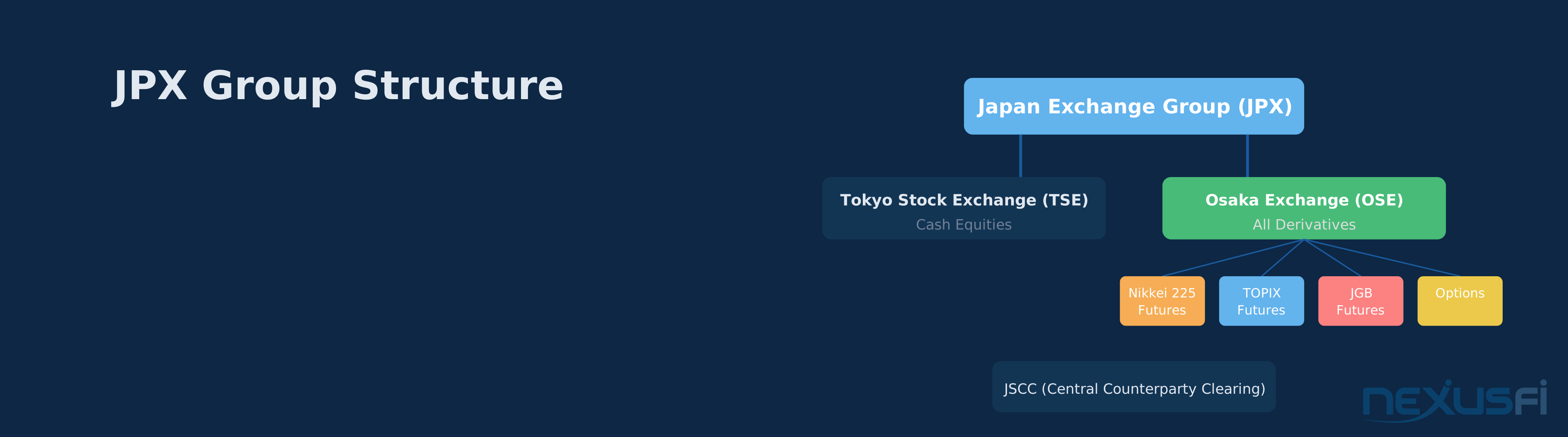
JPX was formed in 2013 when the Tokyo Stock Exchange Group merged with the Osaka Securities Exchange. The merger consolidated Japan's fragmented exchange environment into a single entity: TSE handles cash equities, OSE handles all listed derivatives. This clean separation matters because it means every Japanese index future, bond future, and options contract flows through one centralized venue — no dark pools, no fragmented order books, no wondering where your order actually went.
For retail futures traders, JPX offers something increasingly rare: a transparent, centralized order book where depth-of-book analysis actually works. Unlike US equities where dark pools handle 40%+ of volume, the OSE's single-venue model means the order book you see is the order book that exists. That's a meaningful structural advantage for anyone who reads DOM.
Key Concepts #
Osaka Exchange (OSE) — The derivatives division of JPX. All futures and options on Japanese indices, bonds, and commodities trade here. Formerly the Osaka Securities Exchange before the 2013 merger.
J-GATE — OSE's electronic trading platform. Replaced the older system to deliver institutional-grade latency and throughput. Retail traders don't connect directly to J-GATE — they access it through broker platforms — but the platform's architecture determines your execution quality.
Nikkei 225 — Japan's flagship stock index, price-weighted across 225 large-cap companies listed on the TSE. Price-weighted means high-priced stocks move the index more, similar to the Dow Jones. This creates distinct trading characteristics compared to cap-weighted indices like the S&P 500 or TOPIX.
TOPIX (Tokyo Stock Price Index) — Market-cap-weighted index covering all TSE Prime Market stocks. The institutional benchmark for Japanese equity exposure. Think of it as Japan's S&P 500 equivalent — broader, more diversified, less volatile than the Nikkei 225.
JGB Futures — Japanese Government Bond futures, specifically the 10-year contract. The primary price-discovery mechanism for Japanese sovereign debt. Driven by interest rate expectations and Bank of Japan policy, not equity sentiment. Different game entirely from index futures.
Night Session — OSE extends trading into what Americans would call evening/overnight hours, specifically to capture overlap with European and US markets. This is where global macro flows hit Japanese futures in real time.

Core Products and Contract Specifications #
Nikkei 225 Futures Family #
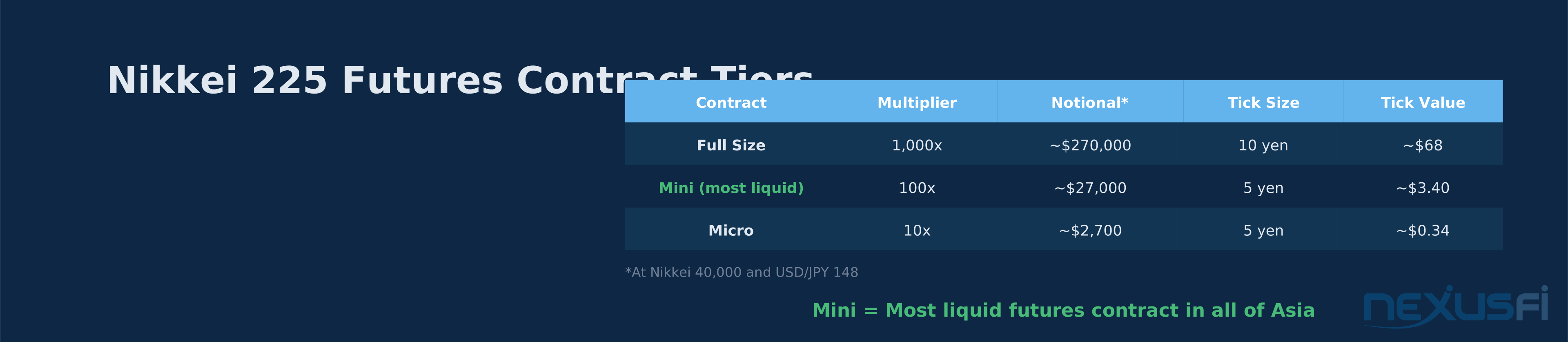
The OSE offers three tiers of Nikkei 225 exposure:
Nikkei 225 Futures (Full Size) — Multiplier of 1,000x the index. At Nikkei 40,000, one contract has notional value of 40 million yen (~$270,000 USD). This is the institutional workhorse. As NexusFi member @mangolassi noted, the full-size contract trades tens of thousands of contracts per regular session.
Nikkei 225 Mini Futures — Multiplier of 100x the index. One-tenth the size of the full contract. This is where retail volume concentrates. @mangolassi pulled the actual numbers: on a single regular session day, the Mini traded 421,359 contracts versus 37,132 for the full-size. The Mini is the most liquid futures contract in all of Asia. Not close.
Nikkei 225 Micro Futures — Multiplier of 10x the index. One-hundredth of the full contract. At Nikkei 40,000, notional value is roughly 400,000 yen (~$2,700 USD). Launched to make the Nikkei accessible to smaller retail accounts, similar to CME's Micro E-mini products.
TOPIX Futures #
Multiplier of 10,000x the index value. Less retail-friendly than the Nikkei due to larger notional values. TOPIX futures are the institutional hedging vehicle — when Japanese pension funds and asset managers adjust equity exposure, they do it through TOPIX futures. For retail traders, TOPIX matters more as a sentiment indicator than a direct trading vehicle.
JGB Futures #
The 10-year JGB futures contract is one of the most actively traded government bond futures globally. Contract size is 100 million yen face value. This market runs on central bank expectations — Bank of Japan policy shifts, yield curve control adjustments, and global rates contagion. If you've never traded bond futures, JGB is not the place to start. The risk dynamics are at the core different from equity index futures, driven by duration, convexity, and the political economy of Japanese monetary policy.
Trading Hours and Session Structure #
OSE runs two distinct sessions with a break between:
Day Session: 8:45 AM — 3:15 PM JST (Japan Standard Time). This is regular trading hours (RTH) for Japanese futures. The morning open at 8:45 is where the overnight gap plays out — the correlation between the prior night's S&P 500 performance and the Nikkei opening direction is strong and well-documented.
Night Session: 4:30 PM — 6:00 AM JST (next day). This extended session was introduced specifically to capture overlap with European and US market hours. For a trader in New York, the night session runs roughly 3:30 AM — 5:00 PM EDT — meaning you can trade Nikkei futures during the US trading day.
@mattz started a dedicated thread on NexusFi for the Mini Nikkei 225, noting the trading hours as "7pm - 1:10AM CST-Chicago time" for the day session window that US-based traders can access. @steve2222 pointed out that the exchange periodically updates session times, so always verify current hours on the JPX website.
The gap between sessions (3:15 PM — 4:30 PM JST) creates a structural feature: any positions held through the break carry gap risk. This matters for risk management and stop placement.

Market Microstructure: Why OSE's Structure Matters #
Centralized Order Book #
This is the biggest structural advantage of trading on the OSE. All orders flow through a single matching engine. No dark pools. No internalization. No payment for order flow routing decisions. The order book you see on your DOM is the actual state of the market.
For traders who rely on order flow analysis — reading the tape, watching DOM dynamics, identifying absorption and spoofing patterns — this centralization makes the data exponentially more reliable than in fragmented markets. When you see 500 contracts sitting on the bid, those 500 contracts are actually there. Not hidden in a dark pool, not being internalized by a market maker.
Tick Size and Pricing #
Nikkei 225 Mini futures trade in 5-yen increments. At the current yen-to-dollar rate, each tick is roughly $3.40 USD. The full-size contract ticks at 10 yen, worth roughly $68 USD per tick. These are reasonable tick sizes for active trading — granular enough for precise entries but not so small that you're fighting noise.
Circuit Breakers #
OSE employs price limit mechanisms — daily price bands beyond which trading halts. For Nikkei 225 futures, these limits are set based on the previous day's settlement price. If the index moves beyond the limit, trading pauses. This is at the core different from CME's dynamic circuit breakers. During the March 2020 crash and various BOJ surprise announcements, these halts locked traders into positions with no exit. Factor this into your risk management: if you're holding a position during a potential circuit-breaker event, your stop order means nothing once trading halts.
Accessing JPX From Outside Japan #
Broker Access #
International retail traders access OSE futures primarily through brokers that connect via CQG or Rithmic data feeds. @mattz confirmed that CQG is the primary feed for Nikkei futures through brokers like Optimus Futures. Interactive Brokers also offers direct access to OSE products.
The broker layer matters more here than on CME because the technology stack between you and the exchange is longer. Your order travels from your platform to your broker to their connectivity provider to J-GATE. Each hop adds latency. For scalping, this makes OSE harder to trade from overseas. For swing trading and position trading, the latency is irrelevant.
Margin Requirements #
OSE sets exchange-level margin requirements (called SPAN margin), but your broker may require more. Margin requirements change based on market volatility — during periods of elevated VIX or JPY volatility, expect margin increases with little warning. This is not unique to OSE but catches traders off guard when it happens.
For international accounts, you're also dealing with margin in yen. Currency fluctuation between your account's base currency and JPY affects your effective margin requirement. A weakening dollar against the yen means your margin requirement effectively increases even if the OSE hasn't changed anything.
Currency Risk: The JPY Overlay #
This is the single most important macro consideration for non-Japanese traders on OSE. The Nikkei 225 and the yen have a historically inverse correlation: when the yen weakens, the Nikkei tends to rise (Japanese exporters become more competitive), and vice versa.
For a USD-denominated trader going long the Nikkei, you're implicitly making two bets: long Japanese equities AND short the yen. If the Nikkei rises 2% but the yen strengthens 3% against the dollar, you lose money despite being right on the directional call. Professional traders either hedge the FX component or explicitly incorporate it into their thesis.
The math matters here. If you're long one Nikkei Mini at 40,000 (notional 4,000,000 JPY) and the yen moves from 148 to 145 per dollar, your notional in USD went from $27,027 to $27,586 — a $559 move that has nothing to do with the Nikkei itself. Scale that to multiple contracts and it gets real fast.

Trading Strategies Specific to OSE #
Gap Trading at the Tokyo Open #
The correlation between overnight S&P 500 moves and the Nikkei opening is one of the most well-documented relationships in futures trading. When the S&P drops 1% during the US session, the Nikkei opens with a gap down in the following morning session. The question isn't whether the gap happens — it's whether it fills and how to position around it.
Initial Balance analysis works well here. Measure the range of the first 60 minutes of the day session. A narrow IB (relative to a 10-20 day rolling average) signals compressed energy and higher probability of a trend extension. A wide IB suggests the gap created sufficient displacement that rotation is more likely.
Night Session Correlation Plays #
During the night session, the Nikkei tracks the S&P 500 in near real-time. This creates opportunities for pair-style strategies — going long Nikkei / short ES when the spread diverges from its mean, or vice versa. The key is that the correlation isn't perfect, and divergences can persist. But the mean-reverting tendency of the spread is statistically strong over multi-day horizons.
Lunchtime Mean Reversion #
The break between sessions and the period around 11:30 AM — 12:30 PM JST during the day session historically shows reduced volatility and mean-reverting behavior. Institutional flow drops as traders break for lunch. For retail traders who can identify range-bound conditions, this window offers opportunities for fade strategies.
JPX vs CME: How They Compare for Retail Traders #
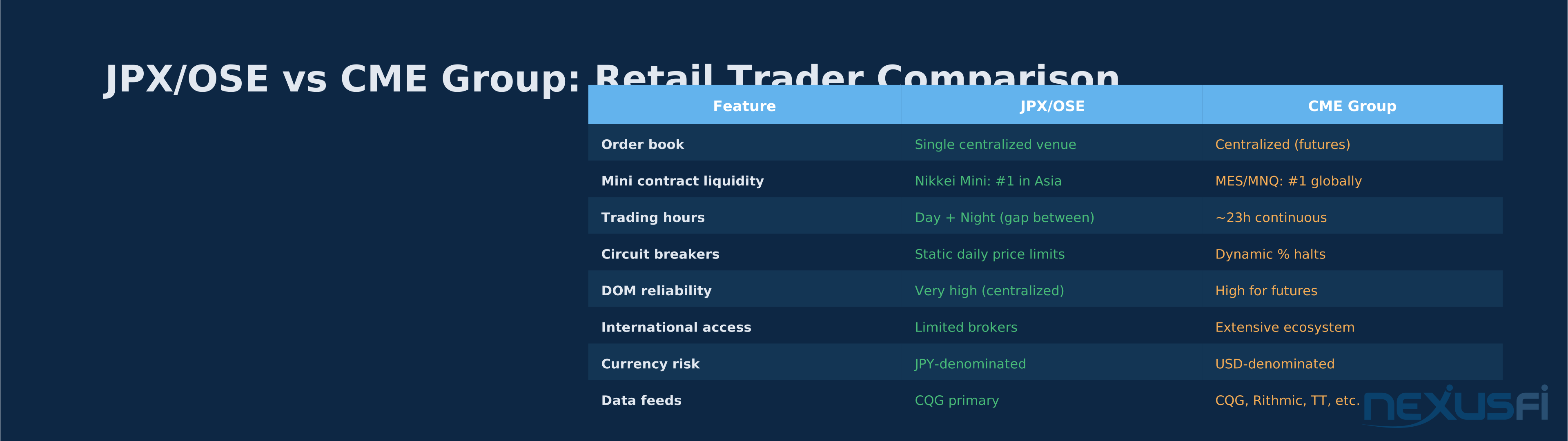
| Feature | JPX/OSE | CME |
|---|---|---|
| Order book transparency | Single centralized venue | Fragmented (dark pools for equities, centralized for futures) |
| Mini contract accessibility | Nikkei Mini widely liquid | Micro E-minis highly liquid |
| Trading hours | Day + Night sessions with gap | Nearly 23-hour continuous |
| Circuit breakers | Static daily price limits | Dynamic percentage-based halts |
| DOM reliability | Very high (centralized) | High for futures, lower for equities |
| International retail access | Limited broker options | Extensive broker ecosystem |
| Primary data feeds | CQG, some Rithmic | Multiple (CQG, Rithmic, TT, direct) |
| Currency risk | JPY-denominated | USD-denominated |
The biggest practical difference: CME's ecosystem is larger and more accessible for international retail. But OSE's centralized structure provides cleaner market data. If you're already comfortable with ES or NQ and want to diversify into Asian markets, the Nikkei Mini on OSE is the natural next step.
The Nikkei-yen inverse correlation is one of the most durable relationships in global macro. When the yen weakens, Japanese exporters earn more in yen terms and the Nikkei rises. When the yen strengthens, those same exporters get squeezed and the Nikkei drops. For a USD-based trader, this correlation is your friend when yen is weakening (the Nikkei rises AND converts to more dollars) and your enemy when yen is strengthening (the Nikkei may rise but converts to fewer dollars). Know which regime you're in before sizing up.
Risk Management for OSE Trading #
Position Sizing With Currency Overlay #
Never size Nikkei positions purely on chart-based stop distances. Convert your risk to your base currency, account for potential adverse FX movement, then determine contract count. A 200-point stop on the Nikkei Mini is 20,000 yen of risk per contract — but that's $135 at 148 JPY/USD or $138 at 145 JPY/USD. Small difference on one contract, meaningful difference on ten.
Circuit Breaker Awareness #
Know the daily price limits before you enter a trade. If the Nikkei is already down 6% and the limit is 8%, you have 2% of downside room before trading halts entirely. Position so. Being locked in a position during a circuit breaker with no ability to exit is one of the worst experiences in futures trading.
Margin Buffer #
Keep extra margin in your account beyond minimum requirements. OSE and your broker can increase margin requirements during volatility with minimal notice. Being margin-called because requirements changed overnight — not because your position moved against you — is an avoidable mistake.
Who Should Trade on JPX #
Good fit: Traders who want diversified index exposure beyond US markets. Swing traders who can manage the currency overlay. Order flow traders who value clean, centralized DOM data. US-based traders looking for actionable markets during their evening hours (day session) or traders who want to trade an Asian benchmark during US hours (night session).
Poor fit: Scalpers trading from outside Japan (latency disadvantage). Traders who can't manage FX risk. Anyone who needs a deep broker ecosystem with extensive platform choice — the options for OSE access are much narrower than for CME products.
Starting point: Open a demo account with a broker that supports OSE products (Interactive Brokers, or a futures broker with CQG connectivity). Trade the Nikkei 225 Mini in simulation first, paying attention to spread behavior, session transitions, and the gap between day and night sessions. Get comfortable with yen-denominated P&L before going live.
The Bottom Line #
JPX and the Osaka Exchange represent the gateway to Asian futures trading for international retail traders. The Nikkei 225 Mini offers world-class liquidity in a transparent, centralized venue. The market structure advantages — single order book, reliable DOM, clean tape — are real and meaningful for traders who read order flow.
The challenges are equally real: limited broker access from outside Japan, mandatory currency risk management, circuit breakers that can lock you in positions, and session gaps that create overnight exposure. None of these are dealbreakers, but all of them require deliberate planning that you don't need on CME.
If you're serious about diversifying beyond ES and NQ, the Nikkei Mini on OSE is the strongest candidate in Asia. The volume is there. The structure is clean. The correlation with US markets creates genuine strategic opportunities. Just don't forget you're also making a yen bet every time you click buy.
Knowledge Map
Prerequisites
Understand these firstGo Deeper
Build on this knowledgeReferences This Article
Articles that build on this topicCitations
- — Mini Nikkei 225 on Osaka - Japan (JPX) (2016) 👍 4“No way. Nikkei 225 Mini on the Osaka Securities Exchange is the most liquid futures contract in all of Asia, period. It runs circles around the SGX Nikkei in volume.”
- — Mini Nikkei 225 on Osaka - Japan (JPX) (2016) 👍 4“400 yen for LVL 2 data but for LVL 1 200 yen volume on OSE is 9 times the SGX Nikkei. The OSE product is the real contract -- SGX is the offshore alternative.”
- — Mini Nikkei 225 on Osaka - Japan (JPX) (2016) 👍 4“The exchange session template shown is wrong. The exchange goes into pre-open at 8:00 AM JST, opens at 8:45 AM JST. There is a lunch break 11:30 AM to 12:30 PM JST, then afternoon session.”
- — Mini Nikkei 225 on Osaka - Japan (JPX) (2017) 👍 1“The Nikkei and Kospi are attractive because you wouldn't have to modify your sleeping pattern to trade at London open. From my research JPX data via CQG runs through OSE.”
- — Mini Nikkei 225 on Osaka - Japan (JPX) (2016) 👍 4“Nikkei 225 Mini volume data confirms OSE dominance: the Mini Nikkei on OSE averages ~1.3 million contracts daily -- more than the ES on some days.”
- — Eurex launching Micro Euro STOXX 50 (FXSE) and Micro DAX (FDXS) futures (2021) 👍 9“JPX and Eurex both launched micro contracts to attract retail traders -- micro Nikkei gives access to Japan's market at 1/10th standard contract size and margin.”