



SGX (Singapore Exchange): Asia's Derivatives Hub for Futures Traders
Subtitle: The exchange that gives you direct, cleared access to Japanese equities, Indian indices, offshore RMB, and regional commodities during the hours that matter most.
Overview #
If you trade US markets, you probably know CME's uptime extends into Asian hours — the Globex session technically runs overnight. But "access to Asian hours" and "Asian market exposure" aren't the same thing. When India holds a central bank meeting that rattles the Nifty 50 at 3pm Mumbai time, you want to trade the Nifty, not ES futures sitting in pre-market drift.
SGX — the Singapore Exchange — is where international traders go for direct Asian market exposure during the hours when that exposure actually matters. It is the venue of choice for Nikkei 225 Mini futures (Japan equity), SGX CNX Nifty futures (India equity), MSCI Asia Pacific ex Japan futures (broad Asia), USD/CNH futures (offshore Chinese yuan), and SICOM rubber. Each of those products lives at SGX because that's where the time-zone alignment, the relevant participants, and the clearing infrastructure converge.
This article covers how SGX works, what makes each product unique, how it compares to CME and Eurex, and the operational specifics US-based traders need to get set up.
A note on the Nikkei Mini before going further: in the discussion of Asian futures, @Fat Tails posted a reference guide to evening/overnight instruments that included SGXNK (Nikkei 225, USD denominated) alongside NIFTY and STW on SGX — and noted that the Nikkei listed instruments are among the viable alternatives to FOREX for Asian session activity. @mangolassi, in the Nikkei 225 Mini thread, put the volume question directly:
That quote is about the Osaka listing specifically — and it highlights an important distinction we'll come back to. SGX lists a USD-denominated version of the Nikkei futures alongside the JPY-denominated Osaka product. Both matter. Most US traders access the SGX version.
SGX Group Structure and Regulatory Framework #
SGX Group is the listed exchange group in Singapore. For futures traders, the relevant entities are two: SGX Derivatives, which is the trading venue, and SGX Derivatives Clearing, which is the central counterparty (CCP) that guarantees every trade.
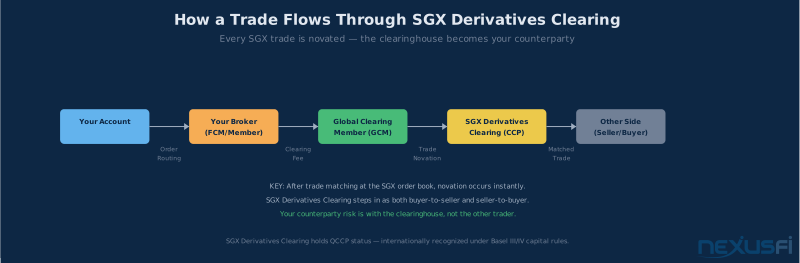
The structure works like CME Group: you trade through a member, but the trade is immediately novated to the clearinghouse. The clearing member (your broker or their clearing partner) faces the clearinghouse, not the other side of your trade. This means counterparty risk is mutualized through the default fund and margin system, not concentrated in the specific broker or participant you happened to trade against.
The Monetary Authority of Singapore (MAS) oversees both entities. MAS has a well-regarded regulatory stance — assertively pro-market-integrity, with international cooperation frameworks that matter when you're a US trader clearing trades through a Singapore-regulated CCP. SGX Derivatives Clearing holds QCCP (Qualified Central Counterparty) status under international standards, which affects how clearing members handle capital treatment.
For a US-based trader, the MAS/SGX framework means:
- Your trades are cleared through a regulated, capitalized counterparty
- Margin models are set by the clearinghouse, not individually by your broker (though brokers add house margins on top)
- Market integrity and position limit rules are enforced by MAS standards
- Cross-border reporting requirements exist — more on that in the US Access section
SGX Derivatives uses the SGX Titan OTC clearing and the Derivatives Trading Engine (DTE) for on-exchange trading. For most retail-adjacent participants, the practical interface is simply "my broker has SGX market connectivity" — the underlying infrastructure is abstracted. What matters operationally is: which products can you trade, during what hours, at what margin, through which broker.
Core Contract Suite: The Five Essential Products #
SGX's product set for international futures traders concentrates in five areas. These are not exhaustive — SGX lists government bond futures, options, and various equity derivatives — but for traders migrating from CME or looking to add Asian exposure, these are the ones that matter.
Nikkei 225 Mini Futures #
Japan equity exposure, Asian-session timing. The Nikkei 225 index tracks the 225 largest companies on the Tokyo Stock Exchange. SGX lists the Nikkei Mini in USD-denominated form — the full-size is JPY-denominated, the mini trades in USD, which matters a lot for US traders managing currency exposure.
@mattz from Optimus Futures described the trading schedule for US traders: "Those of you who are considering other indices besides ES, and those who have stopped trading the TF, may consider the Mini Nikkei 225... Trading: 7pm - 1:10AM CST-Chicago time then after hours - re-opens at 2:30am - until 12:55PM CST."
That schedule puts active Nikkei trading accessible during US evening hours — after the US close but before Europe opens — which is when Tokyo is actually open. The night session @mattz described aligns with the Japanese cash market. Liquidity in the Nikkei Mini during US morning hours tends to be lighter; execution quality is better when you're aligned with Tokyo open.
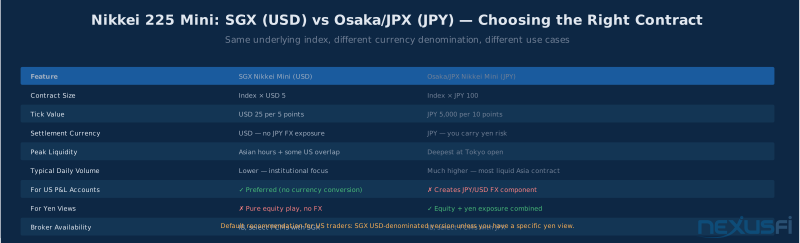
The Osaka Exchange (JPX) also lists Nikkei Mini futures in JPY. US traders generally prefer the SGX USD-denominated version to avoid JPY FX exposure when they're expressing a view on Japanese equities rather than the yen. If you're intentionally carrying yen exposure alongside an equity view, the Osaka version might be deliberate. Otherwise, USD-denominated SGX is cleaner.
SGX CNX Nifty Futures (India Exposure) #
The Nifty 50 tracks the 50 largest companies on the National Stock Exchange of India (NSE). Direct access to Indian equity futures from outside India is heavily restricted — Indian regulators tightly control foreign participation in domestic derivatives markets. SGX's CNX Nifty futures are the gold-standard access point for international investors who want India equity exposure but can't trade NSE directly.
The product settles based on the NSE closing price, which means it tracks the underlying Indian equity market authentically while being traded in Singapore, cleared in Singapore, and accessible to non-Indian participants.
India-specific events drive material moves in the Nifty: Reserve Bank of India (RBI) rate decisions, Indian election results, Indian budget announcements, MSCI rebalances that include or exclude Indian equities. For a macro trader with an India thesis, the SGX Nifty is the cleanest listed expression during Asian hours. The CME does list its own USD/INR FX contract, but that's currency, not equity beta. For Indian equity exposure, SGX is it.
Margin on the Nifty is notably higher than on comparable US indices. India is an emerging market; the underlying index carries higher volatility, and SGX's clearing margin reflects that. During Indian election periods or key RBI meetings, intraday margin calls become real. Size so.
MSCI Asia Pacific ex Japan Futures #
Broad regional exposure without the single-country concentration of Japan or India. The MSCI Asia Pacific ex Japan index covers equities across Australia, China, Hong Kong, Korea, Taiwan, Singapore, and other APAC markets, excluding Japan. It's the standard institutional benchmark for Asia-ex-Japan mandates.
This product is primarily used by:
- Asset managers hedging a broad Asia portfolio against macro drawdowns
- Macro traders expressing a view on the broader Asia risk environment
- Spread traders relative to single-country futures
Liquidity in this contract is thinner than the Nikkei Mini or the Nifty during peak Asia hours. It's institutional rather than retail-facing — the open interest is concentrated with fund hedgers, not intraday traders. Expect wider spreads and more slippage than you'd see in the Nikkei.
USD/CNH Futures (Offshore Chinese Yuan) #
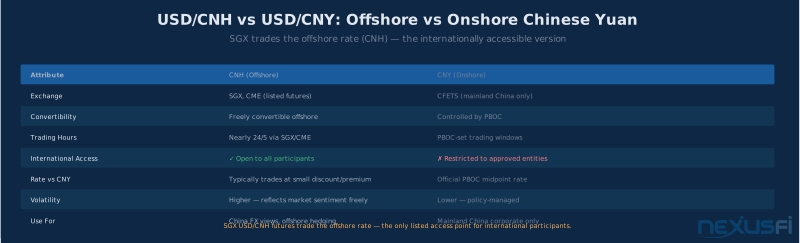
The USD/CNH futures contract gives you traded, cleared, exchange-listed access to the offshore renminbi rate. This is different from the onshore CNY rate, which is more tightly managed by the People's Bank of China. The offshore rate (CNH) is more freely traded and reflects actual market sentiment about China macro, currency pressure, and capital flows.
Why SGX? China's capital controls make it difficult to trade RMB exposure through mainland instruments. The offshore CNH market, centered in Hong Kong and traded through Singapore, is the internationally accessible version. SGX's USD/CNH futures are cash-settled to an official CNH fixing rate and provide a listed, cleared alternative to OTC NDF (non-deliverable forward) hedges.
For traders, this product is most useful when:
- You're hedging USD/CNH FX exposure from Asian operations or positions
- You want to trade China macro without direct equity exposure
- You're expressing a view on PBOC policy relative to the offshore market
CME also lists USD/CNH futures, and in 2026 actually redesigned their quoting convention for Chinese yuan contracts to align with standard FX convention. The SGX product is more Asia-session-oriented; the CME version may be better if you need liquidity during US hours.
SICOM Rubber Futures (TSR20) #
The Singapore Commodity Exchange (SICOM) rubber futures are the global benchmark for natural rubber TSR20 (Technically Specified Rubber, Grade 20). This is a physical commodity contract — the most niche of SGX's offerings for typical macro futures traders, but essential if you have commodity exposure to Asian supply chains.
Natural rubber is produced primarily in Thailand, Indonesia, and Malaysia. The main consumers are tire manufacturers and the automotive supply chain globally. The SICOM contract settles via physical delivery or cash settlement depending on contract month, using warehouse receipts in Singapore and Malaysia.
For most futures traders migrating from US index markets, SICOM rubber is background knowledge rather than an active market. But if you're a commodity trader covering agricultural softs or industrial materials, it's the benchmark. SICOM rubber correlates to crude oil (via synthetic rubber substitution economics), Chinese automotive production data, and Southeast Asian weather events.
Contract Specifications: What Every Number Actually Means #
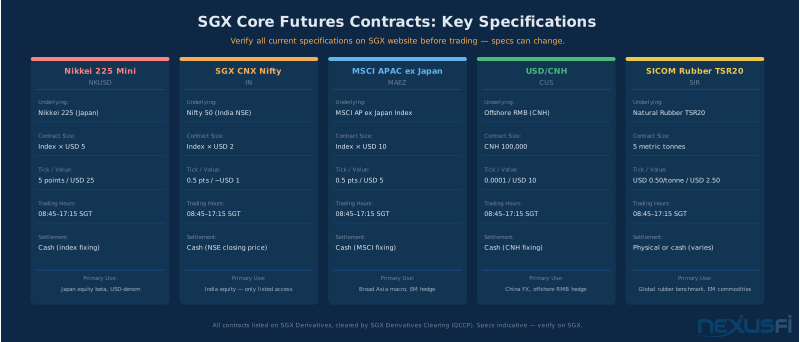
The council research on SGX was emphatic about one point: always verify specs on the current SGX contract page before trading. Multipliers, tick values, and margin schedules change. That said, here are the standard structures for each contract so you know what you're looking at:
| Contract | Contract Size | Tick Size | Tick Value | Settlement Currency | Settlement Method |
|---|---|---|---|---|---|
| Nikkei 225 Mini (USD) | Index × USD 5 | 5 index points | USD 25/tick | USD | Cash-settled |
| MSCI Asia Pacific ex Japan | Index × USD 10 | 0.5 index points | USD 5/tick | USD | Cash-settled |
| SGX CNX Nifty | Nifty 50 × USD 2 | 0.5 index points | USD 1/tick | USD | Cash-settled |
| USD/CNH | CNH 100,000 | 0.0001 | USD 10/tick | USD | Cash-settled |
| SICOM Rubber (TSR20) | 5 metric tonnes | USD 0.50/tonne | USD 2.50/tick | USD | Physical/cash |
These numbers are illustrative. The specific tick value for the Nifty, for instance, depends on exactly which contract version is current. What doesn't change is the structural approach: index times multiplier gives notional, tick size times multiplier gives tick value, cash settlement means no physical delivery for the index contracts.
For context on how this compares to products US traders know: an ES Mini tick is $12.50. An SGX Nifty tick at USD 1 is smaller — giving you more granular control but also meaning you need more contracts for equivalent notional exposure. Factor in margin per tick to understand your effective leverage on each product.
Trading Hours and Asian Session Dynamics #
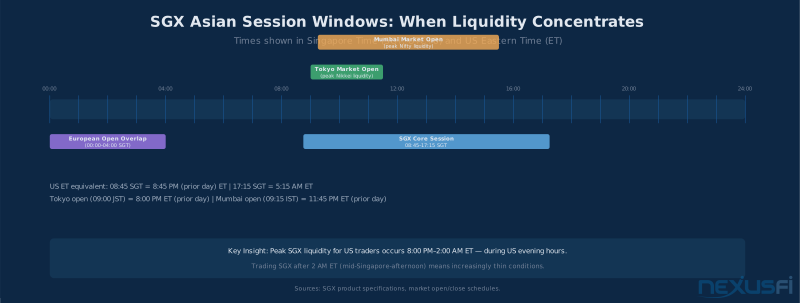
SGX's core trading window is the Asian session. For Singapore-time traders, the main session typically runs approximately 08:45 to 17:15 SGT (Singapore Standard Time, UTC+8), with a pre-open auction before continuous trading begins.
For US-based traders, that translates to:
- US Eastern Time: approximately 8:45 PM the prior evening to 5:15 AM ET
- US Central Time: approximately 7:45 PM to 4:15 AM CT
- US Pacific Time: approximately 4:45 PM to 2:15 AM PT
The practical implication: SGX is an evening/overnight instrument for US traders. If you're watching the Nikkei Mini during your trading day at 2pm ET, you're in thin mid-session conditions on SGX — the Tokyo market has already been closed for hours and Singapore is mid-afternoon. Liquidity peaks around:
- Asian equity market opens — Tokyo opens around 9:00 AM JST (8:00 PM ET the prior day), Mumbai opens around 9:15 AM IST (11:45 PM ET the prior day). Order flow concentrates heavily around these opens.
- Asian macro data releases — Japanese household spending, RBI policy decisions, PMI data. These create sharp initial moves followed by follow-through or fade.
- The European overlap window — Starting around 3:00-4:00 AM ET, European traders start reacting to Asia's overnight session, creating an overlap period before US opens.
@redratsal described the overnight ES dynamic in a way that maps directly to SGX: there's a "waning influence" of the Asian markets as time passes through the London open and into US hours. The Nikkei and Nifty trading windows on SGX are the period before that waning occurs.
Asian market holidays create real execution risk. Lunar New Year (affecting China, Hong Kong, Singapore, Korea, Vietnam), Golden Week in Japan (late April/early May), Diwali for Indian markets, and Singapore National Day — these create multi-day gaps in liquidity that CME traders are not accustomed to. @SMCJB made a related point about commodity futures: "you will see lots of these products not only trading but also having quite deep markets, but if you check early in the month there won't be a single quoted market." Asian holidays behave the same way — the SGX market may remain listed, but don't assume the order book looks normal when half the regional participants are off.
Margin Requirements and Risk Management #
SGX margin is set by SGX Derivatives Clearing and calibrated to each product's volatility and liquidity characteristics. Several structural differences from CME margin are worth understanding before you trade.
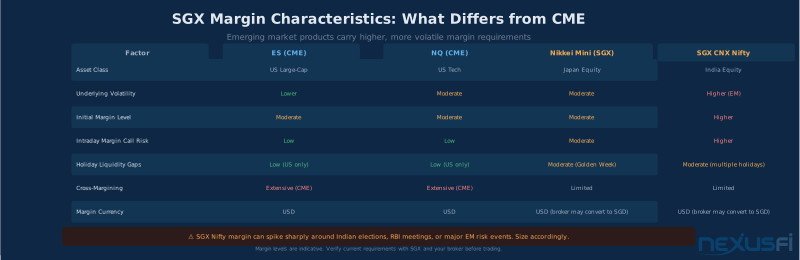
Emerging market premium. The Nifty and MSCI Asia Pacific contracts carry meaningfully higher initial margin requirements than comparable US index products. This reflects the underlying volatility — Indian equities are not as liquid or stable as the S&P 500. During Indian election seasons or RBI meetings, SGX can raise Nifty margin intraday. Budget buffer so.
Currency denomination. Most SGX contracts settle in USD (all five core products listed above are USD-denominated), but your margin may be held in SGD depending on your broker's clearing arrangement. Brokers often auto-convert USD to SGD for margin posting, which introduces a small but real FX conversion cost and potential slippage.
Portfolio netting limitations. CME offers extensive cross-margining across correlated products — for instance, ES and NQ positions offset each other's margin requirements. SGX has more limited cross-margining. If you're running a complex portfolio with SGX and CME positions simultaneously, don't assume the same capital efficiency.
Intraday margin calls. Both CME and SGX can issue intraday margin calls, but SGX's emerging market exposure makes this more likely. The Nifty specifically is prone to sharp gap moves around Indian news — if you're holding size overnight into an Indian data release, margin stress is a real scenario. CME traders accustomed to the relatively deep S&P 500 margin structure get surprised by this.
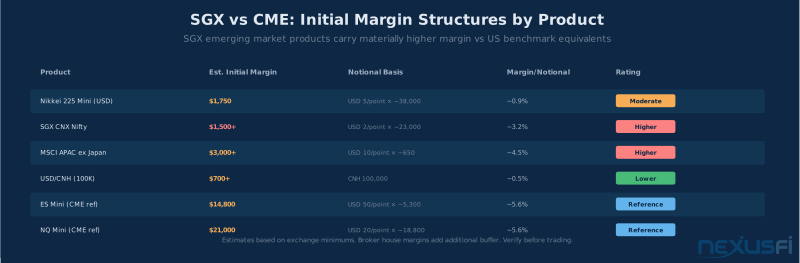
For initial margin ballparks: expect Nifty margin to be roughly 1-2x higher per contract relative to ES, accounting for product size. MSCI Asia Pacific margin can be significant for a broad mandate. Rubber margin reflects commodity volatility, which spikes with supply events.
How SGX Clearing Protects You #
SGX Derivatives Clearing operates the standard futures clearing model: every trade is novated, the clearinghouse becomes counterparty to both sides, and default risk is socialized through the default fund and initial margin requirements.
The key risk mitigation layers are:
- Initial margin: collected from both sides to cover anticipated short-term market moves
- Variation margin (daily MTM): positions are marked to market daily; losses are collected, gains are paid out
- Default fund: contributions from clearing members create a pooled buffer against large defaults
- Clearinghouse capital: SGX's own capital acts as an additional backstop
The QCCP status matters for institutional traders because it affects how clearing members must capitalize their exposure to the clearinghouse under Basel III/IV rules. For individual traders, it mostly means you're trading through a highly regulated, capitalized structure with international recognition.
One operational note: SGX's clearing timeline runs on Singapore business days. US Federal holidays don't close SGX, but Singapore public holidays do. Settlement cycles are generally T+1 for cash-settled contracts — your realized P&L from expiry appears in your account the following business day in Singapore time. Factor the time zone into cash flow planning.
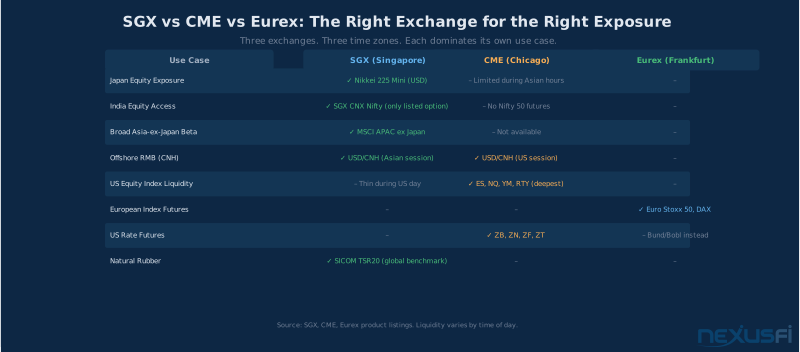
SGX vs. CME and Eurex: Choosing the Right Venue #
These three exchanges serve overlapping but distinct use cases:
SGX strengths:
- Time-zone alignment for Asian-hour trading — liquidity is authentic because participants are active during their own market hours
- India equity access via SGX CNX Nifty — no equivalent on CME for the Nifty 50 index
- Offshore RMB — USD/CNH is the cleanest listed expression of China FX views
- SICOM rubber — the global benchmark for natural rubber
CME strengths:
- Global benchmark depth — ES, NQ, NQ, ZB, CL, GC, 6E — none of these have SGX equivalents with comparable liquidity
- US trader infrastructure — most brokers have native CME connectivity; SGX requires specific clearance
- Cross-margining ecosystem — CME's SPAN-based portfolio margin creates capital efficiency across a wide product range
- US hours liquidity — if you're trading from US East during the day, CME depth far exceeds SGX
Eurex strengths:
- European session index futures (Euro Stoxx 50, DAX, FTSE) during European hours
- European rate futures (Euro-Bund, Euro-Bobl)
- Not typically the right venue for Asian market exposure
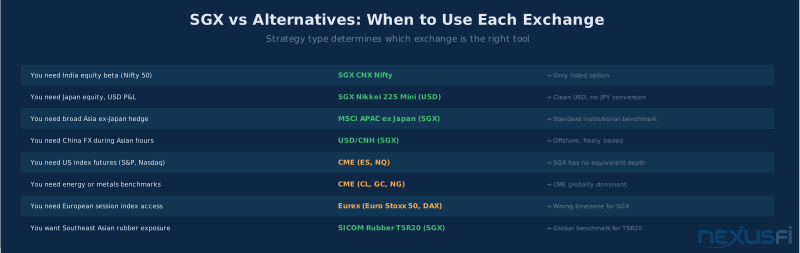
The practical decision rule:
- If your strategy requires Japan equity beta during Asian hours → SGX Nikkei Mini
- If your strategy requires India equity exposure → SGX CNX Nifty, nothing else comes close
- If you're hedging broad APAC exposure → MSCI Asia Pacific ex Japan on SGX
- If you need global benchmark liquidity → CME is the default
- If you need European-session index trading → Eurex
The question isn't which exchange is "better" — they serve different timing, asset class, and regional needs. A multi-market trader will have accounts on both SGX and CME because the use cases don't fully overlap.
Who Trades SGX: The Participant Environment #
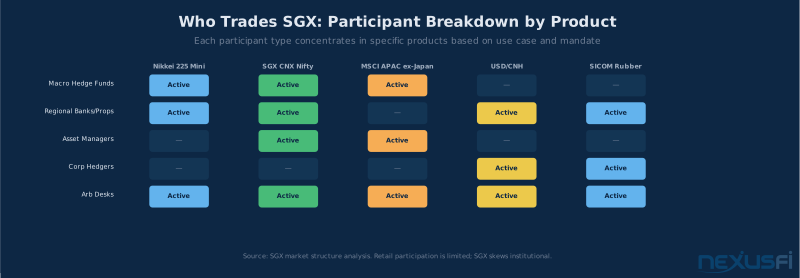
SGX's participant mix is heavily institutional, with a regional bias that creates different microstructure dynamics than US futures traders are used to.
Macro hedge funds represent a significant share of SGX volume. Firms running Asia-focused or global-macro strategies use the Nikkei Mini, Nifty, and MSCI products for directional positioning and relative-value expressions (e.g., Japan long/India short, or APAC ex-Japan vs. S&P 500).
Regional banks and prop desks are active market makers and liquidity providers in Nikkei and Nifty. Asian banks with large domestic equity hedging needs provide two-sided flow in these markets, which sustains tighter bid-ask spreads during the Asian session than you might expect for a relatively narrow product set.
Asset managers with Asia mandates use SGX for systematic hedging. Pension funds and long-only funds with significant Japan, India, or APAC allocations use SGX futures to manage intraday and short-term exposure without disrupting their cash positions. This creates predictable flow patterns around rebalancing windows and end-of-month activity.
Electronic market makers and arbitrage desks provide liquidity through the Nikkei, Nifty, and MSCI contracts and run cross-market spreads (SGX Nikkei vs. Osaka Nikkei, SGX USD/CNH vs. CME CNH, etc.). This arbitrage activity ties SGX prices to the underlying cash markets and to parallel listings.
Corporate hedgers and commodity merchants use the USD/CNH and SICOM rubber contracts. An automotive manufacturer importing rubber from Southeast Asia, or a company with significant USD/CNH currency exposure from China operations, might use SGX as their listed hedge alongside OTC forwards.
What you don't see at SGX in large numbers: retail algorithmic traders, high-frequency US prop shops focused on overnight index moves, or discretionary day traders working small size. The participant base skews toward size — the products and their institutional character are less accessible to the retail-infrastructure side of the market that dominates US futures volumes.
The practical implication: expect SGX order books to look and behave differently from ES or NQ. The bid-ask spread can widen materially during thin periods. Position sizing and entry/exit planning need to account for market impact in ways that ES traders don't typically consider at standard size.
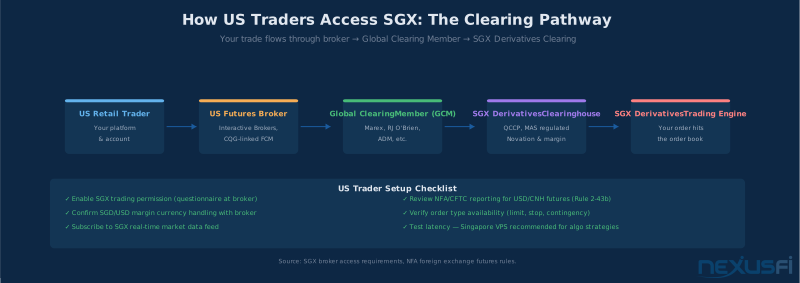
US Trader Access: Brokers, Clearance, and Setup #
Getting access to SGX from a US account is straightforward if you work with the right broker, and involves more friction than it should if you work with the wrong one.
Broker requirements: Your broker needs either direct SGX clearing membership or a clearing arrangement with a Global Clearing Member (GCM). GCMs that serve US brokers for SGX access include firms like Marex, RJ O'Brien, and ADM. Interactive Brokers has native SGX connectivity and is the most common path for retail-adjacent traders. CQG-linked brokers with global market access also typically support SGX.
Account setup checklist:
- Enable SGX trading permission — usually a short questionnaire about familiarity with international futures
- Margin currency setup — confirm whether your broker holds SGX margin in USD (most common) or SGD; understand the conversion cost
- Market data subscription — real-time SGX order book data is a separate subscription from CME data; confirm this is set up before trying to trade
- NFA/CFTC reporting compliance — US traders trading foreign exchange futures (USD/CNH) have NFA reporting obligations; verify your broker handles this correctly
- Order type availability — not all order types available on CME are available on SGX through every broker; confirm limit order and stop functionality before going live
Latency consideration: If you're co-located at CME in Chicago or running algorithms optimized for US microstructure, know that SGX's order matching engine is in Singapore. Cross-continental round-trip latency from US to Singapore is roughly 200-250ms — not an issue for discretionary traders or strategies with holding periods beyond tick-by-tick, but significant for latency-sensitive automated strategies. If you're running algorithms on SGX, you'll want VPS infrastructure in Singapore, not Chicago.
Tax and regulatory reporting: USD/CNH futures on SGX are foreign exchange futures for US regulatory purposes. NFA Rule 2-43b and related disclosure requirements apply. Your broker should handle the routing and reporting, but verify they do before you get into position. Also confirm 1099-B treatment is handled correctly for end-of-year tax reporting — some brokers flag SGX contracts differently than CME contracts.
Holiday Calendar and Execution Risks #
This is where traders migrating from US markets get caught most often.
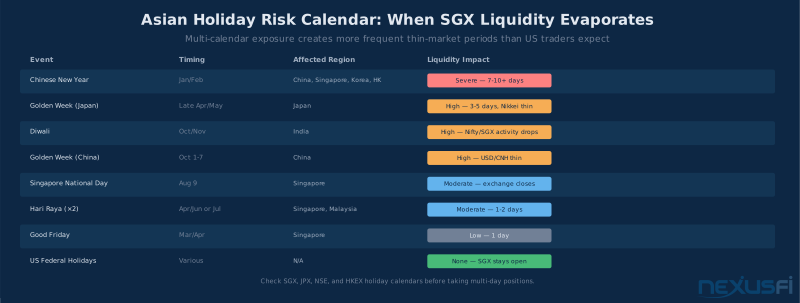
The calendar mismatch. US traders are accustomed to roughly 10 federal holidays per year, all well-known and easy to plan around. SGX interacts with multiple Asian holiday calendars simultaneously:
- Singapore public holidays: New Year's Day, Chinese New Year (2 days), Good Friday, Hari Raya Puasa, Labour Day, Vesak Day, National Day, Hari Raya Haji, Deepavali, Christmas
- Japan holidays affect Nikkei liquidity: Golden Week (late April/early May, can span 10 days), Marine Day, Mountain Day, and others
- India holidays affect Nifty liquidity: Diwali, Holi, various state and national holidays
- China holidays affect USD/CNH liquidity: Golden Week (October 1-7), Chinese New Year (typically 7+ days)
@bobwest flagged this dynamic in the context of US futures: "If you're going to trade those days, make sure you have checked the trading hours on the CME website. I would suggest taking those days off." The same advice applies more sharply to SGX — except SGX's holiday overlap with multiple Asian calendars creates more frequent occurrences where liquidity simply evaporates.
Gap risk around Asian holidays. When Japan or China is observing a major holiday and SGX remains technically open, the Nikkei Mini or USD/CNH order books can be extremely thin. A normal 2-contract fill at 1 tick might require 20 ticks of slippage. More seriously: positions held going into a major Asian holiday can experience significant gap moves when liquidity returns after the closure. This is true even for positions that look small relative to typical volume.
Practical management: Check the SGX holiday calendar and the relevant country holiday calendars (Japan, India, China, Singapore) before entering positions you plan to hold for multiple days. Know when the underlying cash markets are closed and plan your rolls so. The last trading day before Golden Week in Japan is routinely a sharp reduction in Nikkei Mini liquidity — experienced SGX traders flatten or reduce much before the holiday window.
Pre-Trade Setup and Decision Framework #
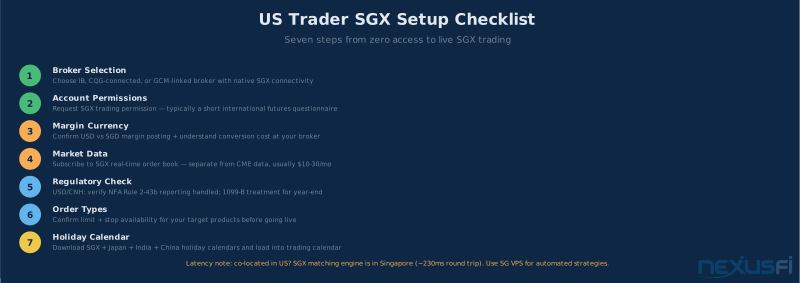
If you're planning to add SGX products to your trading, here's the practical sequence:
1. Identify the exposure you actually need. Japan equity beta → Nikkei Mini. India equity exposure → CNX Nifty (no alternative on a listed exchange). Broad Asia ex-Japan → MSCI AP ex Japan. China macro/FX → USD/CNH. Commodity/rubber → SICOM.
2. Verify current contract specs on SGX's website. Tick value, last trading day, settlement reference, final fixing time. Don't trade from memory or from this article's table — specs change.
3. Pull the margin schedule. Both the SGX exchange minimum and your broker's house margin. Calculate your per-contract notional, your margin as a percentage of notional, and your P&L per tick to confirm the math before you enter.
4. Confirm your trading hours overlap with liquidity. For US-based traders, Nikkei Mini and Nifty liquidity concentrates during US evenings. Know which part of the SGX session you're trading in and what the depth looks like.
5. Check the holiday calendar. Find the SGX holiday schedule and map it alongside Japan, India, China calendars for any multi-day holding periods.
6. Set up your broker connectivity and data feeds. Confirm SGX market data is live, order routing works, and your account has the proper permissions enabled.
7. Size smaller initially. SGX markets have different microstructure than US benchmarks. Execution quality, slippage, and market impact behave differently. Trade small, understand the actual fill behavior, then scale.
Why SGX Exists in Your Toolkit #
SGX doesn't compete with CME for what CME does best — deep global benchmark liquidity across US rates, equity indices, energy, and metals. What SGX provides is the exposure that CME genuinely doesn't offer in a useful form during Asian hours.
India equity exposure via SGX CNX Nifty is the clearest example. If you want to trade the India narrative — demographic growth, IT sector cycles, RBI policy, FII inflows and outflows — the SGX Nifty is the only listed, cleared, internationally accessible expression during the hours when India is actually trading. CME doesn't offer it.
The Nikkei Mini on SGX provides clean USD-denominated Japan equity exposure during Asian hours, with no JPY FX translation if you're using the USD-denominated contract. The Osaka Nikkei is more liquid overall, but for US traders managing USD P&L, the SGX USD-denominated version simplifies the position.
The practical framework is simple: if your strategy or risk management requires Asian market exposure to function correctly, SGX is the execution venue where that exposure lives. If your strategy is purely US-centric and you're looking at Asian hours as "extra time to trade ES in the overnight session," you probably don't need SGX specifically. The distinction is whether you need the Asian product itself — the Nifty, the Nikkei, the MSCI basket, the offshore yuan — or whether you're just looking for something that moves during US evening hours.
For traders building multi-market portfolios, SGX slots into the Asia component alongside Eurex for Europe and CME for global benchmarks. Each exchange serves its time zone and regional product set. Understanding all three is what institutional macro trading actually looks like in practice.
Knowledge Map
Go Deeper
Build on this knowledgeReferences This Article
Articles that build on this topicCitations
- — EST Market hours (2010) 👍 5“Weekend markets in Islamic countries, plus evening sessions on SGX including SGXNK (Nikkei 225 USD) alongside NIFTY and STW listed alternatives for Asian session activity.”
- — Mini Nikkei 225 on Osaka - Japan (JPX) (2016) 👍 4“Nikkei 225 Mini on the Osaka Securities Exchange is the most liquid futures contract in all of Asia, period. It rivals the ES in the volume it does.”
- — Mini Nikkei 225 on Osaka - Japan (JPX) (2016) 👍 7“Those considering other indices may consider the Mini Nikkei 225. Trading: 7pm-1:10AM CST then re-opens at 2:30am until 12:55PM CST.”
- — Overnight Session ES Trading (2011) 👍 20“The key to understanding the night market is knowing who is controlling it. The first major market to open following the close of the US day session is the Nikkei.”
- — MrMojoRisin's Journal (2021) 👍 2“The CME usually has partial-day trading on US holidays when you would expect markets to be closed. Check the CME website before trading those days.”
- — Trading natural gas futures (2019) 👍 11“Margin is risk based and its simplest form is a function of contract size and volatility. Volume is how much a contract trades and liquidity is how efficiently you can enter and exit positions.”
- — JacLau Trading Journal (2015) 👍 20“I started trading SGX derivatives full time from mid 2004 with S$200K capital. Made money 7 out of the last 10 years.”
- — Evaluating Futures Broker Capital Protection (2012) 👍 82“After the PFG collapse I have been evaluating my futures brokers to determine whether my capital is adequately protected. Regulation is poor and required legislation to protect capital is some time off.”
- — Session Indicators (2013) 👍 240“This thread is about session indicators and how to trade them. Asian session timing and behavior are a key component of understanding overnight market structure.”
- — Instrument comparison: ES, YM, TF, FDAX (2010) 👍 132“Each instrument has a different character. FDAX is very volatile. When comparing markets across exchanges, the key factors are liquidity, volatility, and time-zone alignment.”