



Eurex: Europe's Derivatives Powerhouse and What It Means for Your Trading
Overview #
Eurex is where European derivatives liquidity lives. If you trade futures and you've never looked beyond CME and ICE, you're missing the exchange that runs European equity index futures, German government bond futures, and the volatility products that price Euro-zone risk. It's not a niche venue — Eurex handles billions in notional daily and sets the benchmark for European rate and equity derivative pricing.
Deutsche Börse launched Eurex in the late 1990s by consolidating German derivatives trading into a single electronic platform. Today it runs on the T7 trading architecture, a deterministic matching engine with sub-millisecond latency. Everything clears through Eurex Clearing, the central counterparty that guarantees every trade. Trading, clearing, and risk management live in one integrated ecosystem — and that integration matters when you're managing margin across correlated positions.
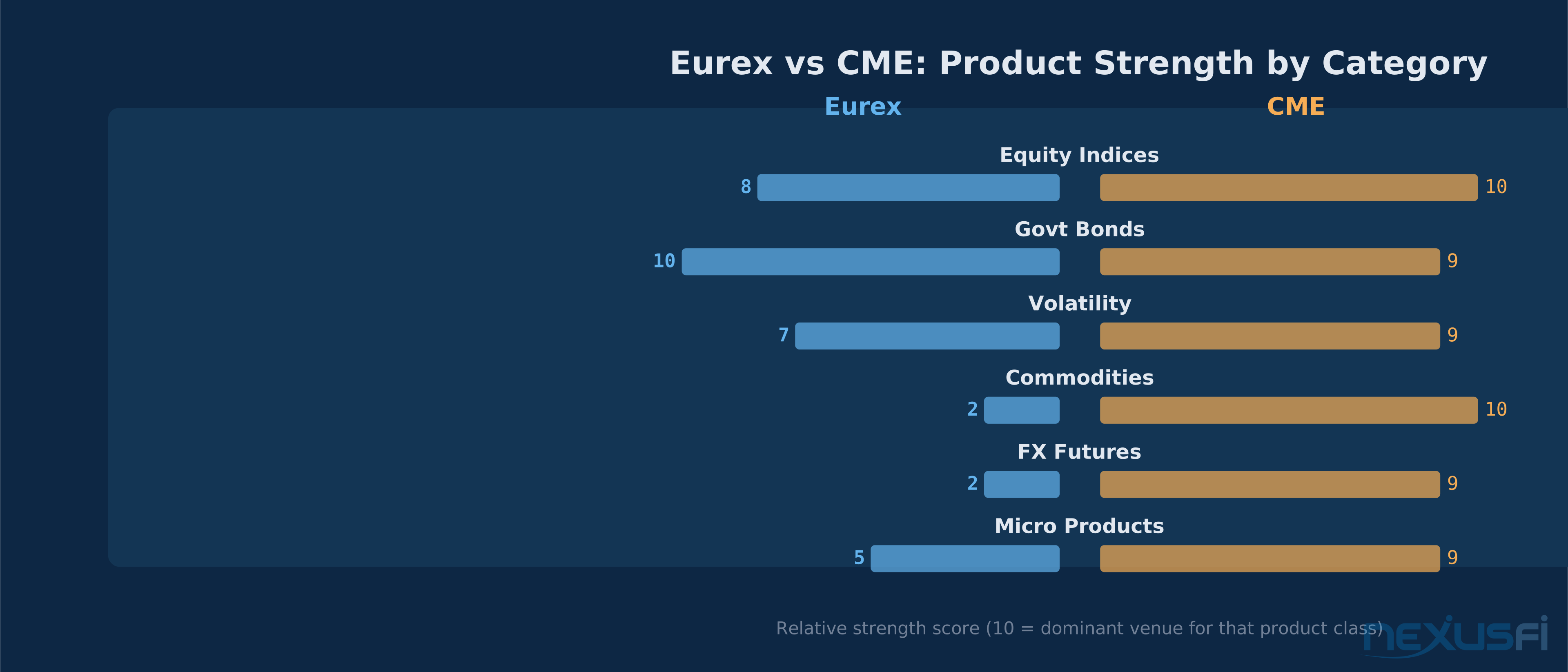
For US traders used to CME, here's the headline: Eurex is the CME of Europe. It dominates European equity index derivatives (DAX, Euro Stoxx 50) and German sovereign bond futures (Bund, Bobl, Schatz). If you trade macro, rates, or European equity beta, Eurex products belong in your toolkit.
Core Product Families #
Eurex's product lineup spans equity index futures, fixed income futures, volatility derivatives, and options. Here are the contracts that matter most.
Equity Index Futures: FESX, FDAX, and Micro Contracts #
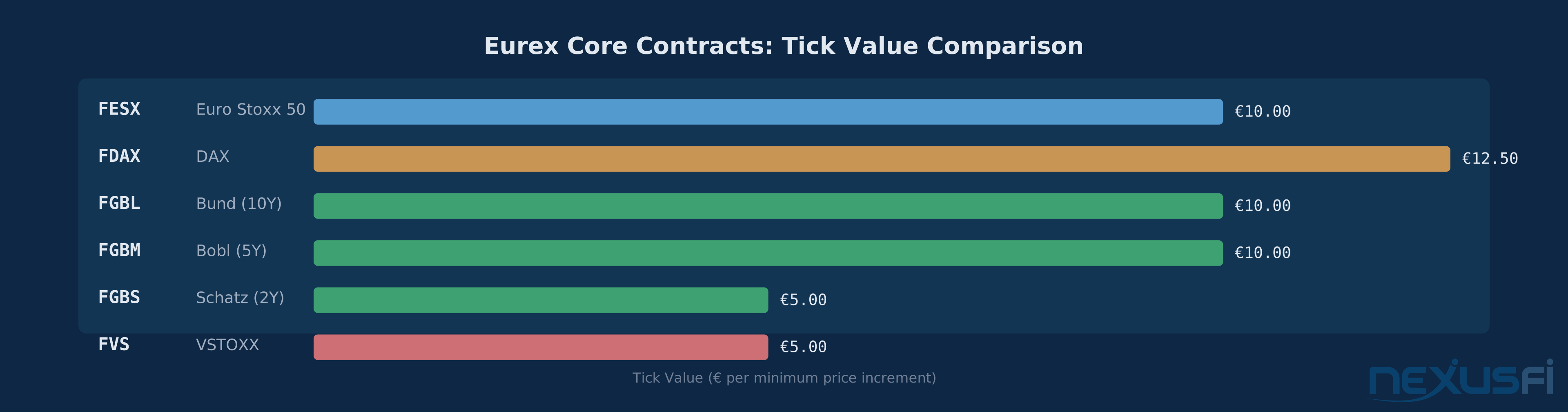
Euro Stoxx 50 Futures (FESX) are the European equivalent of the ES. The contract multiplier is €10 per index point with a tick size of 1 index point, making the tick value €10. Cash-settled quarterly. When NexusFi traders compare FESX to ES, the critical difference is economics: FESX at 5,000 gives you €50,000 notional versus ES at 5,500 giving you $275,000. Different risk profile entirely.
DAX Futures (FDAX) are the European NQ — volatile, fast, and popular with scalpers. The multiplier is €25 per index point, tick size is 0.5 points, so each tick is worth €12.50. Cash-settled to the Xetra DAX closing auction on the third Friday. At a DAX level of 18,500, one FDAX contract represents €462,500 in notional. Intraday ranges of 100-300 points are common, which means €2,500-€7,500 swings per contract. That's why FDAX scalping draws experienced traders who can handle the velocity.
Mini-DAX Futures (FDXS) give you one-fifth the exposure: €5 per index point, tick value of €2.50. Five FDXS equals one FDAX. This matters for retail traders who want DAX exposure without the full-size notional, and for anyone who needs finer position sizing — adding or trimming one FDXS at a time rather than committing €12.50 per tick.
Micro Euro Stoxx 50 (FXSE) contracts run at €1 per index point. Eurex launched these specifically for the retail segment and smaller institutional books that need the Euro equity beta without the capital commitment of FESX.
Fixed Income Futures: The German Yield Curve Suite #
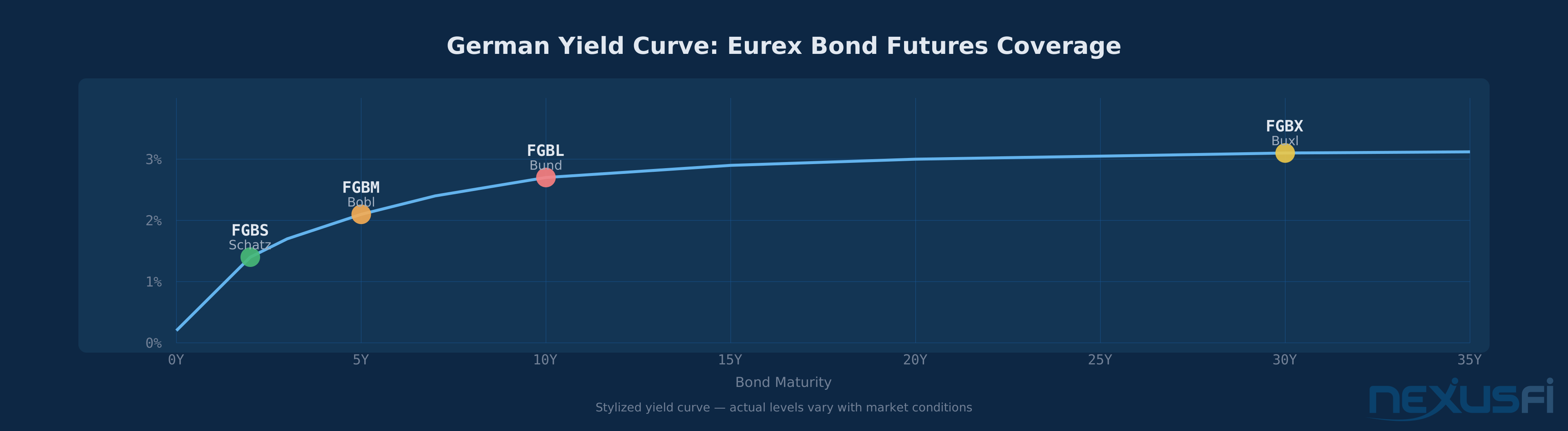
This is where Eurex has no peer. The German government bond futures complex — Bund, Bobl, Schatz, and Buxl — is the backbone of European rates trading.
Euro-Bund Futures (FGBL) track 10-year German government bonds. Contract notional is €100,000, tick size is 0.01 points (€10 per tick), and they're physically delivered. The Bund is the European equivalent of CME's 10-Year Treasury Note futures (ZN), but with a key difference: physical delivery through a cheapest-to-deliver (CTD) mechanism that makes basis trading and delivery optionality core features of the market.
Euro-Bobl Futures (FGBM) cover the 5-year segment. Same €100,000 notional, same 0.01 tick size (€10/tick), same physical delivery mechanics. Rates traders use Bund-Bobl spreads as their primary curve-steepener/flattener expression.
Euro-Schatz Futures (FGBS) sit at the 2-year point. Notional is €100,000, but the tick size is 0.005 points (€5/tick) — finer granularity because short-end rates move in smaller increments. Physical delivery.
Euro-Buxl Futures (FGBX) are the 30-year ultra-long contract. Tick size is 0.02 points (€20/tick). Less liquid than Bund but essential for duration-hedging long-dated liabilities and expressing views on the very long end of the German curve.
These four contracts give you the entire German sovereign yield curve in tradeable form. Curve trades — long Bund/short Schatz for a steepener, or the reverse for a flattener — are bread-and-butter institutional strategies executed on Eurex daily.
VSTOXX Volatility Futures #
VSTOXX futures reference the implied volatility of Euro Stoxx 50 options — Europe's answer to VIX futures. The multiplier is €100 per volatility index point, tick size is 0.05 points (€5/tick), and they're cash-settled. Liquidity is thinner than index futures, but VSTOXX is the primary instrument for trading European equity volatility term structure.
Traders use VSTOXX for event hedging (ECB decisions, European elections, sovereign debt stress) and for term-structure plays — front-month VSTOXX typically trades at a premium during calm markets (contango) and inverts during crises (backwardation). Different game than trading the underlying index.
Contract Specifications Reference #
Here's the quick-reference spec sheet every Eurex trader needs:
| Contract | Ticker | Multiplier | Tick Size | Tick Value | Settlement | Notional Example |
|---|
|
| Euro Stoxx 50 | FESX | €10/pt | 1.0 pt | €10 | Cash | €50,000 at 5,000 |
|---|---|---|---|---|---|---|
| DAX | FDAX | €25/pt | 0.5 pt | €12.50 | Cash | €462,500 at 18,500 |
| Mini-DAX | FDXS | €5/pt | 0.5 pt | €2.50 | Cash | €92,500 at 18,500 |
| Bund (10Y) | FGBL | €1,000/pt | 0.01 pt | €10 | Physical | €100,000 |
| Bobl (5Y) | FGBM | €1,000/pt | 0.01 pt | €10 | Physical | €100,000 |
| Schatz (2Y) | FGBS | €1,000/pt | 0.005 pt | €5 | Physical | €100,000 |
| Buxl (30Y) | FGBX | €1,000/pt | 0.02 pt | €20 | Physical | €100,000 |
| VSTOXX | FVS | €100/pt | 0.05 pt | €5 | Cash | €2,000 at 20 |
All equity index futures settle quarterly (March, June, September, December). Bond futures follow the same quarterly cycle with physical delivery. VSTOXX has monthly expiries for near-term contracts and quarterly for deferred months.
Clearing and Margin: Prisma, Not SPAN #
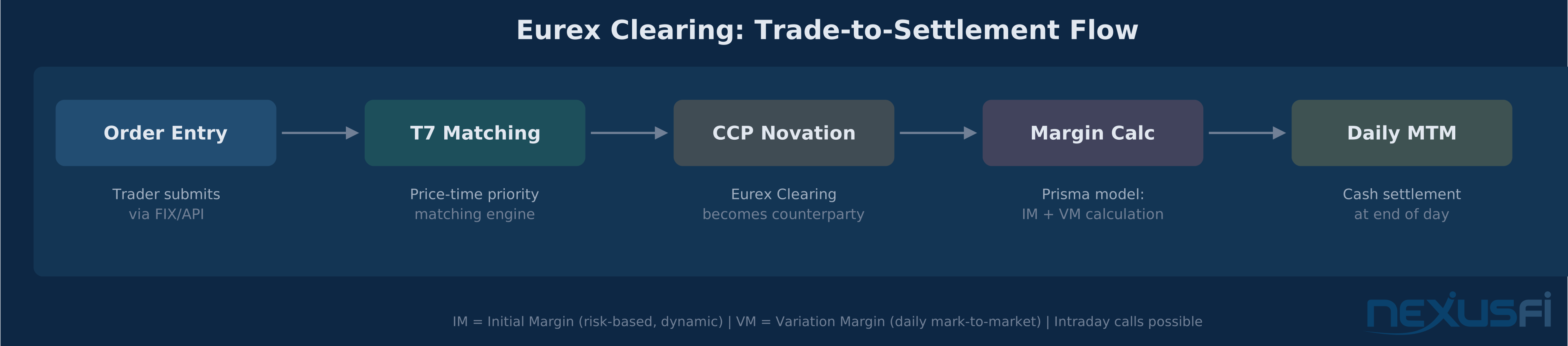
Eurex Clearing operates as the central counterparty for all Eurex-traded derivatives. Every trade you execute has Eurex Clearing on the other side — that's the CCP guarantee.
The margin model is Prisma, which is portfolio-based and at the core different from CME's SPAN. Where SPAN evaluates risk per contract family, Prisma models risk across your entire portfolio of Eurex positions, recognizing correlations and offsets between related products.
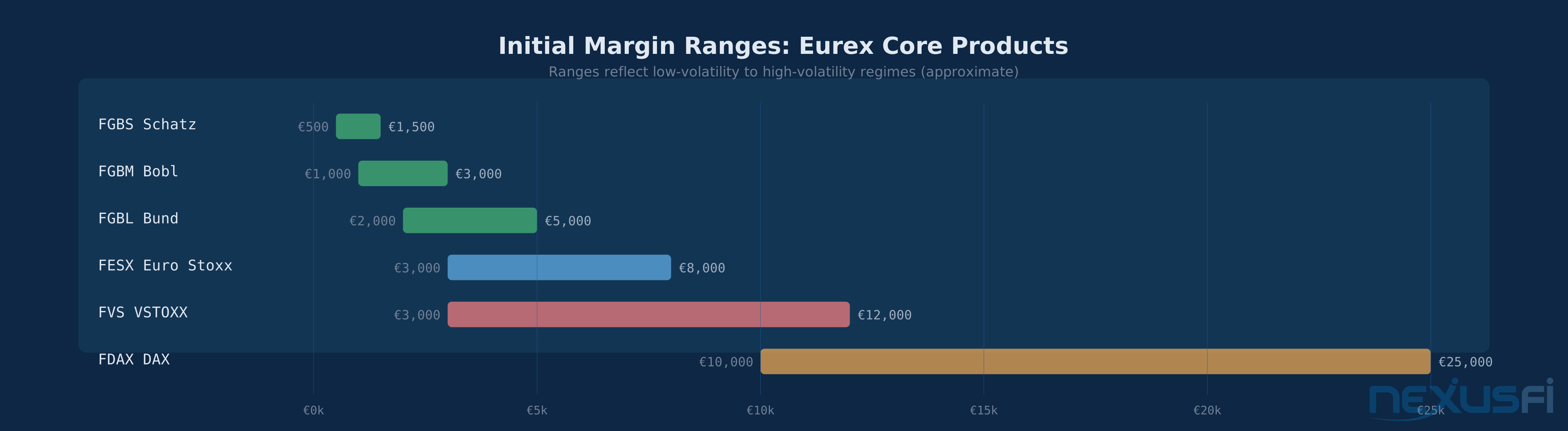
Initial margin (IM) is the collateral you post against potential future losses. Prisma calculates IM using historical stress scenarios and expected shortfall methodology — not a simple percentage of notional. This means IM changes dynamically: it rises during volatile regimes and falls during calm markets. A Bund position that costs €1,800 IM in a quiet week might demand €3,500 after an ECB surprise.
Variation margin (VM) is the daily mark-to-market settlement. Here's where Eurex differs operationally from CME: variation margin settles intraday at 12:00 CET and again at end of day. CME settles once daily. This means Eurex demands more working capital discipline — you can face a midday margin call that CME traders never see.
Portfolio offsets are the payoff for running correlated positions. Long 10 FDAX plus short 50 FESX? Prisma recognizes the correlation and can reduce your IM by 30-40% compared to margining each leg independently. Bund-Bobl curve spreads consume dramatically less margin than outright positions because the CCP models them as partially hedged. Smart position structuring on Eurex isn't just about P&L — it directly reduces your capital consumption.
The practical takeaway: don't assume static margin per contract. Budget a buffer for IM expansion during events, plan for midday VM settlement, and use portfolio offsets deliberately to free up capital for additional positions.
Trading Hours and Session Structure #
Eurex trading hours center on European business hours, with an extended evening session that overlaps with US markets. Here's the session map for the major product families:
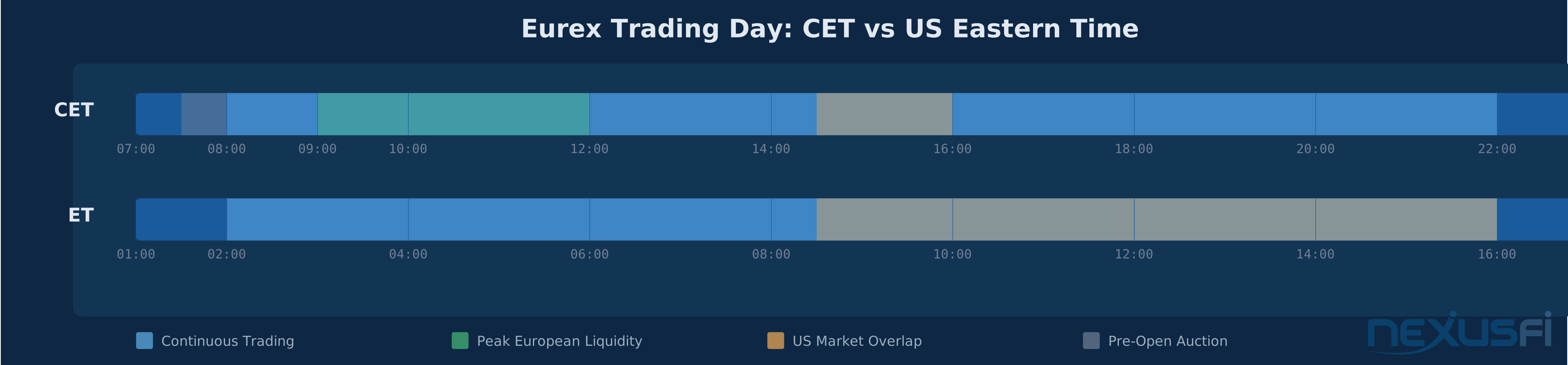
Equity index and fixed income futures trade from 08:00 to 22:00 CET. That's 02:00 to 16:00 Eastern Time. The pre-open auction runs from 07:50 to 08:00 CET.
For US-based traders, the time windows that matter are:
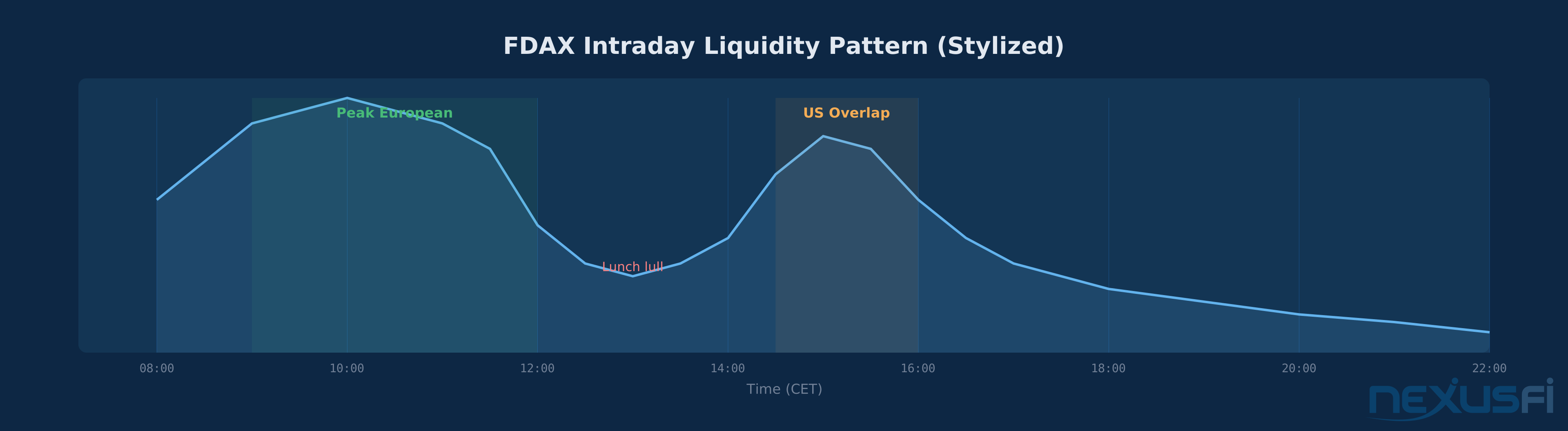
02:00-03:00 ET (08:00-09:00 CET) — European Open. Initial volatility, wider spreads. FDAX typically shows 2-3 tick spreads with aggressive directional movement as European cash markets open.
03:00-06:00 ET (09:00-12:00 CET) — Prime European Session. This is where liquidity is deepest. FDAX shows 0.5-1 tick spreads with 300-500+ contracts at the best bid and offer. Bund depth is equally strong. If you're scaling into positions, this is the window.
06:00-08:30 ET (12:00-14:30 CET) — European Lunch. Liquidity thins as European traders step away. Spreads widen. Scalpers generally avoid this dead zone.
08:30-10:00 ET (14:30-16:00 CET) — US Overlap. The highest-energy window of the day. US economic data releases hit, S&P and Nasdaq futures activate, and Eurex products respond to cross-Atlantic flow. FDAX spreads tighten back to 1-2 ticks with volume spikes. NexusFi scalpers focus heavily on this window because FDAX reacts to US macro data while still carrying European positioning.
10:00-16:00 ET (16:00-22:00 CET) — Extended Session. Progressively thinner liquidity. FDAX spreads widen to 2-5 ticks. Most institutional Eurex flow is done by 16:00 CET. Trading during this window is feasible but requires wider stops and lower size.
Bond futures follow the same schedule but show different intraday patterns. Bund depth peaks around ECB communications and European macro data releases (German GDP, CPI, PMI), then gets a second wind during US Treasury auctions and FOMC-adjacent flow.
How Eurex Differs from CME and ICE #
This isn't about marketing — it's about the mechanical differences that change how you trade.
Matching algorithm. Eurex T7 uses pro-rata elements with top-of-book priority. CME Globex is predominantly FIFO (first-in-first-out) for most products. On CME, getting to the front of the queue matters. On Eurex, size at a price level matters more. This changes order placement strategy: on Eurex, splitting orders across multiple price levels is less effective than concentrating size at your target level.
Contract economics. Same index move, different P&L. A 10-point DAX move on FDAX produces €250. A 10-point S&P move on ES produces $500. A 10-point Euro Stoxx move on FESX produces €100. You can't port position sizing math from CME to Eurex — recalculate everything.
Margin model. Prisma (portfolio-based, dynamic) versus SPAN (scenario-based, more static). Prisma rewards portfolio diversification more aggressively. CME-to-Eurex switchers consistently underestimate how much margin savings they get from correlated position offsets on Eurex.
Data feeds. Eurex Enhanced Market Data Interface (EMDI) shows aggregate quantity at each price level, not individual orders. CME's MDP 3.0 works differently. If you're doing DOM-based analysis or tape reading, your tools need to account for how the exchange publishes depth data.
Latency. Co-location in Frankfurt (Eurex data center) gives 1-5ms round-trip. US-based traders face 80-120ms to Frankfurt. That's not a deal-breaker for swing or position traders, but it means FDAX scalping strategies optimized for co-located CME latency won't transfer directly. Different execution environment requires different parameters.
Bond delivery mechanics. Eurex bond futures use German government bonds with specific conversion factor and CTD mechanics. CME Treasury futures have their own deliverable baskets and conversion factors. Same concept, different eligible bonds, different delivery timing, different basis dynamics. You can't assume Bund basis trades behave like ZN basis trades.
Settlement Mechanics: Cash vs Physical Delivery #
Cash-Settled Contracts #
FDAX, FESX, FDXS, FXSE, and VSTOXX are all cash-settled. On expiration day, the exchange calculates a final settlement price and your P&L is simply the difference between your entry and that settlement price, converted to euros at the contract multiplier.
FDAX settles to the Xetra DAX closing auction at 17:30 CET on the third Friday of the expiry month. FESX settles to a price derived from constituent option settlement values. These are electronic auction mechanisms — less manipulation-prone than the old pit-based settlement processes.
Physically Delivered Contracts: CTD Mechanics #
Bond futures — Bund, Bobl, Schatz, Buxl — are physically delivered. This is where Eurex gets interesting for rates traders.
At expiration, the short delivers a German government bond from an eligible basket to the long. The short chooses which bond to deliver, and economic self-interest dictates they'll deliver the cheapest-to-deliver (CTD) — the bond that minimizes their cost of delivery.
The invoice price calculation:
Invoice Price = (Futures Settlement Price × Conversion Factor) + Accrued Interest
Each deliverable bond has a conversion factor that normalizes it to a hypothetical 6% coupon bond. The CTD is the bond where the difference between the market price and the invoice price is most favorable for the short — effectively, the bond with the highest implied repo rate.
Why this matters to traders: CTD switching changes the futures basis. When the CTD shifts from one bond to another (typically because yield levels cross a threshold), the futures price relationship to any single cash bond changes. Order flow around delivery windows and CTD transitions creates tradeable dislocations that basis traders exploit. If you're holding Bund futures through a roll period, CTD dynamics determine whether the roll spread is driven by carry alone or by delivery optionality — and those are different trades.
Most traders close or roll positions 5-10 days before delivery. The delivery process itself is institutional infrastructure. But understanding CTD economics is mandatory for anyone trading Bund basis, curve spreads, or holding positions through roll windows.
Liquidity Patterns and Roll Dynamics #
Intraday Liquidity Map #
Eurex liquidity follows European business hours with predictable concentration patterns:
FDAX typically shows 300-500 contracts at the best bid and offer during the 09:00-12:00 CET core session. Spreads compress to 0.5-1 tick. After the European lunch thin-out, depth rebuilds during the US overlap (14:30-16:00 CET) but rarely matches morning levels. After 16:00 CET, you're trading in progressively thinner conditions.
FESX shows 200-400 contracts at top of book during core hours. The spread is consistently 1 point (the minimum tick) during active sessions.
Bund (FGBL) has deep, steady liquidity during European hours. Depth concentrations shift around macro events — ECB rate decisions can triple volume for 15-minute windows while thinning the book between announcements.
Roll Dynamics #
All major Eurex futures follow the quarterly cycle: March (H), June (M), September (U), December (Z). The roll window typically opens 5-10 trading days before the front-month expiry.
Liquidity migration follows a predictable pattern: the front month stays most liquid until roughly 3 days before expiry, then the deferred month becomes the active contract. Calendar spread markets (front vs deferred) are the primary execution vehicle during rolls — most institutional traders roll via the spread rather than legging independently.
For bond futures, the roll isn't purely mechanical. Because Bund, Bobl, and Schatz are physically delivered, roll pricing incorporates carry, CTD optionality, and financing rates. A rates desk rolling a Bund position isn't just moving from one month to the next — they're re-evaluating the delivery economics embedded in the calendar spread. CTD switching risk during the roll can cause abnormal spread movements that pure-carry models miss.
For equity index futures, rolls are more straightforward — cash-settled contracts roll based on fair value (cash index ± cost of carry). FDAX and FESX rolls are typically smooth with tight spread markets during the active roll period.
Roll execution tip: Avoid the last hour of the final roll day. Book thins dramatically as remaining front-month positions are either rolled or closed. Execute your roll during peak liquidity windows (09:00-12:00 CET or the US overlap) to minimize slippage.
Trading Eurex from the United States #
US-based traders can absolutely access Eurex, but the operational setup differs from trading CME products.
Broker Access #
Most US traders access Eurex through an FCM or broker that provides European exchange connectivity. Interactive Brokers, AMP Futures, and several other FCMs offer Eurex routing. You're not trading directly with Eurex — your broker's clearing relationship with a Eurex clearing member handles the CCP interface.
Not every US broker offers Eurex access. Before committing, verify that your broker supports: Eurex connectivity, real-time Eurex market data, EUR-denominated margin handling, and the specific products you want to trade.
Currency Exposure #
This catches US traders off guard: FDAX P&L is in euros. Your account is probably in dollars. That means your P&L has two components — the futures trade itself and the EUR/USD exchange rate. A profitable FDAX trade can lose money if the euro drops against the dollar while you're in the position. For day trades this is negligible. For swing or position trades, it's a real risk factor that needs managing.
Margin is typically collected in USD (converted at your broker's rate), but variation margin settlement happens in EUR. Your broker handles the conversion, but the FX spread is a hidden cost. Over many trades, it adds up.
Regulatory and Tax #
US persons trading Eurex futures remain under CFTC jurisdiction for fraud and manipulation. Eurex rules govern contract terms and exchange mechanics. Your broker handles the regulatory interface.
For US tax purposes, Eurex futures generally qualify for Section 1256 treatment — the 60/40 split between long-term and short-term capital gains. Confirm with your tax advisor, but this is the standard treatment for regulated exchange-traded futures.
Practical Workflow for US Traders #
Here's how experienced US traders typically approach Eurex:
- Session planning. Focus on the 02:00-10:00 ET window (08:00-16:00 CET) for the best liquidity. The 08:30-10:00 ET overlap is the sweet spot.
- Platform configuration. Set your DOM to show Eurex tick increments correctly (0.5-point for FDAX, 0.01 for Bund). Display P&L in USD auto-converted from EUR.
- Position sizing. Recalculate everything. FDAX at €12.50/tick and ES at $12.50/tick look equivalent but represent very different notional exposures and volatility profiles.
- Market data. Eurex data is a separate subscription from CME. Budget for it. You need real-time Level 2 for any serious Eurex trading.
- Risk management. Set stops accounting for EUR/USD exposure on swing trades. Monitor margin utilization with Prisma's dynamic adjustments in mind.
Eurex's intraday margin settlements catch US traders off guard. Where CME settles variation margin once at end of day, Eurex Clearing does it twice — at 12:00 CET and again at close. Day traders are fine. But if you hold Eurex positions overnight and a major macro event hits during European hours, you may face a midday margin call before US markets even open. Budget working capital so.
Who Should Trade Eurex #
Eurex isn't for everyone, but it's indispensable for specific trading profiles:
Global macro traders need Eurex for European rate and equity exposure. You can't properly express a view on ECB policy, German yields, or Euro-zone equity risk without Bund and FESX/FDAX.
Rates and fixed income traders find Eurex's bond futures suite unmatched. The Bund-Bobl-Schatz-Buxl complex gives you the entire German curve. No other exchange offers this depth in European sovereign rate derivatives.
Scalpers seeking volatility gravitate to FDAX. The combination of €12.50/tick, 100-300 point daily ranges, and deep European-session liquidity makes it one of the most traded scalping instruments globally.
Diversification-minded traders use Eurex products to trade during European hours when CME products are in their quietest overnight sessions. FDAX is actively traded while ES is in its thin overnight period — different liquidity regime, different opportunities.
Portfolio hedgers holding European equities or Euro-denominated fixed income use FESX and Bund futures as their primary hedging instruments. These are the benchmark contracts for European risk.
Eurex complements CME — it doesn't replace it. The strongest traders use both venues, matching their instrument choice to the session, the liquidity environment, and the specific risk they're trying to express. That's how professionals trade the global derivatives market.
Knowledge Map
Prerequisites
Understand these firstGo Deeper
Build on this knowledgeReferences This Article
Articles that build on this topicCitations
- — Eurex launching Micro Euro STOXX 50 (FXSE) and Micro DAX (FDXS) futures (2021) 👍 9“FESX has the equivalent liquidity and daily volume as the ES -- Eurex micro contracts provide retail access at 1/10th the margin of standard FESX.”
- — European index most suited to tape reading (2016) 👍 7“I've found the Bund (FGBL) to be really the most easy to read in terms of order flow. Iceberg orders are easily identified, the market is technical as well.”
- — Choosing a right Eurex product (2020) 👍 2“Based on personal experience FDAX is very difficult to trade by DOM due to its ultra thin order book. You often have just 1-2 contracts per level and if algos decide to go, it gaps.”
- — Eurex Products Advice - FDAX/FDXM/FESX (2020) 👍 2“Don't forget the Bund FGBL. A lot of the prop shops trade this. Good volume whereas the ES is thinner in UK mornings. Also the margin on the Bund is $1000, whereas the ES mini is $13,000.”
- — The Most Liquid Futures on the European Market? (2010) 👍 6“Current Ranking by Liquidity: 3 Month Euribor (I), 3 Month Sterling (L), DJ EuroStoxx 50 (FESX), Brent Crude IPE (B/BC/COIL), Gasoil IPE (G/GOIL) -- Eurex dominates European derivatives by volume.”
- — Mini FDAX - FDXM from Eurex (2015) 👍 19“Rumors condense that the Eurex will start a Mini FDAX contract -- and there are several German sources that cite it, so it might be true. Lots of reasons to launch a smaller-notional DAX contract for retail access.”
- — PA Dax CL, ES and Bund Price Action Trading Log (2017) 👍 23“After coming off of trading Dax futures, I decided to move to a more structured, higher volume, less slippage future. FDAX is volatile -- you need very precise execution and wider stops than ES.”