



ConnorsRSI: The Three-Component Momentum Oscillator Built for Mean Reversion
Overview #
Most momentum oscillators have one job: measure how fast price is moving and flag when it's gone too far. Standard RSI does this reasonably well, but it has a well-known problem — it can sit at extreme readings for long stretches during trending markets, giving traders false entry signals repeatedly before the actual reversal shows up.
ConnorsRSI addresses this by fusing three separate measurements into a single composite oscillator. Where standard RSI only knows how much price has moved, ConnorsRSI also knows how long it's been moving in one direction and how extreme today's move is relative to recent history. That combination catches exhaustion more precisely than any single-component oscillator can.
Developed by Larry Connors and Cesar Alvarez — the same researchers behind the popular RSI(2) mean-reversion framework — ConnorsRSI was published in 2012 as an evolution of their earlier work. The formula assigns equal weight to three distinct components, averages them, and outputs a value between 0 and 100. Readings below 10 signal oversold conditions. Readings above 90 signal overbought. Simple thresholds, but the composite nature of the signal makes them meaningfully more reliable than RSI(2) thresholds alone.
ConnorsRSI is not a trend indicator. It's a mean-reversion tool. Every trade it generates assumes the market is about to snap back from an extreme. Without a trend filter — most commonly the 200-period SMA — it will lose money in trending markets because it's designed for the opposite.
For futures traders, ConnorsRSI has found a home primarily on ES and NQ daily and 15-minute charts, where the mean-reversion edge is well-documented. Crude oil (CL) traders typically widen the percentile lookback window due to event-driven volatility from OPEC decisions and inventory reports. The underlying logic works across all futures contracts, but parameter tuning matters.
How ConnorsRSI Works #
Three Components, One Signal
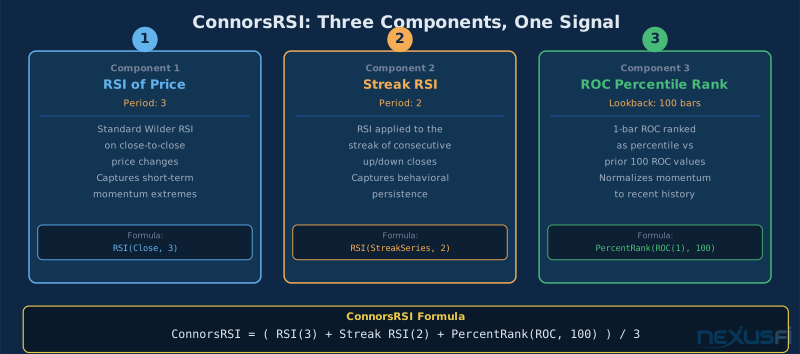
ConnorsRSI is the simple average of three independent measurements, each returning a value between 0 and 100:
ConnorsRSI(3,2,100) = [ RSI(Close, 3) + RSI(Streak, 2) + PercentRank(ROC(1), 100) ] / 3
The three numbers in the parameter notation — 3, 2, 100 — correspond to one parameter per component. That's the first thing to understand: adjusting ConnorsRSI means changing how each component behaves, not adjusting a single speed knob.
Component 1 — RSI of Price (Period: 3): This is standard Wilder RSI computed over 3 periods. With a period of 3, it reacts within 3 bars to momentum changes. A 3-period RSI will hit near-zero after a few consecutive down closes and near-100 after a few consecutive up closes. This component measures raw momentum extremes.
Component 2 — Streak RSI (Period: 2): This is where ConnorsRSI gets interesting. First, compute the streak — the count of consecutive closes in the same direction. If price has closed higher for 4 days in a row, the streak is +4. If it's closed lower for 3 days, the streak is -3. Apply RSI(2) to this streak series. The result measures the behavioral persistence of the move — how "crowded" the directional trend has become. A streak RSI near 100 means price has been relentlessly trending up for an unusual number of consecutive bars. That's exactly the kind of exhaustion setup mean-reversion traders want to fade.
Component 3 — ROC Percentile Rank (Lookback: 100): Compute today's 1-bar rate of change (today's close versus yesterday's close, expressed as a percentage). Then rank that ROC value against the prior 100 ROC values. If today's ROC is larger than 90 of the past 100 readings, the percentile rank is 90. This component normalizes momentum against recent history. The same 1% move might be extreme in a low-volatility regime but routine in a high-volatility environment — the percentile rank automatically adjusts for this.
Average these three together and you get ConnorsRSI. That's the complete formula. No weighting, no lookback interactions, no hidden complexity.
The percentile rank component is the key differentiator between ConnorsRSI and RSI(2). Two markets can have identical RSI(2) readings but completely different percentile ranks if their recent volatility differs. ConnorsRSI's context-awareness is the key improvement over its predecessor.
Step-by-Step Calculation #
Worked Example
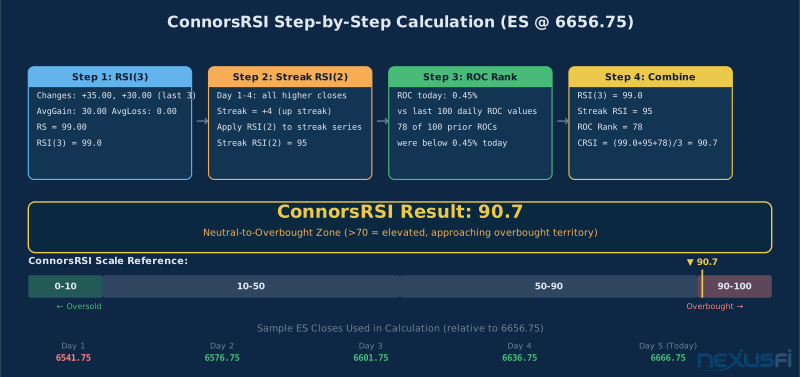
Using 5 recent ES daily closes as the input (indexed as Day 1 through Day 5), here's how to compute ConnorsRSI(3,2,100) from scratch. The example uses round numbers for clarity — real computation requires the full historical lookback for accurate results.
Step 1 — RSI(3):
Compute the 1-bar price changes for the last 3 bars, then separate into gains and losses. Average them using Wilder's smoothing (simple average for initialization). Divide average gain by average loss to get RS. Apply the RSI formula: RSI = 100 - 100/(1+RS). If the last 3 bars showed gains of +12.50 and +25.00 with one loss of -6.25, the calculation is straightforward. Most platforms handle Wilder smoothing automatically.
Step 2 — Streak RSI(2):
Count consecutive closes. If Day 1, 2, 3, and 4 all closed higher than the prior day, the streak at Day 4 is +4. If Day 5 is also higher, streak is +5. Apply RSI(2) to a series of these streak values. A streak RSI of 95 means the streak behavior has been relentlessly positive — a bullish extreme that mean-reversion traders want to fade on the short side, or confirm for bulls that the uptrend is intact before looking for a dip.
Step 3 — ROC Percentile Rank:
Calculate today's ROC: (Close today - Close yesterday) / Close yesterday × 100. In a production system using a 100-bar lookback, gather the last 100 ROC values and count how many are smaller than today's ROC. That count divided by 100 gives the percentile rank as a decimal; multiply by 100 for the 0-100 scale. A rank of 78 means today's ROC was larger than 78% of recent daily moves — elevated but not yet at the 90+ extreme that suggests a reversal.
Step 4 — Average the Three:
With RSI(3) = 72, Streak RSI(2) = 95, and ROC rank = 78, ConnorsRSI = (72 + 95 + 78) / 3 = 81.7. That reading sits above 70, approaching the 90 overbought threshold. Not a shorting signal yet, but the market is elevated on all three measurements simultaneously.
Platform implementations differ in streak definition (equality handling), percent rank computation (inclusive vs exclusive), and RSI variant. Verify your platform's output against manual calculation on 5-10 known bars. A mismatch of 2-3 points can shift threshold signals by one bar.
One important detail: Wilder RSI requires warmup before it stabilizes. For the 100-bar ROC lookback, you need 100+ bars before the percentile rank is statistically meaningful. Most platforms handle this transparently, showing N/A values during warmup.
Default Parameters: Why 3-2-100 #
The 3-2-100 default wasn't chosen arbitrarily. Each number reflects a deliberate tradeoff between speed and noise reduction.
RSI Period = 3: Standard RSI uses 14 periods by default. At 14 periods, the indicator becomes too smooth for mean-reversion trading — it misses the sharp, short-lived pullbacks that create the best entries. RSI(2) is faster but generates more false signals. RSI(3) sits between them: responsive enough to catch real exhaustion, slow enough to filter out microstructure noise on most timeframes above 5 minutes.
Streak Period = 2: The streak series itself has limited variance — streaks of +5 or -5 consecutive closes are already extreme in most markets. Applying RSI with period 2 means the streak RSI reacts sharply to recent changes in streak direction. When a 4-bar down streak suddenly stops (streak goes from -4 to -1 as one up close interrupts the trend), RSI(2) on the streak values captures that inflection almost immediately. A longer streak RSI period would smooth over this signal and delay the entry.
ROC Lookback = 100: One hundred bars of daily data represents roughly 5 months of trading history. That's long enough to capture seasonal patterns and different volatility regimes while remaining short enough to stay relevant to current market conditions. Too few bars (20-30) makes the percentile rank unstable — a single large move can dominate the distribution. Too many bars (200+) makes the rank unresponsive to regime changes.
For different timeframes, these defaults require adjustment. @BostonTrader1 demonstrated that for TradeStation strategy development, the 200-SMA combined with RSI(2) as a trend-filtered oscillator produced clean signal logic that translated directly to NinjaTrader implementation. [3] The 200-SMA trend filter is so fundamental to ConnorsRSI strategies that Connors effectively built it into his original trading rules — the indicator itself signals the extreme, and the 200 SMA tells you which side of the trade to take.
The 3-2-100 default is designed for daily charts on liquid equity indexes. For ES and NQ intraday (5-15 minute), the defaults work reasonably well but many traders shorten the ROC lookback to 50-75 bars for faster adaptation to intraday volatility regimes. For CL, widening to 3-2-150 reduces false signals during commodity-specific event risk.
The key parameter to tune first is the ROC lookback (the third number). It has the most impact on how the indicator adapts to regime changes. Changing the RSI period (first number) shifts sensitivity to price momentum. Changing the streak period (second number) rarely needs adjustment — most traders leave it at 2.
Entry and Exit Signals #
Mean Reversion Setup Template
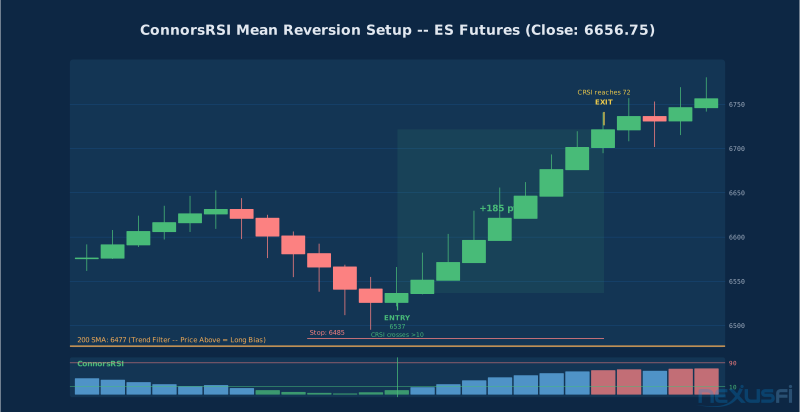
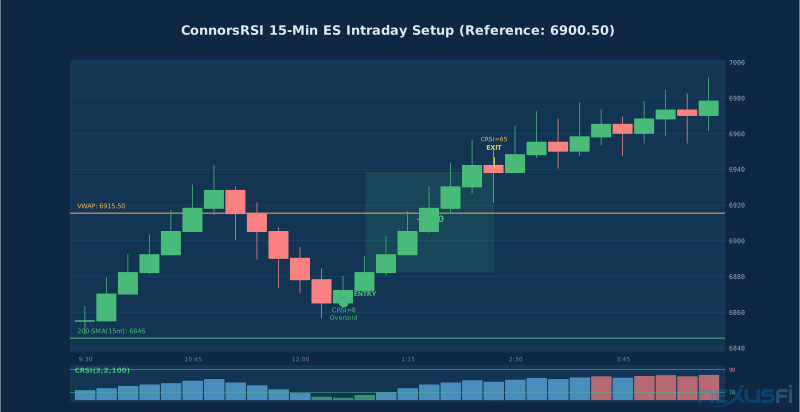
ConnorsRSI has a well-established signal framework that's been published and discussed since Connors first released the indicator. The core setup for a long entry:
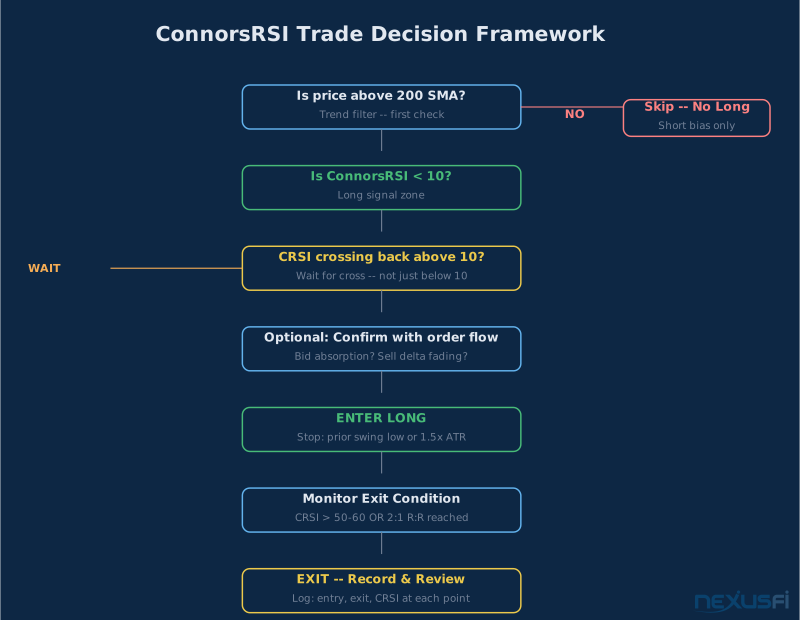
- Confirm trend direction: Price must be above the 200-period SMA (or EMA). This is non-negotiable. Trading ConnorsRSI long signals when price is below the 200 SMA means you're buying into a downtrend and hoping for a bounce -- that's speculation, not an edge.
- Wait for oversold: ConnorsRSI drops below 10. This is the standard aggressive threshold. More conservative traders use below 15 or 20 for more frequent signals at the cost of lower win rates.
- Entry trigger: ConnorsRSI crosses back above the threshold level (crosses above 10). Don't enter on the reading below 10 -- wait for the cross back up. This filters out the "knife-catching" entries where oversold keeps getting more oversold.
- Stop placement: Below the most recent swing low, or 1-1.5 ATR below entry. Never use a fixed dollar stop without considering the instrument's current volatility.
- Exit: ConnorsRSI reaches 50-60 (neutral zone), OR price hits a 2:1 reward-risk target, whichever comes first.
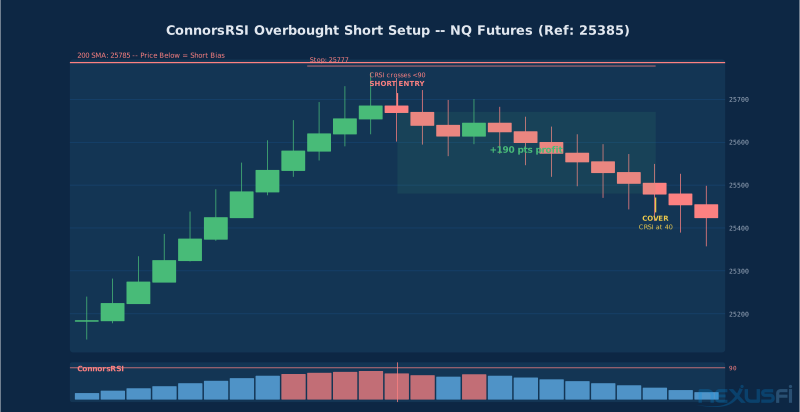
For short entries, mirror the setup: price below 200 SMA, ConnorsRSI above 90, entry on cross back below 90.
@vmodus documented an important refinement to this approach [6]: rather than entering at the bar where ConnorsRSI crosses the threshold, waiting for a slight pullback in price (using RSI(2) timing on top of ConnorsRSI) produced measurably better average entry prices across 18 instruments in backtesting. [4] The improvement was small per trade but consistent — roughly $0.09-$0.18 better per share on equity instruments, translating to meaningful improvement on leveraged futures positions.
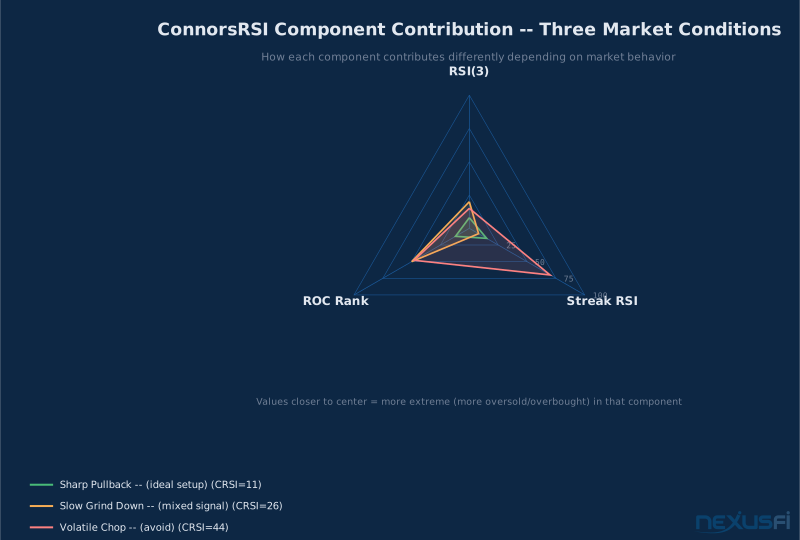
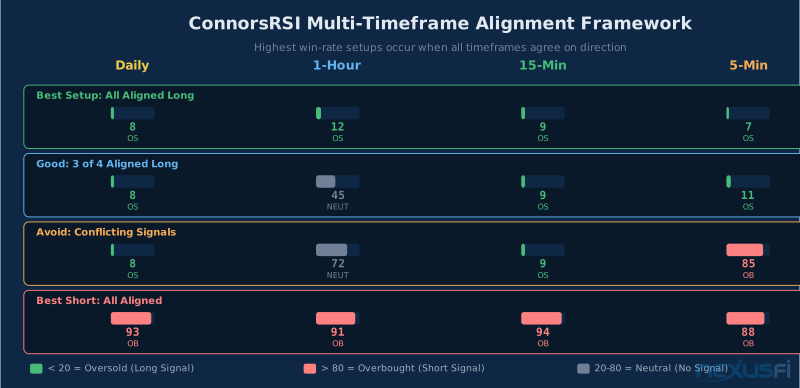
For ES and NQ futures, the most reliable ConnorsRSI setups occur when all three components are extreme simultaneously — RSI(3) near 5-10, streak RSI near 5-15, and ROC rank below 15. When one component is borderline while the others are extreme, win rates drop measurably. The composite nature of the signal means you want all three components to agree.
Position sizing matters more with mean-reversion strategies than with trend-following approaches. Because mean-reversion entries often occur during fast-moving, volatile conditions (price is getting hit hard, which is why the oscillator is oversold), slippage can be significant. Plan fills conservatively. A 1-lot trade at limit with 1-tick slippage is worth modeling before you commit to a systematic strategy.
Partial Exits and Scaling
Some traders use a partial exit: take half off at CRSI reaching 40 (midway recovery), let the rest ride to 60 or a price target. This captures the mean-reversion move while keeping exposure to follow-through. The tradeoff is smaller average winners but more consistent per-cycle profitability.
When the initial setup is especially extreme (CRSI < 5, all three components simultaneously at multi-bar lows), pyramiding the position as it proves out is justified. These rare, high-conviction setups warrant larger position size than routine threshold crossings.
ConnorsRSI vs Other RSI Variants #
Sensitivity Comparison
Understanding how ConnorsRSI differs from standard RSI and its variants helps you choose the right tool for specific setups.
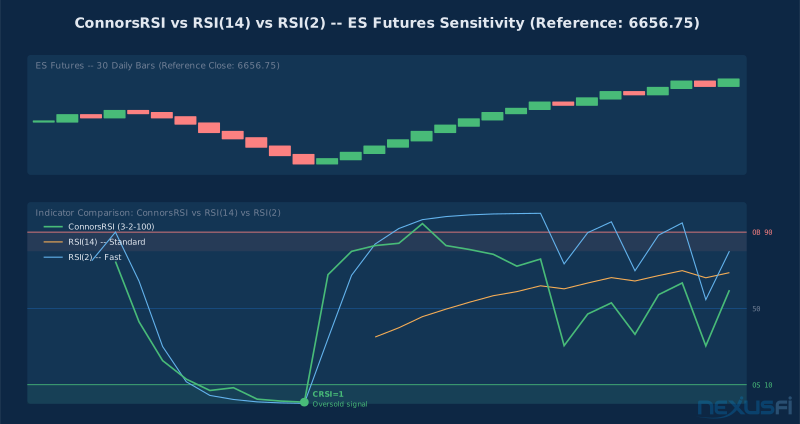
vs Standard RSI(14): RSI(14) is smooth and slow. It misses short-term exhaustion entirely — by the time RSI(14) reads below 30 (the conventional oversold threshold), the mean-reversion move has often already happened. ConnorsRSI's 3-period RSI component is far more responsive to short-term momentum extremes. RSI(14) is better suited for trend confirmation than entry timing.
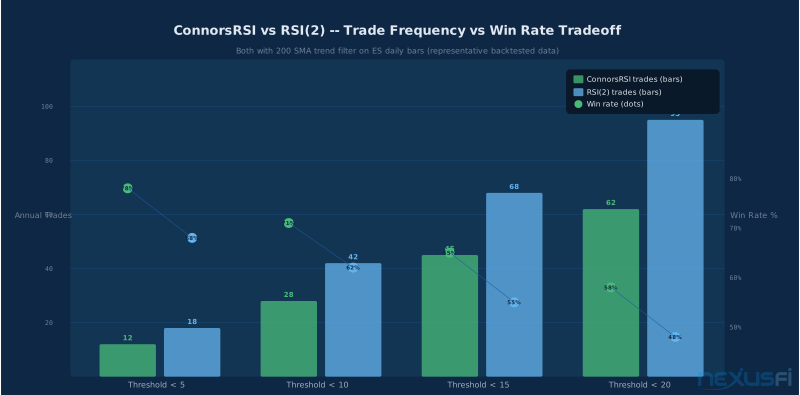
vs RSI(2): RSI(2) is the closest relative and the most direct comparison. RSI(2) produces more signals than ConnorsRSI because it has no context components — a 2-period RSI below 5 can occur in the middle of a strong trend just as easily as at a genuine exhaustion point. ConnorsRSI's streak and percentile rank components add context that RSI(2) lacks. In practice, ConnorsRSI signals tend to have higher win rates but fewer occurrences than RSI(2) signals at equivalent thresholds. @Jeff65 documented RSI(2) system results showing 67% win rates with 64 trades over 15 years on ES — a solid baseline that ConnorsRSI aims to improve upon through the additional context components. [2]
vs StochRSI: StochRSI applies the stochastic formula to RSI values, rescaling RSI within its own recent high-low range. This produces an oscillator that can compress into near-0 or near-100 readings more frequently than either standard RSI or ConnorsRSI. StochRSI also has a tendency to "freeze" at extremes when RSI itself loses volatility during ranging conditions. ConnorsRSI avoids this problem because the percentile rank component doesn't depend on RSI's range — it's based on raw price ROC.
vs MACD: MACD is a trend-following momentum indicator, not a mean-reversion oscillator. Comparing it to ConnorsRSI is a category error. Use MACD for trend direction; use ConnorsRSI for entry timing within that trend.
The clearest advantage of ConnorsRSI over RSI(2) is the percentile rank component. Two markets can have identical RSI(2) readings — both at 5, suggesting strong oversold conditions — but completely different implications if one market's recent volatility is 3x the other's. ConnorsRSI's ROC percentile rank automatically accounts for this. The same raw price move ranks as "extreme" in a calm market and "routine" in a volatile one.
In head-to-head comparisons across futures backtests, ConnorsRSI with a 200 SMA trend filter consistently outperforms RSI(2) with the same filter on the same instruments, primarily due to reduced false signals during trending conditions. The streak component catches situations where RSI(2) would be oversold because of one large down bar but the streak behavior doesn't confirm exhaustion — ConnorsRSI stays out of that trade while RSI(2) triggers it.
The Trend Filter: Non-Negotiable #
Every expert who has published systematic research on ConnorsRSI — and Connors himself in his original documentation — includes a trend filter as a mandatory component of the strategy. Without it, ConnorsRSI is a mean-reversion oscillator trading against momentum in trending markets, which is a reliable way to lose money.
The 200 SMA Rule: The simplest and most tested trend filter. Long signals only when price is above the 200-period SMA. Short signals only when price is below it. On daily charts, this corresponds to the 200-day SMA — a benchmark used by institutional desks globally. On intraday charts, the 200-period SMA of your chosen bar timeframe serves the same function.
@Jeff65 documented an enhanced version: adding a slope filter (only take signals when the 200 SMA is trending in the signal direction) reduced false signals much without missing the best setups. [5] Flat 200 SMA periods are ranging conditions where both trend-following and mean-reversion approaches underperform — this filter avoids those periods entirely.
Volatility Regime Filters
ADX Filter: When ADX is above 25-30, the market is in a strong trend. ConnorsRSI's mean-reversion edge weakens much because oversold conditions can persist far longer than normal. Consider skipping signals when ADX is above 25, or widening thresholds to <5 / >95 for only the most extreme setups.
ATR Expansion Filter: When the current bar's range exceeds 1.5-2.0x the 20-bar median ATR, the market is in expansion mode. Mean-reversion setups during expansion often turn into catching knives. Skip ConnorsRSI signals when ATR is expanding rapidly.
VIX Regime (for ES/NQ): During high-VIX environments (above 20-25), ConnorsRSI extremes are actually more reliable for reversals — elevated fear creates sharper oversold readings at genuine reversal points. During low-VIX environments, extreme readings are rarer and mean reversion happens faster. Adapt holding period so.
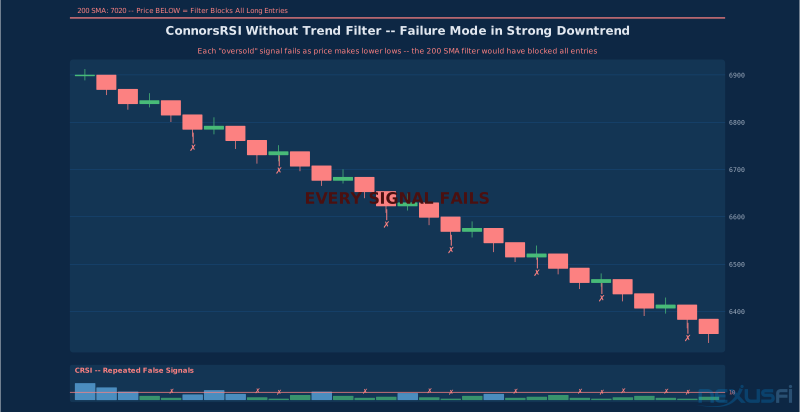
The single most common ConnorsRSI mistake: using it without a trend filter during a strong directional market. A reading below 10 during a sustained downtrend triggers repeatedly as price makes new lows. Each signal looks like a perfect oversold entry; each one fails. Check the 200 SMA first.
Order flow adds another validation layer. When CRSI is below 10 and the footprint shows selling imbalance fading — bid absorption visible, sell delta declining — mean-reversion probability improves meaningfully. The oscillator identifies the when; order flow confirms the how.
Parameter Tuning for Futures Contracts #
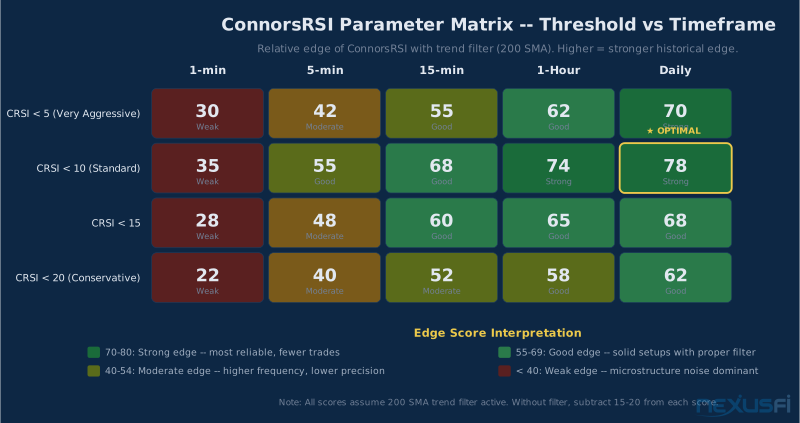
Parameter Matrix
The 3-2-100 defaults work well as a starting point, but optimal parameters vary by contract and timeframe. Here's the framework for systematic tuning:
ES (S&P 500 E-mini) and NQ (Nasdaq-100 E-mini): These are the most liquid equity index futures and the best candidates for ConnorsRSI's default parameters. On daily charts, 3-2-100 with a <10 long threshold and 200 SMA filter is well-tested. On 5-minute charts, many traders use 3-2-50 or 2-2-50 to adapt to the faster intraday regime changes. The key is that the ROC lookback (third parameter) should represent a reasonable sample of recent volatility — 50-75 bars on 5-minute charts covers 3-6 hours of price action, which is a sensible baseline.
CL (Crude Oil): Crude's volatility is event-driven. OPEC decisions, EIA inventory reports, and geopolitical risk create sharp moves that can send ConnorsRSI to extremes and keep it there longer than ES/NQ setups would suggest. Widening the ROC lookback to 150-200 bars gives the percentile rank more history to normalize against these event-driven spikes. Threshold adjustments are also common: <8 for longs, >92 for shorts, to reduce false entries during trending commodity moves.
GC (Gold) and ZN/ZB (Treasuries): Both gold and bond futures show mean-reversion characteristics on daily charts. Standard 3-2-100 defaults apply, though gold's safe-haven dynamics during equity stress events can create persistent oversold conditions that break normal mean-reversion patterns. Adding a gold-specific filter (avoiding long signals when SPX is in sharp downtrend) improves edge.
Intraday Timeframes: ConnorsRSI's edge weakens on timeframes below 5 minutes. On 1-minute charts, threshold crossings are dominated by microstructure noise — the bid-ask spread, individual large order impacts, and data feed latency create false signals that the ROC percentile rank can't filter effectively at that resolution. Five-minute bars are the practical minimum for reliable ConnorsRSI signals. Fifteen-minute and hourly bars produce the cleanest signals in routine testing.
When testing ConnorsRSI parameters, focus your optimization on the ROC lookback (third parameter) first. It has the most impact on regime adaptation. Use the same 3-2 for the first two parameters across most futures instruments, and only adjust them if you're trading a contract with unusual streak characteristics (very long consecutive run lengths are common in some commodity futures).
Walk-forward testing is essential for ConnorsRSI strategy development. The indicator's mean-reversion character means out-of-sample performance can look much different from in-sample results if the test period includes a strong directional market. Always evaluate on both trending and ranging environments before committing capital.
Platform Implementation #
ConnorsRSI is available on all major futures platforms, but implementation details vary enough to require verification before live trading.
NinjaTrader 8: Available through the NinjaTrader Ecosystem as a community indicator. @Ironman9973 built one of the first NT7 implementations and shared it with the NexusFi community. [1] For NT8, verify streak definition (how Close = prior Close is handled) and that ROC uses percent change, not points difference.
TradeStation EasyLanguage: @BostonTrader1 shared a clean RSI(2) implementation demonstrating the core logic for MA-filter integration and alert criteria. [3] For full ConnorsRSI, the percent rank function is the most platform-specific element — verify it counts values strictly below (not equal) and divides by N.
ThinkorSwim ThinkScript:
input lengthRSI = 3;
input lengthStreak = 2;
input lengthROC = 100;
def streakVal = if close > close[1] then 1 else if close < close[1] then -1 else 0;
# Note: streak needs running accumulator, not per-bar +1/-1
def ConnorsRSI = (RSI(length = lengthRSI) + RSI(price = streakVal, length = lengthStreak) + PercentRank(close / close[1] - 1, lengthROC)) / 3;
plot CRSI = ConnorsRSI;
Validation Protocol: Find a 3-5 day down streak followed by recovery. Compute CRSI manually for 5 bars around the streak low. Compare against platform output — they should match within 0.5 points. If they diverge, check the streak definition and percent rank tie-handling first.
The most common implementation divergence: how platforms handle percent rank when the current ROC equals values in the lookback window. Some count ties as "below" (higher rank), others as "above" (lower rank). The difference can shift the component value by 5-10 points — enough to affect threshold signals.
Common Mistakes and Failure Modes #
ConnorsRSI has well-documented failure modes. Knowing them before you start is worth more than any parameter optimization.
No Trend Filter: Any systematic test without a trend filter shows reasonable performance on ranging data and catastrophic performance on trending data. The 200 SMA is non-negotiable. This isn't a suggestion — it's the foundational requirement of the entire framework.
Over-Optimization: ConnorsRSI has enough parameters (three core plus threshold values) that a determined optimizer can perfectly fit any historical period. The research shows 3-2-100 works across instruments because Connors validated it out-of-sample on large datasets. Aggressive optimization produces strategies that work brilliantly in-sample and fail immediately live.
Inconsistent Streak Implementation: Different platforms define streaks differently, especially how they handle bars where Close equals prior Close. Even small implementation differences compound over time in systematic strategies. Verify your platform's output against manual calculation before trading live.
Wrong Timeframe Application: On 1-minute charts, you're applying a mean-reversion oscillator to microstructure noise. The indicator can't distinguish real exhaustion from bid-ask spread noise at that resolution. Five-minute bars are the practical minimum for reliable ConnorsRSI signals.
Ignoring Execution Costs: Mean-reversion signals often occur during fast-moving conditions where slippage is elevated. A system positive at zero cost can turn break-even after realistic modeling. Always include at least 1 tick of slippage per side in ES/NQ backtests.
The most painful failure: entering long with CRSI below 10 during a genuine market dislocation (2008 credit event, March 2020 COVID crash). The indicator reads "extreme oversold" based on recent history, but that history doesn't include the macro shock that's driving price lower. The mean-reversion never happens. Check macro context before sizing up on extreme readings.
Holding Through Macro Events: FOMC announcements, CPI prints, and geopolitical events create persistent directional moves that break the mean-reversion assumption for days. Reduce size before major releases or use time stops that force exit before the event window.
ConnorsRSI was developed on daily equity data. Futures traders applying it to intraday contracts are extending the methodology beyond its original testing environment — which is fine, but requires additional contract-specific validation before deploying capital.
Combining ConnorsRSI with Other Tools #
ConnorsRSI works best as one component of a complete trading framework. Here are the most productive combinations:
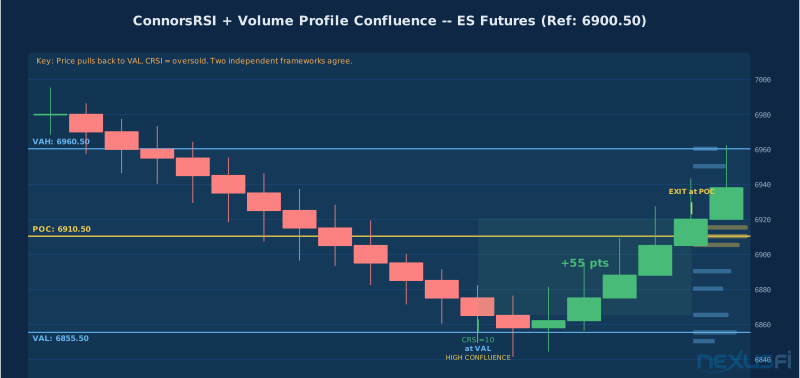
ConnorsRSI + Volume Profile: When ConnorsRSI drops below 10 near a Value Area Low, the confluence of momentum exhaustion and volume-confirmed support creates higher-probability mean-reversion entries. The VAL provides a natural stop level — below VAL suggests the thesis is wrong. This combination improves trade structure compared to ATR-based stops alone.
ConnorsRSI + VWAP: When price is below VWAP and ConnorsRSI is oversold, VWAP itself becomes the mean-reversion target rather than an arbitrary oscillator level. For intraday ES and NQ trading, Anchored VWAP from a prior significant swing low provides an even more precise exit anchor.
ConnorsRSI + Market Internals: For ES and NQ, TICK and TRIN add breadth confirmation. A CRSI below 10 with TICK below -1000 and TRIN above 2.0 suggests broad-based selling where mean-reversion takes longer. CRSI below 10 with mixed or improving breadth suggests localized selling ripe for a snap-back.
ConnorsRSI + Order Flow: The highest-conviction setups show selling absorption in the footprint — price at a new low but sell volume declining and bid absorption visible. When footprint confirms that sellers are exhausting supply as ConnorsRSI reads oversold, the reversal probability increases much. This is how experienced discretionary traders use it: as a context filter that narrows focus to high-probability zones where order flow confirms the entry.
The best setups develop from a top-down process: identify the trend (200 SMA), identify a significant reference level (Value Area, VWAP, prior day high/low), wait for price to reach that level with ConnorsRSI in extreme territory, then confirm with order flow. The oscillator is one layer in a multi-layer framework.
In Automated Systems: ConnorsRSI's mechanical construction suits algorithmic implementation directly. Clear thresholds (below 10, above 90) create unambiguous entry conditions. Combined with the 200 SMA filter, the result is a fully rule-based entry trigger deployable within any automated framework.
Practical Application Framework #
Week 1: Install ConnorsRSI and verify it against manual calculation on 5-10 bars (match within 0.5 points). Add the 200 SMA. That's your complete initial setup.
Weeks 2-3: Scroll back through 6-12 months of daily ES/NQ charts. Mark every CRSI-below-10 instance with price above 200 SMA. Note outcomes: did price recover in 3-5 bars? What was the worst adverse excursion? This manual review builds intuition no backtest report replicates.
Week 4: Paper trade strict rules: long only above 200 SMA, enter on CRSI crossing back above 10, stop at prior swing low, exit at CRSI reaching 50-60. Log every trade.
Live: If forward test matches historical analysis, start minimum size. Scale up after 20+ live trades confirm expected behavior.
ConnorsRSI is not plug-and-play. It requires validation, testing, and context layering. Traders who use it successfully treat it as one component of a complete strategy, not a standalone predictor.
@Jeff65's ES RSI(2) system — 67% win rate, $268 average trade, 64 trades over 15 years — demonstrates the underlying edge ConnorsRSI builds on. [2] The edge is real but not frictionless. Execution quality, sizing, and drawdown management determine whether positive expectancy translates to live profits.
Knowledge Map
Prerequisites
Understand these firstGo Deeper
Build on this knowledgeReferences This Article
Articles that build on this topicCitations
- — Connors RSI, a new Indicator + Strategy (2012) 👍 12“I found an interesting indicator in combination with a strategy. I programmed the indicator and the strategy with NT7. The test results are not so bad.”
- — RSI And How To Profit From It (2012) 👍 8“Sharp price drops in the S&P E-Mini futures during bullish markets have historically been followed by reversals. These reversals can often be detected by using the standard RSI indicator with a period value of two.”
- — Connors RSI2 EasyLanguage -- want to collaborate on this (2017) 👍 4“Entry signal: Close > MA200 and Close < MA5 and RSIValue <= OverSold.”
- — Attack of the Robots - An Algo Journal (2022) 👍 3“We wait patiently for price to come out of oversold. The 2-period RSI timing did perform better across backtesting of 18 instruments.”
- — Building A Better Trend Filter (2012) 👍 10“A market mode filter that produces better results than a standard 200-SMA filter. The 200-SMA creates false signals.”
- — Attack of the Robots - An Algo Journal (2022) 👍 4“I entered only when the 2-period RSI moved out of oversold/overbought (30/70). The RSI 'trick' for entry gave a better equity curve.”
- — Robots Unleashed - a beginners algotrading journey (2021)“If rsi(c,2) < rsioversold and c > average(c,slowsma) then buy ncons contracts next bar market -- the 200 SMA filter is fundamental to the RSI(2) system.”
- — Salao's Journal (2023) 👍 3“The globex bears were able to get 6 consecutive closes lower on the 60m chart. That kind of streak exhaustion is exactly what triggers extreme readings on streak-based oscillators.”
- TradingMarkets / Connors Research — ConnorsRSI: A New & Improved RSI (2012)
- Larry Connors and Cesar Alvarez — Short Term Trading Strategies That Work (2008)
- — Attack of the Robots - An Algo Journal (2022) 👍 3“This system was originally designed for ES (e-mini S&P). The LBR RSI (3-period RSI of 1-period rate of change) was a precursor to the streak RSI concept in ConnorsRSI.”