



VWAP Standard Deviation Bands: The Statistical Envelope Every Futures Trader Needs
Overview #
Most traders who use VWAP treat it as a single line — the volume-weighted average price. That's leaving half the information on the table. VWAP standard deviation bands extend the concept into a full statistical envelope that tells you not just where the average is, but how far price typically wanders from it and when an extension is extreme enough to fade.
The mechanics are borrowed directly from statistics. Standard deviation measures dispersion — how spread out price is relative to VWAP on a volume-weighted basis. The ±1 SD bands capture roughly 68% of price action on a normally distributed day. The ±2 SD bands capture roughly 95%. The ±3 SD bands mark conditions so extreme they're seen less than 1% of the time in any given session.
In practice this translates to a simple framework. When price is inside ±1 SD, you're in the noise zone. When price touches ±2 SD, that's a statistically significant deviation that markets frequently — not always, but frequently — revert from. When price hits ±3 SD, something unusual is happening: either an institutional-size order is moving through, a news trigger has restructured value, or a crowd of traders is about to get squeezed back toward VWAP.
The core insight: VWAP bands give you both a map of accepted value (VWAP itself) and a real-time signal of how far price has wandered from it. The ±2 SD level is the primary decision zone — where mean reversion and trend continuation setups generate the clearest signals.
Anatomy of VWAP Standard Deviation Bands #
VWAP itself is the cumulative sum of price times volume divided by cumulative volume. Every bar updates it as more volume prints. The SD bands float around this moving average, and — crucially — they expand as the session progresses. Early in the morning, when cumulative volume is small and price hasn't traveled far, the bands are tight. By noon, with hours of volume accumulated and an established intraday price range, the bands are much wider.
This expansion has a practical consequence most traders miss: a ±2 SD touch at 9:45 AM EST is mathematically different from a ±2 SD touch at 2:30 PM EST. The early touch happens when the bands represent a small sample of data; the afternoon touch happens after VWAP has stabilized and the SD represents the genuine range of the day's accepted value. The afternoon signal is, statistically, more reliable.
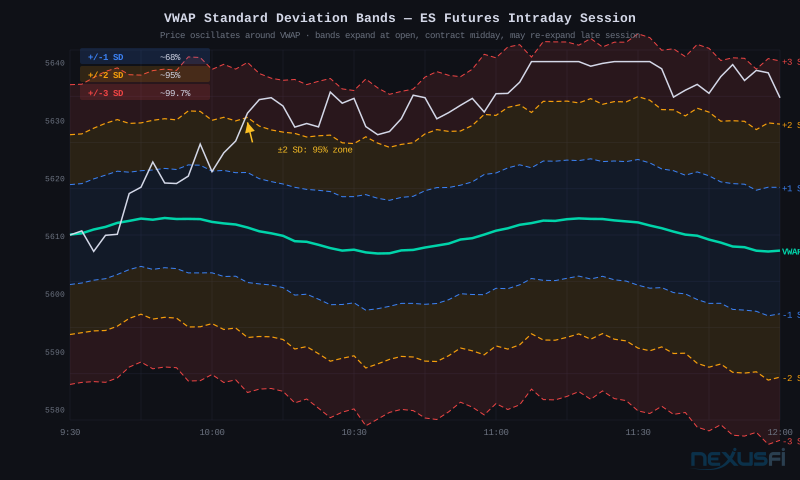
The four critical levels to know:
- VWAP itself: The volume-weighted mean. In a balanced day, price crosses VWAP multiple times. In a trend day, price stays on one side of VWAP for hours.
- ±1 SD bands: The "normal" range for intraday activity. Closes outside ±1 SD are common in trending markets. The ±1 SD level is often a first support/resistance in a ranging market.
- ±2 SD bands: The primary mean-reversion zone. @tigertrader documented that "the flatter the VWAP, the higher the probability the market will trade out to the SDs and subsequently return" -- the ±2 SD is where this plays out most consistently. (tigertrader, 2011)
- ±3 SD bands: Extreme extension. @Fat_Tails noted these mark "overbought/oversold condition" zones where the typical outcome is a violent return to value, often reaching VWAP same session. (Fat Tails, 2011)
@"Once price is outside the 2SD band, there should be a high probability that price reverses and trades back into the envelope. The VWAP bands measure the standard deviation of the distance from VWAP." — @Fat Tails, <a href="https://nexusfi.com/showthread.php?t=14090&p=162326#post162326">The Highest, High-Probability-Trade</a> (2011, 13 thanks)
The Statistical Math Behind the Bands #
For traders who want to understand what their platform is actually computing, here's the formula. VWAP SD bands use a rolling, volume-weighted variance. The standard deviation at any bar N is:
SD = sqrt( sum(volume_i × price_i²) / sum(volume_i) — VWAP² )
This is a volume-weighted standard deviation, not a simple price standard deviation. It weights each bar's price dispersion by how much volume traded at that price. A bar with 10x the volume of its neighbor has 10x the influence on the SD calculation. This is exactly what you want — it anchors the statistical measure to where institutional activity actually occurred, not just the price levels that happened to print.
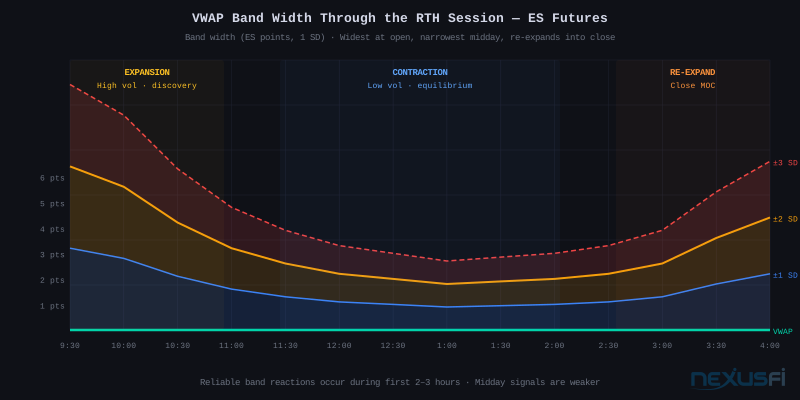
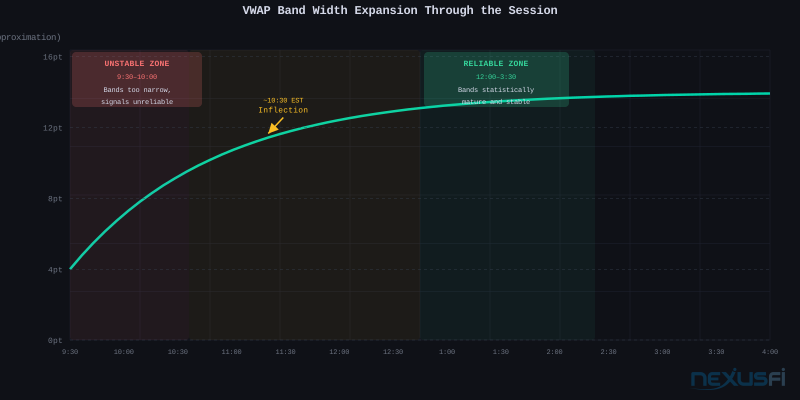
The practical implication of this formula: in a very high-volume session (FOMC day, NFP day, major macro event), the SD bands will be narrower relative to actual price movement. The high volume compresses the statistical calculation. Conversely, on a low-volume holiday session, individual large orders can temporarily blow the bands wide. Always check whether the current day's volume profile is typical before interpreting band touches.
Volume context matters. Before trading a ±2 SD touch, check today's total volume against the 5-day average for this time of day. If volume is running 50% below average (thin market), the ±2 SD touch means less. If running above average, institutional participation makes the reversion more reliable.
The 68/95/99.7 rule from statistics applies in aggregate, not perfectly to any single session. Academic research confirms that intraday returns exhibit excess kurtosis — more extreme moves than normal distribution predicts. This doesn't break the framework; it just means ±3 SD extensions happen a bit more often than pure statistics suggests. The mean-reversion tendency at ±2 SD is empirically strong across thousands of ES and NQ sessions.
(Silvester17, 2014) That's exactly right — the bands are a framework, not a mechanical system.
Regime Classification: Trend Day vs. Balance Day #
Before you place a single VWAP band trade, you need to classify the day. The single biggest mistake traders make with VWAP bands is applying mean-reversion logic on a trend day. They see price hit ±2 SD, fade it, get stopped out, and repeat. They don't fail because the setup is bad — they fail because they're trading the wrong mode on the wrong day.
The classification is simple. Watch the first 30 minutes:
- Balance day signal: Price crosses VWAP at least once in the first 30 minutes. VWAP is roughly horizontal. The day opened near yesterday's settlement. The opening range is contained relative to ATR.
- Trend day signal: Price opens with a gap or strong directional push, crosses VWAP zero times in the first 30 minutes, and the ±1 SD level on one side acts as support/resistance rather than midpoint noise. Volume is front-loaded in the first hour.
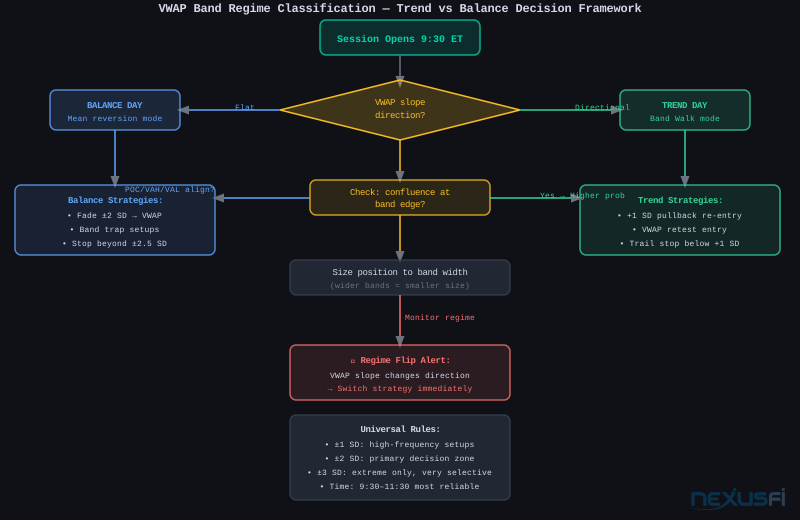
Regime misclassification is the primary loss source for VWAP band traders. On a trend day, the ±2 SD fade is a losing trade — price band-walks from ±1 SD to ±2 SD to ±3 SD without returning to VWAP. If you've taken two consecutive losses at ±2 SD, stop and re-evaluate whether the day's regime is what you assumed.
On a balance day, the mean-reversion setup at ±2 SD has historical win rates traders like @tigertrader documented as high-probability. On a trend day, that same setup turns into a string of losses as price band-walks from ±1 SD to ±2 SD to ±3 SD without returning to VWAP.
The regime can also change mid-session. A balance morning can turn into a trend afternoon after a trigger. The tell is when price breaks through ±2 SD and holds there — that's no longer a reversion candidate, that's a structural shift. Update your regime assessment as new information arrives.
For context on what this looks like across timeframes: @michaelleemoore noted using four VWAPs simultaneously — ETH, RTH, Weekly, and Monthly — because "when multiple VWAP bands converge at the same price, that's where the big reactions happen." (michaelleemoore, 2019) Multi-timeframe regime agreement reinforces the trade. @Private Banker echoed this in the Volume Profile thread: "We had a gap down at the open but VWAP was below — the SD bands told the real story of where value was." (Private Banker, 2012)
Mean Reversion Setups: The ±2 SD Fade #
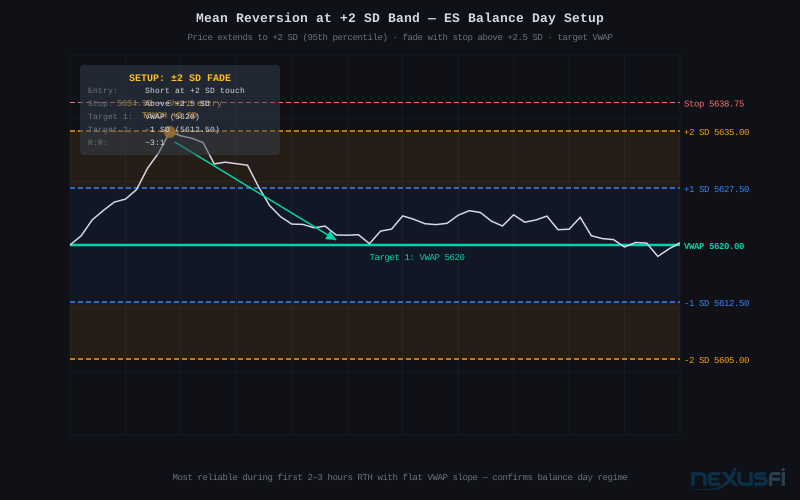
The core VWAP bands mean-reversion setup is simple in concept, harder in execution. Price extends to ±2 SD, shows rejection, and you trade the return to VWAP or ±1 SD. The setup fails more than it succeeds on trend days and has well-above-average accuracy on balance days. Knowing the difference is the entire edge.
Entry Conditions (Long Setup from -2 SD):
- Day has been classified as balance mode (multiple VWAP crosses in first 30 min)
- VWAP slope is roughly flat (not aggressively trending down)
- Price has touched or slightly violated -2 SD
- One or more rejection bars (lower volume bars that fail to extend below -2 SD, or a bar that wicks down but closes inside -2 SD)
- Entry: buy stop above the first rejection bar's high, or limit entry at or just above -2 SD
@JonnyBoy's extensively documented VWAP system defined this precisely: "STANDARD DEVIATION REVERSION TO VWAP LONG SETUP — place a BUY STOP within the BUY ZONE between -SD 1.25 and -SD 1.5." The rule he added: "If price traverses more than -0.25 SD below VWAP, this long setup should be ignored. Rules are rules." (JonnyBoy, 2020)
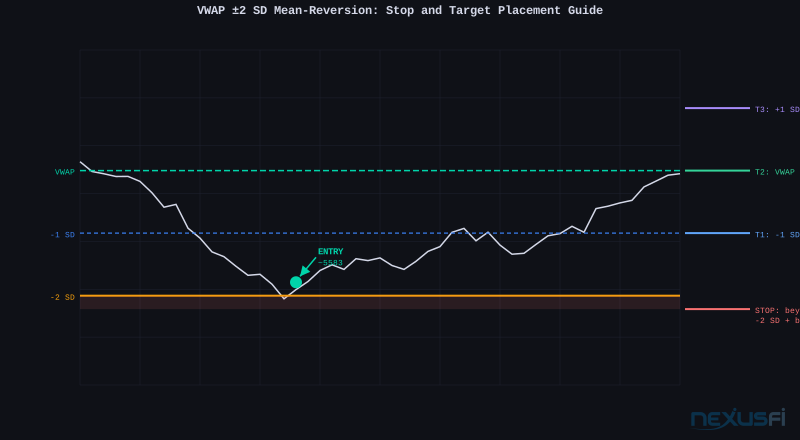
@"STANDARD DEVIATION REVERSION TO VWAP LONG SETUP: Place a BUY STOP within the BUY ZONE between -SD 1.25 and -SD 1.5. Stop below -SD 2. Target: VWAP is the only target in this instance." — @JonnyBoy, <a href="https://nexusfi.com/showthread.php?t=46813&p=798487#post798487">VWAP for stock index futures trading?</a> (2020, 35 thanks)
Stop Placement:
The stop goes beyond ±2 SD — typically 0.25-0.5 SD beyond the band, depending on the instrument. For ES, that's roughly 4-8 points beyond ±2 SD at the time of entry. Don't use tight stops at exactly ±2 SD; price regularly violates the band level slightly before reversing. That 0.25 SD buffer is the difference between being stopped and being filled.
@JonnyBoy also documented a trailing stop approach for ongoing positions: "If you are still holding a position you can always trail your stop with an aim to capture a breakout. Trail your stop with either a 0.5 or 1.0 standard deviation stop." (JonnyBoy, 2020)
Target Selection:
Three valid targets, in order of conservatism:
- ±1 SD: First meaningful support/resistance on the reversion path. Good for quick scalps.
- VWAP: The natural target on a balance day. This is where @sstheo's "RTM (Reversion to the Mean) zone" description applies -- between ±1 SD bands is where price is expected to spend the most time. (sstheo, 2021)
- Opposite ±1 SD: On strong reversion days, price passes through VWAP and reaches the opposite ±1 SD. Valid target if the regime supports full range reversion.
The mean-reversion setup connects directly to concepts in standard VWAP trading and shares risk management principles with counter-trend trading. The key distinction: this isn't a pure counter-trend trade. You're fading extension within an established range, not fighting a primary trend.
Trend Continuation and the Band Walk #
On a trend day, VWAP bands flip from mean-reversion tools to trend confirmation tools. The band walk is what happens: price moves from near VWAP to ±1 SD, then from ±1 SD to ±2 SD, hugging the outer band as institutional buyers/sellers accumulate without releasing their position back toward VWAP.
The signature of a band walk is that price respects ±1 SD as support (in an uptrend) rather than resistance. Pullbacks stop at ±1 SD, not VWAP. If you see three consecutive bars where price dips toward ±1 SD and bounces without touching VWAP, you're in a band walk.
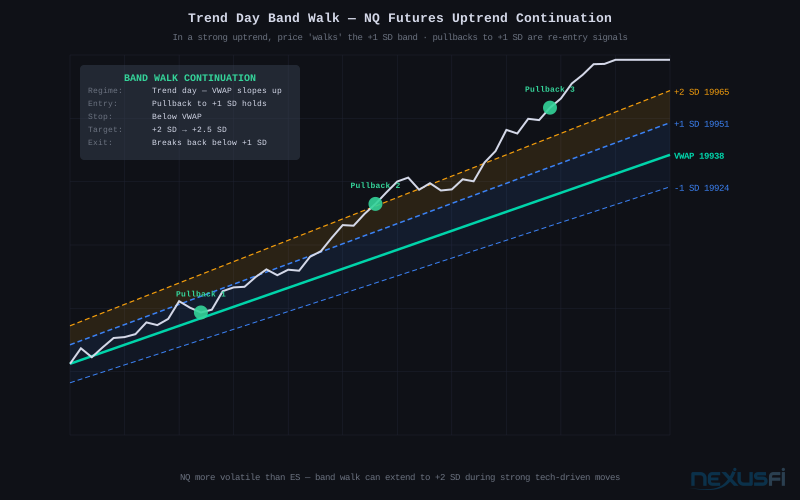
Band Walk Entry (Long Bias, Uptrend):
- Regime classified as trend (minimal VWAP crosses, price above ±1 SD upper band)
- VWAP slope is visibly upward
- Price pulls back toward ±1 SD upper band without breaking below it
- Entry: buy at ±1 SD level or on a bar that bounces from it
- Stop: below ±1 SD (or below VWAP if taking a longer hold)
- Target: ±2 SD or previous high
@JonnyBoy's continuation setup document described this: "SD CONTINUATION SHORT SETUP: Once price is trading below -SD 1, additional entries become possible. The continuation pattern requires VWAP slope pointing down and price holding below -SD 1." (JonnyBoy, 2020) The mirror logic applies to the upside continuation.
@tigertrader also noted the multi-timeframe dimension: "In a trending market, swing traders like to buy weakness on a rising 5-day VWAP and sell strength below a declining 5-day VWAP. The proper VWAP for your trading horizon matters." (tigertrader, 2011)
The band walk connects to breakout trading concepts and the momentum-following principles in ADX trend strength measurement. On high-ADX days, band walks are more reliable. On low-ADX days, prefer the mean-reversion setup.
When the Band Walk Ends:
The band walk terminates when price breaks back inside the ±1 SD band after being on the outer side. That's the exit signal for band walk positions. Often this coincides with a VWAP slope change — the trend is losing momentum and mean reversion is becoming more likely again.
The Band Trap: False Breakout Pattern #
The band trap is among the most reliable patterns VWAP bands generate, and among the most psychologically difficult to trade. Price breaks beyond ±2 SD, triggering stop runs and breakout entries from breakout-following traders, then reverses violently back toward VWAP. The people who chased the breakout at ±2 SD are now underwater, their panic buying/selling adding fuel to the reversion.
The tell is volume. A genuine breakout beyond ±2 SD should be accompanied by above-average volume — institutional participation confirming the extension. A band trap typically shows the ±2 SD breach on lighter-than-average volume, meaning the move is technically-driven rather than at the core-driven. The breakout "prints through" the band but doesn't have the volume to sustain it.
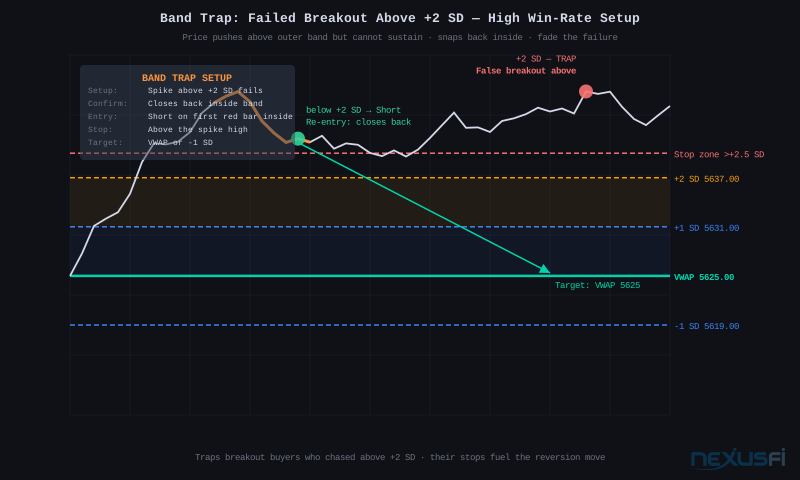
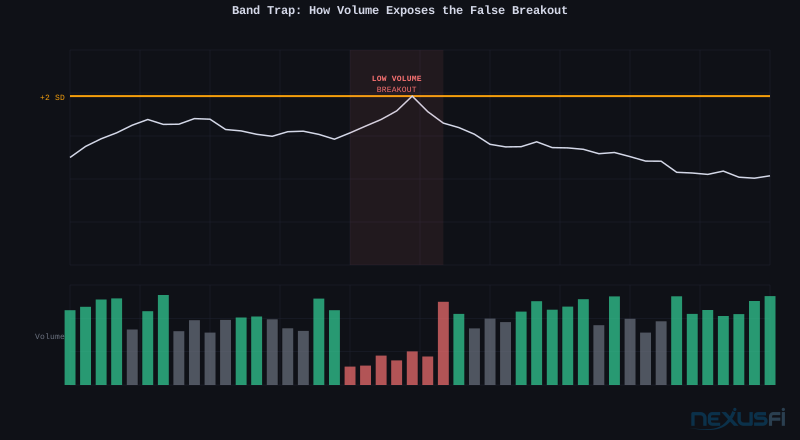
Band Trap Entry (Short After Failed Breakout Above ±2 SD):
- Price extends above ±2 SD upper band
- Volume on the breakout bar is below recent average (or immediately decelerates)
- Price prints a bar that closes back inside ±2 SD (the "trap close")
- Entry: short on the close of the trap bar, or sell stop just below the trap bar's low
- Stop: above the breakout high (above ±2 SD at time of entry, plus buffer)
- Target: ±1 SD, then VWAP
This pattern combines with concepts from volume-weighted indicators — when CMF shows negative divergence as price breaks above ±2 SD, the band trap probability increases substantially. The absence of money flow backing the extension is confirmation that institutions aren't participating in the move.
The band trap that doesn't resolve within 3-5 bars of the trap close has usually resolved into a genuine trend extension, not a trap. If you're holding a fade and price is printing higher 5 bars after the ±2 SD breach, re-evaluate. Cut the position and reassess the day's regime.
Confluence With Other Levels #
VWAP bands are most powerful when they don't work alone. When ±2 SD aligns with another market structure level — prior day high/low, a significant POC from Market Profile, a round number, or a key Fibonacci retracement — the mean-reversion probability climbs substantially. You're no longer just fading statistical extension; you're fading extension into a zone where multiple frameworks agree that price is overextended.
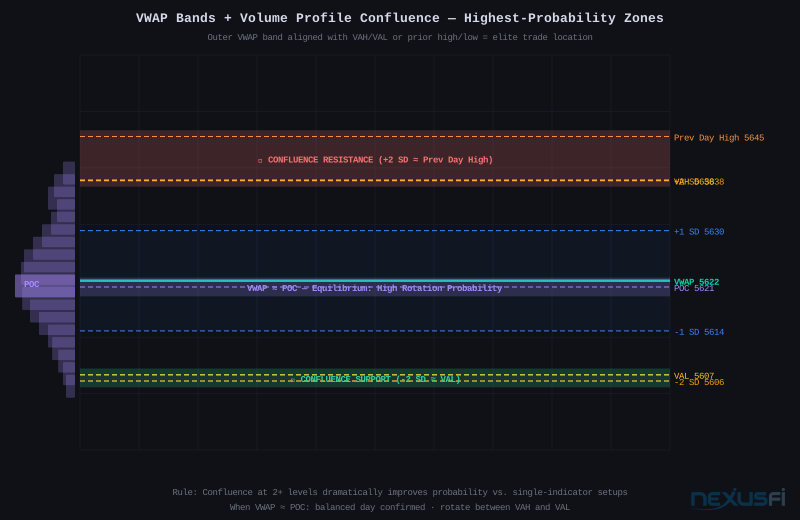
High-Value Confluence Combinations:
- ±2 SD + Prior Day High/Low: Prior day highs and lows are among the most watched levels by institutional desks. When ±2 SD is within 1-2 ticks of a prior day high, expect significant two-sided activity at that level.
- ±2 SD + POC from prior session: Volume Profile POC levels represent prior accepted value. Extension above prior POC + current session ±2 SD is a double overextension signal.
- ±1 SD + Round number: In ES, this often aligns with 10-point round numbers (5500, 5510, 5520). In NQ, 100-point round numbers have similar magnetic effect. ±1 SD touching a round number in a balance day is a high-probability first support/resistance.
- VWAP + Anchored VWAP: When the intraday VWAP aligns with an Anchored VWAP from a significant swing high or low, the level has both intraday and structural significance. Breaks of this combined level are more meaningful; holds at it are stronger.
- ±2 SD + Opening range extreme: The ACD framework's A-level methodology places A-up and A-down at meaningful multiples of the opening range. When ±2 SD aligns with an A-level, the overlap has multi-system confirmation.
@"I have four VWAPs on my chart: ETH, RTH, Weekly, and Monthly. The SD bands from each timeframe interact — when multiple VWAP bands converge at the same price, that's where the big reactions happen." — @michaelleemoore, <a href="https://nexusfi.com/showthread.php?t=46813&p=715892#post715892">VWAP for stock index futures trading?</a> (2019, 29 thanks)
Time-of-Day Considerations #
VWAP bands don't behave identically throughout the RTH session. The time of day substantially affects which setups are higher probability.
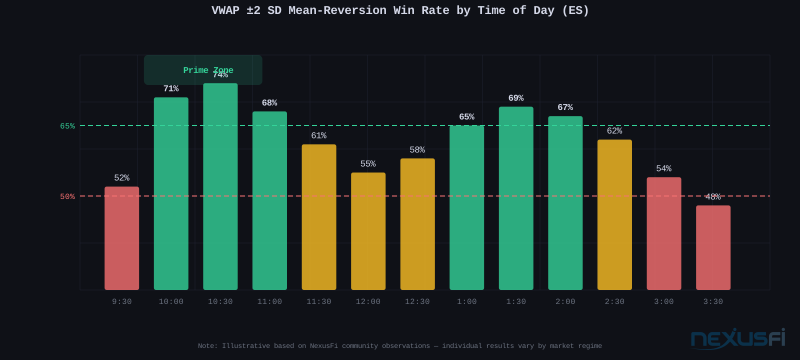
9:30-10:00 EST (First 30 Minutes)
This is the highest-risk period for VWAP band trades. The cumulative volume is minimal, VWAP hasn't stabilized, and the SD bands are narrow. A single large order can temporarily push price far outside the bands. The first 30 minutes should be used to classify the day's regime, not to trade band touches.
Exception: an overnight news trigger that created a sustained overnight range change is a signal the session will trend. In this case, the first-hour band walk setup becomes relevant earlier.
10:00-11:30 EST (Morning Prime Time)
The highest-probability window for mean-reversion setups. Volume has accumulated enough to make the SD bands statistically meaningful. The day's direction has been established but hasn't locked in its final trend (if trend day) or range (if balance day). This is when @tigertrader's documented high-probability setups most often trigger.
11:30 AM-1:00 PM EST (Midday)
Volume drops. Band touches in the midday period tend to grind rather than snap-reverse. The mean-reversion setup works but targets are shorter; price is less likely to reach the opposite band. Focus on VWAP as the first target rather than the far band.
1:00-2:30 PM EST (Early Afternoon)
Bond market closes at 3:00 PM, creating a pickup in activity starting around 1:30-2:00. VWAP bands are most statistically stable here — cumulative volume is large and VWAP is well-anchored. This is the best period for clean mean-reversion setups if the morning established a clear balance range.
2:30-4:00 PM EST (Close Push)
Position squaring and closing flows can push price strongly toward or away from VWAP. The late session often sees a final VWAP test — institutions want to close near VWAP if they've been trading around it. Band touches in the final hour should be treated with more skepticism; closing flows can sustain extensions that would reverse earlier in the day.
ES vs. NQ Band Characteristics #
ES and NQ both respond to VWAP standard deviation bands, but with meaningfully different behavior that affects entry, stop, and target calibration.
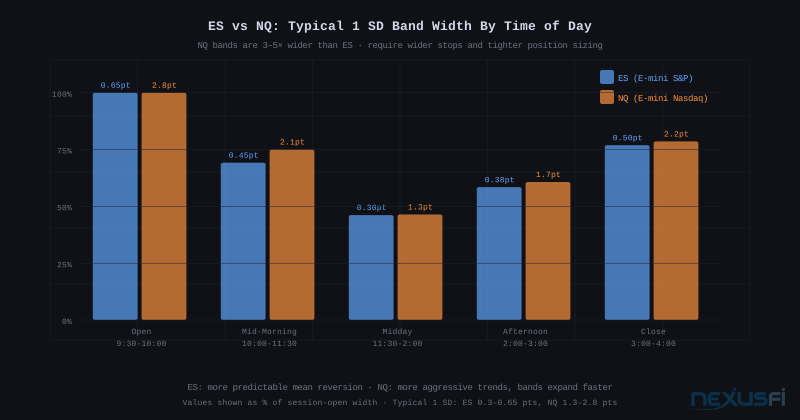
ES (E-mini S&P 500):
- Mean-reversion at ±2 SD is slower and grindier. Price often probes ±2 SD multiple times before committing to the reversion. Patience on entries.
- ±1 SD is respected consistently on balance days -- a strong entry level for range-bound sessions.
- Band walks happen but ES returns to VWAP more often than NQ during the session. Pure trend days in ES are less common.
- Stop buffer beyond ±2 SD: 4-6 points typical.
NQ (E-mini Nasdaq 100):
- NQ extends through ±2 SD more aggressively and reverses faster. The fade setup has sharper, more violent reversals when they work.
- NQ trend days are more common. The band walk can sustain all session. Higher probability of ±3 SD extensions on news days.
- The ±2 SD rejection in NQ often has 3-5 bar duration -- it's faster than ES. Miss the first 2 bars of rejection and the move is partially over.
- Stop buffer beyond ±2 SD: 8-12 points typical (NQ's wider tick range).
- Risk management note: NQ position sizing should account for the wider band excursions -- half the contract count of ES is appropriate if using equivalent dollar risk.
For traders running both ES and NQ, the divergence between them can itself be a signal. When ES rejects ±2 SD but NQ breaks through it, that tells you the tech-heavy names are driving the day's move independently of the broader market — watch for a catch-up or catch-down in ES as the session progresses.
Multi-Timeframe VWAP Stacking #
VWAP doesn't have to be a single session calculation. Many professional futures traders run multiple anchored VWAPs simultaneously — the intraday session VWAP, a weekly VWAP anchored at Monday's open, and a monthly VWAP anchored at the first of the month. Each has its own SD bands.
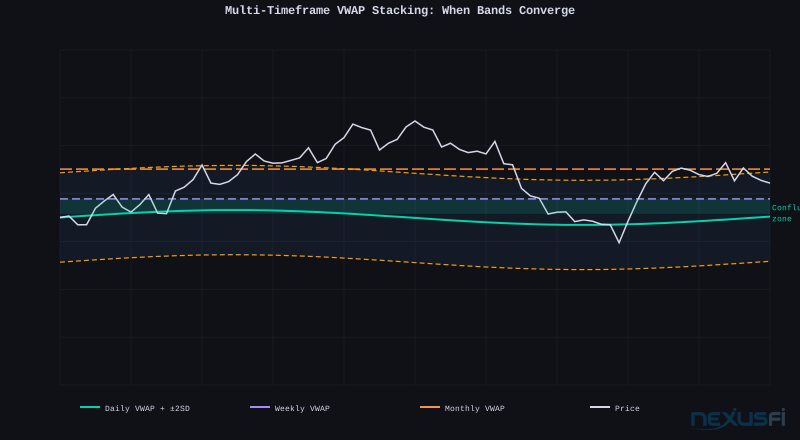
When SD bands from multiple VWAP timeframes cluster at the same price level, that price has significance at multiple institutional timeframes simultaneously. @michaelleemoore described maintaining "ETH, RTH, Weekly, and Monthly" VWAPs for exactly this reason: "when multiple VWAP bands converge at the same price, that's where the big reactions happen." (michaelleemoore, 2019)
Practical Multi-Timeframe Setup:
- Monthly VWAP ±2 SD: Major institutional reference. Touches here are rare; when they occur, the move is significant. Good for swing trade context.
- Weekly VWAP ±2 SD: Intermediate reference for multi-day positions. ±2 SD weekly touches often coincide with key reversal days.
- Daily/session VWAP ±2 SD: The primary intraday trading tool. Most of the setups in this article use this level.
- ETH (overnight) VWAP ±2 SD: Useful for understanding overnight positioning and where the overnight session accepted or rejected value.
The Anchored VWAP article covers the mechanics of non-session-anchored VWAP in more detail. For the SD band framework, the key principle is the same regardless of anchor: the ±2 SD level represents a statistically meaningful deviation from that timeframe's volume-weighted average price.
Common Mistakes and How to Avoid Them #
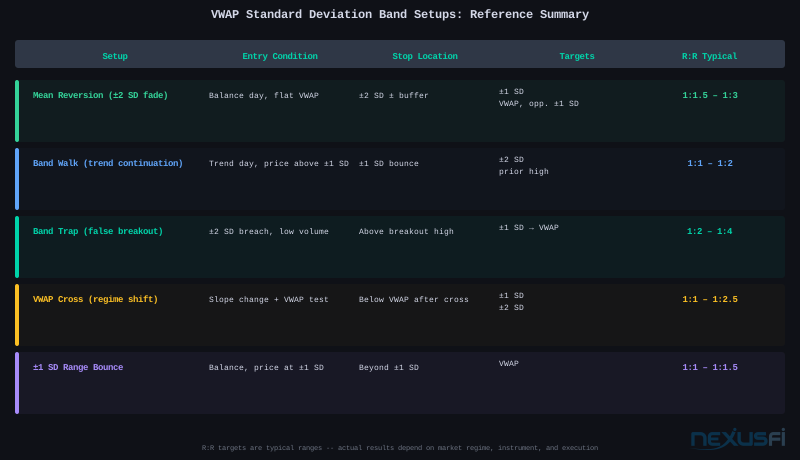
VWAP bands have a specific failure mode profile. Knowing them in advance saves capital.
Mistake 1: Fading ±2 SD on Trend Days
The most expensive mistake. Price hits ±2 SD upper band on a trend day, trader fades it short, price band-walks to ±3 SD and beyond. The stop goes off and the trader watches price continue away from VWAP for the rest of the session. Solution: regime classification before every trade. On a trend day, ±2 SD is not a fade level — it's a trend continuation flag.
Mistake 2: Ignoring Band Width Changes
Early session bands are tight. A "±2 SD touch" at 9:40 AM represents maybe 8 ES points of extension; the same statistical label at 2:00 PM might represent 18 ES points of extension. The setup has the same name but different context. Normalize your expectations to actual point distance from VWAP, not just which band is touched.
Mistake 3: Taking Mean-Reversion Entries in Low-Volume Midday
Midday band touches grind. Price touches ±2 SD, hangs there for 30 minutes, then slowly drifts back. That's fine as an intraday position, but it's hell for a scalper expecting a sharp reversal. In midday conditions, either skip the setup or use a longer time horizon with a tighter target (VWAP not ±1 SD across).
Mistake 4: Not Accounting for Cumulative SD Growth
As the session progresses, the SD bands naturally expand. If you're running fixed absolute-point levels rather than the dynamic SD calculation, you're working with stale numbers. Always use the current SD calculation, not a mental model of where the bands "should be."
Mistake 5: Treating Band Walks as Band Traps
Once a band walk is established — three or more consecutive closes outside ±1 SD without returning to VWAP — don't fade it. The band walk is evidence of sustained institutional pressure. Only fade when you see structural evidence of the walk ending: a close back inside ±1 SD, or a VWAP slope change. The Chandelier Exit applied to the ±1 SD level is a mechanical way to track when a band walk has potentially ended.
Mistake 6: Using the Same Stop Distance for ES and NQ
NQ moves more, requires wider stops, and extends further through ±2 SD before reversing. Applying ES stop parameters to NQ trades results in frequent stop-outs before the expected reversal occurs. Calibrate separately for each instrument.
Platform Setup and Configuration #
Most professional trading platforms include VWAP with standard deviation bands as a built-in indicator. Here's how to configure it correctly.
NinjaTrader 8:
The built-in VWAP indicator in NT8 can be configured with multiple SD bands. Under indicator properties, set:
- VWAP type: Session (RTH) for regular hours trading, or ETH for overnight context
- Standard deviation bands: Enable ±1, ±2, ±3 SD bands
- Band colors: Use distinct colors for each level (teal for VWAP, blue for ±1 SD, amber for ±2 SD, red for ±3 SD is a widely used convention)
- Plot bandwidth: Enable if you want the numerical SD value displayed
NexusFi's Simple VWAP indicator thread has downloadable indicator versions with custom SD band configurations. @Silvester17 maintained a free version there for years with the community-verified calculation.
Sierra Chart:
Sierra Chart's VWAP with standard deviations is widely considered the most accurate calculation among futures traders, especially for tick-by-tick precision. Configure under Studies, VWAP with Bands, set calculation period to "Day session" and enable SD band count 1, 2, and 3.
Key Configuration Notes:
- Always use volume-weighted SD calculation, not simple price SD
- Reset at RTH open (9:30 AM ET) unless you specifically want overnight VWAP context
- Don't backfill VWAP -- it's a real-time, forward-calculating indicator only
- For NinjaTrader users: the band-zone indicator variants documented in the VWAP thread add the chase bands and zone overlays that make the setup entry points visually clear
Bottom line for configuration: VWAP SD bands are a tool, not a signal. The bands require context to be useful — regime classification, volume validation, time of day awareness, and confluence confirmation. Set them up correctly once, then focus on developing the judgment that determines when to act on what they show.
The VWAP standard deviation band framework integrates naturally with VWAP trading strategies and the broader context of volume profile trading. When you combine SD band signals with volume profile's TPO structure, you're reading the market through two independent lenses that often converge on the same entry zone.
Knowledge Map
Go Deeper
Build on this knowledgeReferences This Article
Articles that build on this topicCitations
- — The Highest, High-Probability-Trade (2011) 👍 54“The flatter the VWAP (more horizontal), the higher the probability the market will trade out to the SDs and subsequently return to VWAP. This is the foundational condition for the mean-reversion setup.”
- — VWAP for stock index futures trading? (2020) 👍 35“The STANDARD DEVIATION REVERSION TO VWAP LONG SETUP: Place a BUY STOP within the BUY ZONE between -SD 1.25 and -SD 1.5. Stop below -SD 2. Target: VWAP is the only target in this instance.”
- — VWAP for stock index futures trading? (2020) 👍 32“SD CONTINUATION SHORT SETUP: Once price is trading below -SD 1, additional entries become possible. The continuation pattern requires VWAP slope pointing down and price holding below -SD 1.”
- — VWAP for stock index futures trading? (2020) 👍 38“If price traverses more than -0.25 SD below VWAP, this long setup should be ignored. Rules are rules. Entry: Place a BUY STOP within the BUY ZONE, between -SD 1.25 and -SD 1.5.”
- — The Highest, High-Probability-Trade (2011) 👍 14“The blue zone between +2SD and +3SD indicates an overbought condition. Price is typical for a reversion day -- extends to 2SD/3SD in morning, then reverses to VWAP by afternoon.”
- — Simple VWAP indicator (2014) 👍 23“On a ranging day, the 2nd SD bands can often be used as entry points for mean reversion. There are many more ways the VWAP SD bands can be used.”
- — VWAP for stock index futures trading? (2019) 👍 29“I have four VWAPs on my chart: ETH, RTH, Weekly, and Monthly. When multiple VWAP bands converge at the same price, that's where the big reactions happen.”
- — Making a Living with the Micros (2021) 👍 3“Between the Blue +1 and -1 std dev bands is the RTM (Reversion to the Mean) zone. The mean, of course, is the VWAP.”
- — The Highest, High-Probability-Trade (2011) 👍 11“In a trending market, swing traders like to buy weakness on a rising 5-day VWAP and sell strength below a declining 5-day VWAP. The proper VWAP for your trading horizon matters.”
- — The Highest, High-Probability-Trade (2011) 👍 13“Once price is outside the 2SD band, there should be a high probability that price reverses and trades back into the envelope. The VWAP bands measure the standard deviation of the distance from VWAP.”
- — VWAP for stock index futures trading? (2020) 👍 32“If you are still holding a position you can always trail your stop with an aim to capture a breakout. In this instance you should trail your stop with either a 0.5 or 1.0 standard deviation stop.”
- — Volume Profile and Footprint discussion (2012) 👍 18“These are the type of days that crush a lot of traders as they are not seeing what is being conveyed. We had a gap down at the open but VWAP was below -- the SD bands told the real story of where value was.”