



Overnight and Weekend Holding Rules in Funded Trading: What Every Prop Firm Trader Must Know Before Holding Through the Close
Overview #
Every funded trader eventually runs into the same question: can I hold this position overnight? The answer depends entirely on which firm you're trading with, and getting it wrong can terminate your account faster than any losing trade.
Overnight and weekend holding rules are among the most consequential — and most misunderstood — constraints in funded trading. They determine whether you can capture multi-session moves, whether your drawdown resets while you sleep, and whether a Sunday night gap wipes out weeks of careful progress. These rules exist because prop firms are managing aggregate portfolio risk across hundreds or thousands of funded accounts. A single trader holding 10 contracts of ES through a weekend geopolitical event isn't just risking their own account — they're creating tail risk for the firm's entire book.
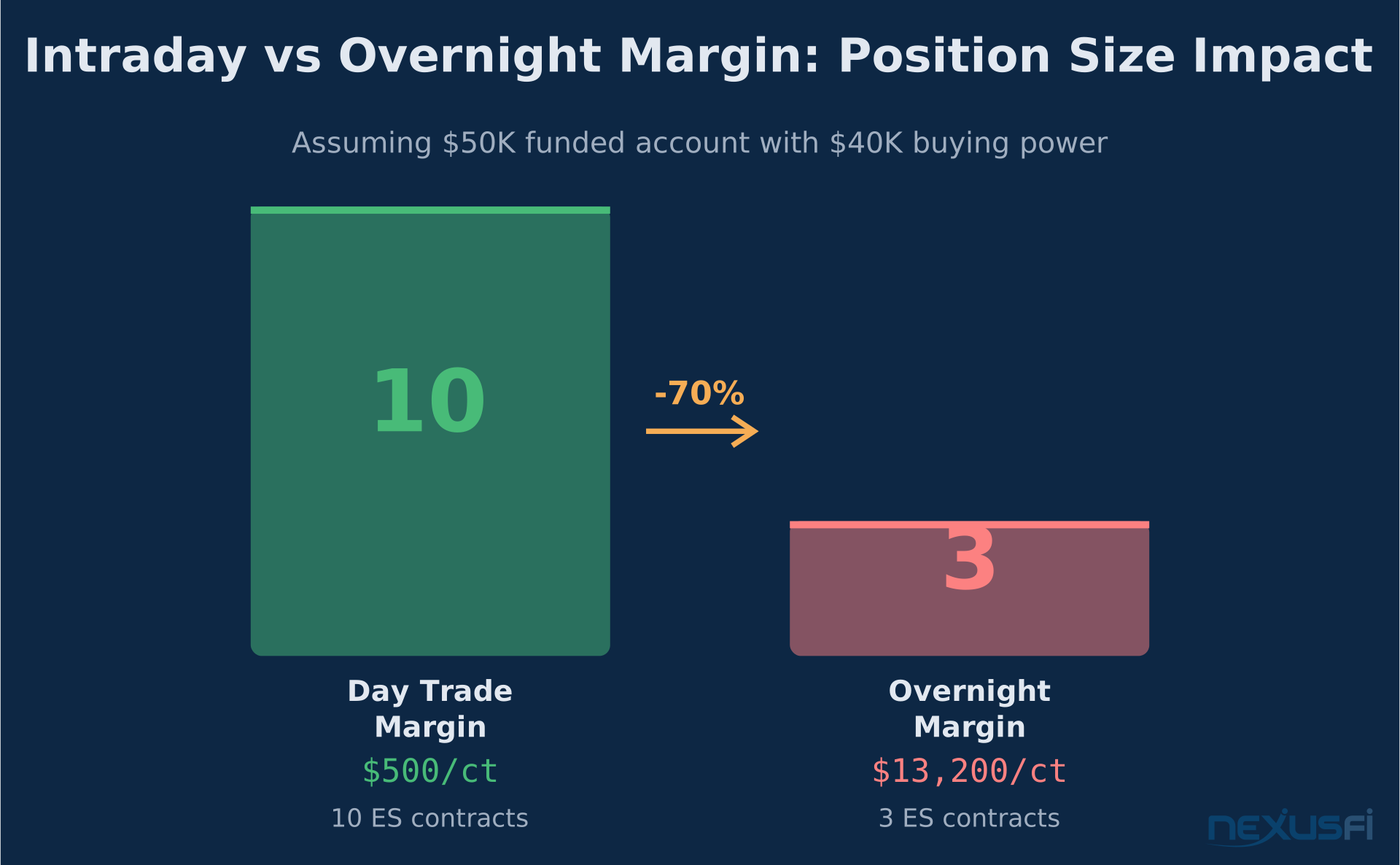
If your funded account allows 10 ES contracts intraday on day-trade margins of roughly $500 per contract, that same account might only support 3-4 contracts overnight at full initial margin of roughly $13,000-$15,000 per contract.
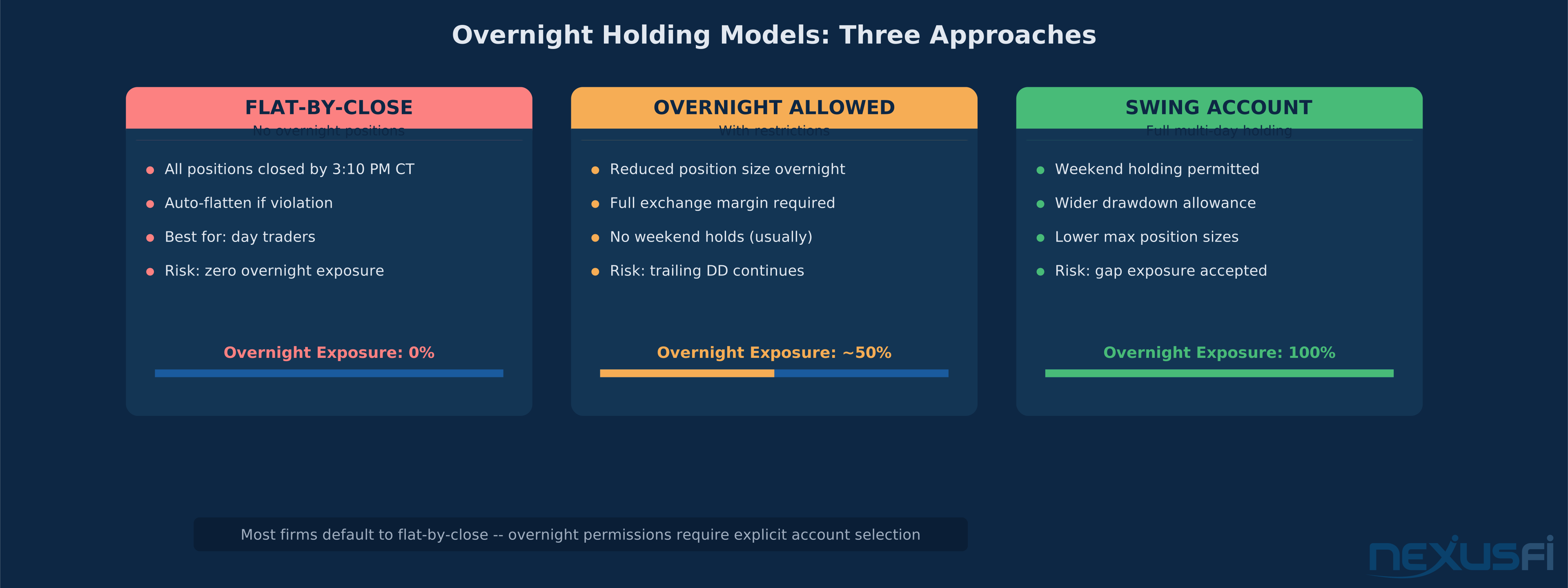
The environment divides into three camps: firms that require flat-by-close with no exceptions, firms that allow overnight holds with specific restrictions, and firms offering dedicated swing accounts with expanded holding permissions. Each model creates at the core different strategy constraints, and the differences matter far more than most evaluation marketing suggests.
Key Concepts #
Flat-by-Close
The most restrictive model. Traders must close all positions before the exchange-defined session end — typically 3:10 PM CT for CME products. No open positions are permitted during the daily maintenance window or overnight. The firm's risk system monitors compliance in real-time and may auto-flatten positions that remain open past the cutoff. This is the default at firms focused on day trading evaluations.
Overnight Margin vs. Day Trade Margin
Futures exchanges require different margin levels for positions held overnight versus those opened and closed within the same session. Day trade (intraday) margins are typically 25-50% of the exchange's initial margin requirements. Overnight positions must meet full exchange initial margin. A funded account that allows overnight holding needs enough equity to support these higher margin requirements — and the firm's max position size rules often shrink so.
The math matters. If your funded account allows 10 ES contracts intraday on day-trade margins of roughly $500 per contract, that same account might only support 3-4 contracts overnight at full initial margin of roughly $13,000-$15,000 per contract. Traders who don't adjust position size for the overnight margin step-up run into forced liquidations.
Gap Risk
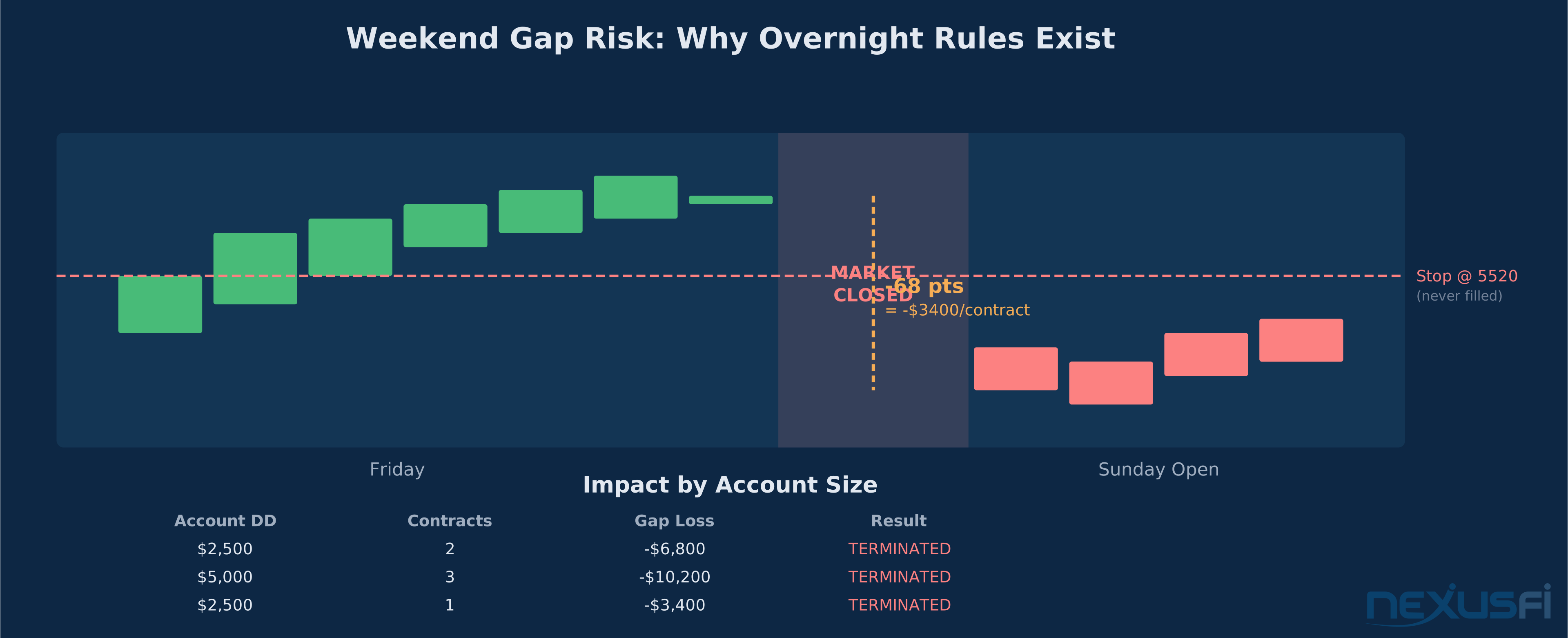
The central reason overnight rules exist. Futures markets close for daily maintenance (typically 4:00 PM - 5:00 PM CT for CME) and are completely closed from Friday afternoon through Sunday evening. During these windows, news breaks and prices move — but your stop orders don't execute because there's no market. When trading resumes, price can "gap" past your stop level, producing losses far exceeding your intended risk.
ES gaps of 20-40 points ($1,000-$2,000 per contract) on Sunday opens aren't rare. During significant geopolitical events, gaps of 80-100+ points have occurred. A 5-contract overnight position that gaps 50 points against you generates a $12,500 loss before you can react. That's an account-terminating event for most funded accounts.
Three Models: How Firms Handle Overnight Positions #
Model 1: Mandatory Flat-by-Close
Firms in this category require all positions closed before the end of the trading session. There are no exceptions, no waivers, and no swing account upgrades. The position must be flat — zero open contracts — by the cutoff time.
Typical cutoff: 3:10 PM CT for CME futures (10 minutes before the 3:20 PM maintenance window begins). Some firms use 3:15 PM or even 3:00 PM to provide a safety buffer.
What happens if you violate: Most firms auto-flatten your position at market price. Some treat the violation as a rule breach that counts against your account — repeated violations during evaluations can disqualify you. In funded accounts, some firms terminate on the first violation regardless of P&L impact.
As one NexusFi community member noted in a discussion of Topstep's rules, the firm required all Combine and Funded traders to "close positions at 3:10 pm CT" with no flexibility. [1] This reflects the strictest end of the spectrum.
Who this model serves: Pure day traders who enter and exit within the same session. If your strategy relies on 5-minute to 60-minute chart setups with defined intraday targets, flat-by-close costs you nothing.
Who it hurts: Swing traders, trend followers, and anyone whose edge requires holding through overnight sessions or capturing multi-day moves.
Model 2: Overnight Allowed with Restrictions
Some firms permit overnight positions but impose additional constraints. Common restrictions include:
- Reduced position size -- you might be allowed 10 contracts intraday but only 2-4 overnight
- Higher margin requirements -- full exchange initial margin applies, reducing effective buying power
- No weekend holds -- overnight Monday through Thursday is permitted, but all positions must be flat before Friday's close
- Trailing drawdown continues -- your drawdown meter doesn't pause overnight, so adverse moves while you sleep count against you
- Evaluation vs. funded differences -- some firms prohibit overnight holds during the evaluation but allow them after funding
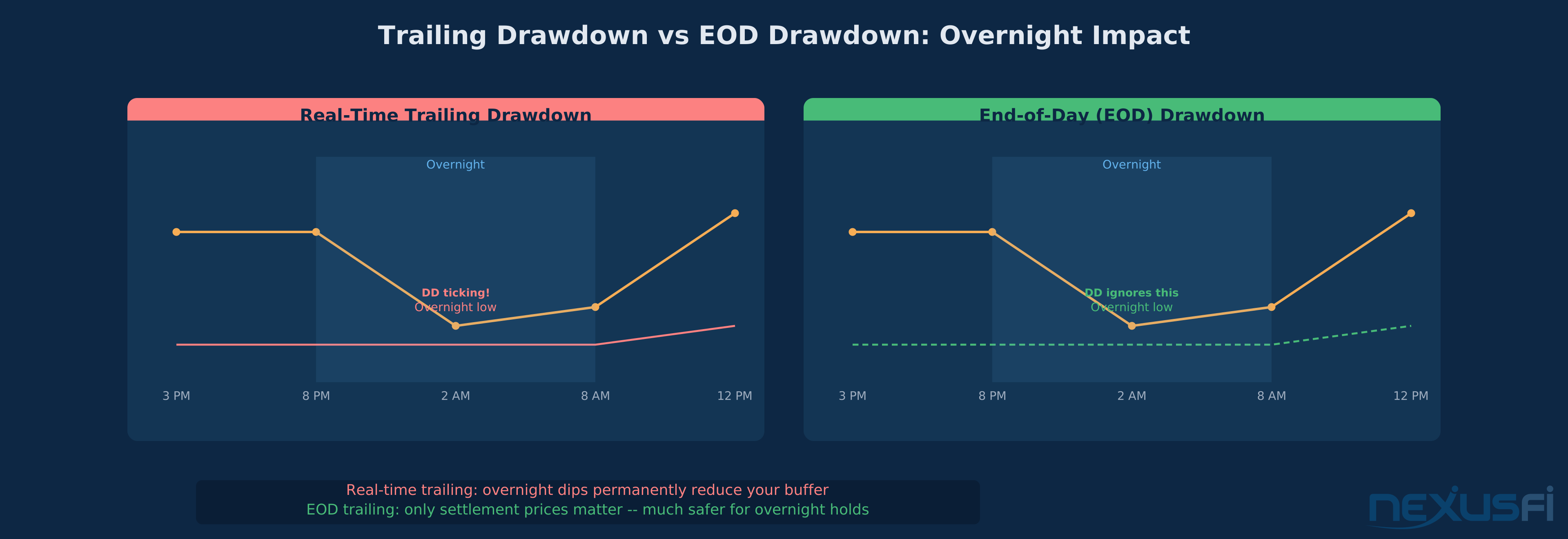
The critical detail is how the firm's drawdown model interacts with overnight positions. If the firm uses real-time trailing drawdown, your maximum drawdown level adjusts tick-by-tick even during overnight sessions. A profitable position at 3:00 PM CT might breach your trailing drawdown at 2:00 AM CT if the overnight session pulls back. You're asleep, but your drawdown isn't.
Firms using end-of-day (EOD) drawdown calculation handle this differently. The drawdown only updates based on your balance at the daily session close. This is much more favorable for overnight holds because intraday and overnight fluctuations don't ratchet up your trailing drawdown as long as you manage the position before the next settlement.
As Fi noted in a NexusFi discussion about prop firms for overnight trading, "just because you can doesn't mean you should" — the research on prop firm failures shows weekend holds are a common culprit in account terminations. [2]
Model 3: Dedicated Swing Accounts
A smaller number of firms offer accounts explicitly designed for multi-day holding. These "swing" or "position" accounts typically feature:
- Full overnight and weekend holding permissions
- Larger drawdown allowances to accommodate gap risk
- Lower maximum position sizes than equivalent day-trade accounts (to offset the gap risk)
- Higher evaluation fees reflecting the firm's increased risk exposure
- Wider profit targets proportional to the extended holding period
Swing accounts often come with their own volatility-based restrictions. Some firms suspend weekend holding during periods of extreme volatility — earnings seasons, FOMC weeks, or major geopolitical uncertainty. As one trader reported on NexusFi, their firm was "not currently allowing positions to be held over the weekend in the Swing Trading Funded accounts due to current volatility." [3] The permission is conditional, not absolute.
The Globex Overnight Session #
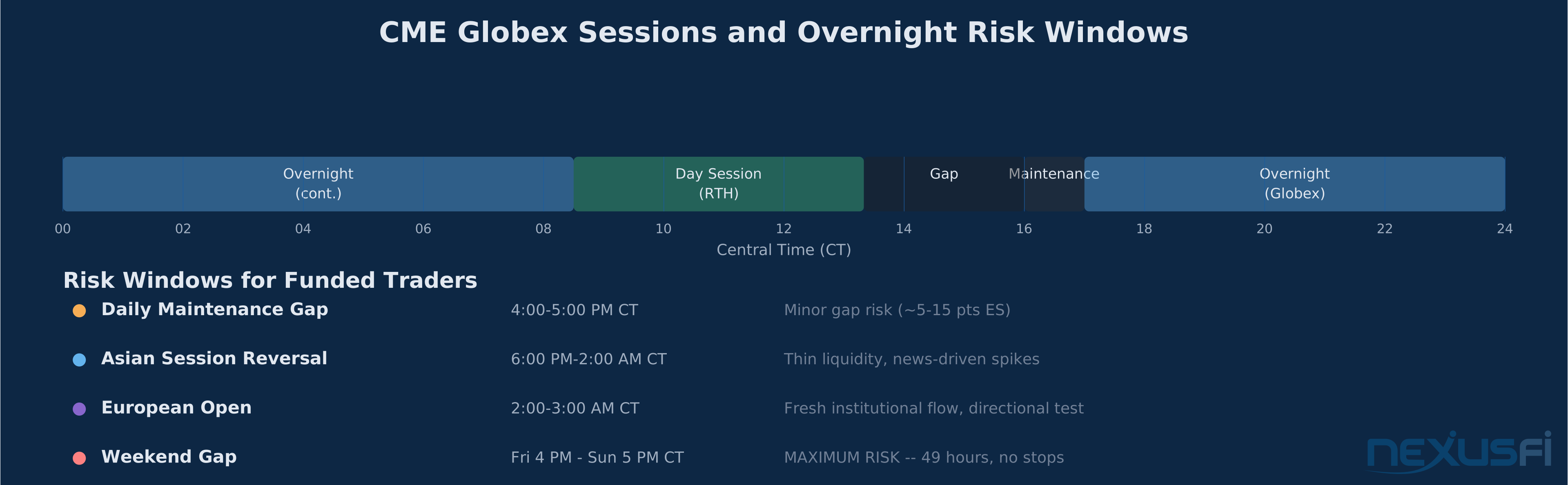
Understanding CME Globex session structure is essential for navigating overnight rules. CME futures trade on Globex from Sunday 5:00 PM CT through Friday 4:00 PM CT, with a daily maintenance break from 4:00-5:00 PM CT Monday through Thursday.
The overnight session (5:00 PM - 8:30 AM CT) is continuous electronic trading. Liquidity is thinner than the regular trading hours (RTH) session, bid-ask spreads are wider, and the order book is shallower. But it's still a live market where prices move, stops execute, and drawdowns accumulate.
Three overnight scenarios matter for funded traders:
Scenario 1: Holding through the maintenance break. If your firm allows overnight positions, you'll hold through the 4:00-5:00 PM CT daily maintenance window. During this hour, the market is closed. No orders execute. Prices can gap when trading resumes at 5:00 PM CT. This is a minor gap risk compared to weekends, but it exists. Most "overnight allowed" firms treat the 5:00 PM CT reopen as continuous trading and don't require positions to be flat during maintenance.
Scenario 2: The Asian session reversal. A position that's profitable at the U.S. close can reverse during Asian trading hours (roughly 6:00 PM - 2:00 AM CT). Volume is lowest between roughly 7:00-10:00 PM CT, making the market susceptible to news-driven spikes with poor fill quality. Trailing drawdown continues to track through this entire period.
Scenario 3: The European session setup. European markets open around 2:00-3:00 AM CT, bringing a second wave of liquidity and institutional flow. Positions that survived the Asian session face a new directional test. The overnight high and low established during this pre-RTH window often become key reference levels for the U.S. open.
The practical implication: if your firm allows overnight holds, you need a management plan for each of these windows. A stop-loss order that makes sense at 3:00 PM CT might be too tight for overnight volatility or too wide for your drawdown budget.
Weekend Holding and Gap Risk #
Weekend gaps are the nuclear risk of funded trading. From Friday's close at 4:00 PM CT through Sunday's open at 5:00 PM CT, no futures trading occurs on CME. That's roughly 49 hours of news, events, and sentiment shifts with zero ability to manage your position.
Weekend gap magnitudes depend on what happens while markets are closed. Routine weekends produce modest gaps — ES might open 5-15 points from Friday's close. But extraordinary weekends produce extraordinary gaps. Credit downgrades, military conflicts, pandemic developments, central bank emergency actions — any of these can create gaps of 50, 100, or even 200+ points.
The position sizing math for weekend holds is punishing. If your funded account has a $2,500 maximum drawdown and you're holding 2 ES contracts over the weekend, a 25-point gap against you generates $2,500 in losses — exactly your maximum drawdown. You'd need to either hold one contract (cutting your profit potential in half) or accept that any meaningful gap could terminate your account.
As a veteran NexusFi trader observed, "an over-weekend hold is Sooooo much riskier than a weekday overnight hold because while the market is closed and stops can't pull you out." [4] Another trader with 20+ years of experience reported seeing "massive gaps down from Friday close to Sunday open" that "would wipe out trading accounts." [5]
Even firms that allow weekend holding generally recommend against it. The expected value calculation rarely justifies the tail risk. A swing trade that needs three more days to hit its target can be re-entered Monday morning with the gap information already priced in.
Consequences of Rule Violations #
Violating overnight holding rules triggers consequences that range from annoying to account-ending:
Auto-liquidation. The firm's risk system force-closes your position at market price. In thin overnight markets or at the session cutoff, this means potentially poor fills. If you're holding 5 contracts of NQ at 3:10 PM CT when the auto-flatten triggers, you're getting the market price in whatever liquidity exists at that moment — which could include several ticks of slippage.
Rule violation count. Many firms track rule violations cumulatively. Even if the auto-flatten doesn't lose money, the violation itself may count against you. Three violations during an evaluation typically mean automatic failure regardless of P&L.
Account termination. Some firms treat overnight violations in funded accounts as immediate grounds for termination. The logic is simple: if the trader can't follow position management rules, they represent unacceptable risk to the firm's capital.
Drawdown impact. If your position is force-closed at an unfavorable price, the resulting loss counts against your daily and overall drawdown limits. A position that was profitable when you forgot to close it can become a realized loss that breaches your drawdown.
The most dangerous scenario is the "almost forgot" violation: you meant to close at 3:05 PM CT, got distracted, and the system auto-flattens at 3:10 PM. If the market moved against you in those 5 minutes, you've now taken a loss you didn't intend, logged a rule violation, and potentially breached your daily loss limit — all because of 5 minutes of inattention.
Strategic Approaches for Compliance #
For Flat-by-Close Accounts
Set a hard personal cutoff 15-30 minutes before the firm's deadline. If the firm requires flat by 3:10 PM CT, make your personal cutoff 2:45 PM CT. This gives you time to manage exits at reasonable prices rather than rushing in the final minutes when other traders are doing the same thing.
Use bracket orders with time-based exits. Many platforms support time-based conditional orders that automatically close positions at a specified time. Set these as a safety net regardless of whether you plan to be at your screen.
Adjust your strategy to the time constraint. If your best setups tend to develop in the afternoon and need 2-3 hours to play out, you're fighting the flat-by-close rule. Either take those setups earlier in the session or find setups that resolve within the available time window.
Don't take new trades in the last hour. New positions entered after 2:00 PM CT have limited time to work and maximum pressure to close. Unless you're specifically trading the close, avoid initiating positions that can't reach their target before your cutoff.
For Overnight-Permitted Accounts
Size for overnight, not intraday. If you're planning to hold overnight, position size from the start assuming overnight margin requirements and overnight volatility. Don't size for an intraday trade and then "decide" to hold overnight — that's how funded accounts die.
Know your firm's drawdown model. Real-time trailing drawdown versus end-of-day drawdown produces completely different overnight risk profiles. Under real-time trailing, a 20-point overnight pullback in ES that reverses by morning still ratcheted your drawdown level 20 points closer to termination. Under EOD drawdown, it didn't — as long as you managed the position before settlement.
Set wide stops, expect to use them. Overnight stops need to accommodate the wider volatility range. A 10-tick stop on ES that works intraday will get triggered by normal overnight noise. Professional overnight stops are typically 2-3x wider than intraday stops, with position size reduced proportionally.
Have a Friday exit plan. Even if your firm allows weekend holding, develop a default rule: close all positions before Friday's settlement unless you have a specific, thesis-driven reason to hold. "Hoping it'll work out over the weekend" is not a thesis.
For Swing Accounts
Treat the account as a position trading vehicle, not an intraday account with overnight permissions. Swing accounts require a completely different risk management framework. Your stop placement, position sizing, profit targets, and drawdown management should all reflect multi-day holding periods.
Monitor conditional restrictions. Swing account permissions can change. Firms may restrict weekend holding during high-volatility periods, limit instruments eligible for overnight holds, or adjust margin requirements with short notice. Check your firm's dashboard or announcements before each weekend.
Use options for tail risk protection. If you're holding futures positions over the weekend in a swing account, buying cheap out-of-the-money options on the same instrument creates a defined-risk position. This converts your open-ended gap risk into a known maximum loss. The option premium is a cost, but it's a cost that might save your funded account.
Practical Considerations #
Read the fine print on "overnight allowed." Some firms market overnight holding as a feature but impose restrictions that make it impractical. Reduced position sizes, higher margin requirements, and no-weekend-hold clauses can turn "overnight allowed" into "overnight technically possible but not worth it." Know the actual constraints before selecting a firm based on this feature.
Platform time zones matter. If your trading platform displays Eastern Time but the firm's cutoff is Central Time, you need to convert. 3:10 PM CT is 4:10 PM ET. Traders who set alarms in the wrong timezone have lost funded accounts to this administrative error.
Margin calculations aren't always transparent. The switch from intraday to overnight margin happens at a specific time defined by the exchange and broker. If you're near your maximum position size on day-trade margins and you miss the cutoff, the margin step-up alone might trigger a margin call or forced liquidation — even if the position is profitable.
The "almost overnight" trap. Some firms define "overnight" differently than traders expect. Holding through the 4:00-5:00 PM CT maintenance break might count as an overnight hold even if you close at 5:05 PM CT. Verify your firm's exact definition of what constitutes an overnight position.
Journal your overnight P&L separately. Track overnight sessions as a distinct category in your trading journal. Many traders discover that their overnight holds have negative expected value — the gap risk and wider stops eat into profits that would be better captured with fresh intraday entries. The data will tell you whether overnight holding actually improves your results or just adds risk.
Citations #
- @Hoag in Topstep AMA discussing flat-by-close requirements at 3:10 PM CT for all Combine and Funded traders.
- Fi in Prop firms for overnight trading noting that weekend holds are a common culprit in funded account failures.
- @matthew28 in Prop Firm Combines Criteria reporting weekend holding suspensions during high volatility periods.
- @hedgeplay in Holding futures overnight on the dramatically higher risk of weekend holds versus weekday overnight holds.
- @Silver Dragon in Novice approaching DAX and S&P500 micro futures warning of massive weekend gaps observed over 20+ years of trading.