



Prop Firm Scaling Plans: Growing Your Funded Account Beyond the Initial Evaluation
Overview #
You passed the evaluation. You have a funded account. Now what?
The answer for most firms is: you don't get the full buying power you had in the combine. You start small and earn your way up through a scaling plan
Scaling plans exist because prop firms aren't charities. They're risk managers allocating their own capital across hundreds or thousands of traders. Your scaling plan is really the firm's risk model for you — a structured approach to limiting exposure to unproven capital while rewarding traders who demonstrate consistent, disciplined performance.
For the mechanics of evaluation challenges themselves, see Funded Trading Evaluations. For the drawdown rules that interact directly with scaling plans, see Prop Firm Risk Rules.
How Scaling Plans Work #
At its core, a scaling plan ties your available contract size to your cumulative profit in the funded account. You start with a fraction of your evaluation's maximum position size and unlock more buying power as your account equity grows.
Here's the critical distinction most traders miss: **your buying power is not determined by your account balance — it's determined by where you stand in the scaling plan's cumulative profit threshold table.
This means two things that matter for your trading:
- Scaling up is permanent (usually). Once you hit a tier, most firms don't reduce your contract limit even if you take a withdrawal or have a drawdown. Your cumulative performance — not just your current balance — is what determines your tier.
- The firm can override the schedule. Some firms allow traders with strong cumulative profits to request buying power beyond what the standard scaling plan allows. [2]
Typical Scaling Tier Structure #
Most scaling plans follow a stepped progression tied to cumulative profit thresholds. Here's a representative example based on a $150K evaluation account:
| Cumulative Profit | Max Contracts | % of Eval Maximum |
|---|
|
| $0 - $5,000 | 3 | 20% |
|---|---|---|
| $9,001 - $14,000 | 9 | 60% |
| $14,001 - $20,000 | 12 | 80% |
| $20,001+ | 15 | 100% |
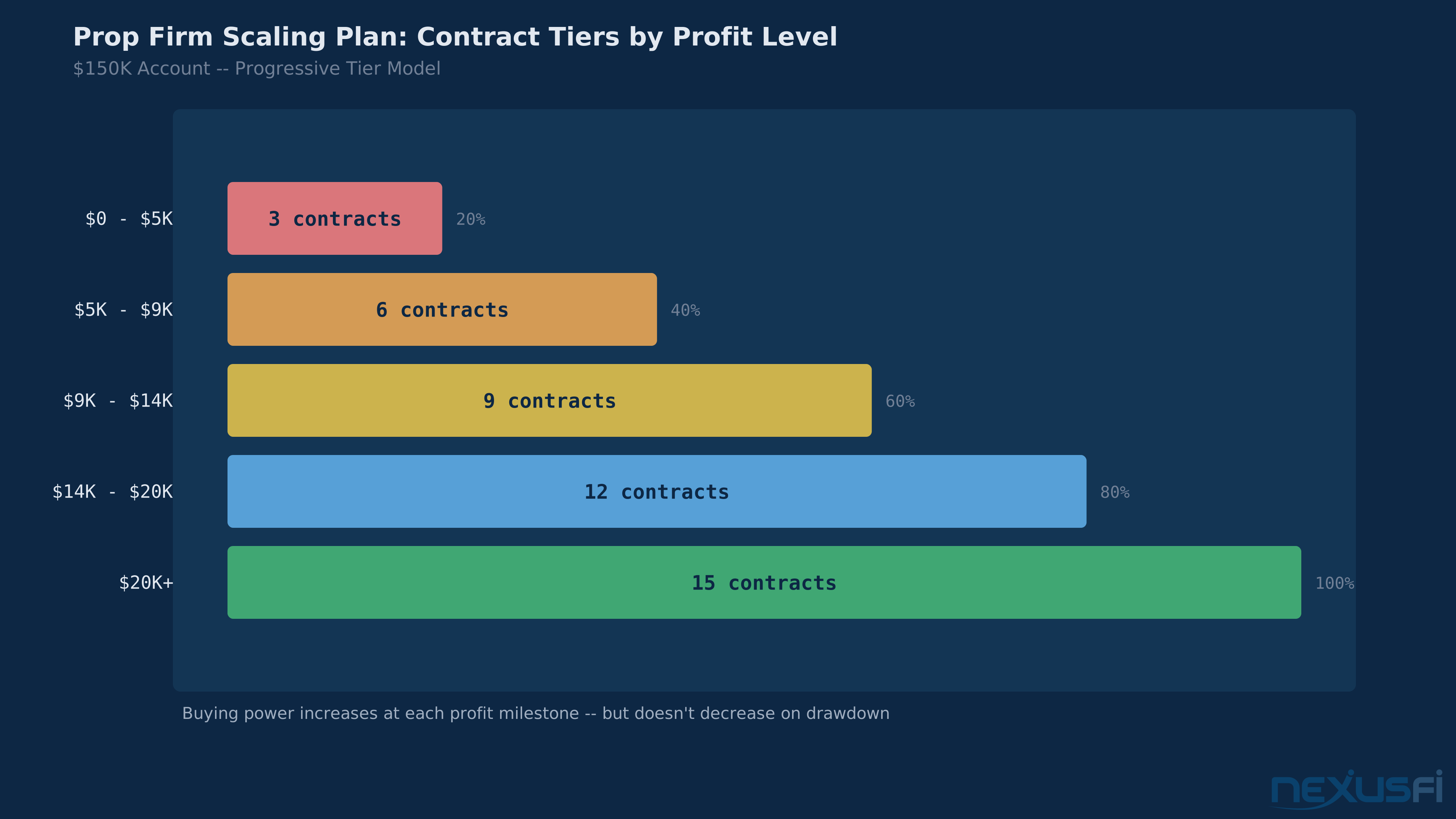
The exact numbers vary by firm and account size. For a $250K account,
The math here is harsh. You start with 20% of your eval buying power, meaning every dollar of profit in the early stages requires substantially more skill per contract than it did during the evaluation. A trader who passed a $150K combine averaging 5 contracts per trade now has to grind with 3 contracts until they've built $5,000 in cumulative profit.
Scaling Models Across the Industry #
Not all firms handle scaling the same way. The model a firm uses at the core changes your optimal trading strategy.
Progressive Tier Scaling #
This is the traditional model, used by firms like Topstep and OneUp. You start at the lowest tier and unlock more contracts at fixed profit thresholds. The advantages: clear milestones, no ambiguity, and once you reach a tier, your buying power generally doesn't decrease.
After hitting certain cumulative profit milestones, some firms allow you to request enhanced parameters. As Topstep explained directly: "Once your cumulative profit is greater than $5K, you can request adjusted risk parameters and once your cumulative profit is greater than $10K, you can request more buying power than the scaling plan allows for." [2]
Trailing Drawdown Lock Model #
Apex Trader Funding and similar firms use a different approach. Instead of explicit contract tiers, your effective scaling happens when the trailing drawdown "locks" at a fixed level. On a $50K Apex account, the trailing drawdown stops trailing once your account reaches $52,600 (starting balance + $2,600). At that point, your floor locks at $50,100 and never moves again. [4]
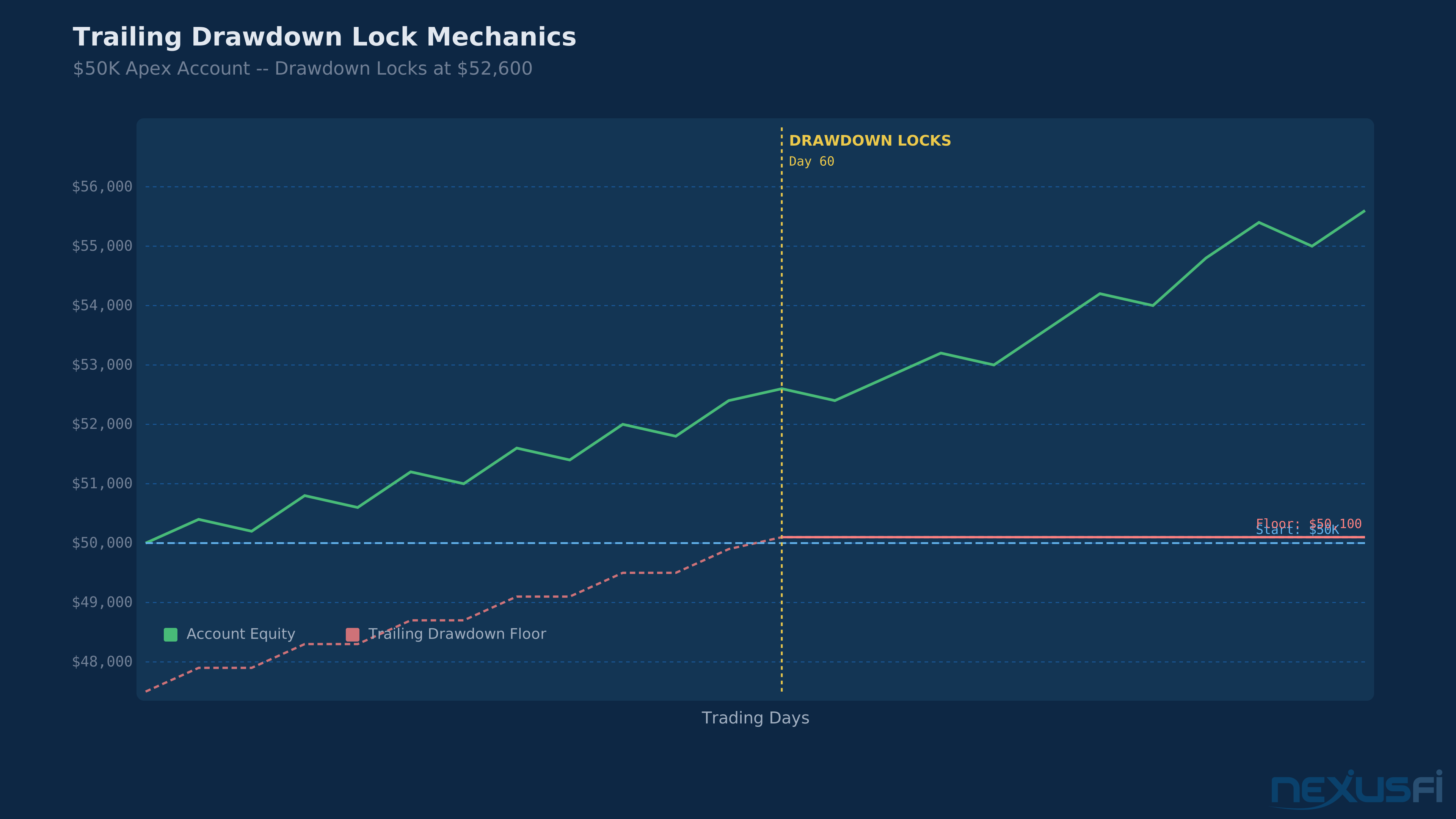
This changes the scaling game entirely. Your first job isn't to trade for profit
Flat Allocation With Withdrawal Triggers #
Some newer firms give you full contract access from day one but restrict withdrawals until profit milestones are hit. The "scaling" here is about unlocking payout frequency and amounts rather than position size. This model has become more common as competition in the prop firm space has intensified.
The Math That Actually Matters #
Here's where most traders get scaling plans wrong: they focus on reaching the next tier instead of optimizing their expected value at the current tier.
Example: $50K Account, Trailing Drawdown Model
Starting account: $50,000 Trailing drawdown: $2,500 (from high-water mark of open P&L) Drawdown locks at: $52,600 account value
To lock the drawdown, you need to build $2,600 in profit without ever letting your high-water mark open P&L exceed your account by more than what you can afford to give back. Here's what this looks like with different position sizes:
Conservative approach (1 MES contract):
- Risk per trade: ~$50-100 (2-4 point stop on MES)
- Average daily P&L: $25-50
- Time to lock drawdown: 50-100 trading days
- Probability of blowing account: Very low
Moderate approach (1 ES contract):
- Risk per trade: ~$200-400 (4-8 tick stop on ES)
- Average daily P&L: $100-200
- Time to lock drawdown: 15-25 trading days
- Probability of blowing account: Moderate
The trailing drawdown calculates from open P&L, not closed P&L.
[5] That single round-trip can instantly destroy weeks of careful drawdown-locking progress by ratcheting your trailing stop to a new high before stopping you out.
Strategic Approaches #
Strategy 1: The Conservative Build #
Trade small, lock the drawdown, then gradually increase size. This is the highest-probability path to a sustainable funded account.
How it works:
- Trade 1 MES or 1-2 MNQ contracts only
- Take profits aggressively
- Focus on hitting $52,600 (on a $50K account) to lock the trailing drawdown
- Once locked, maintain a buffer of at least $2,000-3,000 above your floor before increasing size
- Scale up by adding 1 contract at a time, not doubling
When it fails: If your edge requires larger position sizes to be profitable (for example, a swing trading approach that needs room to breathe), the conservative micro-contract approach may produce such small P&L that commission drag eats your edge.
Strategy 2: The Multi-Account Spread #
Instead of scaling up one account, trade the same small size across many accounts simultaneously using a trade copier.
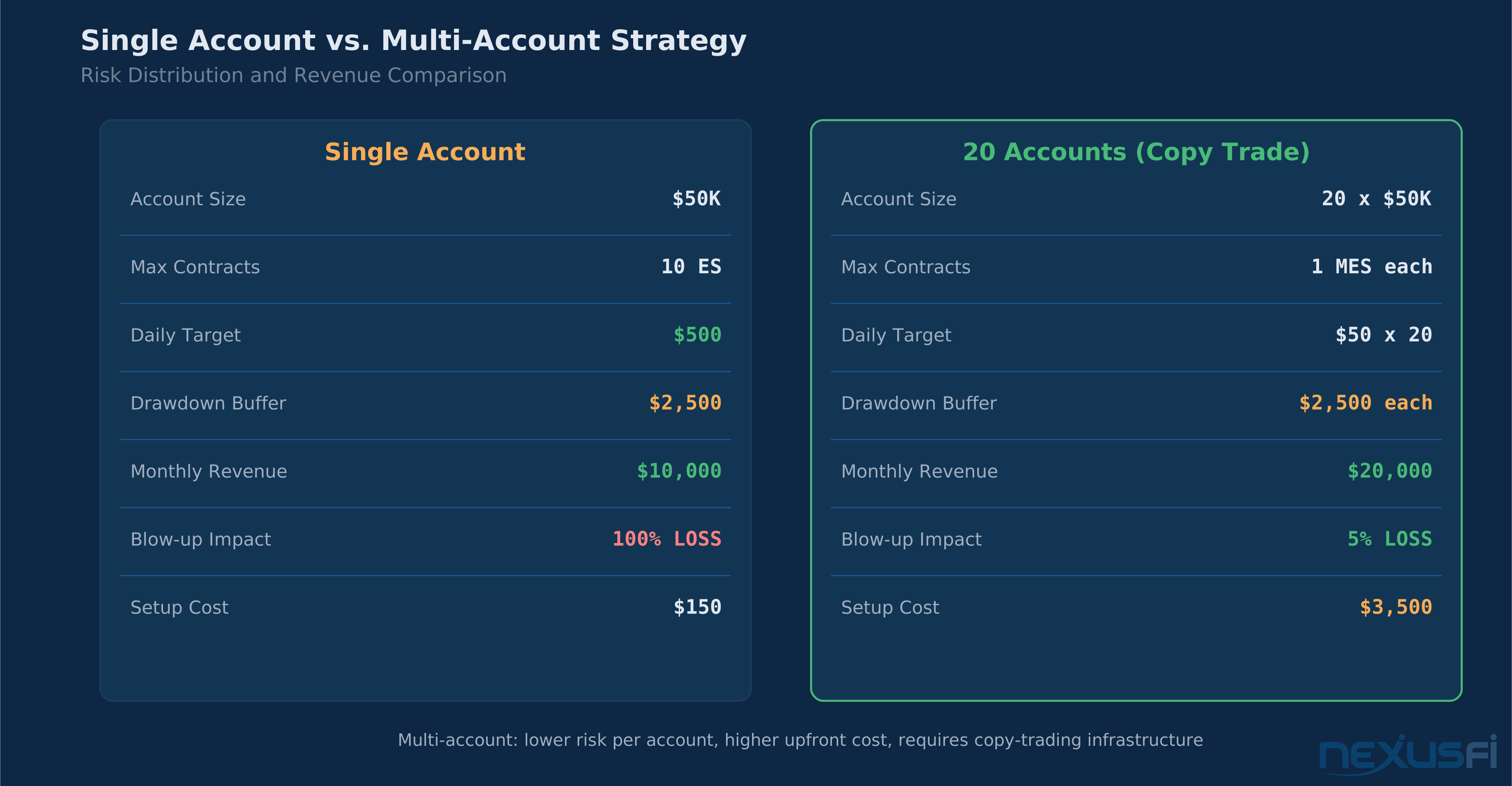
@sevensa laid out the math: "If you can average $100 a day, you can turn this into roughly $40K withdrawal a month for a $3,500 initial investment to get 20 accounts. If you trade 1 contract per account, you basically take on the risk of 1 contract with reward calculated based on 20 contracts." [6]
The advantage is risk distribution. If one account blows up, you've lost 5% of your operation, not 100%.
The reality check: This strategy requires consistent execution across all accounts, reliable copy-trading infrastructure, and the discipline to manage 20 sets of drawdown rules simultaneously. It also assumes the prop firm doesn't change its policies on multiple accounts — a real risk given that several firms have quietly added account caps or banned copier software as their margins tightened.
Strategy 3: The Milestone Sprint #
Trade aggressively to hit profit milestones fast, accept higher blow-up risk, and treat failed accounts as a known cost of doing business.
This is viable when evaluation costs are low. At 80-90% discounts (common in the industry), evaluation accounts cost $17-33/month. If you blow 20 accounts to fund 20, your total cost is still under $5,000. [8]
When this makes sense: When you have a genuine edge but it produces lumpy returns
When it doesn't: When "aggressive" means "no risk management." There's a difference between calculated risk-taking with a proven edge and gambling with prop firm money hoping for a lucky streak.
The Withdrawal vs. Growth Tension #
Every funded trader faces the same dilemma: withdraw profits to get paid now, or leave profits in the account to build a larger cushion and eventually trade bigger size?
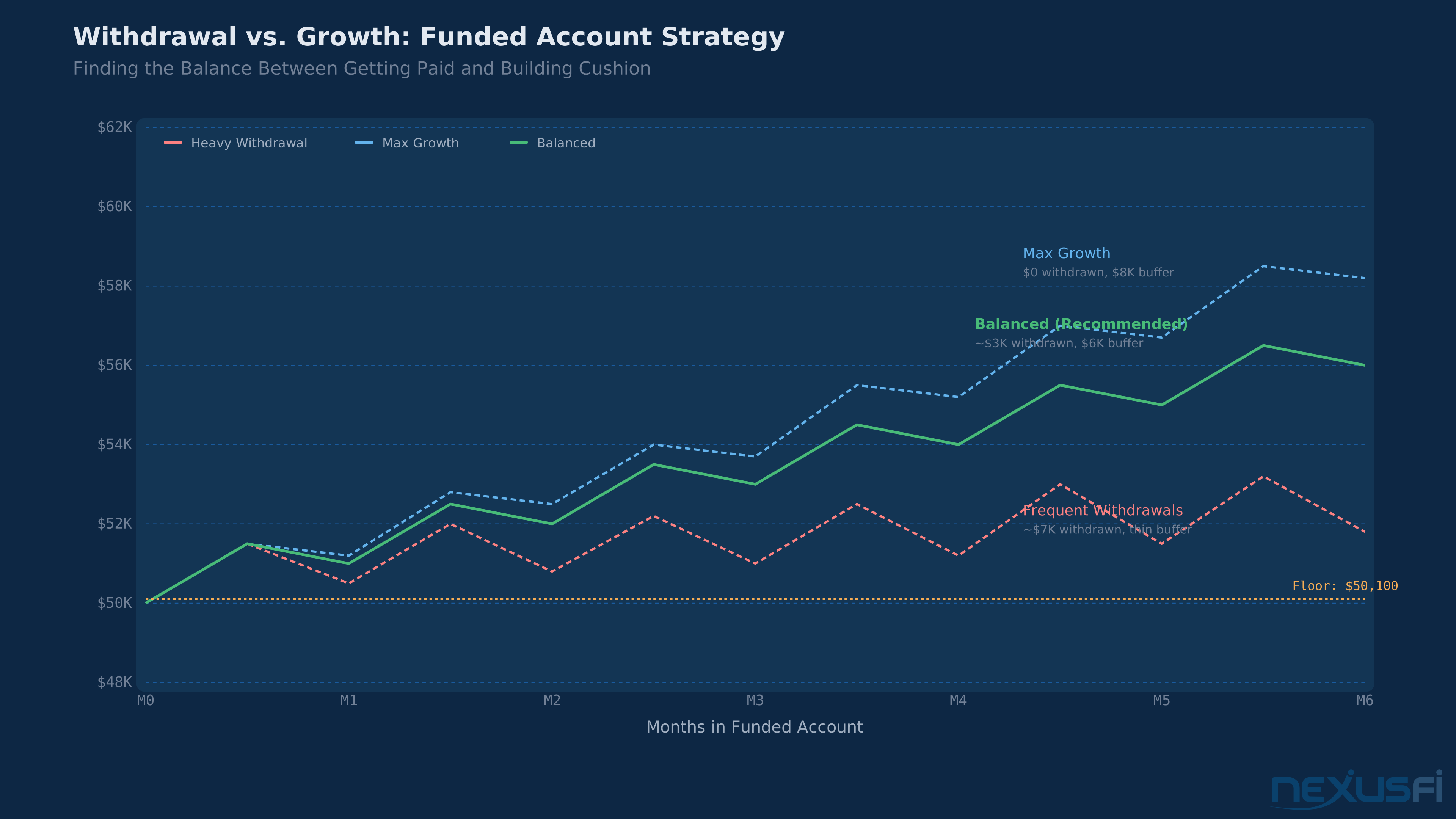
The answer lies in counterparty risk and practical math:
Arguments for growing the account:
- Larger drawdown buffer means less stress and more room for your strategy
- Higher contract tiers (in progressive models) mean more profit potential per trade
- Compounding works in your favor once your trailing floor is locked — every additional profit dollar builds your cushion without increasing your risk of account failure.
Arguments for regular withdrawals:
- As @VirtualMark noted: "It's far more sustainable to grow an account and make small withdrawals." [10] The key word is "small"
- Counterparty risk is real. The prop firm is your counterparty, and you get paid when they choose to pay you. Money in the account isn't yours until it's in your bank
- Prop firms can and do change their terms, sometimes retroactively. Profits sitting in a funded account are at risk of policy changes
The practical compromise: Build to your drawdown lock point first (non-negotiable). Then establish a withdrawal cadence that takes 50-60% of profits above a fixed cushion level. For a $50K Apex account with drawdown locked: keep balance above $55K at all times, withdraw anything above that every two weeks. This gives you a $4,900 buffer while still extracting profits regularly.
When Scaling Plans Limit Your Trading #
Scaling plans aren't always an advantage for the trader. In some cases, they actively constrain strategies that would otherwise be profitable.
The return compression problem:
[11] Scaling plans compound this effect by forcing you to generate high-probability, low-drawdown profits at reduced size before you have a chance to build a meaningful cushion.
Specific failure modes:
- The recalibration trap. Your evaluation strategy was optimized for 5+ contracts. With only 3 contracts during the scaling phase, your entry and exit logic may not work the same way. Scaling into positions, for example, is impossible when your max is 3 contracts.
- The time cost of conservative scaling. If it takes you 100 trading days to lock the trailing drawdown by trading 1 MES, that's 5 months. In 5 months, you've paid 5 months of data fees, 5 months of opportunity cost, and your monthly evaluation subscription if applicable. The expected value calculation may not justify the time.
- The drawdown ratchet during scaling. On firms using open P&L for trailing drawdowns, scaling up your size after hitting a tier creates asymmetric risk. If you increase from 3 to 6 contracts and have a losing trade, you've consumed drawdown twice as fast. But if you win, you've also ratcheted up your trailing stop faster. This is why many experienced funded traders scale up only when they've built significant cushion above the lock point — typically $3,000 to $5,000 above the trailing stop floor — before adding a single contract.
- Policy risk. Firms can change scaling plans, payout structures, and drawdown rules. Traders who built a multi-account operation under one set of rules have occasionally found themselves adapting to new rules mid-stream.
Practical Decision Framework #
Before choosing your scaling approach, answer these questions honestly:
What's your actual edge? If your strategy requires multiple contracts to scale in and out of positions, progressive tier scaling will force you to trade a degraded version of your method during the scaling phase. Consider firms with flat allocation models instead.
What's your time horizon? If you need monthly income from trading, the conservative build takes too long. Multi-account strategies or firms with faster scaling unlock faster revenue streams without the time drag of tier-by-tier single-account scaling.
What's your risk tolerance for the account itself? The multi-account spread approach treats each account as a small, replaceable part of a larger operation. The single-account conservative approach treats the account as precious. Your personality and financial situation determine which is sustainable for you.
What's the total cost of your scaling path? Include evaluation fees (including blown accounts), data fees, platform costs, copy-trading software, and the opportunity cost of reduced position sizes during scaling. Compare this to the alternative: trading your own capital at the full position sizes your strategy requires.
For a full look at the overall evaluation environment, see Funded Trading Evaluations. For the risk rules that constrain every scaling decision, see Prop Firm Risk Rules. For what actually shows up in your bank account, see Payout Structures and Profit Splits.
Knowledge Map
Go Deeper
Build on this knowledgeReferences This Article
Articles that build on this topicCitations
- — Topstep's Nick Dolby - Ask me Anything (AMA) (2016) 👍 6“The firm will allocate to each of its traders the number of contracts that they each have available to trade with.”
- — Topstep's Nick Dolby - Ask me Anything (AMA) (2016) 👍 5“Once your cumulative profit is greater than $5K, you can request adjusted risk parameters.”
- — My MES Live Account Journal (OneUp) (2019) 👍 2“You now start at maximum of 6 Contracts, until you reach $0 - $5,000.”
- — Funded Trader platforms (2024) 👍 4“In a PA account at APEX, the trailing drawdown stops trailing at the starting account size +$100.”
- — Funded Trader platforms (2024) 👍 8“You buy 3 ES contracts, it goes 10 points higher and you have an open profit of $1,500.”
- — Funded Trader platforms (2024) 👍 11“If you can average $100 a day, you can turn this into roughly $40K withdrawal a month.”
- — Supertradersam's Thread Journal on NQ/MNQ (2024) 👍 4“Since I spread my risk across 20 accounts, eventually I dont have to trade more than 2 MNQ a day.”
- — Funded Trader platforms (2024) 👍 11“Even if you pay for 40 accounts to blow up 20, your cost will be $680.”
- — Topstep's Nick Dolby - Ask me Anything (AMA) (2016) 👍 6“Why is the funding team forcing me to withdraw funds before the allowed drawdown is covered?”
- — Get funded firms 2023/2024 (2024) 👍 3“It's far more sustainable to grow an account and make small withdrawals.”
- — How can I accelerate AUM growth? (2025) 👍 1“Due to 5% max daily drawdown rules, returns drop to ~6% per year.”