



Prop Firm Trading Journal: The Complete Guide to Performance Tracking and Playbook Development
Overview #
Most funded traders focus on the wrong problem. They obsess over the perfect setup, the right indicator stack, the ideal market to trade. What actually separates traders who keep funded accounts from those who blow them in the first 30 days is something far less glamorous: documentation. A trading journal for prop firm funded accounts is not a diary. It is an audit-trail, a discipline-enforcement system, and an edge-discovery engine built from real trade data — the single most powerful lever available to funded traders.
Most traders fail funded account evaluations not because they lack profitable strategies, but because they breach drawdown limits. They take oversized positions on bad days. They revenge trade after losses. They repeat the same mistakes without recognizing the pattern. A rigorous trading journal prevents every one of these failures — but only if built correctly, maintained consistently, and actually used to drive decisions.
This guide covers the complete framework: which metrics to track, how to analyze performance, how journals help pass evaluations and survive funded accounts, and how to convert journal data into a living playbook. The goal is not a pretty spreadsheet. The goal is systematic, verifiable edge — documented well enough to prove it through consistent performance.
Why Prop Firm Journals Are Different #
A retail trading journal tracks whether you made money. A prop firm journal tracks whether you followed the rules, stayed within the boundaries, and demonstrated the discipline the firm is betting you have. These are at the core different objectives. Prop firms impose hard constraints — daily loss limits, overall drawdown maximums, consistency requirements, instrument restrictions — and every one of these rules creates a compliance dimension that your journal must track alongside standard performance metrics.
Prop firm journals need two layers. Performance tracking: the standard metrics (win rate, profit factor, expectancy, drawdown). Compliance tracking: daily loss limit usage as a percentage of the cap, rule adherence per trade, drawdown buffer remaining. The second layer is what keeps you alive long enough to benefit from the first.
The Evaluation vs. Funded Mindset Shift
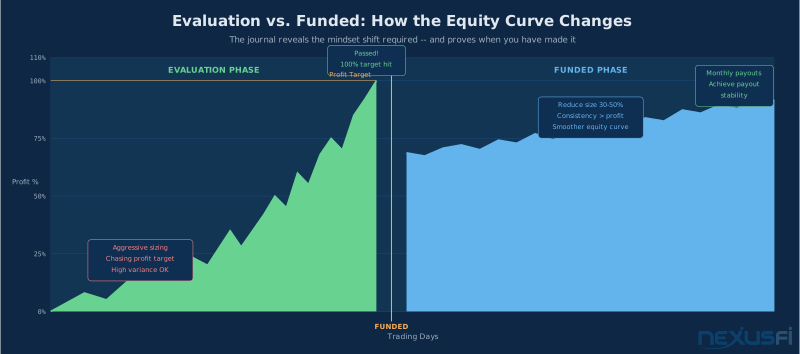
Evaluation phases and funded accounts require different objectives, and your journal should reflect that shift explicitly. During an evaluation, the incentive is to reach the profit target as efficiently as possible while staying within drawdown limits. During a funded account, the incentive is consistency and longevity — because payouts come from sustained performance, not from hitting a target once.
"Survival is the key, we have new market tomorrow, new opportunities tomorrow. We don't have to marry every tick of the market." -- @supertradersam, NexusFi Trading Journals, 2024
The journal is what makes this mindset shift concrete. When you can see your daily loss limit usage percentage trending toward the wall, you make different decisions than when you are operating on intuition. Data replaces emotion — not perfectly, but enough to catch the majority of the mistakes that terminate funded accounts.
The 12-Field Core Template #
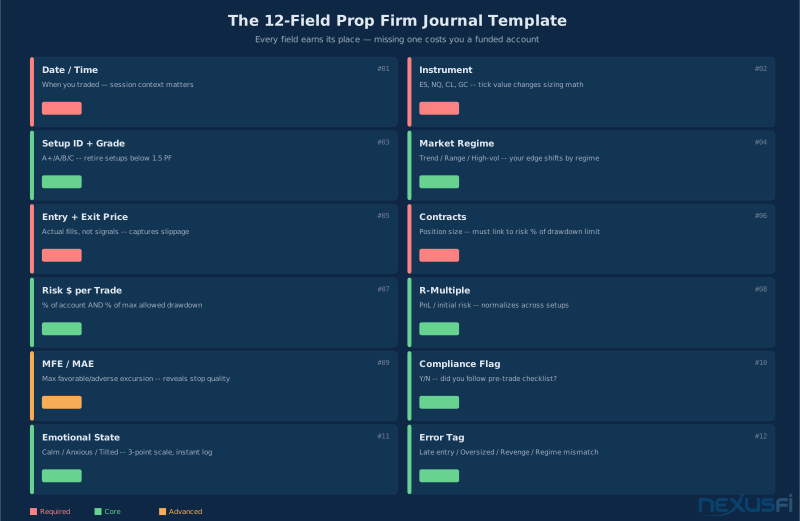
Every funded trader needs a minimum viable journal template. The following 12 fields capture everything required for performance analysis, compliance monitoring, and pattern identification. Add more if useful. Remove nothing.
The minimum viable template: 12 fields. Any fewer and you create blind spots. The compliance fields (risk %, compliance flag, emotional state) are not optional — they are the fields that most directly prevent funded account failures.
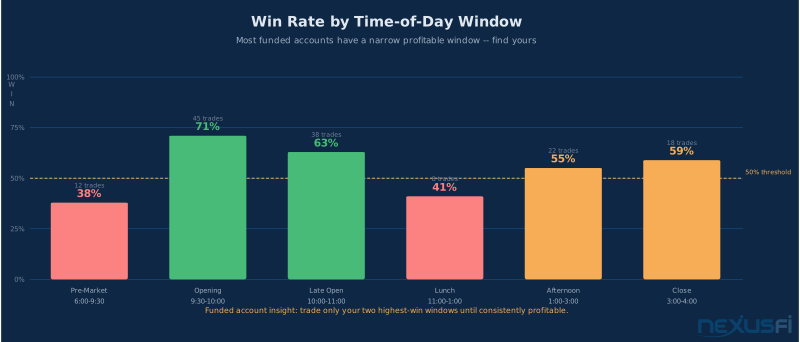
Field 1: Date and Time. Session context — pre-market, opening 30 minutes, lunch, afternoon — determines regime, and time-of-day performance analysis reveals when your edge actually works. @thetradinghermit, in one of the most-thanked posts in NexusFi's Trading Metrics thread, listed "Winning/losing periods (e.g., opening bell vs morning vs lunch vs afternoon vs close)" as a core tracking field. [1]
Field 2: Instrument. ES and NQ have different tick values, volatility profiles, and session behaviors. Track each instrument separately to identify where your edge concentrates.
Field 3: Setup ID and Grade (A+/A/B/C). Not all trades are equal, and your journal should reflect that. A+ setups are your highest-probability, highest-expectancy configurations. B setups are valid but lower confidence. C setups should not be in a funded account at all. Grading every trade forces you to build the habit of evaluating quality before entry — and gives you data to retire C setups after seeing their performance.
Field 4: Market Regime. Trend, range, high-volatility — your edge almost certainly does not work equally across all three. Tag every trade with the regime it was taken in, and you will quickly identify which setups are regime-specific. Most funded account failures involve a trader applying a trending setup during a ranging day.
Field 5: Entry and Exit Price (Actual Fills). Record what actually happened, not what you intended. Slippage compounds. Commission costs compound. An edge that looks positive on paper can be negative after real costs are accounted for. @indextrader7's TST Combine Journal on NexusFi tracked cumulative stats including actual fill prices, noting a 56% win rate with a 2.0 win:loss ratio — numbers that only mean something because they were based on actual fills, not signal prices. [2]
Field 6: Contracts and Position Size. This field exists to keep you honest. Funded account position sizing should be smaller than evaluation sizing — typically 30-50% smaller. If your position size creeps up on days when you are trying to recover losses, the journal catches it. Sized correctly, this field also feeds directly into your risk-per-trade calculation.
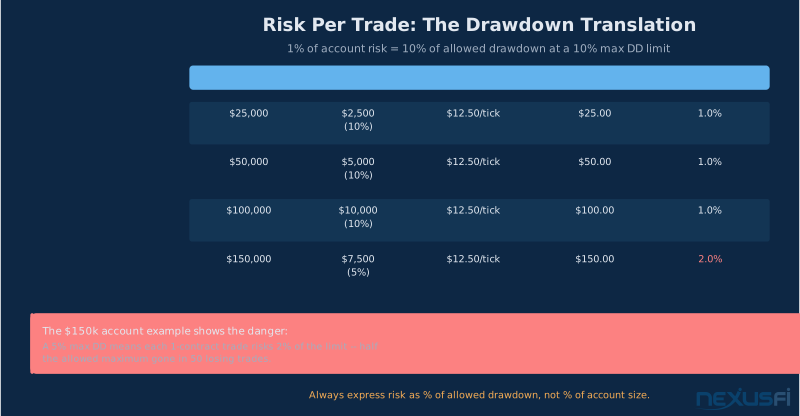
Field 7: Risk per Trade ($ and % of Drawdown Limit). This is the field that connects individual trades to the firm's overall constraints. Risk expressed as a percentage of your account matters less than risk expressed as a percentage of your allowed maximum drawdown. A trade that risks 1% of account value risks 10% of your allowed drawdown on a typical 10% max drawdown account. That reframing changes how you size positions.
Field 8: R-Multiple. R-multiple (PnL divided by initial risk) is the core normalization metric for funded trading analysis. It lets you compare a 2-contract ES trade to a 5-contract NQ trade on equal terms. @Fat Tails explained the mathematical case for R-multiples clearly in NexusFi's Trading Metrics thread: "Expectancy = Average winner Winning percentage - Average Loser Losing percentage... The R-Multiple can be used even after 1 trade and is significant. So it is a concept that can be used to train traders." [3]
Field 9: MFE and MAE. Maximum favorable excursion and maximum adverse excursion reveal stop quality and exit timing. MAE tells you whether stops are placed sensibly. MFE tells you whether you are exiting too early. @Massive l tracked these for a futures strategy with 9 entry conditions, finding that his R-multiple of 0.71 produced $163 expectancy per trade — insights only possible through systematic tracking. [4]
Field 10: Compliance Flag (Yes/No). Did you follow the pre-trade checklist? Track it on every trade. Compliance percentage across a week becomes the leading indicator of future rule violations. A 90%+ rate means you are trading your plan. A 70% rate means you are improvising — and improvisation in funded accounts leads to the drawdown spikes that terminate accounts.
Field 11: Emotional State. Three-point scale: Calm, Anxious, Tilted. Record within five minutes while memory is accurate. This field prevents history-rewriting. Over weeks, the correlation between "Tilted" entries and loss clusters becomes visible — enabling proactive circuit-breakers before the tilt causes damage.
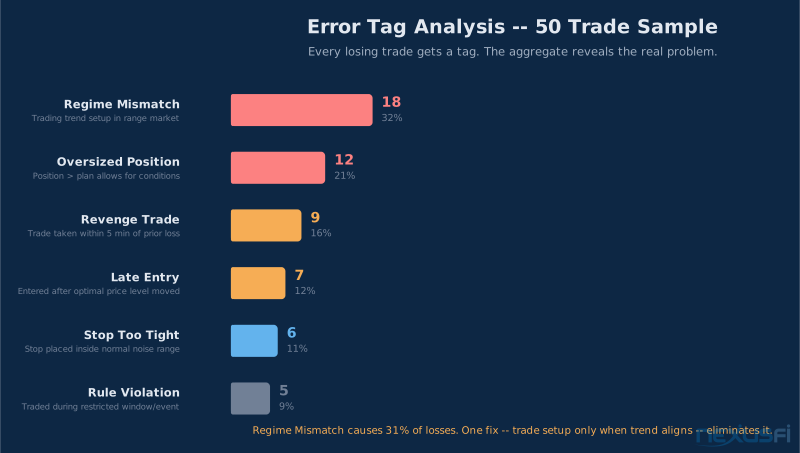
Field 12: Error Tag. Categorize losses by cause: Late entry, Oversized, Revenge, Regime mismatch, Execution error, Stop run. This converts individual bad trades into aggregate patterns. When 80% of losses come from "Regime mismatch," you have a specific, actionable problem. Without the tag, you just have a losing week.
Core Performance Metrics #
Six metrics tell most of the story in funded trading. Understanding each one — and more importantly, understanding how they interact — separates traders who use their journals to improve from those who generate data without insight.
Win Rate
Win rate is the most commonly tracked metric and the most commonly misused. A 70% win rate with a 0.5 R-multiple (winners half the size of losers) produces negative expectancy. A 40% win rate with a 2.0 R-multiple produces strongly positive expectancy. Win rate alone tells you almost nothing about edge quality — it must be paired with payoff metrics.
Where win rate matters most for funded trading is in regime analysis. Track win rate by market regime (trending, ranging, high-volatility) and by setup grade (A+, A, B, C). When you discover that your A+ setups produce 68% win rates in trending markets and 41% win rates in ranging markets, you have a concrete regime filter to add to your playbook. Without that breakdown, the aggregate number obscures more than it reveals.
Profit Factor
Profit factor (gross profits divided by gross losses) is the metric that most directly represents edge quality. A profit factor below 1.0 means you are losing money. A profit factor above 1.5 is the standard minimum threshold for keeping a setup in a funded account playbook. Above 2.0 represents a genuinely strong edge worth protecting.
[5]
The PF 1.5 threshold: Setups with profit factor below 1.5 consume funded account capacity without producing proportionate returns. The regime and time-of-day breakdown often reveals that the same setup produces PF 2.1 in one context and 0.8 in another — actionable information that aggregate PF hides.
Calculate profit factor at multiple levels: overall, per setup grade, per time-of-day window, and per market regime. A setup with aggregate PF 1.3 might be PF 2.4 during the opening 90 minutes and 0.6 from 11 AM onward. The answer is not to retire the setup — it is to filter it to its profitable window.
Expectancy
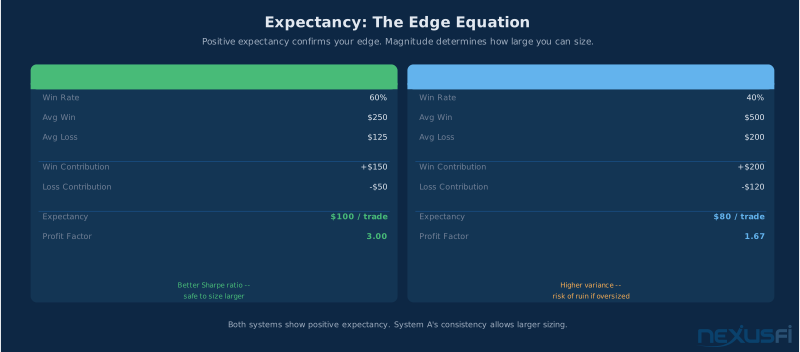
Expectancy is the expected return per trade on average, and it is the single metric that determines whether a strategy can meet a prop firm's profit target while surviving its drawdown constraints. The formula: (Win rate x average win) minus (Loss rate x average loss). A positive expectancy confirms you have an edge. The magnitude tells you how large that edge is relative to your risk.
[3] Two strategies with identical expectancy can have meaningfully different survivability profiles — the one with higher win rate and smaller loss variance can be sized larger for the same risk of ruin.
Track expectancy in both R-multiples (for normalization and stress-testing) and in dollars (for profit-target planning). The dollar version tells you concretely how many trades at current performance are needed to reach the payout threshold.
Drawdown Metrics: The Primary Killer
Most funded accounts are terminated not by a single catastrophic loss but by a sequence of losses that accumulates faster than the trader recognizes. Drawdown metrics in a prop firm journal need to be more granular than standard tracking because the stakes of breaching a threshold are binary — you either stay funded or you do not.
Track four drawdown dimensions. First, depth: what is the worst peak-to-trough decline in percentage terms, and what percentage of the allowed maximum does it represent? Second, velocity: how fast did the losses accumulate? Three losses in 15 minutes indicates emotional trading and warrants immediate session termination. Third, recovery duration: how many trades or days does it take to return to the prior peak? Consistently long recovery times indicate structural problems (oversizing, regime filter failure). Fourth, clustering: do losses tend to arrive in groups, and what triggers the clusters (specific session times, market conditions, days of week)?
[2] The distinction between unrealized MAE drawdown and end-of-trade drawdown matters — it reveals whether the trader's stops are being triggered at the worst possible moment or whether the positions eventually recover.
The Drawdown Circuit-Breaker Framework #
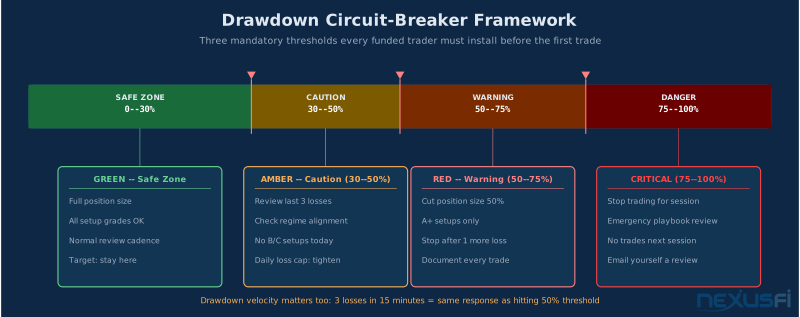
Circuit-breakers are mandatory stops built into your trading plan that trigger before you reach the prop firm's hard limits. Most funded traders do not implement them until after their first significant violation. By then, the damage is done.
The three-threshold framework:
30% of allowed drawdown used — Caution zone. Review your last three losses before continuing. Check that you are not in a regime shift. Confirm that your setup criteria still apply to current market conditions. No setup grade changes yet — continue trading A+ and A setups normally. This threshold exists to interrupt autopilot before momentum builds.
50% of allowed drawdown used — Warning zone. Reduce position size by 50%. A+ setups only — retire B and C setups for the remainder of the session. If your next trade is a loss, stop for the day. Document what happened and why. At this threshold, something has gone wrong with your read of current conditions, and the evidence is in your journal.
75% of allowed drawdown used — Emergency zone. Stop trading for the session without exception. Review the full trade sequence that brought you here. Identify the specific decision that initiated the drawdown cascade. Implement a mandatory break before the next session. At this threshold, continuation puts the funded account at genuine risk.
Daily loss limits apply separately from overall drawdown limits. Most prop firms impose both. A trader can have 30% of overall drawdown used while simultaneously being at 80% of the daily loss limit. Track both dimensions simultaneously, and apply circuit-breakers to whichever threshold is closer.
Drawdown velocity warrants its own circuit-breaker: three losses in fewer than 15 minutes should automatically trigger the 50% threshold response regardless of dollar amount. Rapid consecutive losses indicate emotional trading, poor conditions, or a regime misread — not statistical variance. The velocity signal is often more reliable than the dollar threshold in the moment it matters.
The Four-Tier Review System #
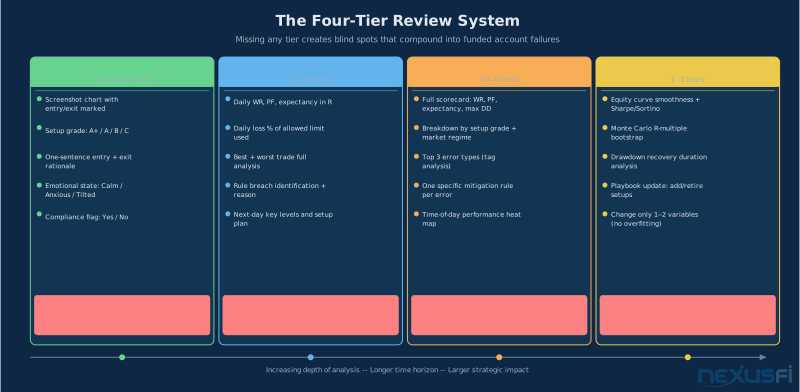
A trading journal is only useful if the data is actually reviewed and converted into decisions. The four-tier review system creates a structured cadence that catches problems at different time horizons and prevents the accumulation of unaddressed blind spots.
Immediate Review -- 5 Minutes Post-Trade
The immediate post-trade review is the most critical and most neglected tier. Within five minutes of closing a trade, memory is still accurate. After an hour, rationalization begins. After a day, the memory has been restructured to align with the trader's preferred narrative.
The immediate review captures five things: a screenshot of the chart with entry and exit marked, the setup grade, a single sentence explaining the entry and exit rationale, the emotional state at entry, and the compliance flag. This takes three minutes maximum if done consistently. Its value multiplies as the data accumulates — because you can actually trust historical records that were written contemporaneously.
End-of-Day Review -- 15 to 30 Minutes
The end-of-day review aggregates the session's data and catches problems that individual trade reviews miss. Compute daily win rate, profit factor, and expectancy in R. Calculate daily loss percentage of allowed limit used — this is the funded account-specific metric that most traders neglect until they are in the danger zone.
Identify the best and worst trade with full analysis. Not just the mechanics — the decision process. For the best trade: what did you read correctly? Can you replicate that read? For the worst trade: which of the 12 error tags applies? The end-of-day review also produces tomorrow's setup: key levels, regime read, high-probability setups to watch for, and any rule restrictions based on daily drawdown used.
Weekly Review -- 60 to 90 Minutes
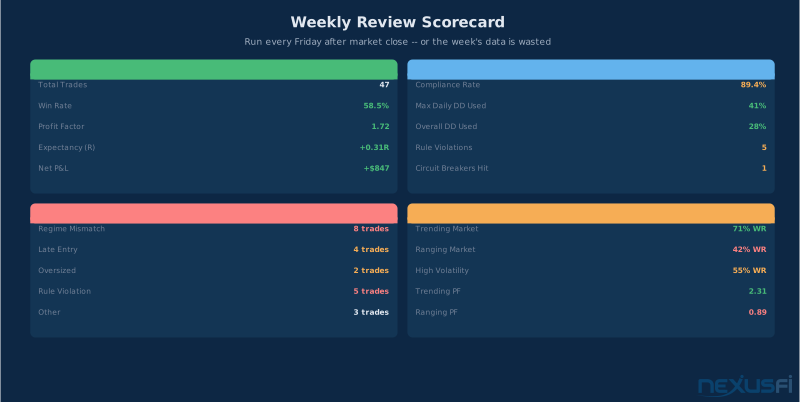
The weekly review is where patterns become visible. Run the full scorecard: aggregate win rate, profit factor, expectancy in R and dollars, maximum drawdown as percentage of allowed maximum, daily loss average, and compliance percentage. Then break it down by setup grade and by market regime.
The error tag analysis is the most actionable part of the weekly review. Identify the top three error types from the week's trades. For each, create one specific mitigation rule. Not a general intention — a specific, testable rule. "No trades in the 30 minutes preceding major economic releases" is a rule. "Be more careful around news" is not.
[6] This level of specificity comes from weeks of journal analysis, not intuition.
Monthly Review -- 1 to 2 Hours
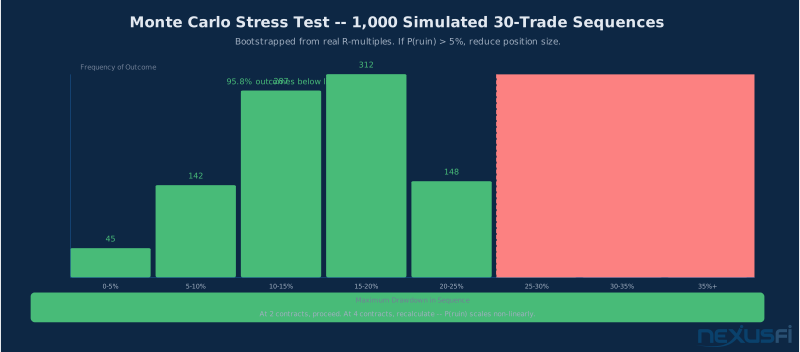
The monthly review operates at the strategic level. Equity curve smoothness analysis, Sharpe and Sortino ratio calculation (useful for longer-term performance assessment), and drawdown recovery duration trends. More importantly, the monthly review includes a Monte Carlo stress test: bootstrap the month's R-multiples with random sampling, and estimate the probability of hitting the prop firm's maximum drawdown at current position sizing. If that probability exceeds 5%, reduce position size before the next month begins.
The monthly review also drives playbook updates. Using the data from 30 days of trading, identify which setups have moved above or below the PF 1.5 threshold, which time-of-day windows have shifted, and which regime filters need tightening. Change only one or two variables per monthly cycle — the discipline to avoid overfitting is as important as the analysis itself.
The Setup Performance Matrix #
After sufficient data accumulates (minimum 30 trades per setup, ideally 50+), the journal enables a setup performance matrix: a systematic evaluation of every setup in your playbook ranked by profit factor and expectancy. This is the evidence base for playbook decisions — what to keep, what to review with regime filters, and what to retire.
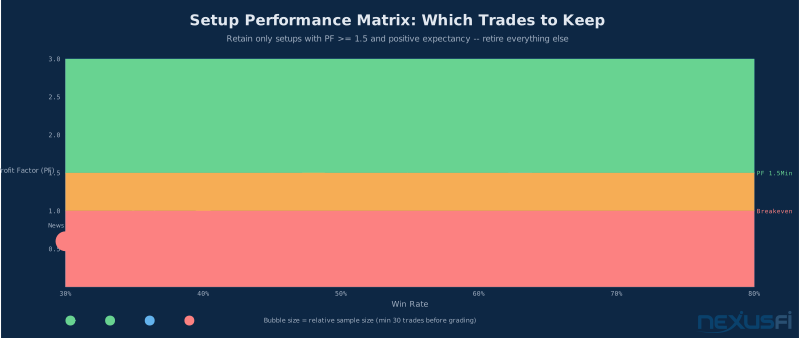
The retention thresholds:
- PF >= 1.5, positive expectancy: Core playbook. Trade in funded account.
- PF 1.0-1.5, positive expectancy: Conditional use. Apply regime or time-of-day filters and re-evaluate at next monthly review.
- PF < 1.0: Retire from funded account immediately. Can paper-trade to see if it recovers, but it has no place in a live funded environment.
@Fat Tails worked through the mathematical relationship between win rate, R-multiple, and position sizing in a highly-regarded NexusFi post: "System A: average win 10 points, average loss 10 points, win rate 60%... System B: average win 20 points, average loss 10 points, win rate 40%... Both systems have the same expectancy of 2 points. However, System A has a better Sharpe Ratio, so you can actually trade it with a larger position sizing, without increasing your actual risk." [7] The practical application: two setups with identical aggregate expectancy can have meaningfully different survivability profiles in funded accounts — and the setup performance matrix reveals this.
The playbook pruning rule: At each monthly review, retire the lowest-performing setup. This forces continuous improvement and prevents the accumulation of C-grade setups that dilute overall performance. You should always be trading a slightly smaller, slightly better playbook.
From Journal to Playbook #
A journal is raw data. A playbook is actionable rules derived from that data. The conversion process is where most traders stop — they accumulate data without systematically extracting the decisions the data implies. The monthly review is the formal conversion point, but the discipline must operate continuously.
Playbook Entry Structure
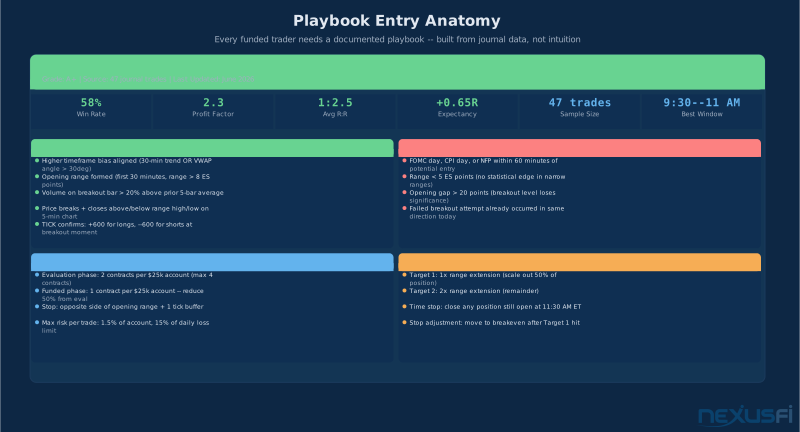
Each playbook entry must document a setup completely enough that another trader could execute it without asking a single question. Four components are required.
Setup definition. The exact conditions for validity: market structure context, indicator alignment, volume confirmation, time-of-day window. @GruttePier's pullback setup entry on NexusFi specified: "Price pulls is strong (longs) or weak (shorts) and pulls back on low RVOL to a level that is very obvious to a large group of traders. It's obvious to institutionals (VWAP) and retail (multiple timeframes). Best time to trade: 10-11am." [6] That specificity eliminates ambiguous entries.
Invalidation rules. What prevents this setup from being taken even when it appears to set up? Typically: major economic releases within 60 minutes, a prior failed attempt in the same direction, and specific regime conditions where the setup has shown negative expectancy in journal data.
Position sizing matrix. Derive sizing from the drawdown stress test. If the Monte Carlo shows 8% probability of hitting max drawdown at 2 contracts, reduce to 1 contract until 90+ trade data points confirm stability. The matrix should also specify the reduction triggered at each circuit-breaker threshold.
Exit strategy and market context filters. Target levels, trailing stop rules, time stop (close by specific time regardless of P&L), and the rule for moving stop to breakeven after the first target. The regime filter comes directly from weekly review data: "only trade Opening Range Breakout when the 30-minute trend is aligned and pre-market volume was above average" because the journal showed 17 of 20 winners met those conditions.
Evaluation-Specific Journal Strategies #
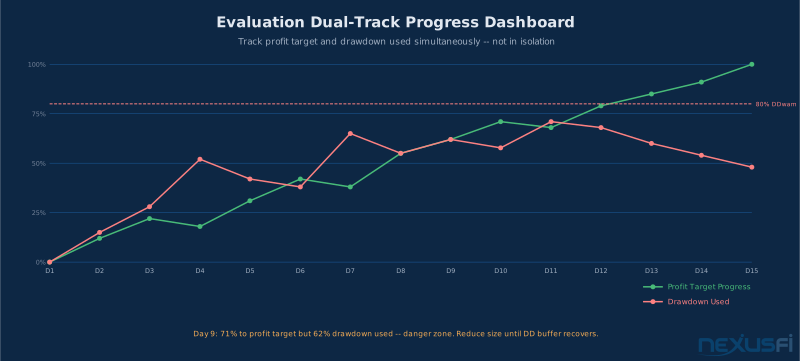
Passing a prop firm evaluation requires a specific journal focus that differs slightly from the ongoing funded account approach. The evaluation has a defined endpoint (profit target) and strict constraints (daily loss limit, maximum drawdown). The journal's role during an evaluation is to track proximity to both simultaneously.
During evaluations, run two parallel tracking systems. The first tracks profit target progress as a percentage. The second tracks drawdown used as a percentage of the allowed maximum. The goal: reach 100% of profit target while keeping drawdown below 50% of the allowed maximum. At 80% of profit target with 60% of drawdown used, the trajectory is dangerous — the next losing streak could breach the limit before hitting the target.
The evaluation timing trap: Many traders fail near the end of the permitted window, becoming aggressive trying to hit the target. The journal prevents this by showing how many trades at current expectancy are needed — and whether that number is achievable with the remaining drawdown buffer.
Before any new evaluation challenge, evaluate your most recent 30-50 journal trades. Calculate expectancy, run a Monte Carlo on R-multiples, and determine the probability of reaching the profit target within the window. If that probability is below 60%, improve consistency before paying for another attempt.
Journaling Tools and Platforms #
The choice of journaling platform matters less than the consistency of use. A complex platform used inconsistently is worse than a simple spreadsheet used on every trade. Purpose-built platforms like TradeZella, TraderSync, Edgewonk, and TraderVue offer broker import, built-in metric dashboards, and tagging systems that support the analysis described in this guide. The primary advantage is removing friction from data entry — if the platform automatically imports your fills, you are more likely to maintain consistency in logging the qualitative fields (setup grade, emotional state, error tag) that the platform cannot capture automatically.
Notion and Excel-based systems offer unlimited customization and narrative-rich post-mortems that structured platforms cannot replicate. Video recording of the screen during sessions is a complementary tool for order flow traders who want to review execution timing. Whatever tool you choose: the cadence of review matters more than the sophistication of the platform. Immediate post-trade, daily, weekly, monthly — that structure is the source of the journal's value, not the software.
Building the Consistency Habit #
The hardest part of maintaining a prop firm trading journal is not the analysis — it is the consistency of data capture. The immediate post-trade entry requires discipline on winning days (when you want to find the next trade immediately) and on losing days (when the last thing you want is to document what went wrong).
Two practical systems help. First, make the immediate entry a mandatory condition for the next trade — you cannot enter another position until the five-field entry for the prior trade is complete. Second, set a hard end-of-day review time that is not connected to P&L. The review happens at 4 PM Eastern regardless of whether the session was profitable.
@Massive l put the underlying principle simply: "I don't see the use of R-multiple if you already use winning %, R/R, and expectancy. That tells you everything you need to know about your strategy. Occam's Razor all day." [4] The journal's design follows the same logic — capture what you will actually use for decisions, nothing more. The 12-field template is the minimum. Funded trading is a performance discipline problem. The prop firm has already determined that profitable strategies exist. The question is whether an individual trader can execute one consistently within defined constraints. A journal answers that question with data instead of hope.
Knowledge Map
Prerequisites
Understand these firstGo Deeper
Build on this knowledgeReferences This Article
Articles that build on this topicCitations
- — Trading Metrics for journals/record keeping (2010) 👍 19“Winning/losing periods (e.g. opening bell vs morning vs lunch vs afternoon vs close)”
- — TST Combine Journal (2013) 👍 5“Winning Days %: 83%, Win %: 56%, win:loss ratio: 2.0”
- — Trading Metrics for journals/record keeping (2010) 👍 32“Expectancy = Average winner * Winning percentage - Average Loser * Losing percentage”
- — IchibomB Futures Trading (2020) 👍 7“My average r-multiple including losers is .71. Expectancy $163 using traditional metrics.”
- — IchibomB Futures Trading (2021) 👍 17“Using profit factor as expectancy is my preferred metric.”
- — GruttePier trading journal to getting profitable (2018) 👍 14“Type: A+... Invalid setups: Pullback to VWAP RTH... Best time to trade: 10-11am”
- — Which risk equivalents favor better drawdowns? (2012) 👍 9“System A has a better Sharpe Ratio, so you can actually trade it with a larger position sizing”
- — Supertradersam Thread Journal on NQ/MNQ (2024) 👍 5“This is my PA Account (Funded), I should NOT treat this as EVAL. Survival is the key.”
- — m28 End of Week Journal (2019) 👍 20“Max daily drawdown $1,000. Personal daily loss limit $460. The tighter risk controls at each stage -- the ever tightening risk model.”
- — King Of The Nasdaq (2024) 👍 4“Average MAE: 31 Ticks, Average MFE: 58 Ticks. The clear distinction of when I trade has created some peace in my entry and exit.”
- — Trade Journal (2016) 👍 9“Trailing Max Drawdown -- there are two loss control rules for the Combine. Track both dimensions simultaneously.”