



Prop Firm Payout Structures and Profit Splits: What Actually Lands in Your Bank Account
Overview #
Prop Firm Payout Structures and Profit Splits: What Actually Lands in Your Bank Account
You passed the evaluation. You're funded. You're profitable. Now the question that matters more than any of that: how much of your profit do you actually get to keep, and when?
The profit split percentage is the number every prop firm puts in the headline. It's also the least useful number for comparing firms. A 90/10 split with aggressive fee drag and tight consistency gates can put less cash in your account than an 80/20 split with clean withdrawal mechanics and minimal overhead.
This article breaks down the full payout pipeline — from the moment you close a profitable trade to the moment cash hits your bank. Every gate, every fee, every rule that stands between gross profit and net payout.
How Profit Splits Actually Work #
The profit split is the percentage of net trading profits paid to the trader after the firm takes its cut. Two models dominate futures prop:
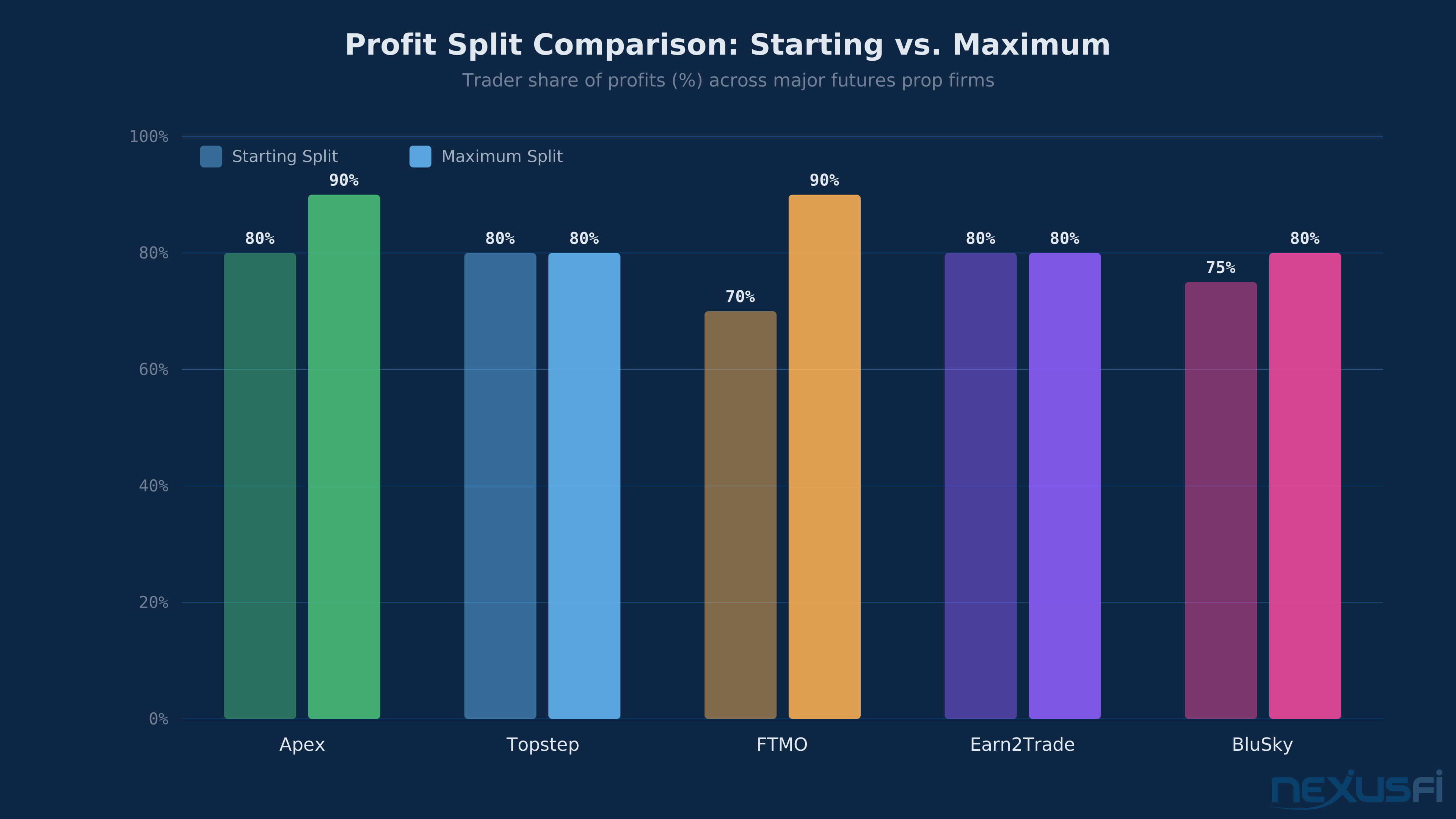
Flat splits hold the same percentage regardless of performance. You make $500 or $50,000 — the ratio stays the same. Topstep and Earn2Trade generally use this model, typically at 80/20 (trader/firm).
Tiered splits improve as you hit cumulative profit milestones or scaling triggers. FTMO starts at 70/30 and can reach 90/10. Apex Trader Funding starts around 80/20 with pathways to 90/10 at higher tiers. BluSky begins at 75/25 and can improve to 80/20 after three consecutive profitable months.
The critical mechanical detail: the split applies to net profit after fees, not gross. As @bobwest explained in a detailed breakdown on NexusFi, "Since it's not your account, the funds in it aren't yours, and the profit isn't yours either. Under the profit split agreement, they will pay you your share" ([NexusFi post] [1]). That distinction between "your profit" and "profit the firm pays you" matters for taxes, withdrawal timing, and everything that follows.
The split also only applies forward when you tier up. If you earned $20,000 at 80/20 before scaling to 90/10, those first profits stay locked at the original rate. Only future profits get the better terms.
What to evaluate:
- Is the split on net profit (after commissions and fees) or gross?
- Does the improvement path require additional evaluation fees?
- Are there payout caps that make the split percentage irrelevant above a certain threshold?
- Does the firm retroactively recalculate past profits at new split rates?
Eligibility and Consistency Rules: The Real Withdrawal Gate #
Here's the part most traders underestimate. The consistency rules — not the split percentage — determine when and whether you can actually withdraw.
Every major futures prop firm imposes some combination of these constraints:
Minimum trading days. Most firms require 7-15 profitable trading days before your first payout request. This prevents someone from passing an eval, hitting one lucky trade, and immediately cashing out.
Daily loss caps. Typically 4-10% of account balance per day. Hit the cap and your payout eligibility resets or gets blocked for that cycle.
Consistency metrics. Some firms require no single trading day to represent more than 30-40% of your total profit. If you make $5,000 total and $3,000 came from one day, you fail the consistency check.
Best day rules.
([NexusFi post] [2]).
This is the single most common reason traders get frustrated with prop firms. They see the profit split, they see their P&L, they do the math — and then discover the consistency gate delays their first withdrawal by weeks.
Strategy implications. If you trade a high-variance style — big wins on some days, small losses on others — firms with drawdown-only rules (like FTMO's 10% max drawdown per 30-day period) will work better than firms with profit-streak requirements. Traders who grind out small daily profits fit the consistency model naturally. Traders who swing for larger moves on fewer days should read the consistency rules before signing up.
([NexusFi post] [3]). Patience isn't optional. The rules enforce it.
Payout Scheduling and Withdrawal Mechanics #
Once you clear the consistency gates, three variables determine when cash arrives:
Payout frequency — how often you can request a withdrawal. Options typically range from weekly to monthly:
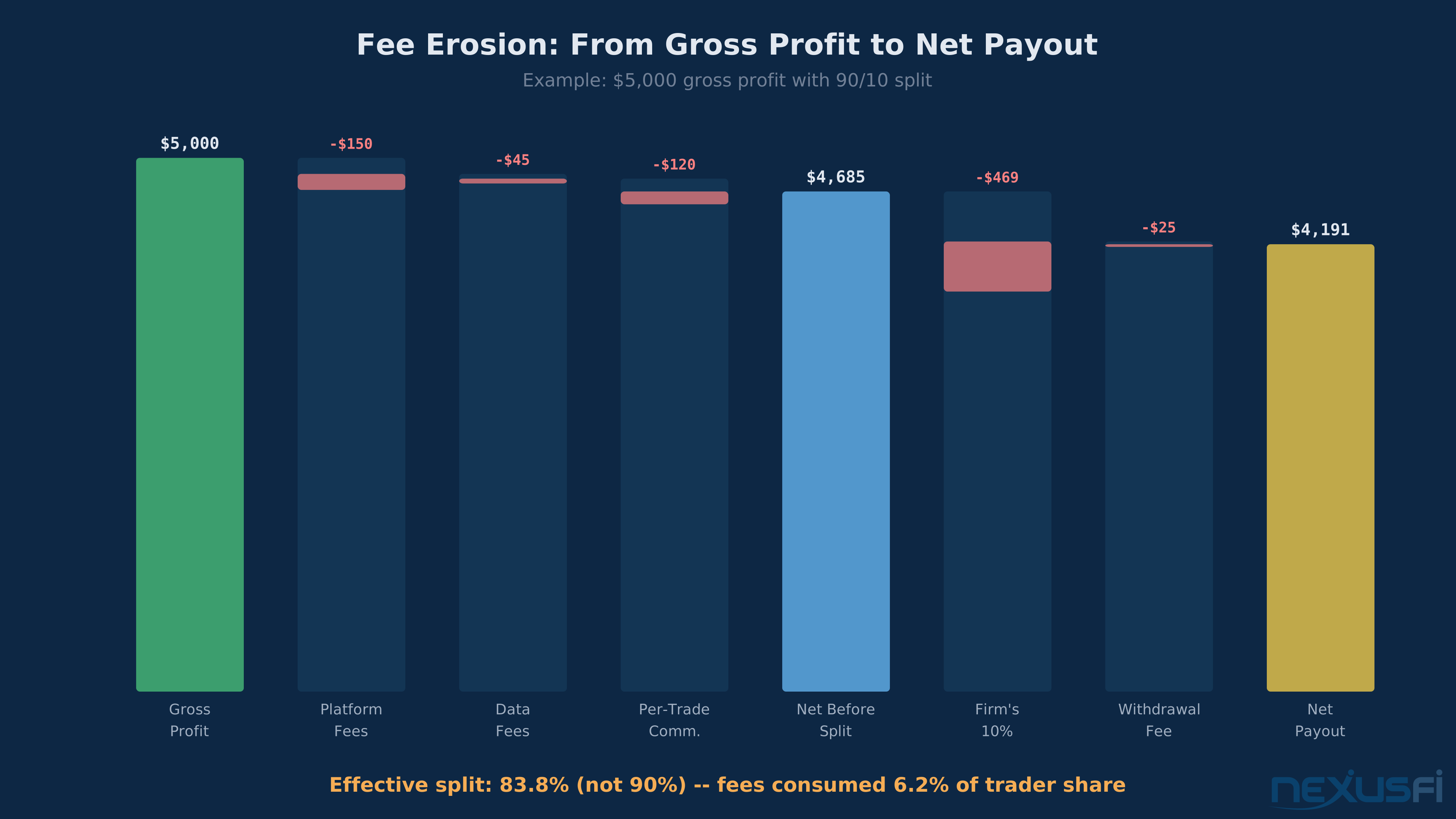
- Weekly: Apex and BluSky offer weekly windows. Better for cash flow, but some firms add processing fees for frequent withdrawals.
- Bi-weekly: FTMO allows bi-weekly cycles. A middle ground.
- Monthly: Earn2Trade and Topstep lean toward monthly cycles. Longer wait, but often simpler mechanics.
Processing time after you submit a request:
- ACH transfers: 2-3 business days, usually zero fee
- Wire transfers: 1-3 business days, $10-25 fee
- Crypto (BTC/ETH/USDT): Same day to next day, network fees passed through
- PayPal: Fast but fee-heavy (3-5% depending on region)
- Riseworks: Infrastructure layer some firms use — adds compliance verification but supports multiple payout rails
Verification and approval. Most firms run a compliance check on each payout request. FTMO requires a confirmation email. Some firms add a manual review step that can add 1-3 business days.
([NexusFi post] [4]). The review process exists, and occasionally it catches legitimate edge cases — but it can also delay payouts when you're expecting faster processing.
Total time from first profitable trade to cash in bank: Typically 2-6 weeks depending on the firm's minimum trading days, payout schedule, and processing method. Weekly-payout firms can get you paid in 14-21 days. Monthly-only firms stretch to 30-45 days.
Scaling Plans and How They Change the Deal #
Scaling is how you grow from a $50K evaluation account to a $150K or $250K funded account. Every firm handles it differently, and the mechanics matter more than the headline numbers.
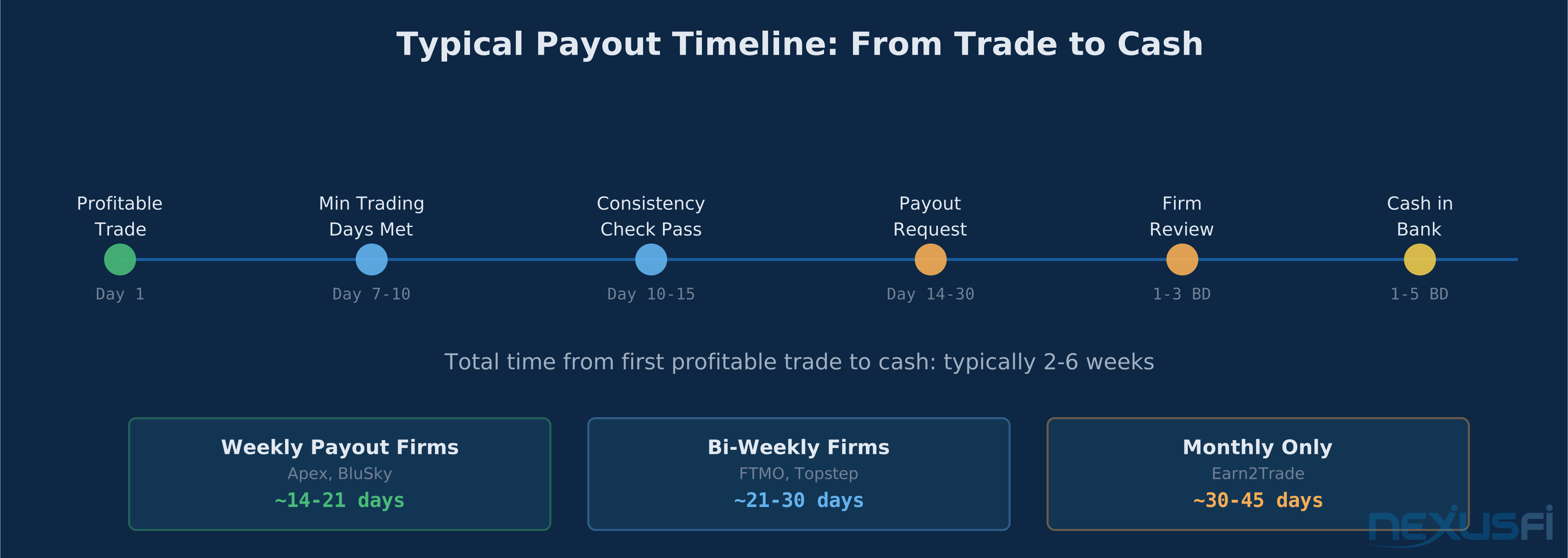
A typical scaling ladder:
- Pass evaluation at base size (e.g., $50K)
- Trade funded account, meet profit milestones
- Qualify for larger account size (e.g., $100K, then $150K)
- Profit split may improve at each tier
FTMO's scaling is the most aggressive — accounts can reach $250K with splits up to 90/10. Topstep adds capital incrementally ($5K per month, capped at $30K) but keeps the split flat. Apex ties scaling to cumulative profit milestones with split improvements along the way.
The question traders miss: Does scaling increase actual withdrawable cash, or just the notional account size? If your account doubles but payout caps don't change, the scaling is cosmetic. If the split improves AND the caps rise, you're genuinely earning more.
Watch for scaling resets. Some firms reset consistency counters when you scale up, meaning your "minimum trading days" requirement starts over. That creates a capital lock-up window every time you advance.
Fee Structures That Erode Your Net Payout #
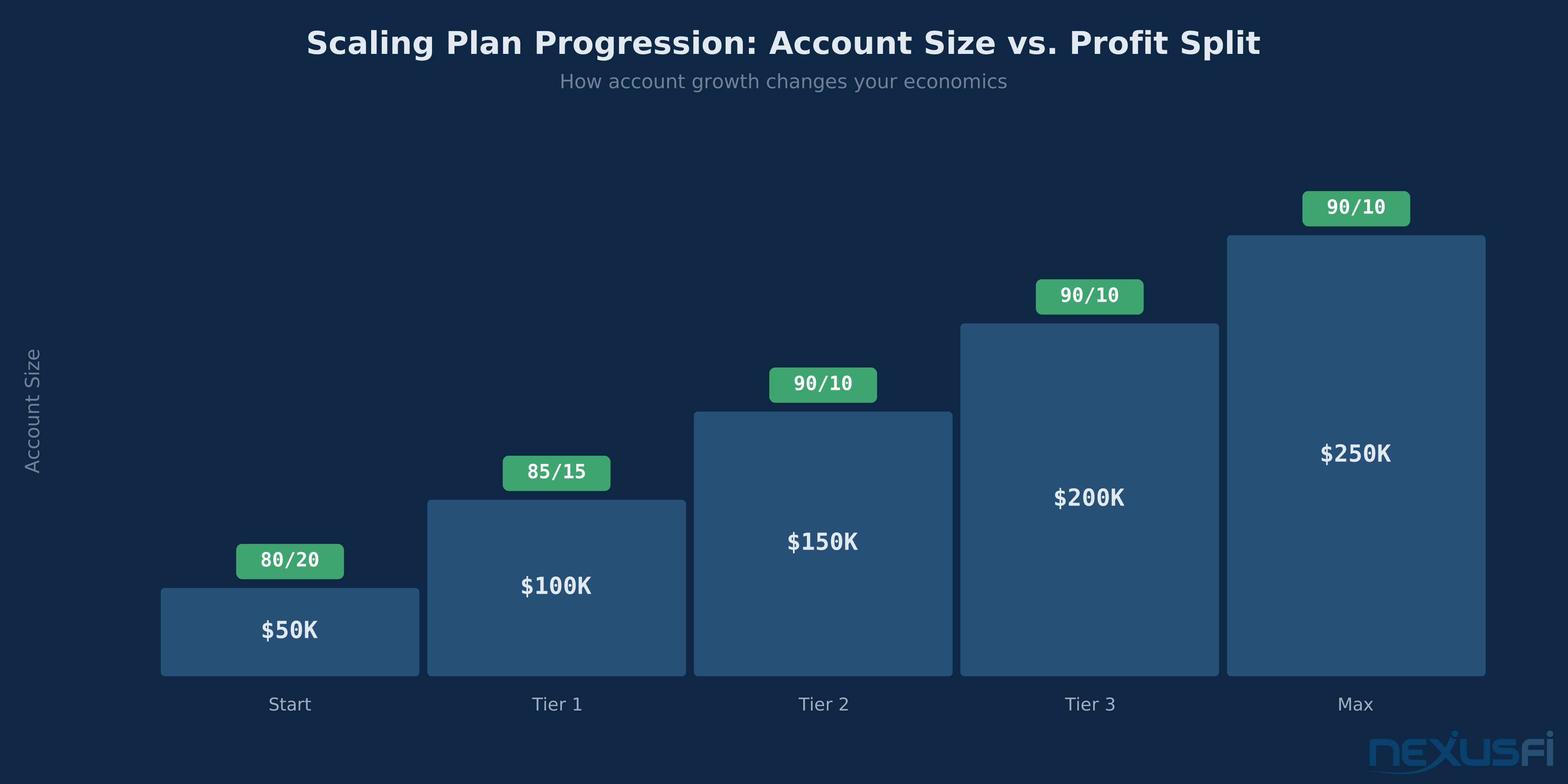
Fees are where the math gets honest. A 90/10 split on $5,000 gross profit is $4,500 in your head. But run the real numbers:
- $5,000 gross profit
- Minus $150 monthly platform fee
- Minus $45 data feed subscription (CME + CBOE)
- Minus $120 in per-trade commissions (at $1.50/contract over 80 round-trips)
- Net before split: $4,685
- Firm's 10%: -$469
- Your 90%: $4,216
- Minus $25 withdrawal fee
- Cash received: $4,191
That's an effective split of 83.8% — not 90%. The gap between headline split and actual payout is where most traders get blindsided.
Categories of fees to track:
- Platform/subscription fees: $0-30/month depending on firm
- Data feeds: CME market data runs $10-15/month, CBOE another $5-8
- Per-trade commissions: $0.50-2.00 per contract, deducted before the split
- Withdrawal fees: $0-25 depending on method
- Evaluation fees: The cost of entry that you've already paid — amortize this across your expected payouts for true ROI
- Reset fees: If you blow an account and want to try again, some firms charge for resets
([NexusFi post] [5]). The simplicity of the raw split hides the mechanical complexity of the actual payout.
The formula that matters:
Net Payout = (Gross Profit - All Fees) x Trader Split% - Withdrawal FeesRun this calculation with your actual trading volume before committing to any firm.
Tax Treatment: What the IRS Sees #
This is not tax advice — consult a CPA. But here's what futures prop firm traders need to understand about the tax environment.
U.S. traders: Most prop firms issue a 1099-NEC (nonemployee compensation). That means your payout is classified as self-employment income, not capital gains. The distinction is significant:
- Self-employment tax (Social Security + Medicare): 15.3% on net earnings
- Plus your regular income tax bracket
- Quarterly estimated tax payments required if liability exceeds $1,000/year
This is different from trading your own futures account, where Section 1256 contracts benefit from 60/40 long-term/short-term capital gains treatment. As @seattle7 highlighted in a NexusFi discussion, the 60/40 treatment of personal futures trading is one of the key financial advantages that prop firm payouts lose ([NexusFi post] [7]).
Deductible expenses on Schedule C:
- Platform and data fees
- Per-trade commissions (if you paid them)
- Home office (if applicable)
- Educational materials and subscriptions
- Evaluation fees (business expense)
Entity structure options:
- Sole proprietor: Simplest. All income on Schedule C. Full SE tax exposure.
- Single-member LLC: Liability protection but same tax treatment as sole prop unless you elect S-Corp.
- S-Corporation: Can reduce SE tax by paying yourself a "reasonable salary" and taking remaining profits as distributions. Worth evaluating if net earnings exceed $30K-40K annually. Adds accounting complexity.
The tax delta between prop firm income and personal trading income is real. Factor it into your comparison when deciding whether a prop firm or a personal funded account makes more sense for your situation.
Simulated vs. Live Funded: The Counterparty Question #
Most retail futures prop firms operate on a simulated funded model. Your trades execute in a simulation environment — the firm is not placing your orders in the live market with real capital. Payouts come from the firm's business operations, not from market profits generated by your trades.
This creates a fundamental counterparty relationship. Your payout depends on:
- The firm staying solvent
- The firm honoring its published rules
- The firm processing your withdrawal request without unexpected delays
([NexusFi post] [6]). Not every firm has earned the same level of trust.
What reduces counterparty risk:
- Long operating history (5+ years)
- Transparent and stable rules (not changing every quarter)
- Public payout documentation and trader testimonials with proof
- Regulatory registration or compliance frameworks
- Responsive support with clear escalation paths
What increases counterparty risk:
- Vague contract language ("payouts at our discretion")
- Frequently changing rules mid-cycle
- Aggressive promotional pricing that raises sustainability questions
- No clear documentation of total payouts distributed
NexusFi's Funded Trading Evaluation Firms forum is one of the best resources for real trader experiences with payout reliability across firms.
How to Compare Firms: The Trader-First Scorecard #
Stop comparing headline splits. Start comparing these five dimensions:
1. Effective net payout. Run the fee-erosion calculation for your actual trading volume. A firm with an 80/20 split and $0 in recurring fees can beat a 90/10 split with $200/month in platform and data costs.
2. Time to cash. Measure the total elapsed time from your first profitable trade to money in your bank account. Factor in minimum trading days, consistency requirements, payout schedule, and processing time.
3. Rule compatibility. Stress-test your trading strategy against each firm's consistency rules. If you regularly have days where one trade produces 40% of your monthly P&L, firms with "best day" caps will reject your payouts.
4. Scaling economics. Does the firm's scaling plan genuinely improve your earnings (higher split + higher caps), or is it just a larger notional number with the same payout constraints?
5. Operational reliability. How long has the firm been paying traders? How responsive is support? What do real traders on NexusFi and other communities report about their withdrawal experiences?
Red Flags and Due Diligence Checklist #
Before signing up with any futures prop firm, verify:
- The exact profit split percentage and whether it applies to gross or net profit
- All recurring fees (platform, data, subscription, per-trade commissions)
- Minimum trading days before first payout eligibility
- Consistency rules — get the specific formula, not just a general description
- Payout frequency options and any fees per withdrawal method
- Scaling plan terms — what triggers scaling, does the split actually improve
- Tax documentation — do they issue 1099-NEC, and by what date
- Contract language around payout denial — is it "at our discretion" or rules-based?
- Account termination conditions — what happens to unrealized profit if your account is closed
- Community reputation — search NexusFi, Trustpilot, and Reddit for real trader payout experiences
The prop firm that looks best on paper isn't always the one that puts the most money in your account. The one with the clearest rules, the most predictable payout mechanics, and the longest track record of actually paying traders — that's the one worth your evaluation fee.
Disclaimer: Prop firm terms change frequently. The structures described in this article reflect commonly published programs as of early 2026. Always verify current terms directly with each firm before making decisions. This article does not constitute financial or tax advice.
Knowledge Map
Go Deeper
Build on this knowledgeReferences This Article
Articles that build on this topicCitations
- — Topstep's Nick Dolby (Social Media and Community Coordinator) - Ask me Anything (AMA) (2020) 👍 2“Since it's not your account, the funds in it aren't yours, and the profit isn't yours either”
- — ApexTraderFunding.com experience and review (2023) 👍 5“Flipping contracts in an attempt to meet the minimum required days to request a withdrawal is prohibited”
- — ApexTraderFunding.com experience and review (2022) 👍 17“Payout scheme -- you need to be patient though: first payout only after 25 trading days”
- — ApexTraderFunding.com experience and review (2024) 👍 7“2/3 of my queried payouts have now been sent, and Apex are seeking long-term relationships”
- — ApexTraderFunding.com experience and review (2024) 👍 3“Contrast this to a straightforward profit split on the live market”
- — ApexTraderFunding.com experience and review (2021) 👍 8“If a trader is funded it's typically hard for him to get paid”
- — Funded Trader platforms (2024) 👍 2“60/40 long- vs. short-term capital gains tax treatment”