



Prop Firm Funded Account Agreements: Reading the Contract Before You Sign
Subtitle: The clauses that determine your right to trade, when you get paid, and when you lose everything — decoded.
Overview #
You spent three weeks grinding through a two-step evaluation. You hit the profit target on Day 18, stayed inside the drawdown on every session, traded minimum days, and avoided news. The firm emails you: congratulations, you're funded.
Then three payouts in, your account gets terminated. The reason? A clause buried in the agreement you agreed to on page 6, which you'd never read carefully because the marketing page said "simple rules, fast payouts."
This happens more than you'd think. The funded trading industry is built on a legal foundation that most retail traders ignore — the funded account agreement and its companion documents. These contracts define whether "funded" means what you think it means, how payout eligibility actually works, when firms can close your account without explanation, and who owns your trading strategies. Understanding these documents is not optional if you plan to trade with real payout risk.
This article does one thing: decodes funded account agreements clause by clause, explains the operational implications for your trading, and gives you a checklist to run before signing anything. It covers the contracts behind the major futures prop firms — Topstep, Apex, TradeDay, OneUp, BluSky, and similar programs — where "funded" typically means a simulated account tracking your performance against firm-defined rules, not a live brokerage allocation.
Reading the marketing page and reading the agreement are two completely different exercises. The marketing page describes the best-case scenario. The agreement describes who wins when things go wrong.
What You're Actually Signing #
Before getting into specific clauses, you need to understand what the agreement itself is — because it's almost certainly not what the headline "get funded" pitch implies.
The Simulated Account Reality #
The overwhelming majority of retail futures prop firm programs involve a simulated ledger, not a live brokerage account holding your name. When Topstep, Apex, or TradeDay call it a "funded account," they mean they've extended you access to trade a simulated environment, tracking performance against their rules. The firm may or may not be trading anything in the real market to hedge your positions. Often they're not.
As @Binkius on NexusFi explained in a March 2024 analysis of two collapsed firms:
This distinction matters in the agreement because it determines:
- The legal basis for payouts (contractual obligation vs. actual profit transfer)
- Your recourse if the firm collapses
- Whether "profit" means realized market gains or a simulated balance the firm controls
Look for how the agreement describes the account model. Language like "performance-based profit participation," "simulated funded account," or "prop trading program" signals a simulated ledger. Language like "managed account," "live allocation," and requirements to register as a professional trader with an FCM signals something closer to actual capital allocation.
The Legal Relationship #
The agreement also defines what you are to the firm. This has direct tax and legal implications.
Most retail futures prop programs classify traders as independent contractors or program participants — neither employees nor customers. You're a participant in a performance program. This means:
- No employment protections
- No FINRA or NFA oversight of the relationship
- Payout is a contractual obligation, not a wage or capital gain
- Disputes go through the firm's chosen arbitration process, not standard financial regulators
Some agreements go further and describe the relationship as a "license" — you're being licensed to access the firm's simulated trading environment. That language matters if they close your account, because license agreements can be revoked without notice or cause.
"Independent contractor" classification means you're on a 1099 in the U.S. But more importantly for trading, it means there is no employment law protecting you from arbitrary termination. Read the termination clause, not just the payout percentage.
The Definitions Section -- Where Everything Is Actually Decided #
Most traders skip the definitions. This is a mistake. Prop firm contracts often hinge almost entirely on defined terms, and the definitions are frequently more restrictive than the headline rules suggest.
Trading Day #
Sounds obvious. It isn't. "Trading Day" in many agreements means a calendar day during which you execute at least one round-trip trade. But some firms define it differently:
- Must include trades on both sides of a session
- Must include a minimum number of contracts
- Does not include days where only automated orders executed
- Excludes days where you only took one position and held
The minimum trading day requirement for payout eligibility (common at 10-15 days before first withdrawal) is counted against this definition, not the calendar. A day where you entered and immediately exited on a stop counts. A day where your contingent order filled but you weren't monitoring doesn't count at some firms.
Check: "How is a Trading Day defined? Does it require minimum activity beyond a single trade?"
Net Profit vs. Gross Profit #
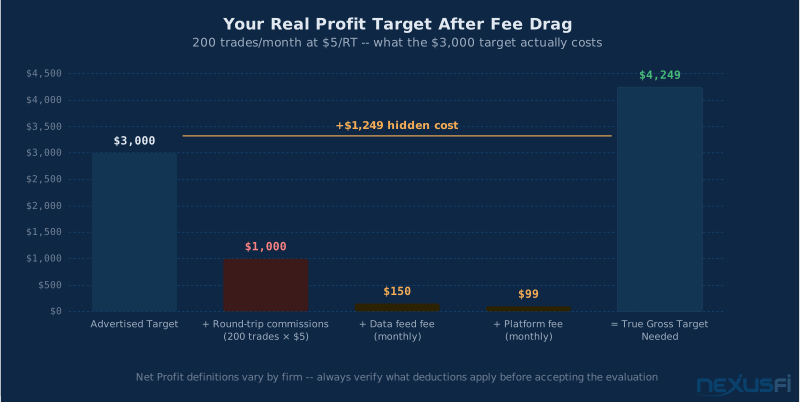
This is where evaluation thresholds get ambiguous. If the profit target is $3,000, is that gross (before commissions and fees) or net (after)?
Some firms define "Net Profit" as gross P&L minus commissions only. Others subtract data fees, platform fees, and monthly account fees. A few also deduct their "risk management fee" which appears nowhere in the marketing materials but surfaces in the definitions section of the signed agreement.
At $4-6 per round trip on NQ, a 200-trade month costs $800-$1,200 in commissions alone. If those come out of your profit target, you need to earn more than the advertised number to trigger the payout gate.
True Target = Advertised Target + (Round Trips × Commission per RT) + Monthly Fees
Check: "Does Net Profit deduct commissions, fees, and data costs from the threshold calculation?"
Realized vs. Unrealized P&L #
This definition controls the trailing drawdown mechanic — the single most misunderstood aspect of retail prop firm agreements.
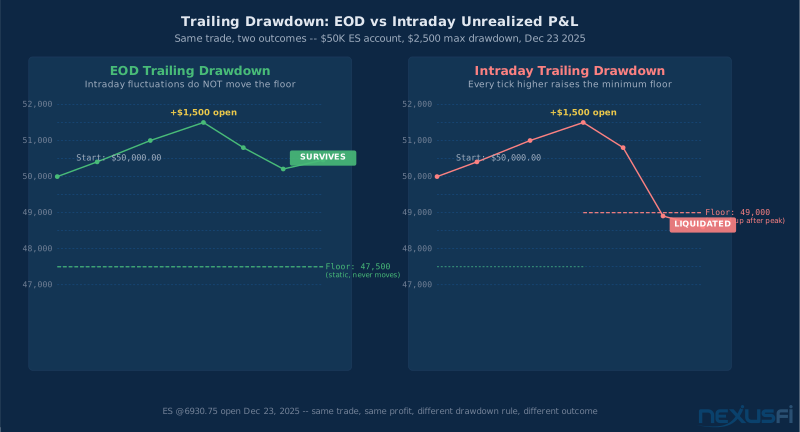
End-of-Day (EOD) drawdown tracks your account balance at the close of each session. Drawdown is measured against your highest closing balance. Intraday fluctuations don't affect the trailing level.
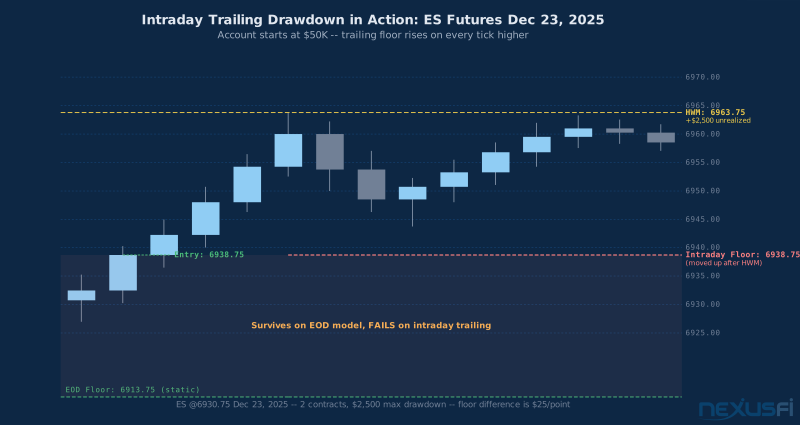
Intraday trailing drawdown tracks the highest equity point reached at any moment during the session, including unrealized (open) P&L. If your account reaches $52,000 intraday on an open position, then that position retraces before you close it, the trailing drawdown limit moves up based on that $52,000 peak — even though you never realized it.
@josh gave a precise breakdown of how Apex's trailing drawdown actually works:
The operational impact: on an intraday trailing model, you can be profitable on the day and still breach the drawdown limit. You can have a 100% win rate and still get liquidated. The account value never went negative. You simply let a profitable trade retrace too far.
@canoekoh, in a widely-read 2022 thread, made the key structural observation:
Whether you agree with that framing or not, the structural point stands: EOD trailing drawdown and intraday trailing drawdown are at the core different risk environments. The definitions section of your agreement tells you which one you're operating in.
EOD drawdown = risk controlled at the session close. Intraday trailing drawdown = any profitable position that retraces converts into a harder drawdown floor. Know which model you're in before sizing any trade.
Performance Requirements and Payout Conditions #
Once you understand what you're signing and how key terms are defined, the payout engine is next. These clauses control whether your trading results convert into money you can actually receive.
Profit Targets and Path Dependency #
Most evaluations state a simple profit target: reach $X and you pass. But the contract often introduces path dependency.
Minimum trading days — the most common path dependency. You must execute on at least N qualifying Trading Days before the target is recognized. You can hit the profit target on Day 3, but if the minimum is Day 10, the target has no effect for another week. During that week, you remain exposed to drawdown risk with no ability to stop trading early.
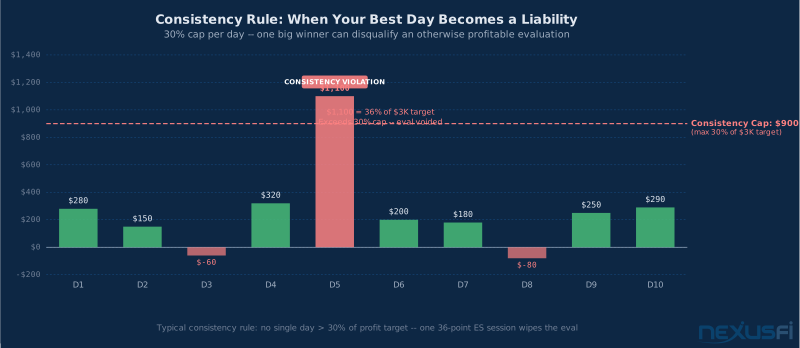
Consistency rules — a second-order path dependency. If one day's profit exceeds a defined percentage (commonly 30-50%) of your total profit, that day may be disqualified or treated as a breach. @idude described encountering this in a 2022 post:
The logic behind consistency rules is defensible — firms want to fund traders who make steady returns, not traders who gambled once and got lucky. But the operational effect is that your best day can work against you. A $2,000 profit on a volatile news session might trigger the consistency cap even though it was methodologically sound.
Check: Does the agreement include a consistency rule? How is the cap calculated? Does it apply to the evaluation only, or to the funded account payouts as well?
Payout Buffer and Minimum Retained Balance #
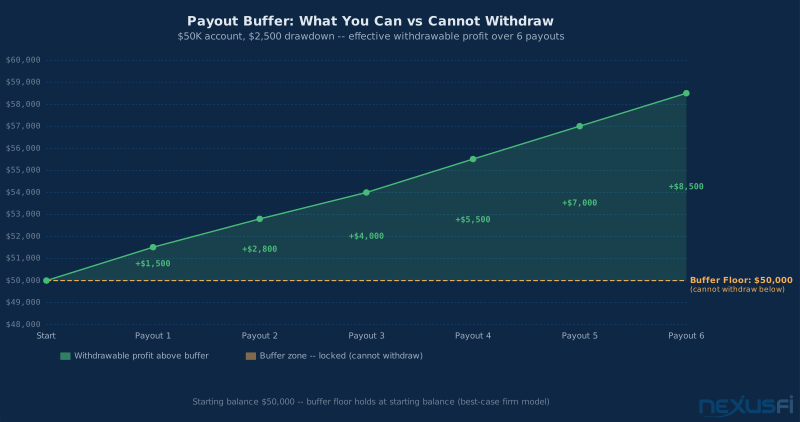
Almost all retail prop firms require a minimum balance to remain in the account after withdrawal. This is called the "payout buffer" or "withdrawal floor."
If the funded account starts at $50,000 notional and the buffer is $48,000, you can only withdraw profits above $2,000. If you've earned $5,000 and want to pull it all, you can't — $2,000 stays locked in.
More importantly: the buffer often rises as you earn more. If the buffer is defined as "initial balance minus maximum drawdown plus accrued profit above threshold," the number you need to stay above keeps moving. Each time you earn more, the floor rises. This mechanic reduces the effective payout percentage much, especially in the early funded period.
@sstheo described the funded account balance mechanics in practical terms after getting funded with MES Capital through OneUp:
That description shows a relatively trader-friendly version — the trailing drawdown stops moving when it reaches the starting balance. Not all firms do this. Some keep trailing indefinitely.
Check: Where does the trailing drawdown floor stop? At the starting balance? After a fixed dollar amount of profit? Never?
Minimum Payout Waiting Period #
Beyond minimum trading days, many agreements also require a waiting period in calendar days before the first payout can be requested. Common ranges: 5 business days at fast-payout firms like BluSky, 30+ calendar days at traditional programs.
The calendar-day waiting period is separate from the trading-day requirement. You may satisfy 10 minimum trading days in 14 calendar days, but if the payout waiting period is 30 days, you wait the full 30.
Termination Clauses and At-Will Language #
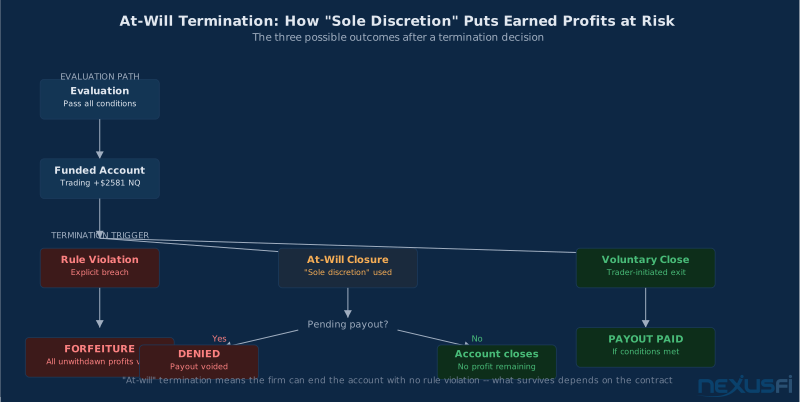
This is the section that surprises the most traders. Most funded account agreements contain language that allows the firm to terminate your account without cause, without notice, and without obligation to pay any pending or future profits.
At-Will Termination #
Look for phrases like "at our sole discretion," "for any reason or no reason," "in our reasonable judgment," and "without prior notice." These clauses give the firm the ability to end the relationship at any point. Account balance at termination is typically returned or forfeited based on a separate clause (see below).
@Howard Roark described the experience of encountering discretionary termination firsthand:
The important distinction he raises: a hard-coded rule (breach metric X and the system liquidates) is predictable and mechanical. Discretionary termination is not. The contract may say warnings are possible, but "may" in a legal agreement does not mean "will."
What Survives Termination #
This is the single most financially consequential clause in the entire agreement.
When an account is terminated, what happens to:
- Profits already earned but not yet withdrawn?
- A pending payout request submitted before termination?
- The evaluation fee paid to access the program?
The answers vary much by firm:
Forfeiture on rule violation: Many agreements state that if a termination is for cause (rule violation), all profits — including previously credited amounts — are forfeited. You can pass an evaluation, build a funded account to $8,000 in profit, withdraw $3,000, then violate a rule and lose the remaining $5,000. Sometimes the $3,000 already withdrawn is clawed back. Read this clause carefully.
Forfeiture on "suspicious activity": Agreements typically define "suspicious activity" broadly enough to include execution patterns that differ from the evaluation period, unusual drawdown recovery patterns, or trading strategies that differ from those "consistent with the firm's expectations." This is where discretionary judgment creates real risk.
No forfeiture on voluntary closure: Most programs allow you to close your account voluntarily and receive pending payouts, provided you've met all conditions. But forced termination and voluntary closure are treated differently. If you've been terminated for cause, closing your account to trigger payout may not work.
@bobwest, in the NexusFi thread on the Topstep payout dispute, identified the underlying trust issue:
The key word in that quote: retroactively. Which leads to the next clause.
Unilateral Rule Amendments #
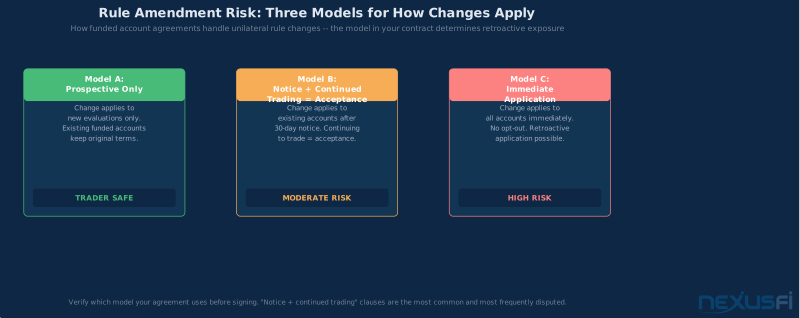
Most funded account agreements allow the firm to modify terms with minimal notice. The typical version: "We reserve the right to amend these terms at any time. Continued use of the platform after notification constitutes acceptance."
The notification method is often a website posting or email. Miss the email while actively trading, and new rules apply to you. If applied to your existing performance history, that's retroactive application.
This happened publicly with Topstep in 2021. A rule change regarding trade duration was applied retroactively, resulting in a payout denial for a trader operating under original rules. @matthew28's summary:
Fi posted a news summary in 2026 on a similar situation at FundingTicks, where retroactive rule changes affected traders who had already passed evaluations.
Check: How are rule amendments communicated? How much notice is given? Do new rules apply to existing accounts or only new enrollments?
"Continued use constitutes acceptance" is standard software license boilerplate. In a funded trading agreement, it can mean that logging into your platform after a rule change accepts the new terms — including retroactive application to prior trading activity. Set up email alerts from your prop firm and read every notification.
Trading Conduct Boundaries #
Beyond the risk mechanics, funded account agreements define a wide range of trading behaviors that can trigger account review or termination. Many of these rules are not prominently listed on the firm's marketing page.
News Trading Restrictions #
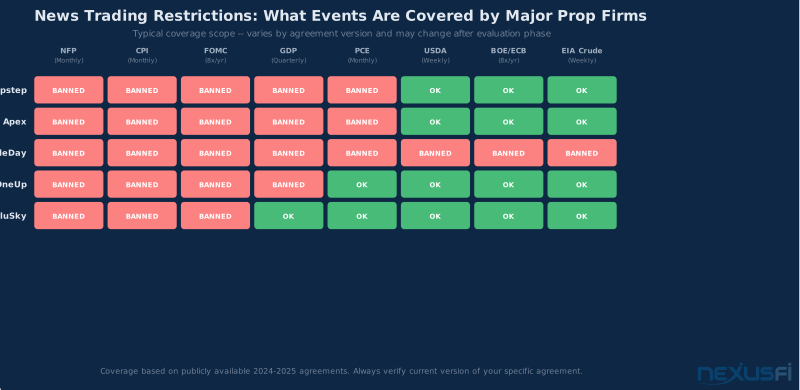
Most funded program (see Prop Firm Evaluation Strategy)s restrict trading around scheduled news events. Common implementations:
- Flat 1 minute before and after designated economic releases
- No new positions within a defined time window of FOMC, NFP, CPI announcements
- "Major news" defined by firm-maintained calendar that may update without notice
@sstheo noted this rule change after transitioning from evaluation to funded status:
That last detail matters: rules can differ between the evaluation phase and the funded phase. You may have traded profitably through news during the evaluation — the behavior that passed you — and then find it prohibited in the funded account.
Check: Are news restrictions different between evaluation and funded phases? How is "major news" defined?
Copy Trading and Multi-Account Correlation #
Most agreements prohibit using your funded account as one leg of a hedged multi-account strategy. Long ES in the funded account, short ES in your personal account — prohibited regardless of whether the funded trades are individually profitable.
Many programs also use software that detects correlation between funded accounts. Identical trades across two funded accounts — even independent decisions — can trigger review above an 80% entry-price similarity threshold within a time window.
Account leasing and third-party trading are prohibited in virtually every agreement. Letting someone else trade your account, including paid signals or copy software, violates standard terms. Detection methods include device fingerprinting, IP monitoring, and pattern analysis.
Automation, APIs, and Algorithmic Trading #
The automation clause is where funded traders using coded strategies face the most risk. Most agreements either:
- Permit automated trading with no pre-approval required (common, but typically includes a clause that "manipulative, high-frequency, or latency-arbitrage strategies" remain prohibited)
- Require pre-approval for any automated or algorithmic trading, with the firm retaining discretion to deny
- Prohibit automation entirely except for basic stop/target orders
The dangerous middle ground: agreements that permit automation but define "prohibited strategies" broadly enough to sweep in legitimate systematic approaches. "High-frequency trading," "excessive order-to-fill ratios," and "latency arbitrage" can be interpreted to include scalping strategies or any approach that places and cancels orders as part of normal operation.
Check: Is automation explicitly permitted? Does it require pre-approval? Does the "prohibited strategy (see Prohibited Trading Strategies in Prop Firm Funded Accounts)" definition capture your approach?
Intellectual Property and Strategy Confidentiality #
This clause gets overlooked almost universally. It shouldn't.
Who Owns Your Strategy? #
Most funded account agreements claim no ownership over the trading strategies or methods you use. But the IP clause is often more complex than that.
Trade log and analytics ownership: Your order history, execution data, and performance analytics generated on the firm's platform may be defined as their data. The agreement may permit the firm to use this for internal risk management or product development.
Strategy confidentiality: Many agreements include a one-way confidentiality obligation prohibiting public discussion of the firm's rules, drawdown thresholds, or system behavior in ways that help other traders "game" the program.
Publication restrictions: Some agreements prohibit discussing trade results, rule details, or performance metrics publicly. Session recordings posted online could technically violate this clause.
Dispute Resolution and Rule Change Provisions #
Arbitration Clauses #
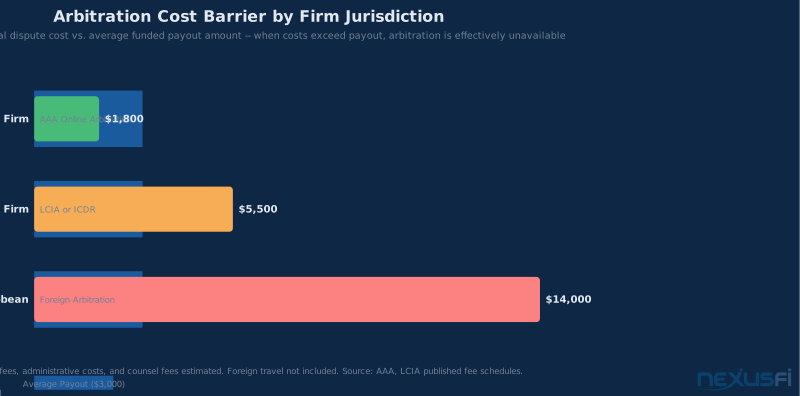
Almost all retail prop firm agreements include mandatory binding arbitration — you waive your right to sue in court. What matters: where arbitration takes place (foreign jurisdictions add cost), who pays filing fees (upfront fees can exceed small disputes), and the class action waiver that removes collective action as an option.
Short Appeal Windows #
If your account is terminated or a payout is denied, most agreements give you a short window — often 5-10 business days — to formally dispute the decision. Missing this window typically waives all remedies.
The practical problem: account terminations often happen without explanation. By the time you understand why the account closed, research the relevant rule, and draft an appeal, the window may have expired.
Document everything from the moment you notice issues. Screenshot dashboards, export trade history, save all communications.
Cross-Firm Structural Differences #
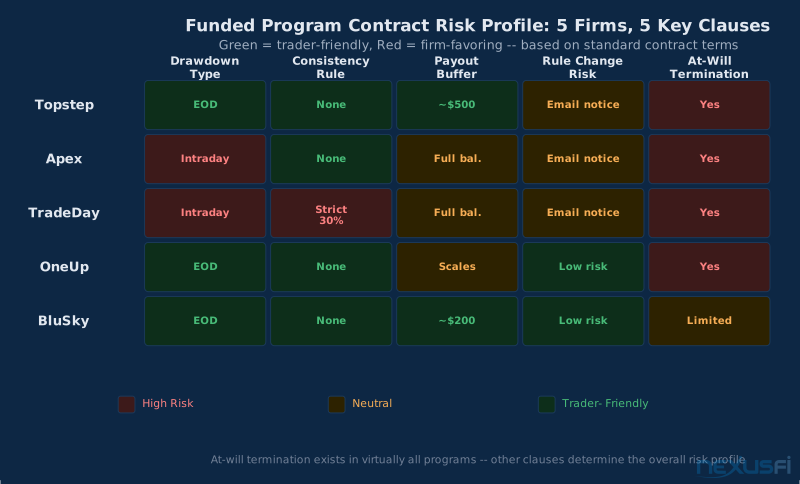
The major futures prop programs share the same general framework but differ meaningfully on the clauses that matter most. This is a structural comparison, not a review of any firm's overall quality.
| Firm | Trailing DD Type | Consistency Rule | News Restriction | Payout Buffer |
|---|---|---|---|---|
| Topstep | EOD (stops at starting balance) | Not standard | Yes (defined calendar) | ~$500 min |
| Apex | Intraday unrealized | No | Yes | Starting balance |
| TradeDay | Intraday unrealized | Yes (stricter than most) | Yes | Starting balance |
| OneUp | EOD | Not standard | Yes (funded phase) | Scales with profit |
| BluSky | EOD | No | Yes | Low (~$200) |
These structural differences have real trading implications:
EOD vs. intraday trailing drawdown changes your intraday risk management entirely. On EOD, you can let winning trades run — your daily risk is the daily loss limit, not a ratcheting floor. On intraday trailing, you must actively manage the high-water mark effect on every position.
Consistency rules require distributed profitability. If a $1,000 day represents 35% of your $2,857 cumulative profit, you may have triggered the cap — even if it was your best trade of the month.
News restrictions vary by scope. Some cover only the big five (NFP, CPI, FOMC, GDP, PCE). Others extend to USDA crop reports and foreign central bank events. The defined calendar matters more than the existence of the rule.
For traders using high-frequency scalping strategies, the difference between EOD and intraday trailing drawdown is often the difference between a viable program and one that structurally cannot work with your approach. The trailing drawdown model and the payout buffer mechanics determine your effective risk-adjusted return, not the advertised profit split percentage.
Practical Application: The Pre-Signing Process #
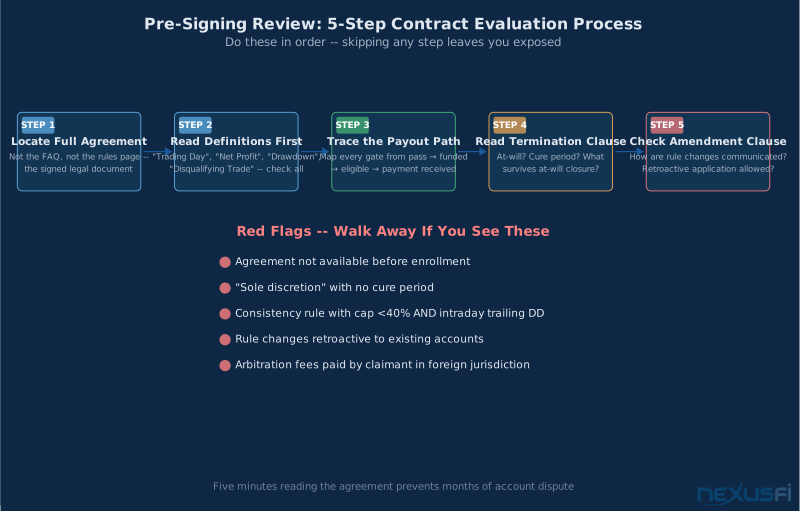
You're looking at a funded program. Here's how to actually evaluate the contract.
Step 1: Locate the Full Agreement #
The program's FAQ is not the agreement. The "Rules" page is not the agreement. Find and download the actual signed document — the Terms and Conditions, Funded Trader Agreement, Participation Agreement, or however it's titled. This is the document that will govern any dispute. If the firm does not make this available before enrollment, treat that as a red flag.
Step 2: Find the Definitions Section #
Read it before the substantive rules. Every rule's meaning depends on its defined terms. Pay specific attention to:
- Trading Day
- Net Profit / Gross Profit
- Maximum Drawdown
- Trailing Drawdown
- Consistent Trading / Consistency Rule
- Disqualifying Trade
- Prohibited Strategy
- At-Will Termination / Cause
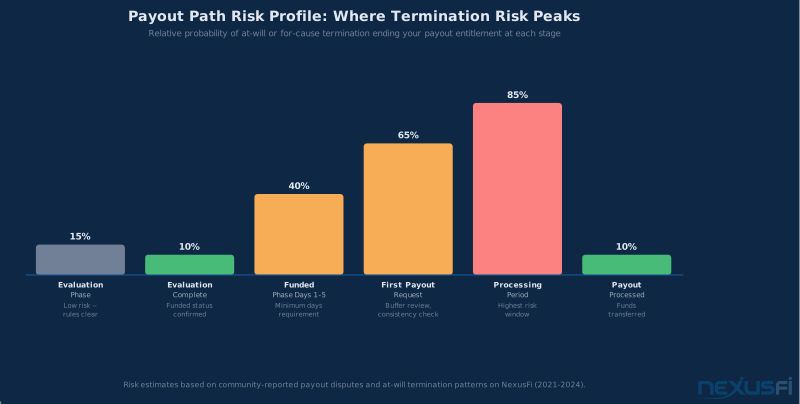
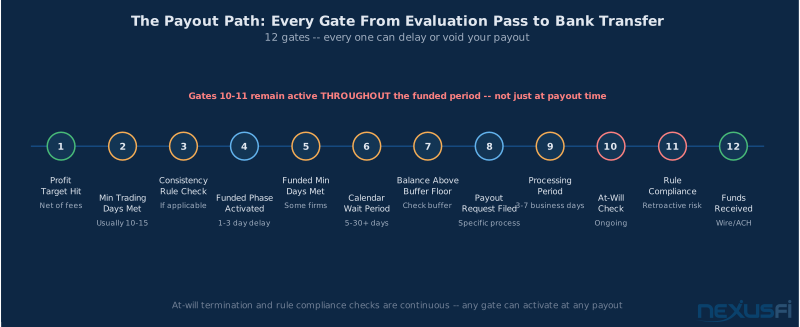
Step 3: Trace the Payout Path #
Map out the exact sequence of events required to receive a payout:
- Pass evaluation (target reached + minimum trading days + consistency rules met)
- Funded account activated
- Funded phase minimum trading days satisfied
- Payout waiting period elapsed
- Balance above payout buffer
- Payout request submitted in approved format
- Processing period (typically 3-7 business days)
- Funds transferred via approved method
Then identify all the ways each step can be interrupted, delayed, or voided.
Step 4: Read the Termination and Forfeiture Section #
Specifically answer:
- Can the firm terminate without cause?
- What happens to pending payouts at termination?
- What happens to credited but unwithdawn profits?
- Is there a cure period for rule violations?
- What constitutes "suspicious activity"?
Step 5: Check the Amendment and Notification Clause #
How and when does the firm communicate rule changes? Do changes apply retroactively? What constitutes acceptance?
@matthew28 captured the floor:
That's the baseline. The actual signed agreement — not the FAQ, not the YouTube review — is the minimum diligence.
Your Pre-Signing Checklist #
Run through this before enrolling in any funded program. If the firm cannot answer every item, get the answer in writing or reconsider.
Account structure: Is this simulated, live, or hybrid? What is the legal relationship (license, profit share, contractor)? Is the firm NFA/CFTC registered (see CFTC Registration for Prop Firms)?
Drawdown mechanics: Is trailing drawdown EOD or intraday unrealized? Does the trailing floor stop at the starting balance? Do commissions count against the calculation?
Payout conditions: How is a qualifying Trading Day defined? What is the minimum day count before first payout? Is there a calendar-day waiting period? Is there a consistency rule and what is the cap percentage? What is the payout buffer? Are payouts formula-based or discretionary?
Termination and forfeiture: Can the firm terminate at will? Does for-cause termination void unwithdawn profits? Is there a cure period for rule violations? How long is the appeal window?
Rule changes: How are amendments communicated? Do changes apply to existing accounts?
Trading restrictions: Are news restrictions different in funded vs evaluation? Is automation permitted? How is "prohibited strategy" defined?
IP and dispute resolution: Who owns your trade data? Where is arbitration conducted?
When the Contract Matters Most #
Most funded traders never encounter these clauses in a meaningful way. Pass the evaluation, trade consistently, request payouts, and nothing surfaces. The contract matters when something goes wrong — a rule is violated, an account is terminated, a payout is disputed, or the firm collapses.
The problem: you cannot retroactively become better-informed about what you signed. By the time a clause matters, the moment to understand it has passed.
Contract terms vary enough across programs — in trailing drawdown mechanics, consistency rules, at-will termination language, and forfeiture provisions — to create a range from genuinely trader-friendly to structurally designed to fail you.
You can't know which from the marketing page. You can know from the contract.
Knowledge Map
Go Deeper
Build on this knowledgeReferences This Article
Articles that build on this topicCitations
- — Funded Trader platforms (2024)“Skilled Funded Trader and The Funded Trader both just collapsed. Looks like both were illegally using the bucket-shop model and not legally trading the actual instrument.”
- — Funded Trader platforms (2024)“Apex's trailing drawdown starts at 100% of starting balance and trails upward as high-water mark rises, locking in new floor until it equals starting balance -- at which point the floor freezes.”
- — Most Funding Firms are a Scam (2023)“The fundamental model is: they sell evaluations. Payouts are secondary -- the incentive structure is built around evaluation fees, not trader success.”
- — TST/OneUp/LeeLoo/Earn2Trade Challenge Comparison (2023)“I had one incredible day that was over 40% of my total profit and suddenly my payout was in question because of a consistency rule I didn't fully understand when I signed up.”
- — My MES Live Account Journal (OneUp) (2022)“The payout buffer is the minimum balance the firm requires you to maintain. Your withdrawable profit is anything above that floor -- not your total balance.”
- — Any long term success stories from funded traders? (2023)“They just closed my account. No rule violation, no explanation. The at-will clause was in the agreement -- I just didn't think they'd actually use it while I had a payout pending.”
- — Topstep didn't pay (2023)“The core question is whether you trust the counterparty. The contract is only as good as the firm's willingness to honor it.”
- — Topstep didn't pay (2023)“A rule change regarding trade duration was applied retroactively, resulting in a payout denial for a trader operating under original rules.”
- — Most Funding Firms are a Scam (2023)“People should actually read all these company's rules properly instead of just signing up to whichever one has a special offer on that week.”
- — TST/OneUp/LeeLoo/Earn2Trade Challenge Comparison (2023)“The trailing drawdown mechanics are the single most important thing to understand before choosing a program. Most traders don't find out how it works until they've already been terminated by it.”
- — Topstep didn't pay (2023)“If you're going to participate in funded programs, you need to understand what you're signing. The agreement is the product, not the marketing page.”