



Trading Burnout: Recognizing the Warning Signs Before They Destroy Your Edge and How to Come Back
Overview #
Every futures trader hits a wall. Not the "bad week" kind of wall — the kind where the screen starts looking like noise, your rules feel meaningless, and the idea of placing another trade makes your stomach tighten. That's burnout, and it's destroyed more promising trading careers than any single losing streak ever will.
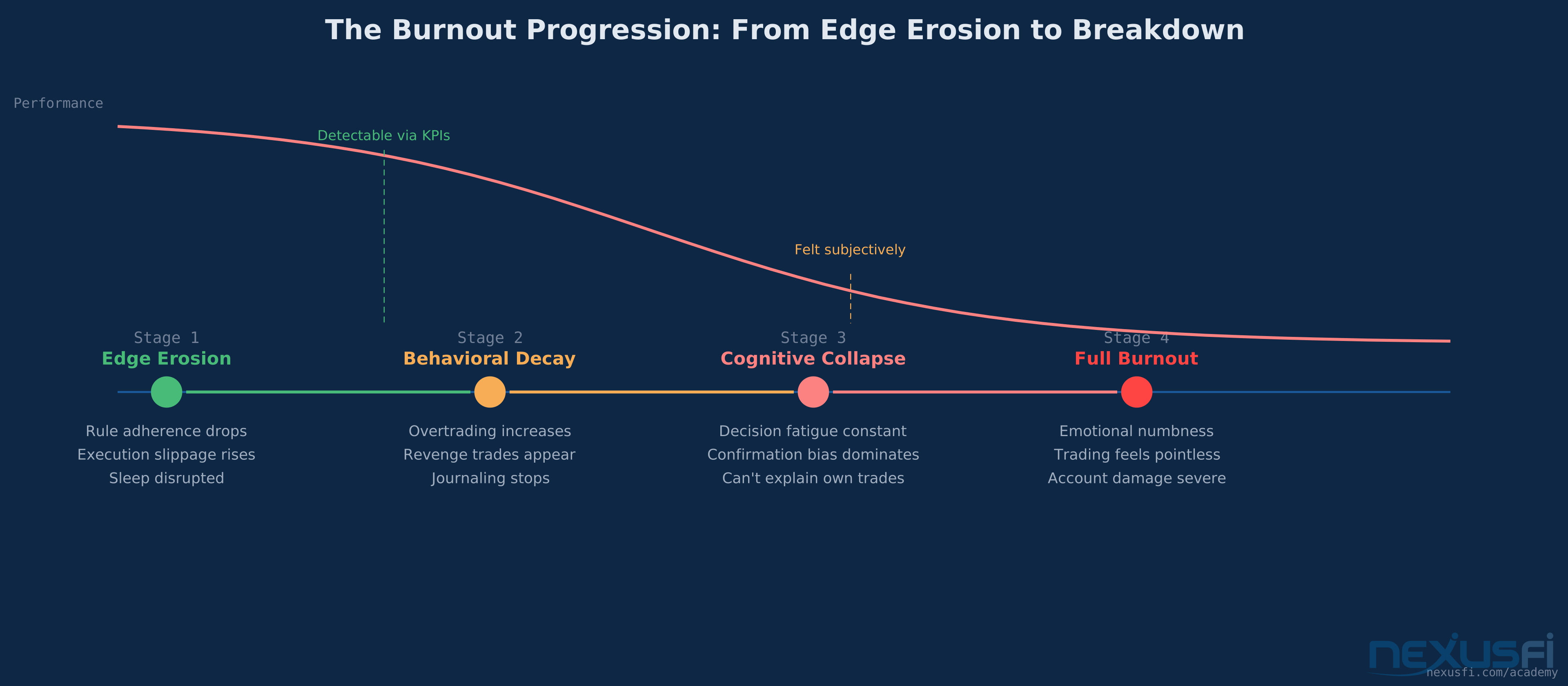
Trading burnout isn't just feeling tired after a long session. It's a measurable, multi-dimensional syndrome involving emotional exhaustion, cognitive degradation, and behavioral decay that compounds over days and weeks until your edge doesn't exist anymore. Research on trader performance indicates cognitive capacity drops by up to 40% during burnout — and the worst part is that you often can't tell it's happening until the damage is severe.
Your slippage widens, your rule adherence drops, your trade frequency climbs -- all while you still think you're "fine, just a little tired." By the time you feel burned out, you've been performing below baseline for days or weeks already.
Here's the critical insight: burnout shows up in your execution metrics before it shows up in your feelings. Your slippage widens, your rule adherence drops, your trade frequency climbs — all while you still think you're "fine, just a little tired." By the time you feel burned out, you've been performing below baseline for days or weeks already.
Key Concepts #
Trading Burnout Defined
Trading burnout is chronic mental, emotional, and physical exhaustion from sustained exposure to high-stakes decision-making. It breaks down into three overlapping components:
- Emotional exhaustion -- feeling drained, numb, unable to care about outcomes that used to matter
- Depersonalization -- cynicism, irritation, contempt for your own rules and setups ("I don't care anymore")
- Reduced accomplishment -- performance feels out of your control regardless of preparation
In futures specifically, burnout carries unique amplifiers. Leverage means losses hit instantly. Mark-to-market feedback is constant — you can't look away. And microstructure demands (spread management, depth reading, slippage control) require sustained attention that depletes cognitive reserves faster than most people realize.
Decision Fatigue
Every trade entry, exit, adjustment, and hold decision costs cognitive energy. The research is clear: decision quality degrades with cumulative load. More decisions plus fewer breaks equals worse choices — regardless of your skill level. As @jstnbrg noted, "over the course of a day decision making gets worse the more decisions a person makes. Having a meal can temporarily reverse this phenomenon."
@TropicalTrader identified the same pattern: "I can get decision fatigue or sucked into impulsive/careless trading after the 4 or 5 hour mark." That 4-5 hour threshold shows up consistently across trader journals on NexusFi — it's roughly when cognitive reserves start depleting for most discretionary traders.
The Overtrading-Burnout Loop
Overtrading and burnout don't just coexist — they feed each other in a vicious cycle that accelerates deterioration in both directions.
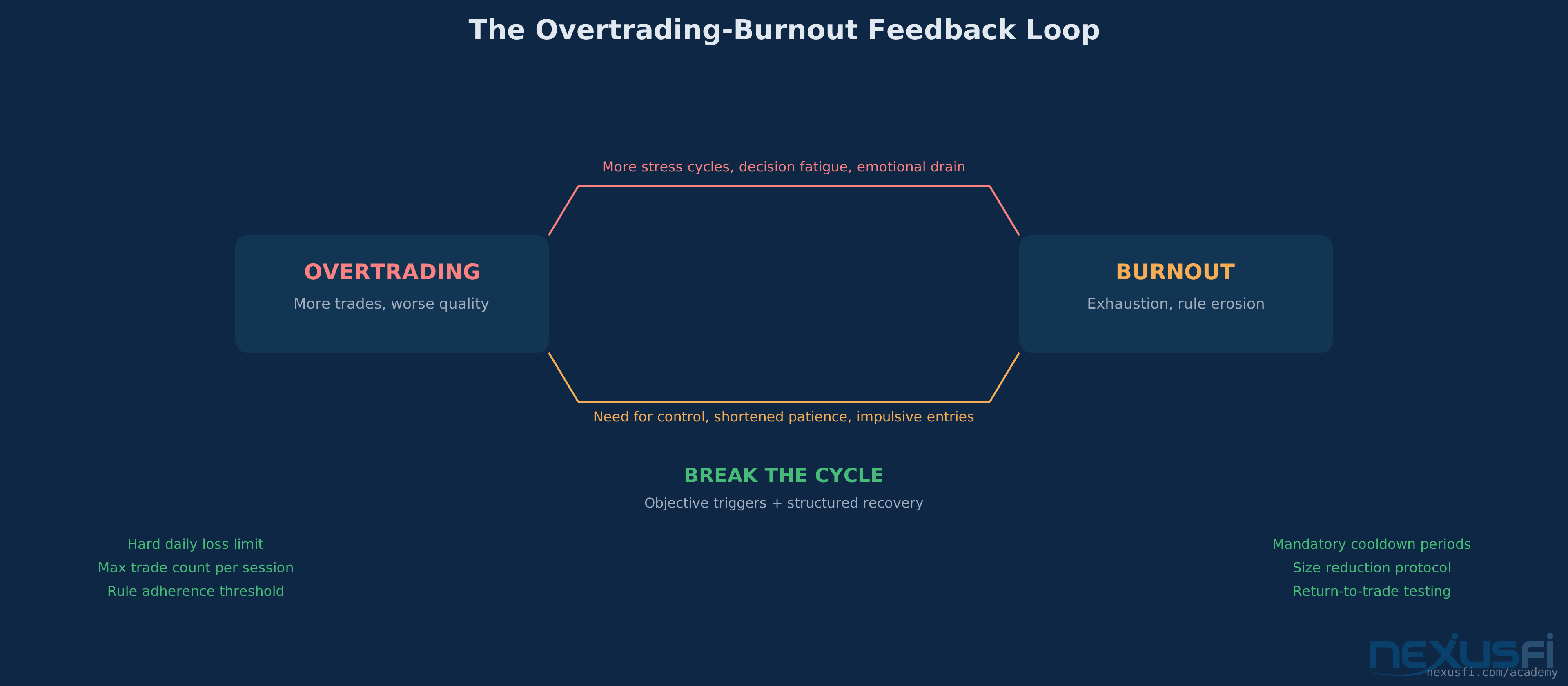
Direction A: Overtrading causes burnout. More stress cycles per day. More time in uncertain states. More exposure to losses and the emotional toll they carry. More decision fatigue leading to rule erosion. Take 20 trades a day instead of 5 and you're running through cognitive reserves at 4x the rate.
Direction B: Burnout causes overtrading. When you're burned out, patience evaporates. You trade to interrupt negative feelings, not because your setup is there. The "need to feel control" increases urgency to act. Shortened patience and degraded planning capacity push you toward impulsive entries — which generate more stress, which deepens the burnout.
Here's why this matters practically: reducing trade count alone won't fix burnout. If you cut from 15 trades to 5 but you're still exhausted, emotionally reactive, and sleeping poorly, you'll take 5 bad trades instead of 15 bad trades. The cycle has to be broken at multiple points simultaneously.
Warning Signs -- What You'll See Before Burnout Fully Hits #
Burnout doesn't arrive overnight. It builds through three layers, and the layers appear in a specific order that most traders get backwards.
Layer 1: Execution Deterioration (Earliest -- Usually Before Awareness)
These are the first signs, and they're almost always invisible to the trader experiencing them because they require objective measurement:
- Rising slippage relative to normal volatility-adjusted benchmarks -- you're entering at worse prices during worse liquidity moments
- Higher market-order-to-limit-order ratio -- impatience showing up in order type selection
- Inconsistent stop/target placement -- stops moved for emotional reasons, targets cut short
- Increased adverse selection -- chasing entries into momentum spikes when liquidity is thin
Layer 2: Behavioral Decay (Mid-Stage)
- Trade frequency rises while edge quality drops -- more trades from B and C setups
- Post-loss escalation -- revenge trades, larger sizes, tighter stops after losing
- Routine breaks down -- skipping pre-trade checklist, journaling stops, preparation gets sloppy
- Rule adherence drops below 80% -- you're following your plan less than 4 out of 5 trades
This is where @ninjus found himself: "I just keep doing stupid things and making mistakes." That self-awareness came at the behavioral layer — after the execution had already deteriorated. The decision to take a break was the right call.
Layer 3: Cognitive and Emotional Collapse (Often Last to Be Recognized)
- Increased confirmation bias -- you see what you need to see, not what's there
- Can't articulate trade rationale -- if you can't explain a trade in one clear paragraph, your cognitive system is offline
- Irritability and rumination -- replaying losses, building stories about "the market is wrong"
- Emotional numbness -- not caring about wins or losses, going through motions
@PandaWarrior described this stage: "I was exhausted mentally and physically. The toll taken on my body, my mind and my soul." When burnout reaches this level, you're not trading anymore — you're going through a motion that resembles trading while performing much below your actual capability.
The Math of Burnout: Why Your Numbers Get Worse #
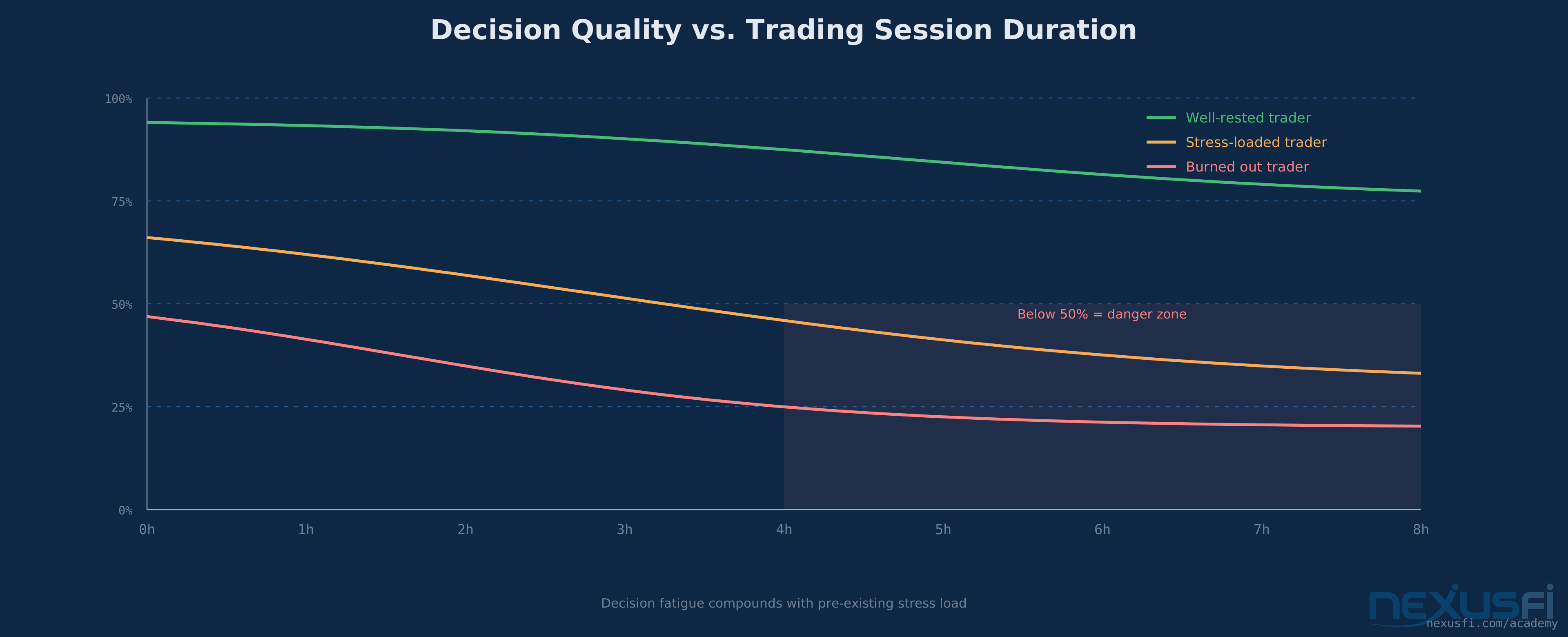
The relationship between session length and decision quality follows a predictable curve, and that curve gets dramatically worse when you're carrying stress into the session.
A well-rested trader making 4 decisions per hour starts with roughly 95% decision quality. After 4 hours, they're still above 85%. After 6 hours, they've dropped to maybe 75% — still functional but noticeably degraded.
A stress-loaded trader (poor sleep, recent drawdown, personal problems) starts at maybe 75% and drops below 50% by hour 3. A burned-out trader might start at 55% and hit danger levels before the first hour is done.
This is why @jstnbrg's observation carries so much weight: "Stopping every day was more important than catching all the action. After I made that decision, I didn't have a losing month for 6 1/2 years. Perhaps lack of decision fatigue is why." Six and a half years of profitability from one structural change. That's not a coincidence — that's the math of cognitive capacity management.
Practical Application: Detecting Burnout Before It Costs You #
The Six KPIs That Tell You What Your Feelings Won't
Track these daily in your trading journal. Compare against your personal baseline — not generic numbers. Your "normal" matters more than anyone else's average.
| KPI | What It Measures | Burnout Signal |
|---|---|---|
| Rule Adherence % | Process discipline | Below 80% for two consecutive sessions |
| Trade Frequency | Activity level vs. opportunity | 2x your normal rate in similar conditions |
| Post-Loss Trades | Revenge propensity | More than 2 trades within 30 min of a loss |
| Average Slippage | Execution quality | 3x your normal slippage rate |
| Setup Quality Rating | Selectivity discipline | A/B setups below 60% of total trades |
| Position Size Drift | Risk escalation | Any size increase following losses |
When 3 or more of these KPIs degrade simultaneously, you're in burnout territory. Don't wait for the feelings to confirm what the numbers already told you.
When to Stop Trading
Breaks should be triggered by objective indicators, not vibes. Here's the decision tree:
Mandatory session stop:
- Rule adherence below 80% for the session
- Multiple emotional rule violations in a single session
- Daily loss limit hit
- 3+ consecutive losses (regardless of size)
Mandatory multi-day break:
- 5+ KPIs degraded simultaneously across two sessions
- Losing streak exceeding your normal variance expectation
- Irritability, compulsive urge to trade, emotional numbness
As Big Mike put it: "Sometimes you simply need to work smarter, which includes taking well-needed breaks." And @bobwest laid out the operating principle: "Just stop. Tomorrow will always have opportunities, as will the next day and the next. You can easily afford to miss any trades today if your objective results show that you are not trading well."
The Recovery Protocol #
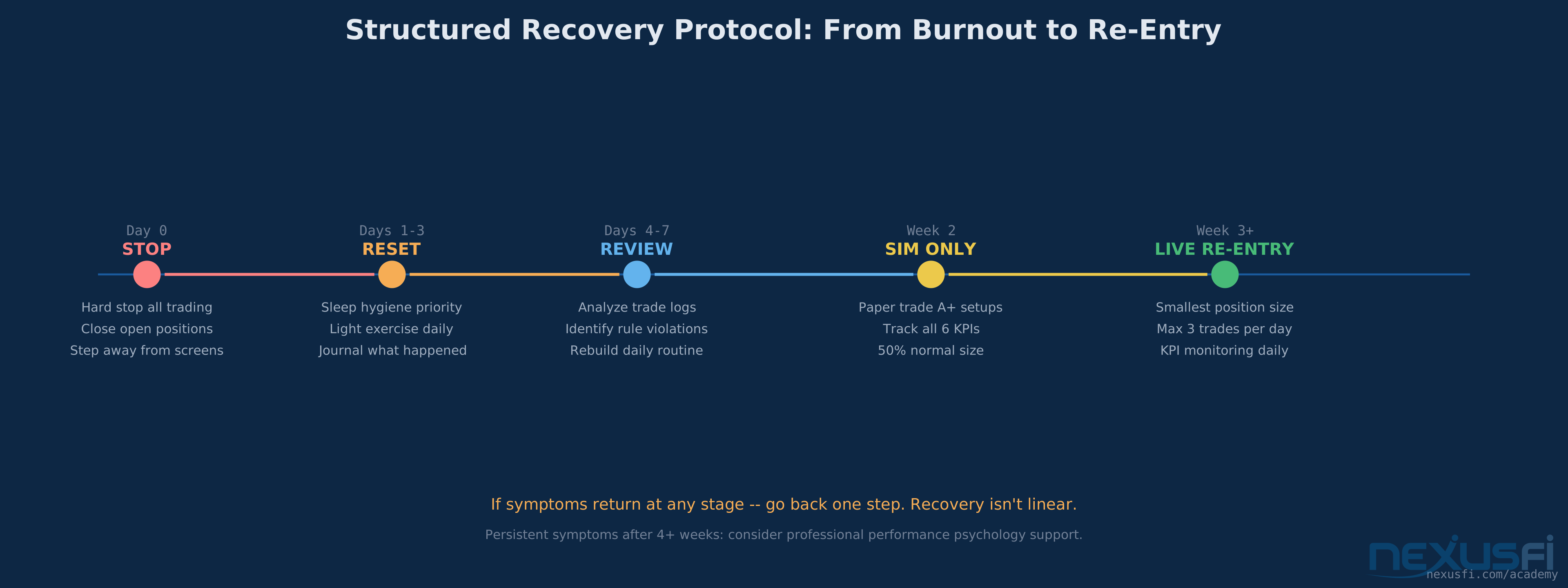
Recovery from trading burnout isn't "take a few days off and come back refreshed." It's a structured process that addresses physiology, cognition, and process simultaneously. Skip any one leg and you'll relapse within a week.
Phase 1: Hard Stop (Day 0)
Close all positions. Step away from screens. This isn't optional and it isn't negotiable. The market will be there when you get back.
@HumbleTrader made this choice deliberately: "I have made the difficult decision to NOT trade for the next 6 weeks. Though my strategy needs only 15 minutes a day for BOTH analysis and execution of my trades, psychologically I'm thinking about it constantly." That self-awareness — recognizing that the problem was mental load, not screen time — is exactly right.
Phase 2: Physiological Reset (Days 1-3)
Sleep and physical recovery are first-class trading inputs, not lifestyle luxuries:
- Fix your sleep first. Fixed wake time, no screens 90 minutes before bed, no caffeine after noon. Sleep deprivation impairs risk assessment directly -- bad sleep literally makes you take worse trades.
- Move your body. Light exercise or even a daily walk shifts your autonomic state from chronic stress back toward baseline. 30 minutes of walking does more for recovery than 3 hours of meditation.
- Journal what happened. Not what trades you took -- what thought process led you here. What rules broke first? What did the spiral feel like?
Phase 3: Process Review (Days 4-7)
Now you're rested enough to think clearly. Pull your trade logs and analyze them without emotional attachment:
- Tag every trade by quality (A/B/C setup)
- Identify when rule violations started (date and approximate time)
- Map your KPI degradation over the burnout period
- Rebuild your daily routine from scratch -- don't "resume" the old one, explicitly rebuild it
Phase 4: Simulation Re-Entry (Week 2)
Paper trade A+ setups only. Track all six KPIs. Use 50% of your normal position size if your platform allows scaled sim. The goal isn't making money — it's proving to yourself (with data) that your process works before you put capital at risk.
Phase 5: Live Re-Entry (Week 3+)
Start with the smallest position size that still has meaning. Maximum 3 trades per day. Monitor KPIs daily. If any regression to pre-break behavioral patterns shows up, go back to Phase 4. Don't negotiate with yourself about this.
As @BlackSwan observed, "There is nothing like coming back to the markets refreshed" — but the key word is "refreshed," not "impatient to get back."
When Recovery Isn't Enough
If you follow this protocol for 4+ weeks and symptoms persist — persistent anhedonia, severe insomnia, panic, inability to follow rules even with operational changes — this has moved beyond normal burnout into territory that benefits from professional support. A psychologist familiar with performance and compulsion cycles can help identify whether you're dealing with clinical issues that trading burnout triggered or revealed.
Preventing Burnout Before It Starts #
The traders who don't burn out aren't tougher or more disciplined. They have structural safeguards built into their process:
- Hard daily max loss that forces a stop. Not a suggestion -- a circuit breaker that turns off the screen. This protects you from yourself on bad days.
- Maximum trade count per session. Whether it's 5 or 15, having a ceiling prevents the "just one more" escalation that feeds the overtrading-burnout loop.
- Fixed session duration. The 4-5 hour mark is where most discretionary traders start degrading. Set an alarm. When it goes off, you're done.
- Weekly KPI review. Spend 30 minutes every weekend reviewing your six KPIs. Burnout is a gradient, not an event -- weekly trend analysis catches the gradient before it becomes a crisis.
- Planned recovery days. Just like physical training, performance requires periodization. One day off per week minimum. One week off per quarter. Build this into your calendar before you need it.
The Bottom Line #
Burnout is a process failure pathway: stress plus fatigue leads to cognitive and emotional dysregulation, which leads to rule erosion, which leads to worse execution and risk calibration. The overtrading-burnout loop accelerates all of it. And the whole thing is detectable in your numbers weeks before you feel it in your gut.
The traders who survive long enough to become consistently profitable aren't the ones who never burn out — they're the ones who recognize it early, respect the recovery process, and come back with structural changes that prevent recurrence. Track your KPIs. Set hard limits. Take your breaks before you need them.
The market doesn't reward toughness. It rewards clarity. And clarity requires a mind that isn't running on empty.
Knowledge Map
Prerequisites
Understand these firstReferences This Article
Articles that build on this topicCitations
- — Fitter, Better and Calmer Trading ES (2017) 👍 13“I am taking a break from trading again. This is probably the 3rd time in the last 3 years. 1st time in 2015 was due to the psychological pain of taking a big loss. Second time in 2016 was due to lack of consistency.”
- — The PandaWarrior Chronicles (2011) 👍 15“I've taken a small break from trading this week. I found I was exhausted mentally and physically. The toll taken on my body, my mind and my soul as I have struggled to find out who I am as a trader has been overwhelming.”
- — HumbleTrader's next chapter (2023) 👍 7“I have made the difficult decision to NOT trade for the next 6 weeks. Though my strategy needs only 15 minutes a day for BOTH analysis and execution of my trades, psychologically I'm thinking about it during the entire RTH 7+ hours.”
- — Ninjus Journal (2020) 👍 8“Okay I'm going to be taking a break from trading for a while. I just keep fucking things up and doing stupid shit. At this rate I'm just going to blow my account with one bad day. I can feel it. I'm just affirming bad habits every week.”
- — Time to Give Up (2013) 👍 8“I agree completely and many (most) people that are suffering from trading losses would be well served to take a couple weeks off with absolutely no trading, no charts, just to regroup and clear their head.”
- — Finally Turning the Corner, tha "its 80% Psychology" thing... (2020) 👍 8“Ouch, messed up. Confession time: so I traded well all morning, was really patient and honouring my per trade limits, then in the last hour went from being up 250 on the day to -250 for the day..”
- — No BS Day Trading www.nobsdaytrading.com (2013) 👍 23“Good advice, and you might be interested why this is true. Researchers in psychology have identified a phenomenon they call "decision fatigue". It turns out that over the course of a day decision making gets worse the more decisions a person makes.”
- — Trading Psychology and How The Mind Works (I) (2011) 👍 23“A friend just pointed me to an interesting and highly pertinent article in the New York Times Magazine online. The title is "Do You Suffer from Decision Fatigue?" http://www.nytimes.com/2011/08/21/magazine/do-you-suffer-from-decision-fatigue.”
- — What do you do to stop overtrading / manage trades? (2019) 👍 8“I agree with the comments about having a plan for when things go wrong -- this seems obvious, but it isn't.”
- — Taking a break from trading (2014) 👍 9“Have been trading full time for 9.5 years now, have come up with the following rules for myself that help me best realign...”
- — Becoming A Better Trader (2020) 👍 7“TMI warning. Yeah I'm not going to trade, I was just being honest about how I felt earlier. I've noticed that growing is such an up and down process..”
- — Automated Trading, Burnout Recovery & Performance Psychology