



Overtrading: Why You're Taking Too Many Trades and the System That Stops It
Overview #
Overview #
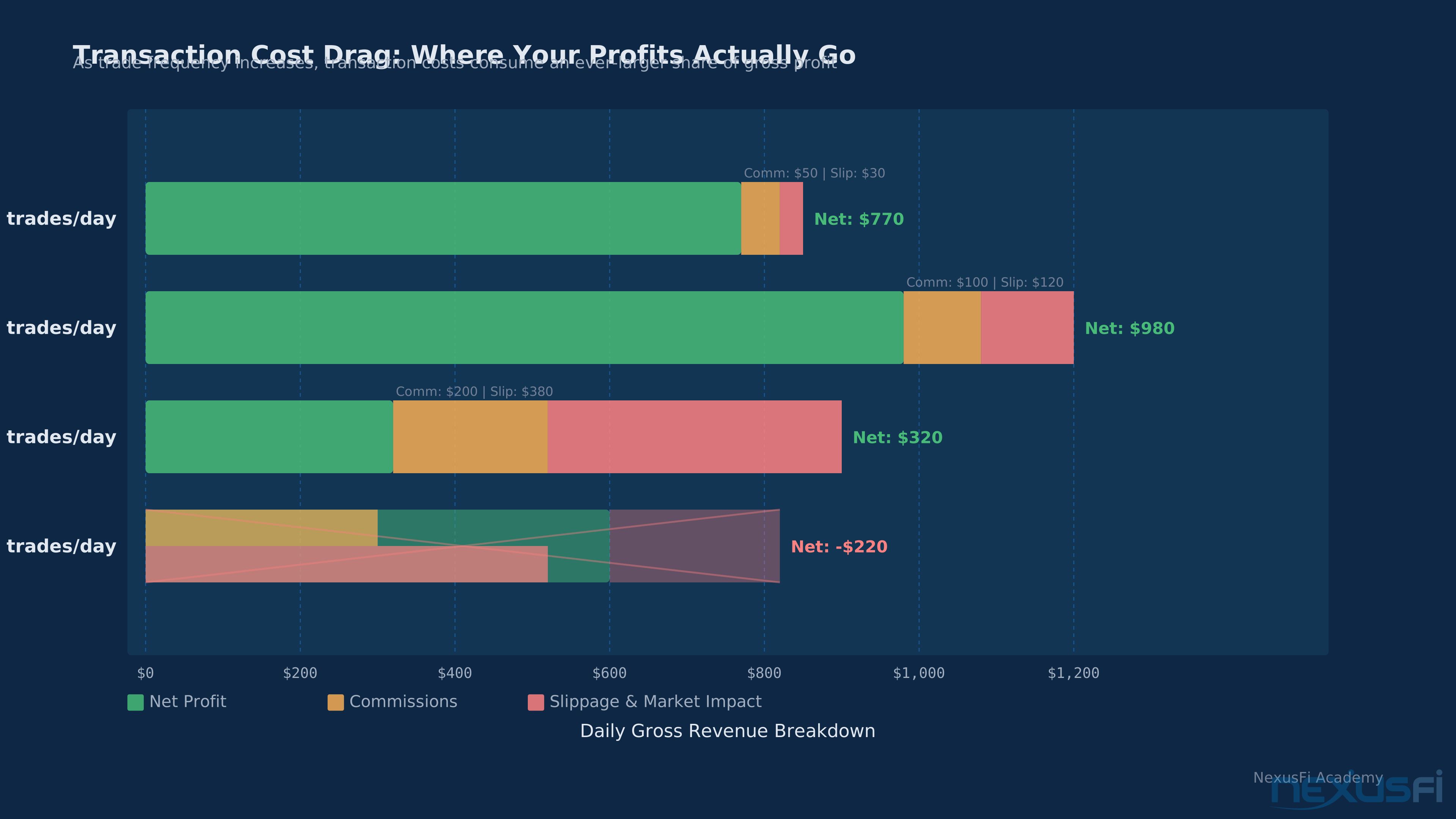
Overtrading is the single most common way futures traders turn a winning method into a losing account. Not bad analysis, not wrong direction — just too many trades. The math is straightforward and unforgiving: every round-trip costs you commissions, slippage, and the bid-ask spread. Stack enough of those costs on top of each other and they'll eat your edge alive, regardless of how good your setups are.
Here's what makes overtrading so dangerous in futures specifically: leverage. A stock trader who overtrades burns through commissions. A futures trader who overtrades burns through margin. When you're controlling $250,000 of ES notional with $13,000 in margin, every unnecessary trade doesn't just cost you the commission — it exposes you to full tick-for-tick risk on a leveraged instrument. The damage compounds faster than most traders realize until they pull their monthly statement and see that transaction costs consumed 30-40% of their gross profit.
The real problem isn't that traders don't know they're overtrading. Most do.
[1] That gap between knowing and doing is what this article addresses — with measurable diagnostics, hard system limits, and intervention strategies that actually work.
Recognition: How to Identify Overtrading in Your Own Trading #
Overtrading isn't just "taking too many trades." It has three distinct forms, and you need to recognize which one is eating your account:
Frequency-driven overtrading is the obvious version — more round-trips than your edge supports. If your strategy produces 4-6 high-quality setups per session on ES and you're executing 15-20 trades, you're filling the gaps between real setups with noise trades. These noise trades don't just underperform — they actively degrade your account through transaction costs and psychological fatigue.
Size-driven overtrading is sneakier. You might only take 5 trades, but if you're loading up 10 contracts when your account and volatility only support 2-3, you've overtraded in risk terms.
Duration-driven overtrading means staying in the market too long during a session. Your best trading happens in the first 2-3 hours. By hour 5 or 6, cognitive fatigue sets in, decision quality drops, and you start manufacturing setups that don't exist. The market doesn't care that you're tired — it'll take your money with the same efficiency at 3:30 PM as it did at 9:30 AM.
The Diagnostic Dashboard: Numbers Don't Lie
Stop guessing whether you're overtrading and start measuring. Pull these metrics from your trade log weekly:
Trades per session. For a single strategy on ES or NQ during a 6.5-hour RTH session, more than 10-12 round-trips is a warning sign. More than 15 is almost certainly overtrading unless you're running a tested systematic scalping approach with documented edge at that frequency.
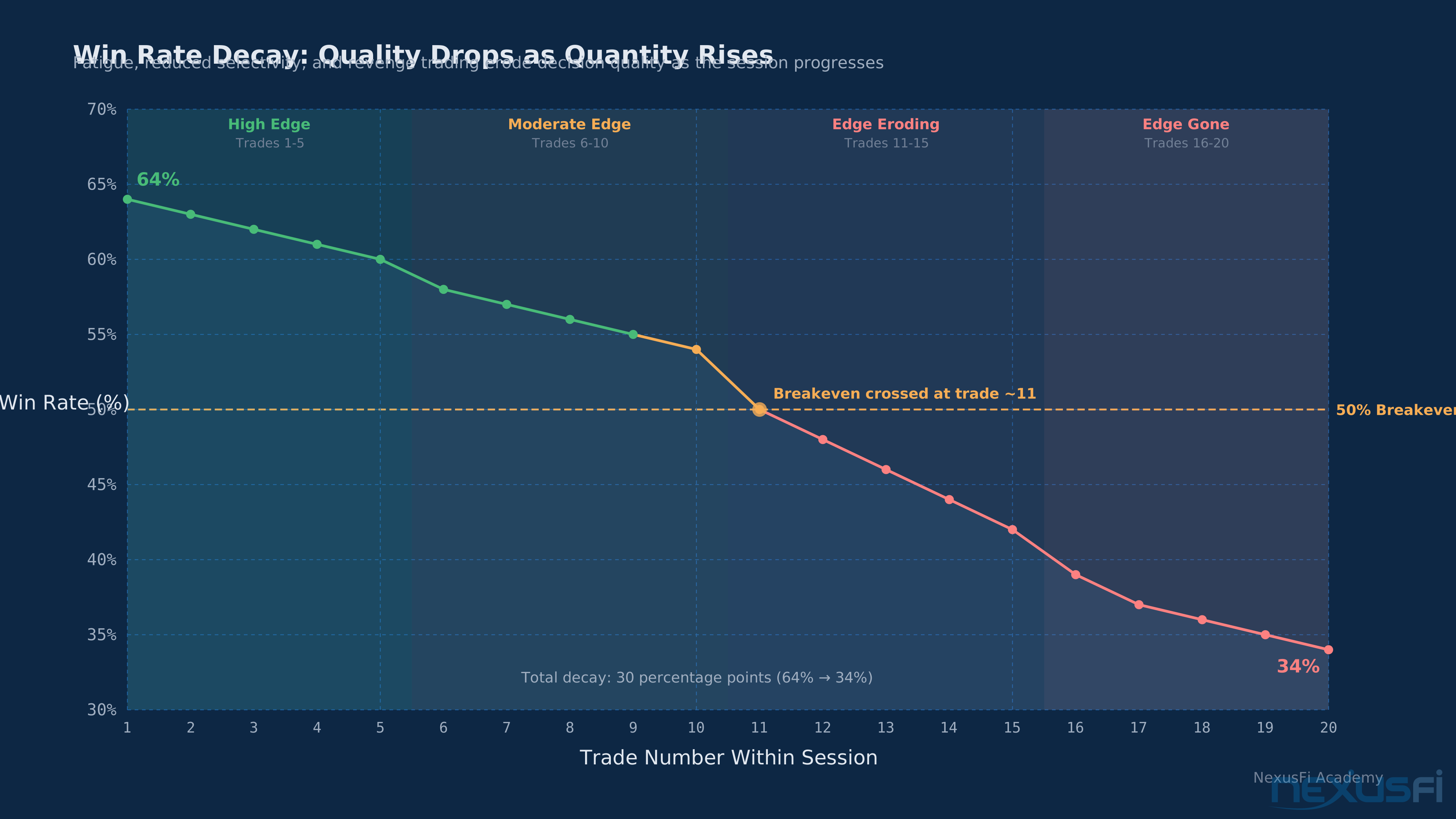
Win rate by trade number. Calculate your win rate for trades 1-5, then 6-10, then 11+. Research on trader behavior consistently shows win rate degrades as trade count rises within a session. If your first five trades hit 60% and your trades after ten hit 40%, you have hard evidence that quality drops with quantity.
Fee-to-profit ratio. Add up all commissions, exchange fees, and estimated slippage for the month. Divide by gross profit. If this number exceeds 20%, transaction costs are a meaningful drag. Above 30%, they're potentially eating your entire edge. As Big Mike warned: "If your commissions are more than 10% of your net profit, it should be a clue." [2]
Average hold time progression. Track your average hold time for each successive trade in a session. If hold times get shorter as the day goes on — say, 15 minutes for trade 1 dropping to 45 seconds for trade 12 — that's a classic overtrading signature. You're shifting from trading setups to trading impulses.
Post-loss trade clustering. Count how many trades you take within 5 minutes of a stop-out. If you're averaging 2+ entries in the 5-minute window following a loss, you've found the trigger point where overtrading begins.
alt="Stacked bar chart showing transaction costs consuming more profit at higher trade counts" loading="lazy" width="800" height="450">
Understanding: Why Your Brain Wants to Overtrade #
Overtrading isn't a character flaw — it's a predictable response to how futures markets interact with human psychology. Understanding the mechanism is the first step to building guardrails against it.
The P&L Trap and Loss Aversion
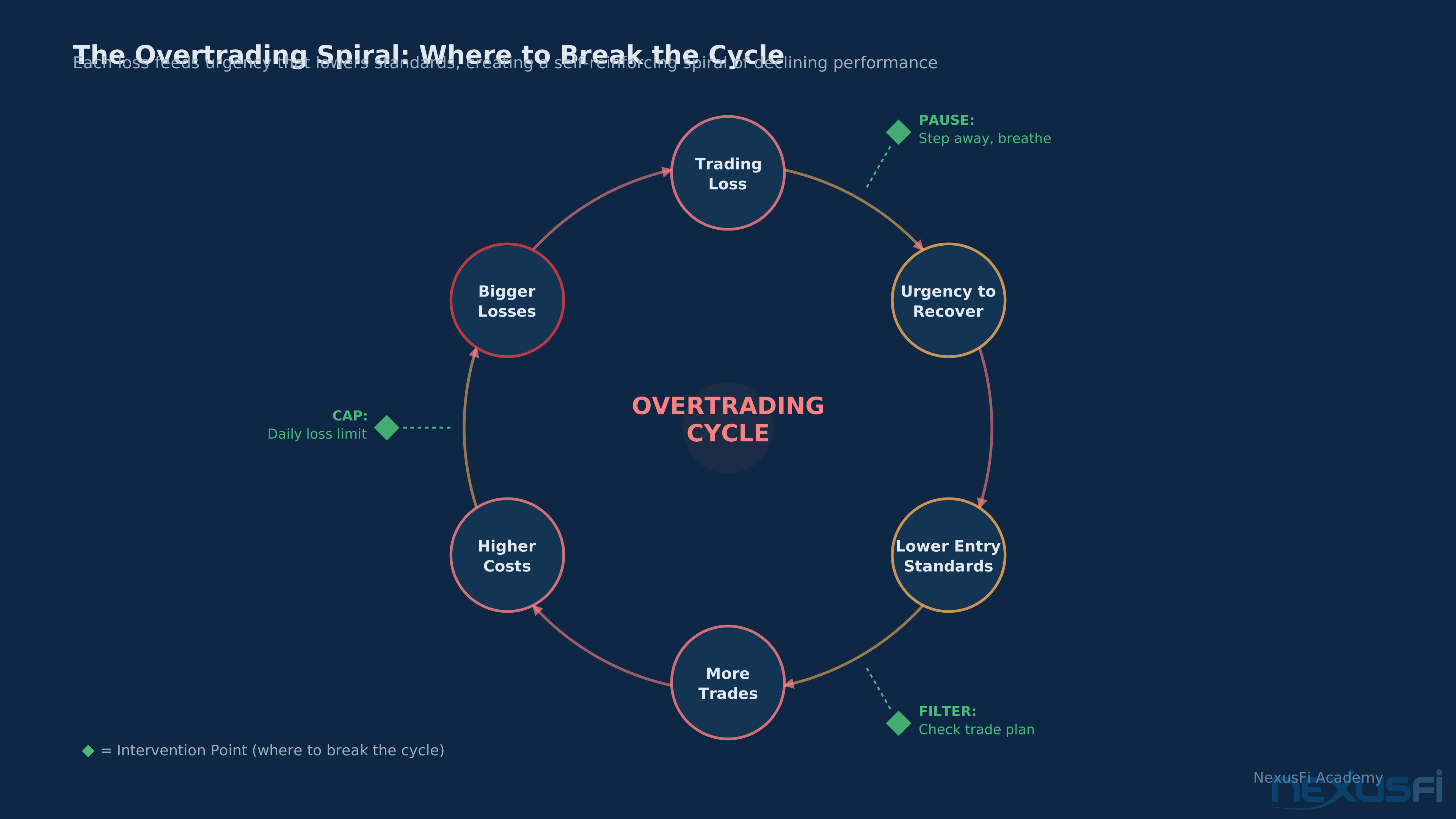
Behavioral finance research quantifies what every trader feels intuitively: losses hurt roughly twice as much as equivalent gains feel good. In futures, where P&L updates tick-by-tick on your DOM, this asymmetry creates a constant pull toward action. A $200 loss on ES (8 ticks) creates an urgency to recover that a $200 gain doesn't create in terms of satisfaction. That urgency manifests as the next trade — often taken with lower standards than the one before it.
The Regime Mismatch Problem
Overtrading is regime-dependent. A trader with a legitimate edge in trending markets can overtrade catastrophically during chop — and chop is the default state for most futures contracts most of the time. The ES spends roughly 70% of its sessions in some form of balance or range rotation. If your trend-following setups produce 4 good trades on a trend day, they produce zero on a balance day. But the balance day still feels like it should have opportunities — price is moving, the DOM is active, volume is printing. So you trade anyway, manufacturing setups that don't exist.
@GruttePier audited his biggest losing days and found a clear pattern: "On all these days: price is chopping sideways, I continue taking re-entries, overtrading, I'm not reducing size on the re-entry." [4] This is the regime mismatch in action — applying a trending approach to a balanced market and refusing to accept that today doesn't have what you need.
The Edge Dilution Curve
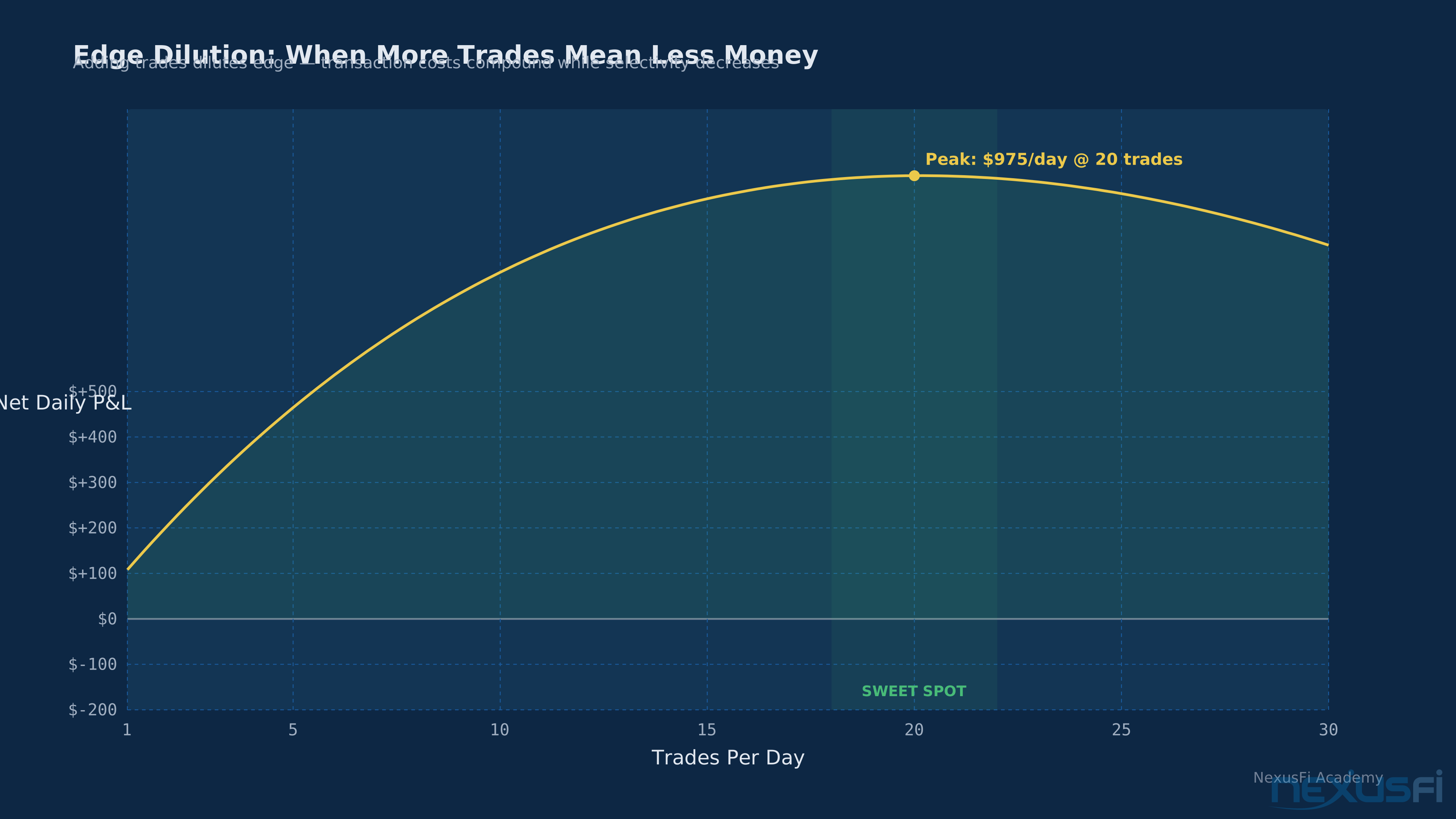
Every trading strategy has an optimal frequency — the number of trades where total profit is maximized after costs. Below that number, you're leaving money on the table by missing valid setups. Above it, each additional trade adds more in costs than it generates in profit. The math is straightforward:
Net daily P&L = (Edge per trade x Number of trades) - (Cost per trade x Number of trades)
If your edge per trade is $50 and your all-in cost per round-trip (commissions + slippage + spread) is $12 on ES, then 6 trades nets you $228. But if you push to 15 trades and edge per trade drops to $20 because the extra trades are lower quality, those 15 trades net only $120 — less than your original 6. Push to 25 trades with edge degraded to $8 per trade and you're at negative $100. More trades, less money.
alt="Line chart showing win rate declining from 64% to 34% as trade count increases" loading="lazy" width="800" height="450">
The Physiological Component
Decision fatigue is real and measurable. Research on cognitive performance shows that decision quality degrades after sustained periods of high-stakes choices. In futures trading, each trade is a multi-variable decision: direction, timing, size, stop placement, target, and management. After 8-10 of these decisions in rapid succession, the brain shifts from deliberate analytical processing to reflexive pattern-matching. Your frontal cortex — the part that evaluates risk and exercises restraint — literally gets tired. The amygdala — the part that reacts to threats and drives "fight or flight" responses — takes over. That's why trade 15 feels so different from trade 3, even if you can't articulate why.
Techniques: Concrete Interventions That Actually Stop Overtrading #
Willpower doesn't work. If it did, no experienced trader would ever overtrade. The interventions that actually work are systematic — they remove the decision from the moment and replace it with a pre-committed rule.
Hard Trade Budget
Set a maximum number of trades per session before the session begins. This isn't a suggestion or a guideline — it's a hard limit. @josh implemented specific rules: "Don't take more than 3 losing trades in a 15 minute period, and 10 trades in a 2 hour period... Rule 2 prevents death by a thousand cuts." [5]
For most discretionary futures traders trading a single strategy on ES/NQ/CL, research and community observation suggest these ranges:
- Conservative: 3-5 trades per session (scalpers excluded)
- Moderate: 6-8 trades per session
- Aggressive: 9-12 trades per session (requires documented edge at this frequency)
- Danger zone: 13+ trades per session (edge must be proven, not assumed)
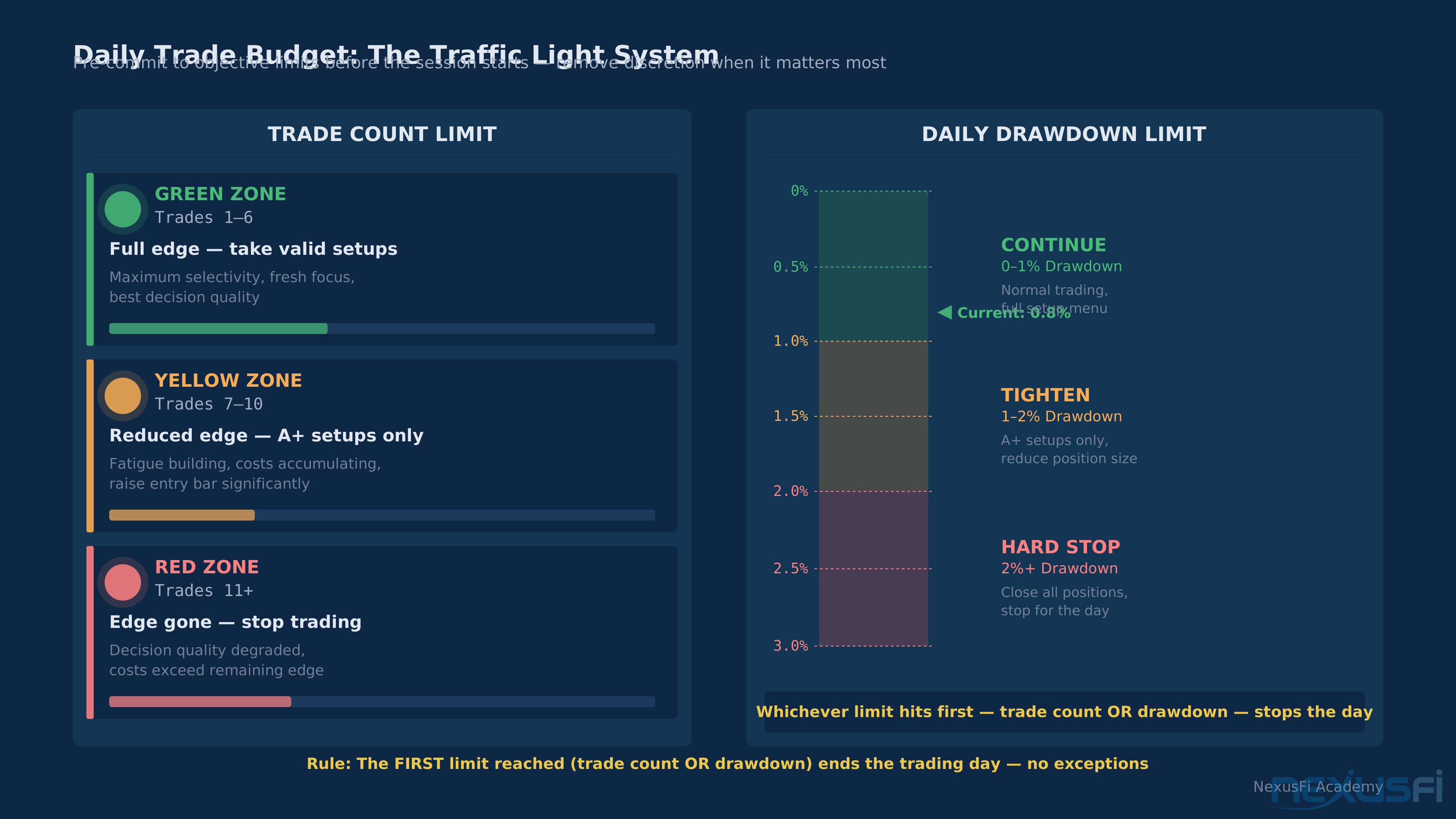
The budget should flex based on market regime. On a strong trend day with clean price action, you might use your full budget. On a choppy, low-range day, cut it in half. If ATR for the session is below its 20-day average by more than 30%, your trade allowance should be proportionally reduced.
Cooldown Timer After Exits
The single most dangerous moment for overtrading is immediately after a stop-out. The urge to re-enter is strongest exactly when your judgment is weakest. Implement a mandatory cooldown: no new entries for a minimum of 10 minutes (or 15 one-minute bars, or until the next significant structure develops) after any exit that wasn't a full target hit.
This isn't about "calming down" — it's about allowing the market to develop new information before you act on it. The trade that stopped you out changed the structure. Your next entry should reflect the new structure, not the old thesis that just failed.
Pre-Trade Gate: The Binary Checklist
Before every entry, run a 5-item binary checklist. Each item must be yes or no — no "maybe" allowed. If any item is "no," you don't trade. The checklist should be specific to your strategy. For example:
- Is the current market regime consistent with this setup? (trend for trend setups, range for mean-reversion)
- Is my stop placement at a level where I would take the opposite trade? (validates the stop isn't arbitrary)
- Is the risk-reward ratio at least 2:1 from current price to my target vs. stop?
- Am I within my daily trade budget?
- Has at least 10 minutes passed since my last exit?
The power of binary gating is that it prevents "searching for justification." When the checklist is pass/fail, there's no room to talk yourself into a trade that doesn't meet criteria.
Intraday Drawdown Circuit Breaker
Set a daily maximum loss that automatically ends your trading session. For most futures traders, 2% of account equity is the standard threshold, though this should be calibrated to your strategy's typical drawdown profile. When you hit it, you're done for the day — no exceptions, no "just one more."
One NexusFi community member recommended making this a platform-level control: "I recommend you contact Dorman and see if you can get a hard daily stop implemented. See if they can lock your account for the day if you hit $200 in losses. This will cure your overtrading." [6] Most brokers and platforms now offer this as a configurable feature. Use it. Taking the decision out of your hands at the moment of maximum emotional pressure is the point.
The Graduated Recovery Protocol
After an overtrading episode (a day where you exceeded your trade budget by more than 50%), don't just resume normal trading the next day. Implement a graduated recovery:
- Day 1 after violation: Maximum 3 trades, no exceptions. One contract only.
- Day 2: Maximum 3 trades. If all 3 are within plan, graduate to day 3.
- Day 3: Normal trade budget with a strike system -- 3 losses maximum.
- Day 4+: Normal operations if day 3 was clean.
This protocol comes from a NexusFi trader's practical experience: "Day 0: some big painful mistake. Day 1: you get 3 bullets. 3 trades, no more, no matter what. Day 2: you get 3 strikes. You can trade more, but only take 3 losses. Day 3: you should be back to normal." [7]
Post-Session Execution Audit
At the end of every trading day, overlay every trade execution on a clean chart. Don't look at P&L — look at the density and clustering of your entries. On a day where you overtraded, the visual is unmistakable: entries stacked on top of each other, often at similar prices, often in rapid succession. This "clutter view" makes the abstract concept of overtrading viscerally concrete.
Calculate these three numbers daily: (1) percentage of trades that were within your defined setup criteria, (2) average slippage per trade vs. your typical average, and (3) win rate for the first half of your trades vs. the second half. If (1) is below 80%, you took trades outside your plan. If (2) is elevated, urgency is causing sloppy execution. If (3) shows a meaningful gap, fatigue or frustration degraded your later trades.
Practice Framework: Building the Habit of Trading Less #
Week 1: Observation Only
Don't change anything about your trading yet. Simply track these metrics daily: total trade count, hold time for each trade, time elapsed between trades, win rate by trade number (1-5, 6-10, 11+), and total transaction costs as a percentage of gross P&L. The goal is to establish your baseline and see the pattern objectively.
Week 2: Implement the Hard Budget
Based on your Week 1 data, set a trade budget that represents your average trade count minus 30%. If you averaged 14 trades per day, your new budget is 10. If you averaged 8, your budget is 6. This reduction forces you to be more selective without requiring perfect discipline — you just need to count.
Week 3: Add the Cooldown Timer
Keep the trade budget and add a mandatory 10-minute cooldown after every exit. Set a physical timer — phone, kitchen timer, whatever is visible. During the cooldown, you cannot open any new positions. You can observe, plan, and prepare, but you cannot execute.
Week 4: Add the Pre-Trade Checklist
With the budget and cooldown in place, add the binary pre-trade gate. Write the checklist on a physical card or sticky note attached to your monitor. Before every trade, touch each item. This creates a physical ritual that interrupts the autopilot loop of rapid-fire entries.
Ongoing: Weekly Audit
Every weekend, review the week's metrics. Compare to your Week 1 baseline. Track: average daily trades (should be decreasing or stable at budget), win rate (should be stable or improving), average hold time (should be increasing), and net P&L per trade (should be increasing as you eliminate low-quality trades). If any metric is moving in the wrong direction, the trade budget is too high — reduce it by 2 trades.
When These Techniques Don't Work #
The interventions above are process fixes for a process problem. They work for the majority of traders whose overtrading is driven by habit, boredom, or misaligned frequency expectations. They don't work for everyone, and it's important to recognize when the problem is deeper than process.
If you can't follow the trade budget for even one day, the issue isn't overtrading — it's impulse control that may benefit from working with a trading psychologist or performance coach. The NexusFi community has discussed this candidly.
[3] The humor is real, but so is the point — compulsive overtrading that resists all systematic intervention may be a psychological issue that requires professional support, not just better rules.
If you're trading for income and under financial pressure, overtrading becomes much harder to control because the urgency to produce daily profits creates constant pressure to "find" trades. This is an undercapitalization problem disguised as a behavior problem. No amount of process discipline can overcome the fundamental stress of needing to pay rent from daily scalping. The honest answer is to address the capitalization issue directly — trade smaller, supplement with other income, or step back to sim until the pressure is removed.
If your strategy genuinely requires high trade counts, make sure you've actually validated the edge at that frequency. Many traders assume they have a scalping edge because they're profitable on some trades. Run the numbers: calculate your expectancy per trade at your current frequency, subtract all-in transaction costs, and see if the remaining edge is positive and statistically significant across at least 200 trades. If the edge doesn't survive the transaction cost math, it's not scalping — it's overtrading with a narrative.
Market regime matters. A trader who takes 12 trades on a high-range trending day with clean structure is not necessarily overtrading. A trader who takes 6 trades on a narrow-range, choppy, pre-FOMC day almost certainly is. The interventions above use fixed budgets as starting points — but the real goal is developing the judgment to match your activity level to the market's opportunity level. That judgment takes time, and it's built through the audit process, not through willpower.
Knowledge Map
Prerequisites
Understand these firstGo Deeper
Build on this knowledgeReferences This Article
Articles that build on this topicCitations
- — Anyone else have overtrading issues? (2022) 👍 6“It is an interesting phenomenon for me to notice exactly what I'm doing wrong, yet be almost powerless to the emotions. Today I took 66 trades and it was a trending market.”
- — Big Mike's day trading method and advice (2015) 👍 49“The increased position size has totally screwed with my ability to trade... Every mistake imaginable was made. What actually caused the mistakes? Had I simply forgotten how to trade? No. Instead, my mind was paralyzed by taking on more than I could handle.”
- — Dear Ruby (2013) 👍 12“I quickly realized that he indeed had a good grasp of price action and a solid method of entry... The problem was that he was using a smaller chart to micro-manage the trade once positioned.”
- — GruttePier's trading journal to getting profitable (2018) 👍 18“On all these days: price is chopping sideways, I continue taking re-entries, overtrading, I'm not reducing size on the re-entry.”
- — Follow these two rules to preserve and grow capital (2018) 👍 24“Don't take more than 3 losing trades in a 15 minute period, and 10 trades in a 2 hour period... Rule 2 prevents death by a thousand cuts.”
- — Which get-funded program is the best these days? (2020) 👍 4“I recommend you contact Dorman and see if you can get a hard daily stop implemented. See if they can lock your account for the day if you hit $200 in losses. This will cure your overtrading.”
- — Just turned Pro and could use a little help, or guidance (2021) 👍 4“Day 0: some big painful mistake. Day 1: you get 3 bullets. 3 trades, no more, no matter what. Day 2: you get 3 strikes. You can trade more, but only take 3 losses.”
- — What do you do to stop overtrading / manage trades? (2019) 👍 14“Am I willing to go short there at my stop if it gets triggered? If my answer is yes, then my stop is valid because if I am willing to go short there, that means my long bias gets invalidated there.”