



Winning Streaks and Overconfidence: Why Your Best Week Precedes Your Worst Trade
Overview #
You just hit five winners in a row. You're up $2,400 on the week and every setup looks clean. You bump your contracts from two to four. You skip your pre-trade checklist because you're "reading the market perfectly." You take a B-minus setup because, honestly, everything's been working.
Then the sixth trade goes against you. You hold it because it "should" come back. You add size. You're down $1,800 in forty minutes and your entire week just evaporated.
That sequence — the winning streak followed by the outsized loss — isn't bad luck. It's the single most predictable pattern in trading psychology, and it's driven by overconfidence bias: the systematic tendency to overestimate your edge, your accuracy, and your control after a run of profitable outcomes.
The research is clear on this. [Behavioral finance studies consistently show][0] that recent success increases risk-taking, loosens discipline, and inflates the trader's belief in their own skill — regardless of whether the wins came from genuine edge or favorable variance. And in futures, where leverage amplifies everything, overconfidence doesn't just hurt performance. It destroys accounts.
This article breaks down what the research actually says, how winning streaks change behavior at a neurochemical level, and the specific systems professional traders use to keep their confidence calibrated.
Key Concepts #
Overconfidence bias — the tendency to overestimate the accuracy of your judgments, the size of your edge, or your ability to predict market direction. Behavioral finance identifies three forms: overestimation (thinking you're better than you are), overplacement (thinking you're better than other traders), and overprecision (being too certain about your forecasts). All three intensify after consecutive wins.
House money effect — the tendency to take larger risks after recent gains because profits feel like "free money" rather than real capital. First documented by Thaler and Johnson in 1990, this effect is especially dangerous in futures because each tick of risk is identical regardless of prior P&L.
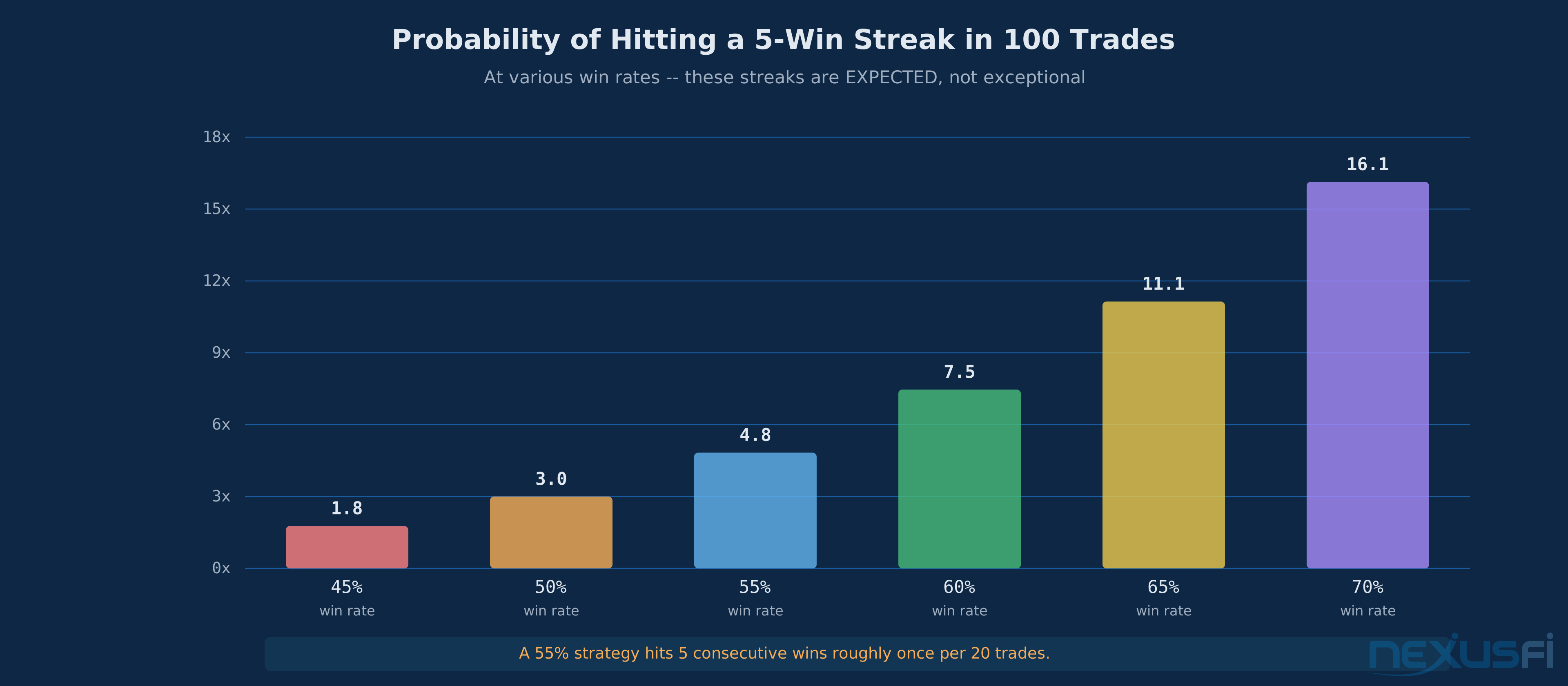
Hot hand fallacy — the belief that a streak of successes means the next attempt is more likely to succeed. In trading, a 55% edge strategy will produce runs of five to seven consecutive wins at statistically predictable intervals. Treating these as evidence of solid skill is a cognitive error.
[Behavioral finance studies consistently show][0] that recent success increases risk-taking, loosens discipline, and inflates the trader's belief in their own skill — regardless of whether the wins came from genuine edge or favorable variance.
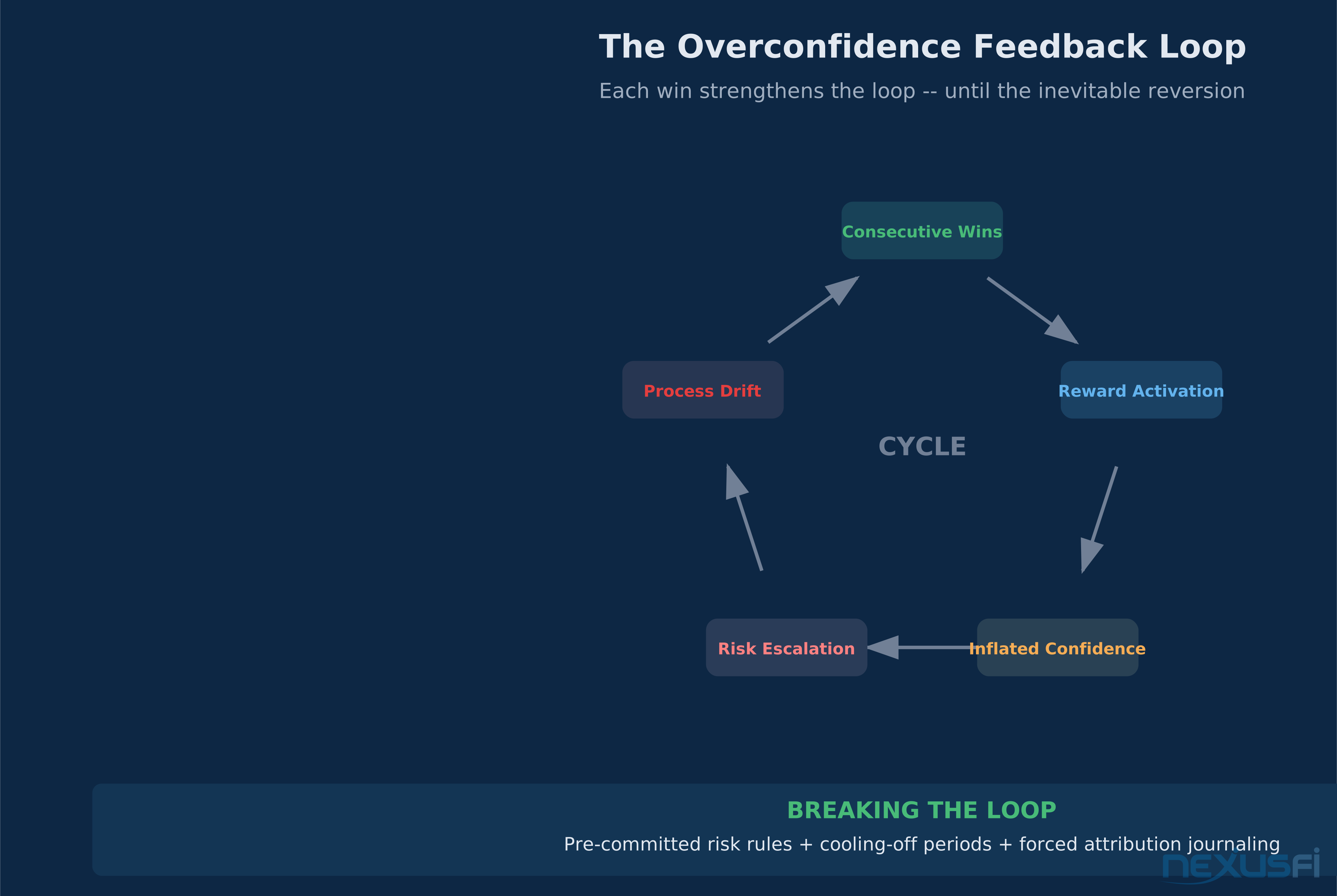
Attribution error — the tendency to credit wins to skill and blame losses on bad luck. After a streak, this creates a reinforcing loop: wins strengthen ego, ego loosens risk controls, looser controls increase exposure to tail losses.
Confidence calibration — the degree to which a trader's subjective confidence matches their actual performance. Professional calibration means your sizing, selectivity, and risk parameters reflect verified edge, not emotional momentum.
How Winning Streaks Change Your Brain #
The behavioral shift during a winning streak follows a predictable progression. Here's what the research shows happens to your brain and your trading.
The Neurochemical Feedback Loop #
Monetary gains activate the nucleus accumbens — the same reward center that fires during other pleasurable experiences. After consecutive wins, this creates a chemical feedback loop: each profitable trade reinforces the behavior that preceded it, making the trader seek the next "hit" with decreasing discrimination about setup quality.
This isn't metaphorical. Brain imaging studies show the reward response strengthens with consecutive positive outcomes, creating genuine physiological pressure to continue trading even when edge conditions deteriorate. The trader isn't choosing to be reckless. Their brain is chemically incentivized to keep going.
The Four Behavioral Shifts #
Research and professional experience converge on four primary changes that winning streaks produce:
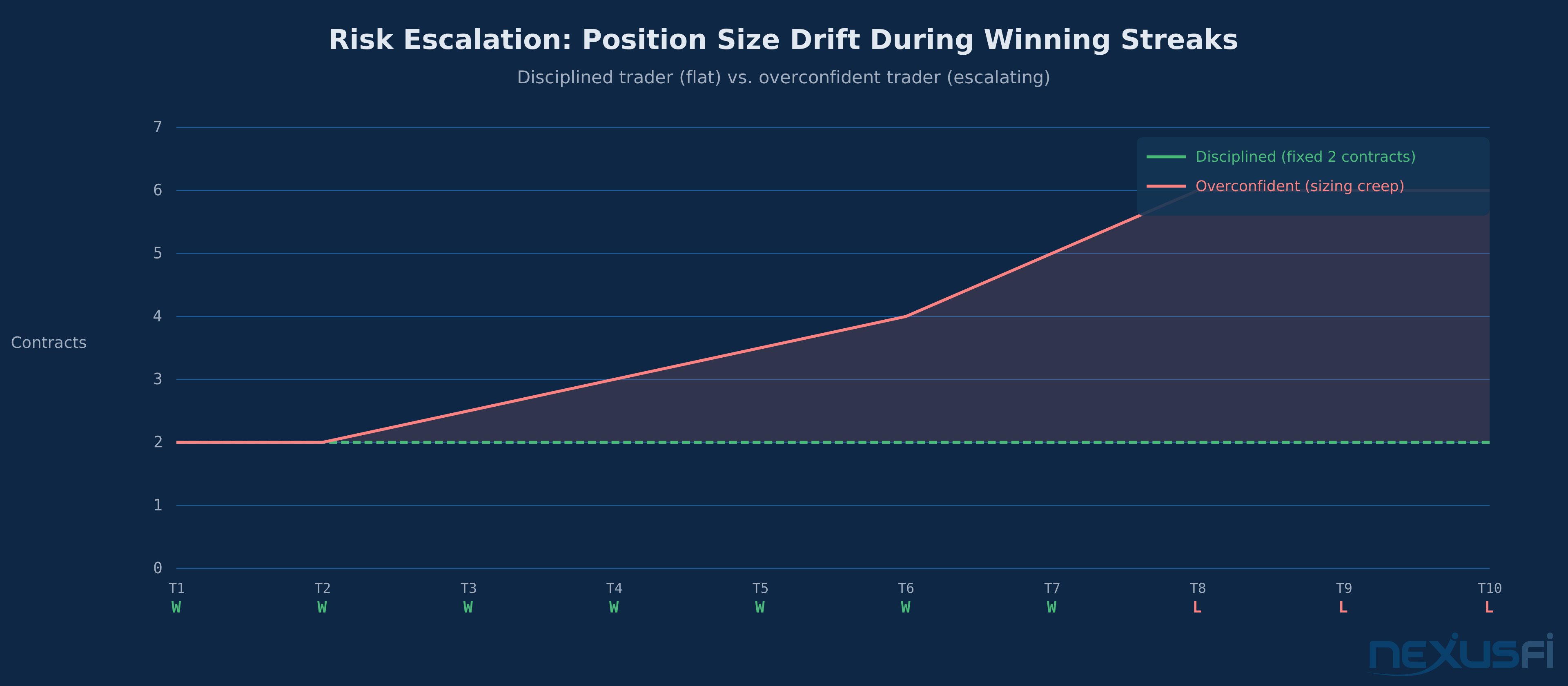
1. Risk escalation. Position sizes creep up. Stops get wider. Correlated exposures accumulate. A trader risking 1% per trade drifts to 2-3% without a conscious decision. As [one NexusFi trader described it][0]: "I've certainly made some of my worst trades after long periods of winning. When you're on a big winning streak, there's a temptation to think that you're doing something special."
2. Process degradation. Entry checklists get skipped. "A-plus setups only" becomes "good enough." The discipline that produced the winning streak erodes precisely because it succeeded. The trader's internal logic goes: "I'm winning, so my adjustments must be working." In reality, they're consuming the buffer their edge created.
3. Attribution drift. Success gets credited to personal insight rather than favorable market conditions, a well-designed system, or ordinary variance. The trader's narrative shifts from "I executed my edge carefully" to "I'm seeing the market clearly right now." That transition — from process confidence to outcome confidence — is where overconfidence begins.
4. Reduced probability sensitivity. Streaks make you underestimate how quickly conditions can reverse. In futures, this compounds with leverage, overnight gaps, and regime shifts. A trader who properly respected a 45% probability of loss on Monday is suddenly treating it like a 20% probability by Friday — not because anything in the market changed, but because they won four trades in a row.
What the Research Actually Shows #
Barber and Odean: Trading Volume and Returns #
The foundational research comes from Brad Barber and Terrance Odean, who analyzed trading records from over 66,000 households. Their key finding: the most active traders earned annual net returns approximately 6.5 percentage points below the market average. The primary drivers were overconfidence-fueled overtrading and poor timing — behaviors strongly correlated with recent success.
While these studies focused on retail equity investors, the behavioral mechanism applies even more acutely to futures. Futures markets offer frictionless scaling (adding contracts is trivial), high leverage (each contract controls significant notional value), and 24-hour access. Every factor that enables overconfident behavior is amplified.
Thaler and Johnson: The House Money Effect #
Thaler and Johnson's 1990 research demonstrated that prior gains increase subsequent risk-taking. In their experimental framework, participants who received a windfall were much more willing to gamble with it. The psychological mechanism: profits feel like a buffer, creating the illusion that you're "playing with house money."
In futures trading, this translates directly. After a $3,000 winning week, a trader might take a position that risks $2,000 on a single trade — something they'd never do with their base capital. They frame the risk against recent gains rather than total equity. As [NexusFi member wldman observed][0]: "What didn't work was a psychological issue where I was not able to be wrong following the streak of wins... I'd get sporty because of course I was right and the market would come around to my position."
Asymmetric Updating: Why Confidence Rises Faster Than It Falls #
Behavioral finance research consistently shows asymmetric confidence updating: confidence rises more with each win than it falls with each loss. After three wins and one loss, most traders feel net-positive about their ability, even though 3-for-4 in a small sample tells you almost nothing about true edge.
This asymmetry is especially dangerous because it creates a ratchet effect. Each win notches confidence higher, but losses don't notch it back down proportionally. Over a streak, the trader's subjective confidence diverges sharply from objective performance probability.
The Math of Streaks: What Variance Actually Looks Like #
Here's where most traders go wrong: they treat winning streaks as signal when they're noise.
Consider a strategy with a genuine 55% win rate — a strong edge by any standard. Over a sequence of trades:
- Probability of 5 consecutive wins: 0.55^5 = 5.0%
- Probability of 7 consecutive wins: 0.55^7 = 1.5%
- Expected occurrence of a 5-win streak in 100 trades: roughly 5 times
A 55% strategy will hit five consecutive wins roughly once every twenty trades. That's not solid. That's Tuesday. If you trade 200 days a year with 3 trades per day, you'll see a five-win streak roughly every seven trading days.
The problem: each time it happens, your brain treats it as evidence of solid performance. The math says it's expected variance.
Now consider the downside of the same strategy:
- Probability of 5 consecutive losses: 0.45^5 = 1.8%
- Expected occurrence in 100 trades: roughly twice
So your system will also produce five-loss streaks. When they arrive — and they arrive at statistically predictable intervals — the trader who increased size during the winning streak gets hit with maximum exposure at maximum drawdown.
The Real Cost: Compounding Overconfidence With Leverage #
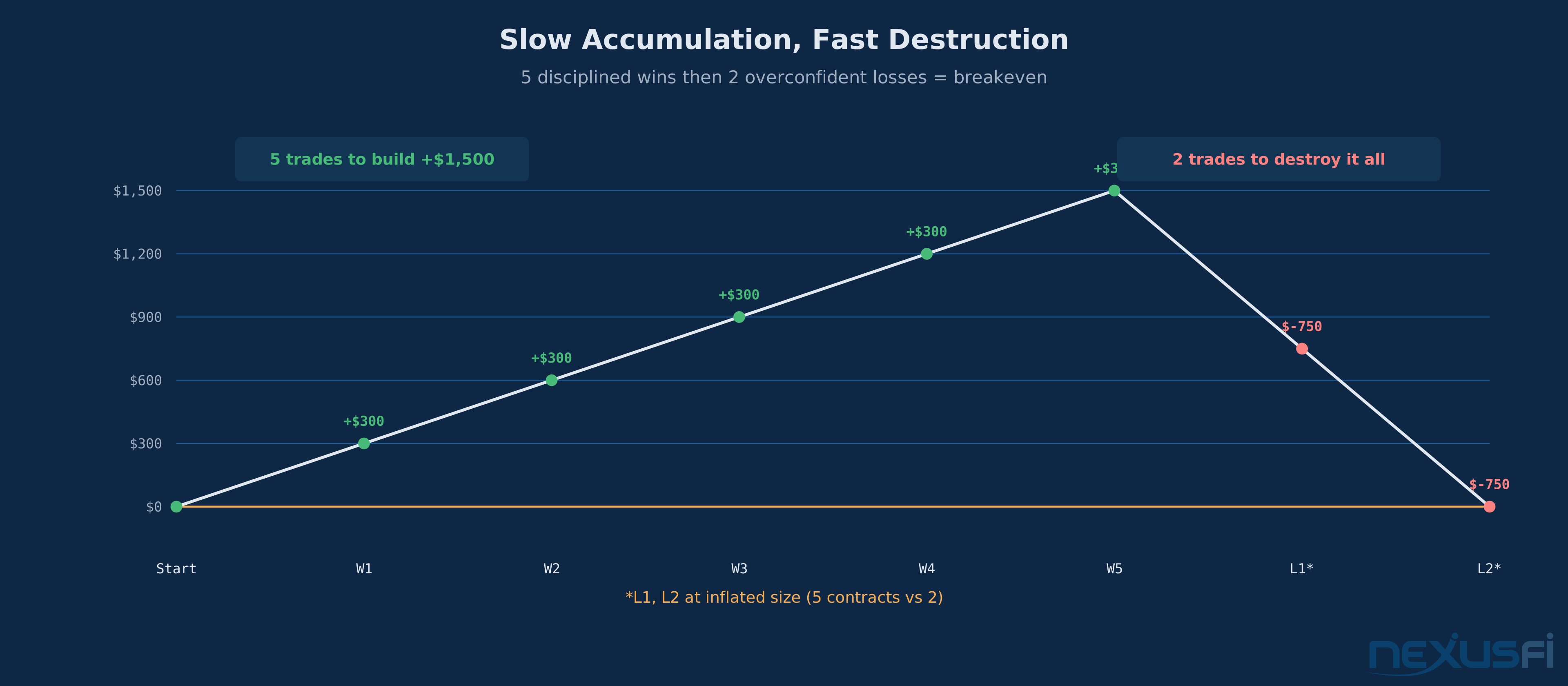
A crude oil scalper normally trades 2 contracts with a $300 target per trade. After 5 consecutive wins (+$1,500), they increase to 5 contracts and widen their stops. The math changes dramatically:
- Normal risk per trade: 2 contracts x 10 ticks x $10/tick = $200
- Post-streak risk per trade: 5 contracts x 15 ticks x $10/tick = $750
- One loss at new size: -$750 (50% of the entire streak's profit, gone in one trade)
- Two consecutive losses at new size: -$1,500 (entire streak erased)
The winning streak took five disciplined trades to build. The overconfident blowback takes two trades to destroy. This asymmetry — slow accumulation, fast destruction — is the structural reason overconfidence after streaks is so lethal in futures.
How It Shows Up in Real Trading #
The NexusFi community has documented this pattern extensively. Here are the recurring themes.
Pattern 1: The "I'm Done for a Week" Rule #
One of the most experienced traders on the platform described his [personal breaking point][0]: "Do you feel great about a big win or a series of wins? You're done for a week. Walk away. Every single significant major loss I can remember has ALWAYS been preceded by a big win."
That's not anecdotal noise. It's a pattern recognition system developed from years of trading data. The correlation between large wins and subsequent large losses is strong because the psychological mechanism — inflated confidence leading to inflated risk — is reliable.
Pattern 2: Success Is More Destabilizing Than Failure #
As [tigertrader noted in his ES journal][0]: "One of the many ironies associated with trading is the fact that success can be more emotionally destabilizing than failure."
This runs counter to how most traders think about risk. They prepare for losing streaks — daily loss limits, max drawdown rules, walk-away protocols. But they don't prepare for winning streaks, which are equally dangerous because they trigger behavior changes that enlarge the next loss.
Pattern 3: The Regime Trap #
Many winning streaks coincide with favorable market regimes — low volatility with persistent trend, or high volatility with clean mean-reversion. The trader attributes the wins to skill, but the real driver is regime. When the regime shifts — and it always shifts — the overconfident trader is sitting with maximum exposure and a strategy that just stopped working.
[John Hoagland (HOAG) of TopstepTrader][0] advised: "If you have a winning streak going, I suggest ending it yourself. Take a day off. The pressure to continue the streak is now broken and you can return to the focus and mindset that created the winning streak for you in the first place."
Professional Calibration Systems #
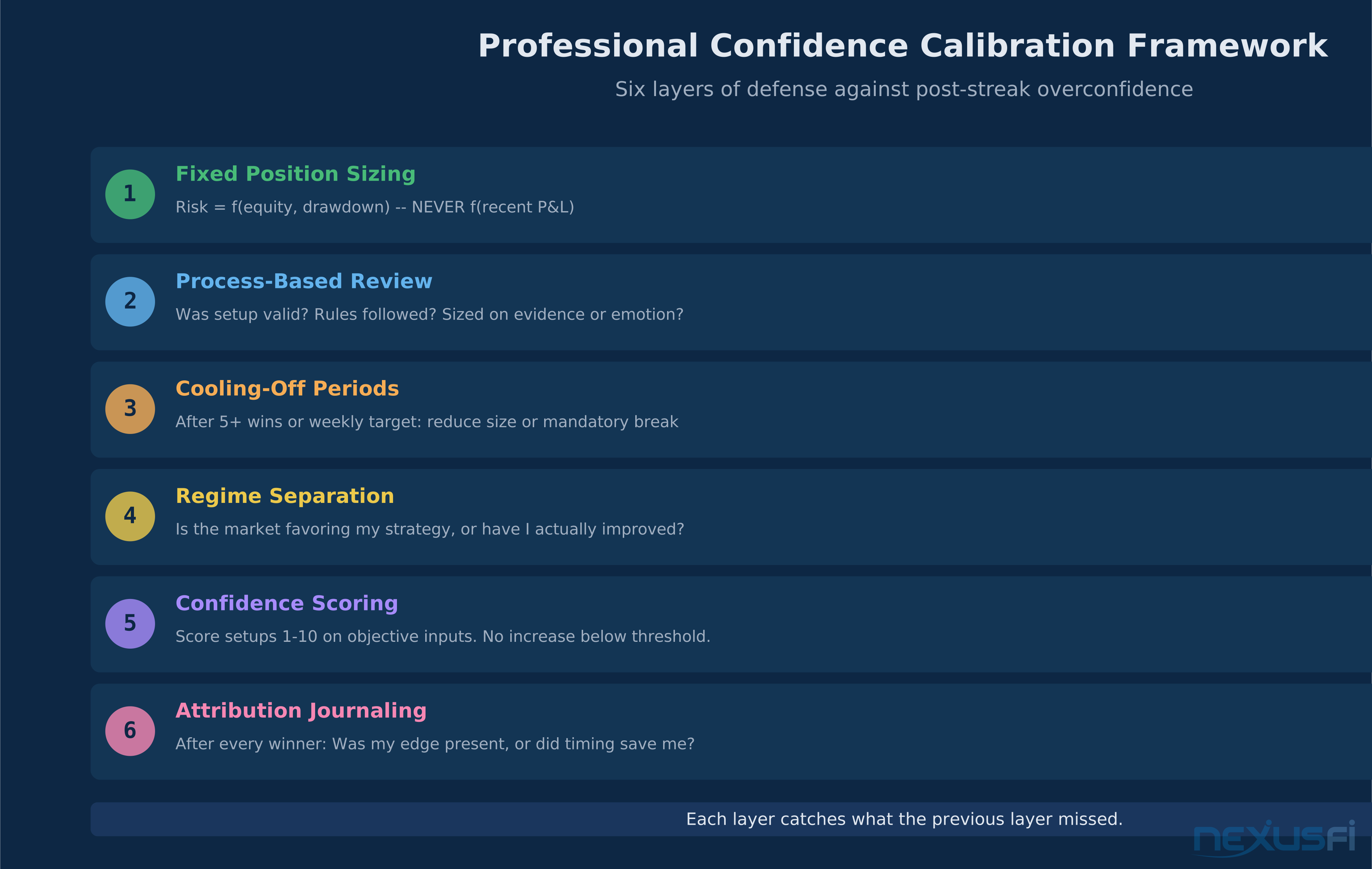
Professional traders don't try to eliminate confidence. They build systems that keep it conditional, measured, and anchored to objective inputs rather than recent P&L.
1. Position Sizing Rules That Don't Scale With Wins #
The most effective anti-overconfidence control: risk-per-trade is a function of total equity and system drawdown parameters, never recent performance. A trader risking 0.5% per trade keeps that number flat regardless of whether they're on a five-trade winning streak or a three-trade losing streak.
Some institutional desks go further — calculating risk on baseline capital rather than current equity. A CTA managing $10M who's up 10% still sizes positions based on $10M, not $11M, until a formal quarterly reallocation.
2. Process Confidence Over Outcome Confidence #
Professional review asks:
- Was the setup valid according to my playbook?
- Did I execute the entry, stop, and target as planned?
- Was my risk properly defined before entry?
- Did I increase size because of evidence or because of emotion?
A winning streak with deteriorating execution quality is a warning sign, not validation. If you're winning but violating your rules, the wins are masking a process problem that will surface violently.
3. Mandatory Cooling-Off Periods #
After significant streaks (five to ten consecutive wins, or weekly gains exceeding a predefined threshold), many professional desks mandate reduced position sizes or a mandatory day off. This isn't punishment. It's circuit-breaker engineering: breaking the neurochemical reinforcement loop before it drives risk decisions.
4. Regime Separation #
Before attributing wins to skill, professionals ask:
- Is this a regime my strategy naturally favors?
- Am I in a favorable volatility/volume environment?
- Did my wins come from a temporary macro theme?
If the honest answer is "the market's been a trending dream and any trend-follower is printing money right now," then scaling up based on recent performance is regime-chasing, not edge-expansion.
5. Confidence Scoring Tied to Measurable Inputs #
Instead of "I feel good about this trade," professional frameworks score setups using observable features: trend strength metrics, volatility regime classification, order-flow imbalance thresholds, liquidity proxies. If the score doesn't meet threshold, size doesn't increase — regardless of how many winners you've strung together.
6. Forced Attribution Journaling #
After every trade — especially winners — the journal asks: "Was my edge actually present, or did I get lucky with timing?" This enforces honest assessment. Over time, it builds a dataset that reveals whether winning streaks correlate with genuine edge or favorable variance.
Building Your Own Anti-Overconfidence Protocol #
Here's a practical framework you can implement today.
The Streak-Proof Rules #
Rule 1: Fixed risk, no exceptions. Your risk-per-trade is calculated from total equity and your system's maximum drawdown parameters. It doesn't change based on recent results. Period.
Rule 2: Define your streak threshold. Pick a number — three, five, seven consecutive wins. After that threshold, your next session starts with a mandatory review of the last N trades for process compliance.
Rule 3: Score your setups. Create a 1-10 rating based on objective criteria (signal strength, volatility regime, liquidity conditions). Only take trades scoring 7+ during normal conditions. After a streak, raise the threshold to 8+.
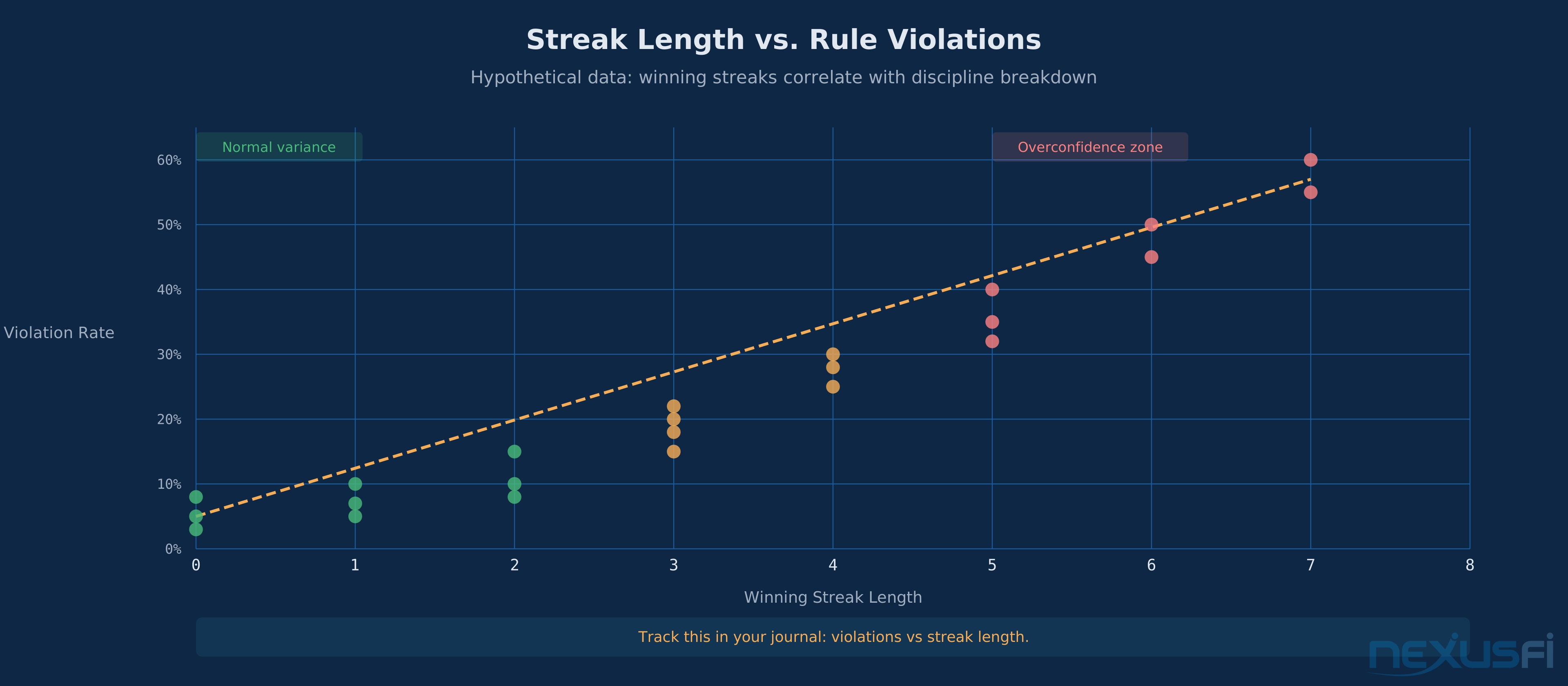
Rule 4: Track deviation metrics. In your trading journal, log two things: (a) did this trade follow all your rules? and (b) what was your current streak length? Over time, plot rule violations against streak length. If violations climb with streak length, you've confirmed the overconfidence mechanism in your own data.
Rule 5: Cool down after threshold wins. After hitting your streak threshold, either reduce position size by 25-50% or take a mandatory break before the next session. The pressure to "keep it going" is the signal that you need to stop.
Rule 6: Separate skill from regime. Weekly review question: "Would any trader using my approach have won this week?" If yes, your wins came from the market, not from you. Act so.
The Weekly Audit #
Every weekend, review:
- Streak length vs. sizing: Did position sizes increase during winning streaks?
- Setup quality vs. results: Did you take lower-quality setups because you were winning?
- Stop discipline vs. P&L: Did stops get wider or get moved during profitable periods?
- Trade frequency vs. edge: Did you trade more often because you felt "in the zone"?
If any of these metrics drift during winning periods, you've identified where overconfidence enters your process. Build a specific rule to counter each drift point.
The Bottom Line #
Winning streaks are a risk management event, not a validation of permanent skill improvement.
The research — Barber and Odean on overtrading, Thaler and Johnson on house money effects, neuroscience on reward-loop reinforcement — all points to the same conclusion: consecutive wins predictably increase risk-taking, loosen discipline, and inflate confidence beyond what the evidence supports. In futures, where leverage converts behavioral errors into P&L catastrophes, this pattern has destroyed more accounts than any technical analysis failure.
The professional response isn't to suppress confidence. Confidence in your edge is essential. The professional response is to anchor confidence to process, risk rules, and statistically meaningful sample sizes rather than to recent P&L.
Build the rules before the streak arrives. When the streak comes, follow the rules. When the rules feel unnecessary because everything's working — that's exactly when they matter most.
As the NexusFi community puts it plainly: [winning streaks are sometimes the worst][0]. You must monitor yourself very closely when on one.
Knowledge Map
Go Deeper
Build on this knowledgeReferences This Article
Articles that build on this topicCitations
- — Trading Lessons from TopstepTrader's John Hoagland (HOAG) (2014) 👍 20“So, you've had a very successful day - one of your best. Perhaps you've been on a good winning streak lately, seeing a great boost to your bottom line over a series of days. That's great.”
- — ES and the Great POMO Rally (2011) 👍 8“Let me be the first to congratulate you on your "personal best" week. We are currently blessed with markets which are perfect for building a trader's confidence, and great for building up their accounts, however they must be kept in perspective.”
- — Concerning risk per trade sizing (2012) 👍 5“from time to time I don't gravitate toward the "scalp" but when I do it is because I'm bored and looking to force some action. The problem is that now from the retail side of the equation there is very limited edge in that game.”
- — I'm in deep S@$% now. (2019) 👍 17“I don't post here that often, but I've been where you've been. I now have a big poster above my station that says, 'Jon' - I use my first name on it because my wife (who is a psychologist), said if you put your name on something you'll always take no...”
- — ES Trade Journal (2014) 👍 11“one of the many ironies associated with trading, is the fact that success can be more emotionally destabilizing than failure; because, it gives you an exaggerated sense of confidence.”
- — IchibomB Futures Trading (2015) 👍 4“Winning streaks are sometimes the worst. You must monitor yourself very closely when on one. For some, the natural compulsion to jump the gun (fear of missing out but also feeling like you can control the outcome because of the string of wins) increa...”