



Advanced Footprint Chart Patterns: Imbalance Stacking, Delta Exhaustion, and Absorption Signals Every Order Flow Trader Needs
Overview #
Footprint charts are the most searched tool on NexusFi — and for good reason. They show something standard price charts hide entirely: which side of the market is driving each move at every single price level. But knowing what a footprint bar looks like and actually trading it are two different things. The basics are everywhere. The hard part is reading the advanced patterns that experienced order flow traders use to identify high-probability reversals and continuations before the move happens.
This article covers six patterns that form the real vocabulary of footprint trading: diagonal imbalances, stacked imbalances, delta exhaustion, absorption signals, delta failure, and high-volume cluster reversals. Each pattern tells a specific story about institutional behavior. Together, they form a complete language for reading market mechanics in real time.
The key insight before anything else: no single pattern equals a trade. The edge comes from confluence — multiple patterns aligning at a key structural level — combined with contract-specific thresholds that differ meaningfully between ES, NQ, and CL.
The footprint shows what price hides: exactly who's in control at every level, and whether that control is real or about to collapse.
Footprint Bar Anatomy: What You're Actually Reading #
Every footprint bar breaks a standard price bar into its component trades at each price level. On the left side of each row you see bid volume — contracts traded at the bid (sellers initiating). On the right side, ask volume — contracts traded at the ask (buyers initiating). The price levels stack from top (high) to bottom (low).
Three elements matter most:
- Imbalance cells: When one side of the market dominates the other by roughly 3:1 or more at a given price level, the cell is highlighted. Most footprint platforms let you configure the threshold -- typical settings are 2:1 to 4:1. Buy imbalances (heavy ask volume) appear on the ask side; sell imbalances (heavy bid volume) appear on the bid side. The NexusFi community member @mk77ch, in the widely-followed FootPrintV2 thread with 351 replies, put it well: "On the FootPrint chart I look at a few things. Delta: Do we have more aggressive buyers or sellers? Absorption: Even if the market is moving up, is someone absorbing those buyers?"
- Delta: The net difference between ask volume and bid volume within a bar. Positive delta means more buying aggression than selling; negative delta means more selling. The cumulative delta (CVD) tracks this across the session.
- Volume nodes: Price levels with unusually high total volume (high-volume nodes, or HVN) act as magnets for price. Low-volume nodes (LVN) are areas price typically moves through quickly.
Understanding these three components is the foundation. The patterns below are built from their combinations.
(@Grantx explains footprint delta, NexusFi)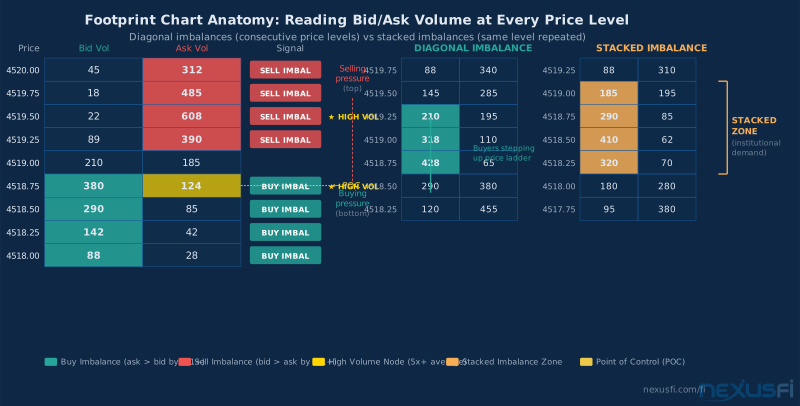
Diagonal Imbalances: The Directional Engine #
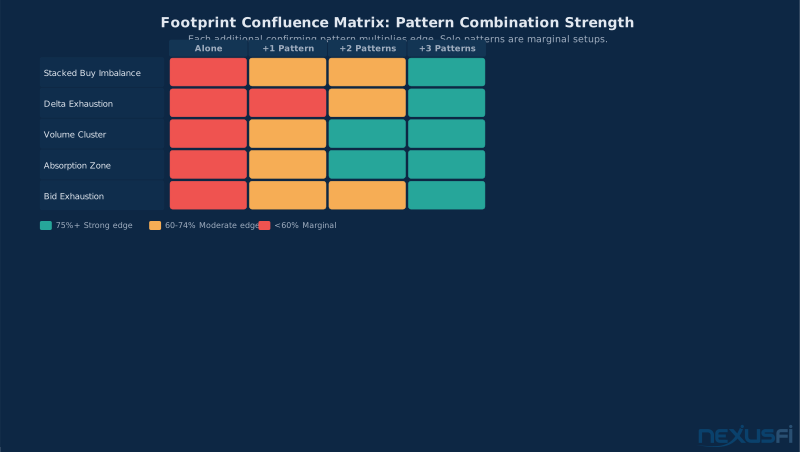
A diagonal imbalance is a sequence of buy or sell imbalances that steps across consecutive price levels — typically in the direction of price movement. When buyers are aggressively lifting the market, you'll see buy imbalances appearing progressively higher, each bar printing more ask-side dominance at higher prices. The imbalances step diagonally up the price ladder.
What it means directionally: diagonal imbalances are continuation signals. They indicate that aggressive order flow is consuming resting liquidity at consecutive price levels — the market is not just moving, it's being driven. The move typically continues until one of three things happens: opposing signals appear, the diagonal stalls at a structural level, or it runs into absorption.
The Jigsaw Trading webinar thread on footprint charts, with 155 posts in The Elite Circle, captures the nuance well: footprint charts are most useful in real time, precisely because the diagonal pattern shows the aggression while it's happening, not in retrospect.
Entry on a diagonal: Don't chase the first bar of a diagonal. Wait for a pullback to the imbalance origin — the first price level where the diagonal started — and look for the same-direction delta to resume. Require at least 3-4 consecutive imbalances before committing. In ES and NQ, 2-3+ point diagonals at the RTH open are especially significant. In CL, 10-20 tick diagonals at EIA inventory releases carry weight, but CL's mean-reversion tendencies demand additional confirmation.
Exit: The first clear opposite imbalance, delta divergence (price continues but imbalances weaken), or the next structural level at a 1:2 risk-reward.
A diagonal that stalls and then reverses is itself a signal. When the directional pressure that created the diagonal stops, the market is telling you something has changed. That transition often produces the setup for the next trade.
Pattern from NexusFi order flow traders: Footprint patterns work best read as a story, not a signal. What happened to the bids? Where did the sellers give up? Did initiative activity follow through? That narrative determines whether the pattern is tradeable or just noise.
(@PrivateBanker on absorption signals, NexusFi)
Stacked Imbalances: Persistent Institutional Pressure #
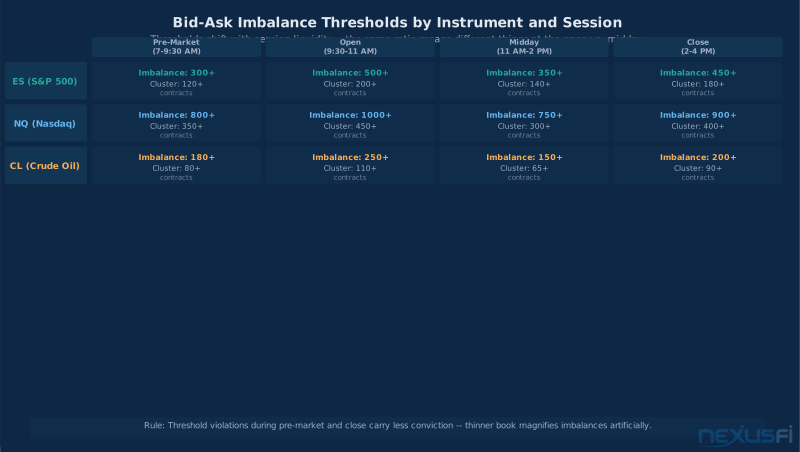
Where diagonal imbalances step across price levels, stacked imbalances concentrate at the same or vertically adjacent price levels across multiple bars or time periods. Three or more buy imbalances at the same zone across different periods is not random noise — it's institutional demand consistently appearing at that level.
Private Banker, one of NexusFi's most-cited footprint practitioners in the Volume Profile and Footprint discussion thread (1,079 replies, consistently thanked for analysis), explained absorption in terms directly applicable to stacked zones: "Think of the markets as a fad following crowd. If all of a sudden the new fad is to sell, everyone jumps in at different periods." Stacked imbalances show when that "fad" is consistently hitting a wall.
Two trade scenarios:
- Continuation (break and retest): The stacked zone creates support (buy imbalances) or resistance (sell imbalances). When price retests the zone and prints a fresh same-direction imbalance, it's a continuation entry. Stop below the zone; target the next structural level.
- Reversal (if the stack is consumed): If stacked imbalances get fully absorbed -- the book clears and price breaks through -- treat it as value migration and enter in the breakout direction with momentum confirmation.
In NQ, stacked buy imbalances at round numbers (19,000, 19,500, 20,000) are especially powerful because institutional algorithms often use these levels as reference points for execution. A stack forming at a round number during the first 30 minutes of RTH carries much more weight than the same pattern at an arbitrary price level during lunch.
The key warning: stacked imbalances frequently continue rather than reverse. Don't fade them without additional confirmation — exhaustion, absorption, or delta failure at the same zone. A stack alone is a flag, not a reversal signal.
(@mk77ch on delta analysis, NexusFi)Delta Exhaustion: The End-of-Leg Warning #
Delta exhaustion is when cumulative delta keeps expanding in one direction but price stops making progress. Buyers are still aggressive — ask volume keeps dominating — but price is no longer advancing. Someone is absorbing that buying pressure without price moving.
The Jigsaw Trading footprint webinar thread captures the practical implication: when you see -5,722 delta with no drop in price, "it means shorts are getting stuck." The same logic applies in reverse for exhausted buys at a high.
Key identification criteria:
- Price makes a new local high or low, but delta gain on that bar is smaller than the prior bar
- The footprint becomes more two-sided -- more back-and-forth volume per level
- Imbalances that previously dominated become muted or disappear
- Price action shows long wicks on increasing volume
Critical warning: Exhaustion alone is not a trade. It's a warning flag that the move is losing energy. You need confirmation — typically a delta flip, absorption at the extreme, or delta failure — before entering a counter-trend position. One of the most common footprint mistakes is treating exhaustion as a reversal signal by itself and getting stopped out on the next push.
In ES, +5,000 delta that can't break yesterday's high is a strong exhaustion signal. In CL, -2,000 delta with price holding above VWAP sets up a short squeeze when the flip comes. The confirmation — not the exhaustion itself — is what you trade.
(@Silvester17 on footprint basics, NexusFi)Absorption Signals: Where the Institutions Are Hiding #
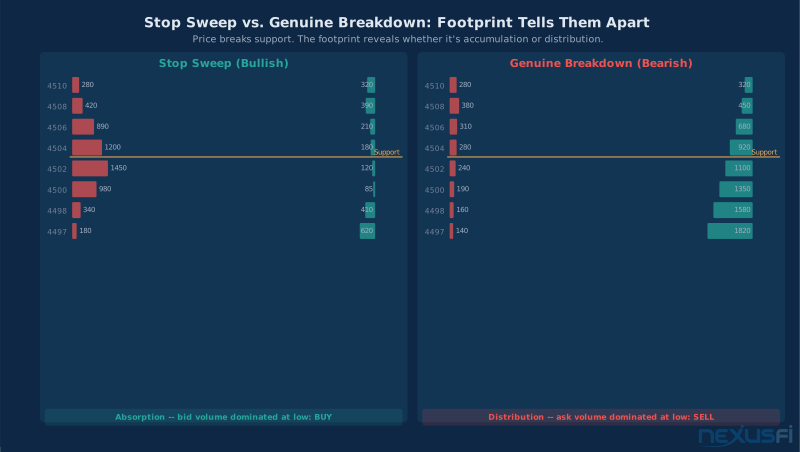
Absorption is the footprint pattern that most clearly reveals passive institutional liquidity. A large number of contracts trade at a price level but price doesn't move through it. The absorber — typically a large market participant with a resting iceberg order — is taking the other side of every order that hits that level.
Private Banker's description from the Volume Profile and Footprint discussion is the clearest formulation: "The way I look at absorption is when you see either buyers or sellers cutting off the opposing traders. Just imagine trading in the pit and the [absorber] standing there, taking every trade that comes." When that absorber wins, price reverses. When the absorber gets overwhelmed, price breaks through and continues.
Volume thresholds (consensus from experienced practitioners):
- ES: 500+ contracts at a single price level with minimal movement
- NQ: 1,000+ contracts
- CL: 200+ contracts
The directionality of absorption depends on which side is being absorbed. Buying absorption — large bid volume soaking up selling — signals an upside reversal. Selling absorption — large ask volume capping rallies — signals a downside reversal.
Two entry scenarios:
- Rejection (reversal entry): When absorption holds -- price makes multiple attempts to push through but keeps reverting -- wait for a failed push away from the absorption level. Enter when price moves 2-3 points away in ES with a delta flip confirming the absorber won. Stop just beyond the absorption level.
- Overcome (continuation entry): If absorption gets eaten -- the resting orders clear and the level loses its holding power -- price breaks through with expanding delta. Enter the breakout direction when delta resumes expanding in the breakout direction. This pattern is more aggressive but confirms genuine trend strength.
Absorption is most reliable when it appears at locations that already matter structurally: VWAP, prior day POC, overnight high/low, or the top/bottom of a value area. Absorption at a random mid-range level carries far less conviction.
In the "Understanding Footprint Charts" thread by Grantx (105 replies), a community member documented absorption at the first standard deviation band: "I saw negative delta and huge volume at this level, but price rejected and reversed." That's the pattern in action — delta pulling hard in one direction while price refuses to follow, then reversing.
(@TropicalTrader on order flow context, NexusFi)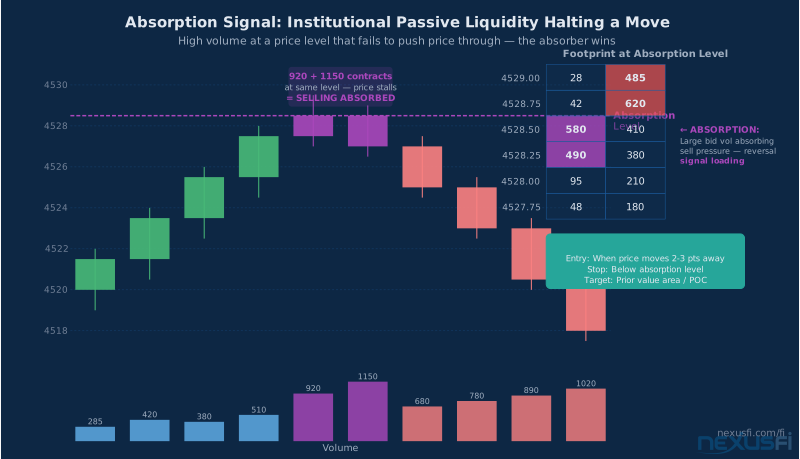
Delta Failure: The Trapped Participants Signal #
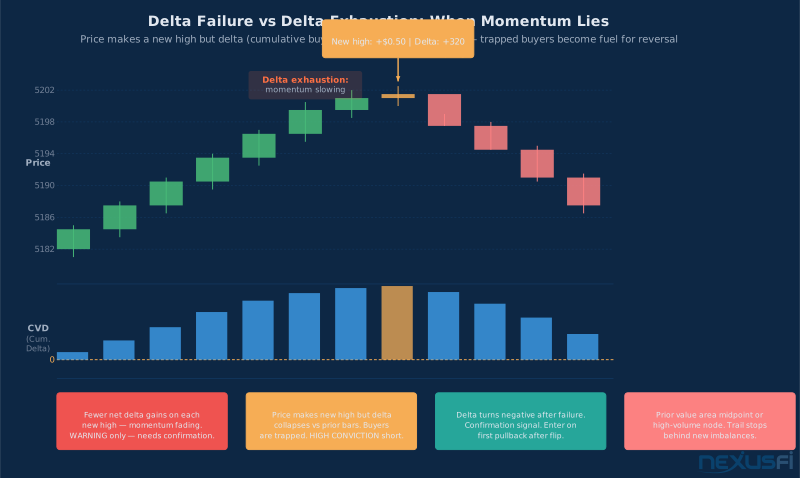
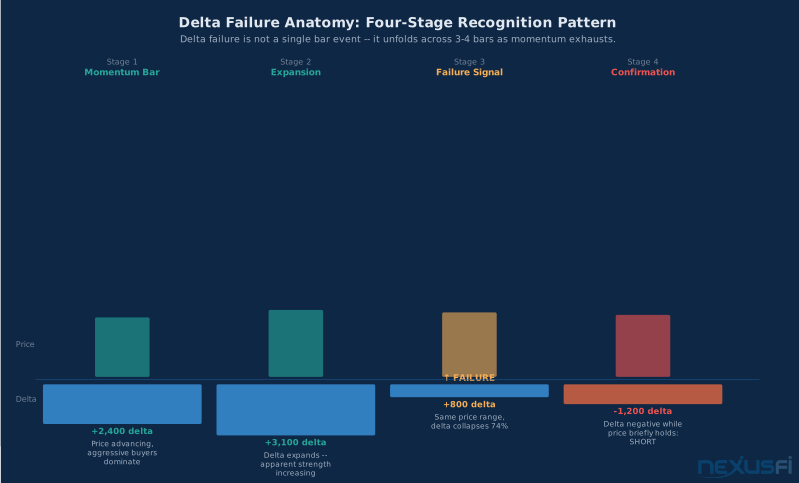
Delta failure is the highest-conviction footprint reversal signal. It occurs when strong delta in one direction fails to produce the expected price movement, then reverses sharply. The initiating orders are trapped — they bought or sold expecting continuation, got minimal movement, and are now caught on the wrong side as the market reverses against them.
The pattern is unmistakable when you see it: a +3,000 delta spike in ES produces only a 2-point move, then price reverses aggressively. Or in NQ — as described by experienced footprint traders — a massive buying imbalance spikes price 2 ticks, then an even larger selling imbalance immediately reclaims it. That's a short signal with high conviction.
What makes delta failure different from exhaustion: exhaustion is gradual degradation of momentum. Delta failure is an abrupt, sharp contradiction. Price goes up, delta goes down (or fails to expand). The trapped participants become fuel for the opposite move as they're forced to cover.
Entry approaches:
- Aggressive: Enter immediately when price breaks back through the origin of the delta spike. You're betting the trapped participants will be forced to exit quickly. Stop beyond the failed delta extreme -- typically 4-6 points in ES.
- Conservative: Wait for the delta to flip direction (positive to negative for a top, or negative to positive for a bottom), then enter on the first pullback after the flip. This costs some of the first move but confirms the reversal is real.
Delta failure at structural confluence produces the cleanest signals. The best setups involve failure at a prior session high or low, at the top or bottom of a stacked imbalance region, or at a key overnight level. Random intra-session delta failures without structural confluence have much lower probability.
Contract timing: NQ during tech earnings, CL during EIA reports. These are the moments when delta failure produces its most violent and reliable follow-through, because trapped positions are often held by participants who took aggressive directional bets on the data and are now getting squeezed.
High-Volume Cluster Reversals: Climactic Turning Points #
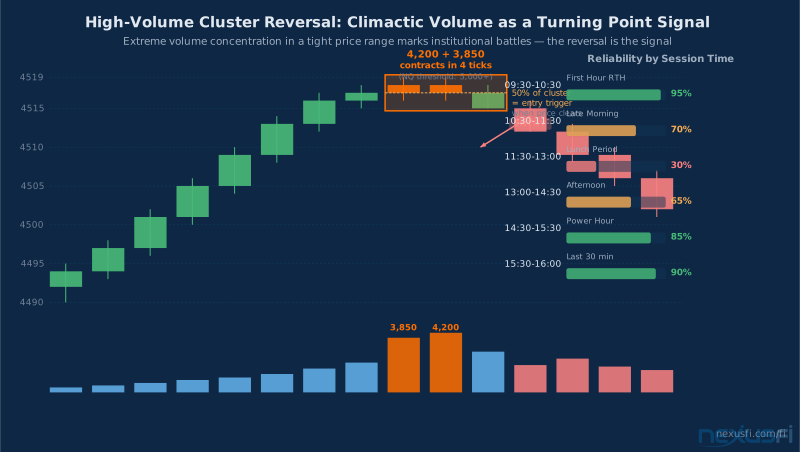
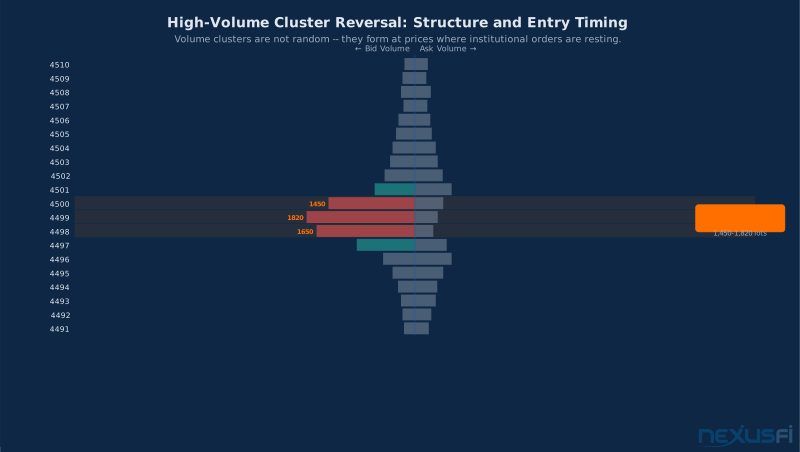
High-volume cluster reversals occur when an extreme concentration of volume prints in a tight price band — 2-4 ticks — followed by an immediate and sharp reversal. The cluster represents a climactic battle where one side has been overwhelmed. Price reversal after the cluster marks the transition from one side's dominance to the other.
Volume thresholds:
- ES: 3,000+ contracts in a 2-tick range
- NQ: 5,000+ contracts in a 4-tick range
- CL: 1,000+ contracts in a 5-tick range
The cluster zone then becomes a key reference level — it may act as support (if the cluster preceded a reversal up) or resistance (if it preceded a reversal down). When price returns to the outer edge of a cluster zone and produces an imbalance rejection, that's a high-probability continuation trade in the reversal direction.
Entry logic: Enter opposite the cluster direction after price clears the cluster by approximately 50%. If ES prints a cluster at 5500-5501, enter short when price drops to 5499.50. This "50% through the cluster" trigger reduces false signals from temporary price excursions that don't represent genuine reversals.
The higher-probability variant: wait for a retest of the cluster edge after the initial reversal, look for an imbalance rejection at that retest, then enter. You give up some of the move but dramatically improve the probability.
Time-of-day filter — this matters more than most traders realize:
- Most reliable: First hour of RTH (09:30-10:30 ET) -- 95% reliability
- High reliability: Last 30 minutes (15:30-16:00 ET) -- 90%
- Moderate: Late morning (10:30-11:30), afternoon (13:00-15:30) -- 65-70%
- Avoid: Lunch period (11:30-13:00 CT) -- 30% reliability, wide spreads, thin book
Cluster reversals during lunch produce the highest proportion of false signals. The lunch crowd doesn't have the institutional weight to sustain a genuine reversal, and the thin book can produce cluster-like prints that are actually just illiquid volatility.
Pattern Confluence: Stacking Signals for Highest Probability #
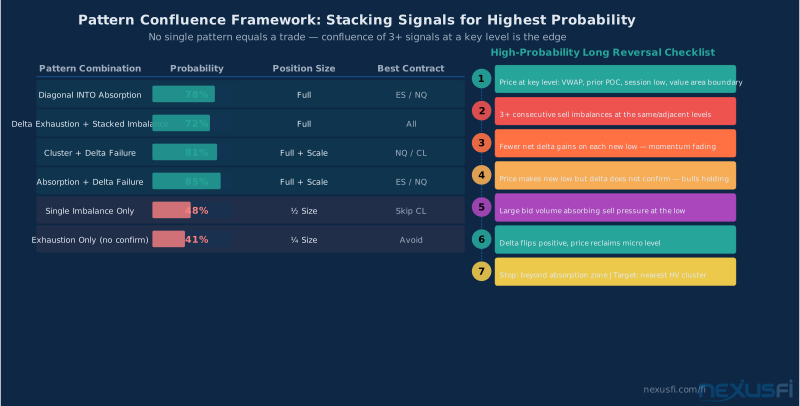
The single most important principle in advanced footprint trading: no pattern in isolation equals a trade. The edge comes from multiple patterns aligning at the same price level at the same time. This is the difference between the 48% single-imbalance setup from the 85% absorption-plus-delta-failure confluence.
The highest-probability combinations (expert consensus):
- Diagonal into absorption (78% probability): A diagonal imbalance drives price to a level, then absorption appears to halt the move. This is explosive move territory -- either the absorption wins and produces a sharp reversal, or it gets overwhelmed and the breakout accelerates.
- Delta exhaustion + stacked imbalances (72%): Exhaustion at a level where multiple prior bars have printed imbalances in the opposite direction. The structural demand or supply is well-established; the exhaustion signals that the initiating side is running out of buyers or sellers to absorb the resting liquidity.
- Cluster + delta failure (81%): A high-volume cluster forms and then delta fails to expand in the cluster direction. This combination is especially powerful because it catches both the climactic volume and the failed momentum simultaneously.
- Absorption + delta failure (85%): The highest-probability combination. Absorption shows passive institutional liquidity. Delta failure confirms that the aggressive side cannot overwhelm that liquidity. Together, they identify a trapped population with high conviction about the reversal direction.
The 7-step long reversal checklist (consensus framework):
- Location: Price is at a key structural level -- VWAP, prior POC, session low, value area boundary, overnight high/low.
- Stacked sell imbalances: 3+ consecutive sell imbalances at the same or adjacent levels -- establishing supply at the low, which will be absorbed.
- Delta exhaustion: Fewer net delta gains on each new low -- momentum fading even as aggressive sellers push.
- Delta failure: Price makes a new low but delta does not confirm -- bulls are holding, sellers are getting absorbed.
- Absorption: Large bid volume visibly absorbing the sell pressure at the low.
- Entry signal: Delta flips positive; price reclaims the micro level above the absorption zone.
- Risk management: Stop below the absorption zone. Target the nearest high-volume cluster or prior value area boundary.
Steps 1-5 define the setup. Steps 6-7 define the execution. Don't enter until steps 1-5 align. Reverse the sequence for a high-probability short reversal.
The NexusFi community member Fluid Fox noted this approach in their trading journal: "I won't take imbalances seriously unless they're in the triple digits. I can't fully mechanize this set-up, because conditions always vary; delta, volume and imbalances are only relatively significant." That's exactly right — the patterns require context, not mechanical execution.
Platform Setup and Visual Configuration #
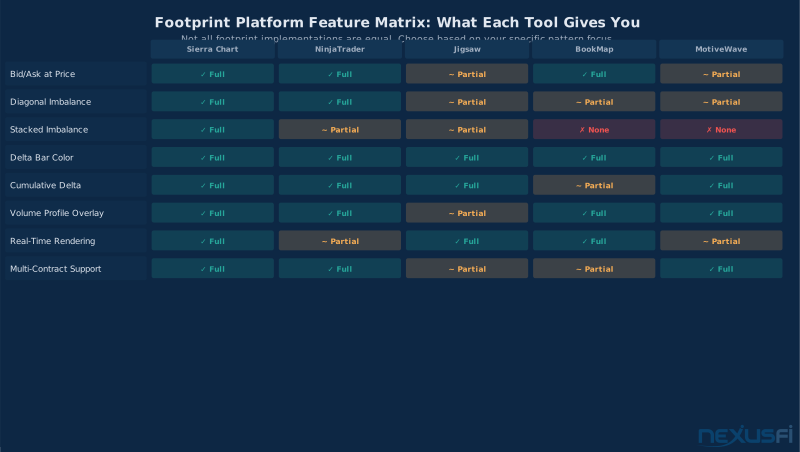
Your footprint is only as good as your ability to read it in real time. The practical consensus from experienced traders: you must configure your platform to make these events visually unambiguous before you can trade them under pressure.
Essential configuration:
- Imbalance threshold: Start at 3:1 (ask/bid ratio for buy imbalances, bid/ask for sell imbalances). Adjust based on contract -- tighter for ES, slightly wider for CL where noise is higher.
- Color coding: Buy imbalances one distinct color (teal or blue is common); sell imbalances another (red). High-volume cells should be visually distinct (bright yellow or orange is typical). At a glance, you should be able to read the pattern without counting numbers.
- Delta histogram overlay: A delta histogram below the footprint, combined with a cumulative delta line, allows you to see both intrabar and cumulative delta behavior simultaneously. This is how you catch exhaustion and failure in real time.
- Volume profile overlay: A volume profile or VPOC overlay lets you immediately contextualize whether an imbalance is occurring at a high-volume node (more significant) or in low-volume air (less reliable, faster movement).
Bar type selection: Most professional footprint traders use volume bars (a fixed number of contracts per bar) or tick bars rather than time bars. This keeps bars consistent in volume and prevents the distortion of thin-book bars during low-volume periods. Typical settings: 1,000-3,000 contracts per bar in ES, 2,000-5,000 in NQ, 500-1,000 in CL.
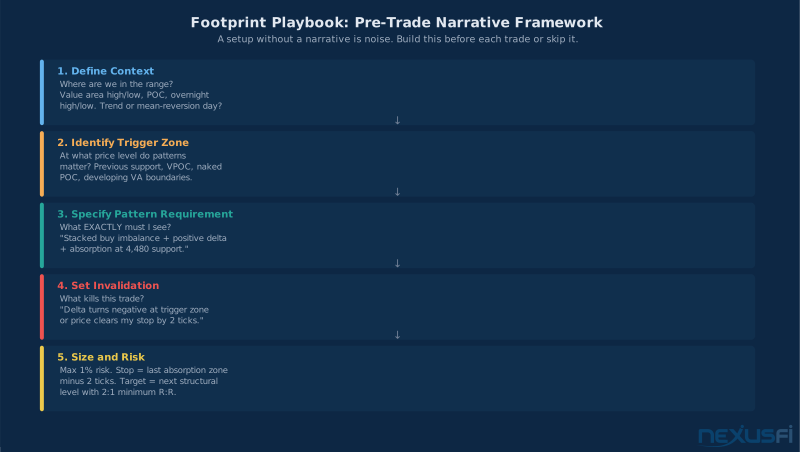
Workflow discipline: The most important element isn't the platform — it's building a pre-trade narrative. Before each trade, articulate what the footprint is telling you: "We are absorbing sell orders at the overnight low. If I see a stacked buy imbalance off this absorption, I enter long with a stop below the absorption zone." If you can't articulate the narrative clearly, you don't have a setup — you have noise.
Contract-Specific Execution: ES vs NQ vs CL #
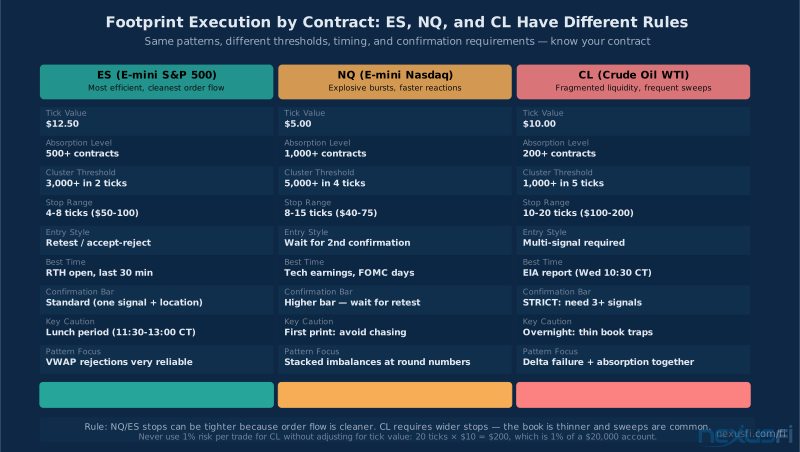
The patterns described above are universal — but the execution rules differ meaningfully between contracts. Applying ES thresholds to CL, or NQ patience to ES, will produce consistent losses.
ES (E-mini S&P 500) — the benchmark: ES has the cleanest order flow of the three contracts. Institutional algorithms are most active here, and the footprint patterns are most reliable at key structural levels. VWAP rejections with absorption confirmation are especially powerful. Standard confirmation requirements apply: one signal plus location is often sufficient. Stops typically run 4-8 ticks ($50-100 per contract). ES rewards the retest-and-accept-reject approach — wait for the level, let the pattern confirm, then enter.
NQ (E-mini Nasdaq) — patience required: NQ moves faster and more explosively than ES, which makes it tempting to chase the first signal. Don't. The first print of a diagonal or imbalance in NQ is frequently a false start that reverses immediately. The discipline: wait for the second confirmation — the retest of the first imbalance origin — before entering. Absorption thresholds are higher (1,000+ contracts). Stops run 8-15 ticks ($40-75 per contract). Watch for absorption at overnight highs and lows during the first 30 minutes of RTH — NQ respects these levels more consistently than ES. Round-number levels (19,000, 20,000, 21,000) with stacked imbalances are some of the most reliable setups in the contract.
CL (Crude Oil WTI) — multi-signal required: CL has the most fragmented liquidity of the three. Wicks and sweeps are common, meaning single-signal footprint setups have a much higher failure rate. The practical rule: require delta failure plus absorption together before entering a reversal in CL. Stacked counter-imbalances alone at a level are insufficient. Volume thresholds are lower in absolute terms (200+ contracts for absorption) but the confirmation bar is higher. Stops typically run 10-20 ticks ($100-200 per contract). Start with smaller size until you develop the pattern recognition for CL's specific behavior. The EIA inventory report Wednesday mornings at 10:30 ET creates the most reliable CL footprint setups of any recurring event.
The Josh perspective from the footprint understanding thread captures NQ's complexity: "Note that NQ has increasing delta during this entire consolidation. ES did not." This is a critical point — ES and NQ can diverge in delta behavior even when prices are moving together. Cross-checking delta between ES and NQ is a useful filter for high-conviction setups in either contract.
Building Your Footprint Playbook #
Pattern recognition without a playbook produces inconsistent results. A playbook is a specific set of if-then rules built around the patterns you've mastered, applied consistently to situations you've seen before.
Start with one pattern: Pick one pattern — absorption is the most visually clear and beginner-accessible — and trade only that pattern for 30 sessions. Log every setup: did you see it, was it valid (all criteria met), did you take it, what happened. After 30 sessions, you'll know your win rate, average reward/risk, and whether the pattern performs on your contract and timeframe.
Add context one element at a time: Once you have one pattern working, add a second element — for example, only take absorption setups at VWAP. Track whether the filtered setups outperform the unfiltered setups. Most traders find that adding structural context much improves win rates but reduces trade frequency. That's a worthwhile trade.
Build confluence from your data: Your playbook should eventually specify: "Pattern A at Location B with C confirmation = take the trade. Pattern A without Location B = skip." These rules should come from your own trade log, not from general advice.
Risk management across all patterns:
- Never risk more than 1% of account per setup
- Anchor stops to where the market proves your thesis wrong -- beyond the absorption zone, beyond the LVN boundary, beyond the failed delta extreme
- Scale out at the first logical resistance or support level, not at a fixed profit target
- Cut immediately if the pattern invalidates -- if the absorption gets overwhelmed or the delta failure produces a higher high, exit without waiting for the stop
The community member @trymph in the FootPrintV2 thread noted a powerful combination: "Looks like together for those visually oriented left histo of delta while right histo of imbalances can indicate possible exhaustion/absorption for a retracement fade entry with the trend?" This describes the exact confluence approach: delta histogram showing exhaustion on the left, imbalance cells showing absorption on the right, entering in the trend direction at the retracement. That's a playbook entry.
How These Patterns Connect to Other Concepts #
Footprint patterns don't exist in isolation. They work best when integrated with the broader analytical framework that most professional futures traders use.
- Footprint Charts: Reading the Bid-Ask Volume Inside Every Price Bar -- foundational mechanics before studying these advanced patterns
- Cumulative Volume Delta (CVD): Reading the Hidden Order Flow Story -- the CVD indicator that tracks delta failure and exhaustion
- Delta Divergence in Futures Trading -- delta divergence from price is the root of both exhaustion and failure patterns
- Tape Reading for Futures Trading -- absorption at the DOM level vs footprint level
- VWAP: The Volume-Weighted Benchmark -- the primary structural location for footprint pattern validation
- Market Microstructure: How Futures Trades Actually Get Filled -- understanding why absorption occurs and what iceberg orders look like in the book
- Volume Ladder and Footprint Charts -- the volume ladder variant that some practitioners prefer to standard footprint
- Delta Analysis and Cumulative Volume Delta -- deeper delta analysis integrated with footprint patterns
Footprint patterns are one layer of market analysis. They tell you about order flow mechanics. They don't predict fundamental direction, macro regime, or news-driven moves. Used within a complete analytical framework — starting with higher-timeframe structure, applying VWAP and value area context, then confirming with footprint patterns — they provide a real execution edge. Used in isolation without context, they produce the same results as any other indicator-based system: inconsistency.
The practitioners who get the most from footprint trading treat it as a confirmation layer, not a prediction layer. The higher-timeframe analysis tells you which side of the market to be on. The footprint tells you when and where the entry is.
Knowledge Map
Prerequisites
Understand these firstGo Deeper
Build on this knowledgeCitations
- — FootPrintV2 Chart for NT8 (2022) 👍 31“Delta: Do we have more aggressive buyers or sellers? Absorption: Even if the market is moved by aggressive buyers or sellers, there is always a buyer and a seller for each transaction.”
- — Understanding Footprint Charts / Number bars (2020) 👍 21“Things you should look for on a footprint bar: What delta means in each bar, what delta means in relation to price, what delta means between bars, what delta means at each price level.”
- — Volume Profile and Footprint discussion (2012) 👍 21“The way I look at absorption is when you see either buyers or sellers cutting off the opposing traders. Just imagine trading in the pit and the other side just absorbing everything you throw at them.”
- — ES Footprint charts at the hard right edge (2013) 👍 20“Footprint charts are one of the few charts that are better real time than hindsight. The patterns you see in the footprint reveal order flow dynamics that are invisible on a standard candle chart.”
- — Understanding Footprint Charts / Number bars (2020) 👍 20“If there's very negative delta that means that sellers are selling into the market, and the buyers have a lot of limit orders. As soon as the market upticks you see the buyers absorb the aggressive sellers.”
- — GOMI all NT7/8 and SC - MP and Orderflow at Gomicators.com (2016) 👍 35“For new users of footprint (volume ladder) charts, some of the features may be a little overwhelming. The key is to start with the fundamentals: buy imbalances, sell imbalances, and high-volume nodes.”
- — Is Orderflow An Outdated Concept? (2020) 👍 2“Footy with the profile on the left chart and bid vs ask on the right. This view shows volume at price and order flow simultaneously -- the combination tells a more complete story than either alone.”
- — Webinar: Order Flow Techniques for Day Traders (2013) 👍 5“Absorption by large participants at key levels is identifiable in real-time footprint data. The 43k contracts at the top -- that looks like absorption by whoever is selling into aggressive buyers.”
- — Footprint Chart Type Reference (2024)
- — Volume by Price Chart Type (2024)