



Trading with Market Internals: A Day Trader's Practical Framework for ES and NQ
Overview #
Most traders watch price. The best traders watch what's driving price. NYSE TICK, TRIN, Advancing/Declining Issues, and VOLD are not derived from the futures contracts you're trading — they're derived from the thousands of individual NYSE-listed stocks trading simultaneously beneath the surface of the S&P 500 and Nasdaq 100. They tell you whether the move you see on your ES or NQ chart is being carried by broad institutional participation or held together by a handful of mega-caps with the rest of the market quietly leaking lower.
This is the fundamental value of market internals: they answer the question that price alone cannot answer. When ES pushes to new highs, is it a healthy trend day or a narrowing advance setting up a reversal? When NQ pulls back to VWAP, is it a buyable dip or the beginning of a trend change? Breadth indicators answer these questions not by predicting the future, but by measuring the current health of the move in real time.
[2]
This article is not about adding more indicators to your chart. Every additional data source has a cognitive cost. The traders who use internals most effectively use 2--3 of them, know exactly what question each one answers, and have specific rules for when they matter and when they don't. That's the framework this article builds.
What Market Internals Are and Where They Come From #
Before explaining how to use these indicators, it's essential to understand what they actually measure — because this determines when they work and when they don't.
All the major market internals are derived from the NYSE stock universe (approximately 2,800 stocks), not from the futures markets directly. This creates both their value and their limitation:
The value: NYSE stocks include most of the large-cap U.S. equity market. The ES futures tracks the S&P 500, and the NQ tracks the Nasdaq 100. Both of these indices reflect the same underlying market activity as the NYSE breadth data. When institutions are buying or selling broadly across the equity market, both the cash stocks and the futures will reflect it.
The limitation: The relationship between NYSE breadth and ES/NQ price is a correlation, not a direct mechanical link. There are periods — especially in concentrated markets dominated by a few mega-cap technology names — where ES/NQ can make significant moves while NYSE breadth remains flat or even diverges.
[5]
The practical implication: Use internals as a confirmation and health-check layer, not as standalone entry signals. Price action sets up the trade; internals tell you whether to execute it.
The Four Core Internals: What Each One Measures #
NYSE TICK: The Immediate Pressure Gauge #
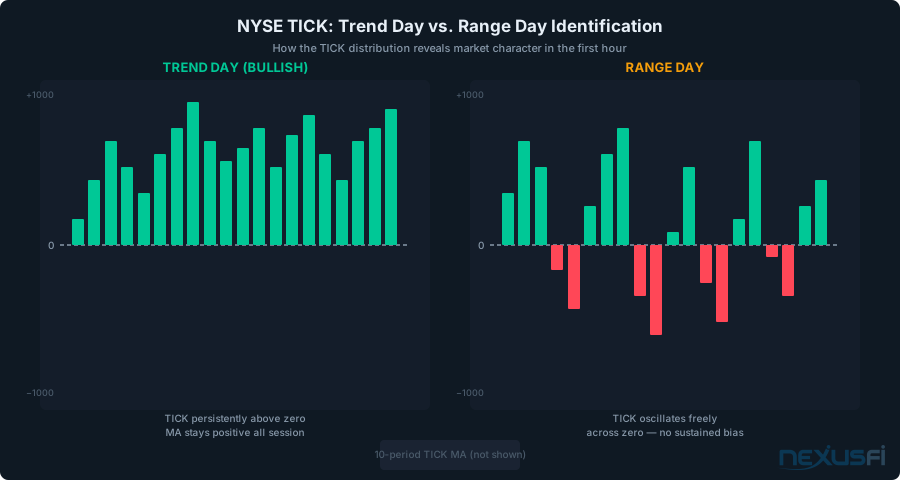
NYSE TICK measures the number of NYSE-listed stocks trading at their offer price (upticking) minus the number trading at their bid price (downticking) at any given moment. A reading of +800 means 800 more stocks are currently upticking than downticking.
[1]
What TICK tells you: The immediate order-flow balance. Is buying pressure or selling pressure dominant right now? Is that pressure broad (many stocks involved) or narrow?
How to read it: TICK oscillates constantly during the trading session. In a bullish trend, it tends to oscillate in positive territory — dipping toward zero on pullbacks but rarely sustaining deep negative readings. In a bearish trend, the opposite: persistent negative readings with brief bounces toward zero. In a range or choppy market, TICK oscillates across zero with no sustained bias.
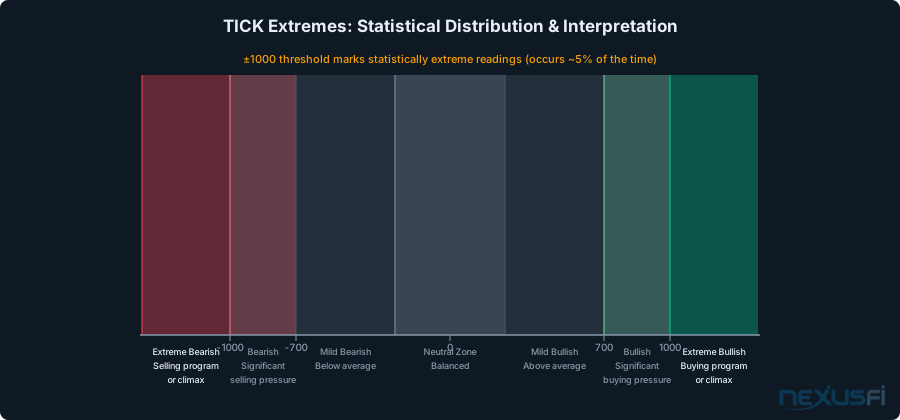
The extremes: Conventional reference levels for meaningful TICK extremes are ±800 to ±1000. Research by Dr. Brett Steenbarger found that the daily Adjusted NYSE TICK has a standard deviation of approximately 527, with extreme daily readings (beyond one standard deviation) showing meaningful predictive value for subsequent price action [10]. On average, one-minute high TICK values cluster near +250 and low values near -250, with a standard deviation of approximately 450. This means roughly 95% of all TICK values fall between +1000 and -1000, making values beyond these thresholds statistically significant.
How to use it: TICK works best for two purposes:
- Entry timing: When price pulls back to a key level (VWAP, prior high, value area), TICK tells you whether the selling on the pullback is broad or narrow. If TICK stays well above zero during a pullback to VWAP in an uptrend, sellers are not committed — the pullback is a dip, not a shift.
- Exhaustion identification: When ES or NQ pushes to new intraday highs, TICK should be corroborating with positive extremes. If TICK fails to print readings comparable to prior legs up — or worse, if it's in negative territory while price makes new highs — that's a classic breadth divergence warning.
[3]
What TICK doesn't tell you: Duration and follow-through. An extreme TICK reading tells you buying or selling pressure is intense right now, but it doesn't tell you how long it will last.
ADD (Advancing/Declining Issues): The Breadth Participation Gauge #
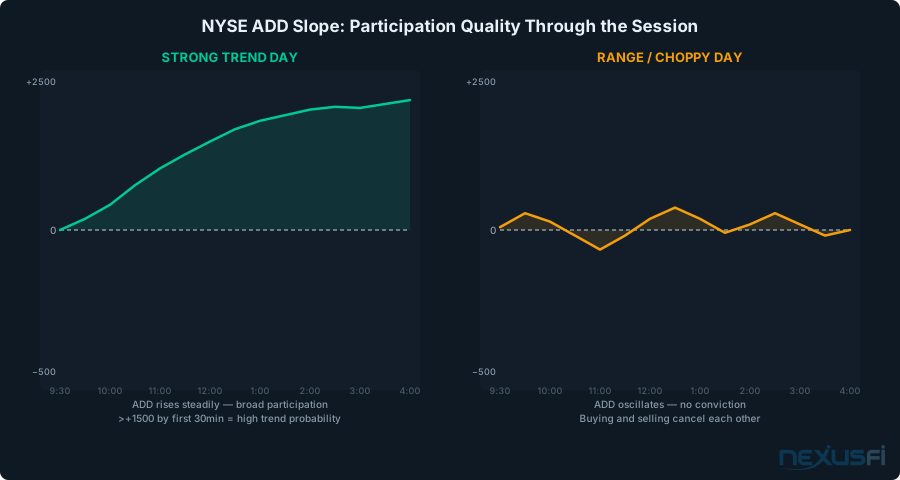
ADD measures the number of NYSE stocks advancing minus the number declining at any point during the session. A reading of +1200 means 1200 more stocks are rising than falling.
What ADD tells you: The participation quality of the current move. Is the ES/NQ rally being carried by hundreds of individual stocks, or is it a narrow move driven by a few large-cap names?
How to read it: Unlike TICK (which shows instantaneous pressure), ADD shows the cumulative bias of the session developing over time. In a strong trend day, ADD will show a clear, consistent slope — rising steadily in a bull day, falling in a bear day. In a choppy day, ADD will oscillate without conviction.
[4]
The early readings: When ADD opens at ±150 or greater within the first 15 minutes, the probability of a trend day increases meaningfully. When ADD reaches ±1500 within the first 30 minutes, there is a high probability of a sustained trend.
Using ADD for divergence: ADD's slope is more important than its absolute level. When ADD is making lower highs while ES/NQ is making higher highs, you're seeing a breadth divergence — institutional participation is weakening even as price continues higher.
[8]
TRIN (Arms Index): The Volume-Weighted Sentiment Gauge #
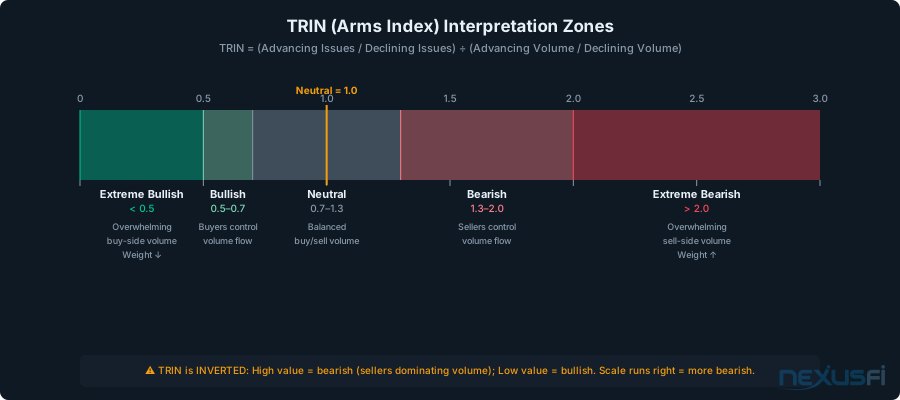
TRIN — originally developed by Richard W. Arms Jr. in 1967 and first published in Barron's [9] — is calculated as:
(Advancing Issues / Declining Issues) ÷ (Advancing Volume / Declining Volume)
A TRIN of 1.0 indicates perfect balance — the volume ratio matches the issues ratio. A TRIN below 1.0 indicates that advancing stocks are attracting disproportionately more volume than declining stocks (bullish). A TRIN above 1.0 indicates the opposite (bearish). TRIN is inverted relative to direction: low TRIN = bullish, high TRIN = bearish.
How to read it: Unlike TICK and ADD, TRIN is less useful as a timing tool and more useful as a session character gauge. TRIN below 0.5 at session open is a significant signal — it indicates overwhelming buy-side volume commitment. TRIN above 2.0 indicates extreme sell-side volume dominance.
Using TRIN as a filter: The most reliable TRIN application is as a confirmation filter rather than a standalone signal. When TRIN is above 1.3 and ADD is falling, short setups carry much better risk/reward than long setups — and vice versa when TRIN is below 0.7 with rising ADD.
What TRIN doesn't tell you: Direction of the next move. TRIN tells you where volume is concentrated right now, not where it will go. An extreme TRIN reading often indicates climax conditions that can reverse, rather than continuation.
VOLD (Volume Difference): The Institutional Participation Gauge #
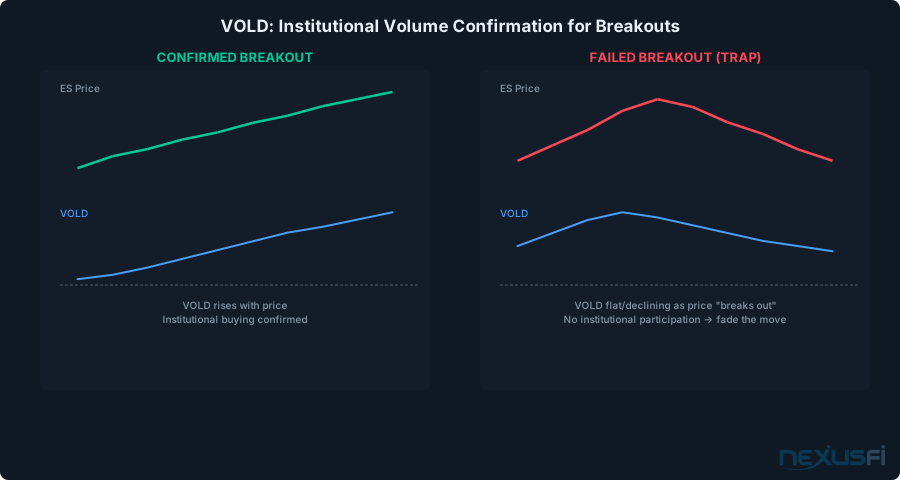
VOLD measures the difference between advancing volume and declining volume on NYSE stocks. Where ADD counts stocks, VOLD counts shares. This distinction is critical: VOLD shows you whether institutional money (which trades in large volume blocks) is participating in the move.
What VOLD tells you: The quality of buying or selling. A price move with rising VOLD indicates that large-block participants are driving it — the move has institutional backing. A price move with flat or declining VOLD indicates retail-driven or thin-market movement — more likely to fail.
The most valuable VOLD application — the failed breakout filter: When ES or NQ breaks above a key level (prior high, VWAP resistance, overnight high) and VOLD is not rising simultaneously, the breakout has a much higher probability of failure. This is Setup 2 in the practical framework below.
How to read it: Like ADD, VOLD's direction and slope matter more than its absolute level. Rising VOLD during an advance confirms institutional participation. Flat or falling VOLD during an advance is a warning that the move lacks underlying support.
Identifying Day Type in the First 30 Minutes #
The most important application of market internals is day type identification — determining whether you're in a trend day or range day environment within the first 30 minutes. James Dalton's Mind Over Markets (1990) formalized this concept through Market Profile analysis, identifying six distinct market day types — from the classic Trend Day (where the open marks the extreme and price trends directionally all session) to various bracketing patterns where price oscillates within a value area [11]. This single decision affects every trade you take for the rest of the session.
Trend Day Signals (bullish):
- ADD opens positive and continues rising
- TICK persistently above zero; MA stays positive
- VOLD rising from the open
- Price opens above VWAP and holds above it
- TRIN below 0.7
Trend Day Signals (bearish):
- ADD opens negative and continues falling
- TICK persistently below zero; MA stays negative
- VOLD falling from the open
- Price opens below VWAP and holds below it
- TRIN above 1.3
[7]
Range Day Signals:
- ADD oscillates without clear directional slope
- TICK prints extremes on both sides (±800 up and then ±800 down within the first hour)
- VOLD oscillates
- Price oscillates above and below VWAP
- TRIN near 1.0 with no directional commitment
If you can identify a strong trend day by 10:00--10:15 AM, you know to hold winning positions longer, add on pullbacks that stay above VWAP with positive TICK, and stay patient with your bias rather than fading every short-term extreme.
The Cumulative TICK -- Your Session Regime Filter #
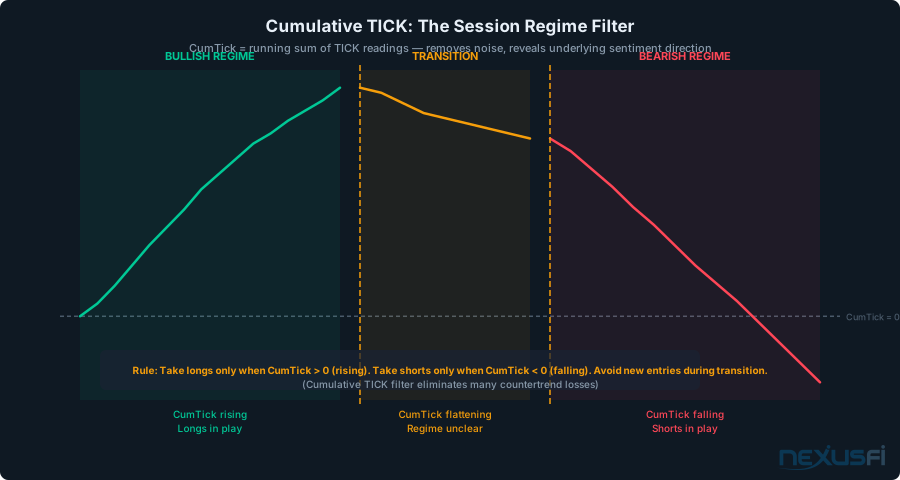
The Cumulative TICK is the running sum of all TICK readings during the session. It removes the constant oscillation of the raw TICK and reveals whether the underlying sentiment is accumulating in one direction or distributing randomly.
What the Cumulative TICK shows you: In a true trend day, the Cumulative TICK will trend persistently in one direction — rising throughout a bullish day, falling throughout a bearish one. In a range day, the Cumulative TICK will oscillate without forming a directional slope.
The most valuable rule: Take new longs only when Cumulative TICK is positive and rising. Take new shorts only when Cumulative TICK is negative and falling. Avoid new directional entries during transitions (CumTick crossing zero or changing slope direction).
This one filter eliminates a large percentage of countertrend losses that occur when traders fight established sentiment patterns.
Five Practical Trading Setups #
Setup 1: The VWAP Retest with TICK Confirmation #
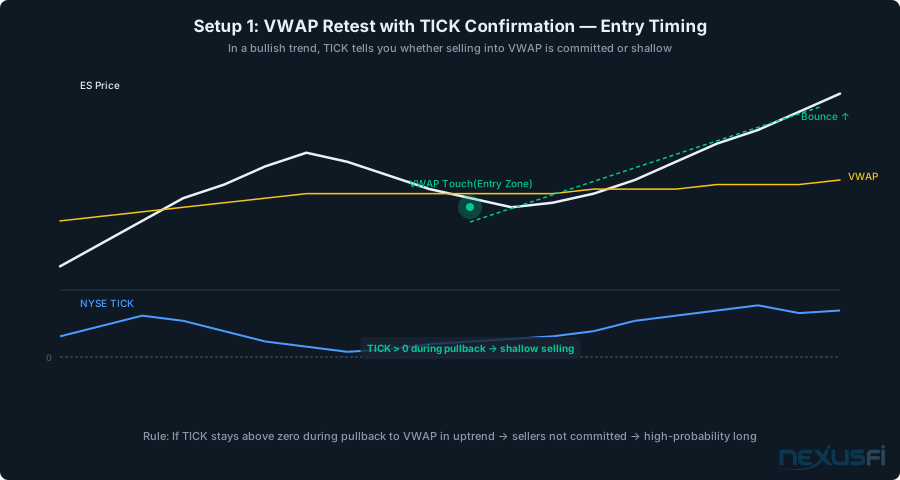
Conditions: ES/NQ in an established uptrend (above VWAP, ADD rising). Price pulls back to VWAP.
Internals check: During the pullback to VWAP, watch TICK.
- If TICK stays above zero (even dips to +100-200 but doesn't go negative): sellers are not committed. The pullback is shallow retail profit-taking, not institutional distribution. Enter long at VWAP with tight stop.
- If TICK goes much negative (-400, -600) during the pullback: sellers are active. Wait for TICK to recover before entering, or skip the setup entirely.
[6]
Target: Prior high, next VWAP band resistance, or next significant volume node.
Stop: Below VWAP (for long) or above VWAP (for short).
Setup 2: The Failed Breakout (VOLD Non-Confirmation) #
Conditions: ES or NQ attempts to break above a key level (prior session high, overnight high, significant resistance).
Internals check: Watch VOLD at the moment of the breakout attempt.
- If VOLD is flat or declining while price breaks above the key level: no institutional participation in the move. High probability of a failed breakout. Look to fade the move back to the breakout level.
- If VOLD is rising with the breakout: the move has institutional backing. Stand aside from the fade; consider momentum long instead.
Entry: Enter short on the first rejection candle after the failed breakout, with a stop above the high.
Best time for this setup: Opening 30 minutes (9:30--10:00 AM), when breakout attempts are frequent and VOLD non-confirmations are most reliable.
Setup 3: The Breadth Divergence Fade #
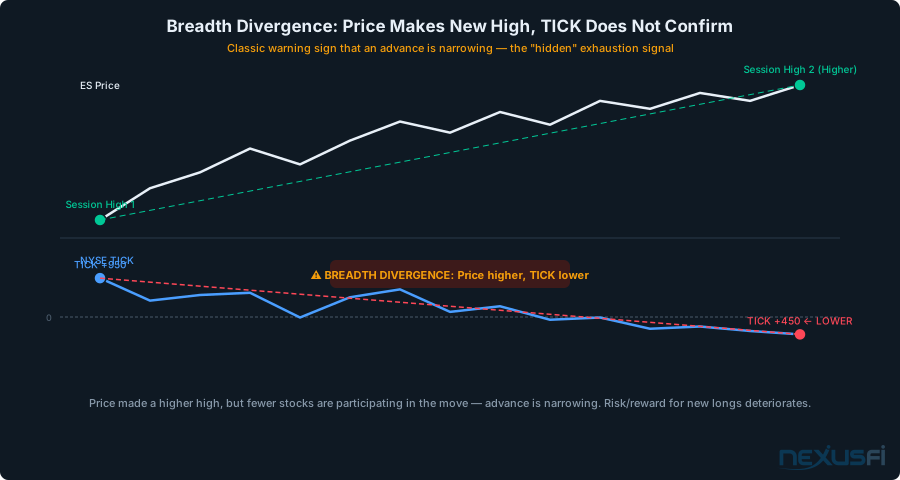
Conditions: ES/NQ is in an established uptrend making successive new highs. The session is maturing (after 11:30 AM).
Internals check: As each new high is made, compare the TICK reading at that high to the TICK reading at the prior high.
- If TICK is making lower highs as price makes higher highs: you have a breadth divergence. Fewer stocks are participating in each successive leg up.
- Confirm with ADD: ADD should also be showing lower slope or making lower highs.
Entry: This is a caution signal, not an immediate short trigger. Wait for price to fail at a key level (prior high, VWAP band, round number) and show a reversal pattern before entering short. The divergence is the context; the price reversal is the trigger.
Target: The most recent significant support level (value area, VWAP, prior swing low).
Risk management: Breadth divergences are not timing signals. The market can continue higher for 30--60 minutes after the divergence first appears. Size appropriately and place stops above the relevant high.
Setup 4: The Trend Day Pullback (Add-On Setup) #
Conditions: Confirmed trend day (ADD consistently positive, TICK MA persistently positive, price holding above VWAP).
Internals check: During each pullback in the trend:
- Wait for TICK to dip toward zero but stay positive (above -100 to +200 range)
- Wait for ADD to flatten or dip slightly but maintain its overall positive slope
- Watch VOLD — it should remain net positive even during the pullback
Entry: Long near the developing VWAP or at a key volume node where the pullback is finding support, with TICK starting to rise from near-zero readings.
Target: Use trailing approach — on trend days, the market tends to close near the highs. Move stop to breakeven quickly; trail it below the developing VWAP.
Critical rule: On confirmed trend days, don't fade the trend based on short-term TICK extremes. A TICK +1200 reading during an uptrend day does not mean "sell" — it may mean "the trend is very strong and you should be long."
Setup 5: The Opening Range Internals Filter #
Conditions: First 15 minutes of RTH session. Price attempts to break above or below the opening range.
Internals check:
- Breakout to upside + ADD positive + VOLD rising: trend day likely developing long. Enter long on opening range breakout.
- Breakout to upside + ADD flat/negative + VOLD flat: false breakout likely. Fade back to opening range midpoint.
- Breakout to downside + ADD negative + VOLD falling: trend day likely developing short. Enter short on opening range breakdown.
- Breakout to downside + ADD flat/positive + VOLD flat: false breakdown likely. Fade back to opening range midpoint.
This setup converts an otherwise low-confidence opening range breakout into a higher-probability setup by requiring internals confirmation.
Session Time Windows: When Internals Matter Most #
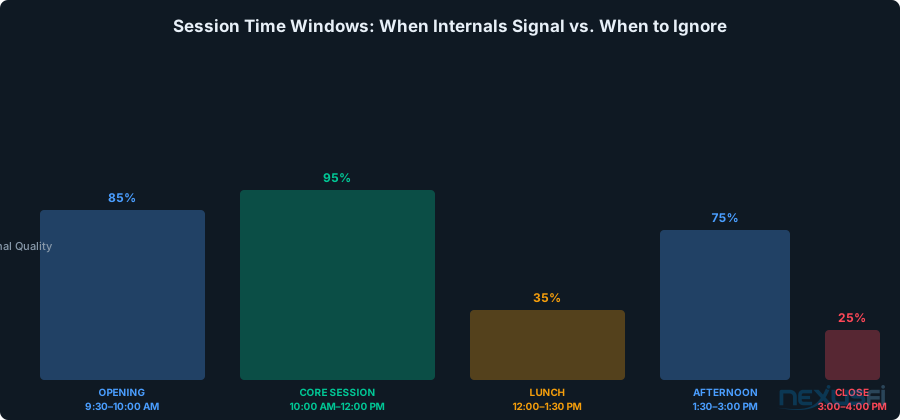
Not all hours of the trading session produce equally reliable internals signals. Understanding the time-based reliability profile is essential for calibrating your responses to what you see.
The Opening 30 Minutes (9:30--10:00 AM ET) #
The opening window is the best time to calibrate your session baseline. Note the opening TICK range, the direction of ADD's initial slope, and whether VOLD is confirming or contradicting the opening price direction.
Unique characteristic: The first 15--30 minutes often contain the highest-velocity moves of the session. Internals signals during this window are real but require faster decision-making. The failed breakout setup (Setup 2) is specifically designed for this window.
Core Session (10:00 AM--12:00 PM ET) #
This is the highest-reliability window for all five setups. Volume is significant, internals readings are statistically significant, and the session's character (trend vs. range) has usually become clear by this point.
Priority: This is when your best setups should be executed at full size.
Lunch Hours (12:00--1:30 PM ET) #
Volume thins dramatically during lunch, and internals lose statistical significance. With fewer stocks trading, a smaller number of order executions can move TICK by larger amounts. A TICK reading of +800 during lunch means fewer actual stocks upticking than the same reading during peak morning volume.
Best practice: Reduce conviction much for internals-based signals during lunch. Focus on price structure; treat internals as weak confirmation rather than setup generator during low-volume periods.
The Afternoon (1:30--3:00 PM ET) #
Signal quality recovers as volume returns. Afternoon sessions often feature either trend continuation (if the morning established a clear trend day) or a reversal attempt (if the morning failed to establish a sustained trend).
Priority application: The VWAP retest (Setup 1) often produces its best afternoon setups as institutional players position for the closing auction.
The Closing Window (3:00--4:00 PM ET) #
Market-on-close (MOC) orders create volume and directional pressure that can appear to confirm or contradict earlier trends. TICK can print extreme readings in the last 15 minutes that reflect end-of-day rebalancing, not tradeable directional pressure.
Best practice: For most intraday traders, the last 30--45 minutes is a "manage existing positions" window rather than a "take new positions based on internals" window.
The Put/Call Ratio: Session Bias, Not Entry Timing #
The put/call ratio (options volume in puts divided by options volume in calls) is often grouped with market internals and serves a different function. It's a session-level sentiment indicator, not an intraday timing tool.
How to use it: Check the put/call ratio before the open or early in the session. A high reading (above 1.0, especially above 1.2) indicates elevated hedging activity — institutional players are buying more downside protection than usual. A low reading (below 0.7) indicates complacency.
The limitation: Put/call data is aggregated and can lag. A high put/call ratio in a confirmed downtrend is not contrarian bullish — it's institutions hedging what they expect to continue. Context matters.
For most futures day traders: Use put/call as background context for the session's likely character, not as a trade trigger.
Multi-Signal Integration: Reading All Four Together #
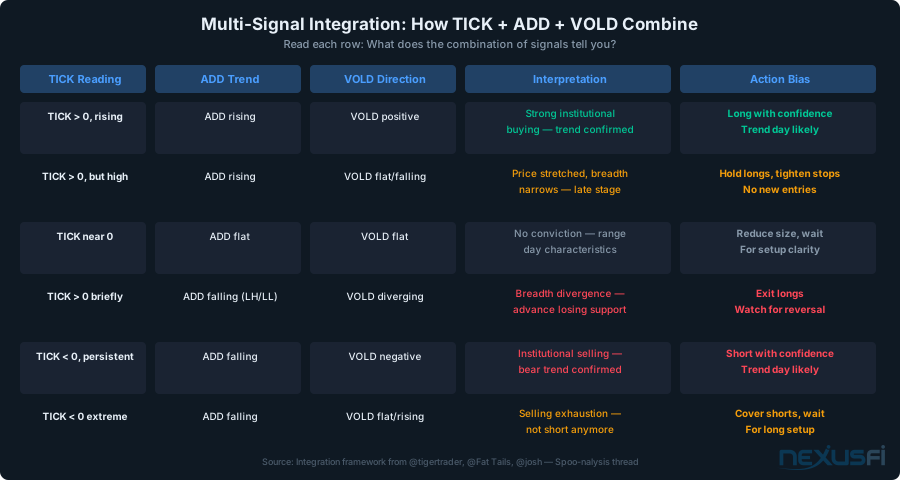
The power of market internals comes from reading all four signals together, not any single one in isolation. The integration matrix above shows the most common combinations and their implications.
The three high-conviction scenarios:
- All bullish (TICK > 0, ADD rising, VOLD positive, TRIN < 0.7): This is the institutional buying signature. Price at key support with this combination is a high-confidence long setup. These conditions often produce the trend days that define a month's P&L.
- All bearish (TICK < 0, ADD falling, VOLD negative, TRIN > 1.3): The institutional selling signature. Price at key resistance with this combination is a high-confidence short setup.
- All conflicting or neutral: Range day conditions. Reduce position size, tighten targets, avoid holding positions through VWAP reversion, and do not chase breakouts.
The divergence warning pattern: When price and TICK/ADD diverge (price higher, breadth lower), you're in a transitional zone. This is not immediately a short signal — it's a "stand down from longs" signal. Let price confirm the reversal before positioning.
Common Mistakes Traders Make With Internals #
Mistake 1: Analysis Paralysis #
Adding TICK, ADD, TRIN, VOLD, and put/call to a chart already filled with price indicators, volume, and multiple moving averages creates cognitive overload. Research consistently finds that traders who add multiple internals see performance decrease initially because they can't integrate the information fast enough during live trading.
Solution: Start with one internal — TICK — and master it for 2--3 weeks before adding anything else. Learn to read TICK's relationship to price in real time. Then add ADD. Then VOLD. Build the stack incrementally as each layer becomes automatic, not consciously processed.
Mistake 2: Single-Indicator Reliance #
"TICK is at +1000, so I should fade." This reasoning fails regularly. A TICK reading of +1000 during a strong trend day might be followed by TICK reaching +1200 and then +1400. Confirming with ADD (is the breadth expanding?) and VOLD (is volume confirming?) before fading prevents shorting into institutional buying programs.
Mistake 3: Fading When Internals Confirm the Trend #
When ADD is strongly positive for the full session, VOLD is consistently positive, and TICK is repeatedly bouncing from near-zero to positive extremes — that's a strong institutional trend day. Fading it, even at extended price levels, is fighting the tape. Internals tell you when to be patient with the trend, not just when to fade.
Mistake 4: Applying NYSE Internals to Narrow Nasdaq Moves #
During periods when NQ is dominated by a handful of mega-cap technology stocks (NVDA, META, AAPL, MSFT, etc.), NYSE breadth may be flat or even slightly negative while NQ makes multi-point rallies. During these periods, TICK and ADD from the broader NYSE may give misleading readings for NQ-specific moves. Use price structure and NQ-specific volume more heavily during such regimes.
Mistake 5: Forgetting That Internals Are Context, Not Crystal Balls #
Internals tell you whether the conditions for a specific outcome are present. They don't guarantee the outcome. A breadth divergence warning doesn't mean the market will immediately reverse — it means the advance is fragile and the risk-reward for new longs has deteriorated. Position sizing and stops still matter enormously.
Putting It Together: A Practical Workflow for ES/NQ Day Traders #
Here is a framework for incorporating internals into a live trading session without creating information overload:
Pre-Market (before 9:30 AM):
- Note the previous day's closing internals readings as context
- Check the overnight put/call ratio for session bias
- Set your TICK alert levels based on expected session volatility
Opening 30 Minutes (9:30--10:00 AM):
- Observe ADD's initial direction and slope
- Watch VOLD's direction on any opening breakout attempts
- Note TICK's opening range (establishes session baseline)
- Apply the VOLD non-confirmation filter for any breakout fade opportunities
Core Session (10:00 AM — 3:00 PM):
- Use ADD slope to confirm session regime (trend vs. range)
- Time VWAP/key level entries with TICK rotation
- Watch for breadth divergences as price approaches session extremes
- Apply TRIN as a confirmation filter, not a standalone signal
End of Day (3:00--4:00 PM):
- Manage existing positions based on price structure
- Reduce reliance on new internals signals during MOC window
- Note the day's TICK range and divergence points for post-session review
Post-Session:
- Identify the 2--3 best divergence setups of the day
- Note the TICK/ADD levels at key turning points
- Build your adaptive model of what "extreme" means in current market conditions
Knowledge Map
Go Deeper
Build on this knowledgeReferences This Article
Articles that build on this topicCitations
- — NYSE $TICK AND $ADD (2011) 👍 47“You can often identify strong days to the upside and downside when the first hour's TICK is persistently positive or negative. This means we have skewed sentiment, with stocks aggressively trading on upticks or downticks. That's a hallmark of a trending day.”
- — NYSE $TICK AND $ADD (2011) 👍 21“I think that watching market breadth indicators in parallel with index futures produces a real edge. Unlike the usual bunch of indicators, which is derived from price, the TICK, ADD and TRIN use information from a different source.”
- — Market Internals (2010) 👍 8“SMA(30) as a trendfilter on a 1 min chart. This is the most important application of $Tick. It is a second judgement of trend based on market depth.”
- — I have no "edge" -- Should I throw in the towel? (2020) 👍 25“A trend day typically opens higher/lower above/below the VWAP accompanied by a strong/weak $TICK and good/bad breadth, and remains above/below the VWAP all day, along with the 21EMA of $TICK staying positive/negative.”
- — Spoo-nalysis ES e-mini futures S&P 500 (2022) 👍 7“Some time ago I talked about the futility of using breadth in a market which is so heavily divided and which is dominated by so few players. Knowing when to throw away tools and pick them back up is important -- it's not always the same!”
- — Spoo-nalysis ES e-mini futures S&P 500 (2014) 👍 7“Location + volume ("order flow") + breadth/sentiment (TICK) = good opportunity. During this time of day the expectation is not for massive moves, but adding a little here and there on a good opportunity does add up.”
- — Spoo-nalysis ES e-mini futures S&P 500 (2015) 👍 12“Range days usually will have extreme TICKs on both side of the chart, indicating buying and selling exhaustion. Once we see a buy and sell exhaustion on both sides, there is a good probability for the day to stay in that range.”
- — Just another trading journal: PA, Wyckoff & Trends (2020) 👍 3“Check out the divergences on volume, $TICK and $ADD, along with the bodies of the $TICK bars near or below the zero line as price was 'going up' in ES. $ADD was making LH/LL almost the entire time before the turn.”
- Richard W. Arms Jr. — En.wikipedia.org
- Dr. Brett Steenbarger — Traderfeed.blogspot.com
- James F. Dalton, Eric T. Jones, Robert B. Dalton — Oreilly.com