



Market Internals Data for Futures Trading: Reading the Equity Tape's Vital Signs to Trade ES, NQ, YM, and RTY
Overview #
Market internals are the pulse of the equity market that underlies every index futures contract you trade. Unlike price-based indicators that tell you what already happened, internals tell you who's participating and how aggressively — in real time, across the entire exchange.
Here's the core idea: ES, NQ, YM, and RTY are derivatives of stock baskets. When you trade ES, you're trading the S&P 500. That basket has 500 components, and internals measure what those components are doing collectively. That aggregate behavior is the signal your chart alone cannot show you.
That captures it perfectly. Internals are not redundant with your chart. They're a at the core different data stream.
This article covers the four primary internals series — $TICK, $ADD, $VOLD, and $UVOL/$DVOL — and how to combine them into a practical trading framework for index futures.
Key Concepts #
- Market Internals: Aggregate statistics measuring the behavior of individual stocks across an exchange, used to gauge broad market participation and conviction behind price moves in index futures.
- Breadth: The degree to which a price move is supported by a wide range of stocks rather than just a few large names. Strong breadth confirms; weak breadth warns.
- $TICK (NYSE Tick Index): The net count of NYSE stocks on their last uptick minus those on their last downtick, sampled roughly every six seconds. A real-time oscillator of buying vs. selling pressure.
- $ADD (Advance-Decline Difference): The net count of stocks trading higher versus lower on the session. Smoother than TICK and better suited for identifying trend-day conditions.
- $VOLD (Volume Differential): The difference between volume flowing into advancing stocks versus declining stocks. Measures where capital is going, not just direction.
- $UVOL/$DVOL (Up Volume / Down Volume): The raw volume components behind $VOLD. The ratio normalizes for overall activity levels and is useful for risk adjustment.
- Cumulative Measures: Running totals of TICK, ADD, or VOLD from the session open. Reveal the day's internal trend and participation character over time.
- Divergence: When price makes new highs or lows but internals fail to confirm — a warning that the move lacks broad support and may reverse.
The $TICK: The Market's Heartbeat #
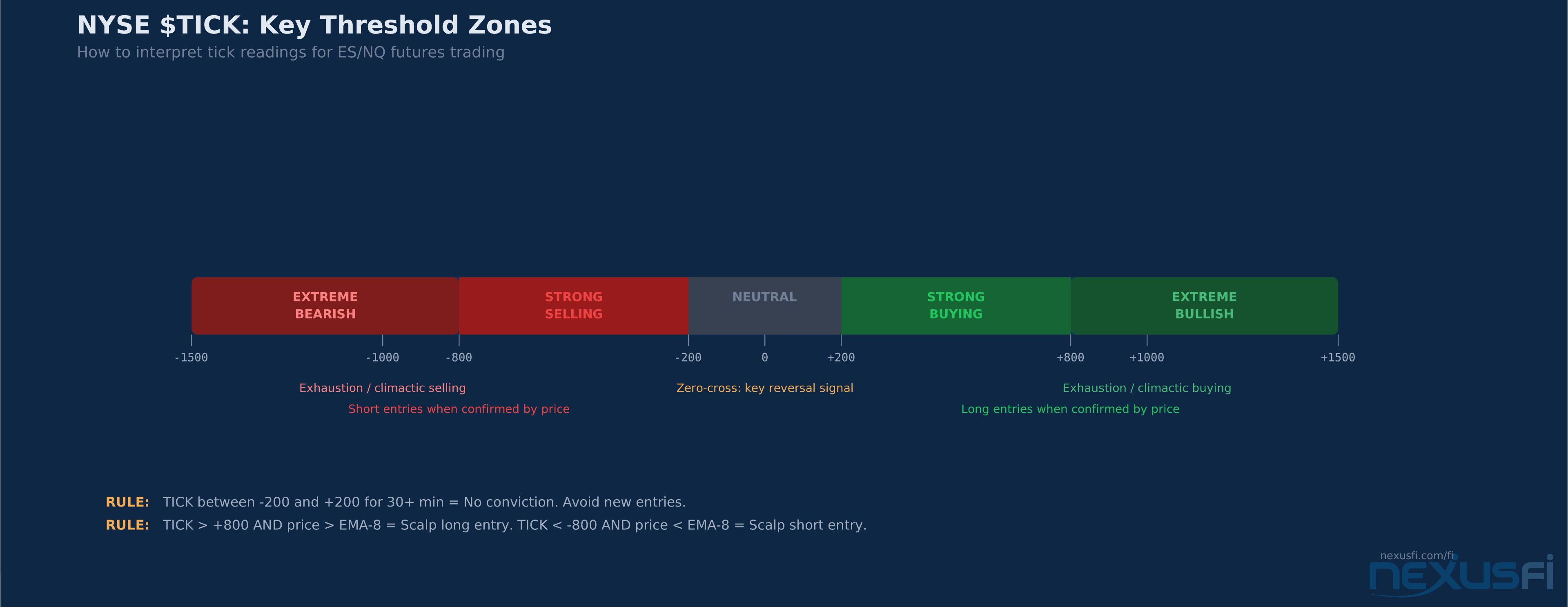
The NYSE Tick Index ($TICK) measures the net number of stocks on their last uptick minus those on their last downtick, sampled roughly every six seconds during market hours. It's a real-time oscillator that ranges from roughly -1500 to +1500 in normal conditions, with extreme readings beyond those levels during high-conviction moves.
That different source is the key — it's not derived from the same price data your chart already shows. Internals give you genuinely independent information about what the broad market is doing.
Reading Instantaneous TICK
The raw TICK reading tells you the balance of buying versus selling pressure across the entire NYSE at that exact moment. Here's what the key levels mean in practice:
- +800 to +1000: Strong buying pressure. The vast majority of NYSE stocks just traded on an uptick. In the context of an uptrend, this confirms momentum. At the end of a rally, it can signal exhaustion.
- -800 to -1000: Strong selling pressure. The mirror image. Confirms downtrends; can signal selling exhaustion at lows.
- +1000 or beyond: Extreme breadth thrust. These readings are rare and often mark significant turning points — the kind of breadth surge that can signal the beginning of a multi-day move.
- -200 to +200: Neutral territory. When TICK oscillates in this range for extended periods, the market lacks conviction. Not the time to initiate new positions based on breadth signals.
As @josh [4] demonstrates in his Spoo-nalysis thread: "One way to use TICK: The day is clearly bullish. The divergence at the high indicates at least caution. Then a pretty good sell." That divergence between price action and breadth is one of the most reliable warning signals in futures trading.
The Zero-Cross
When TICK crosses from negative to positive (or vice versa), it signals a shift in the balance of buying versus selling across the entire NYSE. This zero-cross has been studied extensively by futures traders as a timing mechanism:
- TICK crosses positive while ES is above its 5-minute EMA: Long entry signal
- TICK crosses negative while ES is below its 5-minute EMA: Short entry signal
- TICK crosses zero but price doesn't confirm: Weak signal, treat with skepticism
The zero-cross works best during the first two hours of the session when participation is highest. During lunch hours (12:00-1:30 PM ET), TICK signals become less reliable as participation thins.
Cumulative TICK (CUMTICK)
The running total of TICK readings from the session open reveals the day's internal trend. This is arguably the most powerful single internal for intraday futures traders.
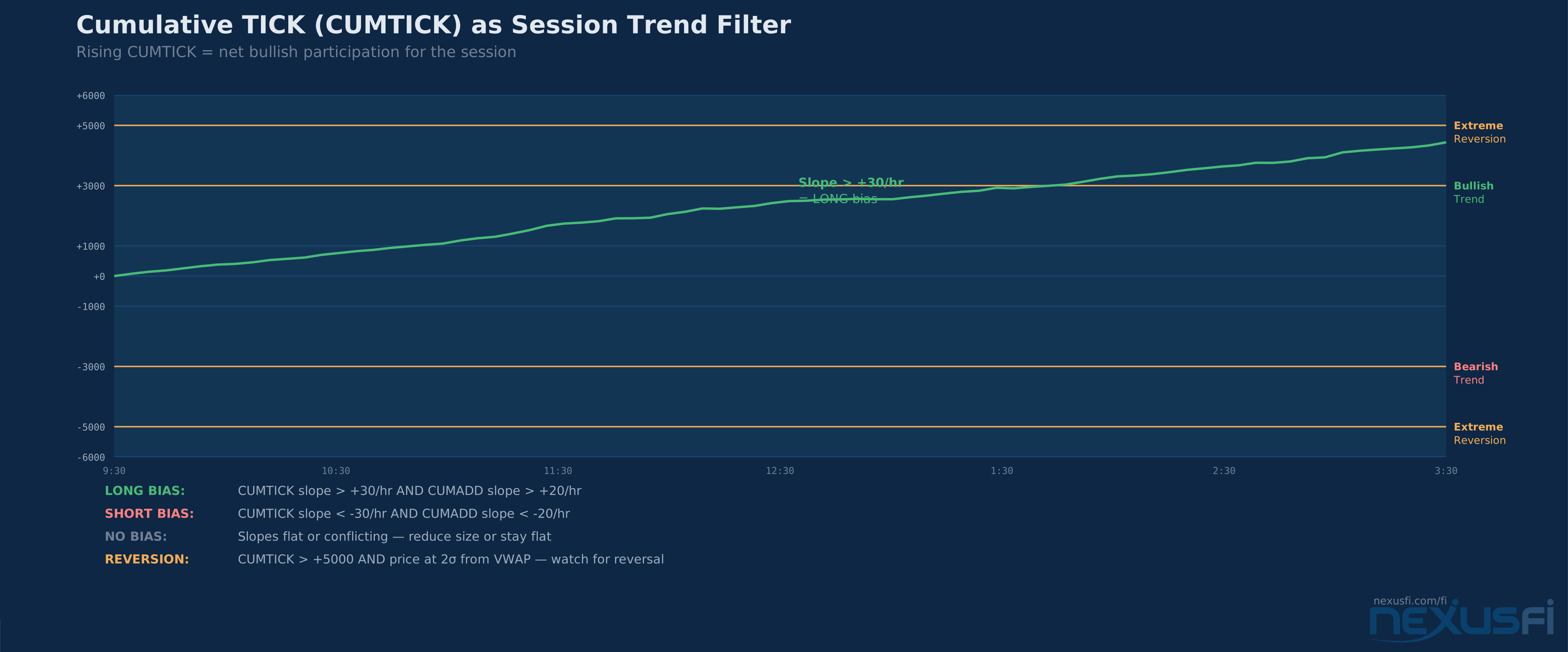
When CUMTICK is rising, the market's breadth is net-positive for the session. When it's falling, breadth is net-negative. The slope matters more than the absolute level. A CUMTICK slope of +30 or more per hour indicates solid bullish participation; -30 or steeper indicates solid bearish participation.
Key thresholds for CUMTICK:
- +3000 or higher: Strong bullish session. TICK has been consistently positive. Bias remains long unless price action contradicts.
- -3000 or lower: Strong bearish session. Bias remains short.
- +5000 or beyond: Extreme levels that often precede mean-reversion. If price is also at a 2-standard-deviation extreme from the session VWAP, watch for a reversal.
The $ADD: Participation Direction #
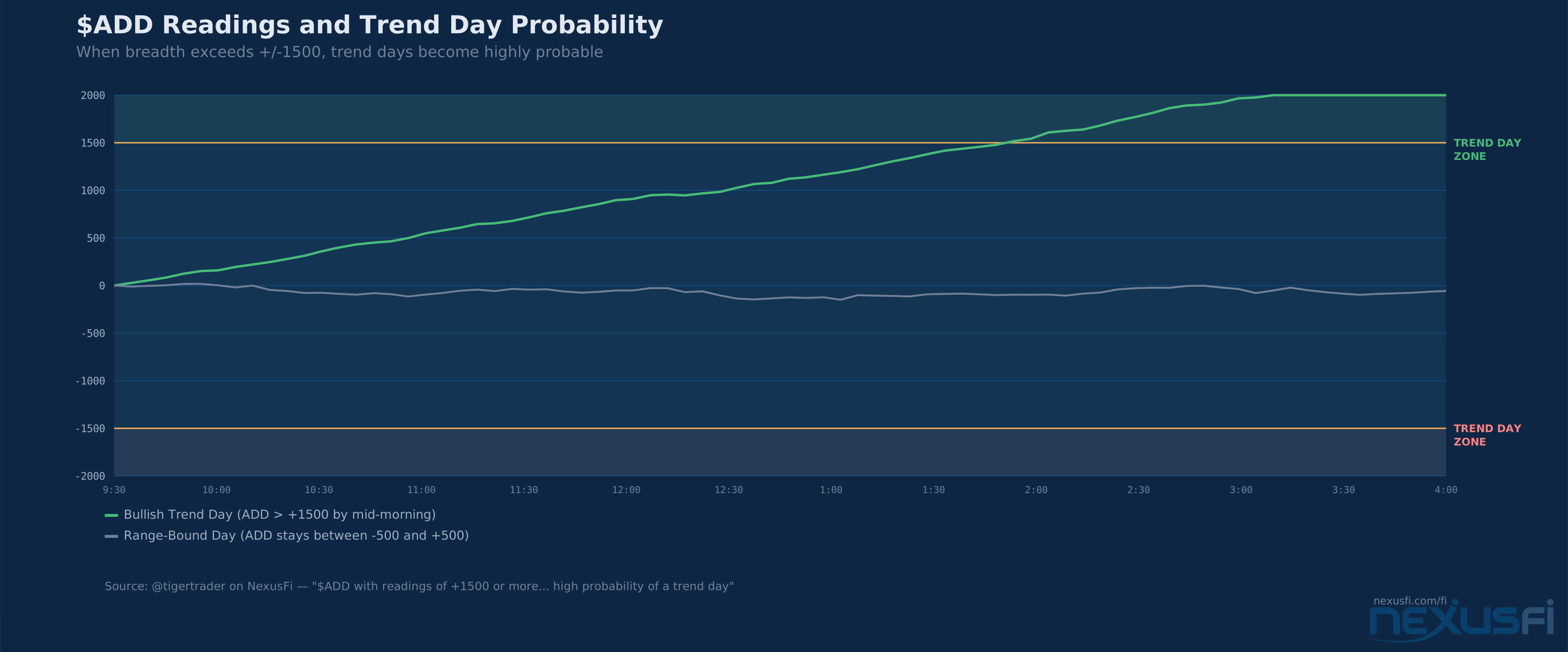
Where TICK measures the last trade direction, the Advance-Decline Difference ($ADD) measures the net count of stocks moving higher versus lower on the session. It's smoother, less noisy, and better suited for identifying the day's overall participation character.
That's the single most actionable use of ADD — identifying trend days early enough to position with the move rather than against it.
ADD Thresholds in Practice
- +1500 or beyond: Broad participation to the upside. High probability of a trend day. Bias long for ES; don't fight the tape.
- -1500 or beyond: Broad participation to the downside. Same logic, reversed.
- -500 to +500: Indecisive breadth. The market hasn't made up its mind. Expect rotation, chop, and mean-reverting price action in futures.
This is the essence of breadth analysis. Price alone doesn't tell you whether the move is real. ADD tells you whether the majority of stocks agree with the direction or whether a handful of large caps are dragging the index.
Cumulative ADD (CUMADD)
The running total of ADD readings from the open. CUMADD trending consistently in one direction tells you the session's participation character. A slope of +20 or more per hour is solidly bullish; -20 or steeper is solidly bearish.
CUMADD is especially useful for position sizing. When CUMADD slope aligns with your trade direction, you can scale up with higher confidence. When CUMADD is flat while price trends, reduce size — the move may lack staying power.
ADD-TICK Divergence
This is where it gets interesting. When TICK spikes to extreme levels but ADD barely moves, it means a few heavily-traded stocks are driving the TICK reading while the broad market doesn't agree. This is "narrow breadth" — and it's a warning sign.
For ES traders, narrow breadth (high TICK, flat ADD) often precedes reversals. The move is being driven by a small number of large-cap names, not by genuine market-wide conviction. As @josh [5] has observed, this becomes especially relevant "in a market which is so heavily divided and which is dominated by so few players."
The $VOLD: Following the Money #
Volume Differential ($VOLD) measures the difference between volume flowing into advancing stocks versus declining stocks. If TICK tells you direction and ADD tells you participation count, VOLD tells you where the capital is going.
A strong VOLD reading means real money is behind the move. Institutional traders can't hide their volume — it shows up in VOLD before it shows up anywhere else.
VOLD Thresholds
- +2 million or beyond: Heavy buy-side volume dominance. Real institutional commitment to the upside. Confirms bullish moves in ES.
- -2 million or beyond: Heavy sell-side volume dominance. Same logic for bearish moves.
- Near zero: Volume is evenly split between advancers and decliners. No conviction.
The VOLD/TICK Ratio
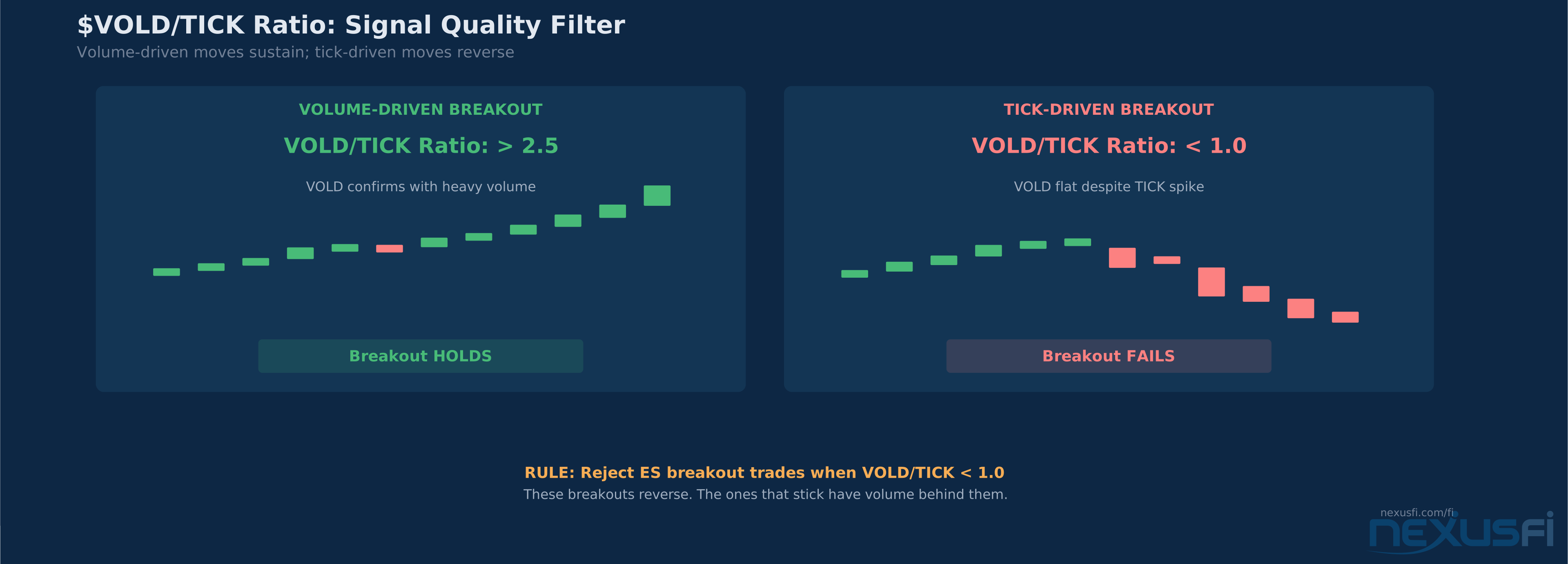
This is an underappreciated signal quality filter. When VOLD/TICK exceeds 2.5, the price move is volume-driven — real capital is behind it, not just algorithmic noise.
Practical application: reject ES breakout trades when VOLD/TICK is below 1.0. These are the breakouts that reverse. The ones that stick have volume behind them.
Cumulative VOLD (CUMVOLD)
The session's running total of VOLD. Trend thresholds: +5 million is solidly bullish volume flow; -5 million is solidly bearish. The slope of CUMVOLD tells you whether institutional participation is increasing or fading. A slope of +0.5 million per hour or more indicates growing buy-side commitment.
$UVOL and $DVOL: The Raw Volume Split #
Up Volume ($UVOL) and Down Volume ($DVOL) are the raw components that compose $VOLD. Some traders prefer working with the ratio rather than the difference, because the ratio normalizes for overall activity levels.
Working with the UVOL/DVOL Ratio
- Ratio above 1.5: Clear buying pressure. Volume is meaningfully skewed toward advancing stocks.
- Ratio below 0.66: Clear selling pressure. Volume is concentrated in declining stocks.
- Ratio near 1.0: Balanced volume. No directional conviction from the volume side, regardless of what price is doing.
The ratio is especially useful for risk adjustment. When the UVOL/DVOL ratio is near 1.0 (balanced), reduce position size even if other signals suggest a directional trade. Balanced volume during a directional move means the move lacks the broad commitment to sustain itself.
As @rahulgopi [7] shares in his trading journal: "This is basically the market internals components that I follow. It has 1) TICK 2) SPREADs (SP and NYSE adv/decline) 3) Volume breadth (NYSE)." That combination covers the three essential dimensions: direction (TICK), breadth (spreads), and volume participation.
Contract-Specific Nuances #
Not all index futures relate to market internals the same way. The underlying basket composition determines which exchange's internals matter most.
ES (E-mini S&P 500)
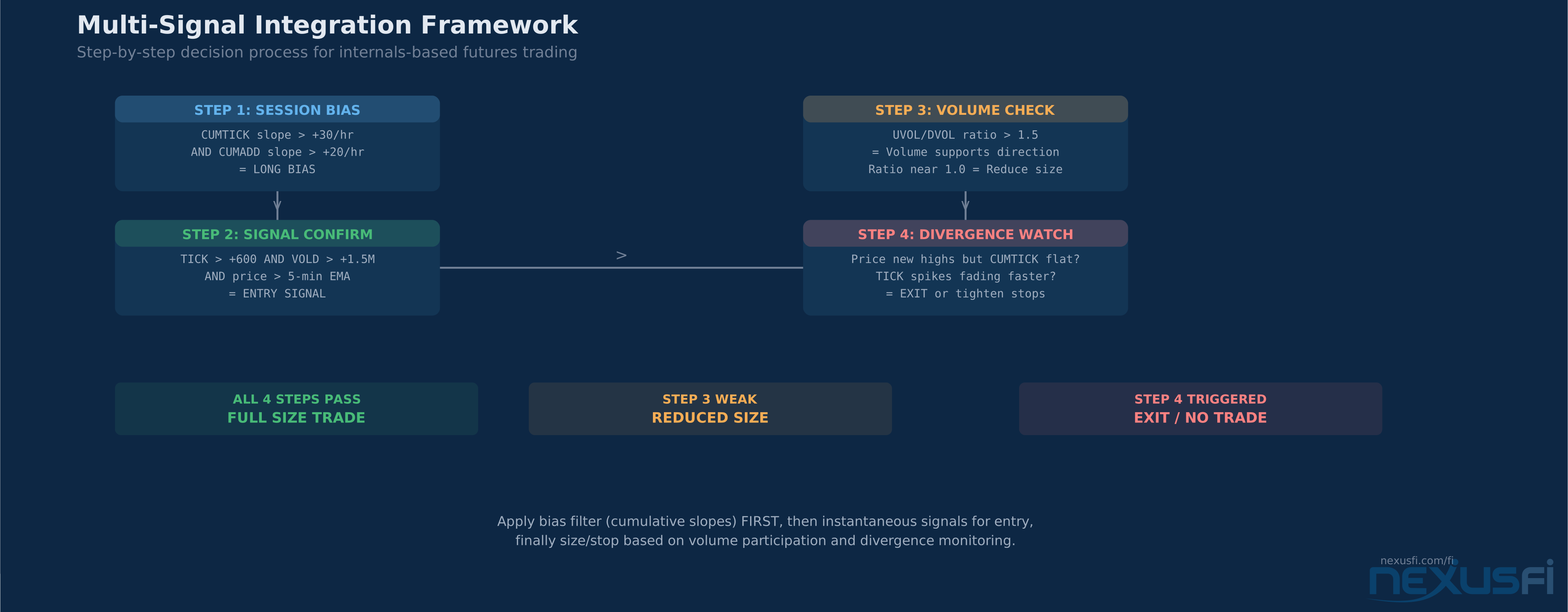
ES has the cleanest relationship with NYSE internals because the S&P 500 is broadly diversified across NYSE-listed stocks. $TICK, $ADD, and $VOLD all work well with ES, and this is where most of the historical research and community experience applies.
NQ (E-mini Nasdaq 100)
NQ is tech-heavy, and the Nasdaq 100 doesn't perfectly overlap with NYSE breadth. Traders working NQ should consider NASDAQ-specific internals ($NASDAQ-TICK, or whatever your data vendor labels the Nasdaq 100 tick equivalent) alongside NYSE measures. As @Jigsaw Trading [3] demonstrates with side-by-side charts: the NYSE TICK and NASDAQ 100 TICK often tell similar stories but diverge meaningfully during tech-driven moves. When they diverge, the NASDAQ-specific reading is more relevant for NQ.
YM (E-mini Dow)
YM (Dow Jones) is price-weighted and only 30 stocks. NYSE internals still apply, but YM can be more idiosyncratic — a single stock like UNH or GS can move the Dow disproportionately, making broad internals less predictive for short-term YM moves.
RTY (E-mini Russell 2000)
The Russell 2000 is the broadest index of the four, and ironically has the strongest correlation with NYSE internals. Small-cap stocks are overwhelmingly NYSE-listed, making $TICK and $ADD highly relevant for RTY. When NYSE breadth moves, RTY tends to follow closely.
Integrating Internals: The Multi-Signal Framework #
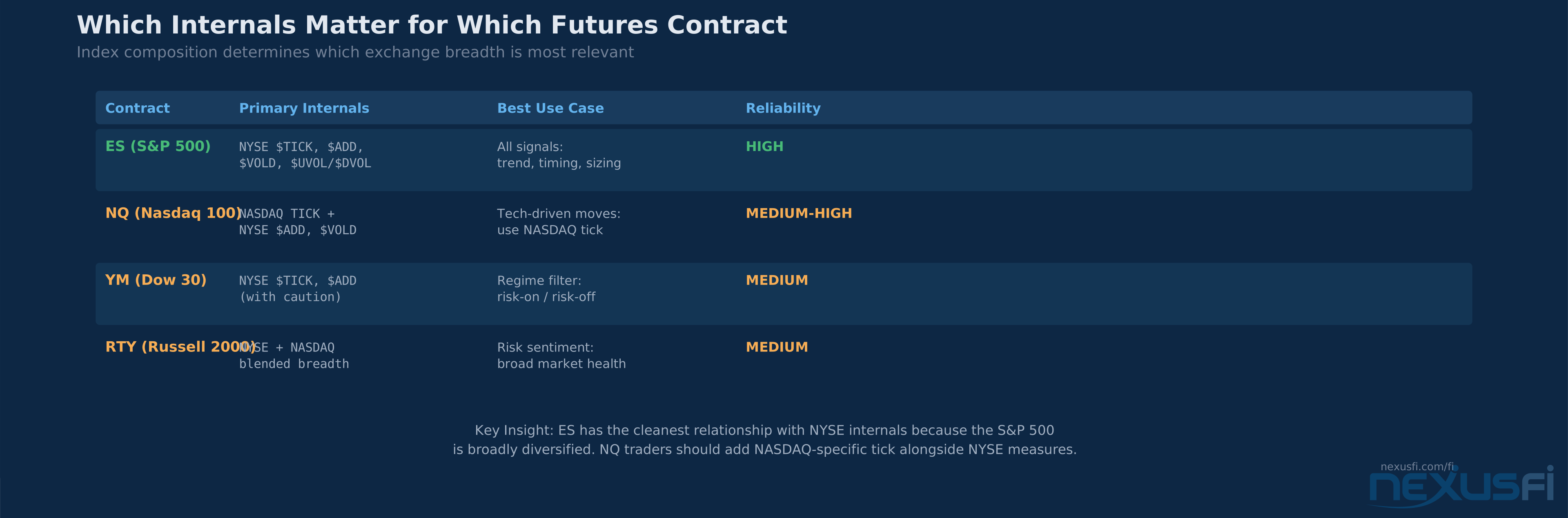
No single internal tells the whole story. The power comes from combining them. Here's the framework that experienced futures traders use, built from the four pillars:
Step 1: Establish Session Bias (Cumulative Measures)
Before taking any trade, check the cumulative slopes:
- CUMTICK slope > +30/hour AND CUMADD slope > +20/hour: Session bias is LONG
- CUMTICK slope < -30/hour AND CUMADD slope < -20/hour: Session bias is SHORT
- Slopes flat or conflicting: No clear bias. Reduce size or sit on hands.
Step 2: Confirm with Instantaneous Readings
For long entries, require: TICK > +600 AND VOLD > +1.5 million AND price above the 5-minute EMA. For short entries, require: TICK < -600 AND VOLD < -1.5 million AND price below the 5-minute EMA.
Step 3: Validate with Volume Participation
Check UVOL/DVOL ratio. If taking a long trade, the ratio should be above 1.5. If it's near 1.0, the volume doesn't support the direction — reduce size or pass on the trade entirely.
Step 4: Monitor for Divergence
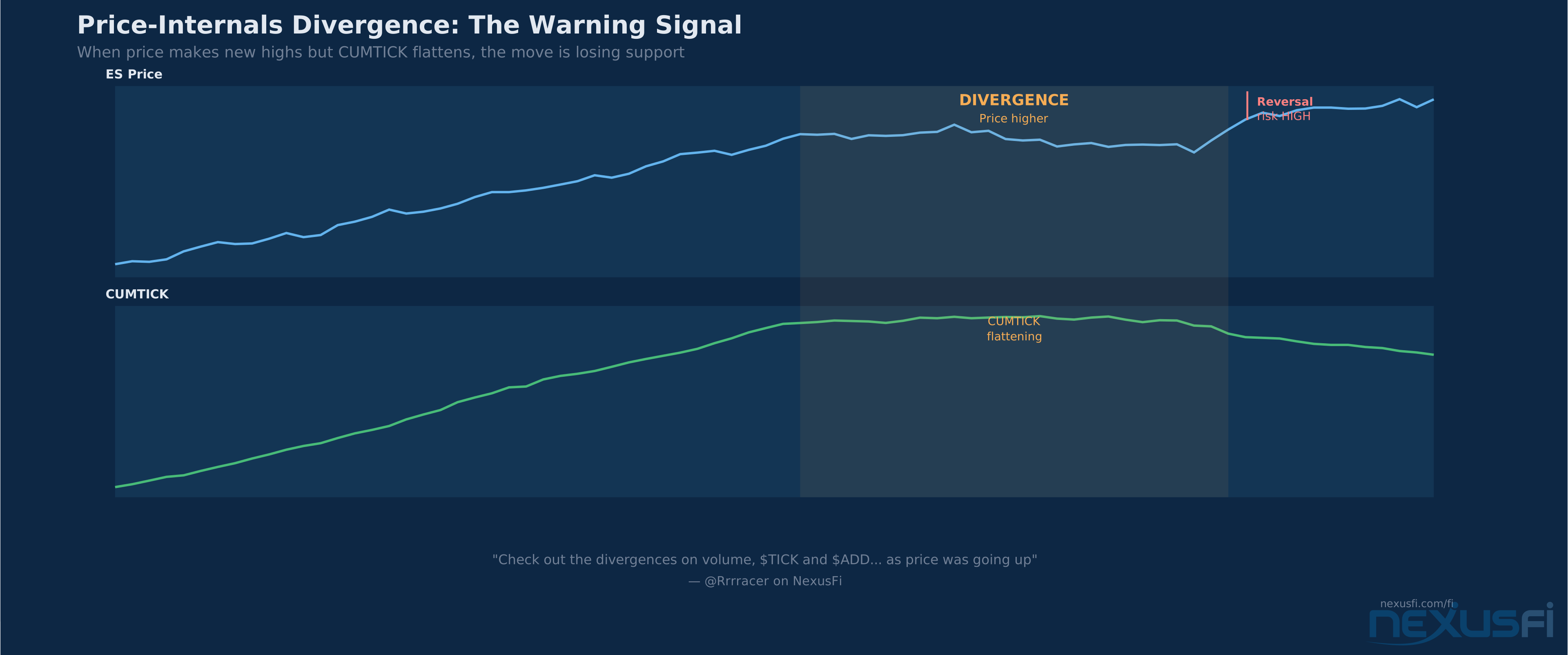
The most important ongoing check: are internals still confirming what price is doing? When price makes new session highs but CUMTICK flattens, or when TICK spikes fade more quickly, the move is losing participation support.
That's the divergence warning in real time. When you see price climbing but internals rolling over, the smart money is already stepping back.
When Internals Fail #
Internals are not a crystal ball, and there are specific conditions where they become less reliable or outright misleading.
Concentrated Market Moves
When a small number of mega-cap stocks drive the index (think AAPL, MSFT, NVDA together comprising 20%+ of the S&P 500), price can move much while breadth stays flat or negative. This is the "narrow market" problem that @josh has written about extensively. In these conditions, TICK and ADD may not confirm the move, but the move can persist anyway because cap-weighted index math doesn't care about breadth.
News-Driven Sessions
Major economic releases (NFP, CPI, FOMC) cause simultaneous repricing across the entire market. TICK can flash to extreme readings (+1000 or beyond) within seconds and then reverse just as fast. During news events, internals readings are unreliable for 5-15 minutes. Wait for the dust to settle before trusting breadth signals.
Low-Participation Periods
During lunch hours (roughly 12:00-1:30 PM ET), holiday weeks, and late-summer sessions, total market participation drops. With fewer stocks actively trading, TICK and ADD readings become noisier. A TICK reading of +600 during a quiet lunch means less than the same reading at 10:00 AM when participation is full.
After Hours
A critical caveat: internals are only available during NYSE/NASDAQ regular trading hours (9:30 AM - 4:00 PM ET). Futures trade nearly 24 hours. During overnight Globex sessions, you have no internals data at all. Don't assume yesterday's internal readings carry over. Each session starts fresh.
As @cogito [6] notes: "I use VIX and the market internals to get an idea of broader market sentiment. I don't read too much into divergences of market internals." That's a healthy perspective. Internals inform your decisions; they don't make them for you.
Data Sources and Setup #
Internals data comes from the exchanges and is distributed through data vendors. The quality and latency vary much.
Where to Get Internals Data
Most futures trading platforms support internals symbols, though the exact ticker names vary:
- NinjaTrader: $TICK, $ADD, $VOLD, $UVOL, $DVOL (with Kinetick or CQG data)
- Sierra Chart: $TICK.X, $ADD.X, $VOLD.X (with various data feeds)
- ThinkorSwim: $TICK, $ADD, $VOLD (included with TD Ameritrade data)
- CQG: TICK, ADD, VOLD (native CQG symbols)
Latency Considerations
For scalping, internals latency matters. A delayed TICK reading is worse than no TICK reading because you'll act on stale data during fast moves. If you're scalping ES with TICK as a trigger, make sure your data feed delivers internals with sub-second latency.
For swing-style intraday trading on 5-minute bars, standard data feeds are adequate. The cumulative versions smooth out any minor latency issues.
Building Cumulative Series
Many platforms don't provide cumulative TICK, ADD, or VOLD natively. You'll need to build them yourself or use community-shared indicators. The logic is straightforward: sum each reading from the session open. Most NinjaTrader and Sierra Chart users find community-developed cumulative breadth indicators in the NexusFi forums.
Quick Reference: Thresholds and Decision Rules #
This table summarizes the key thresholds discussed throughout this article. These are rule-of-thumb starting points based on 5-minute aggregation for NYSE internals. Calibrate to your volatility regime and session.
Instantaneous Signals
- $TICK > +800: Extreme bullish pressure (confirm or fade depending on context)
- $TICK < -800: Extreme bearish pressure
- $ADD > +1500: High probability of trend day to the upside
- $ADD < -1500: High probability of trend day to the downside
- $VOLD > +2M: Strong buy-side volume dominance
- $VOLD < -2M: Strong sell-side volume dominance
- UVOL/DVOL > 1.5: Clear buying pressure
- UVOL/DVOL < 0.66: Clear selling pressure
Cumulative Session Signals
- CUMTICK > +3000: Bullish session, trade with the trend
- CUMTICK < -3000: Bearish session, trade with the trend
- CUMTICK slope > +30/hr AND CUMADD slope > +20/hr: Session bias is LONG
- CUMTICK slope < -30/hr AND CUMADD slope < -20/hr: Session bias is SHORT
Warning Signals
- TICK extreme but ADD flat: Narrow breadth — move driven by few names, likely to fade
- VOLD/TICK ratio < 1.0: Tick-driven move without volume support — don't trust the breakout
- TICK between -200 and +200 for 30+ minutes: No conviction — stay flat or reduce size
- Price at new highs/lows but CUMTICK flattening: Divergence — the move is losing participation
Knowledge Map
Go Deeper
Build on this knowledgeReferences This Article
Articles that build on this topicCitations
- — NYSE $TICK AND $ADD (2011) 👍 47“TICK - First Panel The NYSE TICK tells us how many stocks are trading at their offer price minus those trading at their bid. It is now available on NT with a live Kinetick feed, and goes under the symbol ^TICK.”
- — NYSE $TICK AND $ADD (2011) 👍 21“Thank you for this post. I think that watching market breadth indicators in parallel with index futures produces a real edge.”
- — My Indicators (2011) 👍 7“https://nexusfi.com/attachment.php?attachmentid=32471&stc=1&d=1299120554 These 2 charts are showing almost the same thing. Chart 1 is based on NYSE TICK and Chart 2 is based on NASDAQ 100 TICK.”
- — Spoo-nalysis ES e-mini futures S&P 500 (2014) 👍 7“One way to use TICK: https://nexusfi.com/v/screencast/2RIfT3LGl.png The day is clearly bullish. The divergence at the high indicates at least caution. Then a pretty good sell.”
- — Spoo-nalysis ES e-mini futures S&P 500 (2022) 👍 7“Some time ago I talked about the futility of using breadth in a market which is so heavily divided and which is dominated by so few players (aapl, msft, googl, tsla, etc.).”
- — RG's Emini Journal (2015) 👍 7“My 2 cents I use VIX and the market internals to get an idea of broader market sentiment. I dont read too much into divergences of market internals with any single instrument.”
- — RG's Emini Journal (2016) 👍 4“This is essentially the market internals components that I follow. It has 1) TICK 2) SPREADs ( SP and NYSE adv / decline ) 3) Volume breadth ( NYSE and SP ) 4) VIX 5) Cum TICK I use a combination of internals and inter market correlations (NQ, YM, Ye...”
- — A Cowboy's Trading Journal (2015) 👍 2“Sorry for the losses you took. The biggest clue that you may have overlooked yesterday, when you say you were surprised by the grind up day, was that volume breadth was extremely bullish from open to close of RTH session.”
- — Just another trading journal: PA, Wyckoff & Trends (2020) 👍 3“Check out the divergences on volume, $TICK and $ADD, along with the bodies of the $TICK bars near or below the zero line as price was "going up" in ES. $ADD was making LH/LL almost the entire time before the turn.”
- — Help with Market internals (2020) 👍 4“I'll throw in my two cents, admittedly as an amateur trader myself. I primarily use advance-declines and tick's because what they calculate makes the most sense to me.”