



Automated Futures Trading Architecture: Production System Design for 7 Decoupled Layers
Overview #
Most failed automated futures systems die from the same set of causes: state corruption after a disconnect, a risk check that runs at startup but not live, an order that gets submitted twice after a reconnect, a position that diverges from the broker's records because fills arrived out of order. None of these are strategy problems. They're architecture problems.
Automated trading architecture is how you organize the components between "market moves" and "order hits the exchange" so that each failure mode is contained rather than cascading. When you get it right, a data feed outage stops trading cleanly and resumes without ghost positions. A strategy bug affects one instrument, not the account. A broker disconnect reconciles automatically within seconds.
This article covers the architecture that production futures systems actually use: seven decoupled layers, the event patterns that connect them, order lifecycle state machines, risk control integration, and the fault tolerance patterns that determine whether your system survives 24/7 operation or eats your account at 2 AM.
The most common cause of automated trading account damage isn't bad signals. It's state mismatches, duplicate orders, and reconnection bugs. Architecture determines which failure modes you're exposed to before you write a single line of strategy logic.
The Production Architecture Mindset #
Amateur automation puts the strategy first: write a signal, hook it up to an order submission function, start trading. This works until the first broker disconnect, the first partial fill that corrupts the position tracker, the first reconnect that submits the same order twice.
Professional automation inverts the priority: design the pipeline first, test the failure modes before adding strategy logic.
The fundamental insight from engineers who've built these systems commercially: a trading system that handles failure modes correctly will make money when the strategy is good; a system built without failure handling will lose money even when the strategy is good. The architecture is load-bearing.
Three principles govern every design decision:
Decouple everything. Strategy logic should know nothing about exchange-specific order formats, risk rule details, or position tracking mechanics. Each layer should be replaceable without touching its neighbors.
State lives in one place. Position state doesn't live in the strategy. Order state doesn't live in the market data handler. Canonical state lives in designated services that everything else reads from.
Fail closed. When the system doesn't know its current state — after a disconnect, during reconciliation — it stops trading, not continues with potentially corrupt state.
The Seven Layers #
Every production automated futures system has the same seven components. The sequencing matters: each layer depends on correct input from the one before it.
Layer 1: Market Data Service #
The market data layer connects to your broker or data vendor, normalizes symbols across contract conventions, detects sequence gaps, and publishes timestamped MarketDataEvent objects to the event bus.

What distinguishes production market data handling from naive implementations:
Symbol normalization. ES and @ES# and ESH26 and the broker's internal code for the ES March front-month all refer to the same instrument. The market data service resolves these to a canonical internal symbol before anything else sees the data. Failure to normalize means your risk engine thinks ES and @ES# are two separate instruments with independent position limits.
Sequence gap detection. Market data feeds use sequence numbers. A gap between sequence 1001 and 1003 means you missed 1002 — a price update your strategy never saw. Naive systems ignore gaps. Production systems detect them, log them, and request replays where available. A data gap is worse than a data outage: with an outage the system halts. With a missed update, the strategy continues on stale information without knowing it.
Monotonic timestamps. Every event should carry both the exchange timestamp (when the market event occurred) and the local receive timestamp (when your system received it). Using only local timestamps creates subtle backtesting divergences — your backtest uses exchange timestamps, live uses local, and the mismatch explains half the "backtest-to-live gap."
Session awareness. Market data services must know when exchanges open and close, when maintenance windows start, when contract rolls occur. The 5 PM CME maintenance disconnect should trigger a graceful pause, not an unexpected reconnect sequence that fires your fault recovery protocol.
Layer 2: Event Bus #
The event bus is the nervous system of the architecture. Every component publishes events to it; every component subscribes to what it needs. This decoupling is what makes the system modular: the market data service doesn't know who reads its events, and the strategy engine doesn't know where its signals come from at the transport level.
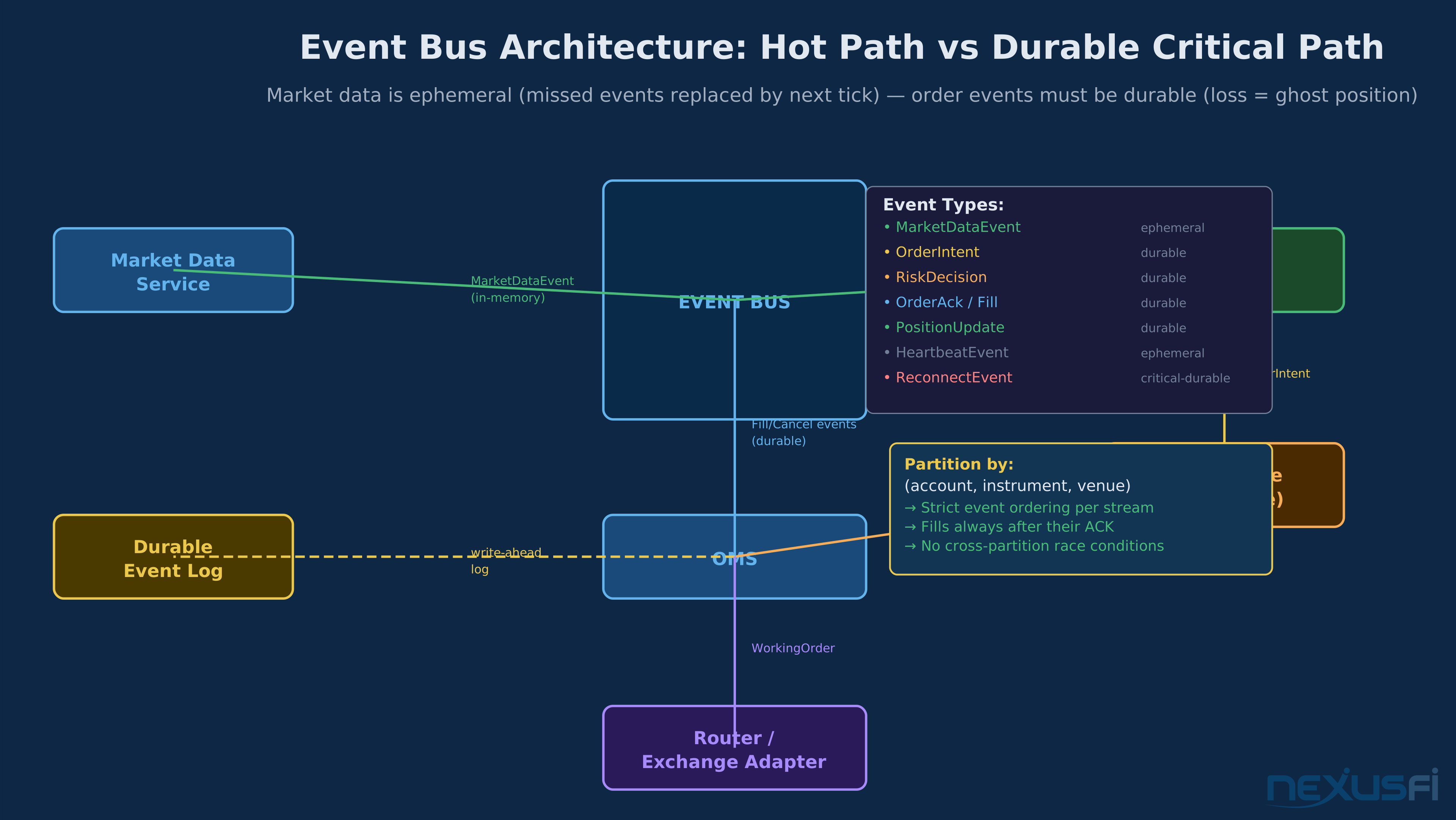
The event taxonomy splits into two categories with at the core different handling requirements:
Hot-path events (high volume, latency-sensitive, ephemeral): MarketDataEvent, BarEvent, BookUpdateEvent. These can be in-memory only — if you miss one, the next one arrives in milliseconds. Processing speed matters; persistence doesn't.
Durable-path events (low volume, crash-critical, must not be lost): OrderIntent, RiskDecision, OrderAck, FillEvent, CancelEvent, PositionUpdate. These MUST be persisted before the system acts on them. If your process crashes between submitting an order and recording the submission, you have an order the exchange has that your OMS doesn't know about. That's a ghost position.
A practical hybrid: use in-memory dispatch for the hot path (ring buffer or async queue), and an append-only write-ahead log for the durable path. This gives you low latency where it matters and crash-recovery guarantees where they're critical.
Partitioning rule: Partition the event bus by (account, instrument, venue). Within each partition, process events in strict sequence. This guarantees that fills never arrive before their acknowledgment, that position updates don't skip a sequence number, and that you can run concurrent processing across different instruments without cross-contamination.
Every order event, fill, and position update should carry a trace ID that propagates through every component that touches it. When debugging why an order was canceled 47 minutes into a session, you want to replay the exact sequence of events by trace ID, not reconstruct from timestamps.
Layer 3: Strategy Engine #
The strategy engine consumes market events and emits OrderIntent objects. That's its entire job. The strategy should know nothing about:
- How to format an order for NinjaTrader, Rithmic, or FIX
- What the current day's loss limit is
- How to calculate margin
- What the current working orders look like at the OMS level
The strategy produces intent: "want to buy 3 ES if price closes above 5,450.00 on a 5-minute bar." Everything downstream converts that intent into action.
This isn't just clean code design. It's a practical requirement for reliable operation:
Testing becomes tractable. You can test strategy logic in isolation by feeding it a stream of market events and asserting on the OrderIntents it produces, without an OMS, a risk engine, or a live exchange.
Backtesting matches live. When strategy logic doesn't contain execution code, the same strategy object runs in backtest and live. The only difference is what subscribes to its OrderIntents — a historical fill simulator or the actual OMS.
Risk checks can't be bypassed. If strategy logic places orders directly, a strategy bug can bypass your risk checks entirely. When all order flow goes through the risk gate as OrderIntent objects, bypassing the gate requires an explicit architectural change, not an accidental one.
Layer 4: Risk Engine (Hard Gate) #
The risk engine is the gate between intent and action. It sits between the strategy's OrderIntents and the OMS. Every intent must be approved before the OMS acts on it. No exceptions.
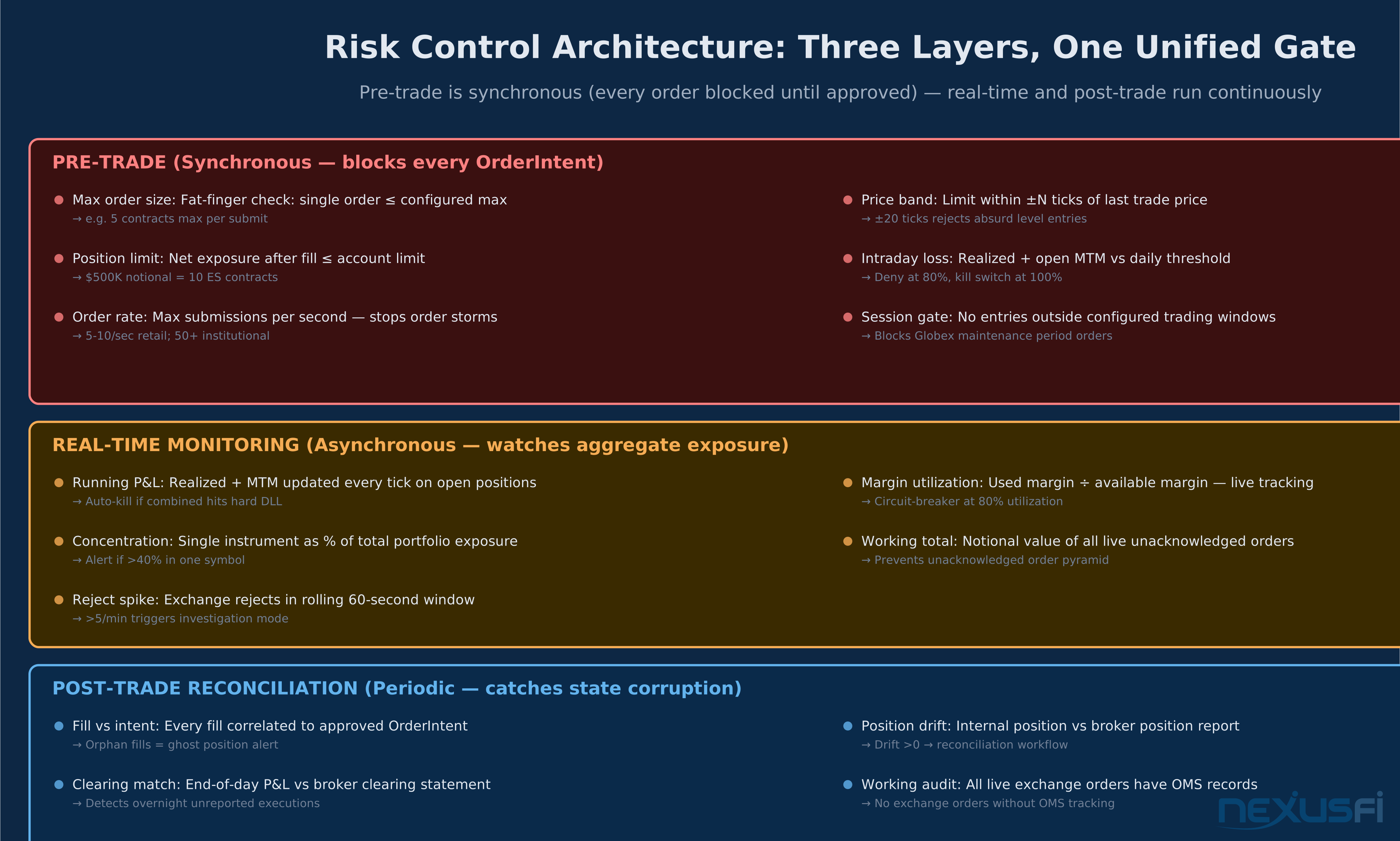
The risk engine should be fast (under 1 millisecond for the check cycle), deterministic (same state + same intent = same decision), and fail-closed (deny all new intents when state is uncertain after a disconnect).
Pre-trade checks (synchronous, run before every order):
Max order size prevents fat-finger submissions. If your strategy normally trades 2-3 contracts and a bug generates a 500-contract intent, the risk engine stops it before it reaches the exchange. NinjaTrader 8's built-in risk settings include per-strategy order size limits as of 2023 — use them as a second layer, not your primary check.
Price band check: the intent's limit price must be within N ticks of a reference price (typically last trade). Catches situations where stale cached prices generate orders at absurd levels.
Position limit check: the position after fill must not exceed the account's configured max. This includes working orders — a strategy that generates 10 sequential buy intents before any fill arrives needs cumulative exposure tracking, not just current-position checking.
Daily loss limit: realized P&L plus open mark-to-market versus the configured threshold. The risk engine needs access to the position service's current MTM to compute this accurately. Most failures happen because the risk engine tracks only realized P&L, ignoring open positions.
Order rate limit: maximum order submissions per second. Without this, a runaway loop submits thousands of orders in seconds.
Real-time monitoring (asynchronous, continuous):
The pre-trade gate checks each order individually. Real-time monitoring watches aggregate exposure as it builds:
- Running P&L (realized + open MTM) updated every tick on open positions
- Margin utilization as a percentage of available margin
- Concentration by instrument — flags when one position represents more than 40% of total exposure
- Working order total — prevents submitting a pyramid of unacknowledged orders
When real-time monitoring hits a threshold, it triggers circuit breakers: reduce-only mode, soft warnings at 80% of limits, hard stops at 100%.
Post-trade reconciliation:
After every fill, the risk engine verifies that the fill matches an approved intent. Orphan fills — fills with no corresponding approved intent — are a critical alert. This happens more often than expected: broker errors, exchange-side corrections, margin liquidations. Any of these can change your account's position without going through your strategy.
Layer 5: Order Management System (OMS) #
The OMS is the source of truth for every order. It receives approved intents from the risk engine and manages their lifecycle through an explicit state machine.

The state machine is not optional. It's the mechanism that prevents replacing an order that's already been filled, canceling an order that was rejected two seconds ago, or submitting duplicate orders after a reconnect.
Order lifecycle states:
NEW → RISK_APPROVED → SUBMITTED → ACKNOWLEDGED → {PARTIAL_FILL, FILLED, CANCELED, REJECTED, EXPIRED}From PARTIAL_FILL, the order either reaches FILLED (remaining quantity executes) or enters CANCEL_PENDING if a cancel is requested against the residual.
Every state transition is recorded in the durable event log before it's acted on. If your process crashes while an order is in SUBMITTED state, the event log shows it was submitted, the next startup can query the exchange for its status, and the OMS can recover to ACKNOWLEDGED or REJECTED from the exchange's response.
Idempotency:
The OMS must be idempotent for all operations. Submitting the same order twice should not create two live exchange orders. Canceling an already-canceled order should not cascade an error. This is implemented via:
- Deterministic client-order IDs: generate the ID from a hash of (strategy_id + intent_id + timestamp_bucket). The same logical order, submitted twice, generates the same client-order ID, which the exchange deduplicates.
- State machine guards: the OMS checks current state before processing a transition. A submit operation on an order already in
SUBMITTEDstate is a no-op, not a duplicate submission.
Partial fill handling:
Partial fills are common in futures. An order for 5 contracts may receive 2 fills, then 2 fills, then 1 fill over several seconds. The OMS must aggregate fill quantities, maintain accurate average fill prices, track remaining unfilled quantity, and support the decision to leave the residual working or cancel it.
Layer 6: Router and Exchange Adapter #
The router converts the OMS's ApprovedIntent into exchange-specific orders. It's the only component in the system that knows anything about FIX protocol encoding, broker-specific WebSocket formats, exchange-specific order type codes, per-venue rate limits, or session management sequences.
Everything upstream of the router speaks a canonical internal order model. The router is where that model meets the exchange's quirks.
Order routing policy:
For retail futures trading with a single broker, routing is straightforward. As you scale, routing policy matters:
- Passive vs aggressive: IOC (immediate-or-cancel) for aggressive fills when urgency is high; GTC limit orders for passive entries where queue position matters
- Order type selection: market orders, stop-limit, stop-market — the router enforces exchange-specific rules about which types are available during which sessions
- Contract roll: the router must handle front-month to next-month roll, either automatically on configured roll dates or flagged for manual confirmation
Throttling:
Exchange rate limits are enforced at the router level. The router maintains per-venue rate governors that queue or delay submissions when approaching limits. This is the difference between a graceful slowdown and a flood of exchange rejects that triggers your reject-spike circuit breaker.
Layer 7: Reconciliation and Control Plane #
The reconciliation service and control plane are often the most neglected components and the most operationally important.

Reconciliation:
At session start, after every reconnect, and periodically during the session, the reconciliation service queries the broker for all open/working orders, recent execution reports since the last known sequence number, and current positions. It then diffs this against the system's internal state:
- Exchange has an order the OMS doesn't know about: cancel it
- OMS shows a working order the exchange doesn't have: mark it CANCELED
- Position discrepancy: alert and suspend trading until resolved
The reconciliation step prevents the worst-case scenario: your system thinks you're flat, but you actually have a 10-contract ES position from an order submitted and filled during a reconnect sequence that the OMS didn't record.
Control plane:
The control plane is the operational interface: kill switches, configuration updates, health checks, deployment controls. It should run in a separate process from the trading pipeline — you want to be able to trigger an emergency stop without depending on the process that might be the one malfunctioning.
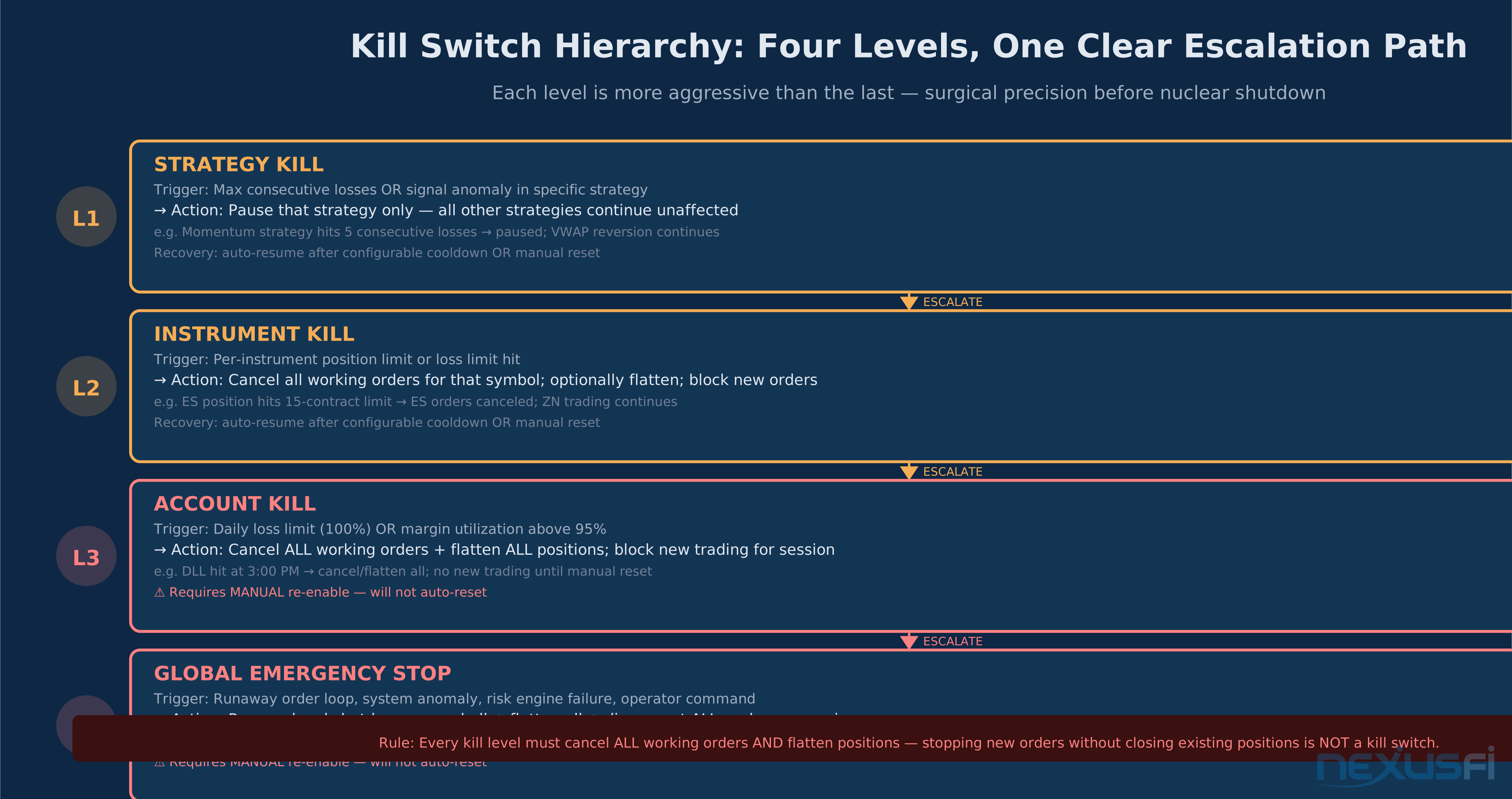
Kill switch hierarchy (from surgical to nuclear):
- Strategy kill: stops a specific strategy, leaves everything else running
- Instrument kill: cancels working orders and optionally flattens for one symbol
- Account kill: cancels all working orders, flattens all positions, blocks new trading
- Global emergency stop: process-level shutdown, all sessions disconnected, alert sent
Every kill level must cancel working orders AND flatten positions. A system that stops accepting new signals but leaves existing positions running has not been killed.
Fault Tolerance: The 24/7 Architecture #
The fault tolerance of your system is determined by what it does when things go wrong. Four patterns cover most production failure scenarios.
State Durability: Event Sourcing and Snapshots #
Every critical order and position event is written to a durable append-only log before any action is taken on it. If your process crashes, the next startup replays the log from the last snapshot to recover full state. The recovery sequence:
- Load the last position/order snapshot
- Replay events from the log since that snapshot
- Query broker for current open orders and positions
- Reconcile internal state with broker state
- Only then resume trading
The snapshot prevents full replay from session start on every restart. A daily snapshot at session open plus 30-minute incremental snapshots keeps recovery time under 60 seconds for most failures.
Idempotency Everywhere #
Assume every operation will be retried at least once. Network errors, acknowledgment timeouts, and reconnect sequences all trigger retries. Without idempotency: retrying a failed order submission creates two live orders; retrying a cancel that succeeded deletes the wrong order; retrying a position query that half-processed leaves split state.
Implementations: deterministic client-order IDs that hash to the same value on retry; state machine guards that reject illegal transitions as no-ops; deduplication in the event log that prevents the same event from being processed twice.
Degraded-Mode Trading Policy #
Define explicit policies for every degradation scenario before going live. The worst time to decide "what do we do when market data is stale?" is when market data is stale.
| Condition | Policy |
|---|---|
| Market data stale >5 seconds | Stop new orders; existing positions held |
| Order ack timeout >30 seconds | Trigger reconciliation; halt new submissions |
| Risk engine unavailable | Fail closed: no new orders |
| Reconciliation fails | Suspend trading until manual reset |
| Single venue unreachable | Route to fallback if configured |
| Margin utilization >95% | Reduce-only: no new positions, close-only allowed |
The policy table is reviewed and updated after each production incident. The first time a scenario occurs is when you discover whether your policy was correct.
Automatic Reconnect Protocol #
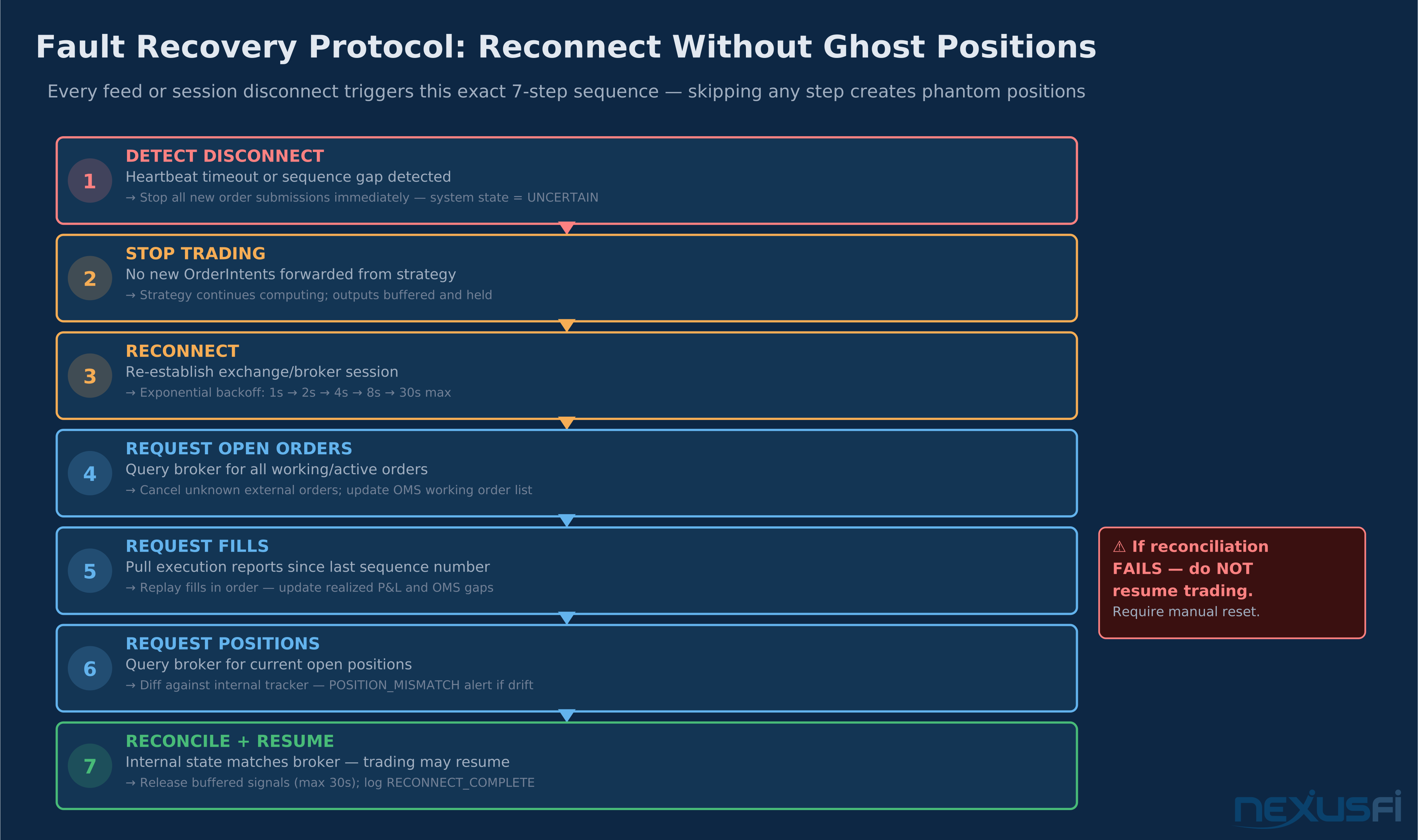
Every reconnect follows the same seven-step sequence:
- Detect disconnect (heartbeat timeout or sequence gap)
- Stop all new order submissions immediately
- Reconnect with exponential backoff (1s, 2s, 4s, 8s, capped at 30s)
- Request all open orders from broker
- Request execution reports since last known sequence
- Request current positions
- Reconcile, then resume
Systems that skip step 6 (position query) are the ones that create untracked positions after reconnect sequences. This is the pattern behind most "where did this position come from?" incidents.


Testing Architecture #
The most reliable pattern for avoiding backtest-to-live divergence: the strategy should not know whether it is in live or simulation mode. Only the adapters differ. In backtest mode, the market data adapter replays historical data; the OMS adapter runs a fill simulator. The risk engine and strategy run identically in both modes.
Test the failure modes explicitly before going live:
- Inject a simulated disconnect mid-session and verify reconciliation behavior
- Submit the same order twice and verify only one exchange order results
- Trigger the daily loss limit and verify clean shutdown
- Send a partial fill and verify OMS handles residual quantity correctly
- Simulate stale data and verify the system halts trading
These tests should be automated and run before every production deployment.
Common Architecture Mistakes #
Strategy directly calling the order API. The most common and consequential mistake. No risk checks, no state machine, no idempotency, no way to test in isolation.
No durable event log. Every process crash is a state recovery problem. Add the write-ahead log before anything else.
Risk checks at startup only. Position limits checked at startup but not recalculated after fills. Every fill changes the exposure environment.
No idempotency on submit/cancel. A retry after a network timeout creates a second live order. This is the primary cause of doubled positions in retail automated systems.
No reconciliation after reconnect. Assuming internal state is correct after a reconnect is the assumption that leads to ghost positions.
Position state in strategy memory. When the strategy object tracks its own position, any restart or reinstantiation starts from a wrong state. Position state belongs in the state manager.
Ignoring partial fills. Treating a partial fill as a non-event until fully filled creates position tracker inaccuracies that compound across the session.
"Best effort" error handling on the trade path. Swallowing exceptions silently. If an order submission fails and you don't know why, your risk state is undefined.
Futures-Specific Architecture Notes #
Contract roll automation. Production systems automate rolls: maintain a roll schedule, switch symbol mappings for market data and router on the configured roll date, transfer working orders from expiring to next front-month if position continuation is needed.
Session calendars. ES trades nearly 24 hours but has breaks. Automated systems that don't implement session awareness attempt to place orders during CME maintenance windows and generate confusing rejects. Session calendar is a first-class component, not an afterthought.
Price limit bands. CME futures have daily price limits — trading halts when price moves beyond ±N points from prior settlement. Your router must handle limit-reached situations without flooding the exchange with orders against a halted market.
Overnight margin. Intraday margin for ES is $500--1,000 per contract at most retail brokers. Overnight margin is $12,000+. The session calendar plus risk engine must enforce session-close flattening policies if you're not holding positions overnight intentionally.
Technology Considerations #
The architecture described here is language- and platform-agnostic. You can implement it in:
- Python with asyncio for the event loop, SQLite or PostgreSQL for the durable event log — practical for most retail strategies, covered in detail in Python Live Trading Execution for Futures
- C# / NinjaScript for NinjaTrader-integrated systems — the platform handles portions of the OMS layer; custom risk logic runs as AddOn or strategy code, as covered in NinjaScript Strategy Development
- C++ for co-located systems where microsecond latency matters — kernel bypass networking, lock-free ring buffers, hardware timestamping, covered in Latency and Infrastructure for Automated Futures Trading
Sponsor DTN IQFeed provides market data feeds with documented sequence numbers and gap-fill protocols — exactly the reliability properties Layer 1 depends on. Sponsor NinjaTrader builds the OMS layer, risk checks, and session management into the platform for NinjaScript-based strategies, much reducing the infrastructure burden for traders working within that ecosystem.
Knowledge Map
Prerequisites
Understand these firstGo Deeper
Build on this knowledgeReferences This Article
Articles that build on this topicCitations
- — NinjaTrader Brokerage Services (www.ninjatraderbrokerage.com) (2023) 👍 9
- — New Risk Management Settings built-in to NinjaTrader (2023) 👍 6
- — My algo hit the kill switch, CME said no! Lady Luck Saved Me! (2022) 👍 6
- — What's wrong with my code? Simple strategy (2016) 👍 2
- — Which the best faster VPS to retail (2022) 👍 8
- — Daily Loss Limit (2011) 👍 6
- — Looking for broker supporting Sierra Chart Teton Futures Order Routing (2022) 👍 4
- — Best way to sync positions on re-connecting (2013) 👍 3
- — Daily Loss Limit (2011) 👍 4