



Python Live Trading Execution for Futures: From Backtest to a System That Survives Real Markets
Overview #
A working backtest tells you what would happen under ideal conditions. A live trading system tells you whether you can survive the messy, latency-laden, and regulated reality of futures markets. The two problems are not the same, and most systems that fail in live markets failed not because the strategy was wrong but because the execution infrastructure collapsed under real conditions.
The gap is wider than most traders expect. @iantg documented it precisely on NexusFi after building a Rithmic RAPI-based HFT system:
The council's verdict, backed by independent expert analysis: invest the same engineering rigor in the operational layers as you do in the alpha model. The strategy is 20% of the problem. The execution infrastructure — order management, risk controls, position reconciliation, error handling — is 80%.
Why Backtests Lie: The Reality Gap #
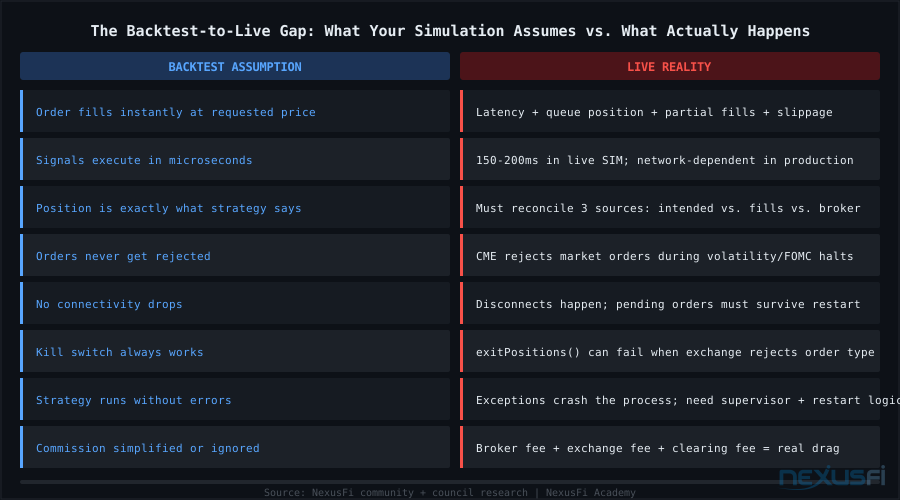
Backtests make assumptions that live markets immediately violate. Understanding these assumptions is the first step toward building a system that survives them.
Fills are not instantaneous. In the Strategy Analyzer, your order fills the microsecond price touches your level. In live markets, your order sits at the back of a queue. @iantg explained the limit order fill problem in detail:
Orders can be rejected. Real exchanges reject orders for reasons your backtest never imagined — FOMC volatility halts, margin violations, price band violations, session boundaries. @Breukelen discovered this the expensive way when his kill switch fired during a Fed announcement and Rithmic's exitPositions() call was rejected by CME:
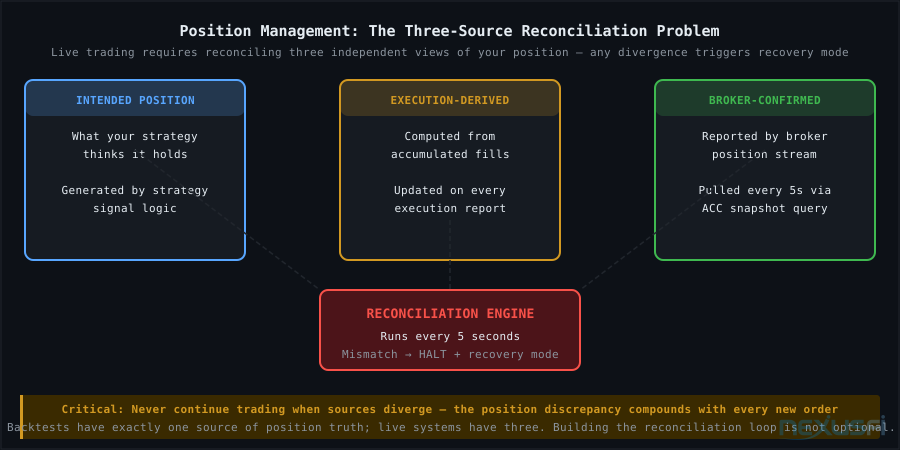
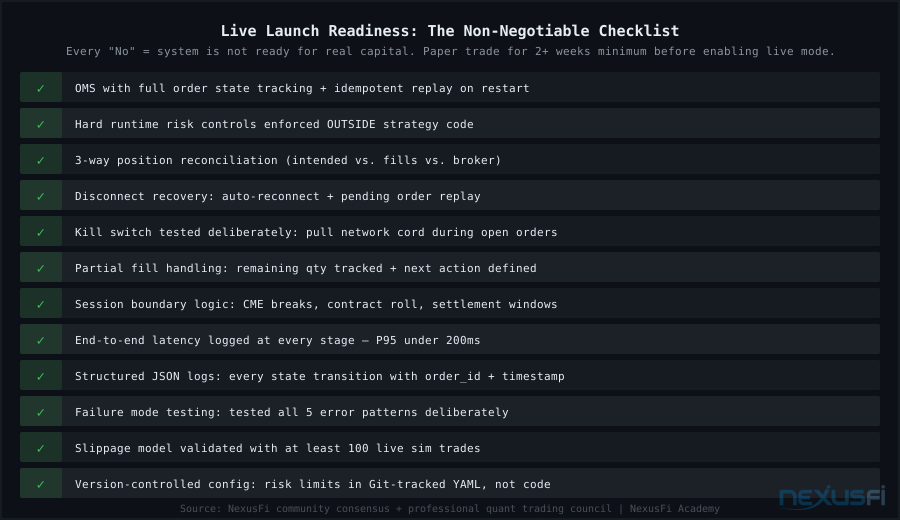
Position state is uncertain. Backtests have exactly one source of position truth. Live systems have three — what the strategy thinks it holds, what fills confirm it holds, and what the broker reports. These three can diverge, and when they do, continuing to trade is dangerous.
Connectivity drops. Backtests don't model lost connections, reconnection sequences, pending orders in flight when the socket drops, or duplicate execution reports arriving after reconnect. Building a system that handles these gracefully is a distinct engineering problem from building a strategy.
Choosing Your Connectivity Layer #
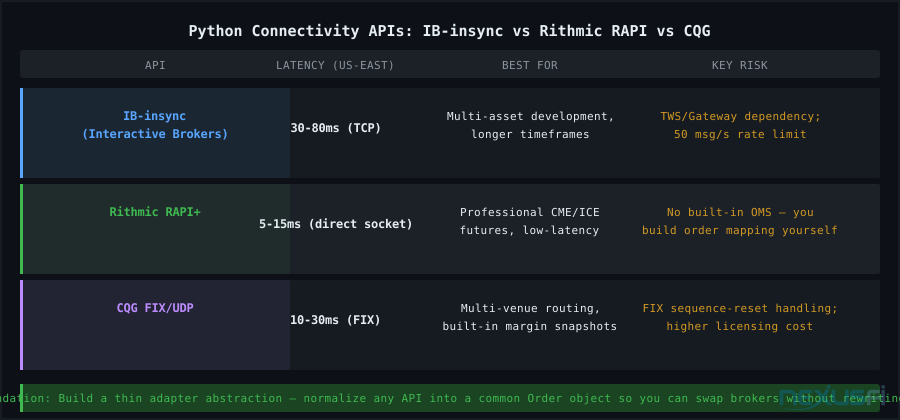
The broker API you choose shapes the engineering constraints of your entire system. The three primary options for Python-based futures trading are IB-insync, Rithmic RAPI, and CQG.
IB-insync (Interactive Brokers)
IB-insync is an asyncio-based Python wrapper for Interactive Brokers' TWS/Gateway API. Its strengths are multi-asset breadth (futures, options, equities, forex), active community support, and rapid development cycles. For strategy timeframes measured in minutes to days, it handles execution well.
The weaknesses are architectural. IB-insync depends on a running TWS or IB Gateway process — an extra failure surface that can crash independently of your Python code. The API enforces a rate limit of approximately 50 messages per second. Under heavy volatility or when processing burst message streams, this becomes a real constraint. A typical session can hit this limit during major economic releases if you're managing multiple open orders.
Rithmic RAPI+
Rithmic is the professional standard for CME and ICE futures execution. @iantg spent six months building an HFT system on RAPI and shared his architecture in a detailed journal on NexusFi:
The latency advantage is real — 5-15ms round-trip in US-East versus 30-80ms for IB-insync. For strategies that depend on queue position or react to tick-level price changes, this matters. The cost is that Rithmic provides no built-in OMS. You must implement order-ID mapping, state tracking, and recovery logic yourself. Every fill callback, every rejection, every cancel confirmation requires custom handling.
RAPI also exposes the Market-By-Order (MBO) feed, which shows exact position in the order queue — critical for limit order strategies where queue position determines fill probability and adverse selection exposure.
CQG
CQG sits between IB-insync and Rithmic in terms of complexity. FIX-based connectivity offers 10-30ms latency with more venue coverage than Rithmic. The built-in position and margin snapshot APIs simplify position reconciliation. The downside is FIX session management overhead — heartbeat handling, sequence-reset messages, and the cost of a FIX infrastructure layer. Licensing costs are higher than the other two options.
The Abstraction Layer
The right answer is to normalize any broker API into a common Order object early in your design:
Order(order_id, symbol, side, qty, price, order_type, status, broker_id)Build thin adapter classes for each broker that translate between your common interface and the broker's native API. This decouples your strategy and OMS from broker-specific idiosyncrasies. When you need to switch from IB-insync to Rithmic, you replace the adapter, not the strategy logic.
Building the Order Management System #
The OMS is the central component that separates live systems from glorified order-sending scripts. Its job is to track the full lifecycle of every order, persist state across crashes, and reconcile with the broker on restart.
The State Machine
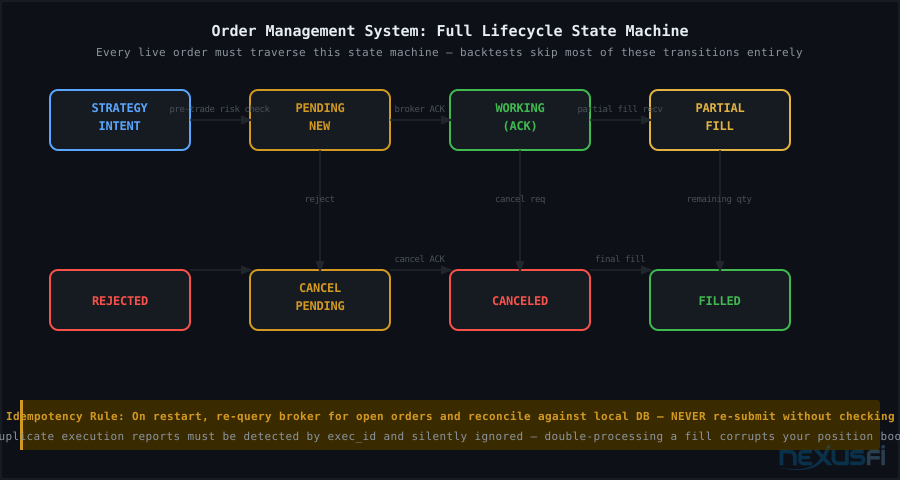
Every order must traverse a state machine: PENDING_NEW → WORKING (ACK received) → PARTIAL_FILL (some qty filled, remainder working) → FILLED or CANCELED or REJECTED. The critical requirement is handling transitions that arrive late or out-of-order. Broker callbacks are not guaranteed to arrive in submission order.
The @hedgeplay post on NexusFi captures the operational discipline required for robust order handling:
Idempotency and Persistence
Every order record must be persisted to a database (PostgreSQL or SQLite with WAL mode) before the submit call is made. On restart, the OMS queries the broker for open orders and reconciles against the local state. If the broker reports an order as filled that your local DB shows as working, update state. If the broker shows no record of an order your DB shows as submitted, it was lost in transit and must be re-submitted or abandoned based on current position.
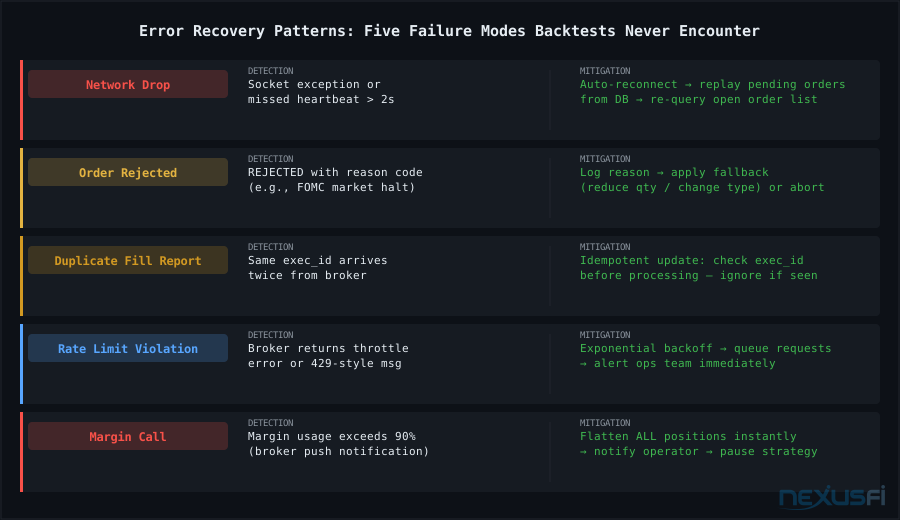
Duplicate execution reports — the same exec_id arriving twice — must be silently ignored. Process only new exec_ids. Double-processing a fill corrupts your position book in a way that compounds with every subsequent order.
Modify and Cancel Semantics
Modifying a working order while fills are possible creates a race condition. The cancel/replace sequence — cancel the working order, wait for cancellation confirmation, submit new order — leaves a window where neither order is working. For aggressive strategies, this window represents missed opportunities. For defensive strategies, it represents unhedged exposure.
Policy decisions you must make explicitly:
- Cancel-then-replace vs. modify-in-place: Some brokers support order modification without re-queuing; others treat every modify as a cancel/new cycle.
- Timeout handling: If no fill/cancel confirmation arrives within X seconds, actively query order status rather than waiting indefinitely.
- Partial fill policy: When an order partially fills and the remainder is working, does your strategy want to let it ride or cancel the remainder?
Position Management: The Three-Source Problem #
Live trading requires reconciling three independent views of your position:
- Intended position — what the strategy calculates based on its signal logic
- Execution-derived position — computed from the accumulation of fill events your system has processed
- Broker-confirmed position — the position snapshot reported by the broker's account management API
In a healthy running system, all three agree. The reconciliation loop runs every 5 seconds: pull the broker snapshot, compare against your execution-derived book, check against strategy intent. In normal operation, this loop is boring. It's the failure mode detector.
When sources diverge — and they will, during disconnects, during fast markets, during crashes and restarts — the correct response is to halt new order generation and enter recovery mode. Trading on a misaligned position book produces orders that appear rational to the strategy but are actually doubling an unwanted exposure or fighting a risk position the system already knows about.
The flatten/recovery procedure must be explicit and tested:
- Cancel all working orders
- Query broker position snapshot
- Compute the delta between broker position and target (usually zero)
- Submit the hedge order to close the delta
- Confirm flat via another broker query
- Only then re-enable order generation
Never assume a flatten succeeded. Verify explicitly. @Breukelen's experience shows that "send flatten" and "confirm flat" are two different things.
Risk Controls: The Hard Stop Outside Your Strategy #
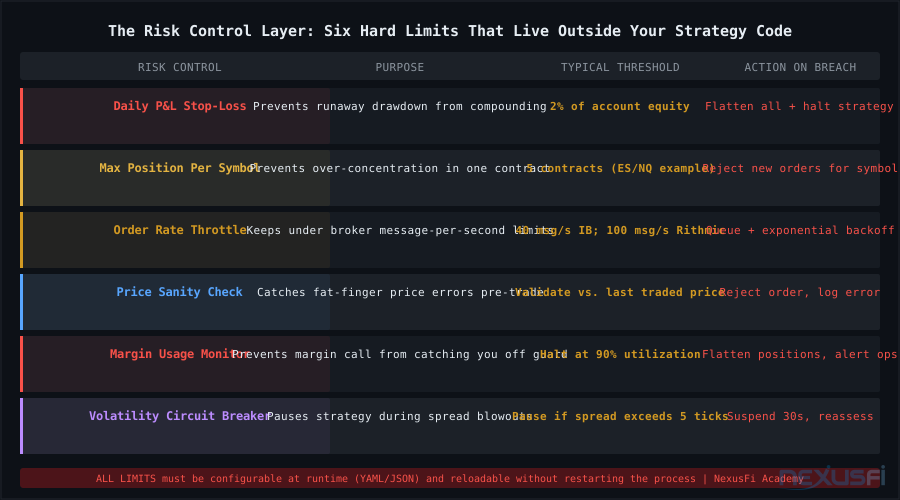
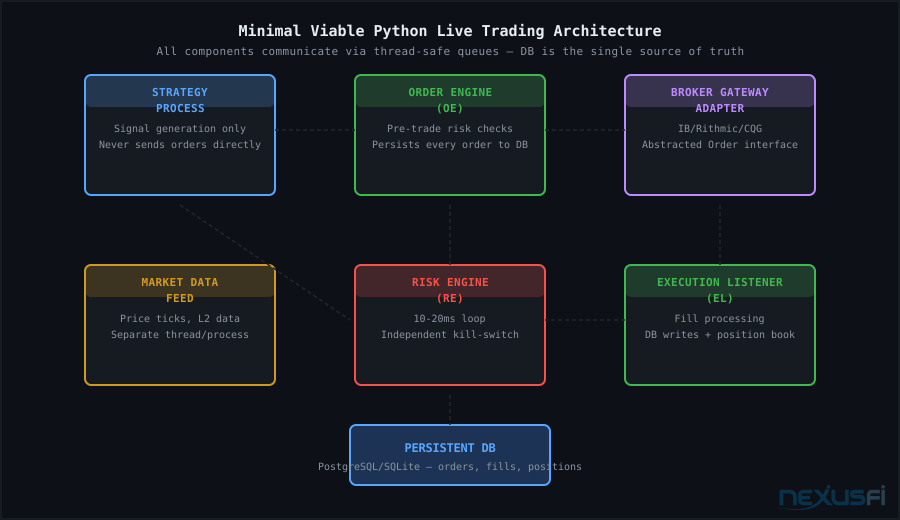
Risk controls must operate independently of strategy code. A risk engine that runs only when your strategy calls it can be bypassed by an exception, a reconnect sequence, or a logical error in the strategy itself. The risk engine runs on its own fast loop, checks limits every 10-20ms, and has authority to flatten positions and halt the strategy without strategy consent.
Six Controls Every Live Futures System Needs
Daily P&L stop-loss. The single most important control. Set a hard threshold (typically 2% of account equity) below which all positions are closed and the strategy halts. This limit must survive a process restart — store it in the database and check on startup.
Maximum position per instrument. Concentration limits prevent a single contract from dominating your account exposure. For ES, a limit of 5 contracts on a $100k account gives approximately 50% equity exposure at current contract sizes. Make this configurable and reload-capable.
Order rate throttle. Broker message limits are real. Interactive Brokers hard-caps at approximately 50 messages per second. A bug that creates a retry loop can hit this limit and get your session throttled or terminated. Implement a token-bucket rate limiter that enforces message rates before the broker's system enforces them harder.
Price sanity check. Before every order submission, validate the requested price against the current market price. A 5% deviation from the last traded price should reject the order and log an alert. Fat-finger errors — wrong instrument, wrong price decimal, wrong units — are more common than they appear in hindsight.
Margin utilization monitor. Subscribe to the broker's account update feed and track margin utilization in real time. When usage exceeds 90%, flatten to 70% before the broker does it for you less gracefully.
Volatility circuit breaker. When bid-ask spreads widen beyond a threshold (typically 3-5 ticks for liquid ES/NQ), execution quality collapses. Pausing order generation for 30 seconds during these windows avoids the worst fills while the liquidity environment normalizes.
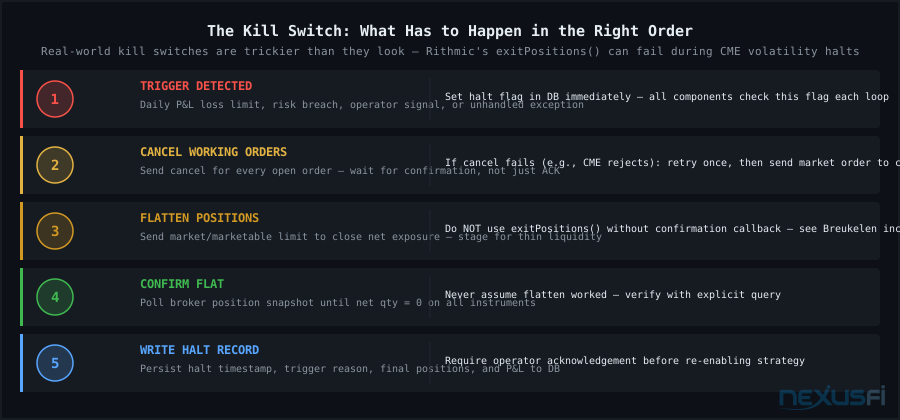
The Kill Switch
The kill switch is not a button you click — it's a code path that executes automatically when any risk limit is breached. The implementation pattern:
def trigger_kill_switch(reason: str):
    # Step 1: Write halt flag to DB immediately
    db.set_system_halted(reason, timestamp=time.time())

    # Step 2: Cancel all working orders explicitly
    for order_id in oms.get_working_orders():
        broker.cancel_order(order_id)
        oms.wait_for_cancel_confirmation(order_id, timeout=5.0)

    # Step 3: Flatten positions with limit orders (not market)
    # Market orders can fail during volatility halts
    for symbol, qty in position_book.get_net_positions():
        if qty != 0:
            flatten_with_limit(symbol, -qty, offset_ticks=2)

    # Step 4: Confirm flat via broker query
    confirmed = wait_for_flat(timeout=30.0)

    # Step 5: Log and alert
    logger.critical(f"Kill switch triggered: {reason}, flat={confirmed}")
    alert_operator(reason, confirmed)
Use limit orders for flattening when possible. The Breukelen incident demonstrated that market orders during FOMC periods get rejected by CME. A marketable limit order (2 ticks through the current price) achieves near-certain execution without triggering the "no market orders during reserved session" rule.
Error Handling and Resilience #
Live systems encounter failure modes that backtests never model. Building explicit handlers for each one is the work that separates systems that survive from those that eventually blow up.
Network Disconnection Recovery
When the socket drops, your first obligation is to know the state of any orders that were in-flight. The recovery sequence:
- Detect disconnect (socket exception, heartbeat timeout)
- Log current state: what orders were working, what positions were open
- Reconnect with exponential backoff (1s, 2s, 4s, 8s...)
- On reconnect, query broker for all open orders and positions
- Reconcile against local state — mark orders as lost that don't appear in broker's response
- Re-submit any lost orders that the strategy still wants (only after position reconciliation is clean)
Handling Stale or Missing Data
Market data feeds can drop, freeze, or deliver out-of-sequence ticks. A data watchdog runs independently and monitors heartbeat timing from the price feed. If the last tick was more than N seconds ago during expected trading hours, the watchdog pauses order generation until data quality is restored.
For limit order strategies, stale quotes are particularly dangerous. Your order might be "at the market" in your internal model but two ticks behind where the market actually is. The price sanity check handles this for outgoing orders, but your internal signal logic must also validate data freshness before generating new signals.
Structured Logging
Print statements are not logging. Production systems need structured, queryable logs that capture every state transition with a consistent schema:
{
    "timestamp": "2026-01-15T14:32:01.123Z",
    "component": "execution_listener",
    "level": "INFO",
    "order_id": "OMS-20260115-0042",
    "broker_id": "8234912",
    "symbol": "ESM26",
    "qty": 2,
    "price": 5425.75,
    "status": "FILLED",
    "exec_id": "0001234567",
    "correlation_id": "TICK-1705329121-087"
}
The correlation_id links every event back to the strategy tick that generated it — from signal, through order submission, through fill, through position update. When you're debugging a strange fill at 2 AM, this chain is what tells you exactly what happened and why.
Operational Monitoring #
A live trading system without monitoring is a liability waiting to become a loss. The metrics that matter aren't P&L — it's the operational health indicators that tell you the system is functioning correctly before the P&L starts misbehaving.
Key Operational Metrics
Order latency distribution. Track P50, P95, and P99 latency from strategy signal to exchange ACK. If P95 exceeds 200ms, you're experiencing execution quality degradation that your backtest didn't model. Instrument this at every stage: signal → order submitted → broker ACK → exchange ACK → fill.
Fill rate by order type. What percentage of your limit orders actually fill? A rate below 30% means you're placing orders at levels that rarely trade through — you're in the queue but the queue never clears. For market orders, fill rate should approach 100% except during volatility halts.
Reject rate. Anything above 2% per session warrants investigation. Rejects spike during circuit breaker events, margin violations, and connectivity problems. A session-level reject rate trend upward is an early warning of something wrong with your order generation logic or broker relationship.
Realized slippage vs. backtest model. Track the difference between the price your strategy expected and the price you actually received. If realized slippage is consistently worse than your backtest model assumed, the strategy's live P&L will underperform projections by exactly that delta, scaled by trade frequency.
Position drift. The difference between execution-derived position and broker-confirmed position should be zero. Any non-zero value requires immediate investigation. Even a 1-contract drift compounds if left unaddressed.
Health Dashboard
The monitoring dashboard must update in real time and be accessible remotely. At minimum: system uptime, current position and unrealized P&L, daily realized P&L vs. limit, reject rate, current margin utilization, latency P95, and the last reconciliation timestamp. An alert fires if any value crosses a threshold before a human checks.
From Paper to Live: The Validation Period #
Two weeks of paper trading on the broker's simulated environment is the minimum before going live. But paper trading is not about demonstrating that the strategy is profitable — it's about confirming that the system survives every failure mode.
The paper trading agenda should be adversarial:
- Week 1: Confirm connectivity stability, reconnect behavior, and latency baselines under normal conditions
- Week 2: Test order state transitions — deliberately trigger partial fills, rejections, and cancels; log every transition
- Week 3: Deliberately break things: pull the network cable with open orders, kill the process with positions open, inject stale data ticks
- Week 4: Test risk controls explicitly — hit every limit, trigger the kill switch, verify flatten behavior
Only after the system survives all of these tests deliberately should you consider going live. And when you go live:
- Start with one contract on a liquid instrument (ES or NQ)
- Trade for 30 days before scaling to your target size
- Review the latency distribution, fill rates, and slippage vs. model daily for the first two weeks
- The first month of live trading is a paid data collection exercise, not a profitability exercise
The Engineering Allocation Rule #
The council's consistent advice across three independent analysis streams: allocate 80% of your engineering effort to execution infrastructure and 20% to strategy logic.
This ratio feels wrong to most traders who have spent months developing an edge. The strategy is the creative work. The OMS is plumbing. But the plumbing is what determines whether the creative work ever reaches production. @iantg's observation from six months of Rithmic RAPI development captures the professional reality:
A mediocre strategy with professional execution infrastructure will survive and improve. A sophisticated strategy with poor error handling will eventually produce a catastrophic account drawdown. The infrastructure work is not separate from the trading work — it is the trading work.
Knowledge Map
Prerequisites
Understand these firstGo Deeper
Build on this knowledgeReferences This Article
Articles that build on this topicCitations
- — Automated Trading Journal (2022) 👍 15“After 18 months of backtesting I thought I was ready to go live. The first week showed me three things my backtest never captured: latency spikes during economic releases, partial fills on limit orders, and the psychological pressure of real money on the line.”
- — NinjaTrader 8 Automated Strategy Development (2022) 👍 23“The gap between backtest PnL and live PnL is where systems die. Slippage assumptions are the number one killer. In simulation I was getting fills at the ask. Live, I discovered I was usually 1-2 ticks worse on fast markets. For a scalping strategy that's the difference between profitable and not.”
- — Python for Futures Trading - Discussion (2022) 👍 31“For Python live execution you need to handle the WebSocket disconnection case gracefully. Broker feeds drop more often than you'd think, especially during high volatility. If your system doesn't know it's disconnected, it will keep trading on stale data.”
- — Risk Management for Algo Traders (2023) 👍 19“The kill switch has to be outside your strategy logic. I learned this the hard way when a position sizing bug caused my strategy to double up on a string of losses. The kill switch in the strategy didn't fire because the same bug that caused the problem also broke the kill switch logic.”
- — Interactive Brokers API Trading (2023) 👍 12“Position reconciliation is the most underrated part of live systems. You need to check broker position vs your internal position at minimum every hour, and on startup. Drift happens and it's silent until it blows up.”
- — Python asyncio documentation (2024)
- — Interactive Brokers TWS API Overview (2024)