



Futures Account Opening: Documentation, Approval, and First Steps
Overview #
Opening a futures account is the gatekeeper moment between wanting to trade futures and actually trading them. Most traders underestimate it. They think it's a form, some paperwork, maybe a week of waiting. The reality is more complex — and more consequential. Get the documentation wrong, choose the wrong account structure, or misrepresent your financial profile, and you're looking at delays, restrictions, or outright rejection.
This article covers the complete futures account opening process: what documents you need, how approval decisions get made, what margin is actually required (hint: it's different from what you need to trade), and the structural choices — individual vs. LLC vs. IRA — that shape your entire trading operation. Most importantly, it covers the ten mistakes traders make that turn a two-day process into a two-week headache.
The process is compliance-driven by design. The CFTC and NFA require Futures Commission Merchants (FCMs) to verify your identity, assess your suitability, and document your risk acknowledgment before giving you access to leveraged instruments. That's not bureaucracy for its own sake — it's protection against accounts that shouldn't have been opened in the first place. Understanding the "why" behind each requirement helps you move through the process faster and makes you a better counterparty when you get to the other side.
Key Concepts #
Futures Commission Merchant (FCM): A firm registered with the CFTC and NFA that accepts orders for futures contracts. The FCM holds your funds, processes your trades, and is responsible for ensuring your account meets regulatory requirements before you trade.
Know Your Customer (KYC): Federal requirement for financial institutions to verify client identity. For futures accounts, this means photo ID verification, tax identification, and proof of residence.
Suitability Assessment: The process by which brokers determine whether futures trading is appropriate for you based on your financial situation and experience. Rooted in NFA Rule 2-30, which requires FCMs to have a reasonable basis for believing customers understand the risks.
Initial Margin: The minimum deposit required to open a position in a futures contract. Set by the exchange and can be increased by the FCM (called "house margin"). This is money held as performance bond, not collateral for a loan.
Maintenance Margin: The minimum account equity required to keep a position open. Falling below this level triggers a margin call — you must deposit additional funds or the FCM will liquidate your position.
Variation Margin: Daily mark-to-market settlement. If the market moves against your position, variation margin is debited from your account the same day. If it moves in your favor, funds are credited. This is what makes futures different from stocks — you don't wait until you close the position to realize losses.
Beneficial Ownership: For entity accounts (LLC, corp, trust), the individuals who ultimately own or control the entity. FCMs must document this per FinCEN requirements. Missing beneficial owner disclosures are the single most common delay in entity account openings.
Self-Directed IRA: An IRA account that allows investment in alternative assets beyond traditional stocks and bonds. Not all custodians support futures trading — selecting the wrong custodian is how IRA futures accounts get stuck before they're even submitted to the FCM.
OFAC Screening: Office of Foreign Assets Control. FCMs are required to check all applicants against sanctioned individuals and entities before opening any account. Happens automatically and nearly instantaneously in modern onboarding flows.
The Documentation Set: What You Actually Need #
Universal Requirements (All Account Types) #
Get these ready before you touch an application. Missing any one of them after submission freezes your application while you scramble.
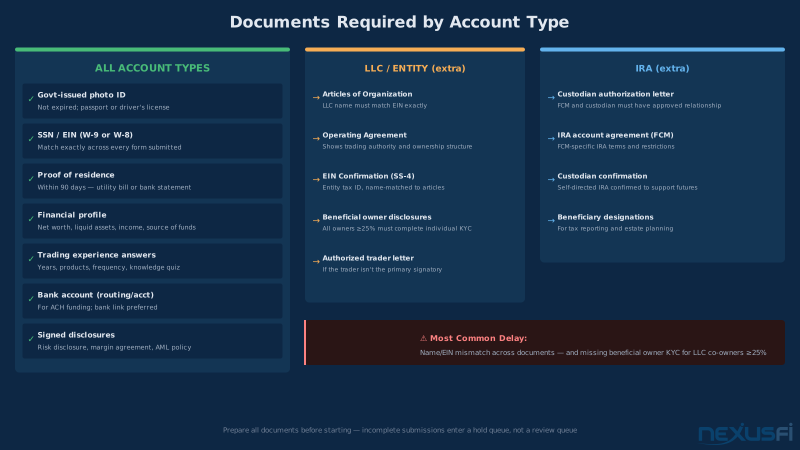
Government-Issued Photo ID Passport or driver's license. Current, not expired. Must show your face, full legal name, DOB, and address (or a current address document accompanies it). Many brokers now use OCR and live-capture verification — you'll take a selfie alongside the ID so the system can match your face to the document. Poor image quality is a rejection trigger. Good lighting, flat surface, all four corners visible.
Social Security Number or EIN Individual accounts use SSN. Entity accounts use EIN. The tax ID must match exactly what's on your tax documents — name format, entity structure, everything. A mismatch between your W-9 and KYC form is the single most common cause of processing delays. The broker will see it instantly and put your application on hold until it's resolved.
Proof of Residence Utility bill, bank statement, or government-issued document showing your current address. Must be recent — typically within 90 days. If your ID shows an old address and you haven't updated it, provide the ID plus a current proof of address document. PO Boxes don't count.
Financial Profile Net worth, liquid assets (cash and equivalents accessible within 30 days), annual income, and source of funds. This isn't for the broker to judge your financial sophistication — it's for them to assess whether you can absorb futures losses without undue hardship. NFA Rule 2-30 requires them to make this assessment. Be accurate. Inflating your net worth to pass a threshold creates inconsistencies the compliance team will catch during review.
Trading Experience Questionnaire Years trading each asset class (stocks, options, futures, forex), frequency (daily, weekly, occasional), and knowledge assessment. Many brokers include a short multiple-choice quiz testing your understanding of margin, settlement, and leverage. There are no consequences for being a beginner — you may receive restrictions on certain products or require additional approval steps, but you won't be automatically rejected for lack of experience.
Bank Account Details Routing number and account number for ACH funding. Most modern platforms support tokenized bank linking (Plaid, Yodlee) that validates your account without exposing the raw numbers. Have your most recent bank statement handy as backup.
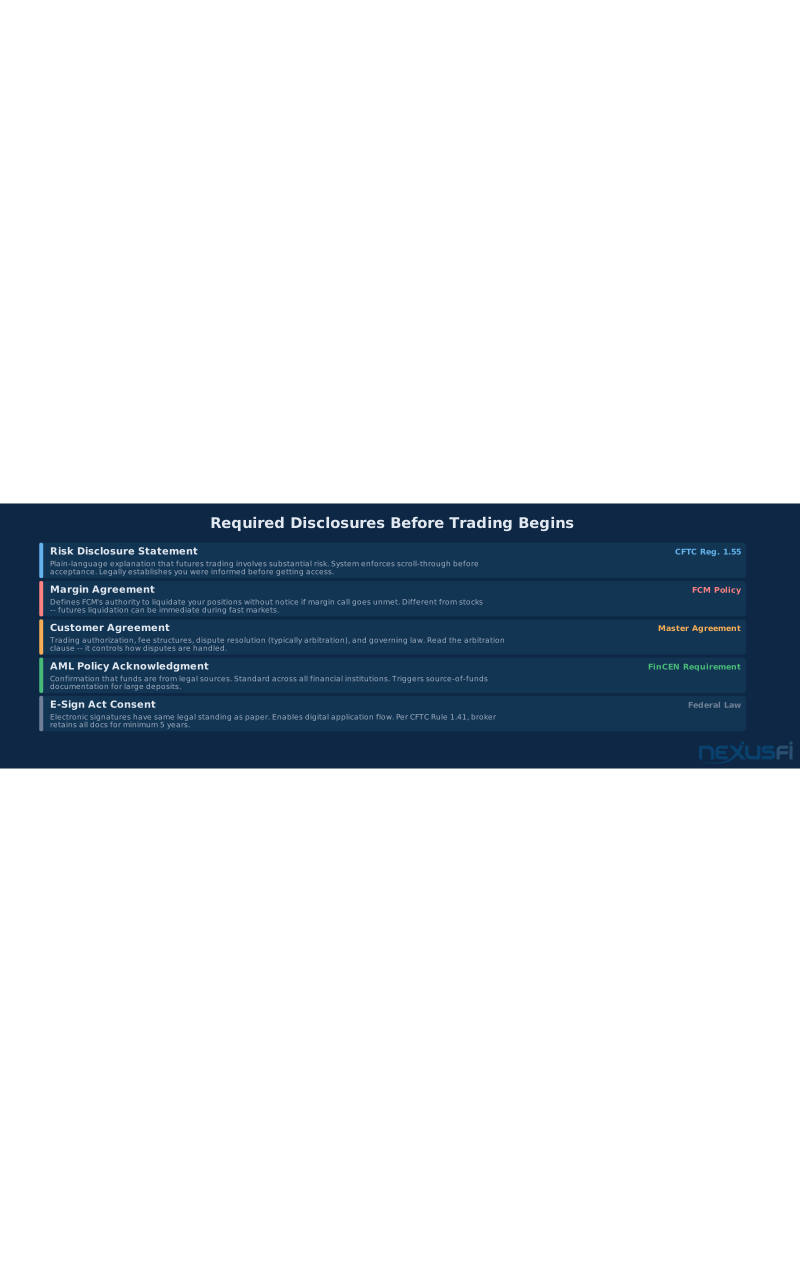
Regulatory Disclosures and E-Signature The regulatory disclosure package includes the Risk Disclosure Statement (CFTC required), the Futures Margin Agreement, the Customer Agreement, the AML Policy Acknowledgment, and E-Sign Act consent. You're legally required to review these. The system typically requires scroll-to-bottom before the acceptance button activates. This is not theater — these documents define what happens if you get a margin call, what liquidation authority the FCM has, and what arbitration process governs disputes.
LLC and Entity Accounts: Additional Requirements #
Trading through an LLC is common among professionals and active traders who want liability separation, potential tax advantages, or a formalized business structure. The tradeoff is materially more documentation.
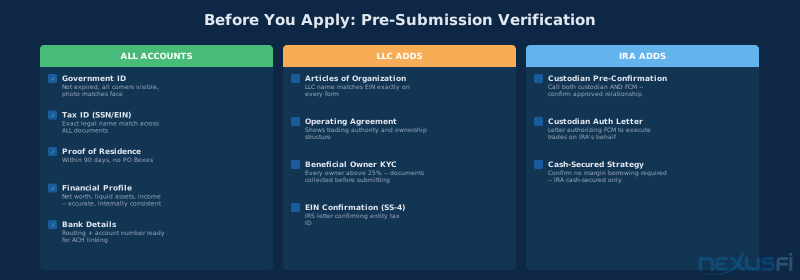
Articles of Organization (or Certificate of Formation) Issued by your state when the LLC was formed. Must show the LLC's legal name, state of formation, and date of formation. This document doesn't change — what matters is that the name on it matches your EIN and every other form you submit.
Operating Agreement The internal document defining LLC governance. FCMs need to see who has authority to trade on behalf of the entity, what the ownership structure is, and how decisions are made. Not all states require LLCs to have a formal operating agreement, but brokers universally do. If you don't have one, you'll need to create one before submitting your application.
EIN Confirmation Letter (IRS SS-4 Confirmation) The letter the IRS sends when your EIN is assigned. This is your entity's tax ID confirmation. Many FCMs also accept a W-9 signed by the entity's authorized representative.
Beneficial Ownership Disclosure FinCEN's 2016 Customer Due Diligence Rule requires FCMs to identify all individuals who own 25% or more of the entity, plus one individual who controls the entity (even if they own less than 25%). Each beneficial owner must undergo individual KYC — meaning the broker needs their personal ID, SSN, and address. If your LLC has multiple members, each one above the 25% threshold needs to complete their own verification.
Authorized Trader Documentation If the person trading the account isn't the entity's primary owner or signatory, you need a written authorization establishing that individual's trading authority. Some FCMs have pre-formatted forms; others accept a formal LLC resolution.
IRA Accounts: Additional Requirements #
Self-directed IRA futures accounts are possible but require more coordination upfront. The FCM doesn't actually hold the IRA — the IRA custodian does. The FCM is just where the trading happens. This two-party structure creates documentation requirements that individual accounts don't have.
Custodian Selection Not all IRA custodians support futures trading. Before you apply anywhere, confirm your chosen custodian is approved by the FCM. Major custodians that support futures-capable self-directed IRAs include Midland IRA, Equity Trust, and a handful of others. Traditional custodians (Fidelity, Schwab, Vanguard) for standard IRAs typically don't support futures through an FCM integration.
Custodian Authorization Letter A letter from your IRA custodian authorizing the FCM to execute futures trades on behalf of the IRA. This document defines the scope of trading authority, how funds will be transferred, and how margin calls will be handled.
IRA Account Agreement (FCM-Specific) Different from the standard customer agreement. Covers how assets are segregated between the FCM and the custodian, how settlement works, and the restrictions specific to IRA trading.
Beneficiary Designations For tax reporting and estate planning purposes, the FCM will require confirmation of how beneficiaries are designated on the IRA. This is typically pulled from the custodian's records.
Critical Constraint: Most IRA futures accounts operate on a cash-secured basis — you can't borrow against the IRA to meet margin calls. When you hit a margin call in an IRA account, you either have the cash in the account or you don't. Liquidation is faster in IRA accounts because there's no margin loan to restructure. If your strategy requires leverage beyond what you can cash-secure, an IRA is not the right structure.
Account Types: The Decision Framework #
Individual Account #
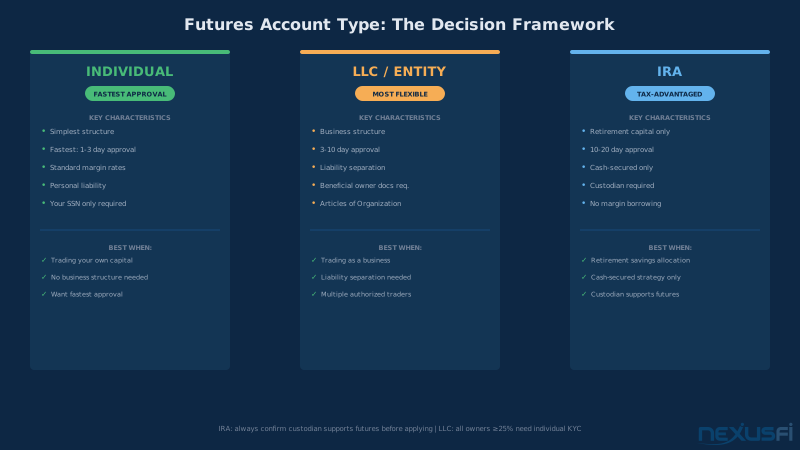
The baseline structure. Your SSN, your name, your liability. Approval is fastest, margin requirements are standard, and trading permissions are tied to your personal suitability assessment.
Use when:
- You're an individual trader managing your own capital
- You want the fastest path to trading
- You don't need business-structure benefits (liability separation, partnership arrangements)
- Your strategy works with standard margin requirements
Margin implications: Standard exchange-set initial margin plus any FCM house margin. No additional margin premium for account structure.
LLC / Entity Account #
Trading through a business entity. Provides liability separation between trading losses and personal assets, enables formal business expense treatment, and facilitates adding authorized traders or partners.
Use when:
- You're managing money for others (even informally — this may require additional regulatory registration)
- You want legal separation between trading losses and personal assets
- You're formalizing a trading business with business accounts, deductions, and structured profit sharing
Margin implications: Most FCMs apply standard margin to LLC accounts. Some apply higher house margin for entity accounts due to additional operational risk. Confirm with the broker before assuming standard rates.
Timeline: Plan for 3-10 business days vs. 1-3 days for individual. Beneficial ownership verification adds material processing time.
Caution: If you're trading other people's money through an LLC, you may require CTA (Commodity Trading Advisor) registration with the NFA. Trading other people's money without proper registration is a regulatory violation. This is a separate analysis from simply opening the account — consult with a compliance professional if you're managing third-party capital.
IRA Account #
Retirement capital only. Tax-advantaged but operationally constrained. All positions must be cash-secured — no borrowing against retirement assets to meet margin calls.
Use when:
- You're allocating specifically from retirement savings
- Your strategy doesn't require leverage beyond cash-secured positions
- You've confirmed your custodian supports futures with your chosen FCM
Critical constraints:
- No margin borrowing — cash-secured only
- Contribution limits apply (same as standard IRA limits)
- Withdrawal restrictions and penalties for pre-59½ distributions apply
- Money movement is slower due to custodian intermediation
Do not use when:
- Your strategy depends on margin leverage
- You need fast fund transfers (ACH between you and the account, not through a custodian)
- Your intended FCM doesn't have an approved custodian relationship
Financial Suitability: What the Assessment Actually Tests #
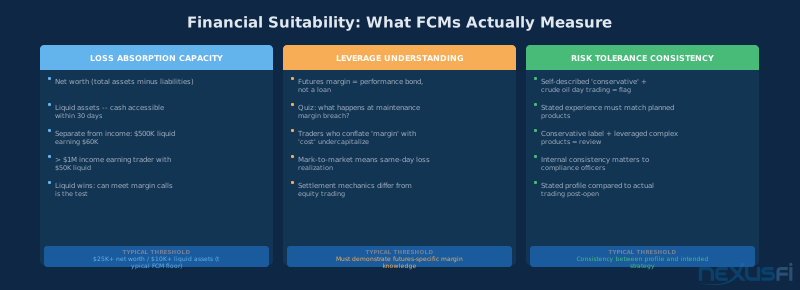
NFA Rule 2-30 requires FCMs to have a reasonable basis for believing that futures trading is suitable for their customers based on financial situation and experience. The suitability assessment isn't determining whether you'll be profitable — it's testing whether you can absorb losses without being financially devastated. These are at the core different questions.
What they're measuring:
Loss Absorption Capacity: Can you meet margin calls without wiping out essential living expenses? Net worth and liquid assets matter more than income here. A trader with $500K liquid earning $60K has higher loss absorption capacity than one with $1M income and $50K liquid.
Leverage Understanding: Do you understand futures margin is a performance bond, not a down payment? The suitability quiz typically includes questions to catch traders who conflate margin with "cost" — because those traders systematically undercapitalize.
Product Complexity Matching: Equity trading experience is relevant but insufficient. Demonstrate understanding of futures-specific mechanics: expiration, settlement, mark-to-market, roll procedures.
Risk Tolerance Consistency: A self-described "conservative" trader indicating they want to day trade crude oil creates a compliance flag. Internal consistency matters.
Illustrative thresholds (not universal — each FCM sets its own): Basic futures access typically requires net worth above $25,000 and liquid assets above $10,000. Advanced products may require higher thresholds. These are internal FCM policy benchmarks, not regulatory standards.
Practical advice: Answer accurately. FCMs compare your stated profile against your trading behavior after opening. Overstating financials creates compliance inconsistencies that delay applications — and doesn't make you more suitable.
Approval Timeline: From Submission to First Trade #
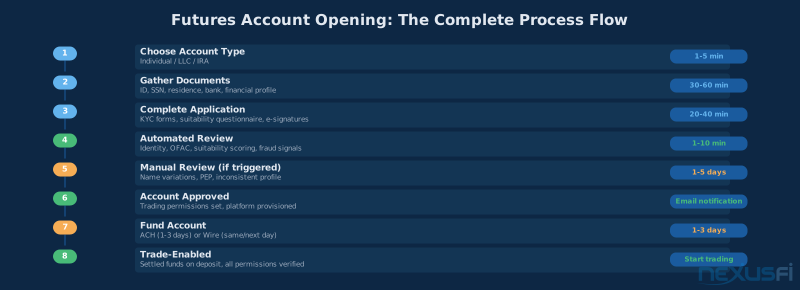
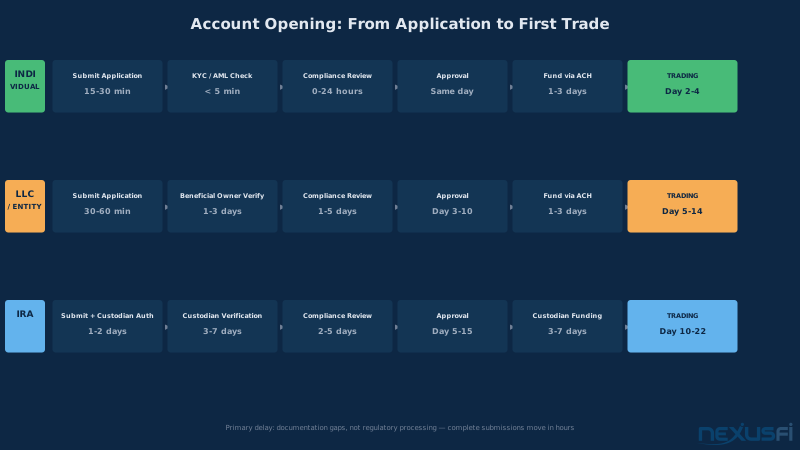
A clean, complete application with no compliance flags can move from submission to trading-enabled in one to three business days. The median for straightforward individual accounts at digital-first brokers is closer to 24-48 hours. The outliers — complex entities, IRA setups, international applicants, or flagged KYC — can take two to four weeks.
The bottleneck is almost always you, not the broker. Compliance automation runs in minutes. Manual review queues are measured in hours. The multi-week timelines happen when applicants submit incomplete applications, get a request for additional information, take three days to respond, then submit something that still doesn't satisfy the requirement.
The Real Timeline Bottleneck The broker's automated systems run in minutes. Manual review queues run in hours. Multi-week timelines happen when applicants submit incomplete applications and then take days to respond to requests for additional information. The bottleneck is almost always the applicant, not the broker.
Automated Steps (Minutes) #
- Identity verification: KYC system matches your ID to your submitted information. Name, DOB, address, tax ID. Automated pass/fail.
- OFAC/sanctions screening: System checks your name and identifying information against sanctioned individuals and entities. Instant via API. Most applicants pass immediately.
- Suitability scoring: Your financial profile and experience answers run through the FCM's risk model. The model may auto-approve, auto-deny with specific reason codes, or flag for manual review.
- Fraud signals check: Velocity checks (has this SSN or bank account been used in recent fraudulent applications?), device fingerprinting for digital applications, and other anti-fraud signals.
Manual Review Triggers #
These situations route to a compliance officer and add 1-5 business days:

- Name variations: Middle name present in one form, absent in another. Hyphenated surnames. Legal name different from common name.
- PEP (Politically Exposed Person) status: Politicians, government officials, senior executives of state-owned enterprises, and their immediate family members receive enhanced due diligence.
- Sanctions adjacency: You're not on the list, but your name is similar to a sanctioned individual, or you have business connections to sanctioned countries.
- Regulatory history: Prior regulatory actions, NFA/CFTC disciplinary records, or securities industry terminations (checked via NFA BASIC and FINRA BrokerCheck).
- High-risk jurisdictions: Addresses in or recent history with countries flagged for high money-laundering risk.
- Inconsistent financial profile: Large gap between stated income and stated net worth, or stated experience level inconsistent with the financial scale of the account.
The Funding Gap #
Getting approved isn't the same as being ready to trade. ACH transfers take 1-3 business days to settle, regardless of how fast your application moved. Wire transfers can settle same-day or next-day but typically incur fees.
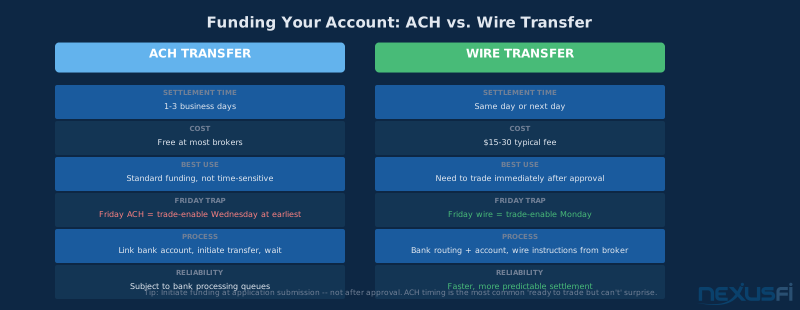
This creates a practical timeline issue: apply on Monday, get approved Tuesday, initiate ACH Tuesday, settle and trade-enable Friday. If you need to be trading on Wednesday, you should have initiated funding before your application — or plan to wire.
Most FCMs show a "pending funding" status during this window. You're approved, you can see the platform, but you can't place orders until settled funds are on deposit.
CFTC and NFA Compliance: The Mandatory Disclosure Set #
Every regulated futures broker must collect specific acknowledgments from every new account before trading is permitted. These aren't optional add-ons — they're federal and NFA rule requirements.
Risk Disclosure Statement (Commodity Futures Trading Risk Disclosure) #
Required by CFTC Regulation 1.55. The statement explains in plain language that futures trading involves significant risk of loss and is not appropriate for everyone. This is the document where brokers legally establish that they informed you of the risks before giving you access. Most platforms require you to scroll through the full document before the acceptance button activates — this is technically enforced, not just asked.
Margin Agreement #
Defines the FCM's authority to liquidate your positions. When you sign this, you're acknowledging that if you fail to meet a margin call, the FCM can close your positions without notice. This is different from stocks, where you typically have time to respond to a margin call before forced liquidation. In futures, the liquidation can be immediate during fast markets.
Customer Agreement #
The master agreement covering trading authorization, fee structures, dispute resolution (typically arbitration), and the governing law. Read the arbitration clause — if there's a dispute, this agreement determines how it's handled.
Anti-Money Laundering Policy Acknowledgment #
Confirming your funds are from legal sources. Standard across all financial institutions.
Electronic Records and Signature Consent #
E-Sign Act compliance — electronically signed documents have the same legal standing as paper. This enables digital applications.
Record Retention #
Per CFTC Rule 1.41, your broker retains all account documents for at least five years: KYC docs, signed agreements, account statements, and communications. This matters if there's ever a dispute about what was represented at account opening.
Common Mistakes: The Ten That Add Weeks to Your Timeline #
1. Name and Tax ID Mismatch #
The single most common delay. Your legal name on the W-9 must match your government ID, which must match your account application, which must match your EIN (for entity accounts). A nickname on your ID and your formal name on the W-9 creates an inconsistency. A maiden name versus married name creates an inconsistency. Middle names included in one document but not another creates an inconsistency. The compliance system flags all of them.
Prevention: Use your exact legal name — as it appears on your government ID — across every form, consistently.
2. Wrong Account Type for Your Strategy #
Selecting IRA for a strategy that requires margin leverage. Selecting individual when you need LLC liability protection and business structure. The time lost isn't just getting rejected — it's closing the wrong account, setting up the correct structure (which for LLCs requires state filings), and restarting the application process.
Prevention: Decide your account structure before you start any application. Model the margin requirements of your intended strategy and confirm your chosen structure can support it.
3. Missing Beneficial Ownership Documentation (LLC) #
The most common LLC-specific delay. If your LLC has multiple members above the 25% ownership threshold, each one requires individual KYC. Applications frequently arrive with the primary owner completed and blank forms for the other members. The application goes on hold. The primary owner gets a request for additional information. Three days pass while they track down documents from a co-owner who's traveling.
Prevention: For multi-member LLCs, collect all beneficial owner documentation before submission. Treat it as a package — submit everything together.
4. Custodian Mismatch (IRA) #
Applying to an FCM with an IRA from a custodian the FCM doesn't have an approved relationship with. You discover this after submitting the application and getting a rejection.
Prevention: Before initiating an IRA futures account application, contact both the custodian and the FCM directly and confirm they can work together. Don't assume — this relationship is not universal.
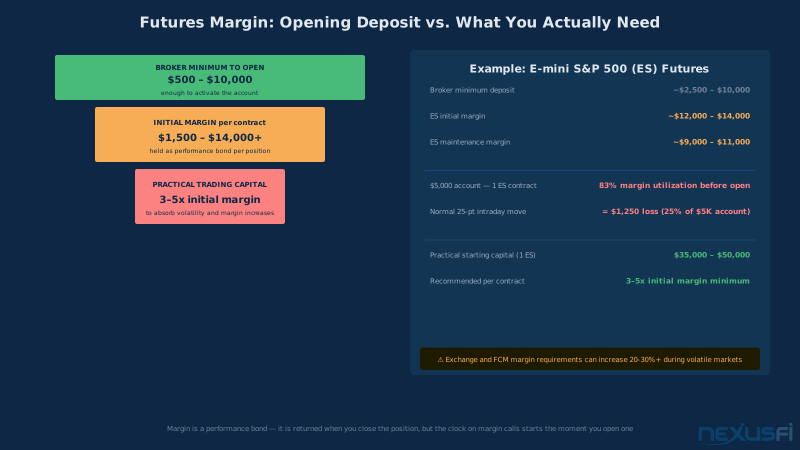
Capital Requirements vs. Minimum Deposits The broker's minimum deposit to open an account and the capital you need to trade are two different numbers. A $5,000 account opening minimum does not mean $5,000 is enough capital to trade ES futures — ES initial margin alone is approximately $12,000 per contract. Size your funding to your trading plan, not to what the broker will accept to open the account.
5. Treating Minimum Deposit as "Enough Capital" #
The community's experience is consistent on this: as @wgreenie noted in NexusFi discussions, institutional-quality brokers like Interactive Brokers require $10,000+ to open, while lower-barrier brokers like AMP Futures have historically allowed accounts as low as $2,000-$2,500. @tr8er notes that the $25K PDT rule doesn't apply to futures — you can technically open accounts with $3,000 or less at some brokers. But opening minimum and trading minimum are different things.
The math is unforgiving: ES initial margin is approximately $12,000 per contract (varying with volatility). A $5,000 account trading one ES contract starts with 41% margin utilization before market movement. A 25-point adverse move — normal intraday volatility — costs $1,250 (10% of account). That's not enough cushion to trade one ES contract.
@Big Mike put it directly in early NexusFi discussions: "Futures are advanced instruments. Most firms require $10K to fund, some require $5K." The practical reality: budget for 3-5x the margin requirement of your intended position size.
Prevention: Size your funding based on your trading plan, not the broker's minimum. Calculate your intended position's initial margin, add 2x for variation margin headroom, and that's your realistic starting deposit.
6. Inconsistent Financial Profile #
Stating $40,000 net worth on one section and $250,000 in investable assets on another. Or $150,000 income with $15,000 liquid assets. These inconsistencies trigger manual review even when there's a legitimate explanation — because the compliance officer doesn't know whether it's an error or misrepresentation.
Prevention: Be precise and internally consistent. If your net worth includes illiquid assets like a home, distinguish that from liquid assets. If income fluctuates, use last year's actual rather than your best-year estimate.
7. Assuming Approval = Permission to Trade All Products #
Your account is approved for futures trading. That doesn't mean you can trade any futures contract at any position size from day one. Many FCMs require separate approval for specific product categories: options on futures, micro vs. standard contracts, commodities vs. financial futures. Some require additional verification of experience for high-volatility products like natural gas or VIX futures.
Prevention: After account approval, review your trading permissions explicitly. If you intend to trade a specific product, verify you're approved before sizing up.
8. Submitting Expired or Low-Quality Documents #
An expired government ID, blurry scan, or photo where the corners of the document are cut off. These seem like obvious errors but cause more delays than you'd expect, especially for traders who don't open accounts frequently.
Prevention: Check document expiration dates before scanning. Use good lighting, scan to PDF, and verify the full document is visible before uploading.
9. Ignoring the Margin Call Policy #
The futures margin agreement includes specific procedures for how the FCM will handle a margin deficiency. Some brokers give you hours to respond; others will begin liquidation in the same trading session where the deficiency occurs. Some have automated liquidation systems that trigger without human review. These procedures vary materially between FCMs.
Prevention: Read the margin call policy section of the customer agreement before signing. Know how much time you'll have, how you'll be notified, and what happens if you don't respond in time.
10. Not Funding Before You Need to Trade #
Initiating ACH funding after approval, then waiting three business days while market setups you want to trade pass you by. Or worse, initiating funding on a Friday afternoon and being unable to trade until Wednesday.
Prevention: Understand the settlement timeline for your chosen funding method at your chosen broker. If you want to trade immediately after approval, use wire transfer or have a pre-funded account ready to transfer from.

The Account Opening Timeline: A Realistic View #
| Stage | Individual Account | LLC Account | IRA Account |
|---|---|---|---|
| Application + KYC | 1-3 days | 3-10 days | 5-15 days |
| Compliance Review | 0-24 hours (if clean) | 1-5 days (beneficial ownership) | 3-10 days (custodian coordination) |
| Funding Settlement | ACH: 1-3 days; Wire: same/next day | Same as individual | Through custodian: 3-7 days |
| Total (best case) | 24-48 hours | 5-10 business days | 10-20 business days |
The bottleneck is almost always documentation completeness. Compliance automation runs in minutes. Manual review queues are hours. Multi-week timelines happen when applicants submit incomplete applications, get a request for additional information, take several days to respond, and then submit something that still doesn't satisfy the requirement.
After approval: Account activation triggers market data provisioning, but exchange data subscriptions (CME, NYMEX, CBOT) often require separate activation. For external platforms like NinjaTrader or Sierra Chart, FCM connection configuration requires your account credentials and specific feed settings. Review your commission structure — all-in costs per round-turn matter more than headline rates. And before your first real trade, test with a micro contract to verify execution confirmation, commission charges, and position visibility all work correctly.
Practical Checklist: Before You Submit #
Individual Account #
- [ ] Government-issued photo ID (not expired, all corners visible)
- [ ] SSN matches exactly what's on your W-9
- [ ] Proof of residence within 90 days
- [ ] Bank account details ready (routing + account number)
- [ ] Net worth, liquid assets, annual income calculated accurately
- [ ] Trading experience documented honestly (years, products, frequency)
- [ ] Funding plan established (amount, method, timeline)
LLC Account #
- All of the above, plus:
- [ ] Articles of Organization (LLC name matches EIN exactly)
- [ ] Operating Agreement showing trading authority
- [ ] EIN confirmation letter (IRS SS-4)
- [ ] List of all owners above 25% threshold
- [ ] Individual KYC documents for each beneficial owner
- [ ] Authorized trader documentation if trader ≠ owner
IRA Account #
- All individual items, plus:
- [ ] Confirmed custodian supports futures with target FCM
- [ ] Custodian authorization letter obtained
- [ ] IRA agreement documentation from custodian
- [ ] Cash-secured trading strategy (no margin borrowing)
- [ ] Funding source within IRA (contributions, rollover documentation)
Knowledge Map
Prerequisites
Understand these firstGo Deeper
Build on this knowledgeReferences This Article
Articles that build on this topicCitations
- — Starting Off (2011) 👍 2
- — What are the requirements for opening a futures trading account? (2018) 👍 2
- — Futures Trading Account Size? (2014) 👍 17
- — Have you dealt with any of these brokers? Looking to open an account (2013)
- — Personal or LLC? (2018) 👍 5
- — Selling Options on Futures? (2021) 👍 6
- — Question about opening new Tradovate account (2026)
- — Introduce yourself here! (2010) 👍 3
- — Interactive Brokers not allowing futures trading in IRAs (2015) 👍 7
- — Futures Margin Leniency (2023) 👍 3