



tastytrade for Futures Trading: The Complete Guide for Retail Traders
The brokerage built by the team that created thinkorswim is designed for one thing: making options and futures trading feel like it belongs to you.
Overview #
tastytrade is not your grandfather's brokerage. When Tom Sosnoff and the team behind thinkorswim left TD Ameritrade after the Schwab acquisition, they built something specific — a platform for active traders who want to understand what they're trading, not just execute it. The result is a brokerage that combines low-cost futures access, micro contract support, and integrated educational content through tastylive (the media arm) in a package that's hard to match for its target audience.
For futures traders, tastytrade sits in an interesting spot. It's not the cheapest broker. It's not the most powerful platform. But for a trader who wants clean execution, reasonable commissions, strong micro futures support, and a unified account for options and futures — it delivers. The question is whether that combination is the right fit for your trading style, and that depends on factors most broker reviews never bother to discuss.
This article covers what counts: the real all-in cost per contract, how the margin structure works in practice, where the platform genuinely excels, where it falls short, and an honest head-to-head against the alternatives a serious futures trader would actually consider.
Key Factors -- What counts for Futures Traders #
Most broker comparison articles rank platforms on features that don't affect your P&L. Here's what does.
Factor 1: All-In Cost Per Contract
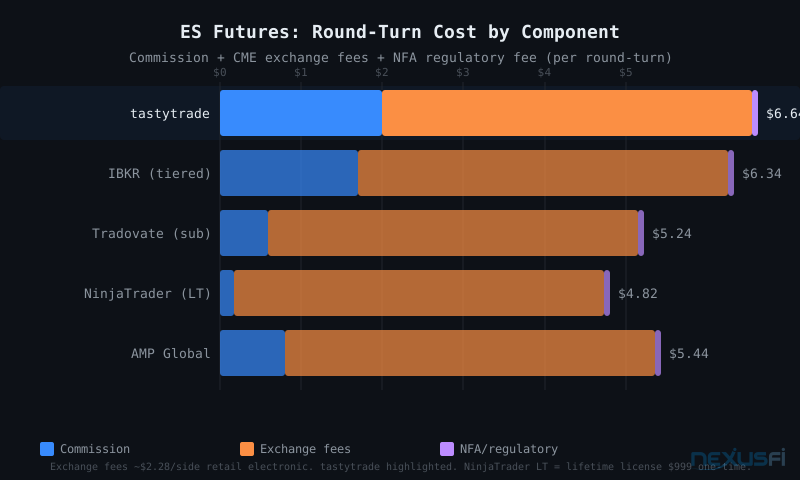
Headline commissions are marketing. The number that matters is your total round-turn cost: commission plus exchange fees plus NFA/regulatory fees plus data costs.
tastytrade's published commission rates for futures:
- Standard futures contracts: $1.00 per contract per side
- Micro futures (MES, MNQ, M2K, MYM, MCL, MGC): $0.75 per contract per side
- Options on futures: $1.25 per contract per side
On standard ES futures, exchange fees from CME run approximately $1.14/side for retail electronic access. NFA fees add another $0.02. Total all-in for one ES contract: roughly $4.32 round-turn at tastytrade. That's competitive but not the lowest in the market — AMP Global with a flat-rate plan can get you below $3.50 round-turn on ES, and NinjaTrader lifetime license holders get close on micro contracts.

The micro math matters more. On MES at $0.75 commission, your round-turn all-in is roughly $2.26. MES tick value is $1.25. That means you're paying 0.9 ticks in round-turn costs for every micro contract trade. If your average winner is 4 ticks ($5), you're giving away 18% in friction. Trade 10 MES contracts instead of 1 ES, and your commission cost triples — something most traders switching from mini to micro don't fully appreciate until they see a monthly statement.

On micro contracts, every extra dollar in round-turn cost matters more than it does on standard contracts. If you're trading MES or MNQ in size, run the math on AMP's flat-rate plan before defaulting to tastytrade.
Factor 2: Margin Structure
tastytrade uses standard SPAN/PC-SPAN margin frameworks with broker-level risk overlays. Margin accounts require a $2,000 minimum. For trading, what matters:
Overnight (initial) margin follows CME minimum requirements closely. For ES in a normal volatility environment, initial margin runs around $16,500-$18,000 per contract, with maintenance at approximately $15,000. tastytrade doesn't heavily discount these — what you see from CME is close to what you'll need in your account.
Intraday margin is where tastytrade stands out negatively compared to some competitors. The broker doesn't offer heavily discounted day-trading margins. While some firms (Tradovate, NinjaTrader Brokerage) offer intraday ES margins in the $500-$1,000 range that inflate on overnight holds, tastytrade's intraday treatment is closer to approximately 25% of initial margin — roughly $4,000+ for ES. Not extreme, but meaningfully higher than the intraday leaders.

For micro futures, this matters less. MES intraday margin at 25% of approximately $1,700 initial is around $425 — affordable for most retail accounts. This is another reason micros and tastytrade pair well.
Spread margin provides some relief. If you trade calendar spreads or inter-commodity spreads, tastytrade credits margin offsets. An ES-NQ spread will require much less margin than two outright positions. But the credit isn't as aggressive as what IBKR offers on equivalent spread strategies.
Margin rates on cash (the interest you pay on borrowed funds) run 8-11% depending on account size — higher than Interactive Brokers, lower than retail stock brokerages. For futures trading specifically, cash margin rates matter less than for stock traders, since futures don't require you to borrow capital to hold positions. The margin in futures is a performance bond, not a loan.
Factor 3: Platform Execution Capabilities
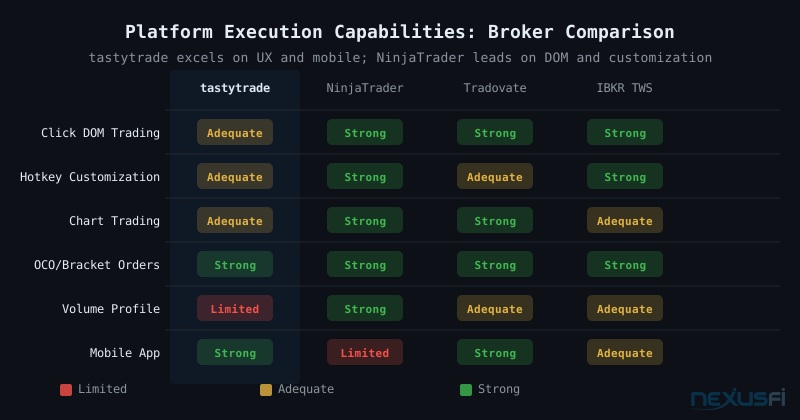
tastytrade's platform is well-designed for discretionary retail trading. It handles the core workflow cleanly:
- Order entry: fast, clear, with good contract search
- Bracket orders and OCO: supported and reliable
- Position monitoring: clean P&L display, Greek visibility for options-on-futures
- Account risk: solid overview of overall risk exposure
- Mobile: functional iOS and Android apps for monitoring
Where it doesn't keep up with futures-specialist platforms:
Depth of Market (DOM): tastytrade has a DOM, but it's not built for active ladder trading. If your execution style depends on reading the book in real time and clicking levels, you'll find it limiting compared to NinjaTrader or Jigsaw.
Advanced order types: no OCO3 or similar complex order chains. The order management is clean but limited.
Hotkey customization: possible but not nearly as deep as NinjaTrader's configuration options.
Charting: adequate for monitoring, not built for technical analysis in the way Sierra Chart or TradingView is. Serious chart traders typically run tastytrade for execution and a separate charting package for analysis.
The honest assessment: if your trading is discretionary, based on reading price action or options flow, and you're not clicking a ladder 20 times a day — tastytrade works. If you're a DOM-based scalper or need serious chart integration, you'll be fighting the platform.
Factor 4: Micro Futures Support
This is where tastytrade genuinely excels for its target audience.
The micro suite (MES, MNQ, M2K, MYM, MCL, MGC) gets full support with $0.75/contract commissions, proper margin scaling, and clean execution on the most liquid contracts. For a retail trader who:
- Wants to risk $100-$500 per trade without needing a large account
- Is testing a new strategy with real money but controlled risk
- Needs to scale positions incrementally (1 MES, then 2, then 5)
- Wants to trade before funding a full ES contract at $16K+ initial margin
...tastytrade is a natural fit. The micro contracts trade on CME Globex with genuine institutional liquidity — not OTC derivatives — and the $0.75 commission keeps round-turn costs reasonable for the tick value.

Compare: 1 ES contract at $16,500 margin vs 10 MES contracts
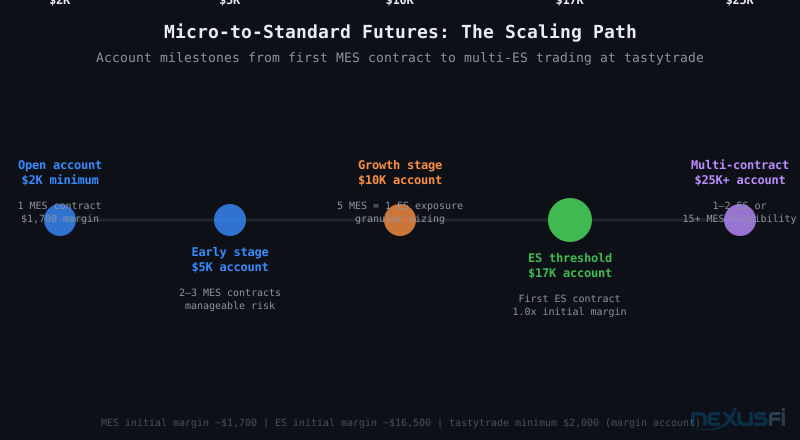
at $1,700 each ($17,000 total, roughly equivalent exposure). The MES route costs more in commissions (10x $0.75 vs 1x $1.00), but provides granular position control that matters for risk management.
Factor 5: Options-on-Futures Integration
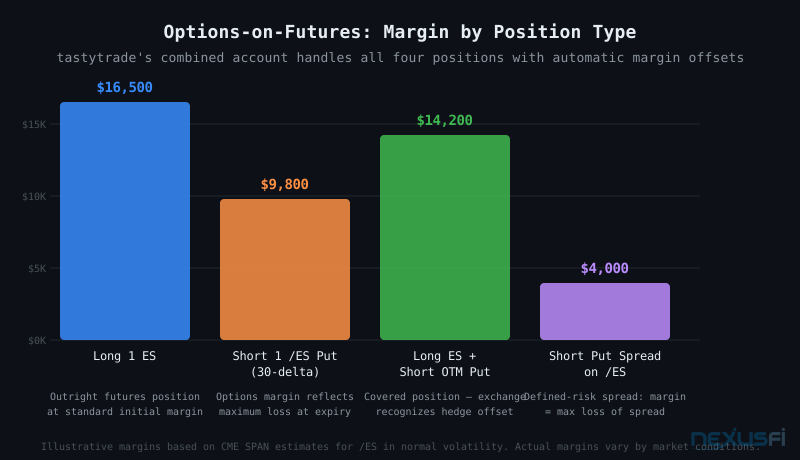
tastytrade's background is options. The full breakdown of options on futures brokerage requirements and mechanics is covered separately. The platform's options tools — probability of profit visualization, IV rank display, position Greeks, P&L curves — are among the best in retail brokerage. If you trade options on ES or GC alongside directional futures, you're managing a complex book, and tastytrade handles that better than most pure-futures platforms.
Options-on-futures commissions at $1.25/contract are reasonable. The platform automatically calculates margin requirements across mixed positions. @Silver Dragon started trading options specifically through tastytrade's educational ecosystem: "The entire team over Tasty Trade are awesome! They are always sharing bits of information to help you succeed." [5]
This integration matters if you use strategies like: selling ES puts while holding a delta-neutral futures position, or hedging a futures position with short calls. Doing this across two separate brokerages is operationally painful. tastytrade unifies it cleanly.


Head-to-Head Comparison #

tastytrade vs Interactive Brokers
Commission: IBKR tiered pricing can get below $0.85/contract on ES for active traders. tastytrade's $1.00 is slightly higher, but the simplicity is better for lower-volume traders.
Margin: IBKR wins, clearly. IBKR's margin rates are lower, and their SPAN implementation is more sophisticated for complex spread strategies. Portfolio margin at IBKR for qualified accounts reduces requirements much.
Platform: IBKR's Trader Workstation is powerful and deeply customizable — and genuinely difficult to use. tastytrade is much more intuitive. Traders who don't need IBKR's institutional-grade tools often leave money on the table fighting the interface.
Global access: IBKR offers Eurex, SGX, Euronext futures. tastytrade is US-only. If you trade Bund futures, STOXX, or Asian index products, IBKR is the only option.
Verdict: IBKR for serious multi-asset traders who need global access or aggressive margin. tastytrade for US-focused traders who want a cleaner platform and don't need institutional-grade tools.
tastytrade vs NinjaTrader Brokerage
Commission: NinjaTrader's lifetime license gets you to $0.09/contract commission with all-in costs around $0.72-$0.85 per side on ES, depending on contract. That's materially cheaper than tastytrade for high-volume traders.
Platform: NinjaTrader is a futures execution platform first. DOM trading, hotkeys, custom indicators, automated strategy execution — NinjaTrader wins on all of them. There's no tastytrade equivalent to NinjaTrader's SuperDOM or Market Analyzer.
Charting: NinjaTrader's charting is much more advanced. If you use volume profile, order flow charts, or custom indicators, NinjaTrader handles them natively. tastytrade relies on its own limited charting.
Intraday margin: NinjaTrader offers genuinely discounted day-trading margins. Their ES intraday margin can be as low as $500 with a performance bond deposit. tastytrade's 25% rule doesn't compete.
Options integration: tastytrade wins here. NinjaTrader's options tools are minimal. If you do options-on-futures, tastytrade is the cleaner solution.
Verdict: NinjaTrader for active intraday futures traders who care about execution quality and platform control. tastytrade for traders who want a better overall experience and also trade options.
tastytrade vs Tradovate
Commission: Tradovate's paid subscription plan offers flat-rate pricing around $0.30-$0.59 per contract all-in on standard futures. For active traders, Tradovate can be meaningfully cheaper.
Platform: Tradovate is purpose-built for futures. Their DOM, chart trading, and web-based execution workflow are strong. The subscription model includes data, so you're comparing all-in costs more cleanly.
Mobile: Both have solid mobile apps. Tradovate's web-first design makes it slightly more accessible from any device.
Options: Tradovate does not offer options on futures. If you trade options alongside futures, Tradovate forces a second account.
Intraday margin: Tradovate offers reduced intraday margins competitive with NinjaTrader — a meaningful advantage over tastytrade for active day traders.
Verdict: Tradovate for futures-only traders who value the subscription pricing model and strong web execution. tastytrade if you need options-on-futures in the same account.
tastytrade vs AMP Global
Commission: AMP on a flat-rate plan can get below $3.50 round-turn on ES and competitive rates on micros. For high-volume traders, AMP is one of the cheapest options available.
Platform: AMP is a platform-neutral broker — they connect you to CQG, Rithmic, NinjaTrader, Sierra Chart, and others. You're not locked into a single interface. tastytrade's proprietary platform is easier but less flexible.
Support: tastytrade's customer service is frequently cited by NexusFi members as responsive and knowledgeable.
[3]
Verdict: AMP for cost-sensitive traders who want platform freedom and don't mind configuration complexity. tastytrade for traders who want a clean, integrated experience at reasonable but not rock-bottom costs.



Decision Framework #

For a framework that evaluates brokers across all dimensions before you deposit, see How to Choose a Futures Broker.
Pick tastytrade if:
You trade micro futures with smaller account capital. The $0.75/contract rate, $2,000 minimum, and micro contract support make this a natural fit. If you're starting with $5,000-$15,000, micros are your tool and tastytrade handles them well.
You trade both options and futures from one account. The platform's options workflow is among the best in retail. If you sell ES puts to fund directional futures exposure, or use short calls to hedge long futures positions, managing this in one interface is worth the slight commission premium over specialists.
You want clean execution without a learning curve. NinjaTrader's power comes with complexity. If you don't need a 20-configuration DOM or custom indicators, tastytrade's straightforward platform gets you live faster with fewer platform-induced errors.
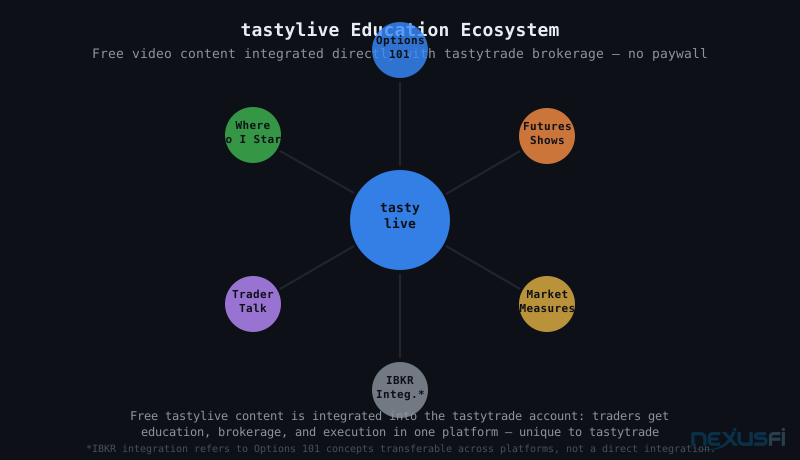
You consume tastylive content. The tastylive media network is genuinely educational. If you're already watching their options and futures shows, trading on tastytrade means your broker and your education are aligned.
Look elsewhere if:
You're a DOM-based scalper. If your strategy involves reading the order book in real time and clicking levels with precision, NinjaTrader or Jigsaw is better suited. tastytrade's DOM works, but it's not built for this use case.
Intraday margin is critical. Firms like NinjaTrader and Tradovate offer intraday margins as low as $500 on ES. tastytrade's ~25% approach means you need roughly 4x the capital for the same number of contracts during the trading day.
You need global futures markets. Eurex, SGX, Euronext — not available on tastytrade. IBKR is the only realistic retail option for European or Asian futures.
You're extremely cost-sensitive at high volume. If you're doing 50+ contracts per day, AMP's flat-rate plans or NinjaTrader's lifetime license math will save you real money monthly.


Getting Started #
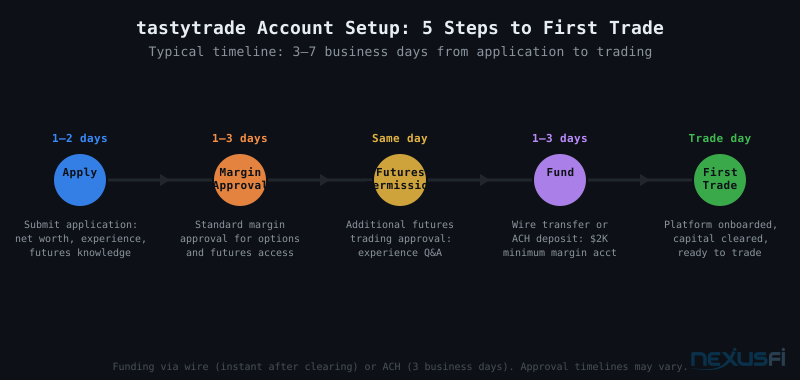
Setting up a tastytrade futures account involves a few specific steps:
1. Open a margin account. A cash account can't trade futures — you need margin approval, which requires the $2,000 minimum funding. The application asks about net worth, investment experience, and futures knowledge.
2. Enable futures trading specifically. After your account opens, you'll see an option to add futures trading permissions. This requires a separate approval — you'll answer a few more questions about futures experience and trading objectives.
3. Fund with at least the margin requirement for your first contract. For MES, you need roughly $1,700 for initial margin. For ES, it's $16,500+. Cushion matters — fund to at least 1.5x the initial margin to handle adverse moves without hitting margin calls in the first week.
Fund to 1.5x
the initial margin minimum. For MES (~$1,700 initial), that's $2,500 in the account before your first trade. Margin calls in week one are almost always a capital-sizing problem, not a strategy problem.
4. Choose your contracts. tastytrade supports the major CME product groups: equity index futures (ES, NQ, YM, RTY, MES, MNQ), energy (CL, NG, MCL), metals (GC, SI, MGC), Treasury (ZN, ZB, ZF), and currency futures (6E, 6J, 6B). The full micro suite is available and fully supported.
5. Set up charting separately if needed. tastytrade's charts are functional for basic monitoring. Traders doing serious technical analysis typically add TradingView (Pro or higher), Sierra Chart, or NinjaTrader charts alongside, using tastytrade for execution only.


Limitations and Honest Drawbacks #
The intraday margin issue is real. If you're day trading and need low intraday margin to deploy capital efficiently, tastytrade's approach limits you. A $10,000 account can trade 2-3 ES contracts at a time with NinjaTrader's intraday margins. The same account at tastytrade gets you 1 contract with margin cushion.
Commission caps out at reasonable
, not excellent.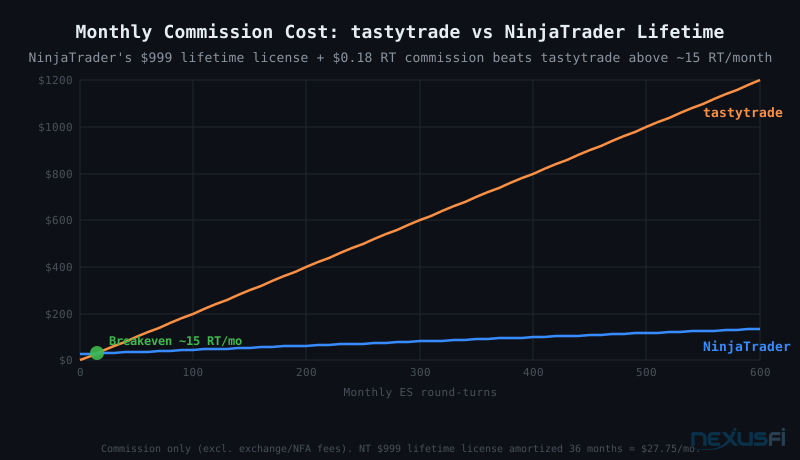
@snax, after two years on tastyworks, switched to Edge Clear and Sierra Chart for their superior DOM and replay capabilities: "I am now on a new platform and broker (switched from tastyworks to Edge Clear/Sierra Chart)." [10] This is the common path for traders whose strategies grow beyond tastytrade's charting ceiling.
The charting platform has real limitations. tastytrade's charts don't support volume profile, footprint charts, or most of the indicators NexusFi members commonly discuss. You can use it for clean candlestick charts and basic indicators, but if your strategy depends on market profile or order flow visualization, you're adding a second platform.
No DOM-centric execution. The DOM exists but isn't a core workflow in the platform. Scaling in and out of futures positions through the ladder is possible but not the native experience the way it is in NinjaTrader or Sierra Chart.
Mobile trading has limitations. The mobile app handles monitoring and simple order entry well, but complex order management (modifying bracket orders, managing multi-leg positions) works better on desktop.
Data fees are part of the cost structure. Market data for standard futures on CME requires exchange data subscriptions. tastytrade bundles some data, but full real-time data for all product groups adds to your monthly cost. Verify the current data fee structure before assuming the commission rate represents your full cost.


What NexusFi Traders Say #
Elite member @TCCONDE moved all accounts to tastytrade after comparing it with ThinkorSwim post-Schwab acquisition: "Tasty was recently rated the number one online broker by IBD. Their educational offerings are all free and extremely good." [4]
@snax, whose trading journal "Crossing the Abyss" documents years of platform evaluation, noted that tastyworks (now tastytrade) "does a LOT of things RIGHT" while acknowledging limitations in futures charting and simulation mode. The customer service experience received specific praise: "excellent, friendly, and always helpful." [2]
@suko introduced the platform to NexusFi in 2016 when it launched: "A next-gen options and futures trading platform from the original team that created Thinkorswim." [1] The founding pedigree matters — the people who built thinkorswim's distinctive options visualization workflow applied the same thinking to this platform.
The consistent theme across NexusFi discussions: tastytrade works well for its target use case (active options and micro futures trading) and the customer service is genuinely good. The recurring friction points are charting depth and the platform's limitations for DOM-centric execution styles.

Knowledge Map
Go Deeper
Build on this knowledgeCitations
- — tastyworks (2016) 👍 6“A next-gen options and futures trading platform from the original team that created Thinkorswim. Affiliated with tastytrade. Not affiliated with TD.”
- — Crossing the Abyss: An Adventure Guide by Snax (2020) 👍 3“tastyworks does a LOT of things RIGHT. If they got a few more things right I would be happy to stay with the platform.”
- — TOS commissions? (2019) 👍 1“I've found Tastyworks customer-service to be excellent, friendly, and always helpful.”
- — Help get more ThinkOrSwim content on futures io! (2021) 👍 4“Tasty was recently rated the number one online broker by IBD. Their educational offerings are all free and extremely good. I have recently consolidated all of my accounts at Tasty.”
- — SD's Options & Futures Journal (2020) 👍 13“The entire team over Tasty Trade are awesome! They are always sharing bits of information to help you succeed.”
- — Crossing the Abyss: An Adventure Guide by Snax (2020) 👍 10“Used to get trade rejections all the time on tastyworks but this was the first one on Sierra.”
- — You've got options (2021) 👍 10“I would suggest the Where Do I Start series over at Tastytrade. They walk you through the entire process from the point of view of someone who has never traded options before.”
- — Stockbrokers.com (2026)
- — Stockbrokers.com (2026)
- — 2020 profit and loss results (2020) 👍 17“I am now on a new platform and broker (switched from tastyworks to Edge Clear/Sierra Chart). I jumped back and forth between the micros and the ES & YM.”