



Keltner Channels: The ATR-Based Volatility Envelope for Trend Trading and Squeeze Setups
Overview #
Keltner Channels wrap an exponential moving average (EMA) with volatility bands derived from Average True Range (ATR). The result is a dynamic envelope that expands when volatility picks up and contracts when the market goes quiet. Unlike Bollinger Bands, which use standard deviation, Keltner Channels use ATR — a measure that captures gaps, limit moves, and the full range of price action futures traders deal with every session.
Chester Keltner introduced the original concept in his 1960 book How to Make Money in Commodities, using a 10-day moving average of the typical price with bands set at the average daily range. Linda Bradford Raschke modernized the indicator in the 1990s by replacing the simple moving average with an EMA and swapping the average daily range for ATR. That modernized version — EMA(20) with 1.5x or 2.0x ATR bands — is what traders use today.
The channels serve three distinct functions: trend identification, volatility measurement, and mean reversion targeting. Price hugging the upper band signals a strong uptrend. Price hugging the lower band signals a strong downtrend. Price oscillating between the bands signals a range-bound market where mean reversion setups dominate. That triple utility makes Keltner Channels one of the more versatile tools in a futures trader's toolkit.
Key Concepts #
Exponential Moving Average (EMA): The channel midline. EMA weights recent prices more heavily than a simple moving average, making it more responsive to current market conditions. The standard period is 20, though some traders use 10 or 50 depending on their timeframe.
Average True Range (ATR): The volatility component. ATR measures the average of the true range over N periods, where true range is the largest of: current high minus current low, absolute value of current high minus previous close, or absolute value of current low minus previous close. For a deep dive on ATR mechanics and applications, see Average True Range (ATR).
Channel Width Multiplier: The ATR reading is multiplied by a factor (typically 1.5 or 2.0) to set the band distance from the midline. Higher multipliers create wider channels that only extreme moves penetrate. Lower multipliers create tighter channels with more frequent band touches.
Upper Band: EMA(N) + Multiplier x ATR(N). Price consistently above this level indicates strong bullish momentum.
Lower Band: EMA(N) - Multiplier x ATR(N). Price consistently below this level indicates strong bearish momentum.
Channel Slope: The direction and steepness of the midline EMA indicates the prevailing trend. A flat midline signals a range; a steeply angled midline signals a strong directional move.
How Keltner Channels Are Calculated #
The calculation is straightforward but the parameter choices matter:
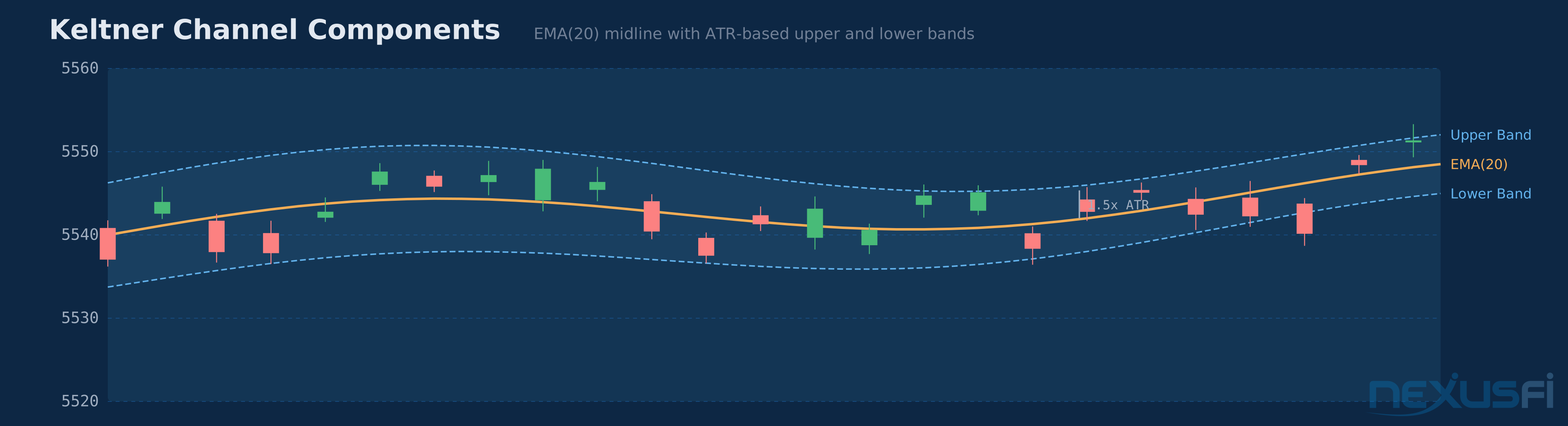
Step 1 — Calculate the EMA midline:
EMA(20) = Price x (2 / (20 + 1)) + Previous EMA x (1 - 2 / (20 + 1))
For the first bar, the EMA equals the simple average of the prior 20 closes. After that, each bar applies the smoothing factor of 2/21 (approximately 0.0952) to the new price and carries forward 19/21 of the prior EMA.
Step 2 — Calculate ATR:
True Range = max(High - Low, |High - Previous Close|, |Low - Previous Close|)
ATR(10) = Smoothed average of the last 10 True Range values
Note the asymmetry: most implementations use a 20-period EMA but only a 10-period ATR. The shorter ATR period makes the channel width more responsive to recent volatility changes while the longer EMA provides a smoother trend reference.
Step 3 — Construct the bands:
Upper Band = EMA(20) + 1.5 x ATR(10)
Lower Band = EMA(20) - 1.5 x ATR(10)
Common parameter sets for futures:
| Setting | EMA | ATR | Multiplier | Use Case |
|---|---|---|---|---|
| Standard | 20 | 10 | 1.5 | Day trading ES, NQ — good balance of signal frequency and reliability |
| Tight | 20 | 10 | 1.0 | Scalping — more frequent band touches, more signals, more noise |
| Wide | 20 | 10 | 2.0 | Swing trading — only extreme moves reach the bands, fewer but higher-conviction signals |
| Responsive | 10 | 10 | 1.5 | Fast-moving instruments like CL, NQ — adapts quickly to regime changes |
| Smooth | 50 | 14 | 2.0 | Position trading — filters out intraday noise, focuses on major moves |
As @Fat Tails explains in a complete NexusFi thread on channel-based indicators, the Keltner Channel "show[s] the non-directional volatility (friction)" — distinguishing it at the core from standard deviation-based measures that reflect directional price expansion.[2]
Trend Identification: Following the Channel #
The most powerful application of Keltner Channels is as a trend filter. When price is in a strong trend, it rides one side of the channel — and the channel itself tilts in the direction of the move.
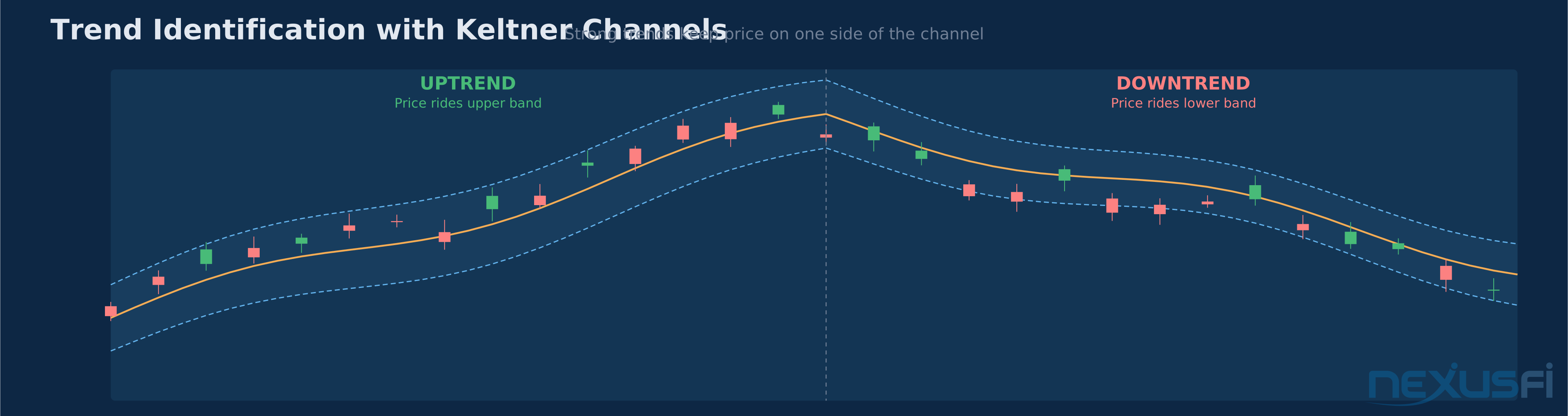
Strong uptrend characteristics:
- Price consistently closes above the midline EMA
- Price touches or exceeds the upper band repeatedly
- The midline slopes upward at a visible angle
- Pullbacks find support at or near the midline
- The channel itself is expanding (ATR increasing)
Strong downtrend characteristics:
- Price consistently closes below the midline EMA
- Price touches or presses against the lower band
- The midline slopes downward
- Bounces find resistance at or near the midline
- Band expansion confirms momentum
Range-bound market characteristics:
- Price oscillates between the upper and lower bands without trend persistence
- The midline is relatively flat
- The channel width is contracting (ATR decreasing)
- Neither bulls nor bears can hold price beyond the midline for extended moves
As @Silver Dragon described in their trading journal, they "use the Keltner Channels to provide context on the trend" combined with MACD for timing — the channels tell you WHERE the market is within its volatility structure, while momentum indicators tell you WHEN to act.[1]
The midline as a trend line: In a trending market, the 20-period EMA midline functions as a dynamic support/resistance level. Pullbacks to the midline in an uptrend are buying opportunities. Rallies to the midline in a downtrend are selling opportunities. When price starts consistently closing on the wrong side of the midline, the trend is likely changing character.
The Bollinger Band Squeeze: Keltner's Most Famous Setup #
The "squeeze" is arguably the most widely traded setup involving Keltner Channels, and it doesn't even use them as the primary signal generator — it uses them as a reference frame.
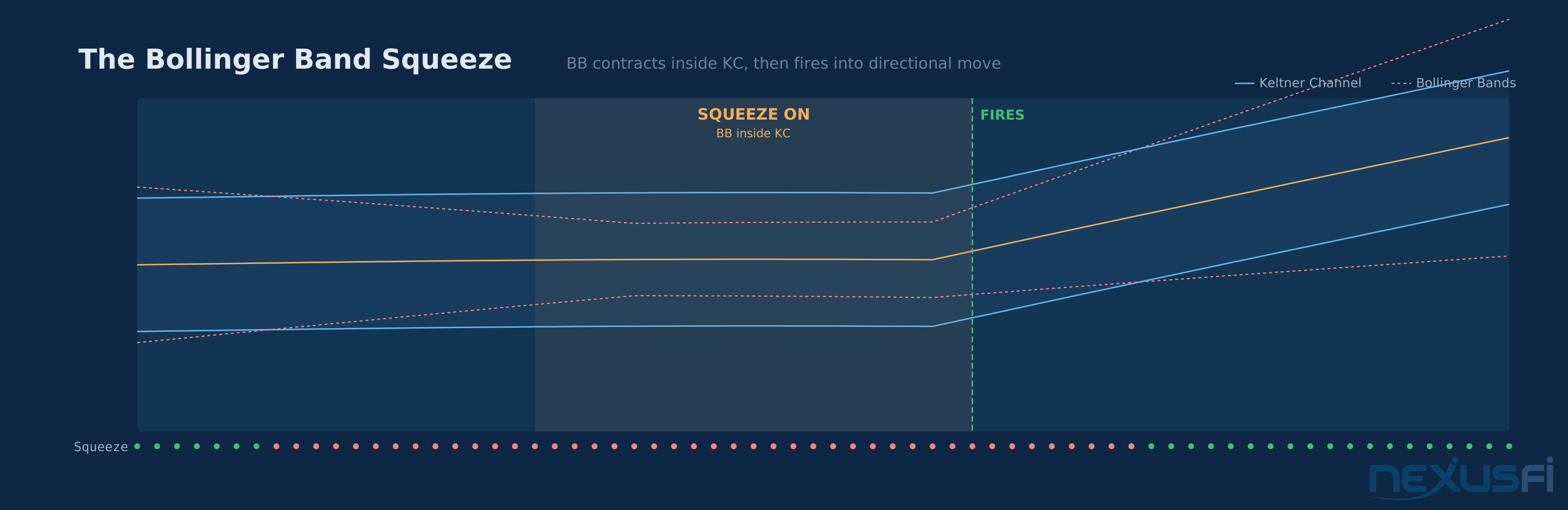
The concept: A squeeze occurs when Bollinger Bands contract inside the Keltner Channels. Since Bollinger Bands measure standard deviation (directional volatility) and Keltner Channels measure ATR (non-directional volatility), the squeeze identifies periods where directional volatility has compressed below non-directional volatility. That's consolidation — and consolidation precedes expansion.
[2]
How to identify the squeeze:
- Plot Bollinger Bands (20-period SMA, 2.0 standard deviations) and Keltner Channels (20-period EMA, 1.5x ATR) on the same chart
- When the upper Bollinger Band drops below the upper Keltner Channel, the squeeze is ON
- When the upper Bollinger Band crosses back above the upper Keltner Channel, the squeeze is FIRING — volatility is expanding
- The direction of the move after the squeeze fires is the trade signal
Squeeze mechanics in detail:
@Fat Tails broke down the math: "The squeeze identifies narrow trading ranges by comparing Bollinger Bands and Keltner Channels. The condition that the Bollinger Band is inside the Keltner Channel just means that StDev < ATR x multiplier_ratio."[7] In other words, the squeeze is a mathematical comparison of two volatility measures, not a subjective visual pattern.
Trading the squeeze:
The squeeze itself is NOT the trade — it's the setup. The trade comes when the squeeze releases:
- Squeeze fires bullish: Bollinger Bands expand outside Keltner Channels AND a momentum indicator (linear regression slope, MACD histogram, or rate of change) is positive. Enter long.
- Squeeze fires bearish: Bands expand AND momentum indicator is negative. Enter short.
- Stop placement: Below the midline EMA for longs, above it for shorts. The midline acts as the invalidation level.
- Target: First target at 1.5x the ATR from entry. Extended target at the next significant level (prior swing high/low, volume node, or pivot).
— providing the context framework while the squeeze signal identifies the timing.[5]
A practical ES example:
ES on a 5-minute chart consolidates for 45 minutes after the open. The 20-period Bollinger Bands compress inside the Keltner Channels. At 10:15 AM, the squeeze fires: Bollinger Bands push outside the Keltner upper band while the momentum histogram turns positive. You enter long at 5,525.00. Stop at the EMA midline (5,520.75). First target at 5,531.50 (1.5x ATR). The squeeze fires into a trend move that runs 15 points.
Mean Reversion Entries at the Bands #
In range-bound markets, Keltner Channels excel as mean reversion boundaries. When the channel is flat and price reaches an extreme band, the probability of a return to the midline increases much.
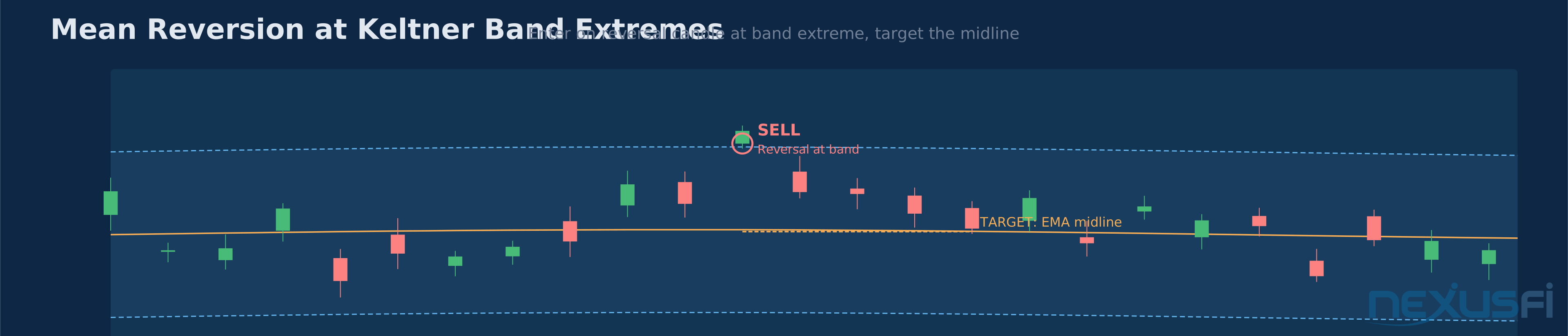
Mean reversion setup criteria:
- The midline is flat or nearly flat (no trend)
- Price touches or slightly exceeds the upper/lower band
- A reversal candle forms at the band (engulfing, pin bar, doji)
- Volume declines at the extreme (exhaustion)
Entry: On the reversal candle close Target: The midline EMA Stop: Beyond the extreme of the reversal candle plus a small buffer (0.5x ATR)
When mean reversion fails: If the channel slope starts changing — if that flat midline starts tilting — mean reversion trades become dangerous. The market is transitioning from range to trend, and fading the band will put you on the wrong side of a directional move.
— but only when the broader context supports mean reversion, not when a new trend is developing.[8]
Breakout Trading: Price Beyond the Bands #
When price closes decisively beyond a Keltner Channel band, it signals extraordinary momentum — the kind of move that doesn't happen in normal ranges.
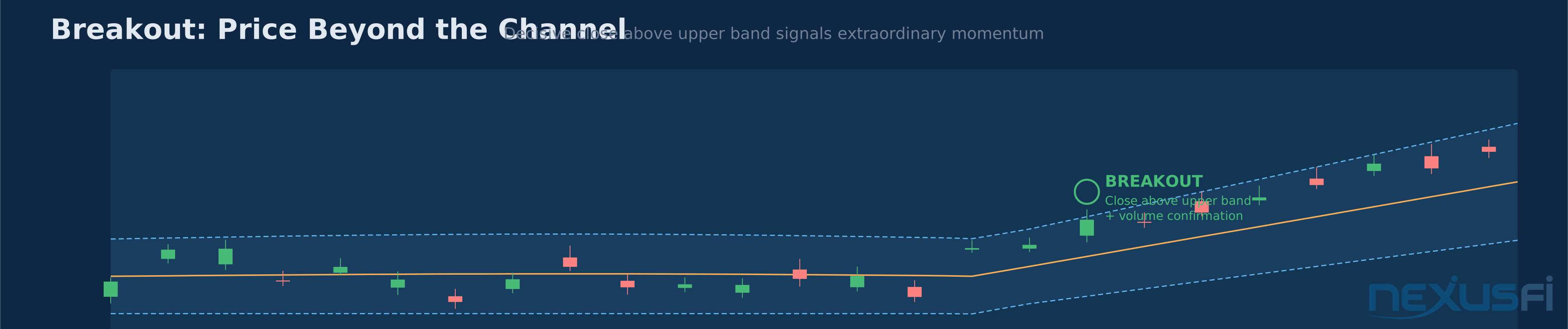
Breakout long setup:
- Price closes above the upper Keltner Channel
- Volume is above average
- The channel midline is sloping upward (trend alignment)
- Enter on the close above the band or on a pullback to the upper band
Breakout short setup:
- Price closes below the lower Keltner Channel
- Volume is above average
- The channel midline is sloping downward
- Enter on the close below the band or on a pullback to the lower band
Critical distinction: A single bar closing outside the channel is not necessarily a breakout. Look for follow-through — a second consecutive close outside the band, or a close-and-hold above/below during the next bar. Single-bar excursions that immediately reverse are failed breakouts, which become mean reversion signals.
CL (crude oil) example:
CL gaps up 80 cents on an OPEC headline, closing well above the upper Keltner Channel on a 15-minute chart. The next two bars consolidate but hold above the upper band. The midline is angling up sharply. That's a breakout continuation setup: enter long on a pullback to the upper band, stop below the midline, target at the next major resistance level.
Keltner Channels vs. Bollinger Bands #
Traders frequently ask which is "better." The answer depends on what you're measuring:
| Dimension | Keltner Channels | Bollinger Bands |
|---|---|---|
| Volatility measure | ATR (captures gaps, full range) | Standard deviation (statistical dispersion) |
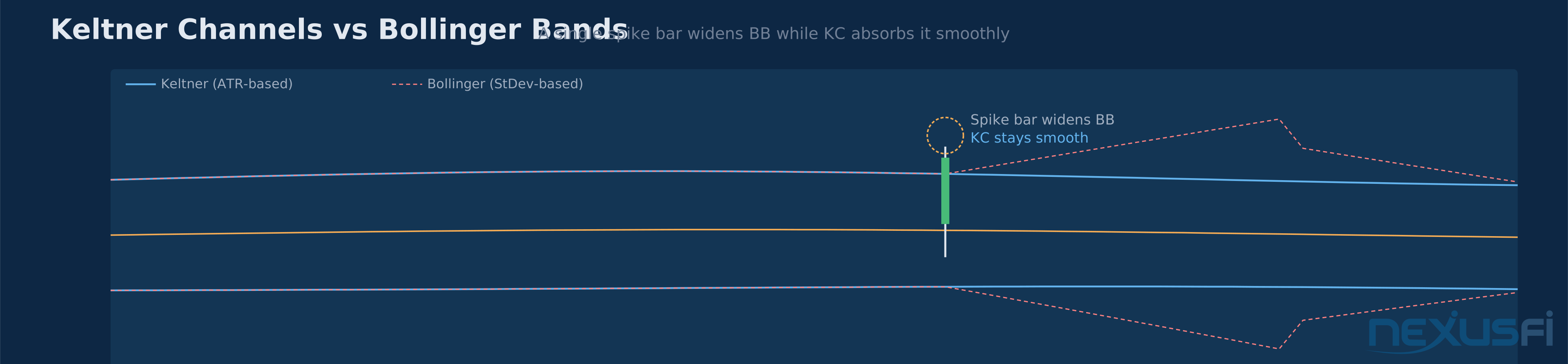
| Band behavior | Smoother, less reactive to single bars | More reactive, whipsaws on spike bars |
| Best for | Trend following, sustained moves | Mean reversion, overextension signals |
| Outlier sensitivity | Low — ATR smooths extremes | High — single spike bar can widen bands dramatically |
| Squeeze partner | Outer reference frame | Inner volatility measure |
| Default midline | EMA (responsive) | SMA (lagging) |
The practical difference: Bollinger Bands react to a single large bar by widening immediately, which can generate false signals. Keltner Channels, using ATR, smooth out that reaction over the lookback period. This makes Keltner Channels more stable for trend-following applications and less prone to whipsawing in choppy markets.
Use both: The most powerful approach is to use them together. Keltner Channels provide the trend context and the outer reference for squeeze detection. Bollinger Bands provide the momentum sensitivity and the inner volatility signal. The two complement rather than duplicate.
Combining with Other Indicators #
Keltner Channels work best as a framework — a context indicator — combined with timing tools:
Keltner + MACD: The channel identifies the trend regime (up, down, flat). MACD signal line crossovers provide entry timing. Only take MACD buy signals when price is above the Keltner midline. Only take MACD sell signals when price is below the midline. This filter eliminates the majority of losing MACD signals in choppy markets.
Keltner + RSI: RSI divergence at the Keltner band extremes produces high-probability reversal setups. Price makes a new high at the upper band, but RSI prints a lower high — that's bearish divergence at a volatility extreme. Dual confirmation.
Keltner + Volume Profile: The Keltner midline often aligns with the Point of Control (POC) or Value Area boundaries. When these levels coincide, the support/resistance is reinforced. See Volume Profile for integration details.
Keltner + Delta Analysis: In strong trends where price rides the upper or lower Keltner band, watch for delta divergence — price pushes to a new extreme at the band, but cumulative delta starts diverging. That's the first sign the trend is losing steam. See Delta Analysis & CVD.
Timeframe Considerations #
Keltner Channel behavior changes across timeframes:
Tick and 1-minute charts: Channels are noisy. Use tighter multipliers (1.0-1.5) and shorter EMA periods (10-13). Best for scalping and recognizing micro-trend transitions. Frequent false breakouts.
5-minute and 15-minute charts: The sweet spot for day trading futures. Standard settings (20 EMA, 1.5x ATR) work well on ES, NQ, YM. Squeeze setups are most reliable on these timeframes because they capture intraday consolidation-to-trend transitions.
Hourly and 4-hour charts: Good for swing trading and overnight position management. Widen the multiplier to 2.0 to filter noise. Band touches are less frequent but more significant. Mean reversion targets become multi-hour holds.
Daily charts: Position trading framework. The channel captures the macro trend. Band touches on daily charts represent major overextension points. Useful for timing entries in longer-term commodity trades (CL, GC, ZW).
Parameter Optimization for Major Futures #
Different instruments have different volatility profiles. Here are field-tested parameter suggestions:
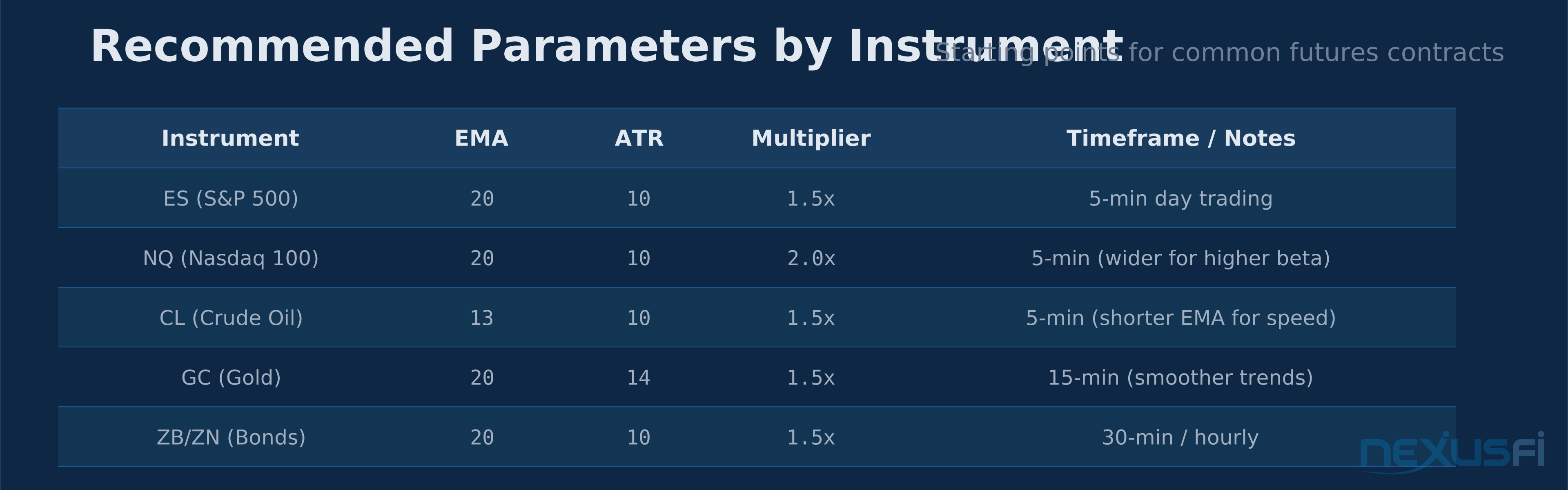
E-mini S&P 500 (ES): EMA(20), ATR(10), Multiplier 1.5 on 5-minute charts. ES is the benchmark — standard settings work well because ES has relatively smooth price action and deep liquidity. The 1.5x multiplier captures normal range; price beyond the bands is genuinely extended.
E-mini Nasdaq 100 (NQ): EMA(20), ATR(10), Multiplier 2.0 on 5-minute charts. NQ is more volatile than ES — higher beta, wider intraday swings. The wider 2.0x multiplier prevents premature band-touch signals that would generate noise with the standard 1.5x setting.
Crude Oil (CL): EMA(13), ATR(10), Multiplier 1.5 on 5-minute charts. CL is faster and more event-driven. The shorter 13-period EMA adapts more quickly to CL's regime changes, which can happen intrabar on inventory reports and geopolitical headlines.
Gold (GC): EMA(20), ATR(14), Multiplier 1.5 on 15-minute charts. GC tends toward smoother trends with less chop than CL. The longer ATR smoothing period captures gold's more measured volatility expansion.
Treasury Futures (ZB, ZN): EMA(20), ATR(10), Multiplier 1.5 on 30-minute or hourly charts. Treasuries trend slowly but persistently. The longer timeframe filters out the tick-by-tick noise and highlights the macro trend channel.
Limitations and When Keltner Channels Fail #
Regime transitions are the killer. Keltner Channels are lagging indicators — the EMA and ATR both look backward. When the market shifts from range to trend or trend to range, the channels need time to adjust. During that transition, the channels provide misleading signals:
- Mean reversion trades at the bands during a new trend get crushed
- Trend-following signals at the midline during a new range get chopped
Overnight gaps bypass the channels entirely. If ES gaps 20 points on an overnight headline, the channels didn't "predict" it and the opening bar will be far outside the band. Don't trade the gap as a breakout signal — the channels need several bars to recalibrate.
Low-volatility environments compress accuracy. When ATR shrinks to historically low levels, the channels become so narrow that every bar touches a band. The signals lose meaning because the bands are too close together to represent meaningful extremes. This is actually when the squeeze setup becomes most valuable — low volatility compressing into the squeeze PRECEDES the expansion.
News events override everything. FOMC announcements, NFP reports, CPI releases — these create moves that respect no technical indicator. Flatten or reduce size before scheduled high-impact events regardless of what the Keltner Channels show.
Single-instrument optimization is dangerous. Settings that work perfectly on ES may fail on CL or NQ. Always test parameter changes on the specific instrument and timeframe you trade. The parameter suggestions above are starting points, not gospel.
Practical Application: A Complete Trade Framework #
Here is a structured approach to using Keltner Channels in daily futures trading:
Pre-market routine:
- Check the daily chart Keltner Channel direction — is the macro trend up, down, or flat?
- Note where price closed relative to the channel — near upper band, lower band, or midline?
- Identify any active daily-timeframe squeeze
Session trading rules:
- Trend day (daily channel sloping, price at band extreme): Trade with the trend only. Use the 5-minute Keltner midline as a pullback entry zone. Don't fade the band.
- Range day (daily channel flat, price mid-channel): Trade mean reversion on the 5-minute chart. Fade upper and lower band touches with stops beyond the extreme.
- Squeeze day (daily squeeze active): Watch for the squeeze to fire on the 5-minute chart. Take the first directional signal after the squeeze releases. This is the highest-probability setup of the three.
Risk management:
- Standard stop: 1.5x ATR from entry (aligned with the channel width)
- Aggressive target: midline EMA for mean reversion trades
- Extended target: opposite band for trend trades
- Maximum risk per trade: never more than the channel width
Position sizing with Keltner width:
The channel width (upper band minus lower band) gives you a direct volatility-adjusted risk measure. If the channel width on ES 5-minute is 8 points and you want to risk $200 per trade:
$200 / (8 points x $12.50 per point) = 2 contracts maximum
This automatically scales your position size to current volatility — smaller when the market is wild, larger when it's quiet.
Knowledge Map
Prerequisites
Understand these firstGo Deeper
Build on this knowledgeReferences This Article
Articles that build on this topicCitations
- — Robert's Market Journal (2018) 👍 5“I use the Keltner Channels to provide context on the trend”
- — How does RSqueeze work? (2012) 👍 31“When the Bollinger Band stay inside the Keltner Channel, the volatility has not moved price thus indicating a congestion”
- — BBSqueeze Histogram (2014) 👍 6“Bollinger Band Squeeze: Bollinger Bands constructed by adding/subtracting standard deviation to/from midband”
- — How does RSqueeze work? (2012) 👍 17“The chandelier stop is a classic. It was used by Charles LeBeau. ATR-based targets and trailing stops.”
- — Trade Journal (2014) 👍 3“In general, the Keltner channels are not unlike hand-drawn trend channels”
- — THREE SET UPS (2010) 👍 15“If you are filtering for Keltner channels it will draw the channel for you”
- — Does anyone Trade Squeezes? (2010) 👍 7“The squeeze identifies narrow trading ranges by comparing Bollinger Bands and Keltner Channels. StDev < ATR x multiplier_ratio”
- — The Land of Vegemite Trading Journal (intraday) (2014) 👍 7“I tend to be fading the market if I'm trading at the extreme of the keltner channels relative to the trade direction”
- — Want your NinjaTrader STRATEGY created for free? (2015) 👍 9“Explanation of anaSqueeze indicator comparing Bollinger Bands and Keltner Channels”