



Managing Multiple Funded Accounts: The Portfolio Approach to Prop Firm Trading
Overview #
Running multiple funded prop firm accounts isn't a hack — it's a portfolio management strategy. The logic is straightforward: a single $50K funded account caps your income at whatever that one account's drawdown rules allow. Ten accounts running the same trades through a copier multiply your throughput without multiplying your risk per position. As @Trader146 puts it, "having multiple accounts allows you to multiply your profits (and losses) as well as your trailing drawdown." [1]
But "more accounts = more money" is the kind of napkin math that gets traders killed. The strategy only works under specific conditions — and it introduces failure modes that don't exist when you're running a single account. Correlation risk, operational complexity, activation fees that stack fast, and the psychological load of managing a portfolio of constrained accounts all conspire against traders who scale up without thinking it through.
This article covers the complete framework: when multiple accounts make sense, the math behind expected value at scale, how to manage drawdown across a portfolio, copy trading mechanics, cost management, and the failure modes that blow up traders who treat this as a cheat code rather than a strategy.
The Portfolio Mindset #
Stop thinking about funded accounts as individual trading accounts. They're limited-risk positions in a portfolio of challenges. Each account has a defined maximum loss (the drawdown limit), a profit target for withdrawal eligibility, and a set of rules that constrain how you trade. That's not an account — that's a structured position with known risk parameters.
The portfolio mindset changes three things about how you approach multi-account trading:
1. Success is aggregate, not per-account. You don't need every account to survive. You need the portfolio's total payouts to exceed total costs (evaluation fees + activation fees + blown accounts). A 60% survival rate across 10 accounts can be wildly profitable if the surviving accounts produce consistent payouts.
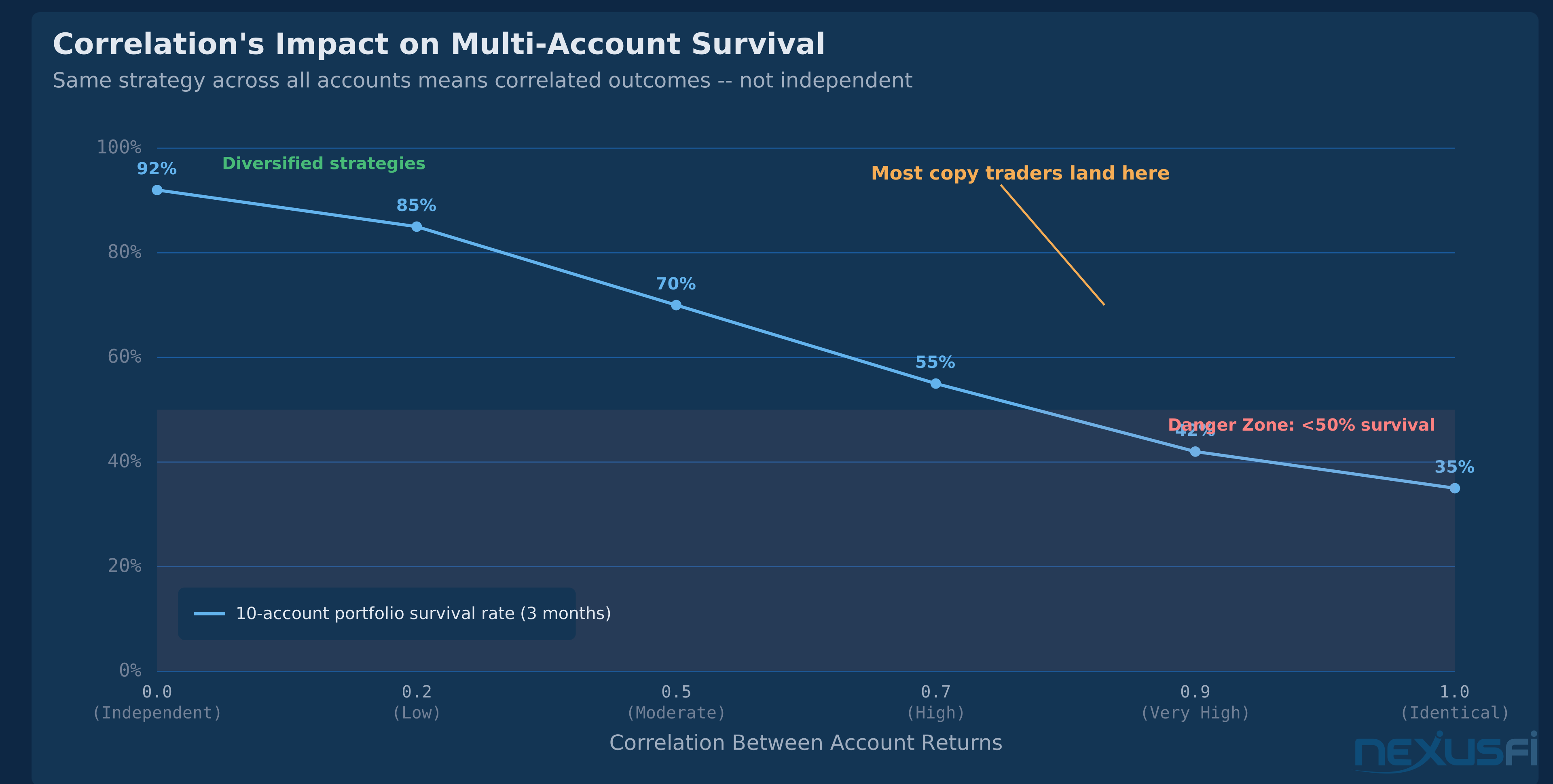
2. Risk is correlated, not independent. Running the same strategy on ES across 10 accounts doesn't give you 10x diversification. It gives you 10x exposure to the same market conditions. When your setup fails on one account, it fails on all of them simultaneously. The math only works if you understand and manage this correlation.
3. Costs are front-loaded, payouts are back-loaded. You pay evaluation fees upfront, activation fees when you pass, and monthly fees while you're building equity. Payouts come weeks or months later. The cash flow profile matters — especially when you're scaling to 10+ accounts.
Why Traders Run Multiple Accounts #
The primary driver is simple: capacity. Most prop firms cap individual account sizes and contract limits. A $50K Apex account lets you trade up to 10 contracts with a $2,500 trailing drawdown. If your edge requires larger size or if you want more income from the same strategy, you hit the ceiling fast.
Multiple accounts solve this in several ways:
Income multiplication.
[2] The math is seductive — and directionally correct, though the reality involves more friction than the spreadsheet suggests.
Drawdown buffer through rotation.
[3] This is genuine risk management — not all accounts take the same hit on the same day if you're staggering which ones are active.
Strategy separation. @planetkill runs different setups across different accounts: "The setups that are working this month, I'll scale up to copy trade to multiple accounts. Withdraw payouts that pay for the whole operation, and then when those accounts inevitably are blown in a couple months, there's already other setups that have now started working." [4] This is the most sophisticated use case — treating each account as a strategy sleeve in a portfolio.
Psychological benefit. This one's underrated.
[3] A trade copier lets you trade small on the screen while running real size across accounts. Your brain sees 1 contract; the portfolio sees 10.
The Expected Value Math #
Here's the formula that determines whether scaling accounts is profitable:
EV(N) = P(survive) x E[profit per account | survive] x N - Cost(N)
Where:
- P(survive) = probability an account survives long enough to generate payouts
- E[profit per account | survive] = expected profit from accounts that don't blow up
- N = number of accounts
- Cost(N) = total evaluation fees + activation fees + monthly fees for N accounts
Let's run realistic numbers for a $50K Apex account strategy:
- Evaluation fee (during 90% discount sales): ~$17/month
- Activation fee (one-time): $150 per account
- Assume 50% pass rate on evaluations (meaning you need ~2 eval accounts per funded account)
- Assume 60% of funded accounts survive to payout eligibility
- Average monthly profit from surviving accounts: $500
For 10 funded accounts:
- Eval cost: 20 accounts x $17 = $340
- Activation: 10 accounts x $150 = $1,500
- Total upfront: $1,840
- Monthly revenue (6 survive x $500): $3,000/month
- Monthly fees for active accounts: ~$170
- Net monthly: ~$2,830
- Breakeven: under 1 month after reaching payout eligibility
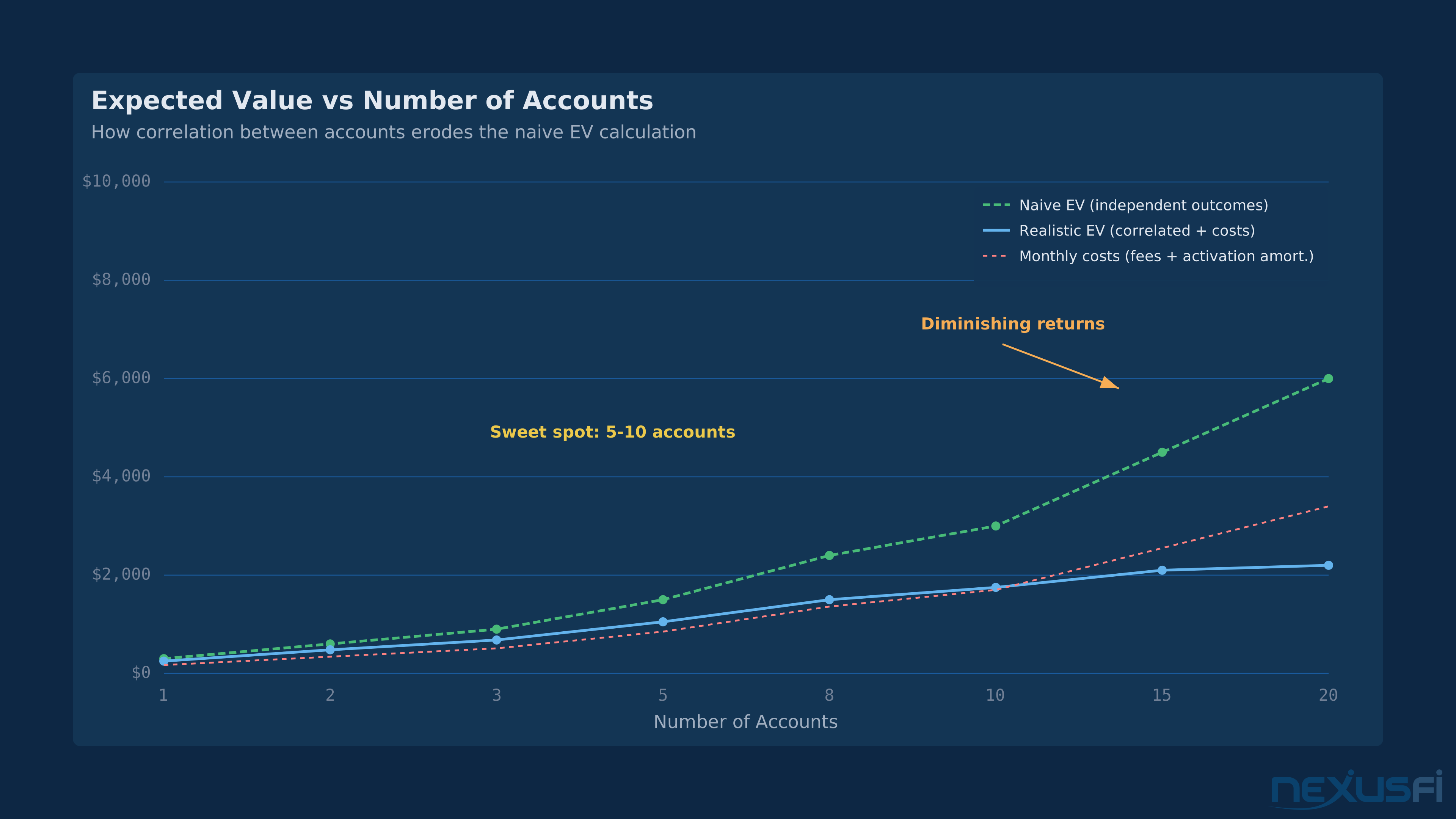
The math looks great on paper. But the critical variable is P(survive), and that number is brutally correlated across accounts when you're running the same strategy. A single bad week in ES can blow 8 out of 10 accounts simultaneously. The EV formula assumes some independence between account outcomes — and that assumption is partially or entirely wrong when you're copy-trading the same signals.
The honest version of the math: if your strategy has a 40% chance of blowing any single account in the first 3 months, and you're running identical trades across all accounts, then the probability of blowing ALL accounts in the same period is much closer to 40% than the 0.01% that independent probabilities would suggest.
Prop Firm Rules That Shape Multi-Account Strategy #
Every firm handles multiple accounts differently. The rules are the binding constraints — not exchange margin, not your trading strategy. You must know these before you scale.
Account caps:
- Apex Trader Funding: Up to 20 accounts per trader. Copy trading explicitly supported. Trailing drawdown on most account types. The $50K account is the sweet spot -- @Baudo notes it has "the best profit target-to-drawdown ratio: for 50K it's $3,000 PT versus $2,500 DD" [5]
- TopStep: Up to 3 active funded accounts. Tighter limits on concurrent accounts. End-of-day drawdown calculation (different risk profile than Apex's trailing drawdown)
- MyFundedFutures: Multiple accounts allowed with end-of-day drawdown options. Different payout schedules
- Earn2Trade: Varies by program. Check current terms -- they change frequently
Drawdown mechanics matter enormously at scale.
[6] Trailing drawdown (intraday) punishes you for unrealized profits that reverse — which happens constantly when you're running multiple accounts through a copier. End-of-day drawdown gives your trades room to breathe but costs more per account.
Always verify current policies. Prop firm terms change constantly. What's true about Apex's copy trading policy today may not be true next quarter. Read the contract. Call support. Don't rely on YouTube reviewers or Reddit posts for current rules.
Copy Trading: Tools, Execution, and Compliance #
Copy trading is the operational backbone of multi-account management. Without it, running 10+ accounts manually is impossible. With it, you trade once and the copier replicates your entries, exits, and modifications across all connected accounts.
How it works: You designate one account as the "leader" or "source." Your copier software monitors that account for new orders and replicates them to all "follower" accounts. The replication happens through your platform (typically NinjaTrader or Sierra Chart) via the data feed connection (Rithmic or CQG).
Popular copier tools for futures prop accounts:
- Replikanto -- NinjaTrader add-on. Handles multiple Rithmic connections simultaneously. Most popular choice among NexusFi traders managing multiple prop accounts
- Apex Trade Copier -- Apex's built-in solution. Simpler but limited to Apex accounts under a single Rithmic login
- Affordable Indicators Account Duplicate -- Budget option for NinjaTrader users
Execution realities: Copy trading adds latency. Your leader account gets filled first; followers get filled milliseconds to seconds later depending on your setup. In fast markets (FOMC, NFP), that latency means different fill prices across accounts. For scalping strategies where every tick matters, this slippage compounds across 10-20 accounts and can meaningfully impact your P&L.
Critical compliance note:
[5] Partial fills, stuck orders, and failed replication can leave accounts in different states — some flat, some still holding positions. You need Rithmic open as a monitoring layer independent of your trading platform to catch these discrepancies before they trigger drawdown violations.
Cost Management and Unit Economics #
The costs stack up faster than most traders expect. Here's a realistic cost breakdown for scaling to 20 funded accounts:
Phase 1: Evaluations
- At 90% discount (common sale pricing): ~$17/month per $50K eval account
- At 80% discount: ~$33/month per account
- Expect to blow through 30-40 eval accounts to get 20 funded (50% pass rate is optimistic)
- Cost: $510 - $1,360 depending on discount and pass rate
Phase 2: Activation
- $150 one-time fee per funded $50K account at Apex
- 20 accounts: $3,000
- As @phantomtrader notes, "if you buy into these copier accounts, you face a huge cost just to activate them." [7] On $250K accounts, activation is $300 each -- $6,000 for 20 accounts
Phase 3: Monthly ongoing
- NinjaTrader license: $0-$60/month (lifetime license or lease)
- Rithmic data: included with most prop accounts
- Trade copier software: $0-$50/month
- VPS if needed: $20-$50/month
Phase 4: Payout timeline
- Most firms require 7-10 trading days minimum before first withdrawal
- Need to build buffer above minimum balance to avoid blowing up while waiting
- Realistic timeline from eval start to first payout: 6-8 weeks for fast passers, 3-4 months for most traders
@dredmond19800 gives a real-world example: "I've spent $1,570 to get 10x Apex accounts ($17 each + $140 funded activation fee) that I will only try and get about $200-300 a day out of." [8] That's a realistic cost structure — and notice the conservative daily target. He's not swinging for the fences; he's grinding $200-300/day across 10 accounts.
Portfolio-Level Drawdown Management #
This is where multi-account management gets genuinely difficult. You have two layers of risk to manage simultaneously:
Layer 1: Account-level compliance (firm rules — hard constraints). Each account has its own drawdown limit, daily loss limit (if applicable), and contract limits. Violate any of these and the account is blown. These are non-negotiable.
Layer 2: Portfolio-level risk (self-imposed — your constraints). If you're running 10 accounts with the same strategy and the market goes against you, all 10 accounts draw down simultaneously. You need your own stop rule that says: "If my portfolio is down X% of aggregate equity, I stop trading ALL accounts for the day." Nobody else enforces this. You must.
Practical drawdown management framework:
- Set a daily portfolio loss limit. If your combined P&L across all active accounts hits -$X, you're done for the day. Period. This prevents a single bad session from cascading across your entire portfolio
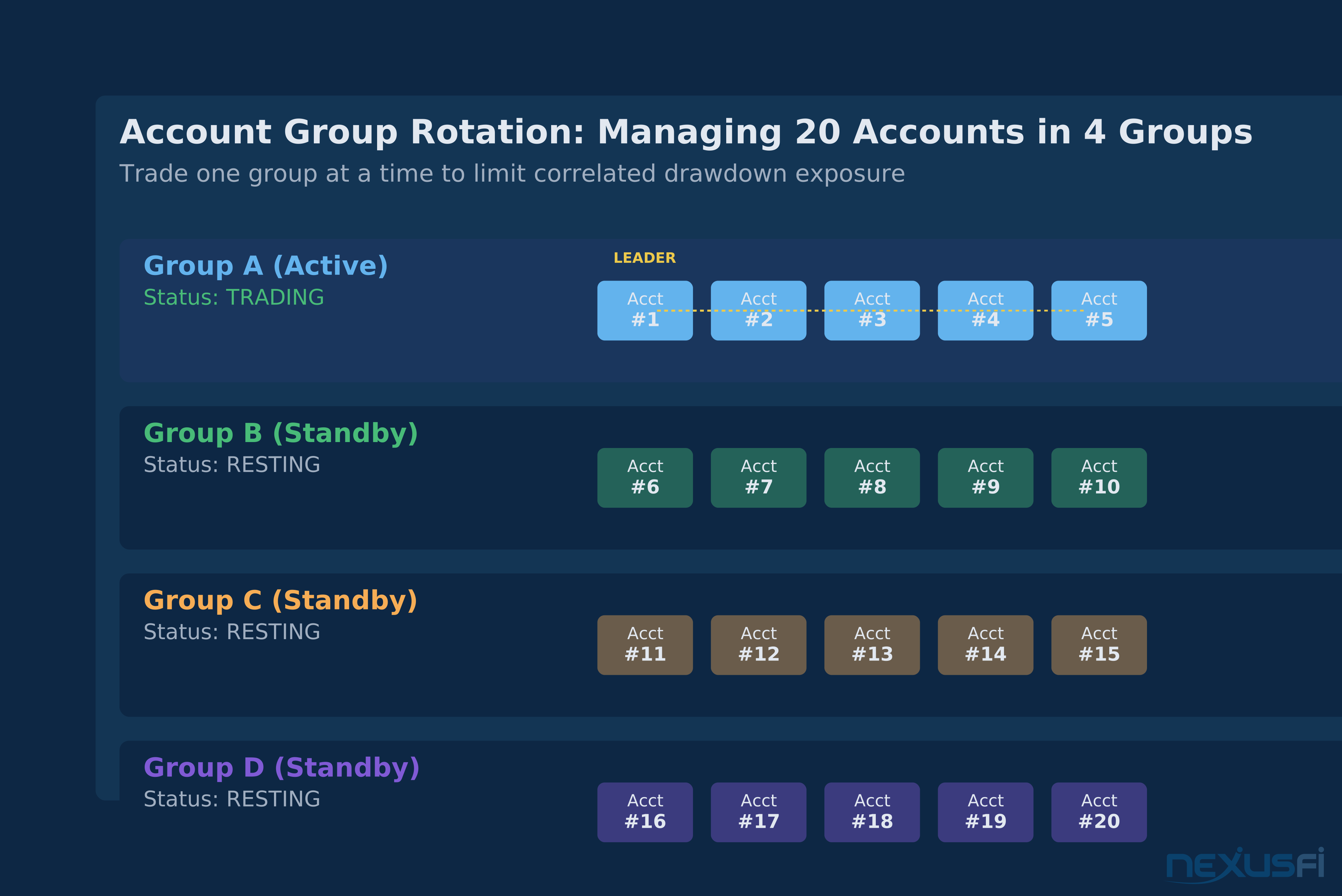
- Trade account groups, not all accounts. @sevensa recommends: "You can spread your risk by using 4 account groups and trade 5 accounts at a time so that a couple of bad trades or copy trading fiasco don't wipe out all 20 accounts." [2]
- Build equity buffers before scaling. Don't copy trade to all 20 accounts on day one. Start with 5, build each to a comfortable buffer above the drawdown threshold, then activate the next group
- Use Rithmic's built-in max daily loss. Set it independently of your platform. If your copier malfunctions or you fat-finger an order, Rithmic will flatten you before you breach the account's hard limit
When Multiple Accounts Fail: The Honest Assessment #
Multi-account trading has specific failure modes that don't exist when you're running a single account. Knowing these in advance is the difference between a calculated portfolio strategy and an expensive lesson.
Failure Mode 1: Correlation wipeout. This is the big one.
[9] When your strategy fails, it fails everywhere at once. If you're running ES across 10 accounts and the market gaps against you on a news event, all 10 accounts take the same hit. The "diversification" of multiple accounts evaporates when the underlying trades are identical.
Failure Mode 2: Operational errors at scale. Wrong account selected. Copier fails to replicate an exit. Partial fill on one account but full fill on another. Order stuck in "working" state. At 20 accounts, the probability of at least one operational error on any given day is uncomfortably high. @Baudo's warning about monitoring through Rithmic independently isn't optional — it's survival. [5]
Failure Mode 3: The trailing drawdown trap. @injpowwetrust describes blowing "around 30 or so accounts" before consistently profiting, noting that many accounts hit the profit target but "ultimately failed because of the trailing drawdown." [10] With copy trading, this problem multiplies. An unrealized gain that ticks up the trailing drawdown floor, followed by a reversal, can blow accounts that were technically profitable moments earlier.
Failure Mode 4: Fee burn during learning. Buying 20 evaluations at $17 each every month while you figure out your approach costs $340/month. Add activation fees for accounts you blow, and you can easily burn through $2,000-$5,000 before ever reaching a payout. If you don't already have a proven edge — defined as "I am consistently profitable on sim with realistic fills" — multiple accounts just multiply your losses faster.
Failure Mode 5: Emotional complexity. Watching 10 accounts draw down simultaneously creates a psychological pressure that single-account trading doesn't. The aggregate dollar figure is larger, the monitoring burden is higher, and the temptation to "revenge trade" to recover portfolio-level losses is intense. This is why the portfolio mindset matters — if you're emotionally attached to each individual account's P&L, you'll make worse decisions than if you're tracking aggregate portfolio performance.
Decision Framework: Is This Strategy Right for You? #
Before buying your first batch of eval accounts, answer these questions honestly:
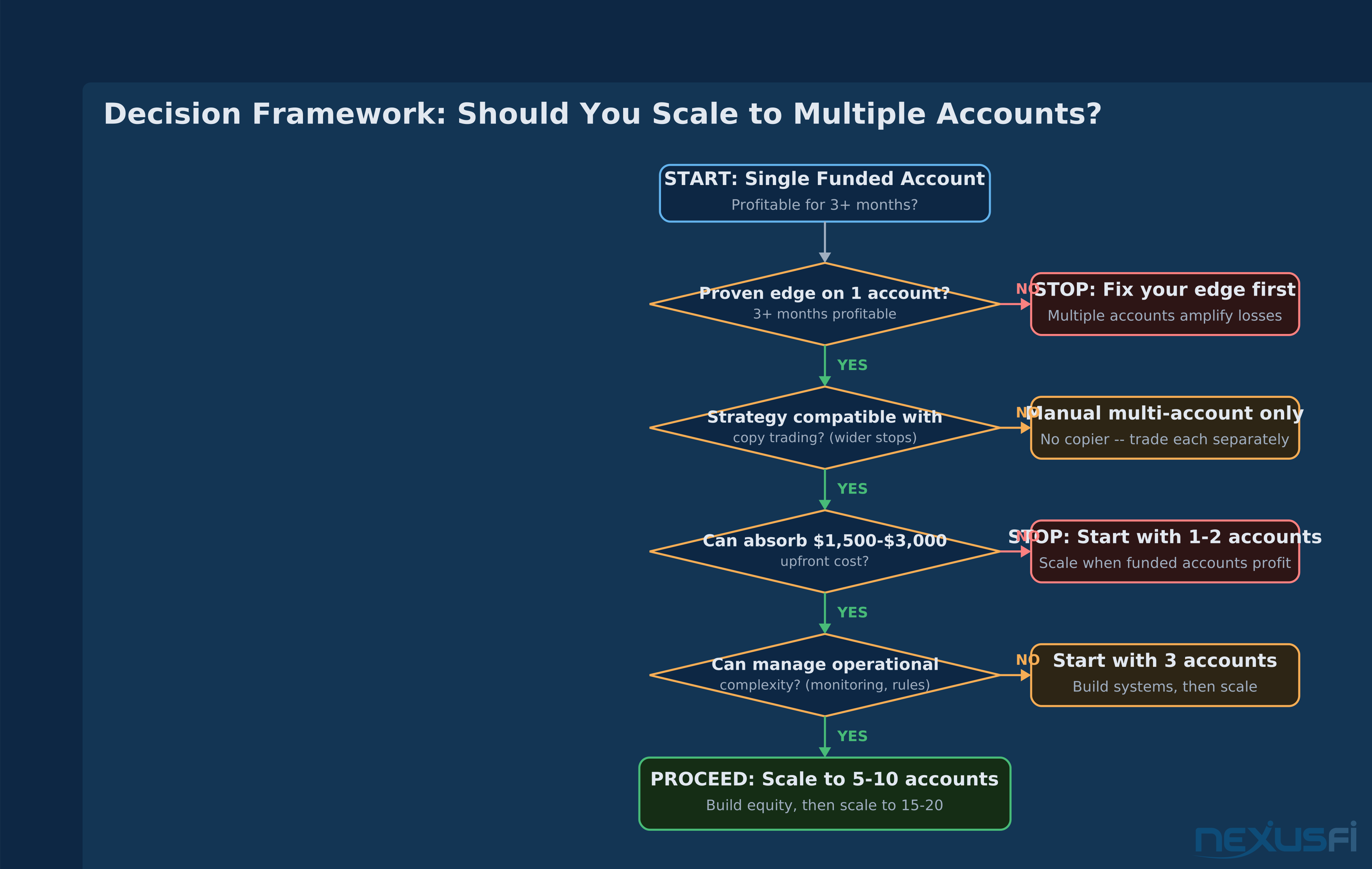
1. Do you have a proven edge?
If you can't consistently profit on a single funded account, multiple accounts won't fix that. They'll amplify the problem. You need at least 3 months of profitable sim trading or live trading before scaling.
2. Is your strategy compatible with copy trading?
Strategies that require fast execution with precise fills (tape reading, order flow scalping) degrade when copied across accounts due to latency. Strategies with wider stops and longer holding periods (swing entries, trend day plays) copy more cleanly.
3. Can you handle the operational complexity?
Running 10+ accounts means monitoring multiple connections, checking for stuck orders, verifying copier replication, and managing account-level compliance for each one. If you struggle to follow rules on a single account, multiplying the number of rule sets is a recipe for blown accounts.
4. Does the marginal EV stay positive after costs?
Each additional account adds fees and operational overhead. At some point, the incremental revenue from adding account #15 doesn't justify the added complexity and cost. For most traders, the sweet spot is 5-10 accounts, not 20.
5. Can you absorb the upfront cost?
Getting 10 funded accounts operational costs $1,500-$3,000 minimum. If that money represents capital you need for rent, you're gambling — not portfolio managing.
The honest answer for most traders: start with 3-5 accounts. Prove the model works — meaning you've made at least 2 successful payouts from the portfolio. Then consider scaling to 10+. Jumping straight to 20 accounts with unproven strategy and untested operations is a fast way to light money on fire.
Practical Application: Building Your Multi-Account Operation #
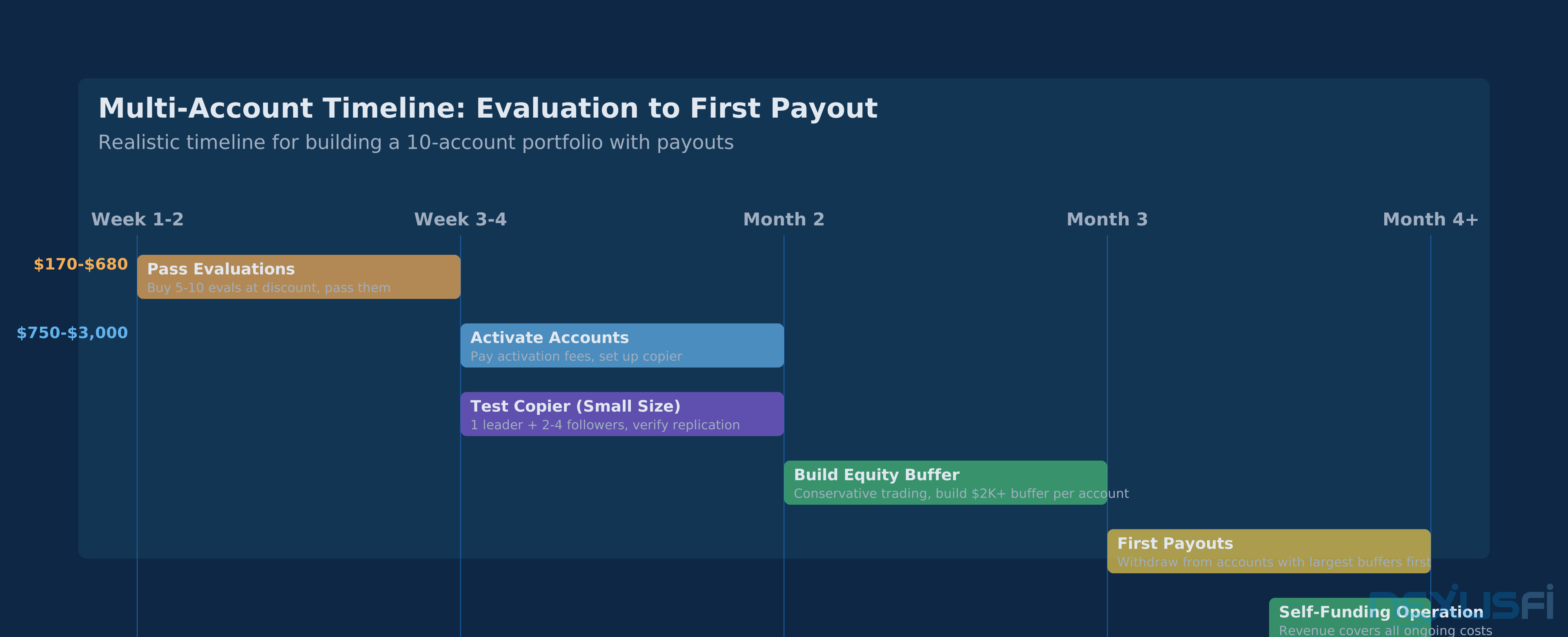
Week 1-2: Foundation. Pick your firm and account size. For most traders starting out, Apex $50K accounts during a discount sale offer the best risk/reward ratio. Buy 3-5 eval accounts. Pass them one at a time to learn the specific rules and drawdown behavior before activating the copier.
Week 3-4: Activate and test. Pay the activation fee on 3 accounts. Set up your trade copier with 1 leader + 2 followers. Trade for a full week at minimal size (2-3 MES contracts on the leader). Verify that orders replicate correctly, exits match, and no accounts have stuck positions at end of day.
Month 2: Scale carefully. If week 3-4 went clean, activate remaining passed accounts. Add to the copier group. Gradually increase leader account size toward your target. Continue monitoring Rithmic independently for each account.
Month 3+: Payout and reinvest. Once accounts reach payout eligibility, request withdrawals from accounts with the largest buffers first. Use payout revenue to cover monthly costs and fund additional evaluations. The operation should be self-funding by month 3-4 if your strategy is working.
Key operational rules:
- Never trade all accounts simultaneously on day one. Stagger by groups
- Set Rithmic max daily loss on every account -- independently of your platform
- Check copier replication before and after every session
- Keep a spreadsheet tracking each account's equity, drawdown buffer, and payout eligibility date
- When you hit your portfolio daily loss limit, shut everything down. No exceptions
Knowledge Map
Prerequisites
Understand these firstGo Deeper
Build on this knowledgeReferences This Article
Articles that build on this topicCitations
- — A Cautionary Tale: My 25-Year Struggle in Pursuit of Trading Success (2023) 👍 15“Having multiple accounts allows you to multiply your profits (and losses) as well as your trailing drawdown.”
- — Funded Trader platforms (2024) 👍 11“If you average $50 a day, this is about $1,000 a month, but since you are doing it over 20 accounts, this is $20,000 a month.”
- — Copy Trading Thoughts? (2022) 👍 1“If you have say a dozen accounts, you can rotate through them, trading 3 accounts at a time, so that if you have a particularly bad account-busting day, you'll still have the others.”
- — Get funded firms 2023/2024 - Any recommendations or words of warning? (2024) 👍 4“The setups that are working this month, I'll scale up to copy trade to multiple accounts. Withdraw payouts that pay for the whole operation.”
- — ApexTraderFunding.com experience and review (2022) 👍 7“Less effort, better profit target-to-drawdown-ratio (for 50K it's 3000 PT versus 2500 DD). Especially when using a trade copier you need to be very alert.”
- — Funded Trader platforms (2024) 👍 7“You want to trade for a few ticks? Get 10-20 trade-copier accounts. You want to trade for longer moves? Get an end-of-day drawdown account.”
- — ApexTraderFunding.com experience and review (2022) 👍 3“If you buy into these copier accounts, you face a huge cost just to activate them. $6,000 if you bought 20 $250K accounts.”
- — Funded Trader platforms (2024) 👍 2“I've spent $1,570 to get 10x Apex accounts ($17 each + $140 funded activation fee) that I will only try and get about $200-300 a day out of.”
- — Funded Trader platforms (2024) 👍 4“Blew the first one on day one trading 20 contracts. Was $6,000 up on 2 trades, took the third and whoops.”
- — APEX 300K+: The Journey (2023) 👍 2“Blown around 30 or so accounts with having reached the goal amount needed to pass, but ultimately failed because of the trailing drawdown.”