



Trader Identity and Self-Worth Separation: Detaching Personal Value From P&L
The market cannot tell you who you are. It has no opinion about your intelligence, your character, or your worth as a person. Every time you treat it as though it does, you hand your decision-making over to randomness.
Overview #
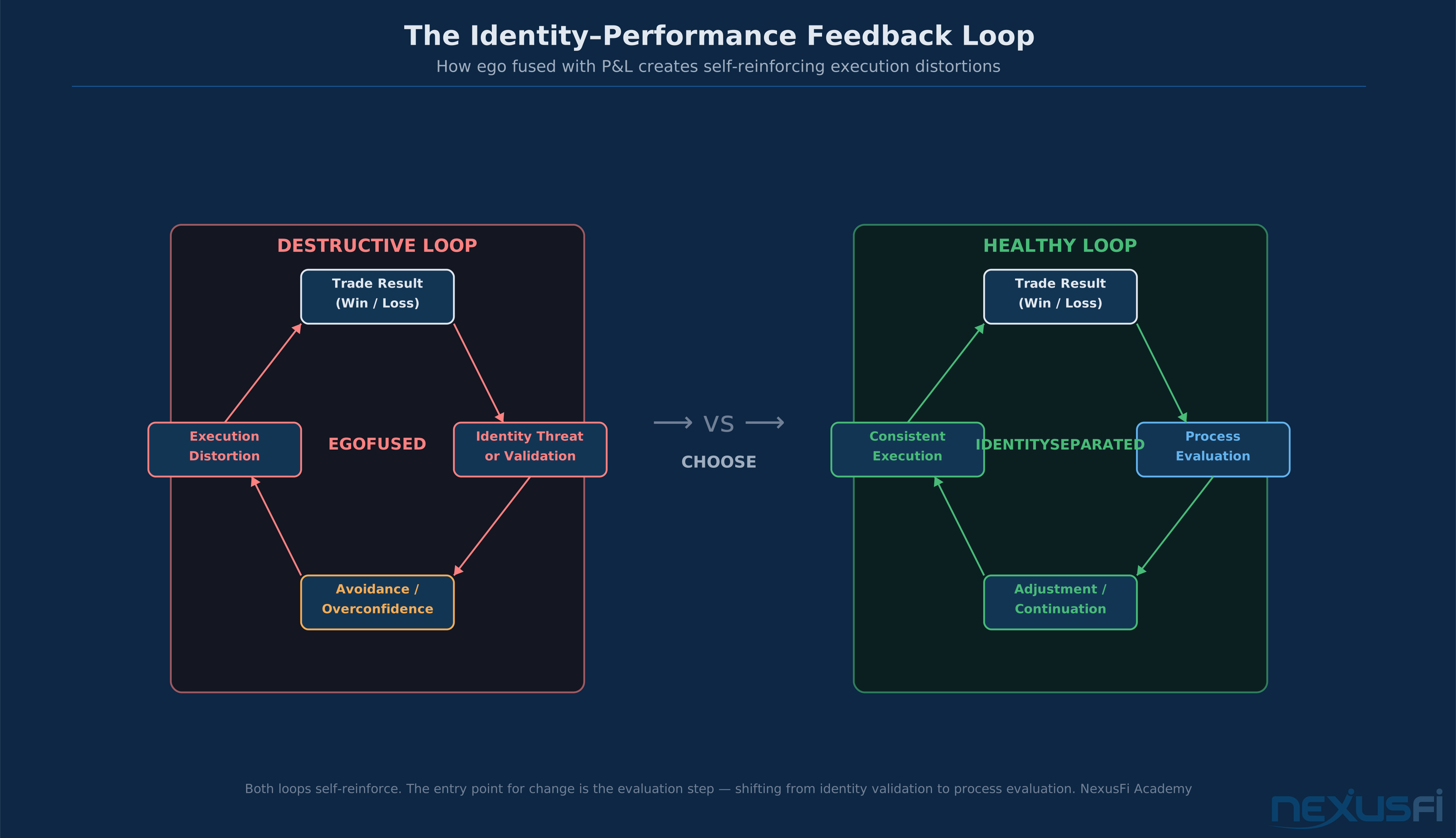
Mark Douglas identified the ego trap as one of the most destructive forces in trading: the fusion of personal self-worth with profit and loss outcomes. When a trader's sense of competence, intelligence, or value as a person rises and falls with the daily P&L, the market becomes a judgment machine. Every loss is a referendum on their abilities. Every win is temporary evidence of worth that must be defended on the next trade.
The consequences are systematic and predictable. Traders hold losers too long because cutting the loss means admitting they were wrong — and being wrong threatens identity. They take profits early because locking in a gain confirms they were right, even when the trade still has distance to its target. They revenge trade after losses because the ego demands vindication. They oversize after wins because success generates a false sense of edge that overrides systematic risk management.
None of these behaviors are irrational from the ego's perspective. They are exactly what the ego should do when tasked with protecting self-worth in an uncertain environment. The problem is that the ego's goal and the trader's goal are not the same. The ego wants to be right. The trader needs to be profitable. These objectives conflict at the most important moments.
The solution is not to eliminate emotion or suppress the ego. It is to construct a trading identity that is grounded in controllable behavior rather than uncontrollable outcomes. This article covers what that construction looks like in practice, why it is so difficult to implement, and the specific exercises that accelerate the transition.

The Ego Trap: How Identity Entangles With Markets #
The ego trap has a specific mechanism. Understanding it makes the solution more logical.
Markets are uncertain. The probability distribution of outcomes is not perfectly known. Even with a genuine edge, any single trade can be a winner or a loser, and the outcome does not directly reveal whether the edge was applied correctly. A trader can execute their system perfectly and lose three times in a row. A trader can violate every rule they have and win large.
The ego, when fused with outcomes, cannot process this reality. It needs a coherent narrative: wins mean competence, losses mean error. When losses occur after correct execution, the ego experiences cognitive dissonance — the outcome doesn't fit the narrative. It resolves this dissonance through rationalization: the stop was too tight, the market maker ran it, the news was unavoidable. The loss must be explained away, not accepted as normal variance.
When wins occur after a rule violation, the ego extracts the wrong lesson: the violation "worked." The reckless behavior is reinforced. The system becomes increasingly contaminated with ad hoc decisions that felt correct and produced short-term reward.
Rahulgopi's observation captures something important: ego identification works in most professional environments because those environments reward competence reliably. A doctor who makes correct diagnoses consistently gets better outcomes consistently. The correlation between ability and result is high enough that identity built on outcomes is stable.
Trading breaks this correlation. The feedback is too noisy. A correct trading decision and a random favorable price move produce identical P&L outcomes in the short run. An incorrect decision and an unfavorable streak are indistinguishable from bad luck. When you build your identity on outcomes in a high-noise environment, you are building on sand — and the tide comes in every drawdown.
Being Right vs. Being Profitable #
This distinction is the operational core of the identity separation problem. It deserves concrete analysis rather than abstract treatment.
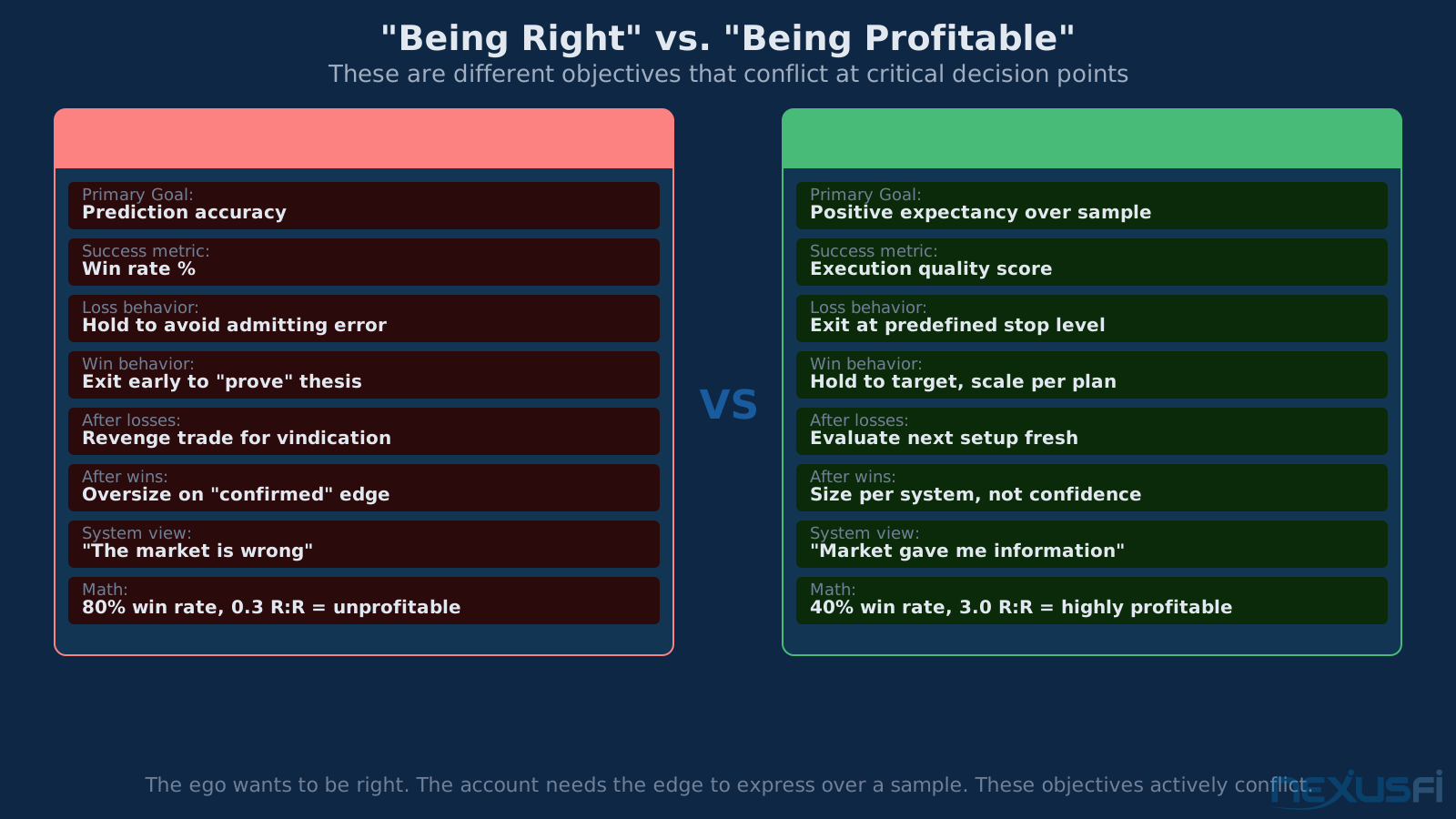
Being right means prediction accuracy. It means calling the direction correctly, identifying the turning point ahead of price, having your thesis confirmed by subsequent market action. The psychological reward of being right is immediate, visceral, and completely independent of whether the trade was executed correctly or sized appropriately.
Being profitable means positive expectancy realized over a sufficient sample. It means that across a representative series of trades, the system produces more reward than it costs in risk. A trader with 40% win rate and 3:1 average reward-to-risk is highly profitable and wrong most of the time. A trader with 80% win rate and 0.3:1 reward-to-risk is unprofitable and right most of the time.
The ego wants to be right. The trading account needs the edge. These are different objectives, and at critical decision points — holding a loser to avoid admitting error, exiting a winner early to "prove" the thesis was correct — they actively conflict.
Josh's retrospective is representative of a pattern that appears repeatedly in trader development: the breakthrough toward consistency comes not from discovering a better system but from disengaging personal worth from trading outcomes. The system was often already functional. The execution failures were psychological, not technical.
The specific behaviors that emerge when "being right" dominates the identity:
Holding losers: The trade hasn't gone to stop yet, so the thesis is still "possibly correct." The ego tolerates unrealized losses because the market hasn't officially rendered its verdict. This behavior distorts the risk/reward of the entire system by allowing losses to grow while cutting winners.
Arguing with the market: The trader has a thesis, the market disagrees, and the trader continues adding to the position rather than exiting. The position grows because the trader is invested in the thesis being correct, not in the trade being profitable.
Analysis paralysis at entry: If not entering, I can't be wrong yet. Waiting for another confirmation is waiting for certainty, and certainty is what the ego needs to feel safe. In a probabilistic environment, this means missing trades systematically.
Narrative-building after losses: Rather than examining whether the stop was placed correctly relative to market structure, the ego constructs an explanation for why this loss was not really a loss — it was an unusual event, a manipulation, a stop run that will reverse.
Observer vs. Participant: A Practical Framework #
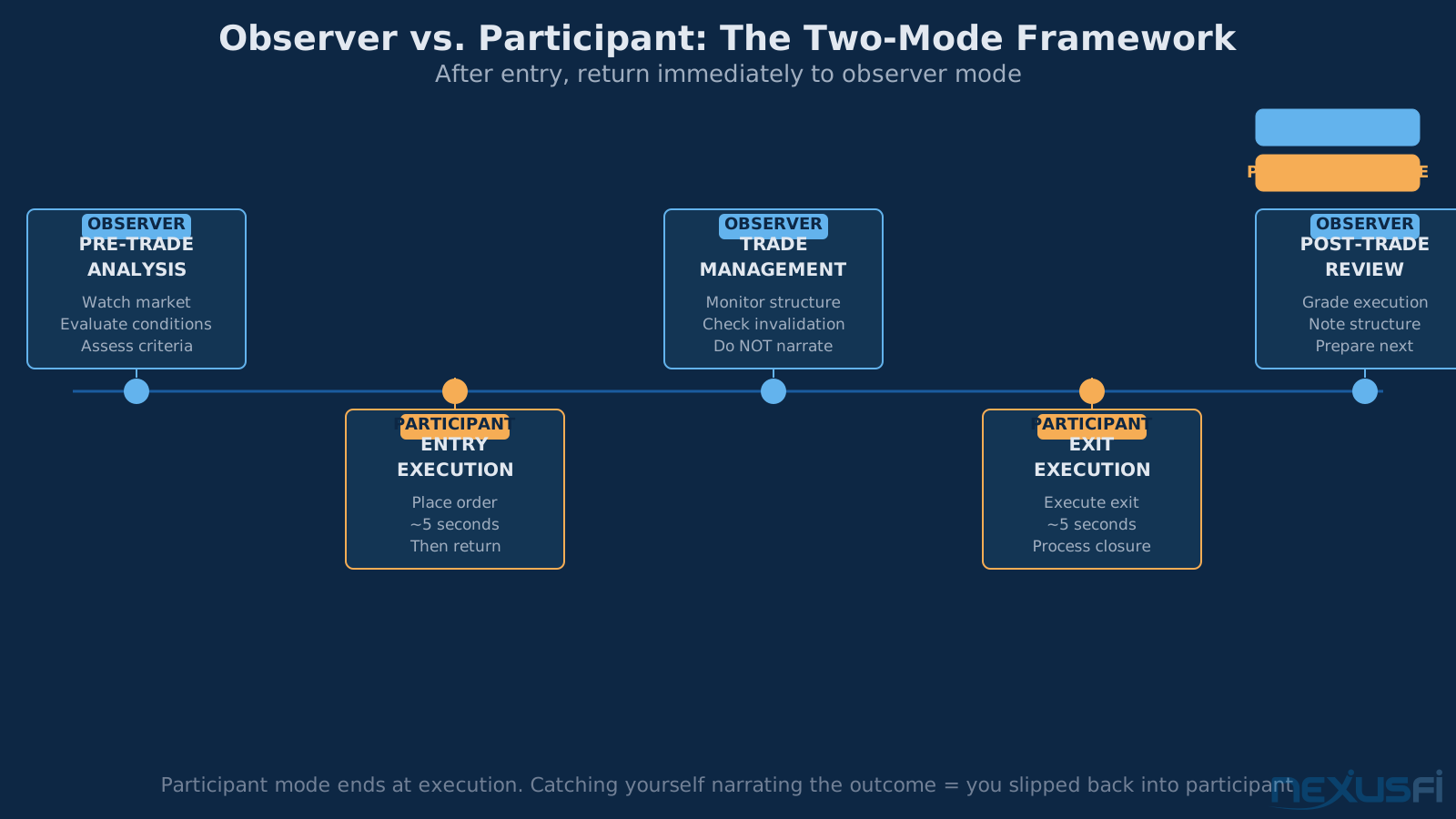
The observer/participant distinction gives traders a concrete framework for managing the moment-to-moment pull toward outcome identification.
Participant mode: You are in the trade. You feel the position moving. Each tick has emotional weight. You are narrating the action from the inside, with a stake in the outcome. This is the ego's natural operating mode during a live trade, and it is the mode that generates intervention impulses — the urge to widen stops, add to positions, or exit early.
Observer mode: You are watching the trade. Your position has been placed according to your plan. The market's behavior is data. Your job is to monitor whether conditions have changed that would invalidate your thesis — not to react to price movement within the expected range. You are a scientist watching an experiment run.
The critical practice is this: after you enter a trade, you return to observer mode. The participant role ended at execution. Everything that follows is monitoring, not participation.
This is harder than it sounds. The transition back to observer mode is disrupted every time the position moves much, every time a known news trigger is approaching, and every time a consecutive-loss pattern is building emotional momentum. Each of these conditions activates the participant mode — the ego re-engages, and the urge to intervene grows.
The practical signal that you have slipped back into participant mode: you are having opinions about what the market should do. "Come on, push through here." "Don't let this give back." These thoughts reveal that outcomes are still emotionally weighted. An observer has no preferences about the experiment's result.
The shift ZviTradingCoach describes is exactly the identity construction that separates process-based from outcome-based traders. "My mastery of trading is consistently executing my plan" is not a consolation prize for losing traders. It is the only statement about trading mastery that is actually within a trader's control, and the only one that produces stable execution over time.

Building Process-Based Identity: The Architecture #
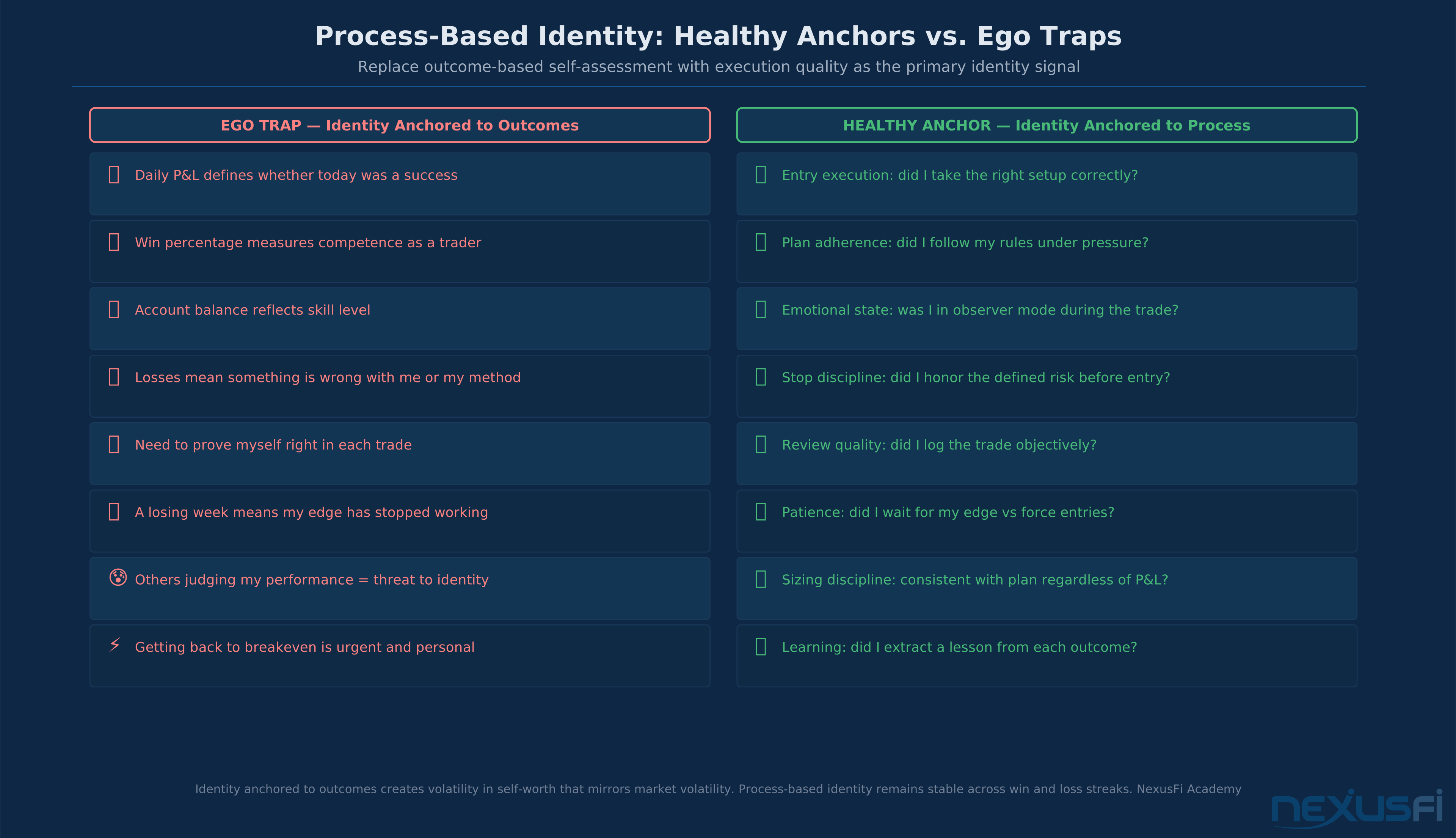
A process-based trading identity is not constructed by telling yourself that losses are okay. It is constructed by systematically redirecting the ego's need for evidence of competence toward controllable behaviors.
The architecture has three components:
1. Identity statement. A specific, controllable definition of what "good trading" means for you. This should be precise enough that you can evaluate it after each trade independent of outcome.
Poor identity statement: "I am a profitable trader." (Outcome-based, outside your control on any given trade)
Stronger identity statement: "I am a trader who enters only when my criteria are fully met, sizes correctly, and exits at predefined levels — regardless of outcome." (Process-based, fully within your control)
The stronger version produces a different response to losses. If you followed your criteria, sized correctly, and exited at your predefined level — and the trade lost — your identity is intact. You did your job. The market did something random. If you violated any of your criteria — and the trade won — your identity is threatened, because you were not the trader you claim to be.
2. Evidence hierarchy. What evidence are you counting as proof of your competence?
Outcome-based evidence: "I made money today." "My win rate this month is 72%." "That trade worked perfectly."
Process-based evidence: "I executed 19 of 20 entries according to my criteria this week." "I followed my stop rule on every trade, including the three that hit my stop level." "I did not take a trade in the three-hour window when my system generates noise."
The shift in evidence hierarchy changes what you pay attention to, what you track, and what you feel good or bad about. Traders who make the shift typically report that they feel genuinely good about sessions where they followed their system flawlessly and lost money — not because they enjoy losing, but because they recognize that the loss was beyond their control and their execution was not.
3. Outcome-neutral post-trade review. After each trade, evaluate execution quality before reviewing the P&L. The sequence matters.
First: Did I enter when my criteria were met? Second: Did my stop follow my invalidation logic? Third: Did my exit follow my predefined exit rules? Fourth: Was my size within my risk parameters? Then: What was the P&L?
When the P&L is reviewed last, it carries less identity weight. You have already established whether you traded correctly before you know whether you made money. A correct trade that lost money is categorized as "data." An incorrect trade that made money is categorized as "pattern to correct."

Exercises for Identity Construction #
These exercises work through conditioning and pattern interruption. They require consistent practice over weeks, not insight over a single session.
The Process Scorecard (Weekly) #
Rate yourself from 1 to 10 on five dimensions every weekend:
- Criteria adherence — did I enter only when my setup was fully present?
- Stop discipline — did I exit at predefined levels without deviation?
- Sizing consistency — did I stay within my risk parameters on every trade?
- Emotional regulation — did I maintain calm and clear decision-making throughout?
- Post-trade review quality — did I evaluate each trade honestly?
P&L does not appear on this scorecard. Track it separately. Your score on these five dimensions is your performance metric. Your P&L is market feedback that you analyze separately and dispassionately.
After completing the scorecard, ask this specific question: "If I consistently scored 9/10 on all five dimensions, would my system produce positive expectancy over the next 200 trades?" If the answer is yes, your job is scorecard improvement, not P&L management.
The Reframe Protocol (Real-Time) #
When you catch yourself in an ego-based thought pattern, interrupt it with a specific verbal reframe. The patterns to watch for:
"I'm such an idiot for that loss" → "I executed my system. That is one data point in my edge's distribution."
"I'm brilliant — called that perfectly" → "I executed my system. That is one data point in my edge's distribution."
"I need this trade to work" → "I need to execute this trade correctly."
"The market is against me today" → "The market is probabilistic. My sample today is small."
"If I can just get back to flat I'll stop for the day" → "I trade setups, not P&L levels. The next trade is the next setup."
HumbleTrader's question — "why do you really want to be a trader?" — is the identity audit question that most traders avoid because the honest answer is often uncomfortable. The desire to prove intelligence, generate external validation, or achieve status through trading performance all load personal worth onto market outcomes. These motivations are not wrong — they are human. But they are incompatible with the process-based execution that trading requires.
The Outcome-Neutral Journal (30 Days) #
For a defined 30-day period, structure your post-trade journal entries to separate execution quality from results:
Entry format:
- Setup: What criteria triggered the entry? Were all criteria met? (Y/N)
- Stop: Was the stop placed at the structural invalidation level? (Y/N)
- Execution score: 1-10 based on process adherence
- Market behavior: What did price do, what did order flow show?
- Lesson: What does this trade teach about market structure?
P&L is tracked separately in a spreadsheet. It does not appear in the journal.
After 30 days, calculate your average execution score. Look at the distribution of P&L relative to execution scores. Traders who do this consistently find that high execution score sessions produce better P&L on average — not because following rules creates market-moving certainty, but because undisciplined execution systematically adds costs (wider effective stops, chased entries, missed exits) that drag on expected value.
Position Sizing as Psychological Calibration #
Your correct position size is the size at which you can watch your stop be reached without emotional dysregulation. This is not rhetorical — it is a specific calibration tool.
Start with your current position size. Place a trade. When it goes to your stop, observe your emotional response. If the response is agitation, urgency, or a strong impulse to intervene — the size is above your current acceptance capacity. Reduce it until the stop-out registers as calm data rather than threat.
This calibration reveals something important: the size that produces emotional dysregulation is not being traded "aggressively" — it is being traded at a level that degrades your decision quality. Reducing to your psychological comfort size is not weakness. It is trading at the size where your edge can actually express, because execution quality at that size is materially better.
The increase back to larger sizes happens gradually, as the practices in this article shift your acceptance capacity upward. Size and psychology must move together.
The Microstructure Perspective: Why Ego Costs Money Directly #
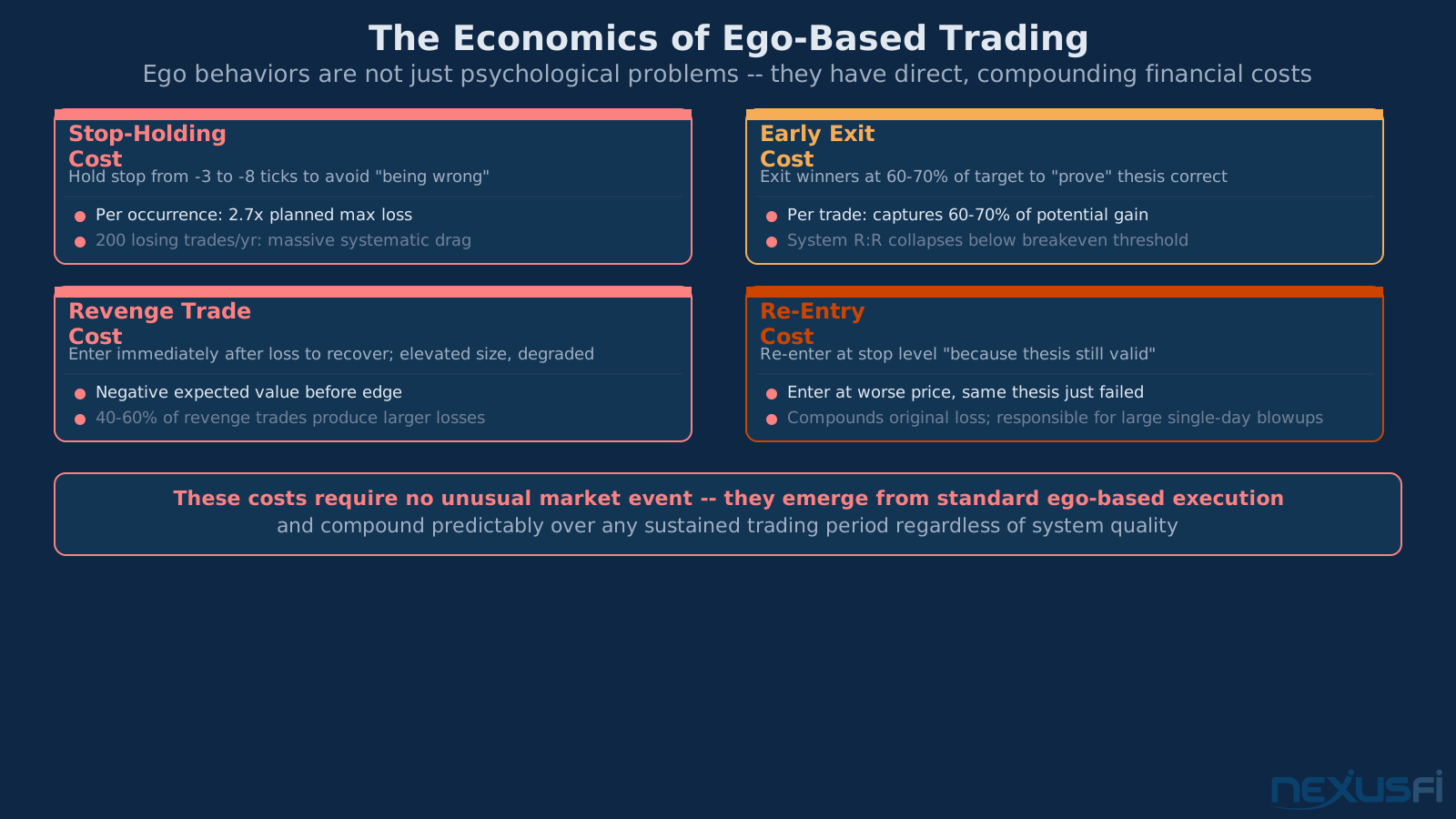
The identity problem is not just a psychological issue — it has direct, quantifiable effects on trading economics that compound over time.
Stop-holding costs: A trader who holds losses beyond their stop level to avoid "being wrong" experiences exponentially worse outcomes than the pre-committed stop would have produced. In futures, a stop at -3 ticks that gets held to -8 ticks because of ego produces 2.7x the expected loss. Over 200 losing trades per year, the total cost of this ego behavior is significant.
Early profit-taking costs: A trader who exits winners early to "prove the thesis" captures an average of 60-70% of potential gains. If the system's expected value is based on full-target achievement, early exits reduce the effective reward-to-risk below the threshold that makes the system profitable.
Revenge trading costs: The trade entered specifically to recover the day's loss is taken with degraded setup quality, elevated position size, and accelerated decision-making. These conditions systematically produce worse outcomes than normal trading. The expected value of a revenge trade in these conditions is negative before any edge is considered.
Re-entry costs: When a trade reaches the stop level and the trader immediately re-enters "because the thesis is still valid," they typically enter at a worse price, with the same position, after the market has just proven the original thesis incorrect in the short term. This pattern is responsible for some of the largest single-session losses traders experience.
None of these costs require an unusual market event. They emerge directly from the failure to separate identity from outcome, and they compound predictably over any sustained trading period.
The Long Game: Identity Resilience During Drawdowns #
The practices above are most straightforward to implement during periods of normal performance. They are hardest to implement — and most important — during extended drawdowns, which is when identity-based trading most commonly destroys accounts.
A sustained drawdown creates specific identity pressures. After 15 losing days in a row, the evidence for "I am a competent trader who follows a working system" becomes difficult to maintain, and the evidence for "I am wrong about this approach" grows. The ego begins to search for explanations that preserve self-worth while explaining the drawdown: the system needs adjustment, the market regime has changed, position sizing needs revision.
Some of these explanations may be correct. The problem is that they cannot be evaluated reliably from within an emotionally activated state. The trader who makes system adjustments during a drawdown because of psychological pressure rather than statistical evidence is more likely to destroy an edge that was experiencing normal variance than to fix a genuinely broken system.
The process-based identity is the protection against this. If your identity is grounded in execution quality — did I follow my criteria, size correctly, and exit at predefined levels — then a drawdown is evaluated differently. The question is not "is my system working?" but "am I executing my system correctly?" If the answer to the second question is yes, the statistical conclusion is that you are experiencing variance, not edge failure. Conviction in that conclusion requires an identity that is not threatened by the drawdown.
Lancelottrader's description of ego and results in direct conflict captures the central tension of the early trader development period. The ego constructs a narrative of competence that the results contradict, and rather than updating the identity, the trader updates the explanations. This pattern can continue indefinitely — it is the mechanism behind traders who have been "almost consistently profitable for years" while accounts slowly erode.
The Weekly Identity Audit #
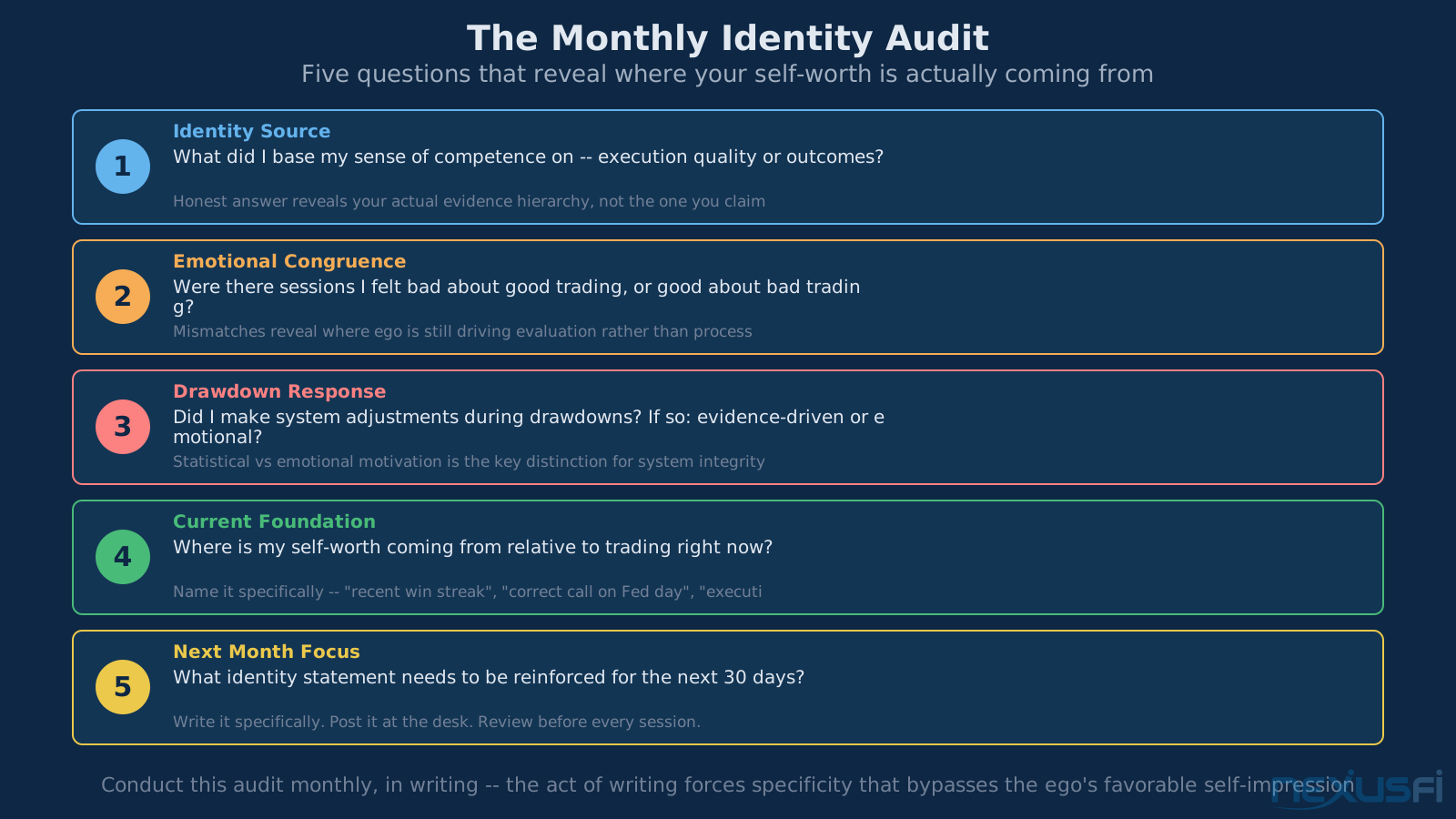
Once a month, conduct a 30-minute structured review specifically focused on identity:
Questions to answer in writing:
- In the past month, what did I base my sense of competence on — execution quality or outcomes?
- Were there sessions where I felt bad about good trading (correct execution, losing trades)? Were there sessions where I felt good about bad trading (incorrect execution, winning trades)?
- Did I make system adjustments during drawdowns? If so, were they driven by evidence (statistical evaluation of the system) or by emotional pressure?
- Where is my self-worth currently coming from relative to my trading?
- What identity statement needs to be reinforced for next month?
The audit is not about generating insights — it is about accountability. Most traders find that the act of writing answers to these questions produces the most honest self-assessment available. The writing forces specificity, and specificity bypasses the ego's tendency to generate favorable general impressions of its own behavior.
Practical Takeaways #
The market cannot tell you who you are. It has no interest in your intelligence, your history, or your worth. Every trade is a probabilistic sample from a distribution defined by your system, the current market regime, and random variance. Treating individual samples as evidence of competence or incompetence is a category error — and an expensive one.
The construction of a process-based trading identity is gradual and requires consistent practice rather than understanding. The exercises above work through repetition, not insight. Traders who implement the Process Scorecard, the Outcome-Neutral Journal, and the Reframe Protocol consistently over 60 to 90 days report a specific and characteristic shift: they stop dreading losing trades and start treating them as the expected cost of running a probability-based operation.
The traders who reach consistent execution report the same experience: they stopped needing the market to tell them they were competent, and started using the market as a workbench for their system. The evidence of their competence became the quality of their process — something they could control and improve independent of what the market did on any given day.
That shift is the goal. Not emotional numbness or detachment from trading. A different relationship with evidence — one grounded in what you can control rather than what the market randomly produces.
Knowledge Map
Go Deeper
Build on this knowledgeReferences This Article
Articles that build on this topicCitations
- — Spoo-nalysis ES e-mini futures S&P 500 (2015) 👍 21“A lot of us tie our self-worth to what we do. We tend to identify ourselves as a doctor or engineer or trader. This ego identification did not hinder my career as a doctor. But in trading? It destroys you. Because the market doesn't care about your credentials.”
- — Desperate call for help, I CANT execute my discretionary trading plan (2022) 👍 17“That guy, me years ago, was not a winning trader, precisely because I had too much of my own self-worth tied up into being successful. Let go of the need for something to prove yourself.”
- — Ego and Trading (2025) 👍 3“Guess what happened once they switched to 'My mastery of trading is consistently executing my plan'? Good fortune in their trading.”
- — HumbleTrader's next chapter (2024) 👍 3“Have a deep look at your real motivation. If you are out there to prove yourself, your worth is tied to your success as a trader. Trading with that energy is incredibly difficult to sustain.”
- — Identity crisis when switching to full time trader (2015) 👍 8“Still I deluded myself -- perhaps because of ego -- or maybe even 'magical thinking' that I was good. Now I may have had the ability... but I was not being honest with myself. My trading results and my ego were in direct conflict.”
- — Trading in the Zone (2000)
- — Winning attitudes create winning traders (2024) 👍 31“Their identity and mental state are tied to their trading performance, win or lose. When they win they are elated and overconfident, and when they lose they are grumpy, negative... Recognize that you are not your trading performance. You have intrinsic value that goes beyond what you do in life.”
- — Do you admit to being a trader? (2010) 👍 16“Pride and self-confidence are both important prerequisites for self-realization, which in turn leads to the emotional fortitude that is required to become a successful trader.”
- — Salao's Journal (2022) 👍 6“It was my ego that ended up killing one of the tools that I could use to fight it. I need it to be process focused instead of outcome driven. My ego is a capricious idiot eager to take credit AND assign blame.”