



Seven Principles of Trading Consistency: Mark Douglas's Framework for Mastering the Zone
Overview #
Mark Douglas's Trading in the Zone (2000) identified why profitable trading systems fail in human hands: the problem is psychological, not technical. His solution is two interlocking frameworks — the 5 Fundamental Truths and the 7 Principles of Consistency. Together, they define the mindset of the consistent winner: not someone who wins every trade, but someone whose behavior generates reproducible results over time.
Mark Douglas spent his career answering a question that tortured traders for generations: why do people with profitable trading systems lose money? The answer, he argued, wasn't technical. It wasn't a better indicator, a different time frame, or access to institutional order flow. The answer was psychological u2014 and it had a specific, trainable solution.
His 2000 book Trading in the Zone distilled that solution into two interlocking frameworks: the 5 Fundamental Truths of trading, and the 7 Principles of Consistency. Together, these form what Douglas called the mindset of a "consistent winner." Not someone who wins every trade u2014 that's impossible u2014 but someone whose behavior generates consistent, reproducible results over time. This article breaks down each principle with the practical depth it deserves, because most traders read these seven sentences, nod, and then continue trading exactly as they did before.
Why Consistency Is a Psychological Problem, Not a Technical One #
Before examining the seven principles, it's worth understanding why Douglas framed consistency as a psychology problem at all. Most traders arrive at the market with an implicit assumption: if I analyze correctly, I'll win. The market rewards correct analysis. Incorrect analysis loses. This assumption is wrong, and its wrongness is the source of most psychological suffering in trading.
The market doesn't care about your analysis. It doesn't validate good thinking or punish bad thinking u2014 at least not trade by trade. It produces outcomes based on the aggregate behavior of all participants at a given moment, and that aggregate behavior is statistically unpredictable on any given trade, even when your edge is real.
Consider a simple example. Suppose you have a setup with a 65% win rate. You place 10 trades. How many of those 10 trades will be winners? Most traders answer: about 6 or 7. But probability doesn't work that way at small sample sizes. You could see 4 winners, or 8 winners, or 2 winners in 10 trades and still have a legitimate 65% edge. The edge only emerges reliably across 50, 100, or 200 trades u2014 not 10.
The consistent winner understands this at a gut level. The inconsistent trader u2014 no matter how sophisticated their analysis u2014 doesn't. And that misunderstanding generates fear (of losses that are part of a perfectly functional system), hesitation (second-guessing valid setups), and revenge trading (trying to "make back" losses that didn't require making back).
As NexusFi member
That sentence is the entire Douglas framework compressed into one line. But living it u2014 across hundreds of trades and drawdowns and winning streaks u2014 is the work.
Forum citation: Concerning risk per trade sizing u2014 @jamiej83, Psychology and Money Management

Mark Douglas's complete psychological framework from Trading in the Zone. The 5 Truths form the foundation; the 7 Principles operationalize that foundation into daily trading behavior.
The 5 Fundamental Truths: The Foundation #
The 7 Principles rest on a foundation of 5 Fundamental Truths. Without genuinely believing these truths at a deep, non-intellectual level, the principles have no psychological traction. They become rules you follow when convenient and abandon when it hurts.
Truth 1: Anything Can Happen
This is the hardest truth for technically-oriented traders to accept. They see a perfect pattern, all the indicators aligning, the higher timeframe confirming. And they're right u2014 the pattern is valid. But "valid" doesn't mean "certain." The market can gap against you at the open, reverse on unexpected news, or behave in a way that has never been seen in backtesting. Not often, but it happens. When you truly accept this, you stop sizing up on "high conviction" trades as if conviction reduced market randomness. It doesn't. It reduces only your analytical error rate u2014 and your analytical error rate was never the primary cause of losing trades anyway.
Truth 2: You Don't Need to Know What Happens Next to Make Money
This truth liberates you from the exhausting pursuit of prediction. A casino doesn't need to know whether any particular spin will land on red or black. It needs to know that the house edge u2014 across thousands of spins u2014 will produce a specific, predictable profit. You don't need to know whether this particular ES breakout will follow through. You need to execute your edge consistently across enough occurrences to let the edge produce its expected value. The moment you're trying to predict outcome #47, you've lost the plot.
Truth 3: Random Distribution Between Wins and Losses
For any specific set of edge criteria, there's a random distribution of wins and losses across your trade sample. You can have 5 losers in a row with a 70% win-rate system. You can have 8 winners in a row and still be doing nothing differently than the previous stretch when you had 5 losers. This truth immunizes you against two of the most destructive trading behaviors: increasing size after a win streak ("I'm on a roll") and abandoning a working system after a loss streak ("it's broken").

A 100-trade simulation with 60% win rate and 2:1 reward/risk. The equity curve fluctuates wildly short-term, but the edge accumulates. Individual trade outcomes are random; portfolio outcomes across the sample are not.
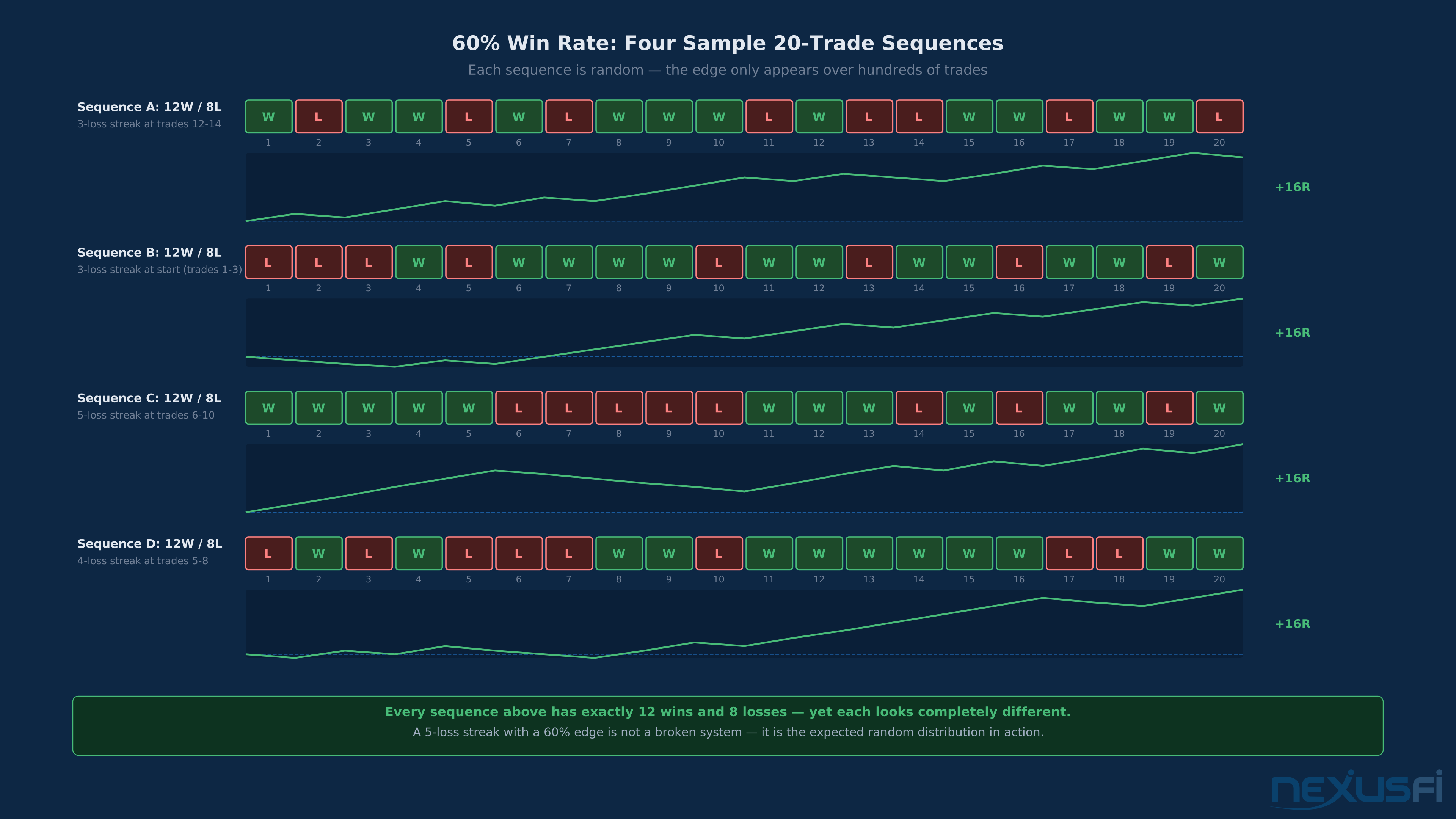
Four sequences, each with exactly 12 wins and 8 losses — yet each looks completely different. A 5-loss streak with a 60% edge is not a broken system; it is the expected random distribution.
Truth 4: An Edge Is a Higher Probability, Nothing More
Edges don't guarantee outcomes. They shift probability. A setup with a 60% win rate means that if you take that setup exactly as defined 100 times, you'll win roughly 60 of those trades. It says nothing about which 60. This truth prevents the psychological error of "expecting" winners u2014 of feeling betrayed when a textbook setup fails. Textbook setups fail. They're supposed to, at the base rate implied by their win rate.
Truth 5: Every Moment in the Market Is Unique
Each trade is a distinct event. What happened on your previous trade u2014 whether a winner or loser u2014 has exactly zero statistical influence on this trade's outcome. The market doesn't owe you a winner because you just took three consecutive losses. It doesn't know your P&L, your emotional state, or your account balance. Trading as though last trade's outcome informs this trade's probability is a cognitive error called the gambler's fallacy, and it's responsible for an enormous amount of avoidable damage to trading accounts.
The 7 Principles of Consistency #
Trading in the Zone (2000) is the essential text for this framework. Douglas's earlier The Disciplined Trader (1990) covers similar ground from a more foundational angle — most traders find it useful to read Zone first, then revisit Disciplined Trader later.

The 7 Principles are sequentially dependent. Skip Principle 3 (accept risk) and Principle 4 (execute without hesitation) is structurally impossible under pressure.
These principles are written in the first person for a reason. Douglas intended them to be internalized as beliefs u2014 as statements of identity u2014 not external rules. "I predefine the risk of every trade" is at the core different from "I should predefine the risk of every trade." The former is who you are as a trader. The latter is a rule you might or might not follow depending on how you feel that day.
NexusFi member @VinceVirgil posted Douglas's exact wording in the Trading Journals forum, quoting the book:
"I AM A CONSISTENT WINNER BECAUSE: 1. I objectively identify my edges. 2. I predefine the risk of every trade. 3. I completely accept the risk or I am willing to let go of the trade. 4. I act on my edges without reservation or hesitation. 5. I pay myself as the market makes money available to me. 6. I continually monitor my susceptibility for making errors. 7. I understand the absolute necessity of these principles of consistent success and, so, I never violate them."
Forum citation: The PandaWarrior Chronicles u2014 @VinceVirgil, Trading Journals
Let's examine each principle with the specificity it deserves.

Principle 1: I Objectively Identify My Edges #
The word "objectively" carries enormous weight. It means you can define your edge without using words like "feels like," "looks like," or "seems like." Your criteria are observable, measurable, and replicable by someone who has never seen you trade.
Most traders believe they have an edge when they have an intuition. Intuitions can contain real information u2014 experienced traders develop genuine pattern recognition over years of screen time u2014 but intuitions cannot be consistently monitored, refined, or scaled. You cannot tell whether your "gut" was right or wrong about setup quality versus execution quality. You cannot isolate which component improved or degraded. Objective criteria can be measured; feelings cannot.
The objective edge identification process: define, backtest, filter, document, forward test. Every step produces verifiable evidence. Skip any step and you don't have an edge u2014 you have a hypothesis.
What objective edge identification requires in practice:
- A written setup definition: Every entry criterion named explicitly. "Price breaks above the prior day's high during the first hour, with above-average volume, in a market above its 20-day moving average" is objective. "A clean breakout" is not.
- Backtested win rate, average winner, average loser, maximum consecutive losses: These numbers exist before you deploy capital. If you don't know them, you're gambling on a hypothesis, not trading an edge.
- Edge filters: The conditions that make the edge work better or worse. Many setups have a 60% win rate overall but an 80% win rate when X condition is met. Objective identification means identifying X.
- A go/no-go checklist: Written criteria you check before entry. If the checklist isn't complete, you don't take the trade. Period.
As NexusFi member
The edge itself didn't change u2014 but the ability to execute it consistently only emerged after the psychological foundation was in place.
Forum citation: What Is the Source of Your Edge?? u2014 @Tangy, Psychology and Money Management
The failure mode here is confirmation bias. Most traders define their edge in terms flexible enough to explain any outcome. "It was a breakout" covers clean breakouts and false breakouts, high-volume and low-volume ones. When you define an edge flexibly, you're collecting psychological validation, not edge data. The setup that "looked like a breakout" when it worked and "was actually a false breakout I should have seen coming" when it failed is not an objectively identified edge.

Principle 2: I Predefine the Risk of Every Trade #
This principle has two components: a predefined stop location, and a predefined stop acceptance. Placing a stop order in your platform and accepting that your capital is genuinely at risk up to that stop level are different psychological events. Most traders do the first. Far fewer do the second.
The stop order says: if price reaches X, close my position. The acceptance says: I may lose exactly Y dollars/ticks/R on this trade, I have already processed this emotionally, and I have consented to it. Without acceptance, the stop is a liability u2014 you'll move it when the moment of truth arrives. With acceptance, the stop is the guardrail that makes it possible to enter without fear.
Every trade expressed in R-multiples before entry. The stop (stop price) defines 1R. Targets at 1R, 2R, and 3R are set before the trade begins. Nothing is decided in real-time u2014 the decisions are made in advance.
The R-multiple system is the practical implementation of predefined risk. R = the distance from entry to stop. If you buy ES at 5215 and place your stop at 5205, your R is 10 points ($500 per contract). Your 2R target is 5235. Your 3R target is 5245.
Expressing all trades in R-multiples creates a common language across different instruments, position sizes, and account sizes. A day where you make 2.3R is a good day regardless of whether that's $230 or $2,300. A month where your R-multiple average is -0.4R means your system is not working as expected u2014 regardless of whether you're up or down nominally (you could have size differences between winners and losers that mask R-multiple performance).
For futures traders specifically, predefined risk also means understanding dollar risk per contract before the trade. A 1R loss on 3 ES contracts is $1,500. If you're not comfortable losing $1,500 on this setup, you shouldn't be trading 3 contracts. This is not risk management in the traditional sense u2014 it's the psychological precondition for clean execution. You can't execute without hesitation on Principle 4 if you haven't genuinely processed the risk on Principle 2.

Principle 3: I Completely Accept the Risk or I Am Willing to Let Go of the Trade #
This is the most psychologically demanding principle. Predefined risk (Principle 2) is mechanical. Accepting it is emotional.
Douglas makes a sharp distinction between assuming you're a risk-taker because you put on trades and genuinely accepting the risk inherent in each trade. The former is bravado. The latter is a quiet, specific mental act: you visualize your stop being hit, feel the loss of that amount, and continue without distress. If that visualization triggers anxiety, you haven't fully accepted the risk u2014 which means your stop will move.
The acceptance test: could you sit at your desk for the duration of this trade without repeatedly checking it, moving your stop, adding to a losing position, or catastrophizing? If yes, you've accepted the risk. If no, either reduce size until acceptance is genuine, or let go of the trade. "Willing to let go of the trade" is an underappreciated clause. Not every setup is tradeable at every size for every psychological state. Skipping a trade with unaccepted risk is correct behavior.
The specific quality is the acceptance distinction u2014 most psychology books say to "manage emotions"; Douglas says pre-acceptance eliminates the need for real-time management, because real-time emotion management under P&L stress is unreliable.
Forum citation: Notes from Trading in the Zone u2014 @lovetotrade, Psychology and Money Management

Principle 4: I Act on My Edges Without Reservation or Hesitation #
Having objectively defined your edge (Principle 1), predefined your risk (Principle 2), and accepted that risk (Principle 3), there's only one rational response when your setup appears: take the trade. Hesitation at this point isn't caution u2014 it's a violation of your own system.
But hesitation is enormously common, and it has a specific psychological mechanism. When a setup appears and you've previously defined and accepted the risk, hesitation means one of three things is happening: (1) you haven't actually completed Principles 1-3, you just thought you had; (2) your emotional state at this specific moment is overriding your rational acceptance; or (3) you're waiting for certainty that doesn't exist and never will.
Two paths when a setup appears. Execution builds the system and produces clean data. Hesitation corrupts the data u2014 you no longer know whether your edge works because you're not applying it consistently. Both outcomes compound over hundreds of trades.
The data integrity problem with hesitation: If your edge has a 63% win rate but you take only 70% of setups (skipping ones that "feel riskier"), you don't know whether the 63% holds on the subset you take. Selective execution corrupts performance data. You can't distinguish "system underperforming" from "I'm taking the lower-probability subset." Consistent behavior: when the checklist is complete, take the trade. Every time. If you can't, you haven't finished Principles 1-3.
@PandaWarrior, one of NexusFi's most influential trading journal contributors, articulated this precisely: "The trading game is about one thing u2014 consistency of your 'edge' and your discipline to take all the trades no matter what as you know it's the only way to make the numbers work for you over time."
Forum citation: The PandaWarrior Chronicles u2014 @PandaWarrior, Trading Journals

Principle 5: I Pay Myself as the Market Makes Money Available to Me #
This principle addresses trade management on the winning side, and it's where Douglas's framework diverges most sharply from popular trading advice. Most traders have been told: "Let your winners run." This advice is not wrong, but it's incomplete u2014 it ignores the psychological reality of watching a $1,500 winner retrace to breakeven.
Douglas's principle says: pay yourself as the market offers it. This means taking partial profits at predefined targets rather than holding for full position until a single exit price. The psychological function of scale-outs is specific: they transform an unrealized gain into a realized one, which removes the emotional pressure of "giving back profits." Once you've locked in a partial profit, the remaining position can be managed with a runner's mentality u2014 genuine indifference to whether it hits the 3R target or reverses to breakeven minus commissions, because you've already banked your primary reward.
A scale-out execution ladder for a typical futures day trade. Partial profits at +1R and +2R lock in reward while a trailing stop manages the remainder. This is Principle 5 operationalized.
A practical scale-out framework for ES futures: Take 25% at +1R (locks in partial, removes pressure), 25% at +2R (trade profitable regardless), 25% at +3R (move stop to breakeven on remainder), and trail the final 25% with a runner stop. Each partial close is "paying yourself" u2014 transforming unrealized into realized. The scale-out plan must be decided before the trade, not in real-time while the P&L is moving.
Principle 6: I Continually Monitor My Susceptibility for Making Errors #
The word choice here is careful and important. Douglas didn't say "I never make errors." He said "I monitor my susceptibility." This acknowledges that every trader has a psychological profile that makes certain errors more likely than others, and that this susceptibility changes with context u2014 with fatigue, with recent losses, with winning streaks, with life events outside trading.
The consistent winner doesn't try to eliminate all psychological states that could cause errors. They maintain real-time awareness of when those states are elevated and adjust so. The practical implementation is a pre-session checklist:
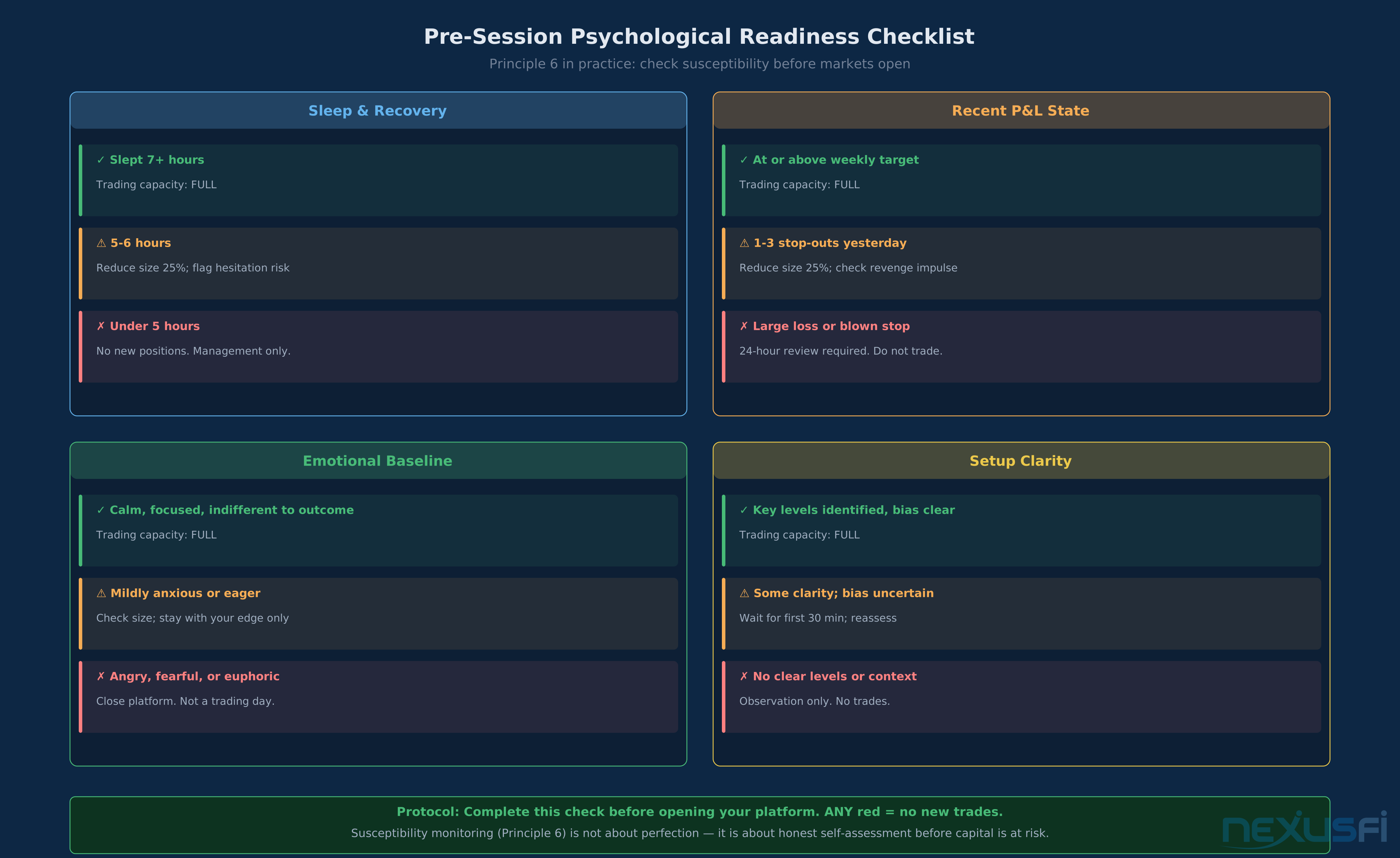
Principle 6 in practice: four key categories to assess before opening your platform. ANY red condition = no new trades.
The error monitoring cycle: execute, record, review, identify, correct, re-apply. This is not a one-time exercise u2014 it runs continuously throughout your trading career. The goal is awareness, not perfection.
Common error susceptibility states and their signatures:
- Post-loss: Urge to "make it back" u2192 revenge trading at increased size. Counter: 15-minute mandatory break after any stop-out.
- Post-win: Overconfidence u2192 size increase on next trade as if recent winning proves predictive ability. Counter: Return to standard size deliberately; previous trade has zero bearing on this one.
- Fatigue: Late-session, end-of-week, low-sleep trading degrades decision quality measurably. Counter: Track screen hours and sleep as trading metrics. Stop trading when red.
- FOMO: Large move happening without you u2192 chase entry that no longer offers original R/R. Counter: Explicit rule: "I enter at the defined price or not at all."
NexusFi member @rubyslippage, reflecting on the Trading in the Zone framework, observed that Mark Douglas understood the specific ways psychological vulnerability corrupts execution: "In the Foreword to Mark Douglas' Trading in the Zone, Thom Hartle writes: 'The 95% failure rate makes sense when you consider how most of us experience the markets.'" That failure rate isn't about analysis. It's about unmonitored susceptibility u2014 systematic errors that compound over time.
Forum citation: Dear Ruby u2014 @rubyslippage, Psychology and Money Management
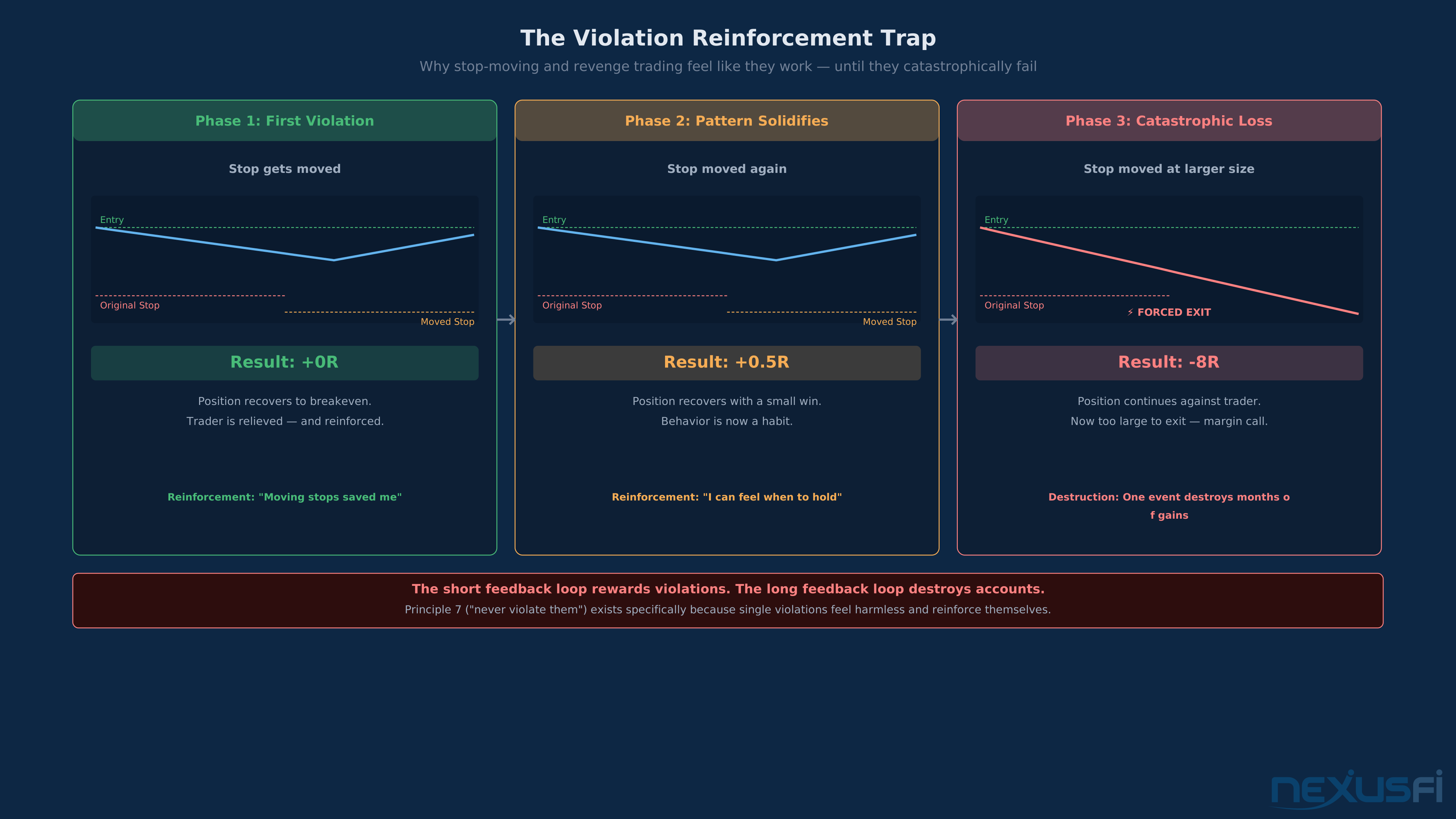
Principle 7: I Understand the Absolute Necessity of These Principles u2014 and Never Violate Them #
The seventh principle is meta: it's the commitment that the previous six are non-negotiable. This is where the framework closes on itself. You understand why these principles work (because you've internalized the 5 Fundamental Truths), and that understanding produces genuine respect for the principles rather than grudging compliance.
Douglas was explicit that "understanding the absolute necessity" is the work. You can't be told these principles are necessary and simply decide to comply. You have to experience u2014 intellectually and emotionally u2014 why violating them costs you. Which means you probably have to violate them, pay the price, trace the damage back to the violation, and build genuine conviction.
This is why "Trading in the Zone" is a book traders return to repeatedly across their careers. The reader who first reads the seven principles at year 2 of their trading career will find them interesting. The same reader at year 5, after two years of watching their own violations produce specific, traceable damage, will find the book devastating in its accuracy. The principles look simple on paper. Their necessity only becomes apparent in the market.
The "never violate them" clause is aspirational u2014 Douglas knew traders would violate them. The purpose of the clause is to remove the idea of acceptable violations. There are no "just this once" exceptions to Principle 2. There's no situation where Principle 4 doesn't apply. The absoluteness of the commitment is what prevents the slow erosion of standards that destroys most traders' discipline over time.
The Consistent Winner: A Self-Assessment Checklist #
Douglas's framework is not a certificate u2014 there's no moment when you declare yourself a consistent winner and stop doing the work. It's an ongoing practice that degrades without maintenance. Use this self-assessment regularly:
| Principle | Self-Check Questions |
|---|---|
| 1. Edge ID | Can I write my criteria without ambiguity? Do I know win rate, avg winner, avg loser? Could another trader replicate my setup from my description? |
| 2. Risk Predefine | Is stop level set before entry? Do I know the dollar loss if stopped out? Is size derived from risk amount? |
| 3. Risk Accept | Can I describe a stop-out without emotional resistance? Am I sized to accept the full R without anxiety? Will I skip rather than compromise the stop? |
| 4. No Hesitation | Am I taking every setup that meets criteria u2014 not "most"? Do I track why I hesitate? Is my checklist complete before entry? |
| 5. Pay Yourself | Is my scale-out plan predefined before entry? Am I executing at defined levels, not feeling it out? Have I stopped holding full position through retracements? |
| 6. Error Monitor | Do I run a pre-session psychological check daily? Do I track errors with the same rigor as P&L? Can I name my top 3 error types and their triggers? |
| 7. Commit | When I violated a principle, did I trace the damage? Am I treating these as non-negotiables or guidelines? Do I have any "acceptable exceptions" I haven't examined? |
The Bottom Line #
The Seven Principles of Consistency are not a self-help framework bolted onto trading. They're a precise technical specification for trader behavior u2014 derived from observation of what consistent winners actually do differently from everyone else. Douglas wasn't philosophizing. He was documenting.
Every principle in this framework removes a specific decision from real-time execution and relocates it to the pre-trade planning phase. Edges are identified in advance (Principle 1). Risk is defined in advance (Principle 2). Risk is accepted in advance (Principle 3). Entry is committed to in advance (Principle 4). Exits are planned in advance (Principle 5). The psychological state is monitored in advance (Principle 6). And the commitment to all of the above is pre-established and unconditional (Principle 7).
The consistent winner, in Douglas's framework, is a trader who has moved every decision that can be moved into the planning phase u2014 leaving only pure execution in the trading phase. Execution is difficult enough. Don't also ask yourself to make decisions about what your edge is, how much you're risking, and whether you'll take the trade, while price is moving and your P&L is in motion.
The market will test your compliance with these principles repeatedly and mercilessly. It will offer opportunities to violate Principle 3 with "just this once" position sizing. It will seduce you into violating Principle 4 by offering setups that "almost" meet your criteria. It will punish Principle 6 lapses with exactly the losses that come from trading while fatigued or emotionally charged.
The seven principles are a defense against the market's constant pressure to make you act like everyone else u2014 the 95% who have systems but don't trade them. The consistent winner is not smarter than everyone else, or more disciplined in some innate sense. They've simply built a set of behavioral commitments that are stronger than the market's pressure to abandon them.
That is what Trading in the Zone means.
Knowledge Map
Go Deeper
Build on this knowledgeReferences This Article
Articles that build on this topicCitations
- — Concerning risk per trade sizing (2012) 👍 43“I accept the 5 fundamental trading truths. I just WAIT until my edge appears and trade without hesitation, have a defined risk on every trade, and understand that anything can happen.”
- — The PandaWarrior Chronicles (2012) 👍 16“I AM A CONSISTENT WINNER BECAUSE: 1. I objectively identify my edges. 2. I predefine the risk of every trade. 3. I completely accept the risk.”
- — The PandaWarrior Chronicles (2011) 👍 18“The trading game is about one thing -- consistency of your edge and your discipline to take all the trades no matter what as you know it's the only way to make the numbers work for you over time.”
- — Dear Ruby (2013) 👍 14“In the Foreword to Mark Douglas' Trading in the Zone, Thom Hartle writes: 'The 95% failure rate makes sense when you consider how most of us experience the markets.'”
- — Dear Ruby (2013) 👍 13“A while back I listened to an interview with Mark Douglas, author of The Disciplined Trader and Trading in the Zone. I liked what he was saying so much I took notes.”
- — Notes from Trading in the Zone (2016) 👍 16“In my opinion Mark Douglas' books offer some of the highest quality trading info from a psychological perspective.”
- — What Is the Source of Your Edge?? (2020) 👍 24“In my experience, my edge never arrived until I focused on my psychology: I have a growth mindset, I'm never done learning.”
- — A Price Action Apprentices First Combine Journal (2013) 👍 9“The constraints of the TST combine ensure that disciplined execution of a tested trading plan comes before anything else.”
- — Trading in the Zone - Mark Douglas (2019) 👍 3“That's the point Douglas is making -- the reason you have a problem being a consistent trader is because of your expectations on every trade.”
- — Take the inexpensive route (2012) 👍 13“Consistency of trade actions becomes habitual. Whatever is wrong with our trading can be fixed because we behave consistently.”
- — Trading in the Zone (2000)