



Gold Futures (GC) Trading Strategies: The Complete Playbook for Trading the World's Premier Safe Haven
Gold is the most macro-sensitive futures contract you'll ever trade. Get the macro right and the technicals sing. Get it wrong and your tightest technical setup evaporates faster than you can say "CPI surprise." This isn't a contract where you can ignore what's happening in Washington, Frankfurt, or Beijing — GC trades the real world, and the real world trades GC.
Overview #
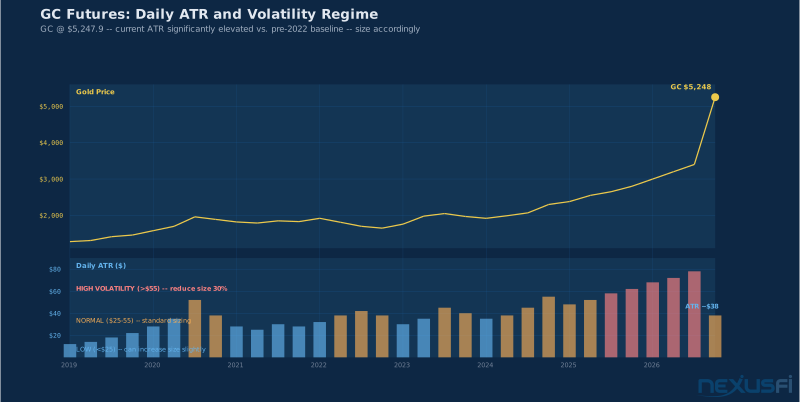
Gold futures (ticker: GC) at the COMEX exchange are trading near $5,247/oz as of early 2026, up dramatically from the $1,800-2,000 range that defined most of the post-pandemic era. That move isn't random — it's the product of falling real interest rates, a weakening US dollar trend, and relentless central bank buying that has been absorbing supply for three straight years.
The GC contract is at the core different from ES or CL in one critical way: it leads with macro, not momentum. An ES day trader can get away with pure technical analysis on a slow Fed day. A GC day trader who ignores the 10yr TIPS yield is flying blind. Every setup in this playbook comes with a macro filter because without it, you're just pattern-matching in a market that doesn't care about your patterns.
The one-sentence framework: GC = real rates inverted + USD inverse + geopolitical premium. When real rates fall, gold rises. When the dollar weakens, gold rises. When the world gets scared, gold gets a temporary bid. The strongest trades happen when all three factors stack in the same direction.
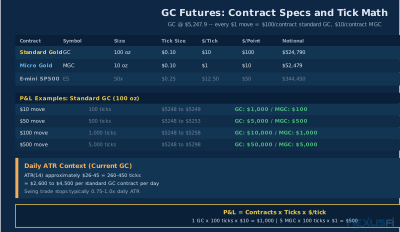
Contract specs: 100 troy ounces per contract, $0.10 minimum tick = $10 per tick, $1 per point. At $5,247, the notional value is $524,700 per contract. The micro version (MGC) is 10 oz = $1 per tick. There's also a 50 oz mini (QO) but MGC has become the retail standard.
Who should trade GC: Traders who follow macro news and can interpret Fed statements, CPI prints, and DXY moves. Traders comfortable with higher-notional instruments who size appropriately. Swing traders who want trend exposure. Day traders willing to work COMEX pit hours (8:20am-1:30pm ET) for tight spreads.
Who should NOT trade GC: Pure technical traders who refuse to run a macro filter. Traders who size based on ES habits and forget the $10/tick difference. Anyone trying to scalp the Asian session with a $50k account.
Why Gold Trades Different #
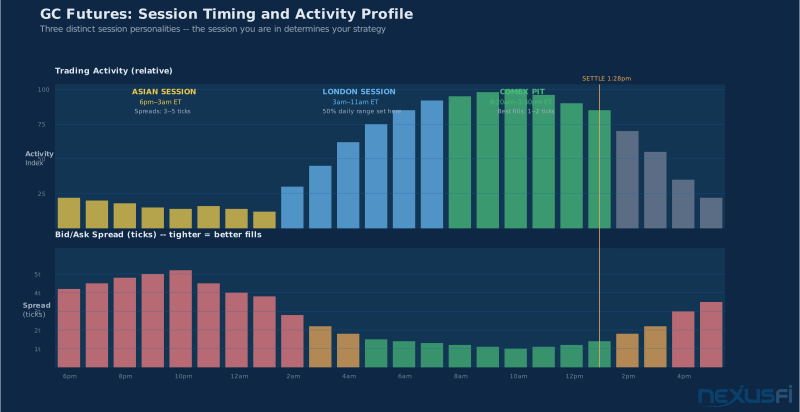
The 24-hour dimension creates three distinct personalities within a single session. Asian session gold behaves nothing like London-open gold, which behaves nothing like COMEX-pit gold. The same technical setup has completely different follow-through probabilities depending on which session you're in. Most retail traders treat it as one continuous market — that's how they get chopped up.
The Real Rates Relationship #
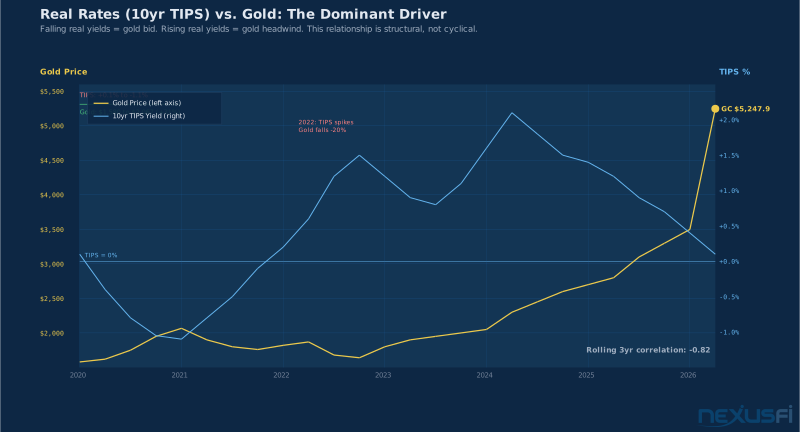
Gold is a zero-yielding asset. It pays no coupon, no dividend, no interest. That means its opportunity cost relative to Treasury bonds is exactly equal to the real yield — the yield after adjusting for inflation. When real rates are negative (Treasury yields below inflation), gold becomes the better store of purchasing power. When real rates are positive and rising, every dollar in gold has a direct opportunity cost versus holding a Treasury bond.
The 10-year TIPS yield (Treasury Inflation-Protected Securities) is the purest measure of real rates in the market. When TIPS yields fell from +0.5% in early 2020 to -1.1% in late 2021, gold rallied from $1,580 to $2,089 — a 32% move driven almost entirely by this single relationship. The data shows a -0.82 rolling 3-year correlation between TIPS yields and gold prices.
This is not a trading signal by itself. It's a regime identifier. Falling TIPS = structurally bullish regime for gold. Rising TIPS = structural headwind. Know which regime you're in before you pick a setup.
The Dollar Correlation #
The USD/gold inverse correlation runs between -0.7 and -0.9 under normal conditions. This makes mechanical sense: gold is priced in dollars, so a stronger dollar makes gold more expensive for foreign buyers, reducing demand. A weaker dollar does the opposite.
But the correlation is not permanent. During liquidity crises (March 2020), gold falls alongside a strengthening dollar because everything sells. During "King Dollar" episodes like 2022, gold can fall despite a muted dollar move because real rates are rising faster than dollar weakness. The correlation is a default assumption, not a law.
Safe Haven Bid vs. Safe Haven Myth #
The "gold is a safe haven" narrative is partially true and dangerously misunderstood.
What gold actually protects against is badly managed economies — chronic fiscal deficits, currency debasement, and institutional distrust. It does not protect against normal inflation, stock market corrections, or short-term geopolitical scares. The spike on a geopolitical headline fades within 3-7 days unless the event creates fundamental structural change. Don't chase those spikes.
Session Timing: When Gold Has a Pulse #
Understanding session dynamics determines which strategies are viable at any given hour. Trade the wrong setup in the wrong session and the market will make you feel incompetent when the problem is actually the timing.
Asian Session (6:00pm — 3:00am ET) #
Range-bound 70% of the time. Thin liquidity means wider bid-ask spreads of 3-5 ticks — that's $30-50 per round trip just in transaction cost before any adverse price movement. Technical levels are respected here, which makes it decent for swing position management or adjusting stops. Day trading or scalping in the Asian session on a standard account is a slow bleed.
Volume is roughly 15-20% of the daily total. The market is primarily driven by Asian physical demand (China, India), sovereign buying, and carry-over from New York's close. Significant moves happen occasionally but rarely have follow-through by COMEX open.
London Session (3:00am — 11:00am ET) #
The trend initiator. Approximately 50% of the daily range gets established in this window, often in the first hour as European institutional flow hits the book. Volatility picks up sharply at 3am ET when London opens, with the London AM Fix at 5:30am ET creating a brief additional volatility spike.
The London session is where direction gets established. If gold gaps up and immediately follows through in London, the COMEX session tends to continue that direction. If London is choppy with no clear direction, COMEX often stays range-bound.
COMEX Pit Session (8:20am — 1:30pm ET) #
Deepest liquidity, institutional order flow, spreads tighten to 1-2 ticks. This is the primary session for day trading and scalping. US macro data releases at 8:30am (CPI, NFP, Retail Sales) hit here and create the biggest single-day moves.
As documented in the Day Trading GC with Pivots thread by @Fat Tails: "Full session: 6:00 PM EST to 5:15 PM EST / Regular session: 8:20 AM EST to 1:30 PM EST / Settlement: 1:28 PM EST to 1:30 PM EST"
The session transition from 8:00-8:30am ET is the highest probability window for directional moves. The 15 minutes before US economic data and the 30 minutes after see the most volatility.
Settlement at 1:28-1:30pm ET: institutional position squaring creates predictable volume but unpredictable direction. Most day traders are flat or mostly flat by 1:15pm to avoid settlement noise.
Key rule: Trade COMEX pit hours for scalping and day trading. Use Asian session for swing position management only. Reduce size 50% minimum during Asian session if you must trade it.
The Fundamental Framework #
The Regime Rule in Practice: When 10-yr TIPS yields and DXY move in the same favorable direction for gold (both falling/weakening), trend-following setups have maximum probability. When they diverge, drop to 50% size and lean toward mean reversion. When both are unfavorable, trade only intraday with tight stops.
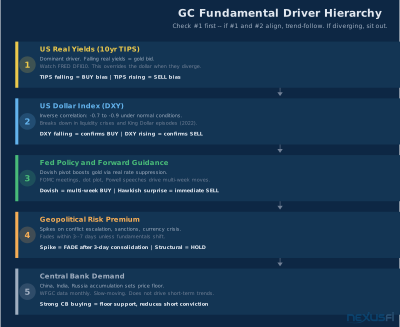
Before every trading session, run through these five drivers in order. The first two dominate. The last three are secondary.
Driver 1: US Real Yields (TIPS) #
Check the 10yr TIPS yield (FRED: DFII10, Bloomberg: USGG10YR) before every session. Is it trending up, down, or sideways? This single factor explains more of gold's multi-week behavior than any other variable.
The mechanical relationship: when real yields fall, gold becomes relatively more attractive versus interest-bearing assets. When real yields rise, the opportunity cost of holding gold increases. The effect is not immediate on a tick-by-tick basis but dominates on any timeframe from 1 week to 1 year.
Driver 2: US Dollar (DXY) #
DXY above key levels (104, 106) is a headwind. DXY below key levels and trending lower is a tailwind. The inverse correlation averages -0.82 but varies widely quarter to quarter.
The intermarket check: is DXY confirming what real rates suggest? If real rates are falling AND DXY is weakening, both drivers are aligned bullish. That's when trend-following setups have the highest probability. If they diverge, reduce size and be more patient with entries.
Driver 3: Fed Policy and Forward Guidance #
Fed rate cut expectations boost gold primarily through the real rate channel — dovish guidance suppresses real yields, and that's what drives gold. FOMC meeting weeks and Fed Chair speeches are high-volatility events. CPI prints matter because they affect market expectations for the Fed's next move.
Rule: know the Fed calendar. The week of an FOMC decision is not the week to be running aggressive directional positions.
Driver 4: Geopolitical Risk Premium #
Gold gets a risk premium during armed conflicts, sanctions regimes, and currency crises. This is real but temporary. The trade is to let the initial spike happen (don't chase), then assess whether the event creates fundamental structural change. If it does (new sanctions regime, prolonged war causing fiscal deterioration), hold the position. If it doesn't, expect the premium to fade within 3-7 days as the situation stabilizes.
Driver 5: Central Bank Demand #
The World Gold Council tracks central bank buying — primarily China, Russia, Turkey, India. This is a slow-moving structural buyer that provides a floor under prices but does not create short-term trading opportunities. Strong CB buying reduces the conviction of shorts more than it powers longs. It matters more for swing holds than for day trading.
The Regime Rule: When real yields and DXY trend in the same direction (both favorable or both unfavorable for gold), trend-following strategies work. When they diverge, mean reversion strategies work. Know which regime you're in before selecting a setup.
Key Concepts for GC Traders #
Volume Profile on GC #
High Volume Nodes (HVN) act as price magnets — price returns to where the most volume has traded. Low Volume Nodes (LVN) are fast-travel zones where price moves quickly with little resistance. The weekly Volume Profile Point of Control (POC) is the single most important reference level for multi-day positioning.
At a recent $5,335 weekly POC, the market spent two sessions probing above and below that level before eventually breaking higher with conviction. That's typical HVN behavior — it tests, retests, then resolves.
VWAP on GC #
VWAP (Volume-Weighted Average Price) is the institutional reference level for the day. Gold respects VWAP better than most contracts because institutional participants — central banks, ETF arbitrage desks, commodity funds — actively use it for execution benchmarking. A price more than $15-20 away from VWAP is "extended" and likely to revert. A reclaim of VWAP after a probe below it is an institutional accumulation signal.
The VWAP slope matters as much as the price relationship. Flat VWAP = range day. Sloping VWAP = trend day. Adjust your setup so.
Opening Range #
The first 30 minutes of COMEX pit session (8:20-8:50am ET) establishes the Opening Range. A compressed OR (less than $8-10 = 80-100 ticks) typically precedes a trend day. A wide OR (more than $15) suggests uncertainty and increases the probability of a chop day. The OR high and low become the primary intraday reference levels.
Key Price Levels #
Round numbers every $50 ($5,200, $5,250, $5,300) are psychological barriers because they represent the largest concentration of resting orders. But a single touch of a round number isn't enough — the market needs to accept or reject it with multiple closes. A single-tick spike through $5,300 and immediate reversal is a failed breakout, not a breakout.
Trade Setups #
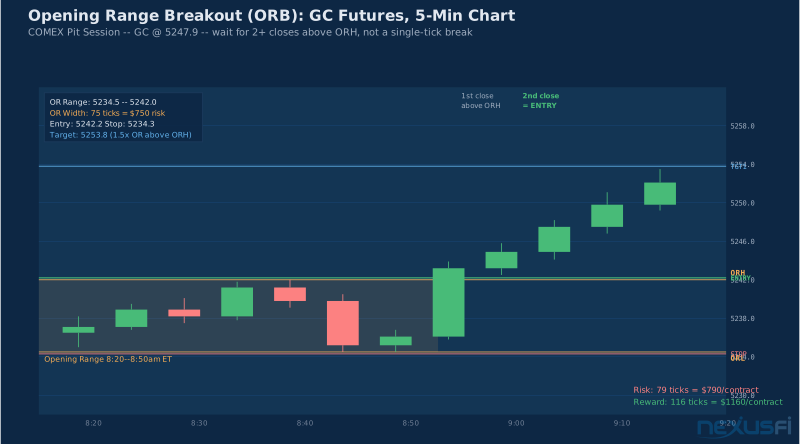
Setup 1: Opening Range Breakout (ORB) #
Best conditions: Trend days, COMEX pit hours only (8:20am-1:30pm ET), no major data release within 30 minutes of setup trigger.
Step 1 — Define the OR: Mark the high and low from 8:20am to 8:50am ET. Calculate the width in ticks and dollar terms. If the OR width is less than $8-10 (80-100 ticks), the setup is valid. If the OR is wider than $15 (150 ticks), skip the day — the market is already pricing in uncertainty.
Step 2 — Filter: Check DXY direction. Check VWAP slope (if the market is already much above VWAP before the break, the trade has less room to run). Confirm no major macro release in the next 30 minutes.
Step 3 — Entry trigger: Wait for ACCEPTANCE, not just a tick through. Two or more 5-minute closes beyond the OR high (for longs) or OR low (for shorts) is the standard acceptance criterion. The first touch of ORH/ORL is often a stop hunt — the market probes the level, clears stops, then decides direction.
Stop placement: Opposite OR boundary. If you entered on a break above ORH, stop goes below ORL.
Targets: Primary target = 1.5x the OR height above ORH (for longs). Secondary target = prior day high or next major weekly reference level.
Example trade (real prices): OR establishes 8:20-8:50am. ORH = $5,242.00, ORL = $5,234.50. OR width = $7.50 = 75 ticks. Price breaks above $5,242.00 with two 5-minute closes above and positive delta. Entry at $5,242.20. Stop at $5,234.30 (below ORL). Primary target at $5,253.45 (1.5x OR width above ORH). Risk: 78 ticks = $780/contract. Reward: 112 ticks = $1,120/contract (1.44R).
No-trade conditions: Wide OR (>$15), conflicting macro signals (DXY rising against a bullish GC break), major data release within 30 minutes, OR already overlaps major weekly reference levels.
Wait for acceptance. Gold routinely fakes breakouts in the first two candles. The first touch of OR high/low often clears stops before price reverses. The 2-close acceptance criterion filters out the majority of false breaks.
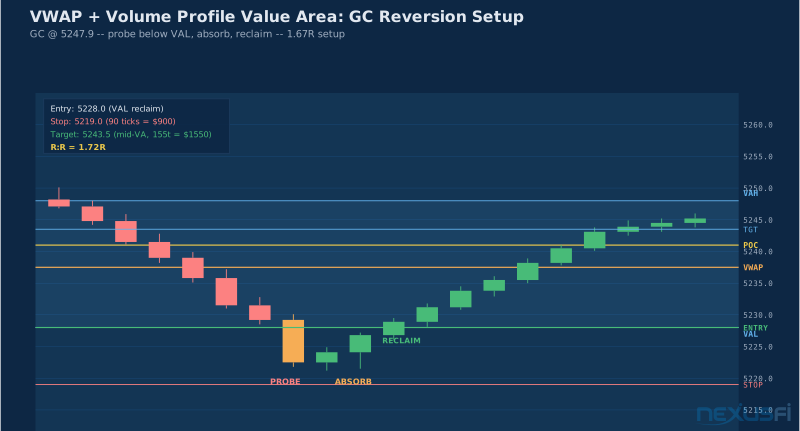
Setup 2: VWAP and Volume Profile Value Reversion #
Best conditions: Range days, post-news consolidation, controlled pullbacks in trending markets. NOT for use during trending sessions.
The market has traded away from value (more than $15-20 from VWAP) and is returning. This is the opposite of momentum trading — you're betting on mean reversion back to where institutional participants want to transact.
Setup anatomy:
- Identify the weekly Volume Profile and its Value Area boundaries (VAH and VAL).
- Price probes below the lower VA boundary (VAL) — this is a test of value.
- Watch for absorption: large volume bars with no new lows, or a slowing of the selling momentum.
- Entry trigger: first close back above VAL or VWAP after the probe.
Long example (real prices): Weekly VP Value Area: $5,222-$5,248. Price drops to $5,219. Three bars of absorption at the low with high volume but no continuation lower. Price reclaims $5,222 (VAL). Entry at $5,222. Stop at $5,213 (below probe low, 90 ticks = $900 risk). Target at $5,237 (mid-VA, 150 ticks = $1,500 reward). 1.67R setup.
No-trade conditions: Trending session (price will not revert to VWAP during a trend day), within 30 minutes of major news release, price below the value area with DXY trending strongly higher (macro not supportive).
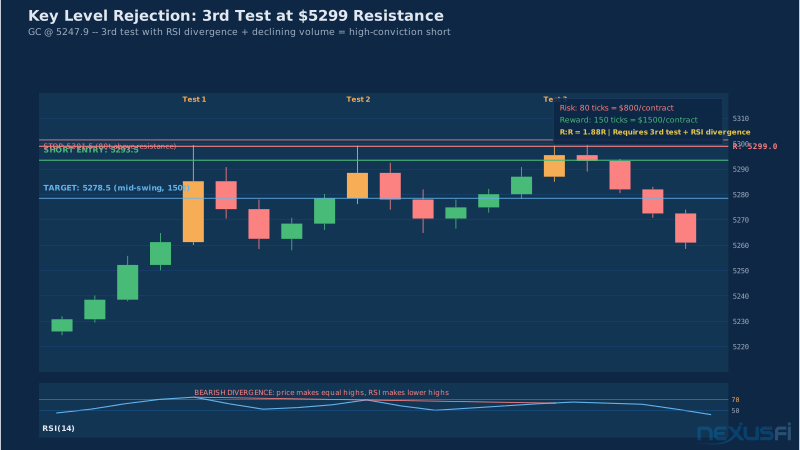
Setup 3: Key Level Rejection #
Best conditions: Swing context, level tests with decreasing momentum, preferably 3rd or later test of a significant level.
This setup requires patience. The first and second tests of a key level often generate false reversals. It's the third test — with confirming evidence that momentum is exhausted — that offers real conviction.
Levels that work: Round numbers every $50 ($5,200, $5,250, $5,300), prior day/week high and low, weekly pivot points, significant high-volume nodes from Volume Profile.
Entry conditions: Third or later test of the level. The test should show at least one of: RSI making a lower high versus the prior test (bearish divergence at resistance), much lower volume at the test versus prior tests (50% or less is meaningful), delta absorption (large sell volume hitting the bid but price not advancing through the level).
Stop placement: 15 ticks beyond the level. For a short at $5,299 resistance, stop is at $5,300.50. For a long at $5,200 support, stop is at $5,198.50.
Target: 50% retracement of the prior swing, or next major reference level. If price hit $5,299 three times after rallying from $5,250, the target is $5,274 (midpoint).
Example trade (real prices at GC high): $5,299 tested for the third time. Third test shows RSI making lower high (65 vs. 74 at first test) while price makes the same high. Delta at the test shows only 60% of the sell volume seen at the first test. Short entry at $5,293. Stop at $5,301.50. Target at $5,278 (midpoint of prior swing). Risk: 85 ticks = $850/contract. Reward: 150 ticks = $1,500/contract (1.76R).
Do NOT fade the first or second touch. The market needs to prove it's rejecting the level, not just testing it. First and second touches are where other traders create the exhaustion that the third test confirms.
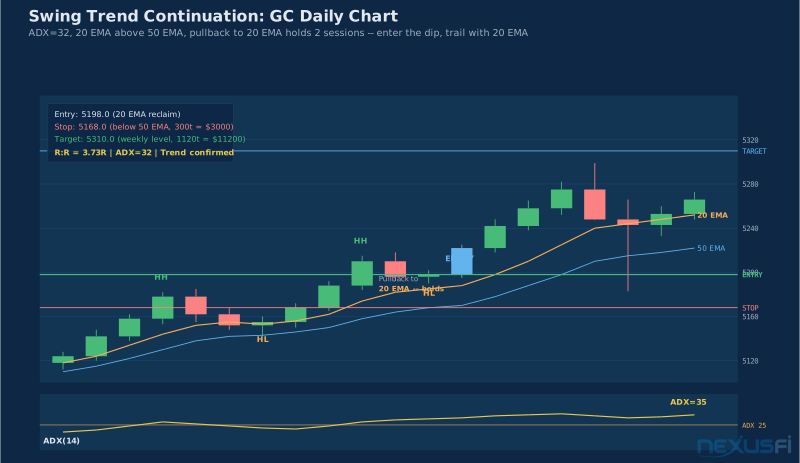
Setup 4: Swing Trend Continuation #
Best conditions: Trending macro environments (TIPS falling, DXY weakening), multi-day or multi-week holds, entries in the pullback phase.
This is the highest-conviction setup but requires macro alignment. The chart tells you when to enter; the macro tells you whether to hold.
Entry requirements:
- Higher-high/higher-low structure on daily chart (or lower-high/lower-low for shorts)
- 20 EMA above 50 EMA (or below for shorts)
- ADX above 25 (confirms trend has enough momentum to continue)
- Price pulling back to 20 EMA and holding for 2+ sessions
Macro confirmation:
- Real yields trending in the supportive direction
- DXY moving inversely to gold trend
- Both confirming = full size. One confirming = 50% size.
Entry: After the pullback to 20 EMA holds for 2 sessions, enter on the third session's open or on a close back above the prior day's high.
Stop: Below 50 EMA or prior swing low. This is a wider stop — typically 0.75 to 1.0 times the daily ATR = $26-45 = $2,600-4,500 per standard contract at current prices. Size down so.
Target: Next major weekly reference level. Trail stop with 20 EMA after first R target hit. Let winners run until either the EMA structure breaks or macro turns.
Example trade (real prices): Daily chart shows HH/HL structure. 20 EMA at $5,185, 50 EMA at $5,162. ADX = 32. Price pulls back to touch 20 EMA at $5,198, holds for 2 sessions. Entry at $5,200. Stop at $5,168 (just below 50 EMA, 320 ticks = $3,200/contract risk). Target at $5,310 (next weekly resistance level, 1,100 ticks = $11,000 reward). R:R = 3.44R.
The four setups address four distinct market conditions. ORB = trend days. VWAP reversion = range days. Level rejection = swing pivots. Trend continuation = extended macro moves. Know which market you're in BEFORE selecting the setup. The wrong setup in the wrong regime is a reliable way to lose money regardless of execution quality.
When These Setups Fail #
Every setup fails. Knowing exactly how they fail lets you cut losses before the market proves it to you.
Trend Days Destroy Mean Reversion #
On genuine trend days, price moves away from VWAP and does not return during the session. VWAP reversion setups get carried through their stops as price extends. The signal that you're in a trend day: gap at the open with immediate follow-through in the same direction, VWAP sloping hard within the first hour, and price reclaiming the OR boundary with a single decisive candle rather than grinding through it.
Fix: By 9am ET on a clear trend day, classify it as a trend day and switch to trend-following entries only. The ORB and trend continuation setups both apply. VWAP reversion is off the table for the rest of that session.
News Events Override Technicals #
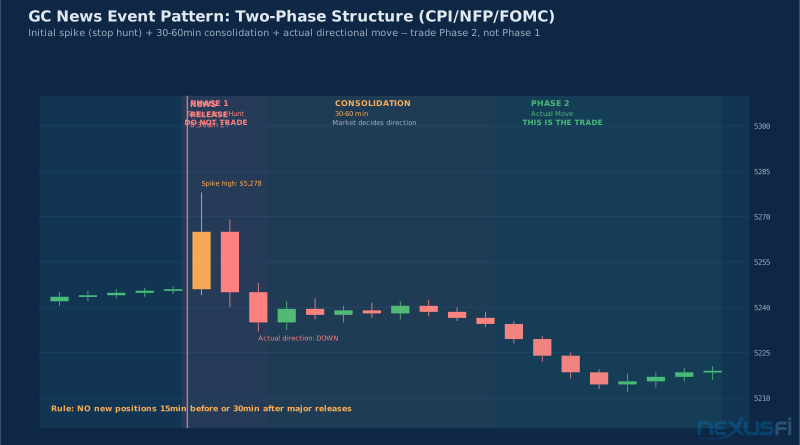
CPI, NFP, FOMC, and surprise Fed speeches create 2-standard-deviation moves that invalidate every technical level for 30-90 minutes. The $5,250 support that held perfectly for three days becomes irrelevant when CPI comes in 0.3% above expectations.
The two-phase pattern after major releases: an initial spike (often the wrong direction, then reversal), followed by 30-60 minutes of consolidation as the market processes the data, followed by the actual directional move. The first-phase spike is a stop hunt, not a trading opportunity. The post-consolidation continuation is the trade.
Rule: no new positions 15 minutes before through 30 minutes after any major data release. The ATR of the 30 minutes after CPI is typically 3-4x the normal 30-minute range.
Correlation Breakdown #
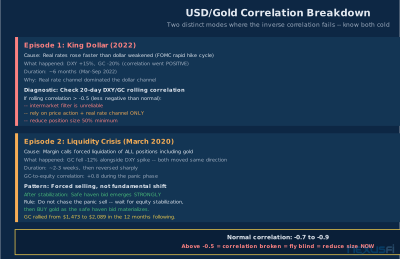
The USD/gold inverse correlation breaks down in two specific environments. First, liquidity crises (March 2020): when leveraged funds face margin calls, everything gets sold including gold. The correlation between GC and equities can go to +0.8 for days. Second, "King Dollar" episodes (2022): if real rates are rising faster than dollar weakness, gold falls alongside the dollar because the real rate channel dominates.
The diagnostic: monitor the 20-day rolling DXY/GC correlation. If it's above -0.5 (less negative than normal), your intermarket filters are unreliable and you need to rely more heavily on price action alone.
Thin Session Traps #
Asian session gap-and-run moves: a $30-50 move happens with no fills at the technical levels you expected because there isn't enough liquidity to absorb your order at the price you wanted. Holiday sessions (day after Thanksgiving, Christmas week): spreads blow out to 5-8 ticks, fills are terrible, and moves that look like breakouts are actually just thin-market noise.
Fix: reduce size 50% minimum in thin sessions. Accept wider stops to account for thinner execution, or skip entirely and wait for COMEX pit hours.
This is the same dollar-dominance dynamic @Salao described in the Dollar Correlation section above — when rate speculation drives the narrative, gold gets dragged along regardless of its own fundamentals.
The safe haven narrative fails in liquidity crises. When everything sells, gold sells. As @petergunz warned earlier in this guide, gold doesn't protect against garden-variety inflation — only currency-crisis-level events. The safety bid kicks in after markets stabilize, not during the initial panic — which means if you're long gold into an equity market selloff, expect a rough 2-3 day period before the safe haven bid materializes.
Practical Application: The Pre-Market Routine #
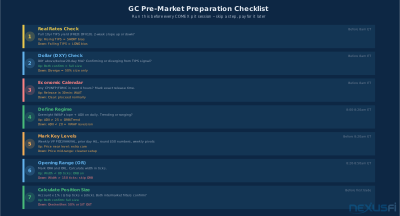
Great GC trading is 80% preparation and 20% execution. Here's the daily process that separates profitable GC traders from the ones who get surprised by moves they should have seen coming.
Step 1: Real Rates Check (Before 8am ET) #
Pull the 10yr TIPS yield from FRED or Bloomberg. Is it trending up or down over the past 2 weeks? This establishes your bias for the day. Falling TIPS = long bias. Rising TIPS = short bias. Flat TIPS = no bias, be ready to trade both directions.
Step 2: Dollar Check #
Where is DXY relative to its 20-day moving average and key levels (104, 106)? Is it above or below its prior day close? Direction confirmation: if TIPS and DXY both point the same direction for gold (both bearish or both bullish), the setup has macro backing. If they diverge, trade smaller.
Step 3: Economic Calendar #
Check the economic calendar for the next 4 hours. Any CPI, NFP, FOMC, PPI, or Fed speaker events? Mark the exact release time. Set a rule: no new positions 15 minutes before that time.
Step 4: Define the Regime #
Using overnight VWAP slope and ADX from the daily chart: is the market trending or ranging? If trending, ORB and trend continuation are the primary setups. If ranging, VWAP reversion and level rejection are the primary setups.
Step 5: Mark Key Levels #
Before 8:20am, mark on your chart:
- Weekly Volume Profile POC, VAH, VAL
- Prior day high and low
- Weekly pivot points
- Round numbers nearest to current price ($50 increments)
- Prior week high and low
Step 6: Opening Range #
After 8:50am, mark the OR high and low. Calculate width. If width is less than 80 ticks, the ORB setup is on. If wider, look for VWAP reversion setups instead.
Position Sizing at Current Prices ($5,248) #
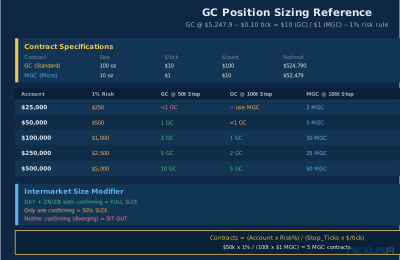
At $5,248, GC has a notional value of $524,800 per contract. A 100-tick stop = $1,000 risk per standard GC contract.
The MGC micro contract (10 oz) is essential for proper sizing at smaller account sizes. One MGC = $1/tick. A 100-tick stop on MGC = $100 risk.
Sizing examples:
- $25,000 account, 1% risk = $250: Use 2-3 MGC contracts with a 100-tick stop ($200-300 risk).
- $50,000 account, 1% risk = $500: Use 5 MGC or consider 1 standard GC with a tight 50-tick stop ($500).
- $100,000 account, 1% risk = $1,000: 1 standard GC with 100-tick stop, or 10 MGC.
- $250,000 account, 1% risk = $2,500: 2-3 standard GC with 100-tick stop.
Intermarket sizing modifier: If DXY and ZN/ZB (bond futures) both confirm your GC direction, trade full position. If only one confirms, trade 50% position. If neither confirms (diverging), sit out or paper trade.
Pre-Trade Checklist #
Before any GC trade, answer these questions:
- What is the current real rate trend? (TIPS 2-week slope)
- What is DXY doing? (Confirming or diverging?)
- Any major data release in the next 30 minutes? (If yes, wait)
- What session is it? (Asian = no scalps, London = trend setups, COMEX = all setups)
- What is the current regime? (Trending vs. ranging — determines which setup to use)
- Where is my stop? (Know before entry, not after)
- What is my max risk per trade? (Calculated before entering)
The traders who consistently make money in GC are not the ones with the most sophisticated setups. They're the ones who answer these seven questions before every entry and have the discipline to sit out when the answers don't support trading.
Knowledge Map
Citations
- — Day Trading GC with Pivots (2013) 👍 32“The regular session starts at 8:20 AM EST and ends at 1:30 PM EST. The settlement price is the volume weighted average price of the daily settlement period (1:28 PM to 1:30 PM EST).”
- — Spoo-nalysis ES e-mini futures S&P 500 (2022) 👍 18“gold along with commodity prices are falling, because on the margin, the dollar has been strengthening...gold is a non-interest bearing asset.”
- — Gold Futures (GC) main discussion (2023) 👍 24“Any data supporting higher prices, having downward pressure on real rates, has been bullish for gold...While data supporting cooling inflation and/or higher Fed funds has been bearish for gold.”
- — Salao's Journal (2023) 👍 19“The dollar was dragging around GC and ES...until the market narrative shifts away from speculation around the Terminal fed funds rate, gold is going to be strongly correlated (inversely) to the wiggles of USD.”
- — Gold Futures (GC) main discussion (2022) 👍 41“Gold does not protect against inflation unless it is hyper/mass inflation on the verge of a currency crisis.”
- — Worldwary's Gold Plated Journal (2013) 👍 28“Gold is my preferred instrument because it is trendy and is prone to sudden outsized moves. Stops are kept tight so the size of the average losing trade is substantially smaller than the size of the average winning trade.”
- — Growing seeds from a rotten mind (2023) 👍 15“I faded the bottom of the minor intraday range around 1928.50 with delta supporting my claim as there's overall more buyside volume.”
- — Mini-gold vs. micro-gold vs. regular gold futures (2021) 👍 22“I use three timeframes to size up the gold market: Weekly chart for primary trend, 1HR for short-term trend with MACD, 19min for entry via EMA crossover.”
- CME Group — Gold Futures Contract Specifications (2025)
- FRED Federal Reserve — 10-Year Treasury Inflation-Indexed Security (DFII10) (2025)