



Opening Range: Why the First 15 Minutes Define Your Entire Trading Session
Overview #
The opening range is the high-low envelope of the first few minutes after the regular session opens. In ES and NQ futures, that window is usually 09:30 to 09:45 or 10:00 ET — fifteen to thirty minutes of concentrated order flow where institutions, algorithms, and retail traders all collide to establish the day's first directional signal.
The concept is deceptively simple: record the highest high and lowest low during a fixed early window, then use those levels as reference points for the rest of the session. But the execution is where most traders get destroyed. Raw "buy the break above OR high" strategies degrade after slippage and fees. The edge — when it exists — comes from combining OR levels with acceptance confirmation, contextual filters, and disciplined invalidation rules.
The opening range is a reference tool, not a signal. The edge comes from what price does relative to OR levels — acceptance, rejection, and extension — not from blindly buying breaks or selling violations.
In ES and NQ futures, that window is usually 09:30 to 09:45 or 10:00 ET -- fifteen to thirty minutes of concentrated order flow where institutions, algorithms, and retail traders all collide to establish the day's first directional signal.
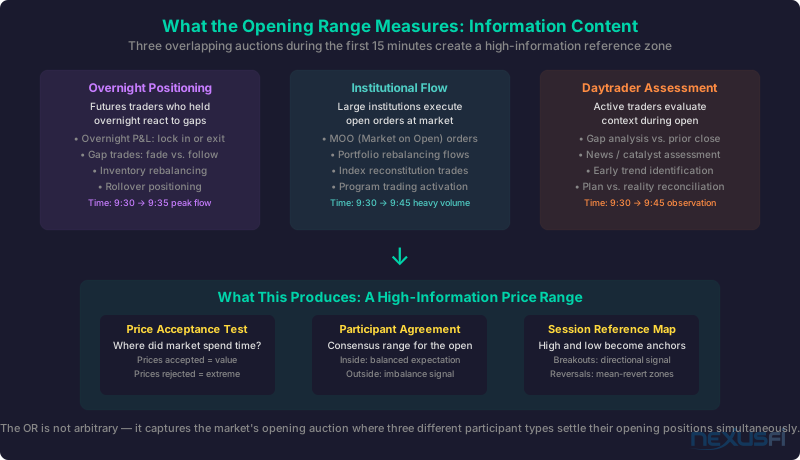
The opening range matters because it captures the market's first real auction after the cash open. Overnight positioning meets fresh capital, earnings reactions meet macro analysis, and the resulting price discovery creates levels that attract liquidity for the rest of the day. Whether you trade the breakout, fade the failure, or simply use OR levels as structural reference points, understanding how the opening range works is foundational to intraday futures trading.
Definition and Measurement #
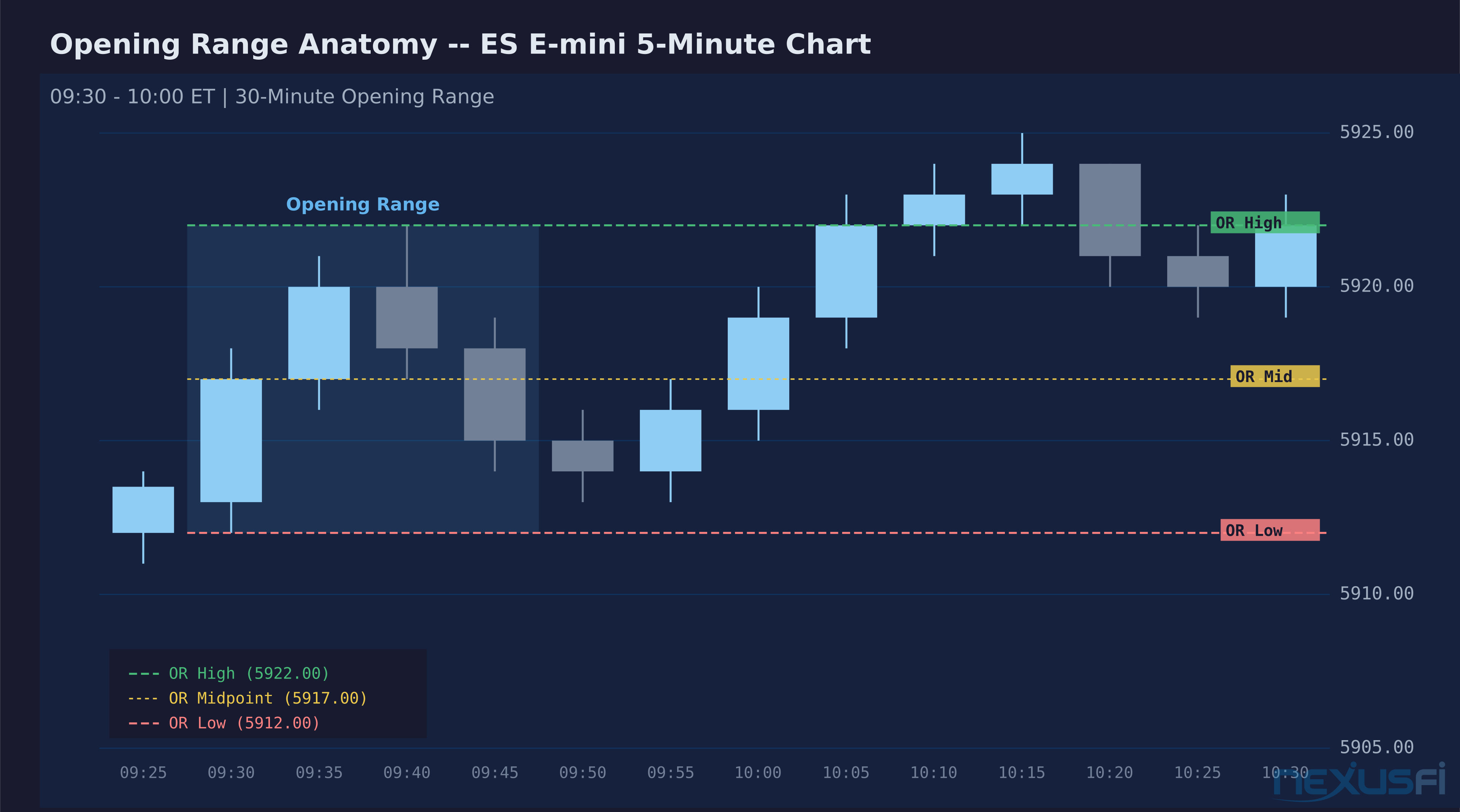
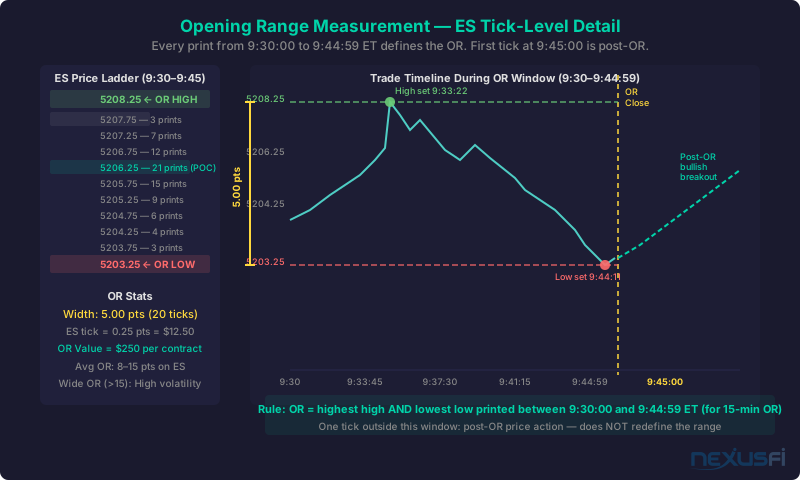
The opening range records the high and low of a fixed time window starting at the Regular Trading Hours (RTH) open. That's the only hard rule. Everything else — duration, where the window starts, which levels you track — varies by product, practitioner, and market regime.
Time Window Variants
There's no universal "correct" duration. The three most common variants in futures trading:
15-Minute OR — The tightest standard window. Captures the initial burst of institutional order flow at the RTH open. For ES and NQ, this means 09:30 to 09:45 ET. The 15-minute OR produces narrower ranges and more breakout opportunities, but also more false signals. Best suited for scalpers and aggressive intraday traders.
30-Minute OR — The most widely used reference period. Gives the opening auction time to settle, reducing noise while still capturing the first directional bias. Toby Crabel's original research and much of the published backtesting literature uses this window.
5-Minute OR (Fisher's ACD Method) — Mark Fisher uses a very short opening range, often shifted into the pre-session period. As @Fat Tails explains, "Mark Fisher uses a longer than 5-minute range to determine the volatility of the current day" and has "shifted the start of the opening range to something earlier than the start of the regular session." [1] The pre-session shift reflects the reality that electronic markets don't truly "open" — trading continues from overnight, and the RTH bell is just a liquidity inflection point.
Core Measurements
Every OR setup tracks four numbers:
OR High — The highest price reached during the OR window. This is the upside breakout trigger and, when held, the first resistance level of the session.
OR Low — The lowest price reached during the OR window. This is the downside breakdown trigger and potential support.
OR Midpoint — The arithmetic average of OR High and OR Low. Some traders use this as a magnet level where price gravitates during rotational days. Others use it as a bias filter: above the midpoint, favor longs; below, favor shorts.
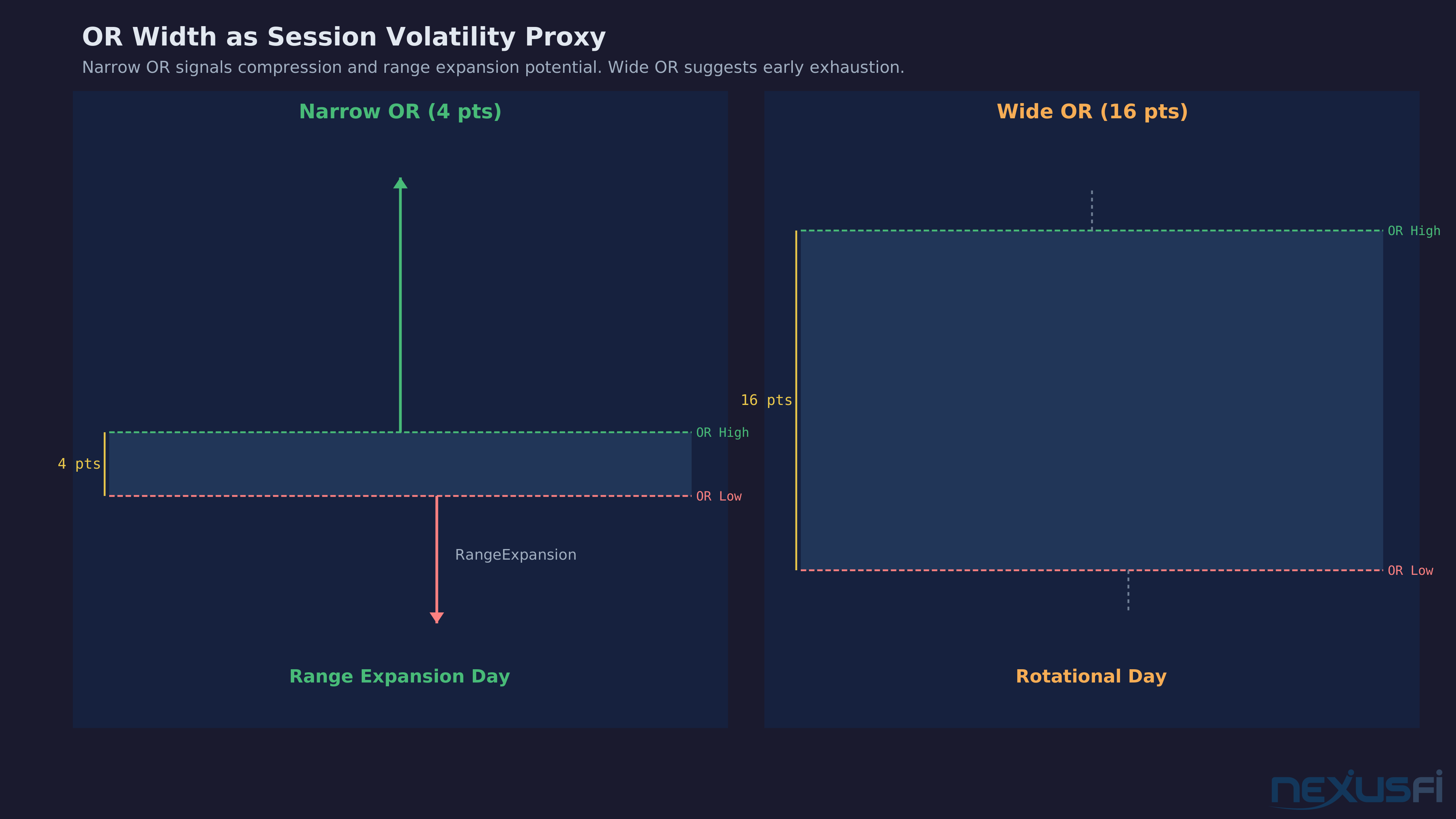
OR Range (Width) — The distance from OR High to OR Low. This single number is a powerful volatility proxy for the session. A narrow OR relative to recent average daily range suggests compression and potential for range expansion. A wide OR suggests the day's move may already be partially exhausted.
Product-Specific Conventions
Different futures products have different OR characteristics because institutional participation timing varies:
Equity Index Futures (ES, NQ, RTY) — The 9:30 ET cash open triggers the heaviest liquidity surge. The 15 or 30-minute OR starting at 09:30 is standard. The opening 30 minutes typically account for 15-20% of the full RTH volume.
Crude Oil (CL) — The 9:00 ET open sees the energy complex's version of the morning rush. Many CL traders use a shorter 15-minute OR because the initial move is fast and directional.
Treasury Futures (ZB, ZN) — Fixed income traders often use a 5-10 minute OR. Bond markets react rapidly to pre-market economic data releases, and the first few minutes after the 8:20 ET open capture most of the re-pricing.
Currencies (6E, 6J) — Session overlap (London/New York) creates a different volatility structure. The OR window often aligns with the US morning when both sessions are active.
What the Opening Range Actually Measures #
The OR isn't just a couple of lines on a chart. It's a compressed view of the first price discovery cycle when real money shows up.
The Auction-to-Continuous Transition
Before the RTH open, electronic markets trade with thinner liquidity and wider effective spreads. The RTH bell triggers a phase transition: institutional algorithms start executing, hedge fund desks begin their VWAP and TWAP programs, market makers replenish depth, and retail traders react to overnight developments.
The OR captures this transition. The high and low represent the boundaries of the first auction — the price levels where aggressive buying found willing sellers (OR High) and aggressive selling found willing buyers (OR Low). These boundaries matter for the rest of the session because they mark where the largest participants collectively agreed the value range begins.
Overnight Inventory Resolution
One of the most important functions of the OR is resolving overnight positioning. Traders who accumulated positions during the Globex session need to either add to those positions or liquidate them once RTH liquidity appears. This creates the initial directional push.
As @Fat Tails noted in his analysis of opening range mechanics, "the solid kernel is the risk side and the fact that it is based on repetitive human behaviour" — the OR exploits the predictable pattern of participants re-anchoring positions at the open. [2]
OR Width as a Volatility Forecast
The OR range width, compared to recent average daily ranges, gives you a real-time volatility estimate for the session. Fat Tails developed specific indicators around this concept, measuring "noise" — the average size of failed moves from the open — using lookback periods of 10 and 20 days to establish what constitutes a significant move versus normal price oscillation. [1]
A practical rule of thumb: if the 30-minute OR range already exceeds 50% of the 20-day average daily range, expect a wide-ranging day. If the OR range is less than 25% of the average daily range, expect range expansion — the day has more room to move.
Trading the Opening Range #
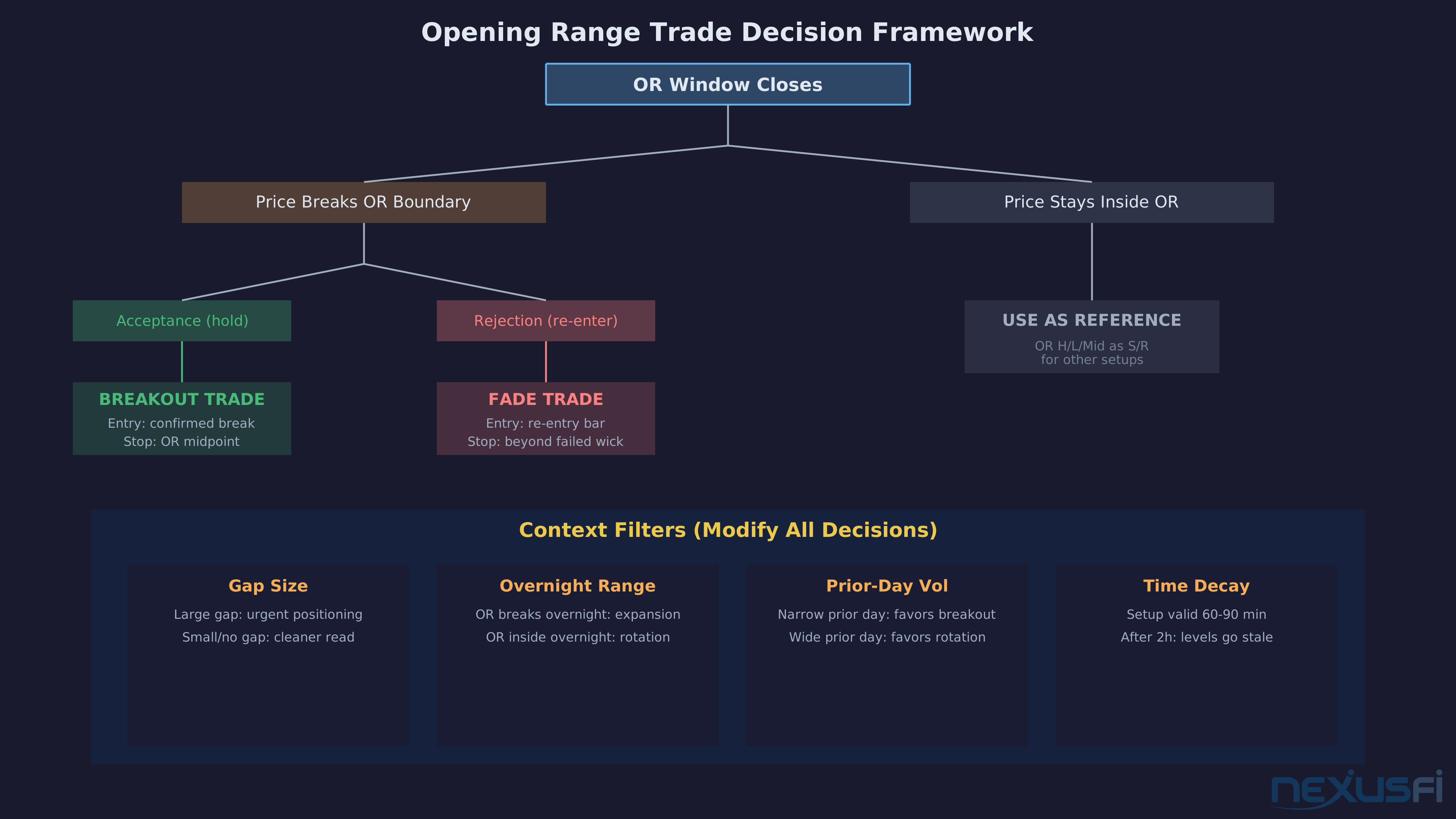
Three canonical approaches exist for trading OR levels. Each works under different conditions, and knowing which regime you're in matters more than the setup itself.
OR Breakout
The breakout trade enters in the direction of the break when price moves beyond the OR High or OR Low with acceptance — meaning price doesn't just poke through and reverse, but holds beyond the level with follow-through volume.
Entry: Price closes a bar (5-minute or higher) beyond the OR boundary. Wait for one confirming bar that holds above the breakout level. Entering on the initial break without confirmation is where most OR traders get destroyed.
Stop: Below the OR midpoint for long breakouts, above the OR midpoint for short breakouts. Placing the stop on the opposite side of the entire OR is common but expensive — the midpoint is where the original auction's bias shifts, making it a more logical invalidation point.
Target: OR range extensions work well. A 1x extension (one OR range width beyond the breakout level) is a conservative first target. A 1.5x extension is aggressive but achievable on trend days.
Invalidation: If the breakout bar doesn't hold and price re-enters the OR within 10-15 minutes, the breakout has failed. Exit immediately. Failed breakouts are the highest-probability fade trades — which leads to the second approach.
OR Fade (Rejection Play)
The fade trade enters against the direction of a failed OR breakout. This is a mean-reversion play that capitalizes on trapped breakout traders who must cover their positions.
Entry: Price breaks the OR boundary, fails to sustain (no acceptance), and re-enters the OR. Enter on the re-entry candle with a tight stop beyond the failed breakout high/low.
Stop: Just beyond the failed breakout extreme — typically 2-3 ticks past the wick. This is the narrowest logical stop you can use.
Target: The opposite OR boundary, or the OR midpoint for a conservative take. The full OR range fade (high to low or vice versa) completes on approximately 30-40% of sessions.
When to fade: Fading works best on days when the OR is wide relative to recent ranges (the initial move may have overextended), when there's no clear directional trigger, and when the overnight range was already wide (suggesting that overnight positioning has already played out).
OR as Reference Levels
Not every trader needs to trade the breakout or fade. Many experienced traders simply use OR High, Low, and Midpoint as structural reference points for the rest of the session — similar to how they use prior-day highs, lows, and settlement.
The OR levels work as reference because they represent consensus from the highest-volume period of the session. When price returns to these levels hours later, the traders who established positions there become active again, creating predictable liquidity pockets.
Context Filters: What Modifies OR Behavior #
The opening range doesn't exist in a vacuum. The same OR setup produces different outcomes depending on context. These four filters separate high-probability OR trades from noise.
Gap Analysis
The gap between the prior close and the current open directly influences OR behavior. Large gaps create urgent positioning needs — institutions that were wrong overnight need to adjust, and that adjustment happens during the OR. Small gaps or no gaps leave the OR as a cleaner directional read.
Key question: does the gap fill within the OR window? If price gaps up and the OR period fills the gap entirely, that's a failed bullish auction — favor short setups. If the gap holds through the OR with price building above the prior close, the gap represents accepted value at higher prices.
Overnight (Globex) Range
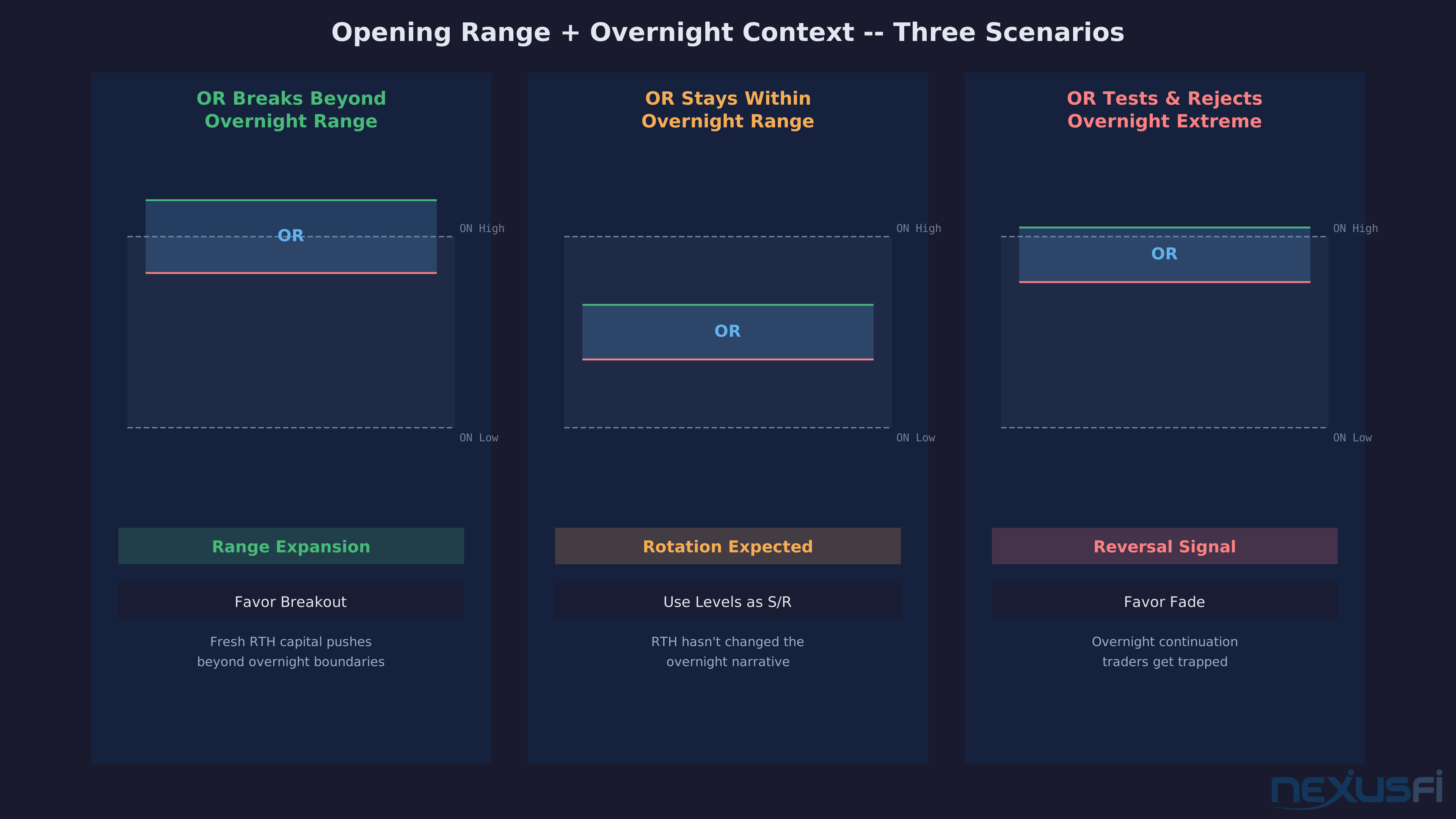
The overnight high and low provide the first layer of context for the OR. Three scenarios:
OR breaks beyond the overnight range: Range expansion signal. Fresh capital at the RTH open is pushing price beyond where overnight participants traded. This often indicates genuine directional conviction and favors breakout strategies.
OR stays within the overnight range: The RTH open hasn't changed the overnight narrative. Expect rotation within the overnight boundaries until a trigger appears. This environment favors OR reference level trading over breakout trades.
OR tests and rejects the overnight extreme: Common on gap-fill days. Price reaches for the overnight high or low during the OR, gets rejected, and reverses. This is a high-probability fade setup because it traps overnight continuation traders.
Prior-Day Volatility
As Fat Tails explained, the quality of an OR breakout depends on what preceded it: "I would prefer that the prior day had rather low volatility and not high volatility. A wide ranging day might be followed by a balancing day." [2] This is the compression-before-expansion principle. Narrow prior-day ranges create coiled conditions where the OR breakout has more follow-through potential.
Time-of-Day Volatility Cycle
Fat Tails identified a critical microstructure insight: "Human behaviour divides the day into different volatility zones. The attractivity of the opening range breakout is that it precedes herding. The herding generates positive feedback loops and increased volatility that can be exploited." [2]
For equity index futures, the highest volatility occurs in the first 30-60 minutes. There's a mid-day lull, then a secondary volatility spike around 14:00-15:00 ET. The OR exploits the morning spike. Traders who extend OR concepts to the afternoon lull-to-spike transition are applying the same principle with different timing.
OR vs. Initial Balance: The Explicit Boundary #
This distinction matters because confusing them leads to incorrect trade logic.
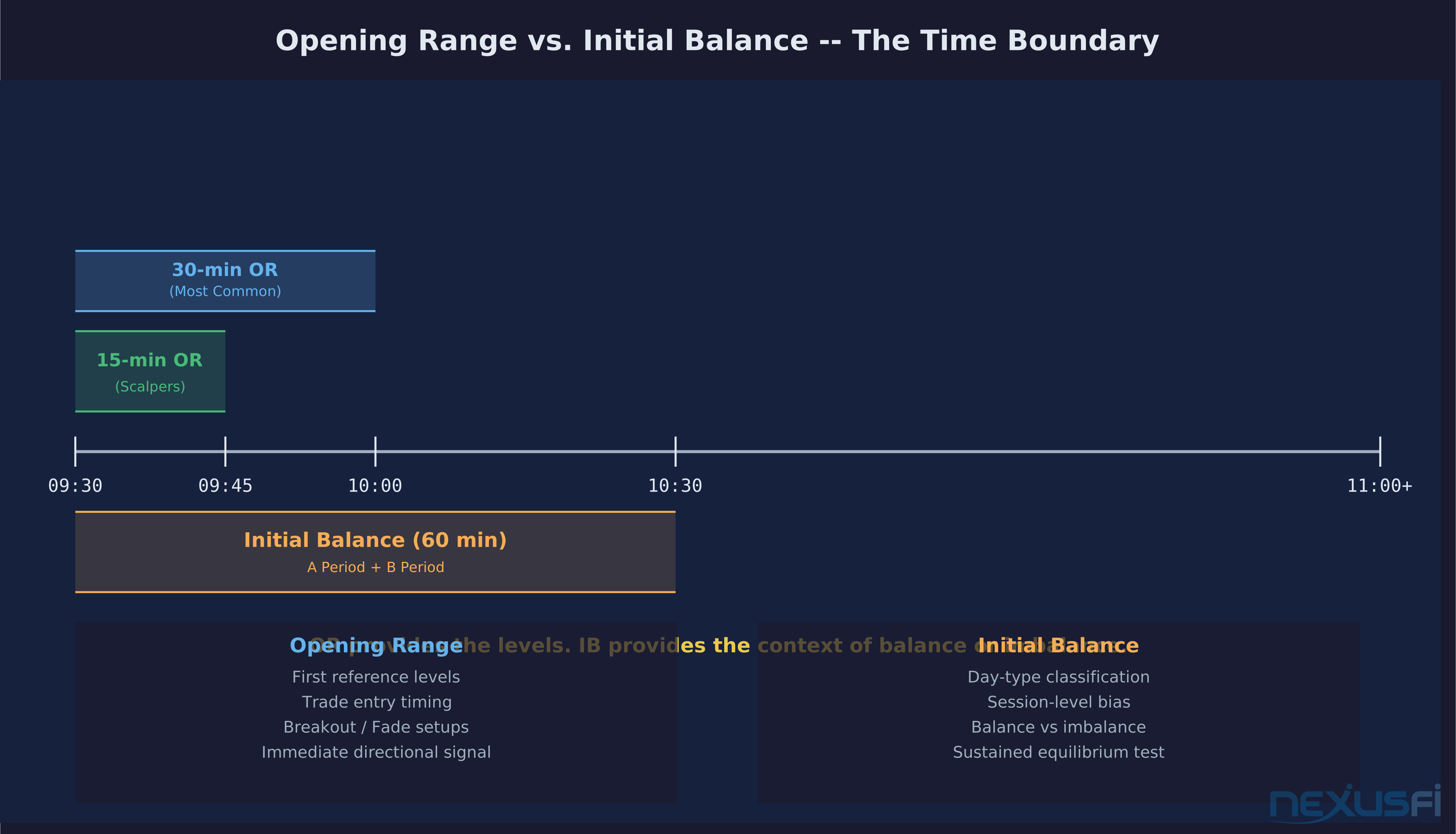
The Opening Range covers the first 15-30 minutes. It captures the immediate opening auction and establishes the session's first reference levels. OR trades are about the initial directional impulse and its acceptance or rejection.
The Initial Balance (IB) covers the full first 60 minutes (the A and B TPO periods in Market Profile). It evaluates whether the OR's directional move persists into a broader equilibrium. The IB is about balance and day-type classification.
The practical boundary: OR provides the levels. IB provides the context of balance or imbalance. Use OR levels for entry timing and immediate trade management. Use the IB framework for day-type classification and session-level bias.
When the Opening Range Fails #
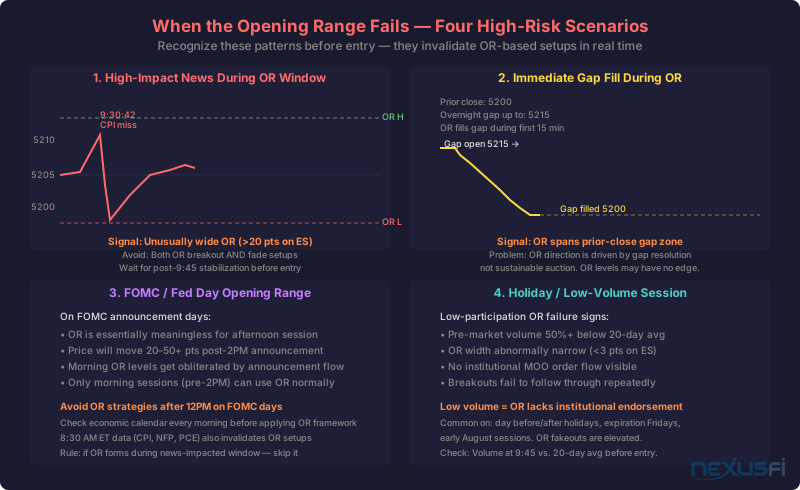
No concept works all the time, and the OR has specific failure modes every trader should recognize.
News-Driven Sessions
When a major data release (NFP, CPI, FOMC) hits during or immediately after the OR window, the levels become meaningless. The OR reflects pre-news positioning, not the market's reaction to new information. On heavy news days, wait for the post-news OR to form before using any OR-based levels.
Holiday and Low-Volume Sessions
Thin markets produce unreliable OR levels. When volume during the OR window is much below the 20-day average (below 50%), the levels weren't established by representative institutional flow. Range expansion from a low-volume OR is more likely to be noise than signal.
Gap-and-Go Sessions
When the market gaps much and immediately trends from the open with no rotational activity, the OR becomes a single-directional artifact. The OR Low on a gap-up trend day might never be tested again. Using it as support in this context is a losing framework — the market has moved beyond the opening auction into discovery mode.
OR Breakout Degradation Over Time
OR breakout strategies have a well-documented performance decay. Toby Crabel's 1990 research showed stronger edge than what modern backtests reveal. The edge has compressed because the strategy is widely known, algorithms specifically target OR levels for stop hunts, and execution costs eat into the narrow-range breakouts that once worked. As @GruttePier noted while researching this topic, the revisited question of whether the opening range remains relevant shows that "the concept needs continuous adaptation to maintain an edge." [5]
This doesn't mean the OR is useless — it means the raw breakout strategy isn't sufficient. The edge lives in combining OR levels with the context filters described above, not in blindly buying highs and selling lows.
Practical Application #
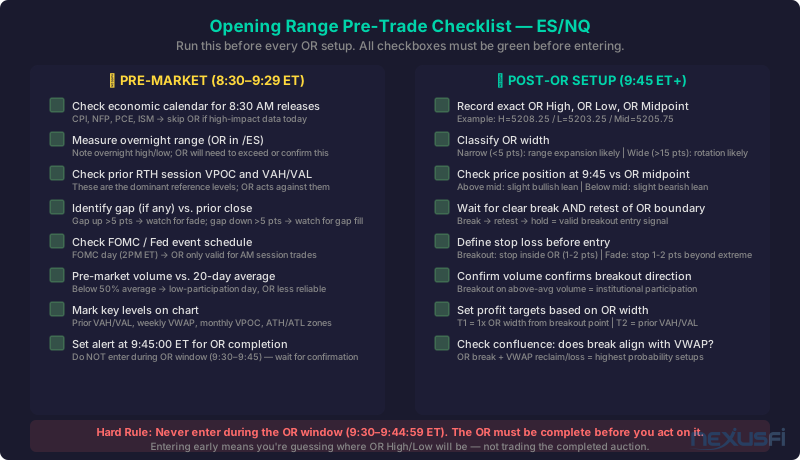
Pre-Market Preparation
Before the RTH open, establish your context:
- Identify the overnight range — Where are the Globex high and low? Is the overnight range narrow or wide relative to the 20-day average?
- Measure the gap — How does the expected open compare to the prior RTH close? Large gaps change OR interpretation much.
- Check the calendar — Any major data releases scheduled during or after the first 30 minutes? If yes, consider waiting for the post-news OR.
- Note prior-day volatility — Was yesterday a narrow-range compression day (favoring breakout) or a wide-range expansion day (favoring rotation)?
Execution Checklist
Once the OR window closes:
- Mark OR High, Low, and Midpoint on your chart. Use horizontal lines that extend through the full session.
- Calculate OR width and compare to your 20-day average OR width. Note whether today's OR is narrow (below 75% of average) or wide (above 125% of average).
- Determine your bias: Where did the OR form relative to the overnight range? Relative to the prior day's value area? Relative to the gap?
- Choose your approach: Breakout (narrow OR + compression context + directional overnight bias), Fade (wide OR + overextended opening move + no trigger), or Reference (unclear context, use levels as structure for other setups).
- Set time invalidation: If your expected OR setup hasn't triggered within 60-90 minutes of the OR close, the setup is stale. The OR's predictive value decays rapidly after the first two hours of RTH.
Risk Management
OR-based risk management starts with OR width. On a day where the ES 30-minute OR is 12 points, your stop for a breakout trade is approximately 6 points (to the midpoint). On a day where the OR is 4 points, the same logic gives you a 2-point stop. Scale position size inversely to OR width so that dollar risk remains constant regardless of session volatility.
The time stop is underrated in OR trading. A genuine OR breakout should show follow-through within 30-45 minutes. If you're long the OR breakout and price is still chopping around the breakout level 45 minutes later, the acceptance you expected hasn't materialized. Close the position and re-evaluate. The "death by a thousand cuts" scenario in OR trading is holding breakout positions that never trend, slowly bleeding the bid-ask spread and opportunity cost.
Statistical Context #
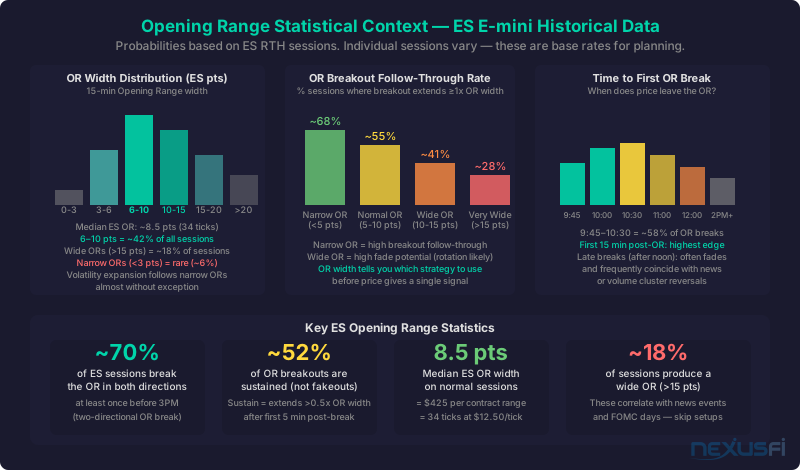
Research by @JohnS in the Master Homework thread, drawing from Crabel's original work and Raschke and Connors' Street Smarts, confirmed that narrow-range days (NR4, NR7 — days where the range is the narrowest of the last 4 or 7 days) precede larger-than-average range expansion approximately 65-70% of the time. [6] This statistical foundation supports the compression-before-expansion filter for OR breakout trades.
The opening range also interacts with prior-day high/low breach statistics. InvestiQuant's analysis on NexusFi found that "odds favor a break of either the high or the low from the prior day" approximately 89% of the time. [3] When the OR breakout aligns with the direction of the nearest prior-day extreme, you're stacking two statistical tendencies in your favor.
Community observations suggest that on balanced/rotational days (approximately 70% of sessions), the OR High or Low is tested at least once during the remainder of the session, making these levels reliable reference points for limit orders and profit targets even when no breakout setup materializes.
Knowledge Map
Prerequisites
Understand these firstGo Deeper
Build on this knowledgeReferences This Article
Articles that build on this topicCitations
- — opening range pivots/extensions (2013) 👍 5“The opening range is a reference range for the value area established during the opening auction. Trading the opening range breakout means to enter the price move in the direction of the trend, once the opening range has been broken.”
- — Can an opening range be used to determine type of day? (2010) 👍 11“The solid kernel is the risk side and the fact that it is based on repetitive human behaviour. Human behaviour divides the day into different volatility zones. The attractivity of the opening range breakout is that it precedes herding.”
- — Statistical edge in trading the indexes e-minis (2020) 👍 3“You see sellers start to become more aggressive and it breaks out of the opening range to the downside, you could get short on the breakdown from the opening range and target the prior day low.”
- — opening range pivots/extensions (2013) 👍 5“The markets of today are not the markets of the Nineties, and all the trading methods need to be adapted.”
- — Opening Range Revisited...Still Relevant? (2020) 👍 2“The concept needs continuous adaptation to maintain an edge in modern electronic markets.”
- — Master Homework and Statistics Thread (2015) 👍 27“After reading Tony Crabel's book, Day Trading with Short Term Price Patterns and Opening Range Breakout, and Linda Raschke & Lawrence Connor's book, narrow-range days precede larger-than-average range expansion.”