



Volume Ladder & Footprint Charts
Overview #
A footprint chart breaks open the candlestick and shows you what actually happened inside. Instead of open-high-low-close, you get executed volume at every price level, split by who was aggressive — buyers lifting offers or sellers hitting bids. The volume ladder is the vertical display format: price rows stacked with bid and ask volume side by side.
This is the closest thing to watching the auction in real time without staring at a DOM all day. You see where the aggression was, where passive orders absorbed it, and where imbalances stacked up hard enough to move price. As @Grantx explained in the NexusFi Understanding Footprint Charts thread: you can see "what delta means at each price level, what absorption looks like, passive and aggressive action" — all inside the structure of a single bar.
The catch is that footprint charts pack enormous information density into a small space. Without a systematic approach to reading them, you'll drown in numbers. This article gives you that system.
Key Concepts #
Volume Ladder — A vertical price grid showing executed bid volume and ask volume at each price level within a bar. Left column = bid-side executions (aggressive sellers). Right column = ask-side executions (aggressive buyers). Center = the price. Think of it as the candlestick's internal anatomy.
Footprint Chart Types — Three primary rendering modes of the same underlying data:
- Bid x Ask: Shows raw volume split (e.g., "150 x 89" at a price level)
- Delta: Shows the net difference (ask minus bid, e.g., "+61")
- Volume: Shows total contracts traded regardless of direction
Aggressive Orders — Market orders that cross the spread to execute immediately. Ask-side volume represents aggressive buyers (market buy orders hitting resting sell limits). Bid-side volume represents aggressive sellers (market sell orders hitting resting buy limits). This is the core of footprint interpretation — who is forcing the trade.
Absorption — When large passive limit orders absorb aggressive flow without price movement. Price gets hit repeatedly from one side but doesn't move because resting liquidity keeps replenishing faster than it gets consumed. This is how institutions defend levels.
Imbalance — A significant disparity between bid and ask volume at one or more price levels. Stacked imbalance: multiple consecutive price levels showing the same directional bias. Diagonal imbalance: bias that ramps across adjacent prices, suggesting momentum stepping up or down.
Delta — The net difference between ask-side and bid-side volume. Can be measured at a single price level, across an entire bar, or cumulatively across a session. Each tells you something different about buying and selling pressure.
Unfinished Auction — An extreme where the market showed heavy activity but didn't establish acceptance. Price left excess at the high or low and rotated away before completing the auction. These levels often act as magnets for future retests.
How Footprint Charts Work #
Reading the Ladder #
Every price level in a footprint bar contains two numbers. On most platforms, the format is BidVol x AskVol — left side is volume executed at the bid (aggressive selling), right side is volume executed at the ask (aggressive buying).
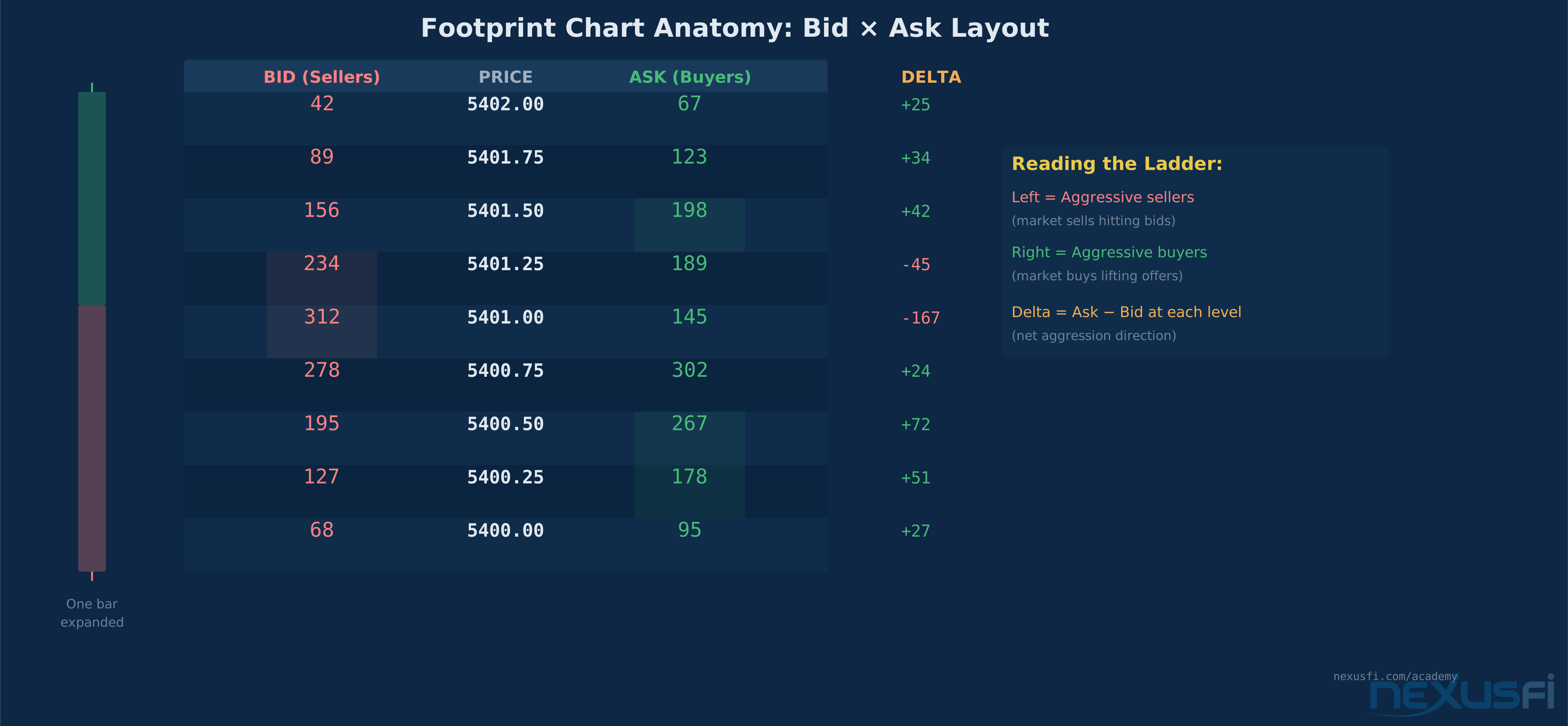
When you see 42 x 187 at 5405.00, that means 42 contracts traded at the bid and 187 traded at the ask at that exact price. Net delta at that level: +145. That's strong buying aggression. As @Silvester17 detailed in the Volume Ladder Highlight thread on NexusFi, "ask traded vs bid traded volume — volume that trades at the ask price is considered buy volume, while volume that trades at the bid is considered sell volume."
The ladder becomes powerful when you look at the whole bar, not just individual rows. Patterns emerge across multiple price levels that reveal the underlying auction structure.
Chart Types and When to Use Each #
Bid x Ask is the raw data view. Use it when you need to see both sides of the trade — especially for absorption analysis where high volume on both sides tells a different story than one-sided aggression. This is the default for most serious footprint traders.
Delta view strips it down to net pressure. Use it for quick momentum reads. A column of green (positive delta) stepping up through price levels tells you buyers are in control. But delta alone can mask absorption — a bar might show modest positive delta while hiding massive two-sided volume at a key level.
Volume view shows total execution without directional information. Useful for identifying where the most trading activity occurred — high-volume price levels often become support/resistance. But it can't tell you who was aggressive.
— the choice of view depends on your trading style and what you're looking for in that moment.
Aggressive Buyers vs Sellers #
Here's the mechanical truth of footprint charts: they show you who was forcing trades through the market. A market buy order that lifts the offer gets counted as ask-side volume. A market sell order that hits the bid gets counted as bid-side volume.
Why does this matter? Because aggression reveals intent. Limit orders are passive — they sit and wait. Market orders pay the spread to execute now. When you see 400 contracts on the ask side at a single price level in ES, that's 400 contracts worth of traders who paid up to get filled immediately. That's conviction.
The ratio matters. In ES during regular trading hours, seeing a 3:1 ask-to-bid ratio at a price level (say, 300 x 100) indicates meaningful buying dominance. In CL, the threshold shifts — you need 2:1 or higher because of natural two-sided hedging flow. NQ sits between the two but requires confirmation across multiple bars because individual prints can be more transient.
Location amplifies meaning. Aggressive buying at the top of a range tells a different story than aggressive buying at the bottom. Aggression at auction edges — where price is testing new territory — matters far more than aggression inside established value.
Absorption Patterns #
Absorption is one of the most important signals footprint charts reveal. It looks like this: heavy aggressive volume on one side, high total execution, but price doesn't move. The aggression is being absorbed by passive orders that keep replenishing.
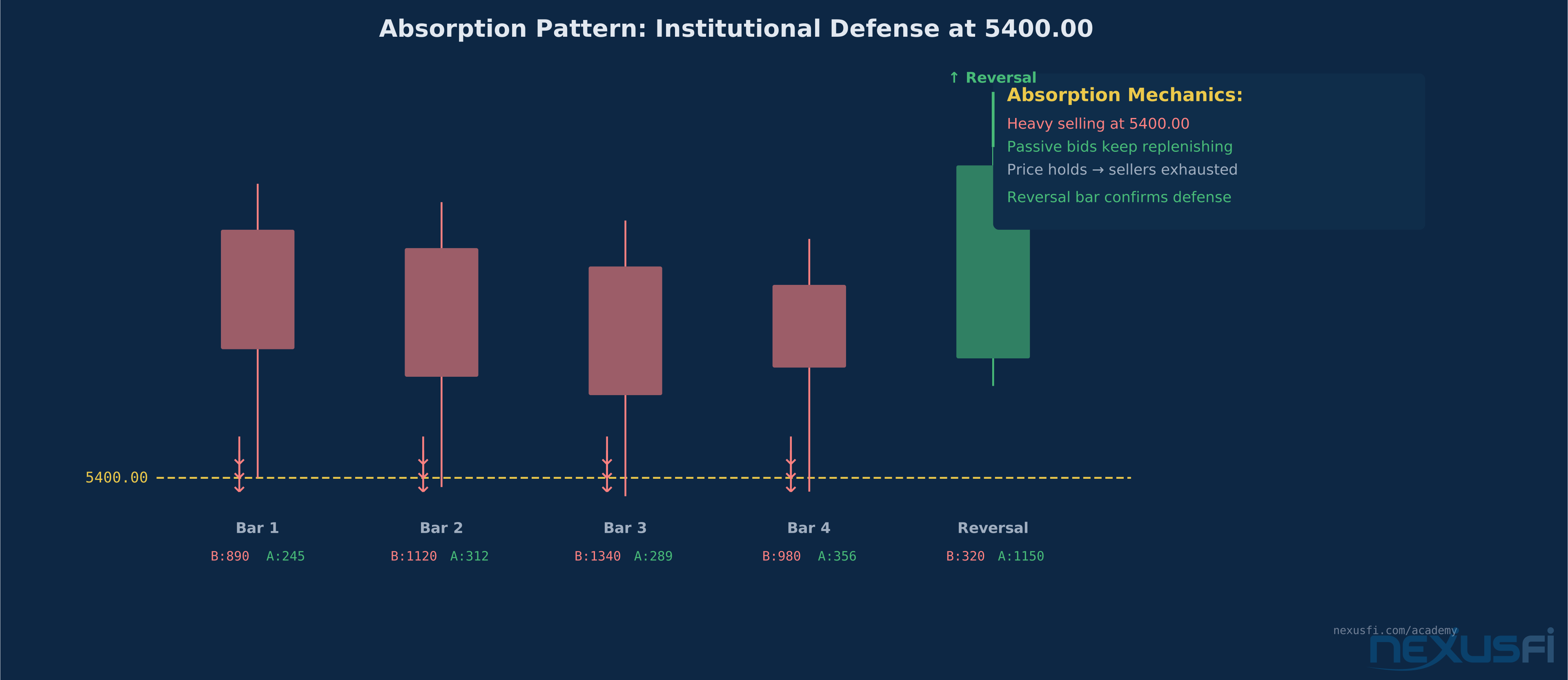
Picture ES trading at 5400.00. Aggressive sellers hammer the bid — you see 600, 700, 800 contracts on the bid side across several bars at the same price level. But price won't break. Each time sellers push, buyers refill the limit orders. The footprint shows massive bid-side volume with no downside displacement.
This is institutional behavior. As discussed in the Understanding Footprint Charts thread on NexusFi, you're watching "passive/aggressive action and responsive/initiative action" unfold in real time. Large players don't chase price with market orders — they stack limit orders at levels they want to defend and let the market come to them.
The absorption signal strengthens when:
- Volume at the level exceeds 2x the local median (adjacent 3-5 ticks) for at least 2-4 bars
- Delta at the absorbed level starts flipping sign (sellers exhausting, buyers stepping in)
- Price stalls despite repeated attacks from the aggressive side
- The absorbed level holds across multiple time frames
Absorption at a level that holds often precedes a sharp move in the opposite direction — the sellers ran out of ammo, and the passive buyer controls the price.
Imbalance Detection #
Imbalances reveal where one side of the market dominates across multiple price levels simultaneously.
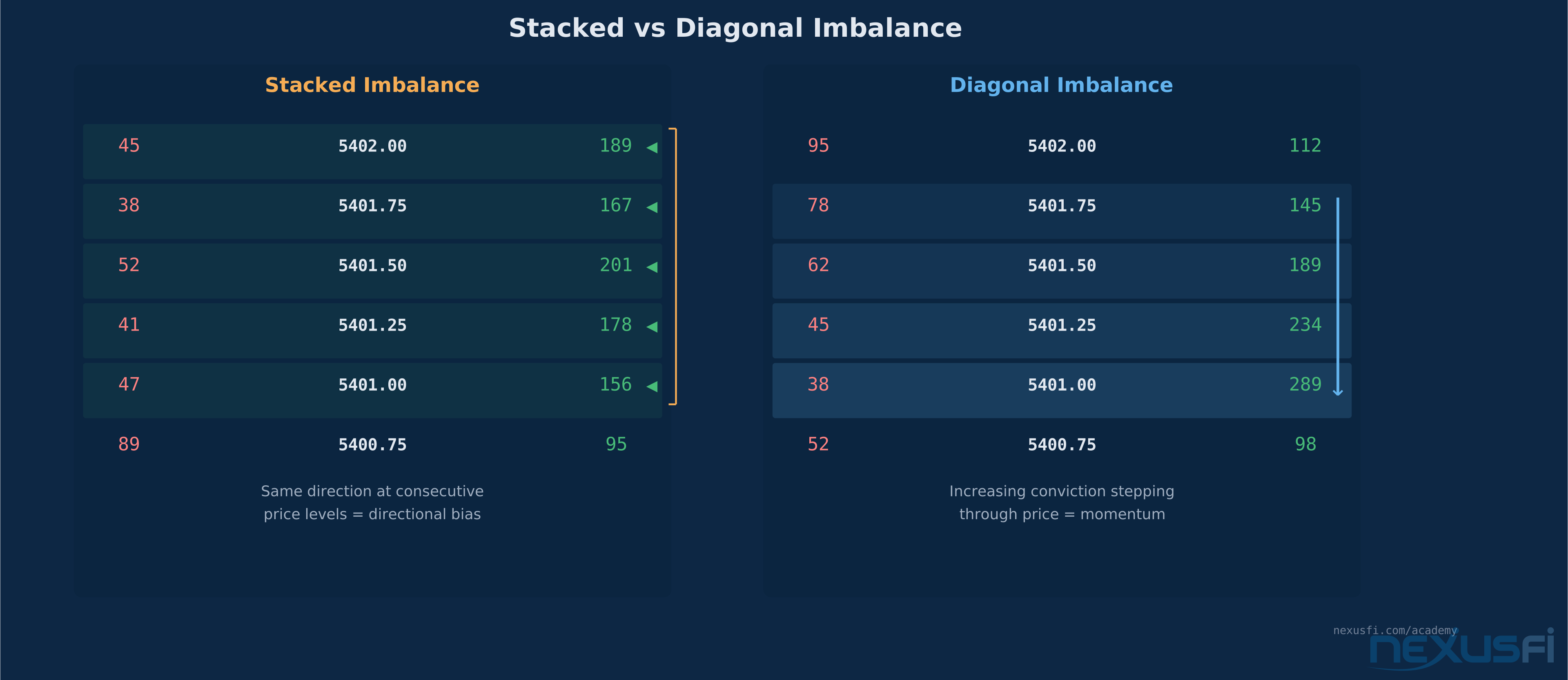
Stacked imbalance: When 3+ consecutive price levels show the same directional bias — say, the ask volume exceeds bid volume by 3:1 or more at each level. This creates a visual "stack" of one-sided aggression.
Diagonal imbalance: The imbalance ramps across prices in a staircase pattern. At 5400.00, ask beats bid 3:1. At 5400.25, ask beats bid 4:1. At 5400.50, ask beats bid 5:1. The buyers are stepping up, paying higher prices with increasing conviction. This diagonal pattern signals genuine momentum.
The standard heuristic is a 3:1 ratio for individual level imbalances, but context matters more than the ratio. A 3:1 imbalance during thin overnight trading means less than a 2:1 imbalance during the cash open when total volume is 10x higher. Always compare to the local context.
Stacked imbalances that fail — where price reverses despite 5+ levels of one-sided aggression — often signal exhaustion rather than continuation. The buyers pushed hard, couldn't get follow-through, and the sellers overwhelmed them. Watch for the follow-through.
Delta at Price vs Cumulative Delta #
This is where many footprint traders get confused, so let's be precise about the three levels of delta:
Price-level delta: Net buying/selling at a single price. Delta of +45 at 5400.00 means 45 more contracts traded at the ask than the bid at that exact price. This is the most granular view.
Bar delta: The cumulative net for an entire bar. If a 5-minute bar has +230 total delta, buyers were net aggressive by 230 contracts over those 5 minutes. Useful for quick momentum reads.
Cumulative delta (session): A running total of delta across multiple bars. This line trends up when buyers are net aggressive and trends down when sellers dominate.
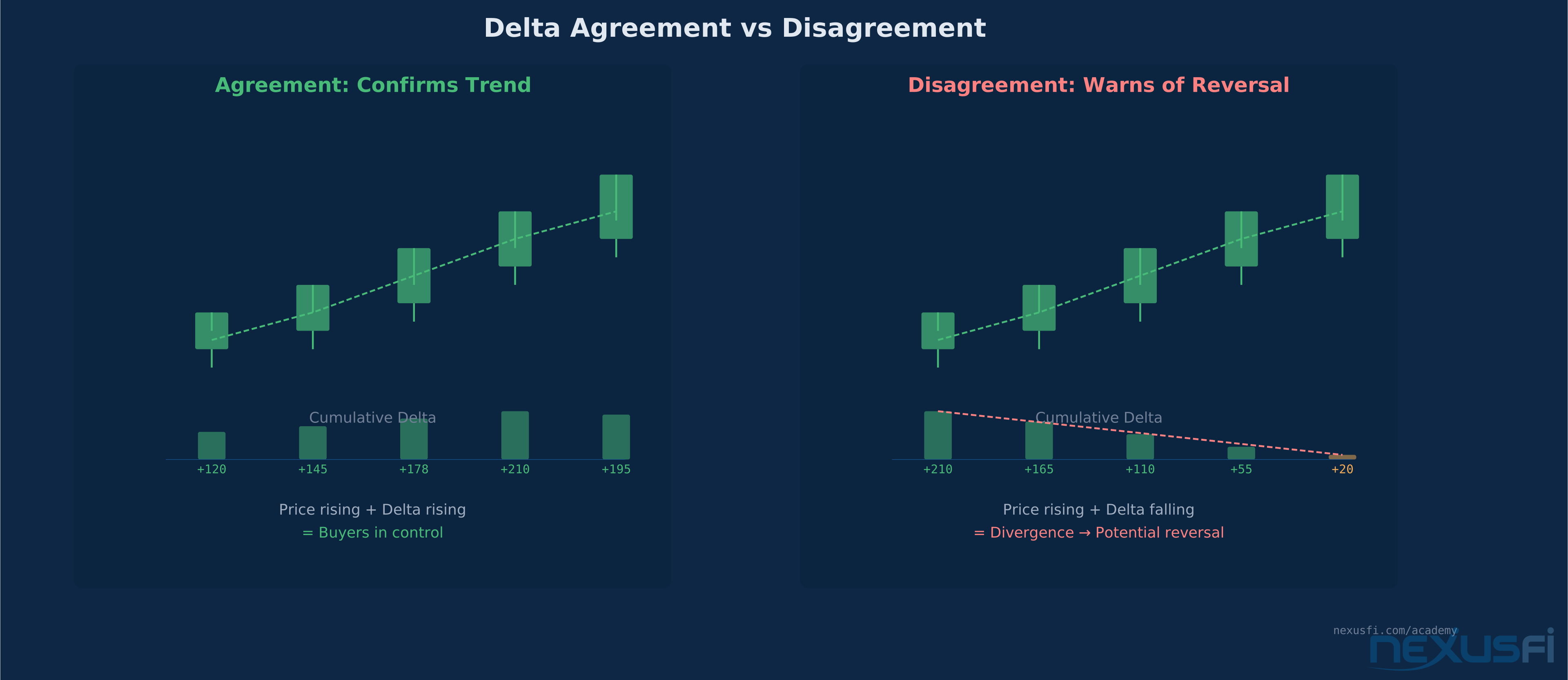
The power is in comparing levels. Agreement between price-level delta and cumulative delta confirms the move. Price rising with positive delta at each new high AND cumulative delta trending up = genuine acceptance. Buyers are both locally aggressive and sustaining pressure over time.
Disagreement is the warning signal. Price makes a new high, but cumulative delta is flattening or rolling over. Locally, buyers might still be aggressive, but the broader pressure is fading. As @josh described in the NexusFi Cumulative Delta thread: understanding "both the benefits and limitations" of delta tools means recognizing that delta confirmation requires agreement across timeframes, not just a single data point.
@Tap In added in the same thread that cumulative delta can reveal "potential areas of reversal" through divergence patterns that aren't visible on price-only charts. When price pushes higher but cumulative delta makes a lower high, the buying pressure is waning despite the price advance.
For a complete treatment of cumulative delta divergence strategies, anchoring methods, and CVD variants, see the dedicated Delta Analysis & CVD Academy article.
Unfinished Auctions and Excess at Extremes #
This concept connects footprint analysis directly to auction market theory. An "unfinished auction" occurs when price reaches an extreme, shows heavy activity, but doesn't establish acceptance before rotating away.
On the footprint, look for this: a bar's high price shows 3x or more volume compared to the local median, often with strong positive delta (aggressive buying at the top). But the next several bars don't revisit that level — price rotates lower. That's excess at the high. The auction went there, found activity, but didn't complete.
Unfinished auctions create magnetic levels. Price has unfinished business at that extreme and statistically tends to return to test it. This is the footprint version of "poor highs" and "poor lows" from Market Profile theory.
The opposite also holds: when an extreme shows clean, single-print excess with minimal volume, the auction completed properly. There's no magnetic pull back to that level.
As @Jigsaw Trading demonstrated in a detailed NexusFi ES footprint analysis: after watching contracts trade at key levels, "the shorts remain and we expect them to defend" — showing how excess at extremes creates defensive behavior from trapped participants.
Practical Trade Setups #
Setup 1: Absorption Fade (ES) #
What you see: Price attempts to break a prior high. At the high, footprint shows heavy ask-side volume (buyers lifting offers aggressively) — 500+ contracts in ES — but price doesn't extend. Next bar shows bid-side delta appearing at/above the same level.
Confirmation: Delta flips from positive to negative at the breakout level within 1-2 bars. Cumulative delta stops rising.
Entry: Short on the confirmation bar (limit at the absorbed level or market on delta flip).
Stop: Above the absorbed high + 2 ticks.
Target: Prior range midpoint or developing VPOC.
Invalidation: Price breaks through the absorbed level with increasing delta and volume acceptance above.
Setup 2: Acceptance Continuation (NQ) #
What you see: Stacked diagonal positive delta walking upward — each higher tick shows increasing buy-side dominance. 3+ consecutive levels with 3:1 or better ask-to-bid ratio.
Confirmation: Cumulative delta continues rising on pullbacks. Sell-side delta on pullbacks is noticeably weaker than buy-side delta on pushes.
Entry: On retrace to a level that re-establishes positive delta (buy the pullback into the diagonal support).
Stop: Below the lowest level of the diagonal support structure.
Target: Next visible excess area or imbalance zone overhead.
Invalidation: Pullback produces heavier sell delta than the prior push produced buy delta.
Setup 3: Unfinished Auction Rotation (CL) #
What you see: Range boundary shows extreme volume prints with a delta magnitude spike. Price rejects and cumulative delta flattens.
Confirmation: Opposing delta appears at the boundary level. Price fails to extend for 2+ bars despite heavy volume.
Entry: Near the boundary after rejection confirmation (fade the failed breakout).
Stop: Beyond the boundary by 2-3 ticks.
Target: Value area midpoint or prior POC.
Invalidation: Price pushes through the boundary with sustained one-sided delta and tight spreads.
Setup 4: Two-Sided Chop Filter #
What you see: High total volume at a level but alternating delta signs rapidly — positive, negative, positive, negative across consecutive bars. Small net delta despite huge gross volume.
Action: Stay out. This is two-sided churn with no directional resolution. Both sides are fighting with neither winning. Wait for a clear breakout of the chop zone confirmed by stacked or diagonal imbalance before entering.
When Footprint Analysis Fails #
Footprint charts don't work in every condition. Know the failure modes:
Thin markets: Overnight or pre-market sessions produce footprint data that's dominated by a few participants. Imbalance ratios become unreliable when total volume is low. A "3:1 imbalance" when total volume is 20 contracts means nothing.
News events: Major economic releases produce simultaneous aggressive orders from both sides that can briefly swamp footprint patterns. Delta can spike in both directions within seconds, creating noise that looks like signal. Wait for the dust to settle — post-news footprint data (5-10 minutes after the release) is more reliable.
Spoofing and layering: Large resting orders that get pulled before execution can create misleading absorption signals. The footprint shows executed volume, not intended volume, but pull-and-replace strategies can still distort the picture by creating phantom support/resistance.
Instrument-specific noise: CL is noisier than ES due to hedging flow and physical market participants. NQ can produce transient signals that vanish in the next bar. Adapt your thresholds by instrument — don't use the same absolute numbers across products.
Latency: Footprint data arrives after the trade is executed. By the time you see the absorption pattern form, the opportunity may have partially passed. Footprint works best as a confirmation tool layered on top of market structure analysis, not as a standalone entry trigger.
Prerequisites and Further Reading #
Prerequisites: This article assumes familiarity with futures contract specifications, bid/ask mechanics, basic candlestick reading, and support/resistance concepts. You should also understand the fundamentals of order types (market, limit, stop) and how trades execute against the order book.
Related Academy articles:
- Delta Analysis & CVD — Deep dive into cumulative delta divergence strategies
- Volume Profile Trading — How volume profile levels complement footprint analysis
- Point of Control (POC) — Understanding POC mechanics
- Value Area (VAH & VAL) — Value area context for footprint trading
Related NexusFi discussions:
- Understanding Footprint Charts / Number Bars — 105+ reply thread covering footprint fundamentals
- ES Footprint Charts at the Hard Right Edge — Real-time ES footprint analysis by @Jigsaw Trading
- Volume Ladder Highlight and Metro Addition — 2,000+ reply thread on volume ladder tools by @Silvester17
- Cumulative Delta Volume Trading — 980+ reply Elite thread on delta strategies
Knowledge Map
Prerequisites
Understand these firstReferences This Article
Articles that build on this topicCitations
- — Understanding Footprint Charts / Number bars (2020) 👍 21“Some notes so far. Sorry Im not in the mood to post pics. Just the one that cant be described in words. This is a very interesting topic and I cant believe I disregarded volume so easily. I mean I can understand why...”
- — Volume Ladder Highlight and Metro Addition (2015) 👍 10“chartman, didn't realize that there's a question in here :) I guess there're different ways you can use start and finish delta. I personally would only consider finish delta.”
- — Ninjatrader - Orderflow (2025) 👍 2“I use footprints a lot, but only on 5 and 15 min timebases. I don't like 1 min FP, it moves across my screen to quickly to absorb.... (and I only scalp) More for a longer term picture of where there is liquidity.”
- — Foot print question (2016) 👍 4“Imbalance is important information but in my humble opinion you should not enter trades based on order imbalance in and of itself. The market delta video you watched was just highlighting the imbalance feature on their footprint charts.”
- — Cumulative Delta Volume Trading (2013) 👍 12“As I sit through a ho-hum kind of day, I thought about delta, and drew this up as kind of a "know both the benefits and limitations of tools in the toolbox.”
- — Cumulative Delta Volume Trading (2016) 👍 8“For all you CD fans out there, I wanted to share another way I have been using CD to find potential areas of reversal.”
- — ES Footprint charts at the hard right edge (2013) 👍 14“So what next? Well we can see above the area at 90.25 & 90.50. What we see there is a lot of contracts trade. By now, the longs amongst them are out, so the shorts remain and we expect them to defend that area.... https://nexusfi.com/attachment.”
- — Spoo-nalysis ES e-mini futures S&P 500 (2022) 👍 7“It doesn't take a footprint chart to see this, and I don't see it real-time this way, but posting so you can observe. The snap-back bids in this market currently are very strong.”
- — Cumulative Delta Volume Trading (2012) 👍 7“Hi guys, so today was a hidden delta divergence bonanza with the TF, ES and NQ setting up beautifully. If you managed to get some of this booty well done.”
- — Cumulative Delta Volume Trading (2013) 👍 4“I use Cumulative delta almost exclusively with some other bid/ask tools. Ill agree Cumulative delta by itself isn't enough. I think a certain amount of experience and understanding are required to make it work on a consistent basis.”