



Scalping Futures with Order Flow
How professional scalpers read the tape, the DOM, and the footprint to find micro-timeframe setups in ES, NQ, and CL
Overview #
Scalping is the shortest-timeframe discretionary trading approach in futures — holding positions for seconds to minutes, targeting small moves, and relying on rapid execution and precise reads of real-time order flow. The typical scalp targets 2-8 ticks in ES, 4-16 ticks in NQ, or 5-15 ticks in CL.
Here's the thing about scalping: it looks simple from the outside. Take small bites, get out fast, repeat. But the math is brutal. Every tick of slippage eats a larger percentage of your target than it does for a swing trader. Every round-turn commission compounds against razor-thin margins. And the psychological demand is relentless — you're making dozens of decisions per session with zero room for hesitation.
The edge in scalping doesn't come from indicators or chart patterns. It comes from reading real-time supply and demand dynamics as they unfold on the Depth of Market (DOM), the time and sales tape, and the footprint chart. You're watching the actual auction — who's aggressive, who's defending, and when control shifts.
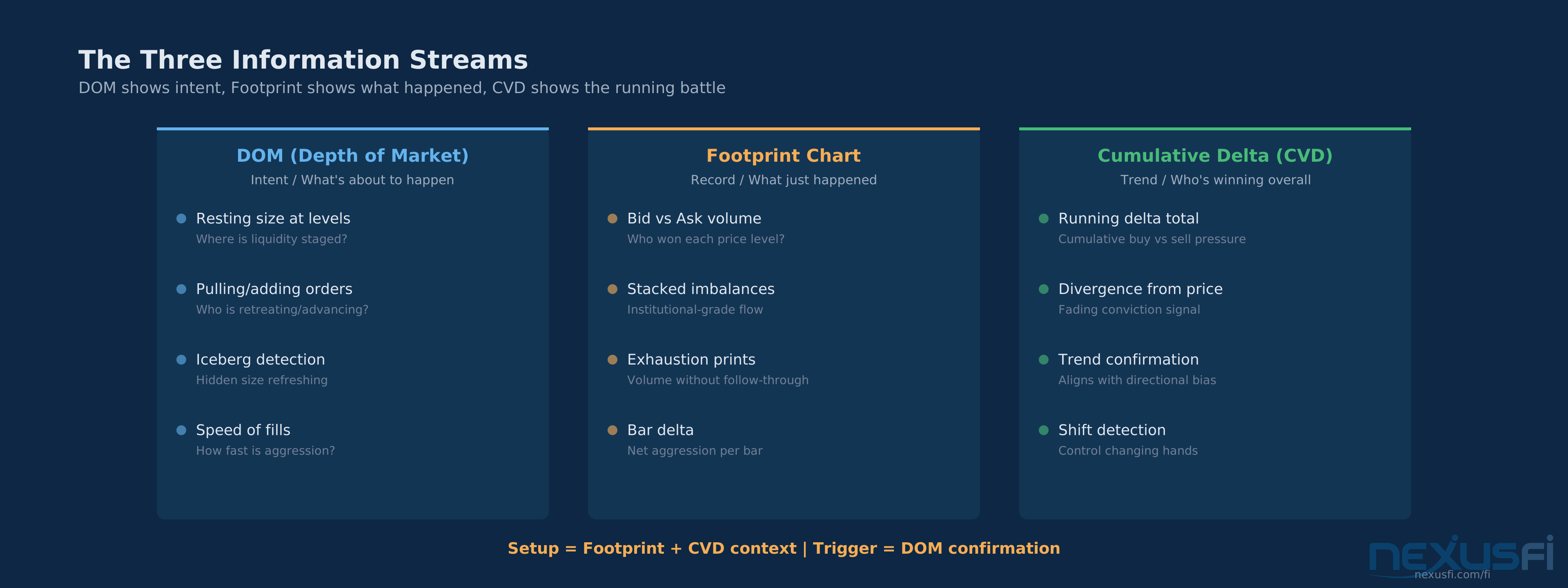
That distinction between what traded and what's intended is the core of scalping edge. Footprint charts are excellent for context — who won the last bar, where did volume cluster, what does the delta tell you. But the live DOM shows you what's about to happen: where size is stacked, where it's pulling, where icebergs are refreshing.
Professional scalpers use both. The footprint and delta provide the setup. The DOM provides the trigger.
The Math of Scalping -- Why Most Fail #
Before diving into setups, you need to understand the arithmetic that kills most scalpers. This isn't optional reading — it's the foundation of whether scalping is even viable for you.
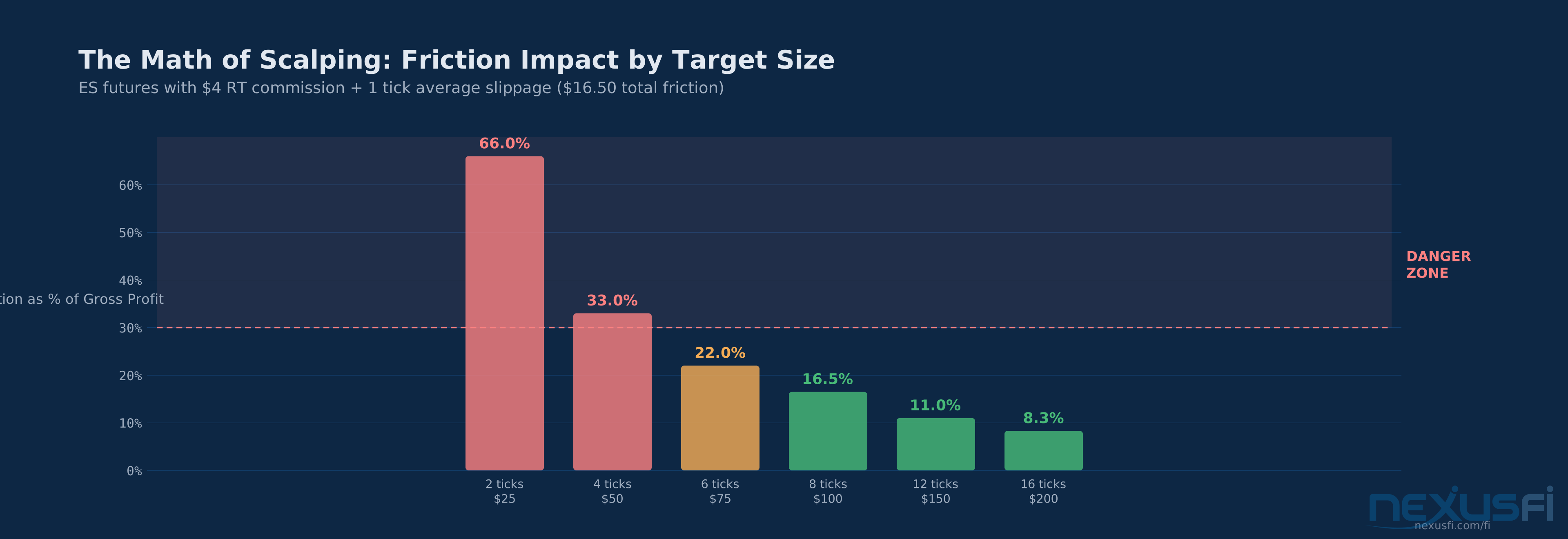
Here's the math on ES with typical retail costs:
Per round-turn costs:
- Commission: ~$4.00 (varies by broker)
- Slippage: 1 tick average = $12.50
- Total friction: ~$16.50 per round-turn
On a 4-tick scalp ($50 gross):
- Friction consumes 33% of gross profit on winners
- Net on winner: $33.50
- Net on loser (4-tick stop): -$66.50
At those numbers, you need a 67% win rate just to break even on a 1:1 R:R scalp. That's before accounting for the psychological slippage of hesitation, over-trading, and revenge trading.
The escape routes from this math:
- Larger targets — 6-8 tick targets drop friction to 20-25% of gross
- Better fills — limit entries reduce slippage to near zero on the entry side
- Lower commissions — volume-based pricing at prop firms or direct-access brokers
- Asymmetric R:R — scaling out at multiple targets while trailing a runner
Don't skip the math. Run it for your broker, your instrument, and your realistic fill quality. If the numbers don't work, increase your target size or find a different approach.
The Three Information Streams #
Effective scalpers synthesize three real-time data streams. Each tells you something the others can't.
Stream 1: The DOM (Depth of Market) #
The DOM shows resting limit orders at each price level. It tells you where liquidity is staged and where it's thin. Key reads:
Stacked bids or offers — Large resting orders clustered at specific levels signal institutional intent. A 2,000-lot resting bid at a round number isn't there by accident. But don't just count the size — watch if it's refreshing. Static size that doesn't update is likely real. Size that flickers in and out is spoofing or algo probing.
Pulling orders — When resting size at a level gets pulled as price approaches, it signals the defender is retreating. If 1,500 lots at 5200.00 disappear when price hits 5200.75, the bulls are stepping aside. That's a bearish tell.
Iceberg orders — Size that keeps refreshing at the same price after being filled. You'll see 200 contracts on the offer, they get hit, and immediately 200 more appear. This means someone is distributing a large position without showing their hand.
Stream 2: The Footprint Chart #
The footprint shows what actually traded at each price within each bar — bid volume vs. ask volume, delta, and imbalance ratios. It's the record of the battle.
Key footprint reads for scalpers:
- Stacked imbalances — 3+ consecutive price levels where bid or ask volume dominates by 300%+ signals aggressive directional flow
- Exhaustion prints — Massive volume at a price extreme with no follow-through on the next bar signals buyers or sellers are spent
- Delta divergence — Price making new highs while bar delta is declining means the aggressive buying is fading, even though price is still moving up
Stream 3: Cumulative Delta (CVD) #
CVD tracks the running total of aggressive buying minus aggressive selling. It shows whether the buying pressure behind a move is building or fading.
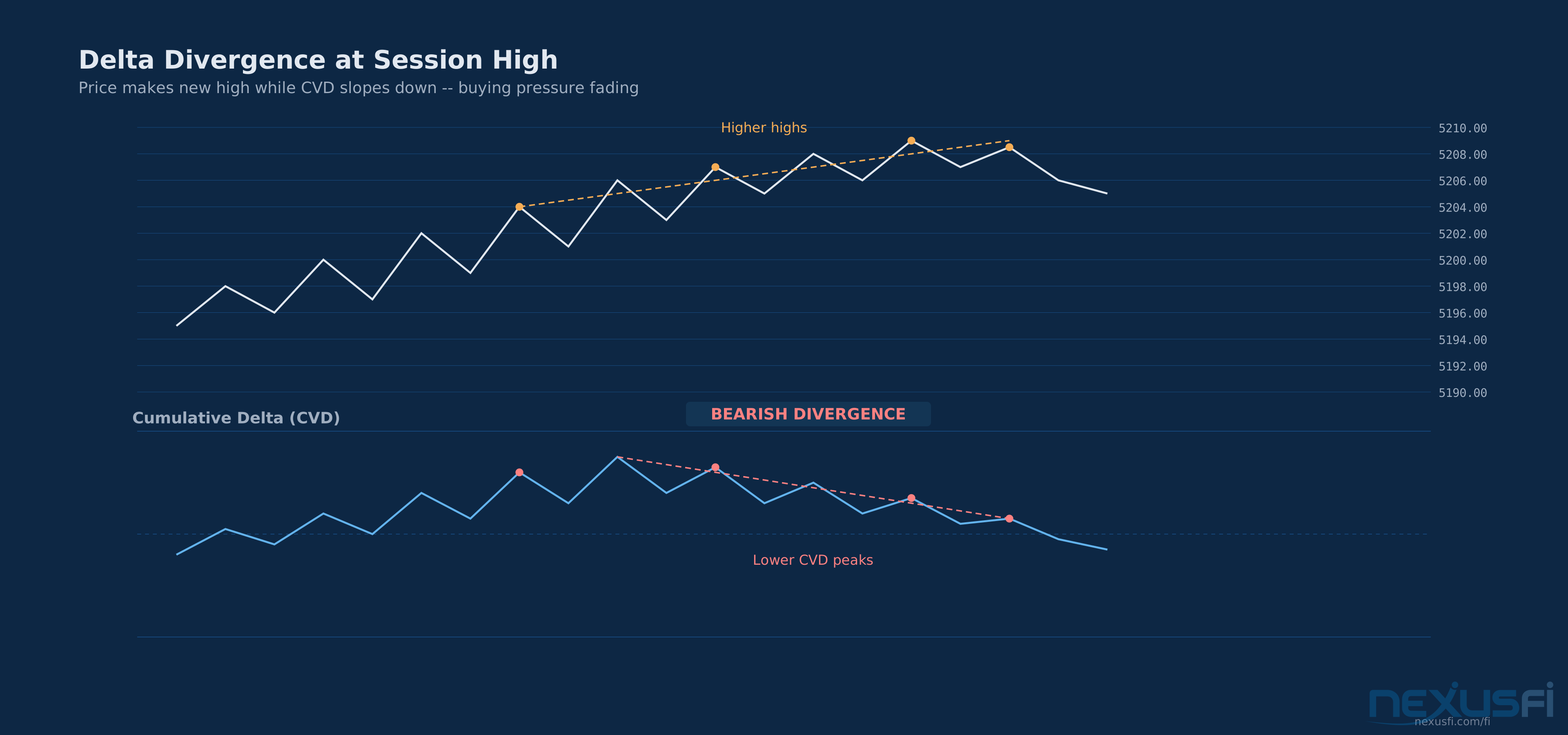
The key scalping read: CVD divergence at extremes. When price pushes to a new session high but CVD is rolling over, the aggressive buying that drove the move is exhausting. The footprint might still show buying at individual prices, but the cumulative picture says the fuel is running out. That's your setup for a fade.
Four Core Scalping Setups #
Each setup combines DOM reads with footprint confirmation. None of these work in isolation — they require context from higher timeframe levels to anchor them.
Setup 1: Absorption Reversal #
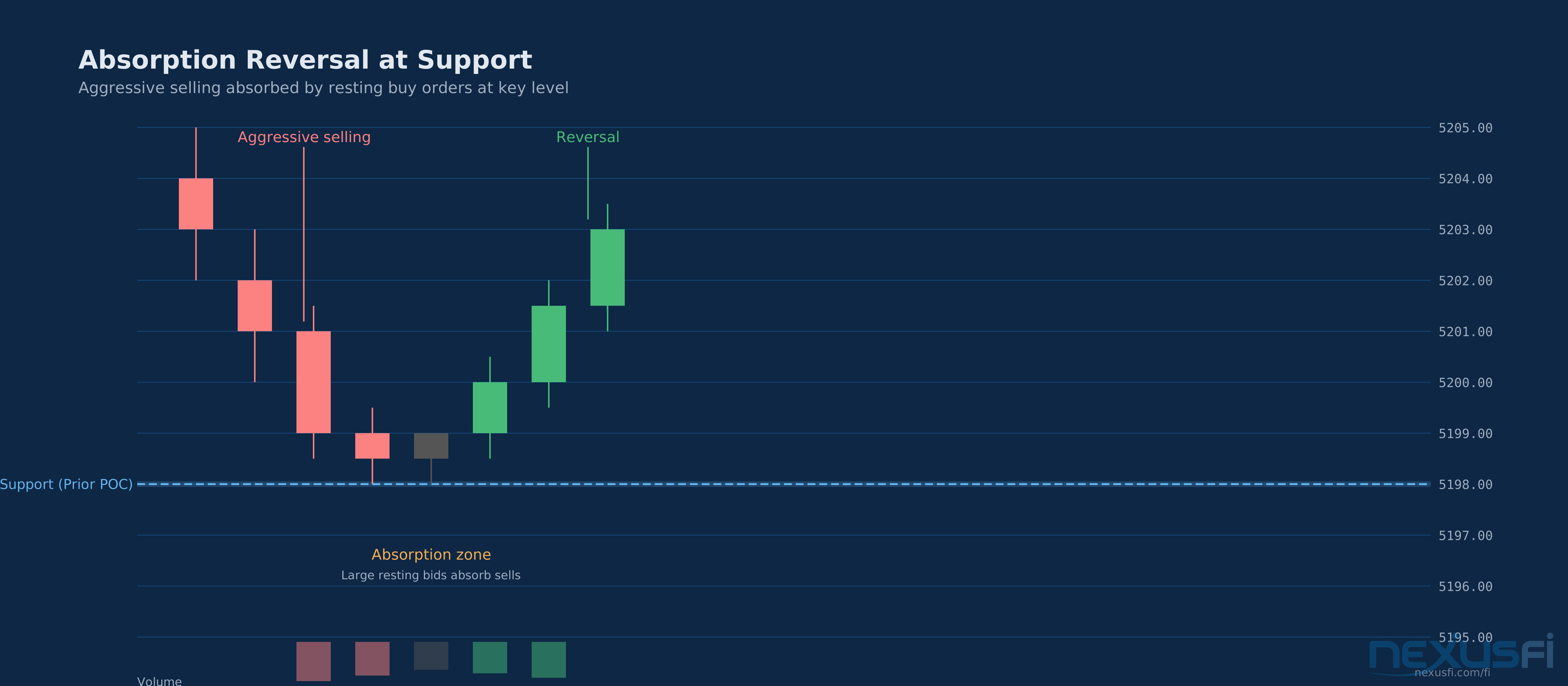
What it is: Price pushes into a level where resting orders absorb the aggressive flow without giving ground. The aggressors exhaust themselves, and price reverses.
The read:
- Price approaches a significant level (POC, VAH/VAL, prior session high/low, round number)
- Aggressive flow is hitting the level — you see large market orders executing on the footprint
- On the DOM, resting size at the level keeps absorbing the hits. 500 lots get filled at the offer, but the offer doesn't move because more limit orders are stacked behind it
- Delta on the footprint bar shows strong selling (or buying) but price isn't moving — the aggressive side is getting absorbed
Entry: After absorption is confirmed (2-3 waves of aggressive flow absorbed without price movement), enter in the reversal direction. Trigger: first footprint bar showing delta flip — selling absorption followed by a bar with positive delta.
Stop: Beyond the absorption level by 2-3 ticks. If the absorption level fails, your thesis is wrong.
Target: First target at the midpoint of the move that pushed into the absorption level. Second target at the origin of the aggressive move.
Failure mode: Absorption works until it doesn't. When size at a level suddenly gets pulled (icebergs stop refreshing), the absorption has failed. Exit immediately — don't wait for your stop.
Setup 2: Stacked Imbalance Breakout #
What it is: Three or more consecutive price levels on the footprint showing extreme imbalance (300%+ bid or ask dominance). This signals aggressive, institutional-grade directional flow that tends to continue.
The read:
- A footprint bar prints 3+ stacked imbalances in the same direction
- The bar closes near its extreme (not a rejection wick)
- Volume on the bar is above the session's average bar volume
- The move is in the direction of the higher-timeframe bias
Entry: On the pullback after the stacked-imbalance bar closes. Don't chase the impulse move. Wait for price to retrace 40-60% of the imbalance bar's range.
Stop: Below the low of the imbalance bar (for longs) or above the high (for shorts).
Target: 1:1 to 1.5:1 R:R. The move has already shown its hand — you're riding continuation, not catching a reversal.
Failure mode: If the pullback exceeds 70% of the imbalance bar, the flow wasn't as strong as it looked. Cancel the setup.
Setup 3: Delta Divergence Fade #
What it is: Price makes a new extreme (session high or low) but CVD doesn't confirm. The aggressive side has lost its conviction even though price is still moving their direction.
The read:
- Price pushes to a new session high/low
- CVD is flat or declining (for longs) / rising (for shorts)
- Footprint bars at the extreme show declining volume compared to earlier impulse bars
- DOM shows the aggressive side's resting orders are thinning — fewer contracts stacked on the side they're pushing toward
Entry: After the first footprint bar that closes opposite the trend direction. For a long-side fade of an uptrend: first bar that closes red with negative delta.
Stop: Above the session extreme by 2-3 ticks.
Target: First target at the prior bar's high (conservative). Second target at the developing POC or session VWAP.
Failure mode: If price breaks to a new extreme after your entry, the divergence was temporary. Cut immediately.
Setup 4: Liquidity Vacuum #
What it is: The DOM shows a pocket with very few resting orders. Price tends to move quickly through low-liquidity zones because there's nothing to absorb the flow.
The read:
- On the DOM, you see a stretch of 3-5 price levels with minimal resting orders (under 50 contracts in ES, where normal depth is 200-500)
- Aggressive flow is building toward the vacuum from the other side
- The vacuum sits between current price and a significant level (prior day high/low, HVN)
Entry: When aggressive flow starts pushing into the vacuum. The speed of the move through thin levels gives you your profit.
Stop: Behind the origin of the push, at the last level with significant resting orders.
Target: The significant level on the other side of the vacuum. Price will likely slow or reverse there as it hits new resting liquidity.
Failure mode: If resting orders suddenly appear in the vacuum (someone places a large limit order into the thin zone), the setup is invalidated. The liquidity picture has changed.
Execution Management #
Scalping execution is a skill that develops separately from read quality. You can have perfect reads and still lose money with poor execution.
Entry method: Limit orders for absorption reversals and pullback entries. Market orders for breakout continuation when you see aggressive flow accelerating — the slippage on a limit order that doesn't fill costs more than the tick you save.
Position management: Scale out at multiple targets. Take 50% at the first target (conservative), trail the remainder with a 2-tick trailing stop. This converts some trades from small winners to occasional runners without giving back much profit.
Time-based exits: If a trade hasn't reached target within 2-3 minutes, the edge has likely evaporated. Exit at market. Scalping setups resolve fast — if yours isn't resolving, the read was wrong or the conditions changed.
Maximum trades per session: Set a hard daily cap. 15-20 trades per 6.5-hour RTH session is a reasonable ceiling for manual scalping. Beyond that, you're over-trading and likely degrading your read quality through fatigue.
When Scalping Doesn't Work #
Scalping has specific failure conditions. Knowing when NOT to scalp is more profitable than any single setup.
FOMC, NFP, and scheduled news events: The 15 minutes before and after major macro releases create conditions where normal DOM behavior breaks down. Size gets pulled, spreads widen in fast markets, and the aggressive flow dynamics you're reading become unreliable. Step aside.
Low volume sessions — Late afternoon (after 2 PM ET), holiday weeks, and summer Fridays. When volume drops below 50% of the session average, the DOM thins out, spreads widen on any fast move, and fills degrade. The setups still appear on the chart, but the execution environment makes them unviable.
Choppy rotation inside a narrow range — When ES is rotating in a 4-6 point range with no clear aggressor winning, the DOM flickers between buyers and sellers too fast to read. The footprint shows alternating delta with no conviction. Don't scalp this — it's a mean reversion environment where you're better off waiting for a range break.
Those statistics matter for scalpers. On the 70% of days that are rotational, scalping the DOM for mean reversion into Value Area boundaries works well. On the 30% of days that trend, fading the aggressive flow is suicide. Know which day you're in.
Integrating Higher-Timeframe Context #
Scalping without context is gambling. Every scalp should be anchored to a higher-timeframe level or directional bias.
Pre-session checklist (before RTH open):
- Where is price relative to yesterday's value? Inside = rotational bias. Outside = trending bias. See Open Type Classification
- Where is the developing POC and Value Area from the prior session?
- Is the overnight range narrow or wide relative to the 20-day average?
- What's on the economic calendar?
During the session:
- Scalp WITH the higher-timeframe bias at LVN levels (continuation)
- Scalp AGAINST the move only at HVN levels or VAH/VAL (mean reversion)
- At the IB breakout, switch from fading to trending
That 72% stat is gold for scalpers. Once the IB breaks, your scalping bias locks to the breakout direction. Stop fading.
The Practical Reality #
Scalping demands more screen time, faster reactions, and higher commission costs than any other approach. The win rate looks impressive on paper (many scalpers claim 60-75%), but the absolute dollar per trade is small and the psychological burden is extreme.
Start with micro contracts. MES, MNQ, and MCL let you practice real order flow reading with $1.25 per tick instead of $12.50. The DOM dynamics are slightly different (thinner book), but the footprint and delta reads are identical. Scale up only after proving consistency over 100+ trades.
Track every trade. Log the setup type, entry trigger, DOM condition at entry, footprint bar that triggered, target hit or stop hit, and time in trade. After 50 trades, calculate your actual per-setup win rate, average winner, average loser, and expectancy. If any setup has negative expectancy, stop trading it until you understand why.
Physical demands: Scalping is cognitively intense. After 2-3 hours of concentrated DOM reading, most traders experience significant degradation in decision quality. Build in breaks. Trade the first 90 minutes (9:30-11:00 ET) and the last hour (3:00-4:00 ET) when volume peaks. Skip the midday chop.
Knowledge Map
Prerequisites
Understand these firstGo Deeper
Build on this knowledgeReferences This Article
Articles that build on this topicCitations
- — GOM Ladder vs Order Flow Analytics? (2015) 👍 6“For scalping purposes, you need to be reading the actual DOM.”
- — Minimum Scalp Targets for TF, CL, and QM (2010) 👍 13“The minimum target depends on commissions, slippage, win-to-loss ratio and % profitable of your setups.”
- — Volume Profile and Footprint discussion (2012) 👍 21“The way I look at absorption is when you see either buyers or sellers cutting off the opposing traders.”
- — Trading Futures with Context (2014) 👍 13“70% (more or less) = rotational / balance days. 30% = trending days.”
- — MWG86's Price Action Journal (2020) 👍 15“Once the IB is in and broken to one side there is a 72% historical probability that the other side won't be broken.”
- — Data on Initial Balance - ES (2013) 👍 9“IB Low Data: 40% of the days the IB Low was the trading hours low for the day.”
- — E-mini S&P 500 Futures: Contract Specifications and Order Types (2024)
- — High-Frequency Trading and Market Microstructure: A Scalper's Perspective (2012)