



XRP (Ripple): The Payments Crypto Every Trader Needs to Understand
Overview #
XRP is one of the most polarizing assets in crypto. It has passionate defenders who believe it will transform cross-border payments, vocal critics who question its decentralization, and regulators who spent four years arguing it should never have been sold in the first place. For traders, that combination creates something valuable: volatility with identifiable catalysts.
This guide covers what XRP actually is, how its supply mechanics work, what the SEC lawsuit meant and where it stands, and — most importantly — how to trade it without getting destroyed by the headline-driven swings.
One thing upfront: XRP is not a "set it and forget it" holding. It rewards traders who understand the event calendar and punishes those who size positions as though it behaves like Bitcoin.
What XRP Is (and Why It's Not Just a Coin) #
The confusion starts here. "XRP," "Ripple," and "the XRP Ledger" get used interchangeably, and they're three different things.
The XRP Ledger (XRPL) is a public, open-source blockchain created in 2012. It's not Ripple's property — anyone can run a validator. It exists to help fast, cheap value transfers.
XRP is the native digital asset of the XRPL. It was created at genesis (100 billion total, no mining), and it serves two functions: paying transaction fees (tiny amounts are burned on each transaction) and acting as a bridge currency in cross-border payment flows.
Ripple is the private company that built RippleNet and On-Demand Liquidity (ODL). Ripple was founded by some of the same people who created the XRPL, and it holds a very large XRP position — which is the core of the supply-overhang concern. Ripple and the XRPL are legally and technically distinct, but in market terms, Ripple's actions affect XRP price.
That tension is real and persistent. XRP isn't trying to disintermediate banks — it's trying to work with them. Whether that's a feature or a bug depends on your worldview, but for trading purposes, it means the institutional adoption narrative is the primary long-term driver.
How the XRP Ledger Works: Consensus Without Mining #
The XRPL doesn't use Proof of Work (like Bitcoin) or standard Proof of Stake (like post-Merge Ethereum). It uses a Byzantine Fault-Tolerant (BFT) consensus protocol based on a network of trusted validators.
Here's how it works in practice:
Unique Node Lists (UNLs): Each node on the network maintains a list of trusted validators — its "Unique Node List." To reach consensus, a proposed ledger needs agreement from a sufficient majority of validators on a node's UNL.
Ledger close time: Every 3--5 seconds, the network achieves consensus on a new ledger state. This is deterministic finality — no reorganizations, no waiting for confirmations.
Transaction fees: Fees are tiny (fractions of a cent) and burned permanently, creating a modest deflationary pressure on XRP supply over time. At current network usage, this burn is negligible relative to overall supply.
The decentralization debate: Critics argue that Ripple has historically dominated the UNL recommendations, giving it outsized influence over which validators are trusted. The network has been diversifying, but the centralization concern remains a recurring sentiment factor. It doesn't affect daily trading, but it comes up in every narrative cycle.
For traders, what matters is this: XRPL's near-instant finality means settlement-lag risk is minimal. When you buy or sell XRP on an exchange, you're trading the exchange's order book, not settling on the ledger — but the protocol's properties support the payments-use-case thesis that underpins the long-term bull narrative.
XRP Supply Mechanics: The Escrow System Every Trader Needs to Understand #
This is where a lot of retail coverage gets sloppy, so let's be precise.
Total XRP supply: 100 billion, created at genesis. No mining. No inflation in the traditional sense.
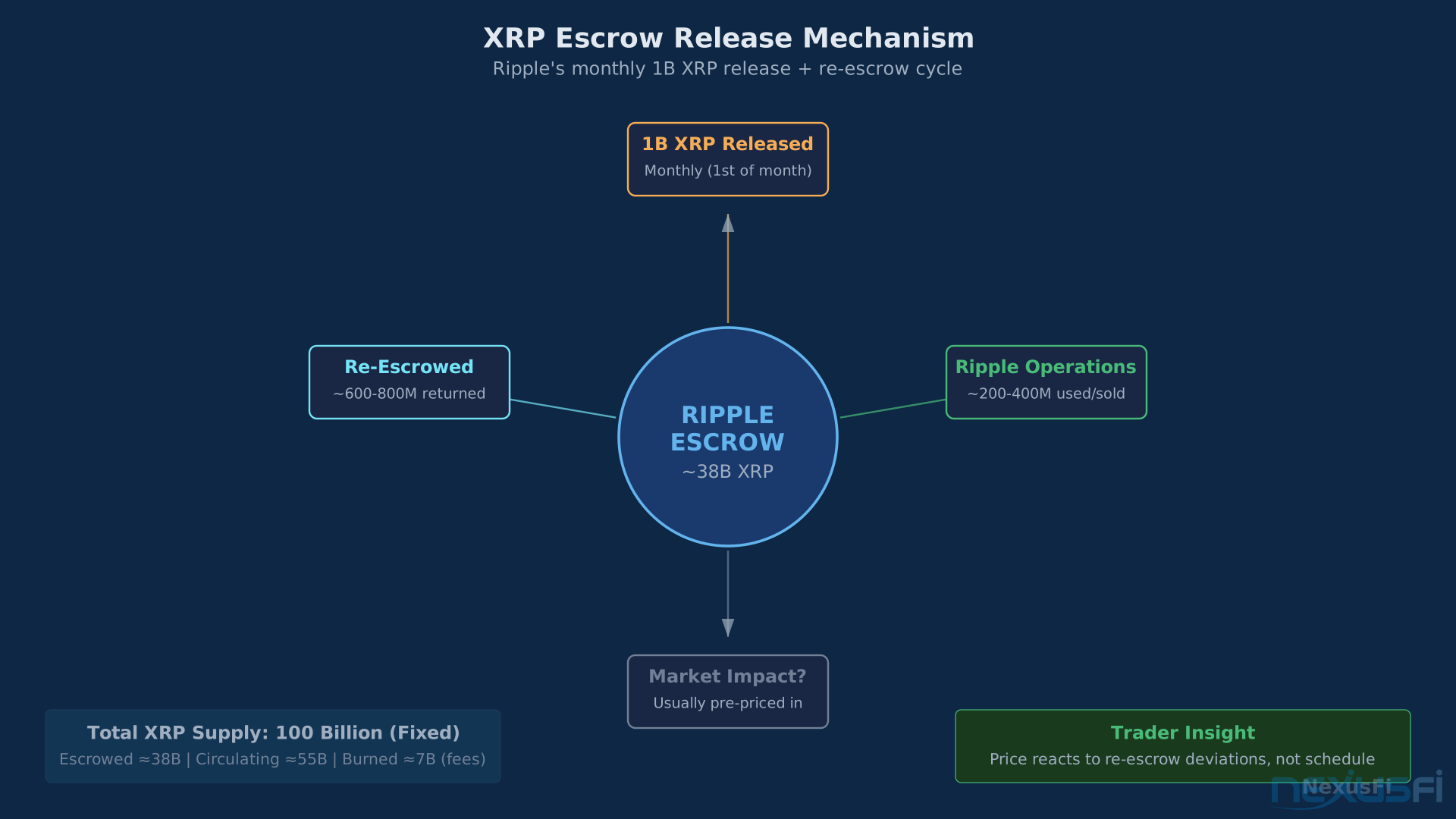
The escrow: In 2017, Ripple locked approximately 55 billion XRP into a series of on-chain escrow contracts — cryptographic time-locks that release a fixed amount each month. The purpose was to provide supply transparency and prevent Ripple from dumping large amounts on the market without warning.
The release schedule: Approximately 1 billion XRP is released from escrow on the first of each month. Ripple then uses what it needs for operations and re-escrows the rest (typically 600--800 million XRP) for 55 additional months.
What traders get wrong: Many retail guides treat the monthly release as direct sell pressure, as if Ripple dumps 1 billion XRP onto Binance every month. That's not what happens. The re-escrow mechanism means only 200--400 million XRP typically enters circulation monthly — and much of that goes to institutional partners, market makers, and operational expenses rather than spot exchanges.
What actually moves price: Deviations from expectations. If Ripple's on-chain escrow wallet shows unusual outflows — or if a large wallet known to be Ripple-linked starts sending to exchange deposit addresses — traders notice. Conversely, if a monthly release results in higher-than-usual re-escrow amounts, it can be a mild bullish signal.
Current state (2024--2025): Approximately 38--40 billion XRP remains in escrow. At the current release rate, this supply will continue through the early 2030s. The remaining circulating supply (~55 billion) is widely distributed across retail holders, exchanges, institutions, and Ripple's non-escrowed treasury.
On the first of each month, check xrpscan.com before opening any XRP position. Look at the escrow wallet's actual re-escrow rate. If Ripple re-escrows >800M XRP, it's a mild bullish signal. If only 500M gets re-escrowed, that extra 300--500M entering circulation is a legitimate concern.
RippleNet and ODL: The Payments Thesis #
RippleNet is Ripple's enterprise payments network — a set of messaging and settlement APIs used by banks and payment providers to move money across borders more efficiently. Think of it as SWIFT with better technology and lower latency.
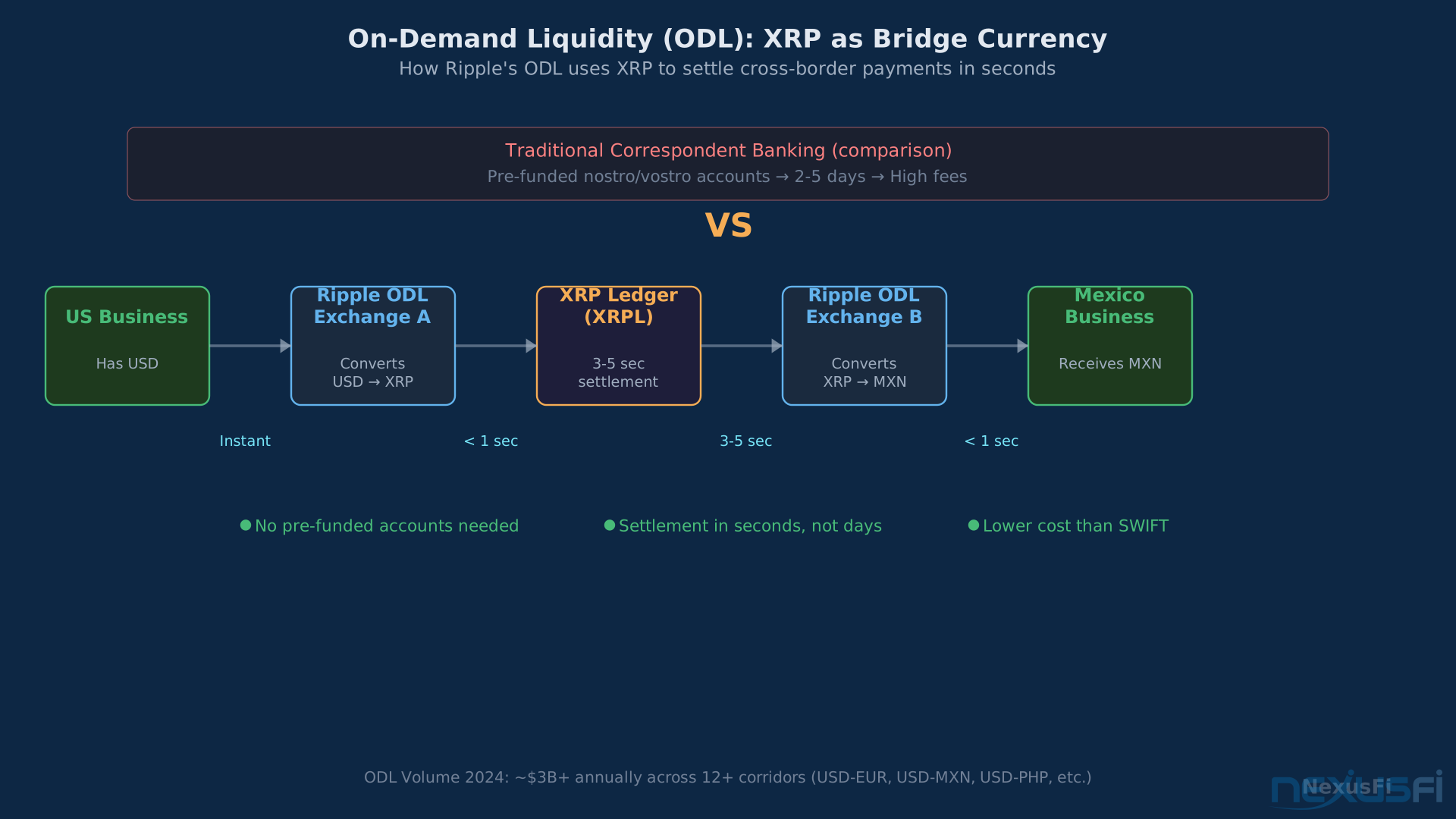
On-Demand Liquidity (ODL) is the product that actually uses XRP. Here's the flow:
- A U.S. business needs to pay a Mexican supplier.
- The U.S. business sends USD to a Ripple-integrated exchange.
- The exchange converts USD -> XRP instantly.
- XRP settles on the XRPL in 3--5 seconds.
- A Mexican exchange receives XRP and converts it -> MXN instantly.
- The Mexican supplier receives pesos.
Total time: under 10 seconds. Traditional correspondent banking takes 2--5 days and requires pre-funded accounts in each corridor (nostro/vostro accounts), which tie up capital.
Why this matters for XRP price: Each ODL transaction creates real, utility-driven demand for XRP as a bridge asset — if only transiently, since both legs (buy and sell) happen almost simultaneously. The market, however, trades on the narrative more than the actual volume. Partnership announcements and corridor launches drive sharp price moves.
Current ODL corridors (2024): Active in 12+ corridors, including USD-EUR, USD-MXN, USD-PHP (Philippine peso), USD-AUD, and others. Volume in 2023 exceeded $2--3 billion; 2024 was trending higher.
The skeptic's view: Stablecoin bridges (USDC, USDT) can accomplish similar cross-border settlement without the FX conversion risk from XRP's price volatility. This is a legitimate competitive threat, and Ripple's long-term success requires signing more institutional partners before stablecoin alternatives become the default.
Don't confuse ODL volume growth with direct price support. Each ODL transaction buys AND sells XRP in the same second — net price impact is near zero. The narrative of "ODL adoption = sustained buying pressure" is misleading. What matters is whether institutional partners choose XRP-based corridors over stablecoin alternatives over the long term.
The SEC Lawsuit: The Case That Defined XRP's Decade #
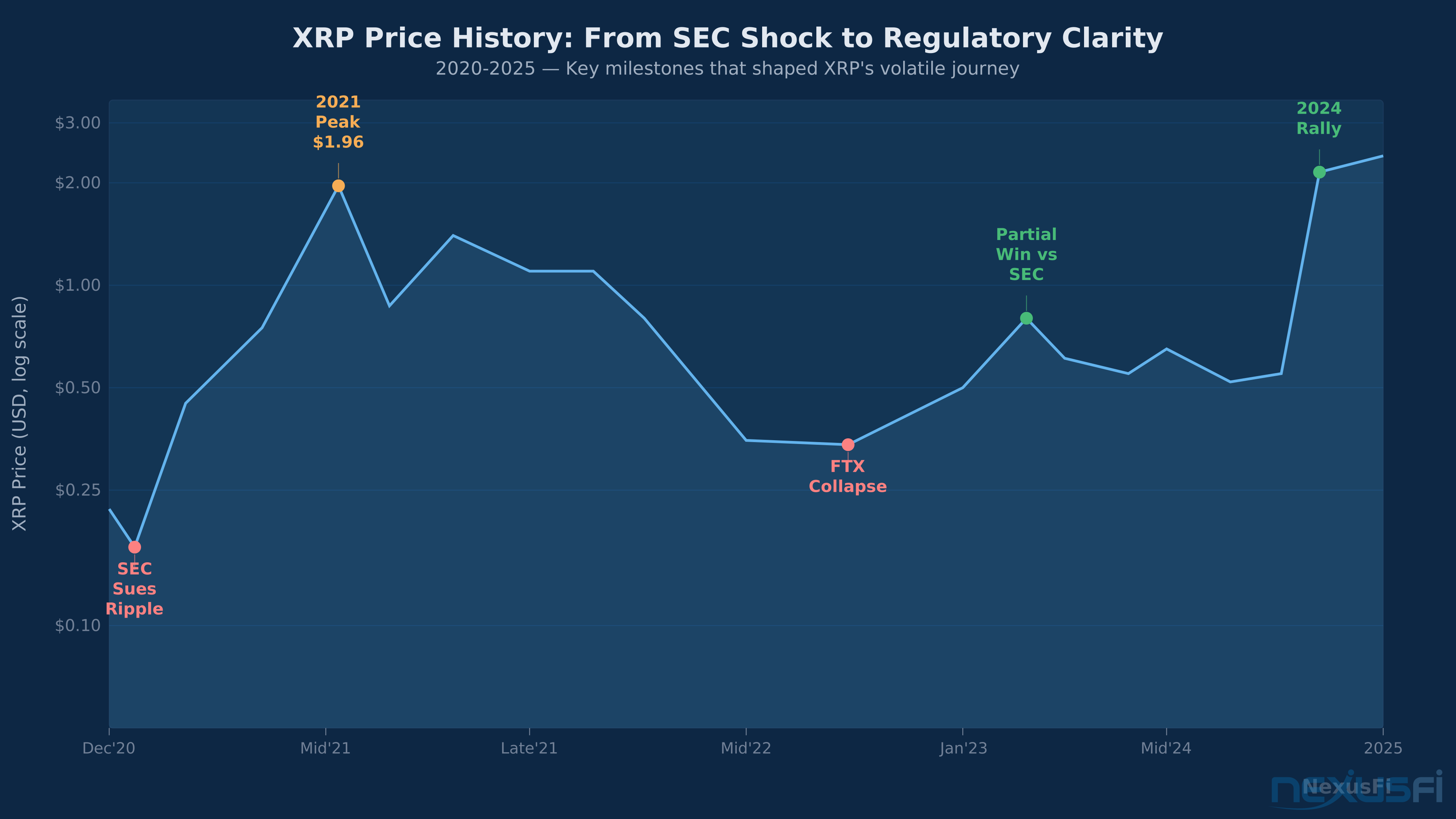
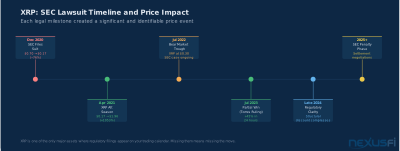
On December 22, 2020, the Securities and Exchange Commission filed suit against Ripple Labs, CEO Brad Garlinghouse, and co-founder Chris Larsen. The allegation: XRP was an unregistered security, and Ripple had raised $1.38 billion through illegal sales to investors.
The immediate market impact: XRP dropped from $0.70 to $0.17 within days. Major U.S. exchanges — Coinbase, Kraken, Bitstamp — delisted or suspended XRP trading. This created a structural disconnect between U.S. and global XRP prices and effectively locked out most U.S. institutional participation.
The Howey Test argument: The SEC argued that XRP sales met the Howey test for an investment contract — investors put money in expecting profits from Ripple's efforts. Ripple countered that XRP is a currency/medium of exchange, not a security, and that buyers had no reasonable expectation of profit tied to Ripple's actions.
The July 2023 ruling: Judge Analisa Torres issued a summary judgment that was a partial win for both sides. Programmatic sales of XRP on exchanges did NOT constitute unregistered securities offerings — because retail buyers on open exchanges couldn't know they were buying from Ripple, breaking the direct investment relationship required by Howey. However, institutional sales (direct sales to hedge funds and sophisticated investors) DID constitute securities offerings.
The market reaction was explosive. XRP jumped ~45% within 24 hours of the ruling. U.S. exchanges re-listed XRP. It was the clearest positive legal trigger in XRP's history.
Post-2023 trajectory: The case moved toward penalty and remediation proceedings on the institutional sales finding. Ripple was seeking to settle the remaining issues for a fraction of the SEC's requested $2 billion+ penalty. By 2024--2025, the broad legal overhang had lifted substantially, allowing institutional participation to resume and the regulatory discount in XRP's price to compress.
The July 2023 ruling reduced XRP's legal risk — it didn't eliminate it. The institutional sales finding was upheld. Appeals remain possible. SEC leadership changes can shift enforcement priorities. Any XRP position carries residual regulatory tail risk that doesn't exist for BTC or ETH. Price it into your stops so.
What Drives XRP Price: Six Factors Ranked by Impact #
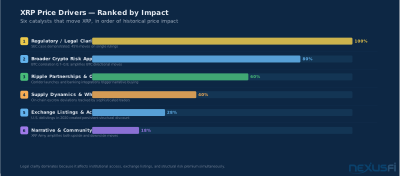
Based on historical price action and market structure analysis, here are XRP's price drivers in rough order of impact:
1. Regulatory/Legal Clarity The SEC case demonstrated this unambiguously. Legal milestones move XRP more than almost any other factor. Institutional access, exchange listings, and structural risk premiums all flow from regulatory status.
2. Broader Crypto Risk Appetite XRP is highly correlated with BTC in most market regimes. When BTC is trending up and dominance is falling (altcoin season), XRP tends to outperform. When BTC drops sharply, XRP gets dragged down.
3. Ripple Partnership and ODL Announcements New banking partnerships, ODL corridor launches, and institutional integrations drive the "adoption narrative" that attracts medium-term buyers. These don't need to show actual volume impact — the announcement alone moves price.
4. Supply Dynamics and Whale Behavior Large XRP wallet movements visible on XRPL are public. On-chain intelligence services track Ripple-linked wallets. When those wallets show unusual activity (large transfers to exchanges), it triggers concern. When they show high re-escrow rates, it provides mild support.
5. Exchange Listings and Market Access XRP's U.S. delistings in late 2020 created a persistent structural discount. Its eventual re-listing on Coinbase and others in 2023 was a significant trigger. New market access — ETF speculation, new exchange integrations — remains a recurring narrative driver.
6. Narrative and Speculation XRP has one of the most active retail communities in crypto. Social media sentiment, community forums, YouTube speculation, and ETF rumors can drive short-term moves independently of fundamentals. This cuts both ways.
How to Trade XRP: Instruments, Venues, and Approaches #
Spot trading remains the cleanest approach for most XRP traders. After the 2023 re-listings, major U.S. platforms including Coinbase, Kraken, and Gemini offer spot XRP. Global platforms like Binance and Bybit provide wider selection and tighter spreads.
Futures and perpetual swaps are available on all major crypto derivatives exchanges. XRP/USDT perpetuals on Binance and Bybit are liquid and frequently traded. CME launched XRP futures in December 2025 — the first major institutional derivative product for XRP. This opened the asset to systematic traders and hedge funds that can only trade exchange-listed products.
Leverage: Strong consensus here: 5--10x maximum on perpetuals. Above 10x, XRP's news-driven gaps will liquidate you before your stop can execute.
A 55% correction at 10x leverage is a wipeout. Position size so.
Never enter XRP with leverage ahead of a known binary event — court dates, settlement announcements, regulatory decisions. The gap risk is real and two-sided. XRP jumped 45% in 24 hours on the 2023 Torres ruling. It dropped 76% in days on the SEC filing. A leveraged position in either direction going into a binary event is speculation on a coin flip with borrowed money.
On-chain arbitrage: The XRPL has a native decentralized exchange (DEX) where XRP trades against any issued currency. Sophisticated traders run arbitrage bots between the on-chain DEX and centralized venues, capturing 0.2--0.5% spreads. This requires XRPL SDK familiarity and sub-150ms execution.
Venue selection: The top 5 exchanges by XRP volume handle >80% of daily flow. For execution quality, use primary venues (Binance, Coinbase, Kraken). Secondary venues for smaller trades may offer price improvement but at the cost of thinner order books and wider spreads.
Funding rate monitoring: Perpetual funding is a useful signal for XRP. Extended negative funding (shorts paying longs) often signals bearish crowding and potential mean reversion. Extended positive funding (longs paying shorts) indicates crowded longs and potential squeeze risk. Check 8-hour funding rates on Binance or Bybit before entering any significant position.
Four Practical XRP Trading Setups #
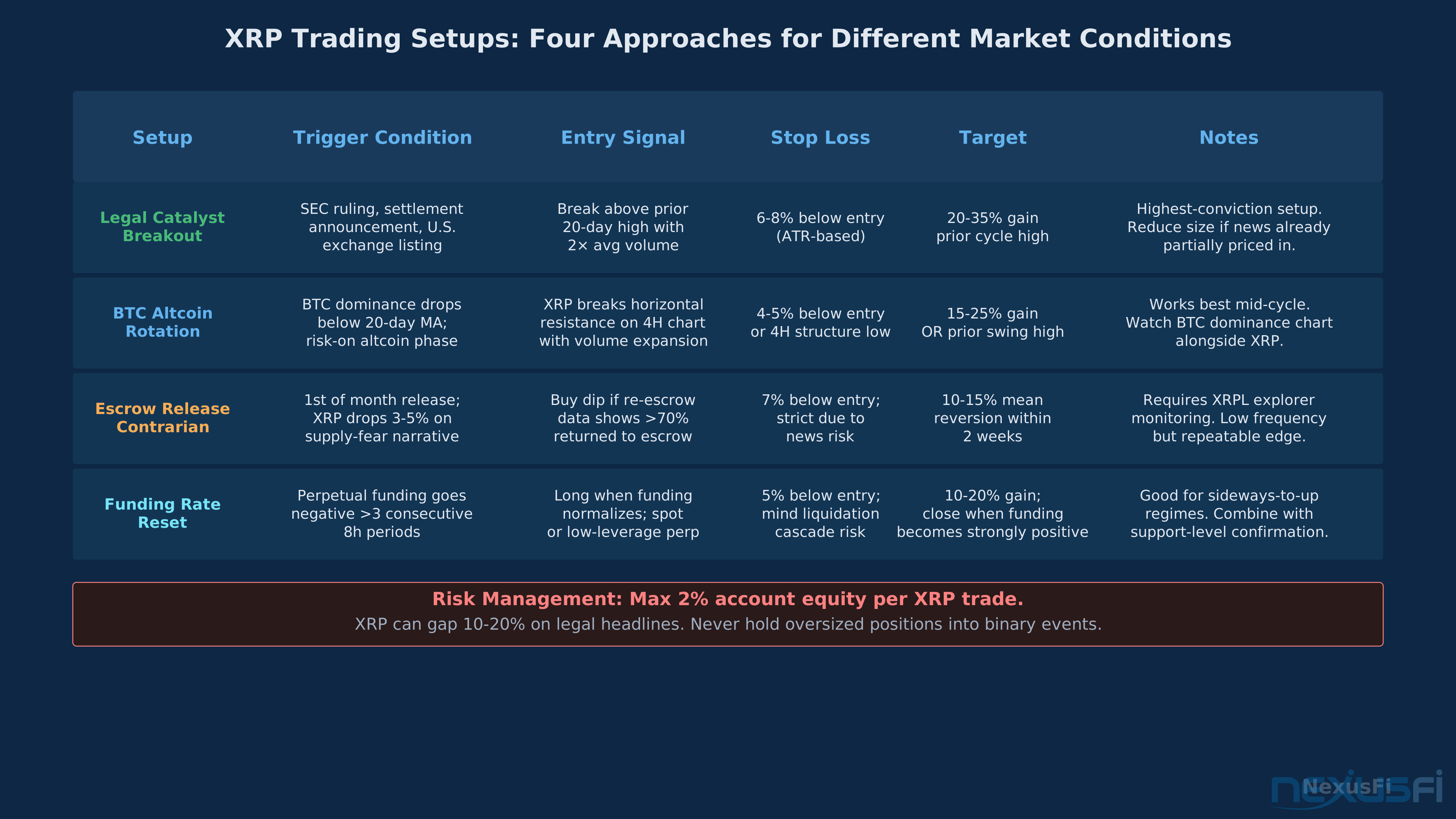
These setups reflect the event-driven nature of XRP and align with what the trading council identified as the highest-probability approaches.
Setup 1: Legal Trigger Breakout The highest-conviction XRP setup. When a major legal milestone (ruling, settlement, dismissal, favorable regulatory statement) is released:
- Wait for the initial spike and partial retracement
- Entry: break above the pre-announcement 20-day high with 2x average volume
- Stop: 6--8% below entry (ATR-adjusted for current volatility)
- Target: 20--35% gain or prior cycle high, whichever is reached first
- Sizing: smaller than you think is appropriate, because headlines can reverse
Avoid entering at the first spike — knee-jerk reactions often reverse within hours, and the second leg higher (if legitimate) offers a better entry with confirmed institutional follow-through.
Setup 2: BTC Altcoin Rotation Play Classic altcoin cycle positioning. When BTC dominance drops through its 20-day moving average while price is rising (risk-on rotation into altcoins):
- Entry: XRP breaks horizontal resistance on the 4-hour chart with volume expansion
- Stop: 4--5% below entry or below the 4-hour swing low
- Target: 15--25% gain or prior swing high
Setup 3: Escrow Release Contrarian Monthly on the 1st: if XRP sells off 3--5% on "escrow supply fear" narrative AND on-chain XRPL data shows Ripple re-escrowing more than 70% of the released amount:
- Entry: buy the dip; XRPL explorers confirm the re-escrow
- Stop: 7% below entry (news can still be wrong)
- Target: 10--15% mean reversion within 2 weeks
- Frequency: low, but repeatable edge
Setup 4: Funding Rate Reset When perpetual funding goes negative for 3+ consecutive 8-hour periods:
- Entry: long when funding normalizes toward zero; prefer spot or low-leverage perp
- Stop: 5% below entry
- Target: 10--20%; close when funding becomes strongly positive (crowded longs)
- Best in sideways-to-up BTC regimes
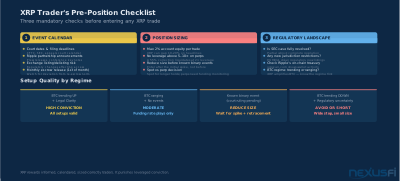
XRP's four core setups all share one characteristic: they wait for confirmation before committing size. Legal Trigger Breakout waits for the retracement. BTC Rotation Play waits for resistance to break. Escrow Contrarian waits for on-chain confirmation. Funding Reset waits for normalization. Entering on anticipation rather than confirmation is how traders get caught in false moves.
Risk Factors: Where XRP Theses Break Down #
Regulatory tail risk remains even after partial resolution. The July 2023 ruling found institutional XRP sales were securities. Appeals court decisions can reintroduce uncertainty. SEC leadership changes can shift enforcement priorities. Any international regulatory action (EU MiCA complications, Asian jurisdiction restrictions) can create new delistings.
ODL adoption may not translate to durable price support. Each ODL transaction creates transient XRP demand — buy in one country, sell in another — with net price effect near zero. The narrative impact is real, but the fundamental "XRP consumed by payments" thesis requires sustained growth in corridor volume and transaction size to create lasting supply absorption.
Stablecoin competition is accelerating. USDC and USDT already handle enormous cross-border volumes. As Circle and Tether expand their payment corridors, the practical advantage of XRP-based ODL narrows. Banks may prefer stablecoins with less FX conversion risk.
The XRP community amplifies both upside and downside. The "XRP Army" is one of the most active retail communities in crypto. They can drive significant short-term buying on narratives. They can also hold positions through drawdowns irrationally, masking the actual balance of supply and demand. Don't confuse community enthusiasm for fundamental validation.
Escrow overhang as a persistent psychological drag. Even if the mathematical impact is small, the perception of ~38 billion XRP waiting in escrow provides a permanent ceiling to unbounded price appreciation in many investors' minds. This isn't irrational — Ripple's treasury position is genuinely large.
Leverage-driven whipsaws around binary events. XRP's derivatives market can be shallower than BTC/ETH. Large open interest going into a legal announcement creates liquidation cascades in both directions. Entering with leverage into a known binary event is not trading — it's speculating on a coin flip with borrowed money.
The XRP Army: Community Dynamics and Market Psychology #
XRP has one of the most distinctive retail communities in all of crypto. "XRP Army" is a well-known phenomenon — a large, organized, often evangelical group of retail holders who actively promote XRP across social media, create content, and engage aggressively with skeptics.
What this means for traders:
Amplified narratives. Positive legal or partnership news gets amplified rapidly through community channels. Price moves happen faster than the fundamentals would otherwise justify, then partially revert.
Persistent holding through drawdowns. Community sentiment can keep XRP's realized volatility lower than you'd expect in severe bear markets — members "DCA the dip" with religious conviction. But this also means exits can cluster when community sentiment finally breaks.
Social sentiment as a leading indicator. For XRP specifically, monitoring Twitter/X sentiment, Reddit r/XRP activity, and YouTube comment patterns provides useful signal around potential moves. When community tone shifts from "accumulate" to "we've waited long enough," it often precedes a peak.
Don't bet against coordinated community squeezes. The 2021 XRP rally from $0.17 to $1.96 included significant community-driven momentum that sustained the move beyond what fundamentals alone would have supported.
That's not a knock on community-driven price appreciation — it's acknowledgment that understanding community dynamics is a legitimate edge in XRP trading.
XRP in the Broader Crypto Framework #
XRP doesn't fit cleanly into any single crypto category. It's not a smart contract platform like Ethereum. It's not a store-of-value play like Bitcoin. It's not a meme coin. It's a payments-focused asset with significant regulatory history and an unusually dominant corporate sponsor.
For portfolio context:
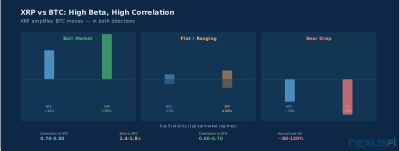
- XRP's correlation to BTC runs approximately 0.7--0.8 in most market regimes, lower during legal-specific catalysts
- XRP's correlation to ETH is slightly lower, as ETH is more driven by DeFi/smart-contract narratives
- XRP's beta to BTC is higher — it tends to amplify BTC moves in both directions
- XRP's volatility is typically higher than BTC/ETH on an annualized basis
For position sizing, treat XRP as a high-beta altcoin: smaller positions than BTC, wider stops, shorter expected holding periods unless you have high-conviction on a specific trigger.
The most common XRP trading mistake is position sizing it like Bitcoin. BTC moves 5% on big news days. XRP moves 20--45% on legal milestones. If your standard BTC risk is 2% of equity, your XRP risk should be 1% or less — the vol ratio alone justifies it.
Cross-links to relevant Academy articles:
- For crypto fundamentals background, see Cryptocurrency Trading Fundamentals
- For stablecoin alternatives to XRP for payments, see Stablecoins: USDT, USDC, DAI
- For understanding on-chain data analysis, see On-Chain Analysis for Traders
- For broader crypto derivatives context, see Crypto Derivatives Trading
The Bottom Line on Trading XRP #
XRP is a high-beta, event-driven asset with a unique combination of characteristics: fast settlement infrastructure, a dominant corporate sponsor with a large treasury position, significant regulatory history, and one of the most active retail communities in crypto.
Trading it well requires three things:
First, know the event calendar. More than any other major crypto asset, XRP's price is shaped by identifiable external events — legal milestones, regulatory statements, exchange listing decisions, Ripple partnership announcements. Map them out before you open a position.
Second, size appropriately. The community enthusiasm and payment narrative are real, but XRP can fall 55% in a matter of weeks when BTC turns down (as the 2021 data showed). Max 2% account equity per trade. No exceptions around binary events.
Third, watch the legal and regulatory environment continuously. The worst XRP positioning comes from traders who assume the regulatory overhang has been "solved." It hasn't been. It's been substantially reduced. There's a difference. Maintain awareness of any new SEC actions, appeals court proceedings, or international regulatory changes.
XRP rewards informed, disciplined traders. It punishes leveraged bulls and bears who rely on conviction without calendars.
XRP's edge is its identifiable catalysts. Unlike most assets where "something might happen," XRP has a court calendar, an escrow schedule, and a partnership pipeline — all publicly available. Traders who monitor these systematically have a genuine information edge over those who simply follow price.
Knowledge Map
Go Deeper
Build on this knowledgeReferences This Article
Articles that build on this topicCitations
- — Becoming A Better Trader (2021) 👍 4“XRP is being marketed to banks by Ripple to replace nostro/vostro accounts. SEC lawsuit dropped price from $0.70 to $0.17.”
- — Becoming A Better Trader (2021) 👍 3“XRP daily: ~75 cent level was resistance for over 1000 days. Parabolic. If SEC case settled, insanely bullish. Up 1881%.”
- — Becoming A Better Trader (2021) 👍 2“XRP 4hr: $1.50 is support. If holds, likely retest and break $1.96 high. If BTC breaks down, $1.10 possible.”
- — Becoming A Better Trader (2021) 👍 2“BTC correction brought altcoins with it. XRP 4hr: 55% correction. BTC rallied from $47,500; XRP from 87 cents.”
- — Money management help pls (2013) 👍 10“Position sizing has 2 key elements - 1) number of ticks risked 2) $ amount risked. The answer comes with position sizing, which is one of most advanced concepts in trading.”
- Ripple — On-Demand Liquidity Overview (2024)
- XRPL.org — XRP Ledger Consensus Protocol (2024)
- SEC.gov — SEC v. Ripple Labs Inc. Case Summary (2023)
- CME Group — XRP Futures and Micro XRP Futures Product Specifications (2025)