



NYSE Advance-Decline Line ($ADD): The Breadth Indicator That Classifies Every Trading Day
Overview #
Every tick on your ES chart is a vote from one future. The NYSE Advance-Decline Line — $ADD — shows you the whole election. While you're watching a single contract move point by point, roughly 2,400 NYSE-listed stocks are simultaneously registering advances or declines, and $ADD is counting them in real time. That count, updated every minute through the trading session, tells you something your price chart at the core cannot: whether the broader market is participating in or diverging from what ES is doing.
$ADD answers the question that matters most before placing any directional trade: Is this move broad, or is it narrow? A broad move has institutional participation across hundreds of issues. A narrow move is being driven by a handful of names while everything else does nothing or moves the other way. These two scenarios have very different continuation probabilities, and $ADD is the tool that distinguishes them in real time.
Market internals are distinct from most trading indicators precisely because they are not derived from futures price data. Moving averages, RSI, MACD — these all repackage the price you're already watching. ADD taps a completely different data stream: the real-time aggregate behavior of the underlying stocks driving the index. This independence is what makes divergences meaningful — when ADD and price disagree, you're seeing a genuine conflict between breadth participation and futures pricing, not just noise in the same data.
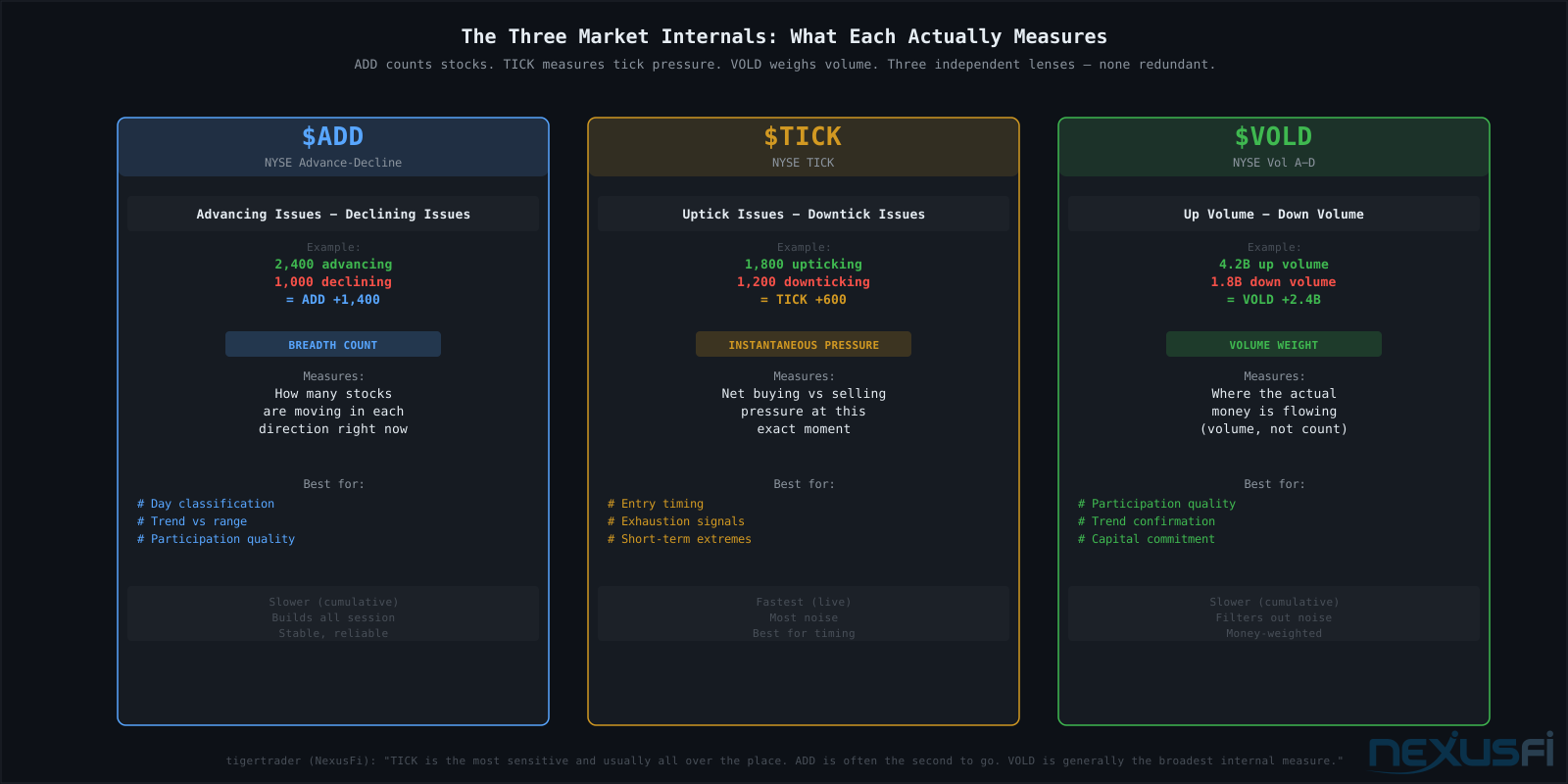
"ADD is number of advancing issues plus the number of declining issues. Often, the second to go. $TICK is the number of issues making an uptick minus the number making a downtick. The most sensitive and usually all over the place."
-- wldman, Tao Te Trade journal
The wldman ordering — VOLD broadest, ADD second, TICK most sensitive — gives you a practical hierarchy. ADD is your regime filter: it moves slowly enough to identify day type without being whipsawed by every short-term fluctuation. TICK is your entry timer: it moves fast enough to catch the exact moment buying or selling pressure peaks. VOLD is your confirmation: it tells you whether the volume is backing the breadth move or staying on the sidelines. Use all three together and you have three independent lenses. Use just one and you have half a picture.
What ADD Measures -- and Why It Differs from TICK and VOLD #
The three NYSE market internals are frequently lumped together as "breadth indicators," but they measure at the core different things at different speeds with different noise profiles. Treating them as interchangeable is a critical mistake.
$ADD (Advance-Decline Line) is the cumulative difference between NYSE advancing and declining issues throughout the session. ADDt = ADDt-1 + (Advancerst − Declinerst). If 1,800 NYSE stocks are advancing and 800 are declining at some point in the session, ADD registers +1,000 in that period. It's a running total: every period adds or subtracts from the prior value. This cumulative nature makes ADD a session-long trend indicator rather than a momentum reading. It builds through the day, showing whether participation is expanding or contracting directionally.
$TICK measures the number of NYSE stocks that traded on an uptick minus those that traded on a downtick at this exact moment. It resets with every trade, making it the most sensitive and noisiest of the three. TICK is best for capturing short-term order flow bursts, identifying exhaustion at extremes, and timing entries within a direction the other internals have already established. It's an instantaneous pressure gauge, not a session-trend indicator.
$VOLD is the difference between NYSE up-volume and down-volume — UVOL minus DVOL. Where ADD counts stocks and TICK measures tick direction, VOLD weighs volume. A day where 1,400 stocks advance on light volume while 1,200 stocks decline on heavy volume will show a positive ADD (+200) but a strongly negative VOLD. The volume is telling a different story than the count. VOLD reveals whether the money — actual share volume — is backing the directional move. See the dedicated VOLD article for complete coverage.
Statistical Baselines and the 30-Minute Rule #
The most widely cited statistical framework for ADD comes from tigertrader's foundational analysis — a post that has guided ES traders for over a decade and which forms the empirical basis for ADD-based day type classification.
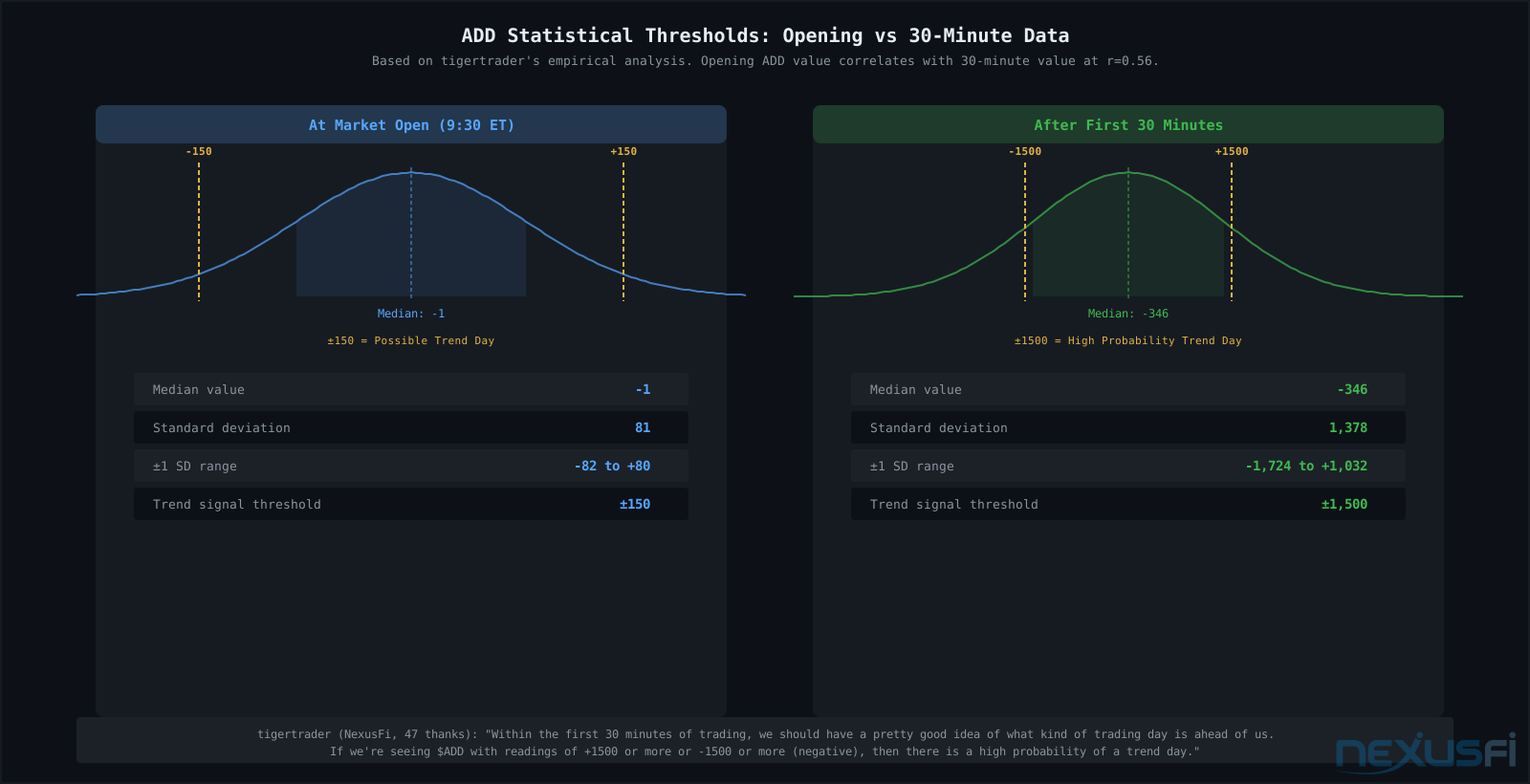
At the open, ADD starts near neutral. The median opening value is approximately −1 with a standard deviation of 81. That tight distribution means the first print of ADD at 9:30 carries relatively little information on its own — almost any value is statistically normal. What matters is whether it immediately shows directional commitment. When ADD opens at +150 or greater (or −150 or less), that's an early signal the session may develop directional character.
"The opening value for $ADD correlates with the value at the end of the first half hour of trade by .56. The median opening value for $ADD has been −1, with a standard deviation of 81. So when we see $ADD open at +150 or greater or at −150 or less, it is an indication that we might be in a trend day."
-- tigertrader, NYSE $TICK AND $ADD (47 thanks)
The 30-minute reading is where the signal becomes actionable. By 10:00 AM ET, ADD has had 30 minutes to build or stall. At this point, the median value is approximately −346 with a standard deviation of 1,378. This wider distribution reflects the genuine range of daily breadth behavior — some sessions develop strong directional breadth quickly, others stay compressed.
The critical threshold: ADD readings of ±1,500 within the first 30 minutes signal high probability of a trend day. At one standard deviation above the mean (approximately +1,032), you're already seeing above-average breadth. At ±1,500, you've crossed into territory that historically precedes sustained directional sessions. The move may still reverse, but the odds favor continuation.
Four practical ADD zones based on stoplight's ADD indicator framework:
- 0--400: Range day territory. No directional breadth commitment. Mean-reversion and range strategies.
- 400--800: Moderate trend bias. Caution warranted -- directional but not high-conviction.
- 800--1,200: Strong trend signal. Trade with the trend; avoid fades against strong breadth.
- 1,200+: Very strong trend. Maximum directional confidence. Pull back entries only.
These zones apply symmetrically to the downside — negative ADD in each range carries the same implication for bearish sessions.
Day Type Classification: The First 30 Minutes Decides #
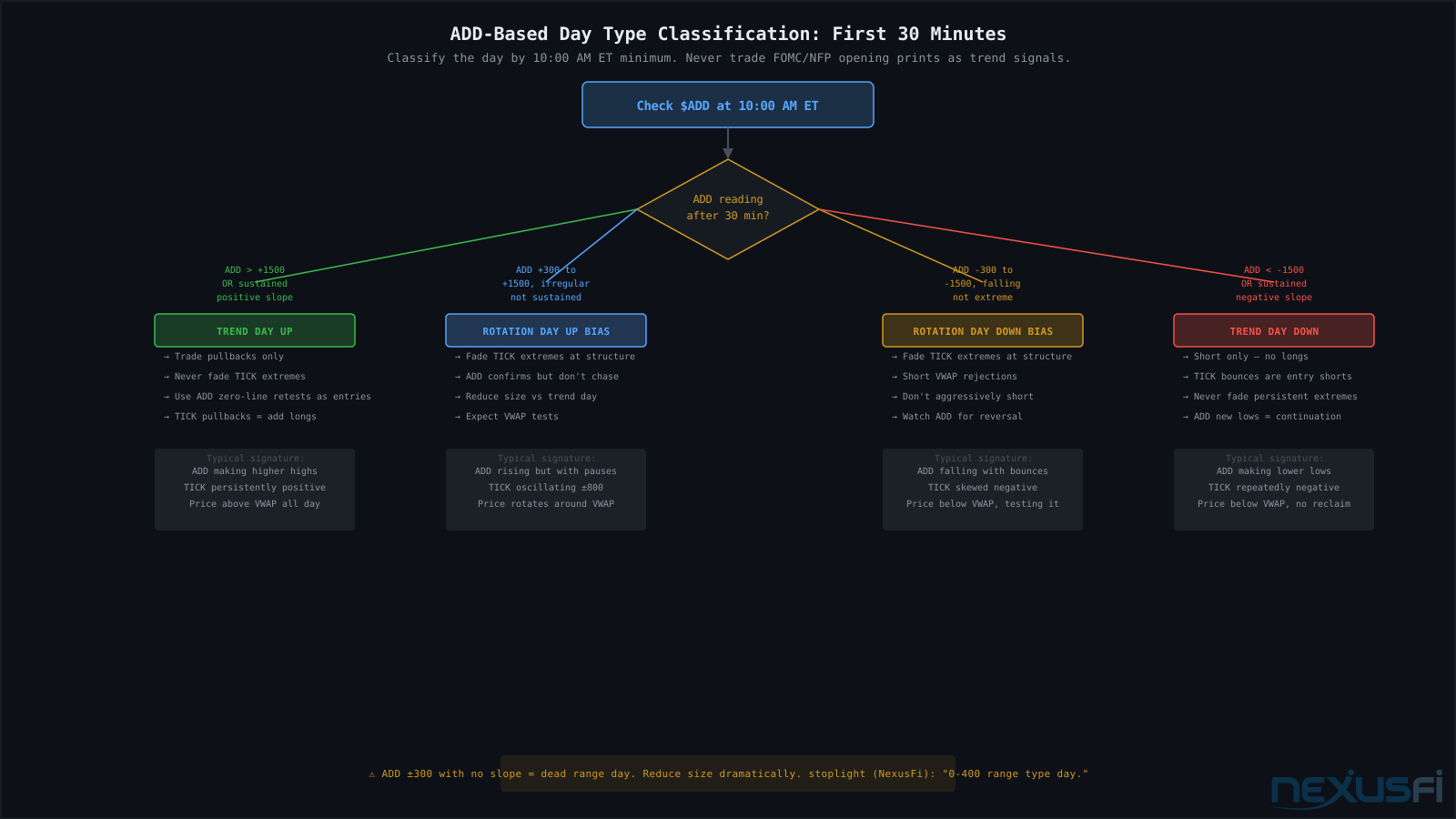
The most powerful application of ADD is not entry timing — it's day type classification. Knowing whether you're in a trend day, rotation day, or range day before 10:30 AM changes your entire playbook: which setups to take, which to avoid, where to put stops, and how much to size.
The classification process starts at 10:00 AM ET minimum — never earlier. The first 10--15 minutes of breadth data contain noise from the opening auction, index rebalancing flows, and overnight order execution. A +1,200 ADD reading at 9:32 AM is categorically different from a +1,200 reading at 10:15 AM. Wait for the session to find its character before committing to a day type.
Trend Day
ADD slopes persistently in one direction, making higher highs and higher lows (for an uptrend) without crossing the zero line on pullbacks. The 30-minute reading approaches or exceeds ±1,500. TICK spending sustained time one-sided confirms. VOLD aligns with ADD direction. Price stays on one side of VWAP and doesn't reclaim it.
On a trend day, the rules flip: TICK extremes are not fade opportunities — they're continuation signals. Use pullbacks in the TICK moving average toward the zero line as entries in the trend direction. Do not fade. Do not trade against persistent breadth.
Rotation Day
ADD oscillates around a neutral value, making no sustained trend but showing directional bias within individual moves. The 30-minute reading might reach ±500--800 but fails to sustain. Price mean-reverts to VWAP repeatedly. TICK cycles between extremes in both directions.
On rotation days, TICK extremes at structural levels become genuine fade setups. A TICK spike to +1,000 at the prior day's Value Area High is a short opportunity. The same reading in a trend day is a signal to add long exposure.
Range Day (Dead Zone)
ADD stays within ±300--400 with no directional momentum. TICK oscillates narrowly. Price grinds within a narrow band with no impulse. This is the day to reduce size dramatically or stop trading. Directional plays in a dead-range day are expensive.
"Left to right in order of sensitivity $ADD $VOLD $TICK. That quick visual scan can give you a Do It!, Maybe? or a Nope! to whatever idea you are contemplating."
-- wldman, Tao Te Trade journal
ADD Line Patterns: What to Watch Through the Session #
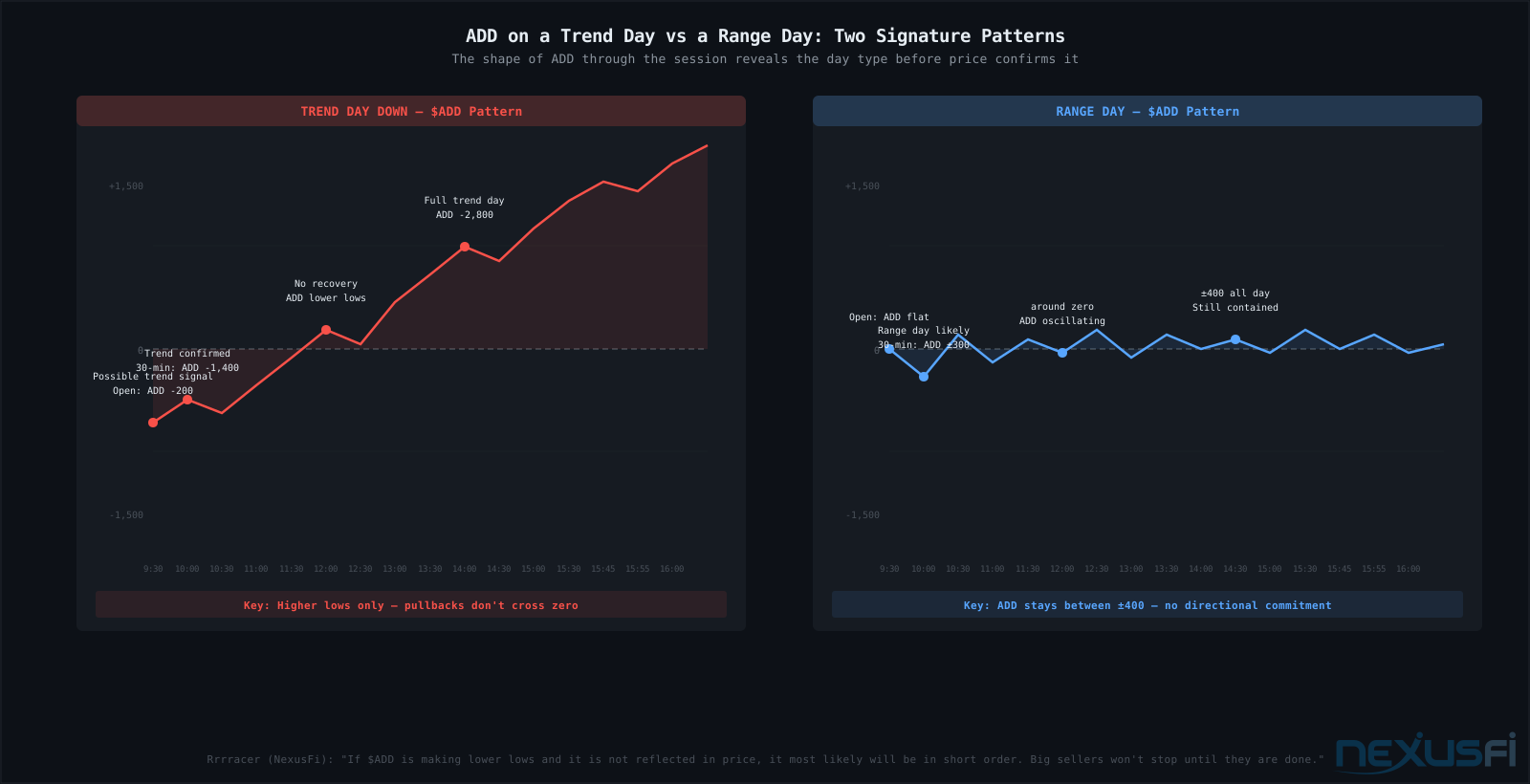
The slope of the ADD line carries more information than the absolute value. A strongly positive ADD that has flattened for 90 minutes is less bullish than a moderately positive ADD that is still making incremental new highs. The directional momentum — whether ADD is building or stalling — is the real signal.
Key ADD line behaviors to monitor:
ADD making higher highs and higher lows — Classic trend day up signature. Each pullback holds above the prior low. Buyers are systematically absorbing every selling attempt across the broad market. This is the pattern that tigertrader documented: "A rapidly falling ADD, which signaled a possible trend day down" — the inverse applies equally to trend days up.
ADD crossing zero on pullbacks — Trend losing conviction. On a genuine trend day, ADD pullbacks should not cross the zero line. If ADD pulls back and crosses from positive to negative territory, the directional breadth is no longer one-sided. This often signals a rotation day or intraday regime change.
ADD diverging from price at session extremes — Price makes a new high while ADD fails to make a new high. This divergence at structural levels (prior day Value Area High, key round numbers, overnight high) is one of the most reliable warning signals available. It's not an immediate reversal entry, but it's a signal to stop adding exposure and start tightening stops.
"If $ADD is making lower lows and it is not reflected in price, it most likely will be in short order. Big sellers are selling stocks out of that broad basket and won't stop until they are done."
-- Rrrracer, Just another trading journal
Divergence Signals: Reading the Warning Before the Reversal #
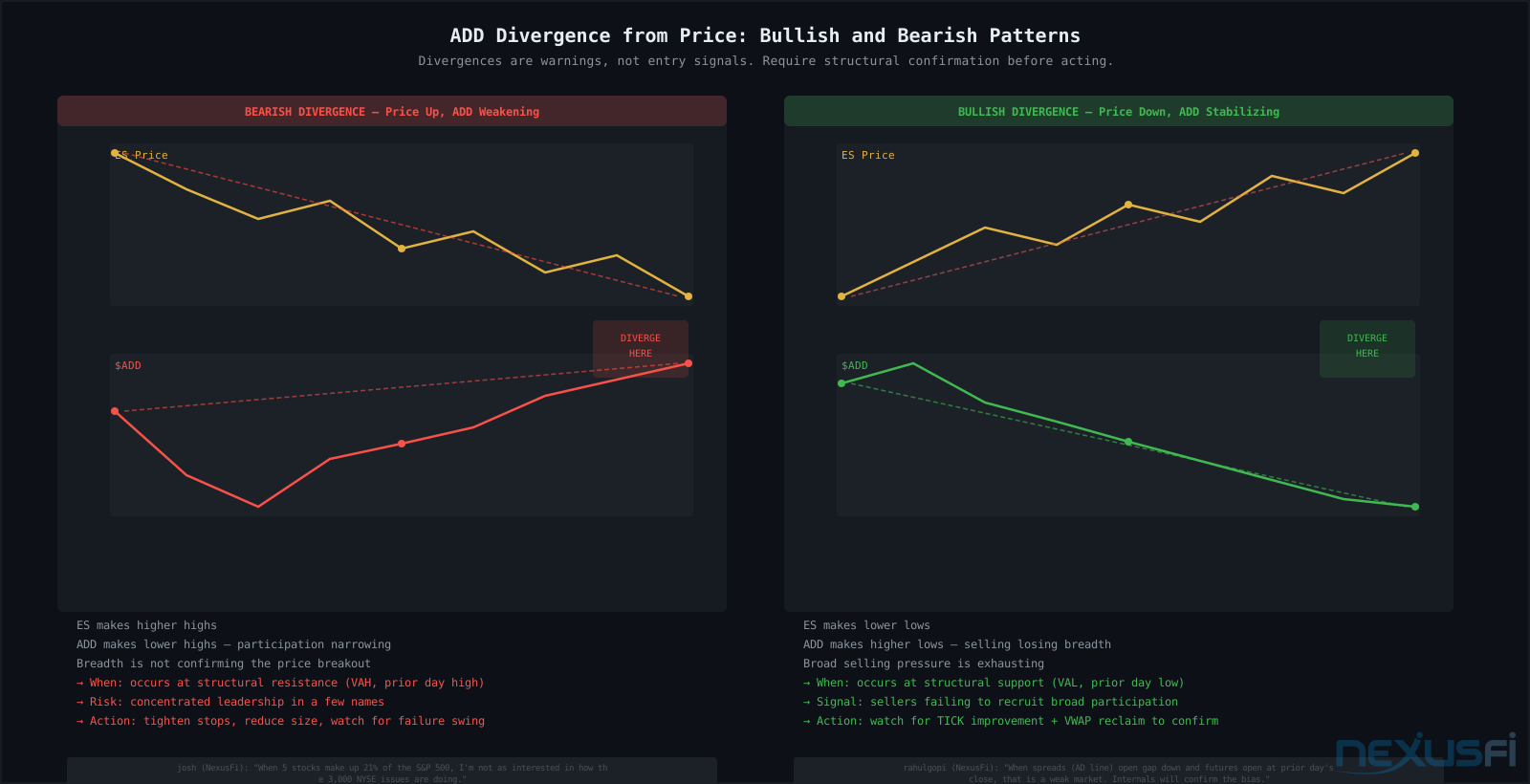
ADD divergence is one of the most cited concepts in NexusFi's market internals discussions — and also one of the most misapplied. The critical distinction: divergence is a warning, not a trade entry. It changes your read of the current move. It does not, by itself, tell you to take the opposite position.
Bearish Divergence
ES makes a higher high. ADD makes a lower high. The price move up is being driven by a narrower set of stocks than the prior high. The move isn't being broadly distributed — a handful of names (often the top-weighted S&P constituents) are doing the lifting while the broader market is static or declining.
This matters most at structural levels: prior day high, overnight high, Value Area High, key round numbers. When bearish divergence occurs at resistance, the setup quality for a fade improves meaningfully. Without structural context, divergence in the middle of a range is background noise.
Confirmation before acting: wait for TICK to fail to print new highs on subsequent price pushes. Wait for VOLD to turn negative while ADD deteriorates. Wait for price to print a lower low below the prior swing. Divergence alone is insufficient — you need follow-through failure.
Bullish Divergence
ES makes a lower low. ADD makes a higher low (or stops making lower lows). The selling is becoming less broad — fewer stocks are being sold on each new price push down. This suggests sellers are running out of breadth to recruit.
The same confirmation logic applies in reverse: TICK should start showing reduced negative extremes, VOLD should be improving, and price should fail to extend meaningfully below the prior low. Without these confirmations, a single ADD higher low can be a false signal in a genuine trend day down.
"There are some definite breadth and momentum divergences present that can be seen in advancing/declining shares index and the McClellan oscillator."
-- tigertrader, Spoo-nalysis
The mega-cap trap: The most common source of false bearish ADD divergence is mega-cap concentration. When AAPL, MSFT, NVDA, or AMZN are driving index prices upward while 2,000 other stocks are flat or declining, ADD will show persistent weakness relative to ES. This is genuine breadth narrowness — but the move can sustain longer than expected because these names have disproportionate index weight. EV Trader captured this dynamic precisely: "The problem is that all the breadth indicators are bearish because most of the money is concentrating on a few mammoth stocks." [Spoo-nalysis, 31 thanks]
The practical implication: on ADD divergence driven by concentrated leadership, don't short aggressively. Tighten stops on longs. Let the leadership stocks tell you when the move is over — they'll show it in price before ADD recovers.
The ADD + TICK + VOLD Stack: Integrated Market Internals #
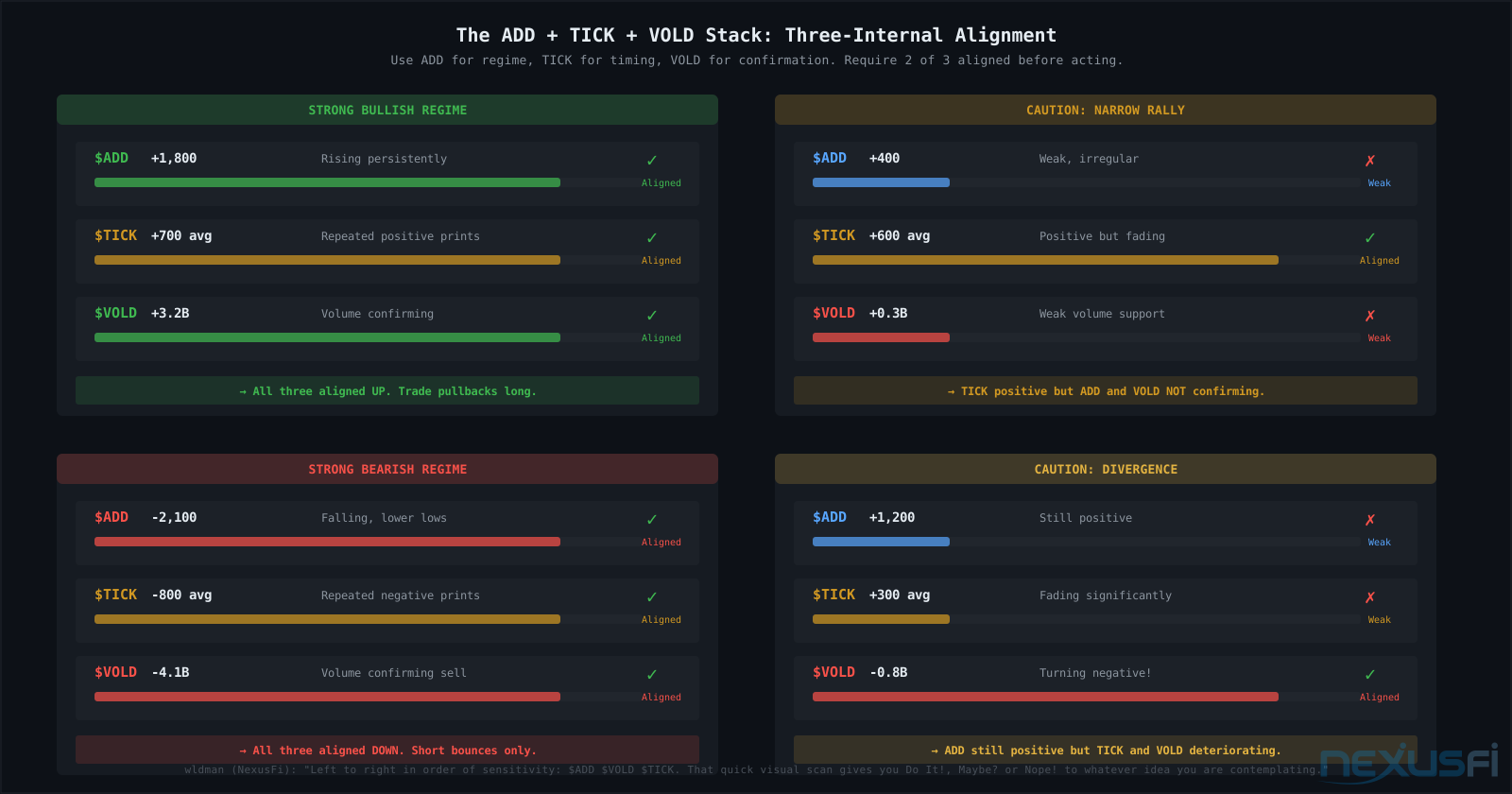
ADD reaches its full analytical power when read in combination with TICK and VOLD. The three indicators are not redundant — they measure different things at different speeds and from different data:
- ADD gives regime context (what kind of day is this?)
- TICK gives entry timing (when exactly within the regime?)
- VOLD gives capital confirmation (is volume backing the breadth?)
The aligned bullish regime looks like this: ADD slopes upward and makes persistent new highs. TICK spends most of its time positive, with occasional pullbacks toward zero that quickly resolve higher. VOLD is solidly positive, showing that advancing volume is far outweighing declining volume. Price stays above VWAP and uses VWAP as support. This is the high-conviction trend day framework. Size appropriately. Trade pullbacks, not reversals.
The caution regime — the most dangerous for directional traders — is when two of the three internals diverge from the third. Price up, TICK positive, but ADD flat or declining while VOLD turns negative: narrow leadership rally that is statistically more prone to reversal. This doesn't mean short immediately, but it means tighten stops on longs and don't add exposure at highs.
Require alignment of at least two of three internals before committing to directional trades. The strongest setups have all three aligned. One-out-of-three alignment in a strong trend can still offer trades, but position sizing should reflect the reduced conviction.
ADD for ES vs NQ: The Mega-Cap Adjustment #
ES and NQ have different relationships with NYSE breadth, and understanding the difference prevents expensive misreads.
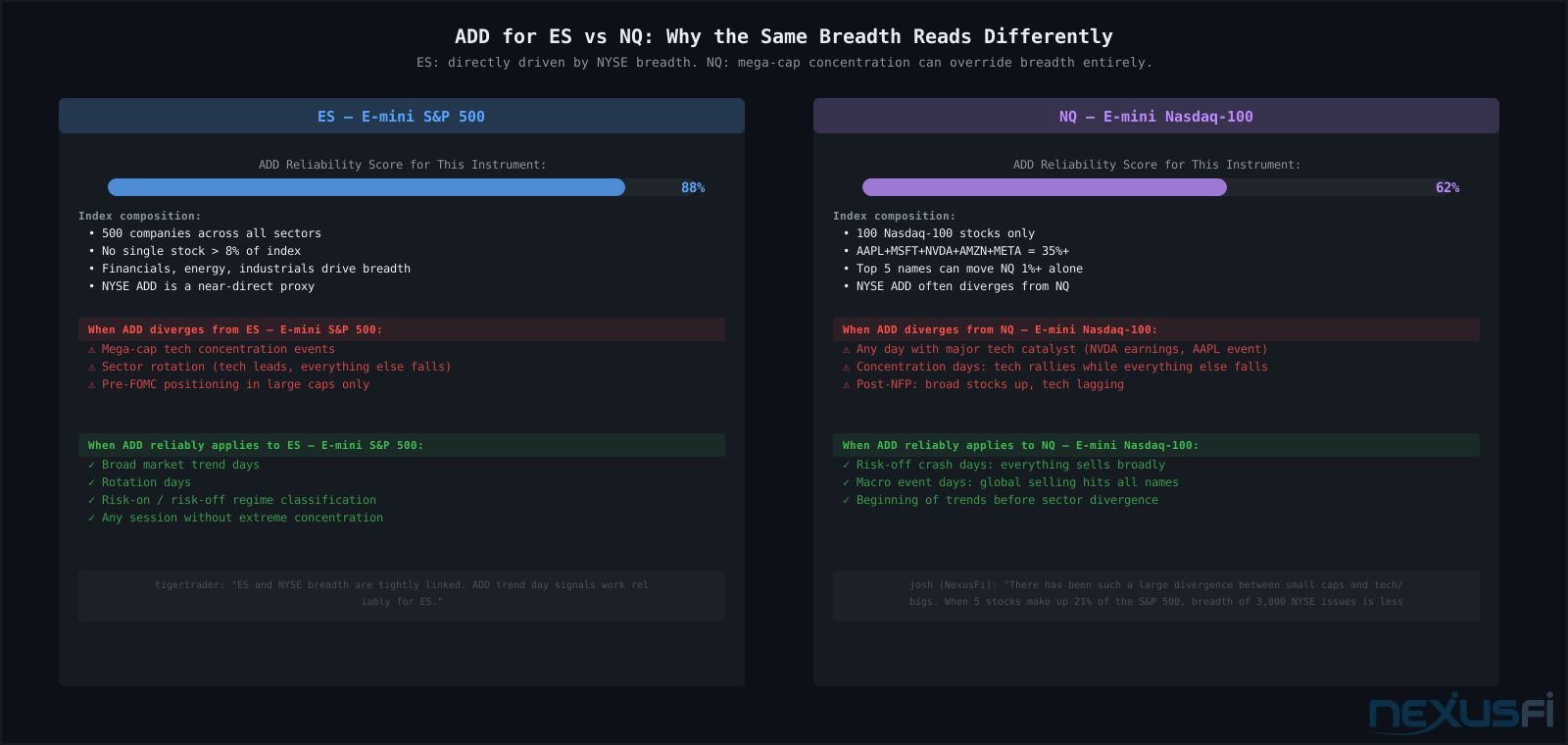
ES (E-mini S&P 500): tracks 500 companies across all sectors. NYSE breadth is a near-direct proxy for ES participation — when the broad market moves, ES moves with it, and when ADD confirms an ES move, the participation is genuine. Trend day signals from ADD translate reliably to ES day type classification.
NQ (E-mini Nasdaq-100): tracks 100 Nasdaq-100 stocks with extreme concentration in the top names. Apple, Microsoft, NVIDIA, Amazon, and Meta collectively represent more than 35% of the index. A single NVDA earnings move can shift NQ by 1.5% while NYSE ADD shows almost no change — because NVDA alone can contribute that much to NQ without moving any other NYSE stocks. Josh's observation has only grown more relevant: "There has been such a large divergence between small caps and tech/bigs. Using only the SPX 500 stocks, I at least see big cap participation, which can be useful." [Spoo-nalysis, 20 thanks]
For NQ traders, the practical adaptations:
- When NQ diverges from ADD (NQ up, ADD flat/down), don't assume NQ will revert to ADD -- the concentration names may genuinely be controlling the move.
- ADD remains useful for NQ on macro risk-off days (when everything sells together) and regime classification at a higher level -- but less so for intraday NQ entry timing.
- Consider using Nasdaq-specific breadth ($TICK-NASDAQ, NISS) in parallel with NYSE ADD when actively trading NQ.
RTY (E-mini Russell 2000): the opposite of NQ — highly sensitive to NYSE breadth because it represents 2,000 small and mid-cap companies across all sectors. RTY tends to underperform when breadth is narrow (concentrated large-cap leadership) and outperform when breadth is broad (everything participates). ADD deterioration often shows up in RTY pricing before it shows up in ES or NQ.
Platform Symbols and Data Feed Access #
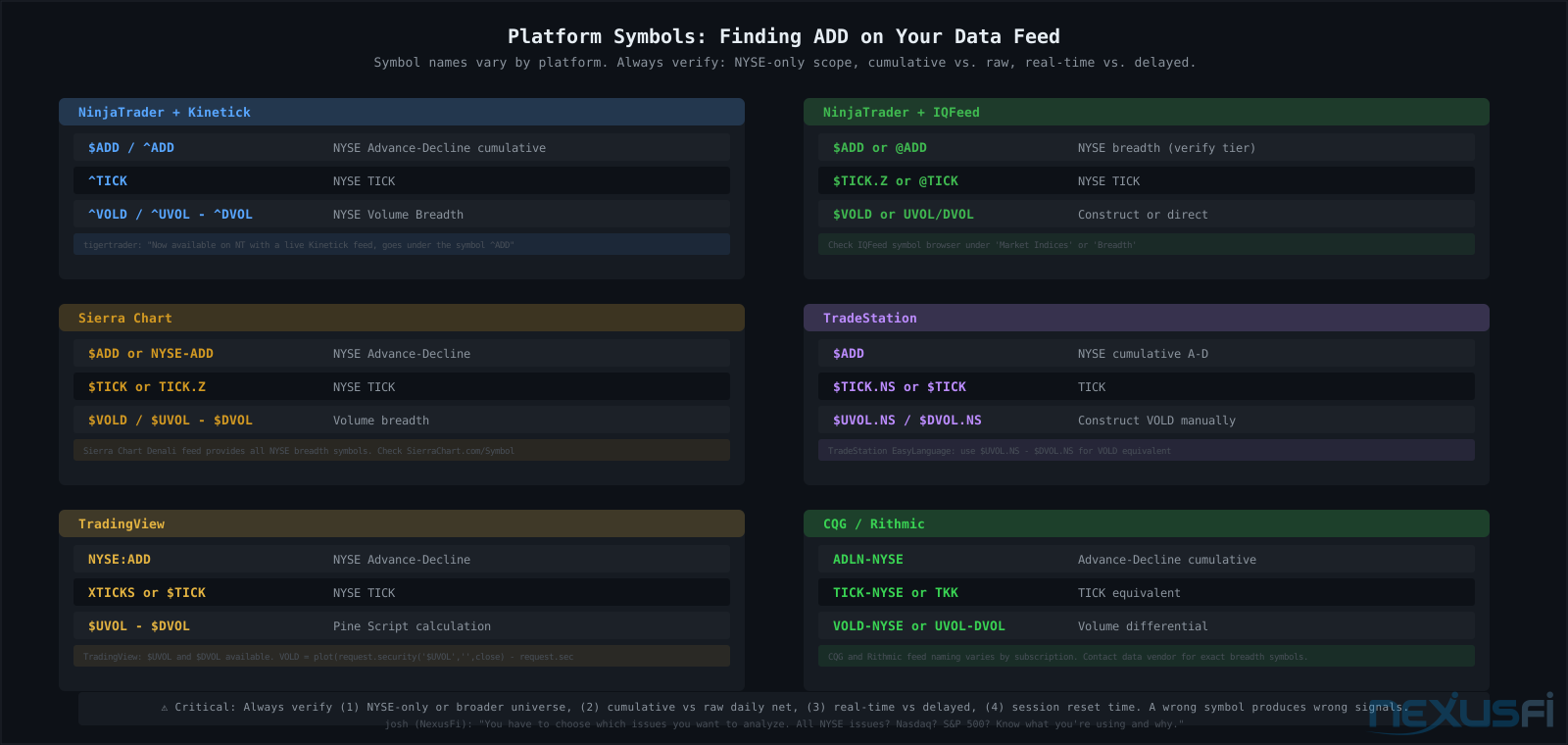
Finding ADD on your platform requires knowing the specific symbol your data feed uses. Unlike futures contracts (which have standardized CME tickers), breadth data symbols vary by vendor and sometimes by subscription tier.
NinjaTrader with Kinetick or IQFeed: As noted by tigertrader in the foundational ADD post, "it is now available on NT with a live Kinetick feed, and goes under the symbol ^ADD." IQFeed users typically use $ADD or @ADD. TICK is ^TICK or $TICK. VOLD may need to be constructed from ^UVOL minus ^DVOL if a precomputed $VOLD symbol isn't available at your tier.
Sierra Chart: $ADD or NYSE-ADD for the breadth line. $TICK or TICK.Z for NYSE TICK. Sierra Chart's Denali data feed includes complete NYSE breadth symbols — check the Sierra Chart symbol browser under "Indices" or "Market Statistics."
TradingView: NYSE:ADD or XTICKS. $UVOL and $DVOL are available for manual VOLD construction: plot(request.security("$UVOL","",close) - request.security("$DVOL","",close)).
TradeStation: $ADD for the breadth line. $UVOL.NS and $DVOL.NS for volume components. Construct VOLD manually in EasyLanguage if needed.
Critical verification before trusting any breadth signal:
- Exchange scope: Is this NYSE-only (proper) or a broader multi-exchange composite? NYSE-only is the standard for ES breadth analysis.
- Cumulative vs raw: Are you looking at the running session total (correct for trend analysis) or just the single-period net? These look very different.
- Session reset time: Does your ADD reset at 9:30 ET or at midnight? A midnight reset accumulates overnight session breadth alongside regular hours, distorting the intraday classification.
- Real-time vs delayed: A 15-minute delayed breadth feed is useless for intraday day-type classification. Verify your subscription includes real-time breadth data.
DTN IQFeed is widely cited as providing the most complete and reliable NYSE breadth data feed, including TICK.Z, TRIN.Z, and separate advance/decline and volume breadth symbols. Their feed consistency makes cross-session comparisons reliable — a critical requirement for developing calibrated thresholds.
ADD and the Opening Gap #
One of ADD's most actionable applications occurs at the open, before day-type classification is possible — watching whether ADD opens consistent or inconsistent with the futures gap direction.
"When spreads (AD line) open gap down and futures open at prior day's close, that is a weak market. Spreads could recover and market could very well move in divergence — but that will require conviction from big players."
-- rahulgopi, RG's Emini Journal
When ES gaps up but ADD opens near zero or negative, the gap is not being broadly confirmed. The premium in ES futures is not matched by widespread stock-level buying. This creates a gap fill risk — the futures premium can evaporate quickly when the broad market fails to follow. The reverse applies to gap-down opens with strong ADD — the selling in futures may be outpacing what's actually happening in the underlying stocks, creating potential for gap recovery.
Rahulgopi's approach: "I usually watch NYSE and S&P spread as primary, along with NQ spread" — watching breadth across multiple indices simultaneously to identify which market is leading and which is lagging.
Practical Trading Workflow: Using ADD Throughout the Day #
The following workflow integrates ADD into a structured approach from market open through session close.
Pre-Market (8:00--9:15 ET)
Note key structural levels: prior day's Value Area, Point of Control, overnight high/low, and any major premarket news. These are the price levels where ADD signals will carry the most weight when they coincide with breadth behavior.
First 30 Minutes (9:30--10:00 ET)
Observe ADD direction and slope but do not classify the day yet. Watch for extreme opening impulses (ADD opening at ±150 or greater) as early directional signal. Wait for 10:00 AM at minimum before committing to a day type. Event days (FOMC, NFP, CPI) require even more patience — let the initial reaction settle for 15--20 minutes after the number before trusting breadth readings.
Classification Window (10:00--10:30 ET)
Read ADD at 10:00 AM. Apply the ±1,500 threshold for trend day classification. Check TICK behavior — has it been consistently one-sided or oscillating? Check VOLD alignment. Assign a provisional day type. Commit to a trading playbook based on the classification.
Midday Monitoring (10:30--14:00 ET)
Monitor ADD for consistency with the morning classification. On trend days: ADD should continue making directional new highs/lows. Any sustained reversal in ADD slope across 30+ minutes warrants reclassifying the session. On range days: ADD should stay contained. An ADD breakout toward ±800+ in midday suggests regime transition — the range is being resolved directionally.
Use TICK pullbacks toward zero as continuation entries on trend days: "If you check all of the +600 tick prints, they were good places to start to look for an opportunity to get in on the pullbacks." [Rrrracer, NexusFi]
End-of-Session (14:00--16:00 ET)
Watch ADD for end-of-day closing auction signals. A late-session ADD acceleration can signal institutional positioning for the next session. ADD divergence from price in the last 90 minutes of the session often resolves against price direction — sellers or buyers closing positions into the close without matching breadth creates an imbalance that can lead to the following morning's gap direction.
When ADD Can Mislead You #
ADD is a powerful tool, but it has predictable failure modes that every serious user should internalize.
Opening auction distortion: The first 10--15 minutes of ADD data reflect opening auction noise, not genuine session breadth. Don't classify the day based on pre-10:00 AM ADD readings. Wait for the opening prints to clear.
Event-driven sessions: FOMC days, Non-Farm Payrolls, CPI releases, and triple-witching create breadth conditions that don't reflect organic market sentiment. Pre-event ADD reflects positioning, not underlying directional conviction. Post-event ADD in the first 15--30 minutes reflects reaction noise. On these days, wait longer before classifying and require sustained sustained signals (not momentary extremes) before committing.
Narrow leadership days: When 5--7 mega-cap names are driving ES while broad ADD is weak, trend day classification based on ADD will mislead you. The session can sustain directional price movement despite weak breadth — until the leadership names stall. EV Trader's research from 2015 remains applicable today in an even more concentrated market: "I decided to look at the market differently. Let's suppose that breadth has no meaning. That funds want to chase momentum in the most liquid stocks." [Spoo-nalysis, 31 thanks]
Sustained TICK fading on trend days: The most dangerous failure mode. On a genuine trend day down, each TICK bounce attempt will be weaker than the last — ADD keeps making lower lows even as TICK temporarily bounces. A trader fading each TICK extreme on a trend day will get repeatedly stopped out as the broader breadth keeps pulling price lower. The tigertrader rule applies: "Avoid playing TICKS against the trend unless you are very experienced. You will get killed. I have seen five −1,200 readings in a row in a very strong downtrend."
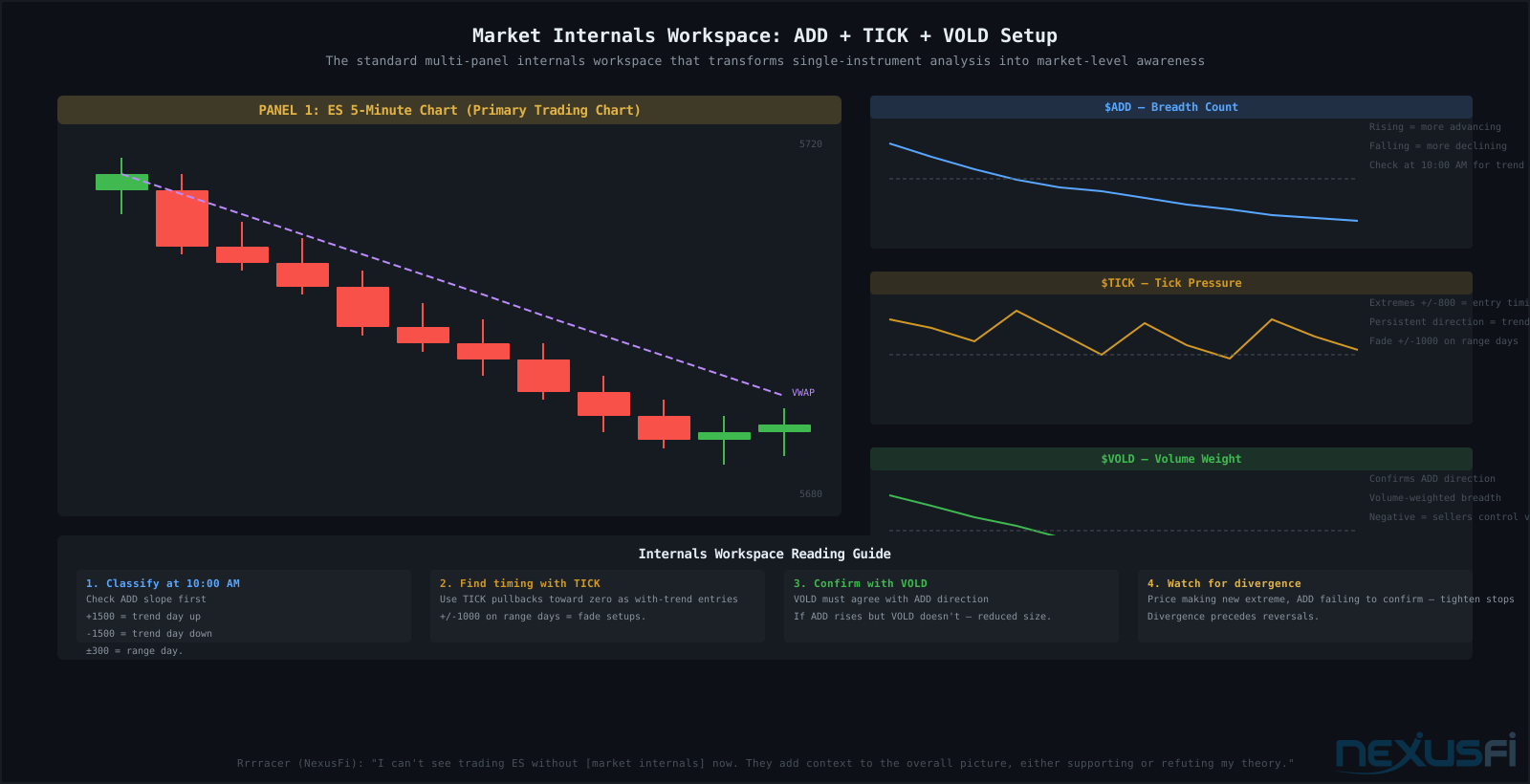
Your Market Internals Workspace #
The effective internals setup puts ADD, TICK, and VOLD on dedicated panels aligned with your primary chart:
Panel 1 (Primary): ES or NQ 5-minute chart with VWAP and key structural levels. This is your trade chart — where entries and exits happen.
Panel 2 (ADD): $ADD as a line chart, cumulative from 9:30 AM, with a zero line and horizontal reference lines at ±500, ±1,000, ±1,500. A 20-period moving average helps filter single-period noise. Color-code the MA to show ADD above or below zero.
Panel 3 (TICK): NYSE TICK as 1-minute bars with a 13-period moving average. Horizontal lines at ±700 and ±1,000. The MA should hug the zero line on range days; on trend days it will stay persistently one-sided.
Panel 4 (VOLD, optional): $VOLD as a line chart, same configuration as ADD. This panel confirms whether ADD's count of advancing stocks is backed by actual volume flow.
Data providers: DTN IQFeed provides a complete breadth symbol package including $TICK, $VOLD, and $ADD with consistent intraday reset behavior. Consistent data sourcing is essential — different providers can show TICK readings that vary by 50--100 points at the same timestamp, making cross-session calibration unreliable if you switch feeds.
"I am really starting to like $ADD. It is adept at providing both short term and intermediate term hints. For someone who starts every trade as a scalp but is looking to take advantage of larger intraday swings — I'm becoming more and more enamored with $ADD, to the point where I am paying attention to it more than that hot temptress $TICK."
-- Rrrracer, complete noob starting from scratch journal (14 thanks)
Companion Articles in the Market Internals Series #
ADD is most powerful when read alongside the other market internals. This article is part of a complete series:
- Market Internals Overview -- How ADD, TICK, TRIN, and VOLD work together as an integrated system
- NYSE TICK Index -- The instantaneous pressure gauge for entry timing
- TRIN (Arms Index) -- Volume-weighted breadth ratio for panic and exhaustion detection
- VOLD (Volume Advance-Decline) -- The volume-weighted complement to ADD
The progression from ADD to TICK to VOLD is deliberate: start with ADD to classify the regime, use TICK to time entries within that regime, confirm with VOLD to ensure volume participation. Each indicator earns its place in your workspace by doing what the others cannot. Together they provide a 3-dimensional view of market activity that no single-instrument price chart can replicate.