



Chaikin Money Flow (CMF): The Volume-Weighted Regime Indicator That Shows Whether Money Is Backing the Move
Overview #
The Chaikin Money Flow (CMF) indicator answers a question that price alone can't: is volume actively supporting this move, or is the market just drifting?
Price tells you direction. Volume tells you conviction. CMF combines both into a single bounded number that ranges from approximately -1 to +1. When CMF is positive, buying pressure is dominating — closes are finishing in the upper portion of bars, and volume is weighted toward accumulation. When CMF is negative, selling pressure is winning — closes are finishing near bar lows, and distribution is underway. That regime reading, updated bar by bar, is what makes CMF useful for futures traders in a way that raw price action or volume alone isn't.
Marc Chaikin developed this indicator as an improvement over his earlier Accumulation/Distribution line. The core insight: where the close lands within the bar's range is a direct signal of who won the intrabar battle. A bar that runs from 5268 to 5275 and closes at 5274.50 tells a different story than one that closes at 5269.00, even if both have identical volume. CMF captures that story mathematically and normalizes it over a rolling window.
For futures traders, CMF has a specific advantage over equity applications: futures volume is exchange-reported and single-source. There's no fragmentation across dark pools or off-exchange venues. When ES trades 42,000 contracts in a five-minute bar, that number is real and complete. CMF's volume weighting is more reliable here than in equities or forex precisely because the volume input is clean.
NinjaTrader includes CMF as a native indicator, making it immediately accessible without custom coding. That matters for a platform-native workflow.
How CMF Works: The Formula in Full #
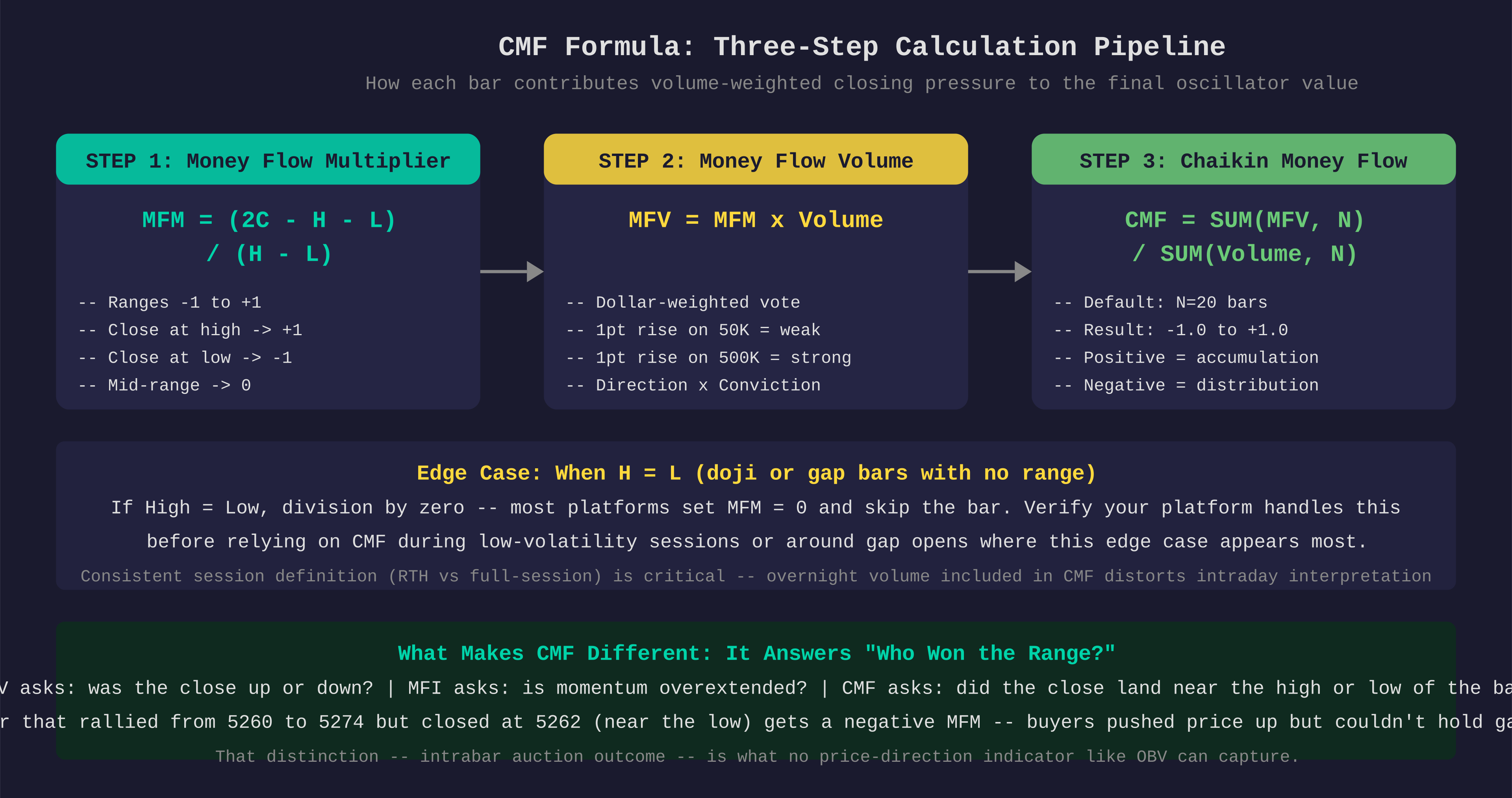
CMF's calculation has three steps. Understanding each step tells you exactly what the indicator is measuring and why.
Step 1: Money Flow Multiplier (MFM)
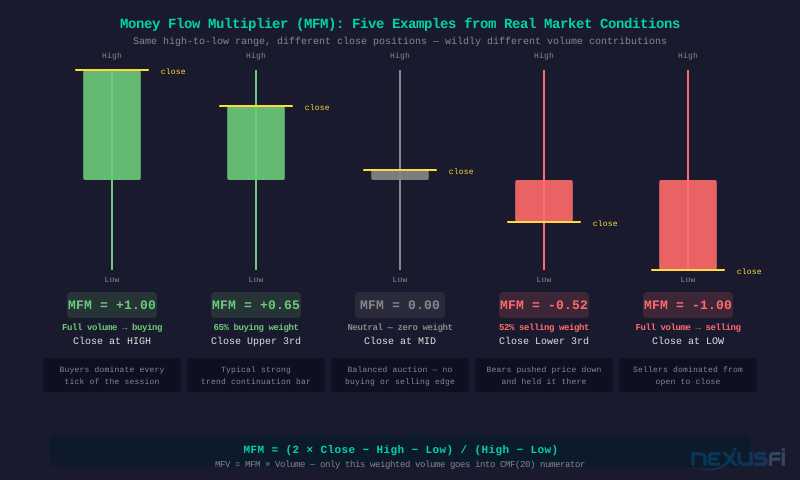
MFM = (2 × Close − High − Low) / (High − Low)This is the heart of CMF. The MFM measures where the close landed within the bar's range. It ranges from -1 to +1:
- MFM = +1: the close was at the exact high of the bar — maximum buying pressure
- MFM = -1: the close was at the exact low — maximum selling pressure
- MFM = 0: the close was at the exact midpoint of the range
- MFM = +0.65: the close was in the upper 82.5% of the range — strong buying
Edge case: when High equals Low (no range on the bar), most platforms set MFM to 0 to avoid division by zero. This typically occurs on limit-move days or during extreme halt conditions.
Step 2: Money Flow Volume (MFV)
MFV = MFM × VolumeThis step weights each bar's volume by its directional quality. A bar where the close finished at the high (MFM = +1) contributes its full volume to the buying side. A bar where the close finished at the midpoint (MFM = 0) contributes nothing in either direction. A bar where the close was at the low (MFM = -1) contributes its full volume to the selling side.
A worked example for an ES bar: High = 5,274.25, Low = 5,268.50, Close = 5,272.75, Volume = 42,300 contracts.
MFM = (2 × 5,272.75 − 5,274.25 − 5,268.50) / (5,274.25 − 5,268.50) = (10,545.50 − 5,274.25 − 5,268.50) / 5.75 = 2.75 / 5.75 = +0.478
MFV = 0.478 × 42,300 = +20,219 contracts (weighted toward buying)
Step 3: Chaikin Money Flow (CMF)
CMF(N) = Sum(MFV, N) / Sum(Volume, N)Sum the MFV values over the last N bars (default: 20), divide by total volume over the same period. The result is bounded approximately between -1 and +1 because every MFV is between -Volume and +Volume.
What CMF(20) tells you: over the last 20 bars, where has volume been concentrated relative to bar ranges? A reading of +0.25 means that roughly 25% of total session volume has been "net buying" after weighting by close position. A reading of -0.35 means distribution is dominating.

The 20 vs 21 Period Question
The difference between CMF(20) and CMF(21) is negligible for practical futures trading. CMF(20) is the textbook standard and what most backtesting literature uses as the baseline. CMF(21) adds one Fibonacci-number bar of smoothing. In practice, the difference in signals is rarely measurable — test 21 only after walk-forward validation shows meaningful stability improvement for your specific instrument and timeframe.
Reading CMF Signals: Zero Line, Regimes, and Extremes #
CMF produces three levels of signals with different reliability profiles.
The Zero Line: The Most Important Reference
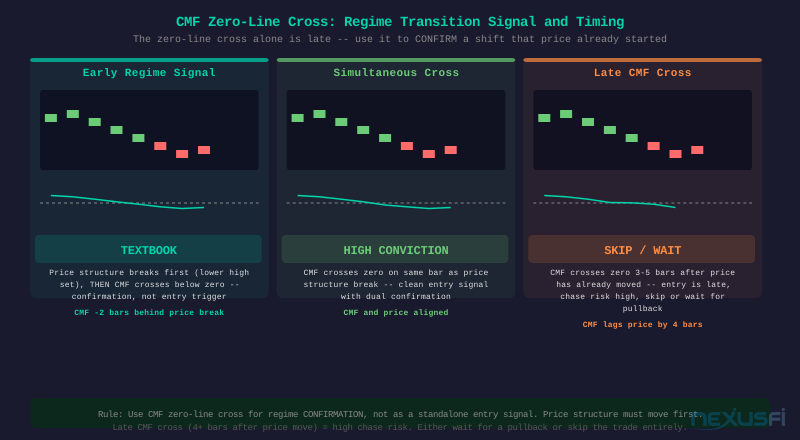
The zero line is where CMF's primary value lies. CMF above zero means net buying pressure over the lookback period — closes are finishing higher in their ranges, volume is weighted toward accumulation. CMF below zero means net selling pressure — distribution is dominant.
The correct application is regime identification, not entry triggers. When CMF is above zero, the bias is bullish — favor long setups, treat pullbacks as reloads rather than reversals. When CMF is below zero, the bias is bearish — favor short setups, treat rallies as distribution opportunities. Zero-line crosses alone are lagging signals; they confirm a regime shift that's already in progress.
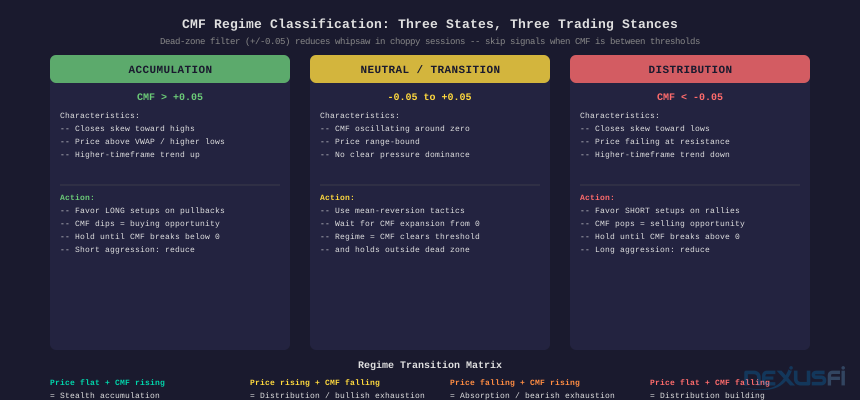
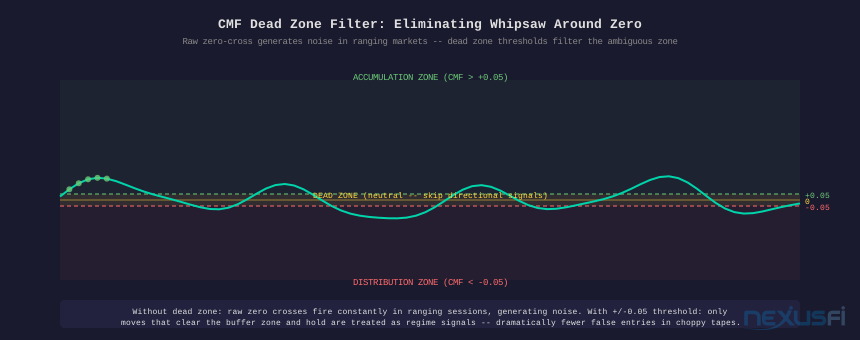
Use a dead zone around zero (approximately ±0.05) to filter out noise in directionless sessions. CMF oscillating between -0.05 and +0.05 without conviction in either direction typically indicates a balanced auction — neither buyers nor sellers are dominating, and new directional positions are higher-risk.
Overbought and Oversold Levels: Strength Qualifiers, Not Reversal Signals
The most common CMF mistake is treating extreme readings as automatic reversal signals. They aren't. In strong trending markets, CMF can sustain readings above +0.25 or below -0.25 for extended periods — that's the indicator working correctly, confirming trend strength.
Instrument-specific thresholds reflect volatility differences:
- ES (S&P 500 E-mini): ±0.20 is the standard observation level. ES has relatively tight intrabar ranges, so CMF extremes are meaningful at lower absolute values.
- NQ (Nasdaq E-mini): ±0.25 to ±0.30. NQ's higher volatility produces wider bar ranges, driving CMF to more extreme readings more frequently. Raising the threshold prevents false exhaustion signals.
- CL (Crude Oil): ±0.25 to ±0.30. Wide range bars from inventory reports and geopolitical events push CL CMF to extremes regularly.
The adaptive approach: track the standard deviation of CMF over the last 50 periods. Use ±1σ as your dynamic observation level rather than fixed numbers. This adjusts automatically across different volatility regimes.
The Four CMF-Price Combinations
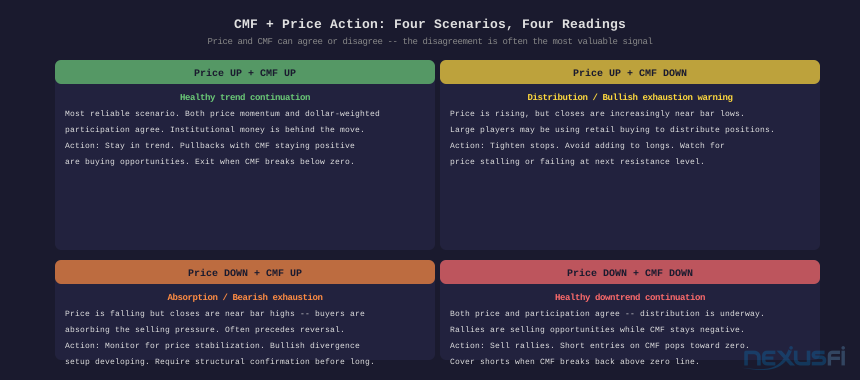
There are four possible combinations of price direction and CMF direction. Each tells a different story:
Price Rising + CMF Rising: Healthy participation. Volume is confirming the price move — closes are finishing in the upper portion of bars as price climbs. This is the cleanest trend setup. Stay in the trade, look for pullbacks to add rather than exit.
Price Rising + CMF Falling: Distribution warning. Price is moving higher, but closes are finishing lower in bar ranges — buyers can no longer dominate intrabar. This is the earliest signal of distribution. In a persistent trend, this is a cue to tighten stops and stop adding. In a marginal new high near resistance, this is a high-probability reversal setup.
Price Falling + CMF Rising: Absorption. Price is declining, but volume is weighted toward buying — sellers are being absorbed by buyers at lower prices. This is the classic "smart money accumulating while retail sells" pattern. Watch for a price structure trigger (break of a lower high) before entering long.
Price Falling + CMF Falling: Confirmed distribution. Selling pressure is dominant and volume confirms it. The cleanest short continuation setup. Sell rallies, not breakdowns.
Divergence Trading with CMF #
CMF divergence is the highest-probability signal the indicator produces — and the most overtraded. The setup is specific enough that most divergences traders see in real-time are not the valid ones.
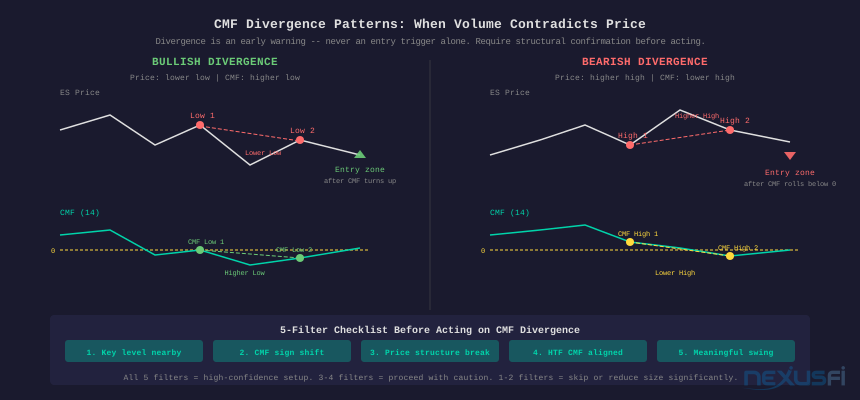
What Valid Divergence Looks Like
Bullish divergence: price makes a lower low, CMF makes a higher low. The interpretation is mechanical — sellers pushed price lower, but they couldn't push the closes as far toward bar lows as they did at the previous swing. Volume-weighted selling pressure is exhausting. The next swing is more likely to see buyers dominate.
Bearish divergence: price makes a higher high, CMF makes a lower high. Buyers pushed price higher, but closes are finishing lower in bars at the new high than they did at the prior high. Distribution at elevated prices — the move is losing volume backing precisely when it should be strongest.
The Five-Filter Confirmation Checklist
Acting on divergence without all five filters produces high false-positive rates, especially in ES and NQ during range expansion sessions:
- Key level: The divergence must form at a meaningful structural level — overnight high/low, VWAP, volume profile POC or value area edge, session pivot, or round number. Divergence in the middle of a range with no structural context is noise.
- CMF sign shift: CMF must not just diverge in magnitude — it must show a meaningful slope change. A higher low that's still deeply negative (-0.42 vs -0.38) is weaker than one that approaches the dead zone (-0.42 vs -0.08).
- Price structure break: Wait for price to break the micro-structure that confirms the setup — a break above the prior swing high for bullish divergence, a break below the prior swing low for bearish. Do not enter on CMF alone.
- Higher timeframe alignment: The divergence on the 5-min chart should align with higher-timeframe CMF reading. A bullish divergence on 5-min with CMF strongly negative on 15-min is fighting the tide.
- Meaningful swing: Both price swings must be genuine moves, not micro-fluctuations. A "lower low" of 0.25 points with no corresponding volume behavior is not meaningful divergence.
Why Valid Divergences Are Rare
At NexusFi, @EV Trader documented this reality directly in the Spoo-nalysis ES journal thread:
"It is very very rare to see [money flow] pointing into the opposite direction. These events offer good trading opportunities. I wish there were more of them, but markets are very efficient."
That's the correct frame. Valid CMF divergence with all five filters confirmed might appear 3-5 times per week in ES at the 5-min timeframe. Trading every apparent divergence is not the game — finding the ones where institutional money is clearly repositioning before the price move confirms it is.
CMF vs OBV vs MFI: Choosing the Right Indicator #
These three indicators all measure volume flow, but they do it differently and excel in different contexts.
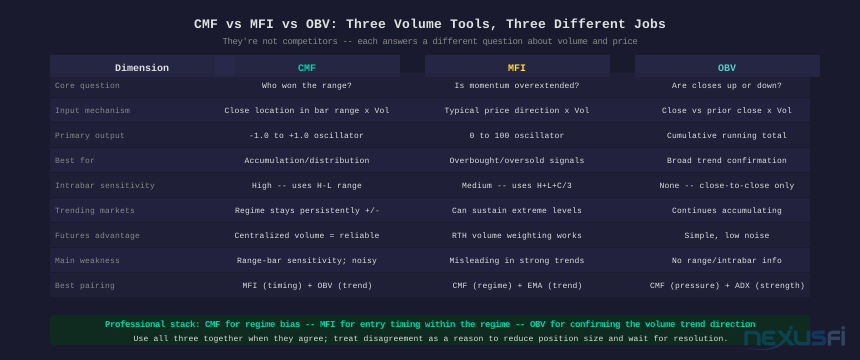
On Balance Volume (OBV) is the simplest of the three. Each bar, it adds full volume if the close is higher than the prior close, or subtracts full volume if the close is lower. The result is a cumulative, unbounded line. OBV's weakness in futures: it ignores where the close lands within the bar's range. A bar that gapped down and closed at its low votes the same as a bar that drifted slightly lower but closed near its high — both subtract volume from OBV. It also can't distinguish between a close that's marginally below the prior close and one that's dramatically below. Useful for multi-day trend direction and divergence on daily charts; less suited for intraday ES and NQ work where bar structure matters.
Money Flow Index (MFI) uses typical price (H+L+C)/3 and weights it by volume in an RSI-style formula, producing an oscillator bounded from 0 to 100. The advantage over OBV is the bounded range and the overbought/oversold framework. The weakness: typical price is less granular than close-within-range. MFI doesn't directly capture whether the close was strong or weak relative to the bar's extremes — it just looks at whether typical price was higher or lower today. In fast-moving NQ sessions, MFI whipsaws more than CMF around the 50 line.
Chaikin Money Flow (CMF) directly answers "where did the close land in the range?" The MFM is more informative than OBV's close-to-close comparison and more specific than MFI's typical price direction. The bounded output (approximately -1 to +1) makes it always interpretable without the trend-contamination issues that make OBV readings context-dependent.
For ES and NQ futures: CMF is the preferred regime indicator. Use OBV for multi-day context on daily charts. Use MFI for overbought/oversold signals in slower-moving instruments or longer timeframes where the RSI-style extremes are more meaningful.
These indicators aren't mutually exclusive. When all three agree — CMF positive, OBV making new highs, MFI above 50 — the signal strength multiplies. Disagreement between them is a position-size reduction signal, not a trade.
@Fat Tails explained the technical distinction clearly in NexusFi's NinjaTrader forum: CMF is "a normalized version of the Accumulation/Distribution Index... obtained by adding up the accumulation/distribution figures over a specified period and dividing it by the total volume." That normalization is what makes CMF bounded and so always meaningful, unlike the raw A/D index.
CMF Settings by Timeframe and Instrument #
Getting the period right matters. The goal is enough bars to smooth noise without adding so much lag that signals arrive after the move is over.
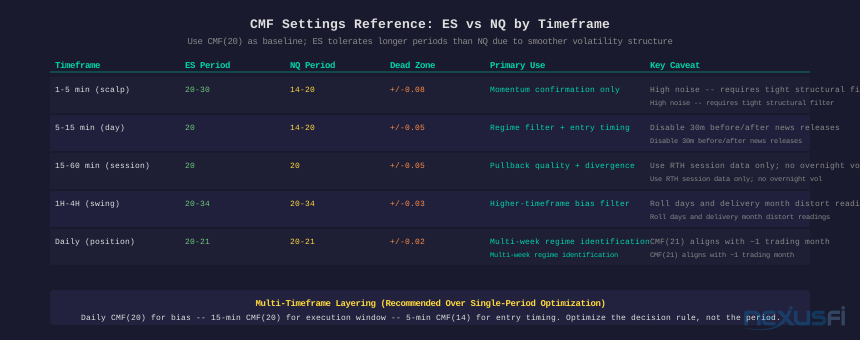
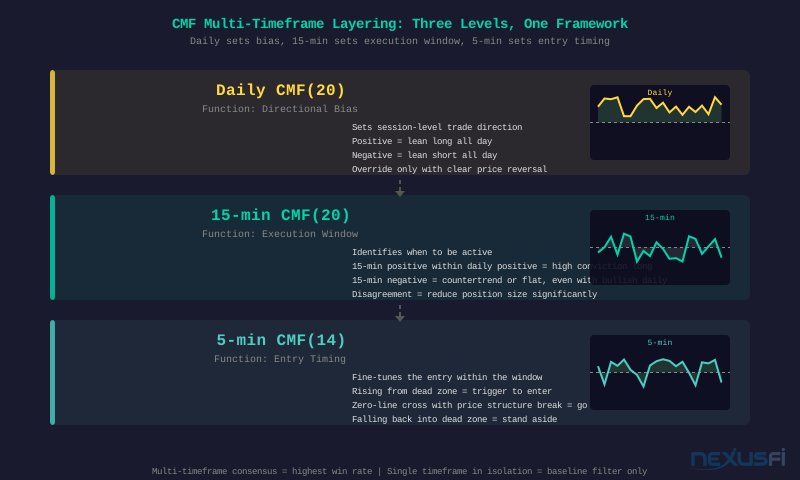
Period Selection by Timeframe
- 1-minute charts: CMF(10-14). Shorter periods allow fast-moving accumulation and distribution to register before the bar closes. Use 10-12 for scalp entries where you're trying to catch institutional bursts; 14 for slightly more noise reduction on busy sessions.
- 5-minute charts: CMF(12-20). The 5-minute is the primary execution timeframe for most ES and NQ day traders. CMF(20) is the textbook standard; CMF(14) responds faster at the cost of more noise. Test both on your specific instrument and session.
- 15-minute charts: CMF(20-21). The longer lookback smooths out 5-minute noise and provides clean regime reading for directing the lower-timeframe analysis.
- 30-minute / 1-hour charts: CMF(20-30). These timeframes are primarily for directional bias identification. The longer lookback matches the longer decision horizon.
- Daily charts: CMF(20-25). Multi-day regime identification, useful for swing traders and for understanding broader institutional positioning.
Multi-Timeframe Layering

The most strong CMF implementation uses three timeframes simultaneously:
- Daily CMF: Determines overall session bias. If daily CMF has been negative for three days, even strong intraday bounces may be fading opportunities.
- 15-min CMF: Identifies the execution window. A positive 15-min CMF within a negative daily context means a tradeable bounce, not a trend reversal.
- 5-min CMF: Provides timing. Enter when 5-min CMF turns positive (within a positive 15-min context) and price breaks structure.
This layering approach is superior to optimizing a single period because it captures different time-scale institutional activity simultaneously.
The Dead Zone Filter
In range-bound, low-conviction sessions, CMF oscillates around zero producing false regime signals. The fix: require CMF to clear a dead zone threshold before acting.
The Dead Zone Rule: CMF oscillating between -0.05 and +0.05 in ES/NQ is noise, not signal. Require CMF to clear ±0.05 before treating a regime shift as tradeable. This single filter eliminates the majority of false zero-line crosses in range-bound sessions.
For ES: ±0.05 is a reasonable dead zone on 5-minute charts. Don't treat a move from -0.03 to +0.04 as a regime signal. For NQ: ±0.08 on 5-minute, given higher natural volatility. For CL: ±0.06 on 15-minute, where inventory reports produce genuine regime shifts that need to clear noise first.
Walk-Forward Optimization Protocol
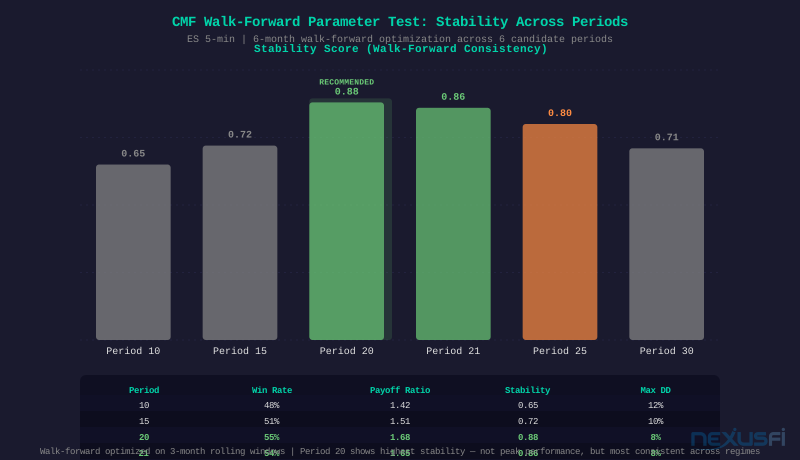
If you need to improve the CMF period for your specific setup, use this disciplined approach:
- Test only a narrow set: 10, 15, 20, 21, 25, 30. Not a brute-force sweep from 1 to 200.
- Improve on one month, validate on the following month, roll forward.
- Evaluate multiple metrics: win rate, payoff ratio, average adverse excursion (MAE), max drawdown, trade frequency.
- Stress-test across regimes: high-volatility macro release days and low-volatility midday sessions separately.
- Choose stability over peak performance — a setting that produces consistent results across market conditions beats one that looks optimal on past data.
Applying CMF to ES Futures #
The S&P 500 E-mini is where most NexusFi members use CMF, and the 5-minute chart is the primary battlefield.
Recommended Setup
- Chart: 5-minute or 15-minute
- CMF: period 20, dead zone ±0.05, observation levels ±0.20
- Supporting indicators: VWAP from session open, 20 EMA on price chart
The Core Bias Framework
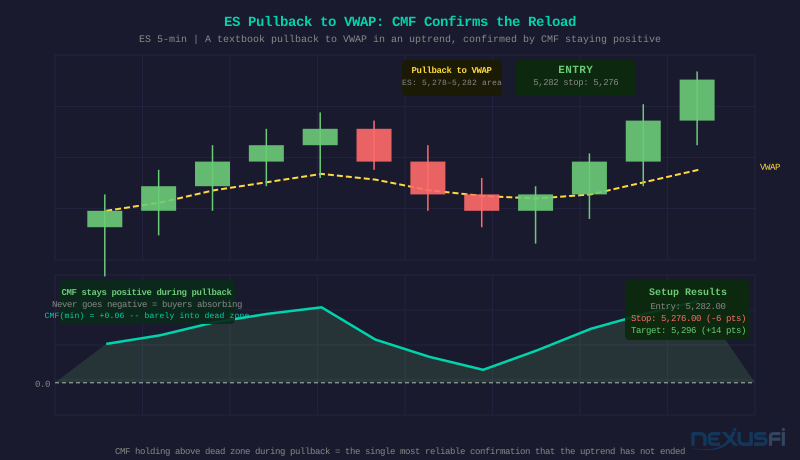
At the market open, check 15-minute CMF from the prior day's close. If CMF is positive entering the session, lean long for the first couple of hours unless price action contradicts. If CMF is negative, lean short.
As the session develops, VWAP and CMF give you two independent reads on bias. When both agree — price above VWAP and CMF above zero — the long bias is strong. When they disagree — price above VWAP but CMF negative — the move lacks volume confirmation and is higher-risk to hold.
Pullback Identification
This is where CMF earns its keep in ES day trading. When price pulls back to VWAP or the 20 EMA in an uptrend, watch CMF during the pullback. If CMF stays above zero (or only dips briefly into the dead zone), volume is not moving with the pullback — it's a reload. Enter on reclaim of the pullback high. If CMF goes much negative during the pullback, selling pressure is real and the trend may be breaking.
Applying CMF to NQ Futures #
NQ has higher volatility and a more momentum-driven character than ES. CMF behavior differs in important ways.
The Leading Behavior in NQ Uptrends
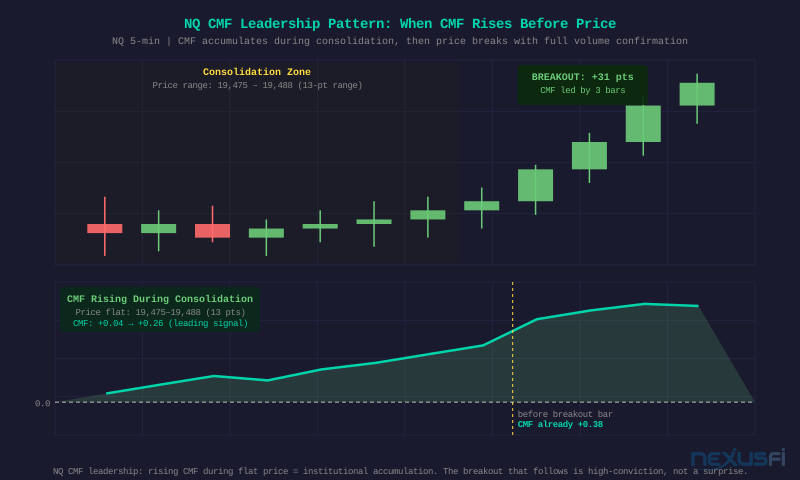
In persistent NQ uptrends, CMF often leads price. The pattern: price consolidates in a tight range while CMF rises — buying pressure accumulates in bars that appear sideways because closes keep finishing toward the highs even as price doesn't make new highs. Then price breaks out with full volume confirmation.
This leading behavior makes NQ CMF useful as an early-warning indicator for breakouts, not just a confirming tool. Rising CMF during apparent consolidation is the tell that institutional positioning is happening before the price move materializes.
Adjusted Thresholds for NQ
Because NQ's wider range naturally pushes CMF to more extreme readings, the dead zone and observation levels need adjustment:
- Dead zone: ±0.08 on 5-minute charts
- Observation level: ±0.25 to ±0.30
A CMF reading of +0.22 in NQ is relatively neutral — about where ES would interpret +0.12. Calibrate expectations so.
Momentum Exhaustion Signals
NQ is prone to momentum exhaustion at session highs and lows. When CMF pushes above +0.35 in a strong NQ uptrend, you're not at a reversal signal — you're at a "highest conviction zone." But if price makes a marginal new high while CMF posts a lower high (bearish divergence at an extreme), the probability of at least a corrective pullback is elevated. This is the bearish divergence setup in NQ with the highest historical reliability.
Applying CMF to CL Futures #
Crude oil has at the core different volume dynamics than equity index futures, and CMF settings need to reflect that.
Inventory Report Dynamics
The weekly EIA crude inventory report typically drops Wednesday at 10:30 AM ET. Volume spikes 5-10× in the two minutes following the release. This creates CMF distortion that can persist for 15-20 bars afterward. During this window, CMF signals are unreliable — the volume spike overwhelms the indicator's rolling average.
Protocol: Do not enter new positions based on CMF in the 20 minutes after an inventory report. Let the indicator "flush" the distorted bars before trusting its readings again.
Longer Lookback for CL
CL benefits from CMF(20-25) on 15-minute or 30-minute charts, rather than the 5-minute timeframe used for equity indices. Crude's wider intraday ranges and lower relative volume (compared to ES/NQ) make shorter-period CMF noisier. The 15-minute chart with CMF(20) gives cleaner regime readings and more reliable zero-line crosses.
Zero-Line Context for CL
CL zero-line crosses align closely with inventory report reactions. A bullish inventory number (draw in stocks) that pushes price higher typically produces a CMF cross from negative to positive territory within 3-5 bars of the report. This is one of the more reliable CMF signals in CL — confirmed by fundamental trigger, visible in volume weighting, and tradeable with a specific stop reference (the pre-report price level).
Building a Trade Setup: The Five-Step Workflow #
Every CMF-based trade should follow a structured workflow that prevents impulsive entries on single-signal conviction.
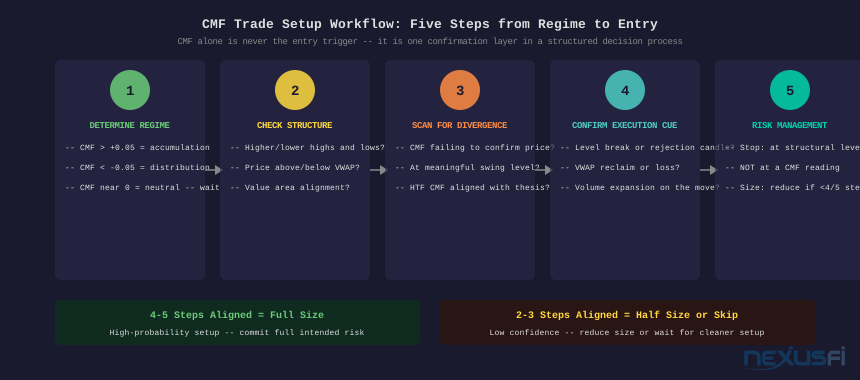
Step 1: Determine Regime on Higher Timeframe
Check 15-minute CMF first. Is it above zero (accumulation), below zero (distribution), or oscillating in the dead zone (balanced)? This sets the directional bias for the session. Only override the 15-minute regime if price structure clearly breaks the bias.
Step 2: Identify Structural Location
Price must be at a meaningful level before CMF signals matter. Key locations:
- VWAP (daily)
- Prior session high/low
- Volume Profile POC or Value Area edges
- Opening Range high/low (first 30 minutes)
- Round numbers (5,250, 5,300, etc. in ES)
CMF signals at random price locations — mid-range with no structural significance — carry no edge.
Step 3: Scan for Divergence or Regime Confirmation
At the structural level, check whether CMF is confirming or diverging from price. Price at resistance with declining CMF = distribution warning (short setup). Price at support with CMF making a higher low = absorption and potential reversal (long setup).
Step 4: Wait for Execution Trigger
CMF identifies the context. Price structure provides the entry:
- Long: Break above the prior swing high after CMF confirms positive regime
- Short: Break below the prior swing low after CMF confirms negative regime
Do not enter on CMF alone. The price structure trigger determines timing precision.
Step 5: Apply Risk Management
Stops go at price structure, never at CMF levels. If you're long after a CMF-confirmed pullback to VWAP, the stop goes below the pullback low — the price level that would invalidate the setup. CMF exit signals (slope reversal, zero-line cross on execution timeframe) are secondary exits, not primary risk management references.
Position sizing based on conviction: all five steps aligned at a major structure level = full intended position. Three or four steps aligned = half size or reduced risk. Fewer than three = stand aside.
Risk Management and Failure Modes #
CMF has specific failure modes that any trader using it needs to recognize and avoid.
Volume Spike Distortion
The most common CMF failure in futures trading. FOMC announcements, major economic releases, options expiration events, and the first and last 5 minutes of the trading session all produce volume spikes that dwarf normal bar volume. These spikes dominate CMF's 20-bar rolling calculation for several bars after the event.
Volume Spike No-Trade Window: FOMC announcements, major economic releases, and the first and last 5 minutes of the trading session create volume spikes that distort CMF for 5-15 bars after the event. This is not a time to trust the indicator — disable CMF-based signals during these windows and resume once the rolling average has absorbed the distorted bars.
The effect: CMF may show a strongly positive or negative reading immediately after a spike that has nothing to do with directional accumulation or distribution — it's the volume weighting responding to a single outsized bar. Protocol: treat the 10 bars following any major volume event as a CMF dead zone. Verify CMF independently with price action before trusting the reading.
Sideways Chop and the ADX Filter
In range-bound sessions with no directional conviction, CMF oscillates around zero without sustaining either side. Each zero-line cross looks like a new regime signal. Acting on each produces a series of small losses.
The filter: require ADX(14) > 20 before entering on CMF signals. When ADX is below 20, the market lacks sufficient trending behavior for CMF's regime signals to be reliable. Combined with a higher-timeframe alignment check, this eliminates the majority of sideways-chop false signals.
Strong Trend Extremes Are Not Reversal Signals
CMF above +0.30 in a trending NQ session doesn't mean sell. It means the trend is strongly backed by institutional participation. Fading extreme CMF readings in strong trends is one of the most reliable ways to lose money in index futures.
The correct response to extreme readings: hold the position if you're already in the trend direction; wait for a price structure reversal signal before acting if you're considering a counter-trend trade. Extreme CMF is a strength indicator, not an exhaustion indicator, unless accompanied by clear divergence at a major structural level.
Contract Roll Days
Quarterly futures expiration and roll-over days produce volume that reflects position migration, not directional conviction. Traders are rolling long March ES into June ES — the volume is real but the direction is operational, not speculative. CMF will misread roll-day volume as directional signal. Mark quarterly roll dates in your trading calendar and treat CMF signals on those dates with heavy skepticism.
Lag in Fast-Moving Markets
CMF is a rolling average calculation — it confirms after the best entry in sharp, fast-moving situations. In a sudden news-driven move, price will run 5-10 points before CMF registers a clear signal. This disqualifies CMF as a timing tool for news trades. It's a regime filter and a structural confirmation tool, not a scalp-entry indicator for fast markets.
NinjaTrader Configuration #
NinjaTrader includes Chaikin Money Flow as a built-in indicator under the standard indicator library. No custom script required — it's ready to use in any NinjaTrader 8 installation.
Setup steps:
- Right-click on your chart → Indicators → Search "Chaikin"
- Select ChaikinMoneyFlow from the list
- Period: 20 (default is correct for most applications)
- Add as a separate panel below price
Configuration adjustments:
- Right-click on the indicator panel → Add Plot → add a horizontal line at 0.0 (the zero reference)
- Add additional horizontal reference lines at your chosen thresholds: +0.20 and -0.20 for ES; +0.25 and -0.25 for NQ and CL
- Consider adding a dead zone band between -0.05 and +0.05 using a shaded region
@Fat Tails confirmed CMF's native presence in NinjaTrader in the Accumulation/Distribution forum thread, noting it as a "NinjaTrader default indicator" and recommending it over raw A/D line approaches. That native availability means consistent implementation across multiple chart templates and strategy backtesting without version-control issues.
For multi-timeframe analysis: create a second CMF indicator on the same panel with a different period (14 for faster, 30 for slower), using different colors. The visual alignment or divergence between the two CMFs gives an additional layer of confirmation without requiring a separate chart window.
The Bottom Line #
CMF earns its place on a futures trader's chart by doing one specific thing well: revealing whether volume is backing the price move. It won't give you entries. It won't tell you how far price will run. It won't work in choppy markets or during volume events. But used correctly — as a regime filter, a breakout confirmation tool, and a divergence detector at structural levels — it consistently improves signal quality over price alone.
The core rules:
CMF above zero biases toward longs. CMF below zero biases toward shorts. Divergence at key levels with all five filters confirmed is the highest-probability standalone signal. Extreme readings in trending markets mean strength, not exhaustion. Volume spikes, sideways chop, and roll days are no-trade zones. Always use price structure for entries and stops, not CMF levels.
Where CMF excels over MFI: it's specifically calibrated to intrabar close position rather than typical price direction. Where it excels over OBV: it's bounded, always interpretable, and doesn't accumulate trend-contamination over time. For ES and NQ day trading, CMF is the volume indicator that most precisely tells you what institutional participation is doing bar by bar.
The three-indicator stack — VWAP for bias, 20 EMA for trend direction, CMF for volume confirmation — represents the closest thing to a universal framework for filtering high-quality setups in index futures. Not every signal requires all three, but the more that align, the higher the conviction.
CMF doesn't make trading easy. Nothing does. But it makes the question "is volume backing this move?" answerable in real time, and that's a question worth having on your screen.
Knowledge Map
Go Deeper
Build on this knowledgeReferences This Article
Articles that build on this topicCitations
- — Accumulation/Distribution Indicator? (2011) 👍 16“The Chaikin Money Flow Index is a normalized version of the Accumulation/Distribution Index. It is obtained by adding up the accumulation/distribution figures over a specified period and dividing it by the total volume. The Chaikin Money Flow Index is a NinjaTrader default indicator.”
- — OBV (on balance volume) Divergence indicator (2009) 👍 64“Divergence tools don't work in strong trends, just like oscillators don't, so a divergence tool built on top of an oscillator tool really, really doesn't work well in strong trends. The zero line is important. Below zero typically means shorts only, above zero typically longs only.”
- — Spoo-nalysis ES e-mini futures S&P 500 (2015) 👍 31“It is very very rare to see [money flow] pointing into the opposite direction. These events offer good trading opportunities. I wish there were more of them, but markets are very efficient. When the MF crosses below zero, the S&P500 is at a top or is already moving down.”
- — Is scalping Emini a sustainable trading strategy? (2021) 👍 4“I use these charts to leg into a position... what you also see is an EMA 14 and an EMA 9 as well as an OBV line and a Chaikin money flow line (shows the underlying buyer/selling pressure and are leading indicators). This works on ES, GC, CL, RTY, YM. I stay with MNQ.”
- — Spoo-nalysis ES e-mini futures S&P 500 (2014) 👍 7“The 20 Day Money Flow offers a pretty accurate picture of what the big money is doing. Most of the time, the 20DMF follows the price trend. It is either pulling the price or it is being pulled. It is very very rare to see it pointing into the opposite direction.”
- — APEX 300K+: The Journey (2023) 👍 4“What you see in the first image are the signals from the OBVM-CD indicator using the 2-minute dataset that are switched long-short based on the VWAP and EMA. Using volume oscillator + VWAP + EMA combination on NQ 1-minute chart.”
- — Chaikin Money Flow (CMF) -- StockCharts Technical Analysis Reference
- — Chaikin Money Flow: Definition and Uses for Futures Traders
- — Chaikin Money Flow Technical Reference: Formula and Interpretation
- — Using Chaikin Money Flow in NinjaTrader 8
- — BMT Diver Indicator for Divergence (2009) 👍 38“Classic divergence indicator discussion establishing NexusFi community standards for volume divergence detection -- the foundational thread that the CMF divergence approach builds upon for ES and NQ futures.”