



Money Flow Index (MFI): The Volume-Weighted RSI That Shows Whether Price Is Backed by Real Participation
Overview #
The Money Flow Index (MFI) is a volume-weighted momentum oscillator that ranges from 0 to 100. It answers a question RSI can't: is the price move backed by real dollar participation, or is it running on empty?
Every bar contributes to MFI's calculation by combining typical price with volume — turning each candle into a weighted vote on buying or selling pressure. When price climbs on heavy volume, MFI rises fast. When price climbs on thin volume, MFI lags, often diverging from the candles. That divergence is the signal futures traders care about most.
Some analysts call MFI the "volume-weighted RSI." That framing is useful because it immediately tells you what's different: the same oscillator structure, but now each price move is weighted by how much dollar volume actually participated. A 3-point ES rally on 500K contracts votes louder than a 3-point rally on 50K contracts. MFI sees that difference. RSI doesn't.
For futures traders, this matters more than in equities. Futures volume is real exchange-reported volume — not a tick proxy. That makes MFI's volume signal far more reliable in ES, NQ, CL, or GC than in instruments where volume data is estimated or fragmented across venues.
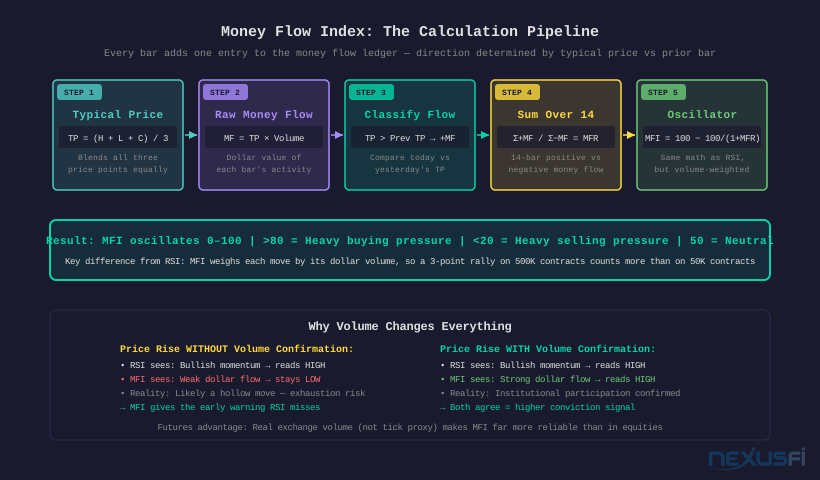
The chart above shows the five-step pipeline from raw bar data to the oscillator reading. What makes Step 3 critical: the direction of money flow is determined by whether today's typical price is above or below yesterday's. A bar where price rose but volume was minimal contributes almost nothing to the positive money flow sum. Over 14 bars, the ratio of positive to negative dollar flow becomes the oscillator's core signal.
How MFI Works: The Dollar Flow Calculation #
The math follows four steps that any trader can reproduce in a spreadsheet.
Step 1: Typical Price
Typical Price (TP) = (High + Low + Close) / 3Using the typical price instead of the close blends the full bar's range into the calculation. A bar that ran from 5260 to 5274 with a close at 5271 has a different TP than one that gapped and closed near the same level without exploring the range.
Step 2: Raw Money Flow
Raw Money Flow (MF) = Typical Price × VolumeThis is the dollar vote for each bar. If ES traded 42,000 contracts at a typical price of 5270, the raw money flow is 221,940,000 — that's the weight of that bar's move in the ledger.
Step 3: Classify the Flow
Compare today's TP to the prior bar's TP:
- If TP rises → the raw money flow is Positive (buyers controlled the bar)
- If TP falls → the raw money flow is Negative (sellers controlled the bar)
- If TP is unchanged → most implementations count neither
This is where MFI diverges from pure price oscillators. A bar where price rose 2 points on 8,000 contracts contributes only a fraction of what a 2-point rise on 80,000 contracts contributes. The direction matters, but the weight matters just as much.
Step 4: Build the Ratio and Calculate the Oscillator
Over the lookback period (default: 14 bars), sum up all positive and negative money flows:
Money Flow Ratio (MFR) = Sum of Positive MF (14) / Sum of Negative MF (14)
MFI = 100 - [100 / (1 + MFR)]
The final formula is identical to RSI's — the only difference is that you're feeding dollar-weighted flow instead of raw price change. When positive dollar flow dominates, MFI pushes toward 100. When negative dollar flow dominates, MFI drops toward 0.
Futures-specific implementation notes:
- Use RTH session data consistently. Including overnight Globex volume can distort MFI readings because thin overnight sessions have structurally different volume profiles than regular trading hours. Pick one session convention and stick with it.
- Handle contract rolls carefully. A volume spike on roll day reflects position rolling, not directional conviction. MFI will misread roll-day data as a strong money flow signal. Filter these dates from your analysis.
- Real exchange volume is an advantage. Unlike equity or forex instruments where volume is often estimated or aggregated across venues, futures volume is a single exchange number. This makes MFI more reliable in ES and NQ than in virtually any equity or FX application.
Reading MFI Signals: Levels, Zones, and the 50 Line #
MFI produces three categories of actionable signals. Each has a different use case and a different failure mode.
Overbought and Oversold Levels #
The standard thresholds are 80 for overbought and 20 for oversold. When MFI exceeds 80, dollar volume buying pressure has been dominant for 14 bars. When it falls below 20, selling pressure has dominated.
The mistake most traders make is treating these as automatic reversal signals. They aren't. In a strong trend, MFI can sustain readings above 80 for extended periods — the market is telling you that buying pressure is persistent, not exhausted. Fading a strong trend because MFI hit 80 destroys accounts.
The correct interpretation: MFI levels identify potential exhaustion zones. Whether exhaustion is actually happening requires price structure confirmation:
- For oversold signals (MFI < 20): Is price at a meaningful support level — prior swing low, high-volume node, or major S/R? Is there a rejection candle, absorption pattern, or failed push lower?
- For overbought signals (MFI > 80): Is price at a prior swing high or resistance? Is momentum stalling in the candlestick structure?
Without that price structure context, an MFI extreme is just information — not a trade.
You can also adjust thresholds to match your trading style:
- 70/30: More signals, noisier. Useful for active traders who want early warning.
- 80/20: Standard baseline. Best for most intraday futures setups.
- 85/15: Fewer, higher-conviction signals. Better for swing trading or traders with limited screen time.
Only take MFI overbought/oversold signals in the direction of the prevailing trend. When price is above EMA(50), use MFI oversold as a buy timing tool. When price is below EMA(50), use MFI overbought as a sell timing tool. Counter-trend fades at extremes are how MFI burns accounts — the trend filter turns MFI from a fade tool into a momentum confirmation tool.
The 50 Centerline #
MFI crossing the 50 line is a momentum regime shift. When MFI climbs from below 50 to above 50, dollar buying pressure has just crossed into dominance for the lookback period. When it falls from above 50 to below 50, selling pressure has taken over.
Most traders treat this as a trend confirmation or bias filter rather than a standalone entry signal. If you're hunting longs, you want MFI above 50 — it tells you the recent money flow regime favors buyers. If MFI is below 50, taking long entries is fighting the current.
The 50 line cross also matters for divergence trades: after spotting a bullish divergence, traders often wait for MFI to recross 50 as confirmation before entering long. That one filter removes a significant chunk of the false starts.
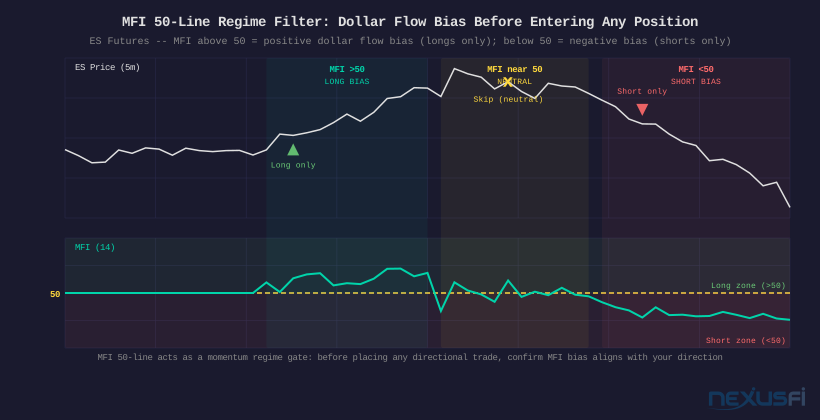
The MFI 50-line acts as a regime filter: sustained readings above 50 confirm bullish money flow, while readings below 50 confirm bearish flow. Crossovers of the 50 line on above-average volume often precede trend changes — making the centerline a powerful filter for directional bias.
Trend Filter Application #
The single most effective improvement to MFI-based trading is combining it with a trend filter — typically an EMA (50 or 200) on the same timeframe.
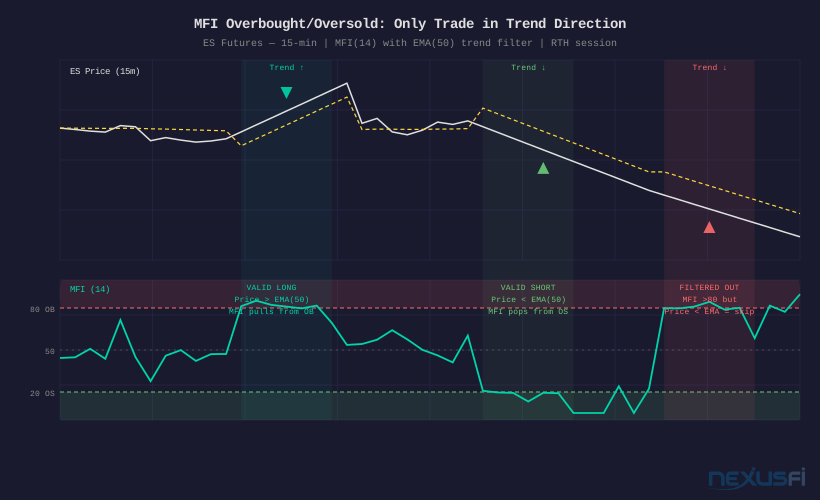
The chart shows three MFI extreme readings on the same ES chart. Two are valid trade setups; one is filtered out:
- Valid long: Price is above the EMA(50), trend is up. MFI pulls back into oversold territory, then turns up. This is buying a dip in an uptrend — MFI is timing the entry.
- Valid short: Price is below the EMA(50), trend is down. MFI pops into overbought territory, then turns down. This is selling a bounce in a downtrend.
- Filtered: MFI signal in a trending context where taking the counter-signal would fight the dominant trend. Skip it.
The principle: only take MFI overbought/oversold signals in the direction of the prevailing trend. This single filter dramatically improves win rate.
After sustained MFI readings above 80 or below 20, the oscillator return toward 50 often precedes price consolidation or reversal. The best mean-reversion signals occur when that return is accompanied by volume contraction — indicating the extreme pressure has genuinely dissipated rather than just pausing.
The Art of Divergence Trading with MFI #
Divergence is MFI's highest-value application and its most misunderstood. Done right, it catches turning points that no price-only indicator can see. Done wrong, it produces losing trades in strong trends.
Bullish Divergence #
Bullish divergence occurs when price makes a lower low but MFI makes a higher low. This tells you that while price reached a new low, the dollar volume behind the selling was weaker than on the previous low. Sellers are running out of conviction.
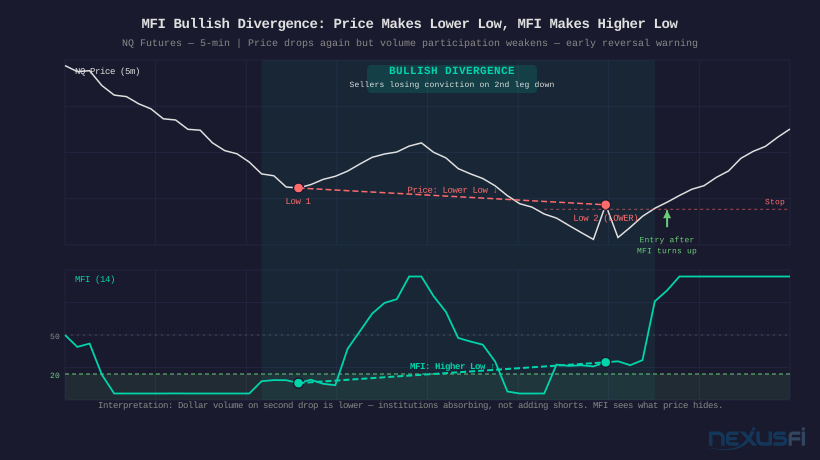
In this NQ example, price forms two lows — the second one clearly lower. But MFI's second trough is shallower than the first. The dollar volume on the second drop didn't match the first. That's the market telling you institutions absorbed the selling rather than added to it. The divergence preceded a meaningful reversal.
Members in the NexusFi community have noted this pattern across different oscillators.
The volume dimension is exactly what makes this divergence different from RSI divergence. RSI bullish divergence tells you price momentum is weakening. MFI bullish divergence tells you the dollar weight behind the selling is weakening — a more direct signal that sellers are running out of firepower.
Bearish Divergence #
Bearish divergence occurs when price makes a higher high but MFI makes a lower high. Price extended to new territory, but the dollar participation on that push was weaker. Distribution is likely underway.
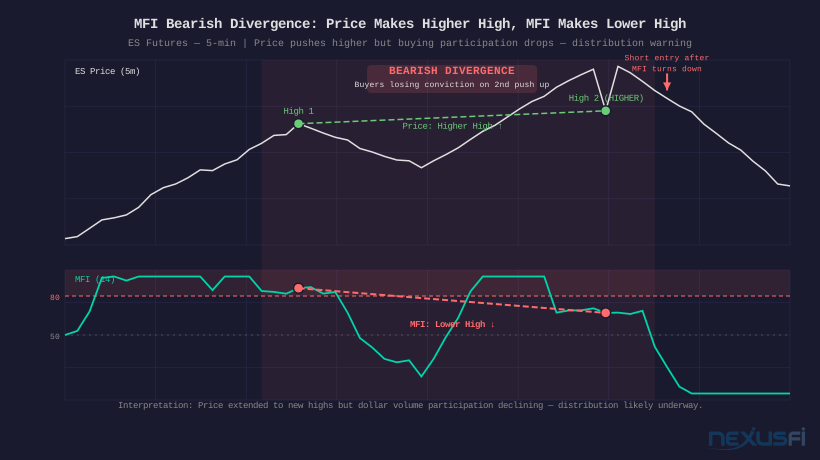
The pattern is the mirror image. Price pushes to a new high while MFI's second peak is clearly below the first. Buyers were able to move price higher, but they needed less volume to do it — which often means large participants are using the retail buying to distribute positions.
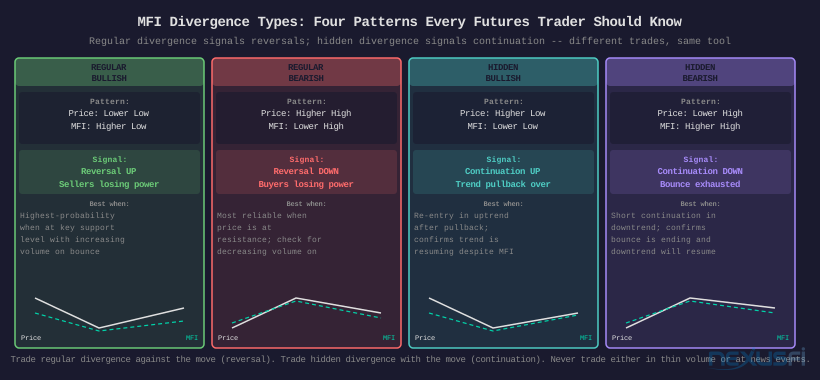
All four MFI divergence types: regular bullish (higher MFI low vs lower price low — signals reversal up), regular bearish (lower MFI high vs higher price high — signals reversal down), hidden bullish (lower MFI low vs higher price low — signals trend continuation up), and hidden bearish (higher MFI high vs lower price high — signals trend continuation down). Regular divergences catch turning points; hidden divergences confirm existing trends.
Divergence Trading Rules That Actually Work #
@Big Mike built an RSI divergence tool specifically for NinjaTrader based on these principles — a warning that applies to every oscillator-based divergence framework including MFI:
This is the most important caution. MFI divergence is a reversal signal, not a trend-following signal. In trending markets, divergences form repeatedly as normal course of business. Trading every divergence in a strong trend is a losing strategy.
The rules that filter the valid setups from the noise:
- Require structural context. The divergence must occur at an identifiable level — a prior swing high/low, a volume node, a major support/resistance level. Divergence in the middle of a range doesn't carry the same weight.
- Require MFI confirmation. Don't enter on the divergence pattern itself. Wait for MFI to turn back toward the center — for bullish divergence, wait for MFI to tick up from the oversold extreme and ideally cross back above a local high.
- Stop placement is structural, not indicator-based. The stop goes beyond the divergence swing in price — below the lower low for bullish setups, above the higher high for bearish setups.
- Scale entries. Enter the first partial position when MFI confirms. Add the second if price retests the divergence level and holds.
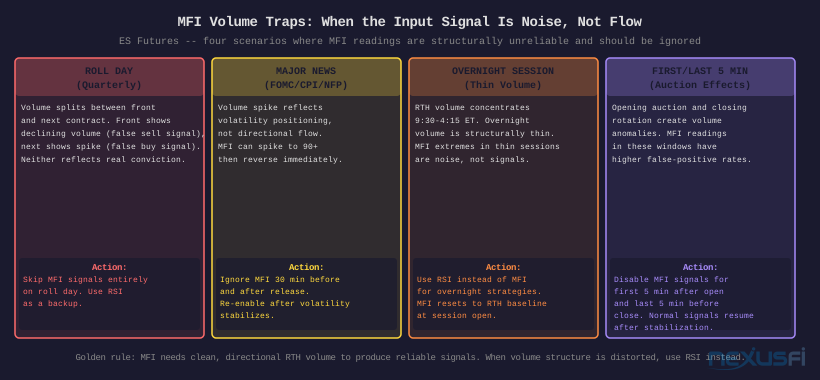
Volume traps are a special case of bearish divergence: price breaks to new highs, drawing in breakout traders, but MFI fails to confirm the move. The dollar participation behind the breakout is weaker than the prior swing — a classic distribution signal. When combined with overhead resistance, this setup frequently precedes failed breakouts and sharp reversals.
MFI Settings by Timeframe and Instrument #
There is no universally optimal MFI period, but there are well-tested starting points based on how volume behaves across different timeframes and instruments.
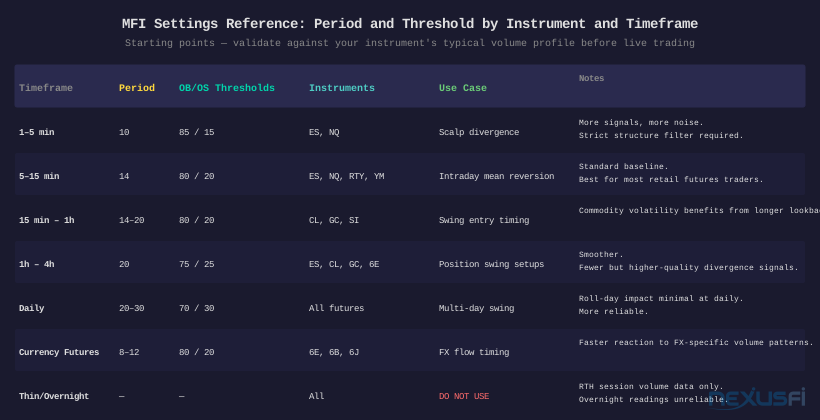
The critical guidance embedded in that table:
- The 1--5 minute timeframe with period 10 is for experienced traders with strict structural filters. The signal-to-noise ratio at that resolution requires more confirmation, not less.
- The standard 14-period MFI on 15-minute charts is the most widely used configuration. It's the baseline from which you adjust.
- Overnight sessions are explicitly excluded. RTH session volume data only. Overnight readings unreliable.
- Roll days, first and last 5 minutes of the session, and major news events produce volume spikes that distort MFI readings.
One framework used by experienced futures traders: think of MFI as a tool that requires "clean" volume to work properly. Anything that introduces structural noise into the volume series — rolls, thin sessions, news spikes — makes MFI temporarily unreliable.
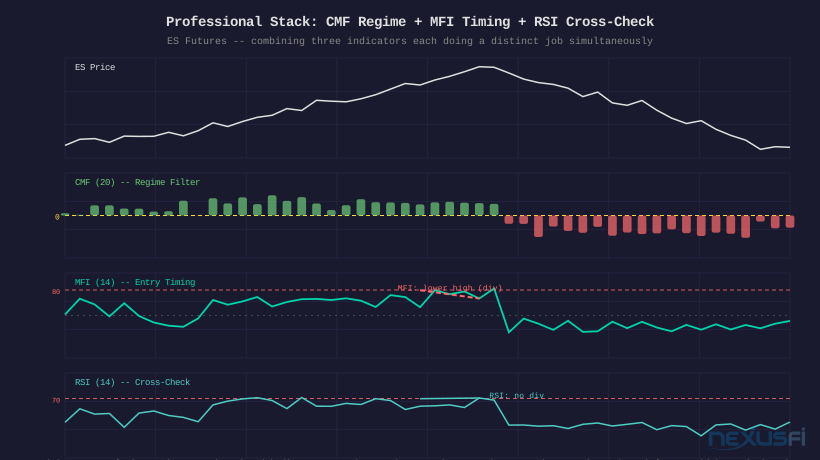
The three-panel setup — price bars, MFI(14), and raw volume histogram — provides maximum confluence. When all three confirm (price at structural support, MFI oversold turning up, and a volume spike on the reversal bar), signal quality is at its highest. This stacked view is the professional baseline for MFI-based analysis.
MFI vs RSI: When Volume Changes Everything #
The comparison between MFI and RSI is where the indicator's real value becomes clear. They share the same mathematical structure but produce different readings whenever volume diverges from price momentum.
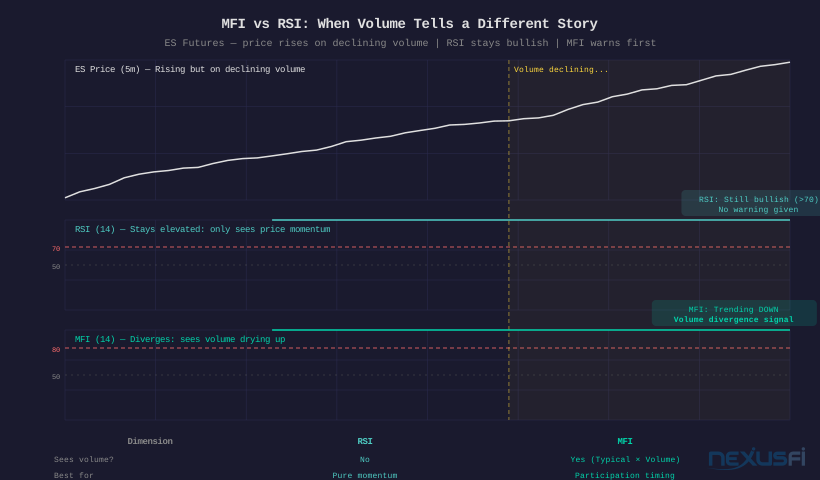
The chart illustrates the critical scenario: ES price is rising consistently, but volume is declining over the latter half of the chart. RSI stays elevated above 70 — all it sees is that price is going up. MFI tells a different story: it starts trending down even as price advances, because the dollar volume backing each new high is shrinking.
That divergence between the two indicators is a warning. It doesn't guarantee a reversal, but it does tell you that the move is becoming less confirmed by volume, which should raise your risk management alertness.
When MFI and RSI diverge from each other — RSI elevated above 70 while MFI trends lower — price is advancing on declining dollar participation. This gap between the two indicators is one of the earliest institutional warnings available on a standard indicator panel, often appearing several bars before price itself gives any reversal signal.
When to prefer MFI over RSI: #
Volume expansion precedes continuation. Many futures instruments show predictable volume patterns at breakout moments — volume surges as price clears a key level. MFI will capture this participation surge with a strong reading. RSI won't differentiate between a breakout on 3x average volume and one on 0.3x average volume.
Identifying hollow moves. When price grinds higher in late afternoon RTH on thin volume, RSI will track the grind and show elevated momentum. MFI will show weakening dollar flow — earlier warning that the move isn't institutionally supported.
When to prefer RSI over MFI: #
Overnight sessions. RTH volume is unavailable, and overnight volume is structurally thin. RSI, being purely price-based, is unaffected by this.
Instruments with unreliable volume data. If your platform provides tick volume instead of actual exchange volume, MFI's volume-weighting advantage disappears.
Roll periods and delivery months. When a futures contract enters delivery month, volume concentrates unusually. RSI is unaffected; MFI may distort.
Practical approach: Run both indicators. When they agree, confidence in the signal increases. When they diverge — RSI says bullish, MFI says weakening — that disagreement itself is information worth examining.
MFI vs Chaikin Money Flow: Two Tools, One Job? #
Chaikin Money Flow (CMF) is another volume-based indicator commonly compared to MFI. They look similar on charts — both incorporate volume and price — but they measure different things and are used differently.
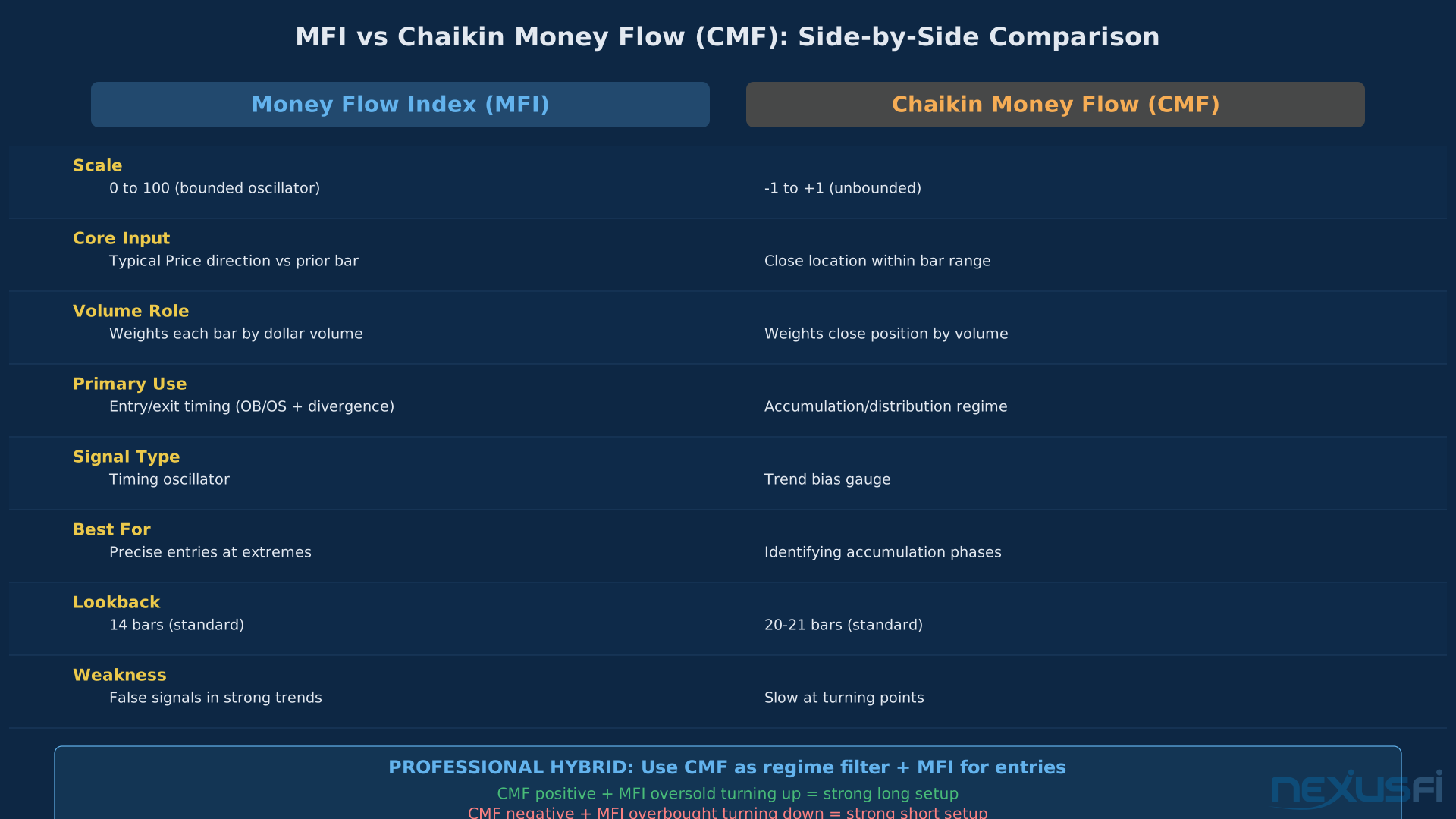
The comparison above highlights the structural differences between the two indicators and the professional hybrid approach that combines both.
How CMF works: CMF calculates where the close sits within the bar's high-low range, then weights that position by volume. If a bar closes near its high with heavy volume, CMF gets a strong positive reading. The result is an oscillator that captures accumulation vs. distribution based on close location within bars.
The structural difference:
| Dimension | MFI | Chaikin Money Flow |
|---|---|---|
| Calculation basis | Typical price direction vs. prior bar | Close location within bar's range |
| Scale | 0 to 100 (bounded) | Roughly -1 to +1 |
| Primary use | Timing overbought/oversold + divergence | Accumulation/distribution regime |
| Best for | Entry and exit timing | Trend bias and regime identification |
The fundamental distinction: MFI is a timing oscillator. CMF is an accumulation/distribution gauge. They're not competitors for the same job; they fill different roles.
The professional hybrid approach:
- Use CMF as a regime filter. When CMF is positive and rising, the instrument is in an accumulation regime. When CMF is negative, distribution is underway.
- Use MFI for entries within the regime. If CMF is positive (accumulation), only take MFI bullish signals. Ignore MFI bearish signals.
- Highest-conviction setups: CMF positive + MFI oversold turning up = strong long setup. CMF negative + MFI overbought turning down = strong short setup.
This combination addresses a known weakness of each: MFI can generate false signals in ranging markets (where CMF shows neutral readings), and CMF can be slow to signal at turning points (where MFI divergence fires earlier).
Building a Complete Trade Setup: The Three-Scenario Playbook #
Here's how MFI integrates into a complete trading framework across three common scenarios.
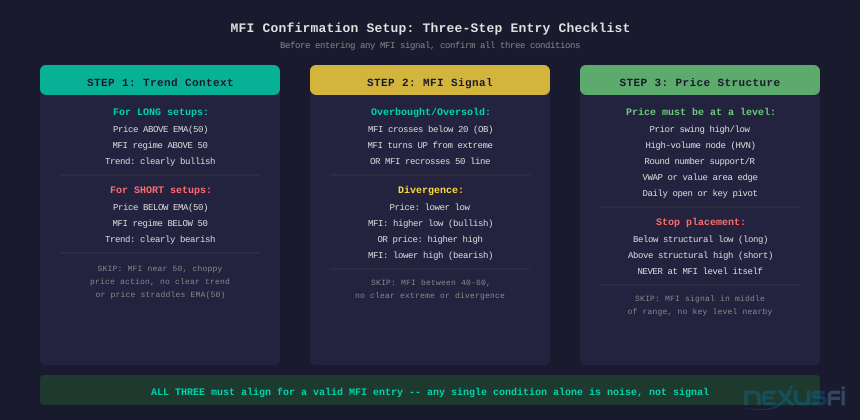
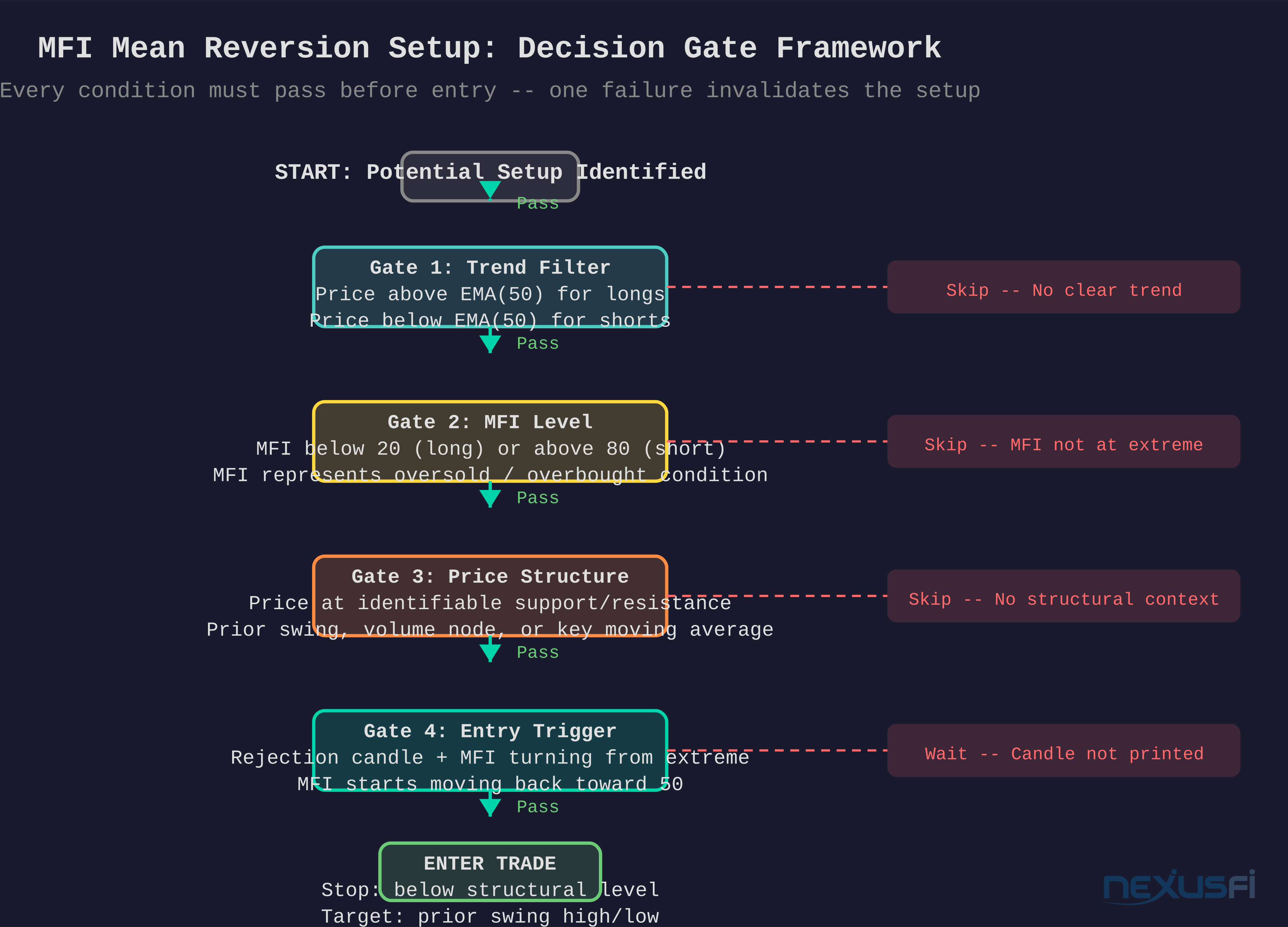
Before any MFI-based entry, all three conditions must align: trend context first (price above/below EMA50), MFI signal second (extreme reading or divergence), and price structure third (key level present). Any single condition alone is noise — the checklist ensures you are stacking genuine confluence before committing capital.
Scenario 1: Mean Reversion in an Uptrend #
Setup conditions:
- Price is above EMA(50) — trend is up
- Price has pulled back from a recent swing high
- MFI drops below 20 (oversold) on the pullback
- Price is at an identifiable support level (prior swing, HVN, or round number)
Entry trigger: MFI turns up from below 20 AND a rejection candle prints (wick into support with a close near the high of the bar).
Stop: Below the pullback low (below the support level that triggered the setup).
Target: Initial target is the prior swing high. Move stop to breakeven after the first third of the range is recovered.
Why MFI adds value here: An RSI-only trader would also flag the oversold condition. But MFI's oversold reading tells you that the dollar-weighted selling during the pullback was intense. When MFI turns up, you have confirmation that dollar buying has resumed — combined with the trend filter and structural support, this is one of the higher-probability setups available in futures trading.
Scenario 2: Divergence Reversal at a Key Level #
Setup conditions:
- Price makes two consecutive lows (or highs) over the session
- MFI makes the opposite type of low (or high) — divergence forms
- The divergence occurs at or near a recognized technical level
- Volume on the second price extreme is visibly lower than the first
Entry trigger: MFI turns and crosses above (or below) the 50 centerline after the divergence pattern forms. This is the confirmation that dollar flow has shifted.
Stop: Structurally — beyond the divergence swing. For bullish divergence, below the second (lower) price low.
Target: If you're at a daily low (or high) and the divergence fires, target the midpoint of the prior session's range as a first target. Second target: prior day's VWAP or value area edge.
Position sizing: Reduce size on divergence setups compared to trend-following setups. Divergence trades are reversal setups — they have lower base rates. Account for this in your risk allocation.
Scenario 3: Momentum Filter for Trend Following #
Setup conditions:
- Price is in a clear directional trend (above or below a trend average)
- MFI is above 50 and has recently crossed up (for long setups)
- A minor pullback occurs without MFI dropping below 40
Entry trigger: Price reclaims a short-term moving average (8-period or 13-period EMA on the entry timeframe) while MFI is holding above 50.
Stop: Below the entry bar's low, or below the short-term EMA if that's tighter.
Target: Trail the stop — move it to the low of the prior two bars as price extends. Exit when MFI drops below 50 on a close, signaling the dollar flow regime has shifted.
Why this works: MFI above 50 means net positive dollar flow for the lookback period. As long as that condition holds, the trend has volume confirmation. When it breaks, even before price gives a reversal signal, you have early warning to tighten stops or reduce size.
Risk Management, Roll Days, and Volume Traps #
MFI's greatest strength is also its primary vulnerability: it depends on volume data quality. Understanding where the data goes bad is as important as understanding where the signals are reliable.
Roll days: On quarterly roll dates for ES and NQ, total volume splits between the front contract and the next contract. Each contract individually shows a distorted volume picture. Mark the roll dates in your calendar and treat MFI signals from those days with skepticism.
Major news events: FOMC announcements, payrolls, CPI, and other high-impact economic releases produce volume spikes that reflect volatility positioning, not directional money flow. MFI can spike dramatically on these events and then immediately revert. Many professional traders disable or ignore MFI signals for 30 minutes before and after high-impact releases.
Roll days and high-impact economic releases (FOMC, payrolls, CPI) make MFI readings unreliable. Volume on roll days reflects position rolling, not conviction — MFI misreads it as strong money flow. During news events, MFI can spike to extreme readings and immediately snap back. Mark these calendar events and treat any MFI signal within 30 minutes of them as noise, not signal.
Thin overnight sessions: MFI's reliability degrades significantly when volume is thin. Either use a separate set of MFI parameters calibrated for those sessions, or rely on RSI instead.
Stop placement discipline: Regardless of what MFI says, stops should always be placed at structural price levels, not at arbitrary indicator values. "Exit when MFI crosses below 50" is not a stop — it's a direction signal. The stop is at the price level where your analysis is wrong.
Volume concentration in specific time windows: For ES and NQ, volume concentrates heavily in the opening hour (9:30--10:30 ET) and the final hour (3:00--4:15 ET). MFI readings during these windows carry more weight than readings during the lunch hour lull (12:00--2:00 ET), when thin volume can produce MFI extremes that immediately snap back.
The mathematical relationship between buying and selling pressure has been studied across multiple approaches in technical analysis — from Sibbett's Demand Index to Aspray's Demand Oscillator. The underlying principle across all these tools is the same: normalize the dollar weight of up-moves vs. down-moves over a lookback period. MFI is the most accessible version of this concept.
NinjaTrader Configuration and Practical Setup #
MFI is built into NinjaTrader's standard indicator library. Access it via the Indicators menu in the Chart Trader or Strategy Analyzer.
Key configuration parameters:
Period: Default is 14. Set this first. Test 10 and 20 as alternatives against your specific instrument before going live.
Upper Band (Overbought Level): Default 80. Adjust to 70 or 85 depending on your signal frequency preference.
Lower Band (Oversold Level): Default 20. Mirror the Upper Band adjustment.
Practical setup for ES day trading:
- Load MFI(14) in the lower panel
- Set overbought at 80, oversold at 20
- Add horizontal lines at 50 (for centerline reference)
- Load EMA(50) on the price chart for trend filter
- Disable MFI from 3:55 PM ET onward (session close behavior distorts readings)
NinjaScript access: MFI values are accessible programmatically via Mfi(14)[0] for the current bar's value or Mfi(14)[1] for the prior bar. When building automated strategies, always confirm that volume data is RTH-only by checking session settings in your data series configuration.
Backtesting notes: When backtesting MFI strategies on continuous contracts, be aware that roll-adjusted volume data does not perfectly replicate the volume pattern in original contracts. Test on individual contract months where possible, and exclude the last two weeks of each contract's life from your backtesting sample to reduce roll contamination.
The Bottom Line #
The Money Flow Index is a precision tool in a toolbox that often suffers from imprecision. Most futures indicators either track price momentum (RSI, stochastics, MACD) or volume (OBV, delta analysis). MFI does both simultaneously, producing a single number that represents the dollar-weighted conviction behind price moves.
Its best applications:
- Divergence trading at key structural levels — catching turns when price is exhausting on weak volume
- Overbought/oversold timing as an entry tool within a trend, not a standalone reversal signal
- Regime confirmation — using MFI above/below 50 as a bias filter before taking directional positions
Its constraints:
- Requires clean volume data — RTH sessions only, no roll days, no major news windows
- Does not work as a mechanical fade-everything-at-80 tool in trending markets
- Should be combined with trend context (EMA, VWAP, ADX) for best results
The traders who get the most from MFI treat it as confirmation, not as a signal generator. They already know what the trade is — price structure, order flow context, market profile levels — and they use MFI to answer one final question: "Is the volume backing this move, or is it running on air?"
When the answer is "running on air," MFI tells you first.
Knowledge Map
Go Deeper
Build on this knowledgeReferences This Article
Articles that build on this topicCitations
- — Another OneUp Trader Journal Here! (2022) 👍 2“The Money Flow Index (MFI) is a technical oscillator that uses price and volume data for identifying overbought or oversold signals in an asset. Unlike conventional oscillators such as the RSI, the Money Flow Index incorporates both price and volume data.”
- — mRSI divergence indicator for NinjaTrader (2012) 👍 45“Divergence tools don't work in strong trends, just like oscillators don't, so a divergence tool built on top of an oscillator tool really, really doesn't work well in strong trends.”
- — Recreate Precision Divergence Finder Indicator? (2011) 👍 8“Definitive formulas for Sibbett's Demand Index and Aspray's Demand Oscillator -- the mathematical ancestors of volume-weighted pressure indicators including MFI.”
- — Money Flow Index (MFI): Definition and Uses
- — Money Flow Index (MFI) | ChartSchool
- — Spoo-nalysis ES e-mini futures S&P 500 (2021) 👍 9“Using divergence in volume, internals and correlated instruments to anticipate high probability trades. Volume divergence from price is one of the earliest available signals before a turning point.”
- — My 6E trading strategy (2011) 👍 8“In an uptrend when price is pulling back to the MA or cloud, watch the volume. Volume should contract on the pullback and expand on the move in the trending direction -- dollar flow confirms trend health.”
- — Collection of "ana"-Indicators for NinjaTrader (2014) 👍 14“When the KVO diverges from price action, especially on price extremes in overbought or oversold territory -- when a security makes a new high or low and the volume-weighted indicator fails to confirm it, the non-confirmation is the primary signal.”
- — InletCap's Random Collections (2016) 👍 18“Trading in areas where stopping power exists -- high volume nodes, prior swing lows, structural levels -- is what separates setups from noise. Volume-weighted indicators confirm whether that stopping power is actually showing up in the current session.”
- — Just another trading journal: PA, Wyckoff & Trends (2020) 👍 6“Volume divergence continues to be one of the most reliable early warning signals for trend exhaustion. When price extends but volume participation drops, institutional footprints are telling you the move is running out of fuel.”