



The Treasury Yield Curve for Futures Traders: How Interest Rate Dynamics Drive Every Asset Class
Subtitle: From NOB Spreads to ES Day Trading — Why Rates Shape Everything You Trade
Overview #
The yield curve is the most important macro indicator in futures trading, and most traders barely look at it.
That's backwards. If you trade ES, NQ, ZB, GC — or really anything that responds to economic conditions — the shape of the Treasury yield curve is telling you something about the regime that no indicator on your price chart can. It's the bond market's consensus forecast for economic growth, inflation, and Fed policy. And because it's a forward-looking market driven by the most sophisticated institutional investors on the planet, it tends to lead equity markets by weeks to months.
Here's what it shows you: are rates rising because growth is accelerating (steepening)? Or is the yield curve flattening because the market expects the Fed to choke off growth? When it inverts — when the 2-year yield climbs above the 10-year yield — bond traders as a collective are saying the economy will slow enough that the Fed will eventually need to cut rates. That signal has preceded every U.S. recession in the modern era.
You don't need to be a bond trader to use this. You need to understand what the curve is saying about the environment you're trading in. The ES day trader who ignores the yield curve is flying blind on the macro context that shapes whether the market is in "buy the dip" mode or "sell the rip" mode.
What the Yield Curve Actually Is #
The Treasury yield curve is a plot of yields across U.S. Treasury maturities: from 1-month bills on the short end through 3-month, 6-month, 1-year, 2-year, 5-year, 10-year, and 30-year bonds on the long end.
The most closely watched spread is the 2s/10s spread — the difference between the 10-year yield and the 2-year yield. When you hear "the yield curve" in trading conversation, 9 times out of 10 this is what's being discussed. A positive spread (10-year above 2-year) means a normal, upward-sloping curve. A negative spread means an inversion.
Other spreads active traders track:
- 2s/30s: Broader measure of curve slope, moves less dramatically than 2s/10s
- 5s/30s: Belly of the curve vs. long end — useful for detecting long-end-driven steepening
- 3m/10s: The spread the NY Fed uses in their recession probability model
- NOB spread: Notes Over Bonds — 10-year Treasury futures (ZN) vs. 30-year bond futures (ZB) — the tradeable futures spread most commonly used to directly speculate on curve shape
The 2-year yield is the market's forecast for the average Fed Funds rate over the next two years. The 10-year yield blends growth expectations, inflation expectations, and term premium. The spread between them measures what the market thinks happens BETWEEN today's policy rate and where growth takes rates over the medium term.
The Four Yield Curve Shapes #
Every yield curve shape tells a different story. Learning to read them is a mandatory macro skill.
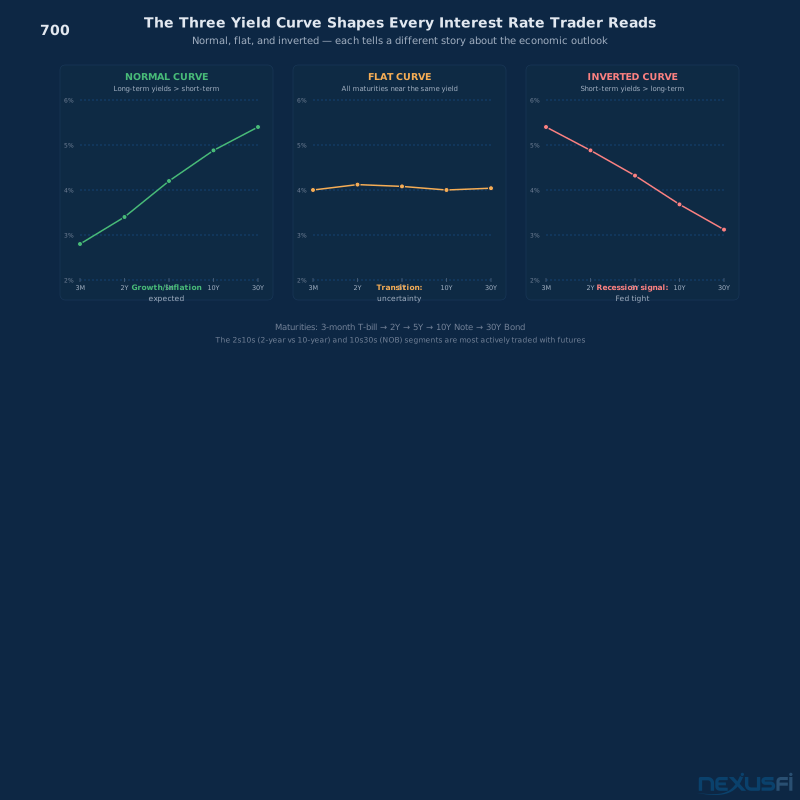
Normal (upward-sloping): Short rates below long rates. The baseline condition. Investors demand a premium for longer-dated bonds to compensate for inflation risk and time uncertainty. The economy is growing, the Fed is accommodative, and credit conditions are healthy. Good regime for ES longs on pullbacks; bonds trend lower slowly.
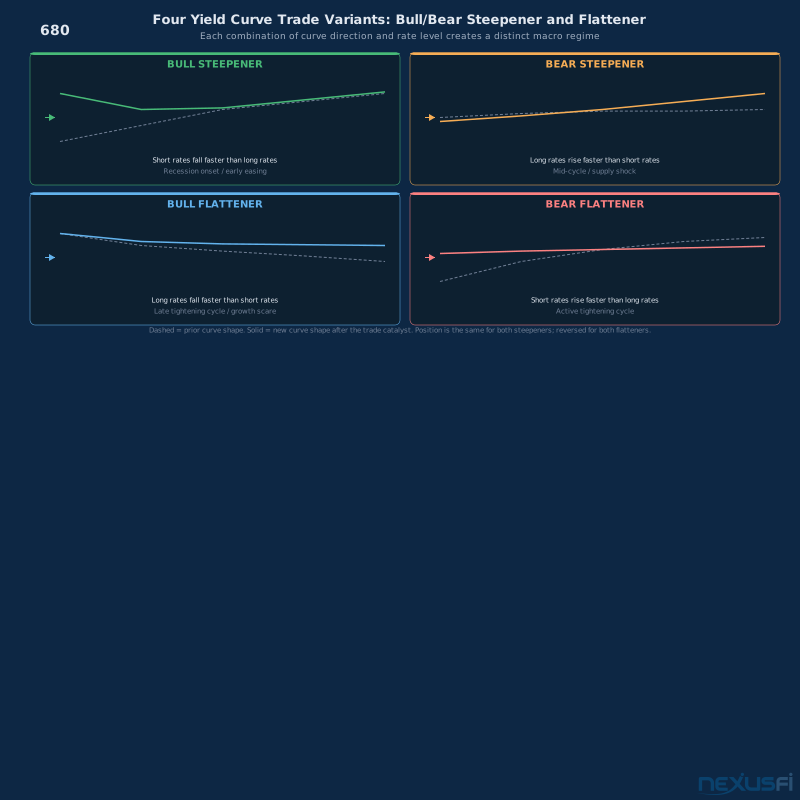
Steep: Long rates rising fast relative to short rates. Can be bull steepening (short end falling faster because the Fed is cutting) or bear steepening (long end rising faster because inflation expectations are climbing). Bull steepening is early-cycle — the most risk-on environment possible; ES loves this. Bear steepening late in a tightening cycle can be equity-hostile if it's driven by inflation fear, not growth optimism.
Flat: Minimal spread between short and long yields. Signals transition — either the Fed is tightening and choking growth expectations, or the market is genuinely uncertain about the trajectory. Flat curves are ambiguous: they're not bullish, but not yet recession signals. Execution quality matters more here; context is thin.
Inverted: Short rates above long rates. The bond market says growth is slowing enough that the Fed will eventually cut. This curve has preceded every U.S. recession since 1955, with a lag of 6-24+ months. The 2s/10s curve inverted in April 2022, remained deeply inverted through 2023, and began un-inverting in late 2024 — a "bull steepening" that historically occurs as recession risk materializes and the Fed eventually pivots.
What Drives Yield Curve Shape #
The Short End: Fed Policy #
The Federal Reserve directly controls the Fed Funds rate, which anchors the short end of the curve. 2-year Treasury yields are basically the market's forecast for where Fed Funds will average over the next two years. When the Fed is hiking, 2-year yields rise. When markets anticipate a pivot to cutting, 2-year yields fall first — often months before the actual cut.
This is why the 2-year is so closely watched. It's not just reacting to what the Fed does today — it's predicting what the Fed will do over the next 24 months. @tigertrader, writing in the Spoo-nalysis thread in late 2014, captured the mechanics exactly: "Nominal 2 year yields have tended to coincide with the nominal growth of GDP, except during QE/ZIRP, of course. If not for the Fed's accommodation, today's 4% nominal GDP would give us 2 year yields of 3.5-4.0%, instead of 0.70. What the curve is saying is that we are not going to see enough growth to get back to this norm again." [1]
The Long End: Inflation + Growth Outlook #
The 10-year and 30-year yields are driven primarily by inflation expectations (what investors demand as compensation for rising prices), supply and demand for long-dated bonds (including Treasury auction results and foreign central bank buying), and growth outlook. The Fed has far less direct control over the long end than most traders assume.
This created what Alan Greenspan famously called a "conundrum" in 2004-2006 — the Fed raised short rates from 1% to 5.25%, but long yields barely moved. The curve flattened dramatically.
[2]
The implication for traders: you cannot assume Fed tightening will automatically raise long rates. If global capital is flowing into U.S. bonds as a safe haven (or for yield differential with foreign bonds), long rates can stay suppressed or even fall while the Fed hikes. This disconnects the curve from its traditional signaling role.
The Belly (5-Year): The Swing Point #
The 5-year sits between Fed policy and long-term growth expectations. It tends to be the most volatile part of the curve during regime changes. Institutional portfolio managers often express duration views in the 5-year because it gives good bang-for-duration-risk while being less sensitive to inflation surprises than the 30-year.
Term Premium: The Wildcard #
Beyond rate expectations, long-term yields include a "term premium" — extra compensation investors demand for holding long-dated bonds instead of rolling over short-term bills. Term premium collapsed to near-zero and even negative during the 2010s as the Fed's QE programs suppressed volatility. When term premium rises (as it did in late 2023), long yields can rise independent of Fed rate expectations — creating bear steepening that confuses traders who only watch the Fed.
The Yield Curve as a Leading Indicator for ES #
The most actionable use of the yield curve for index futures traders isn't about trading bonds — it's about using curve shape to contextualize your ES and NQ setups.
Yield and equities are positively correlated in growth-driven environments. When rates rise because growth is accelerating, equities usually rise with them. This is the normal, healthy correlation. When you see the 10-year yield rising alongside ES, the market is telling you growth expectations are the driver. This is an environment where ES dips are buys.
Yield and equities go negatively correlated when fear dominates. During risk-off episodes, money flows from equities to bonds (flight to quality), sending yields down while equities fall. This is the 2008, 2020 crash environment.
@tigertrader's 2020 analysis during the COVID crash illustrated the yield-equity relationship precisely: "Chart 1 demonstrates the highly positive correlation between equities and the 10Y yield, with the 10Y leading and equities lagging. And, while TNX bounced, it appears to be headed down, perhaps into negative territory, most likely due to deflationary/recessionary concerns." [3]
The leading indicator effect: Changes in the yield curve tend to precede equity inflection points by weeks to months. When the curve begins steepening after a prolonged inversion, it often signals the most acute phase of economic slowdown is approaching — not improving. The classic bull steepening pattern (2-year falling faster than 10-year) in 2019 preceded equity volatility before the Fed's eventual pivot stabilized markets.
[4]
The yield curve gives you something no moving average can: it tells you what the SMARTEST money in the world expects growth and inflation to do over the next 2-10 years. A flat or inverted curve while ES is making new highs is the market's two hemispheres disagreeing. Eventually, one capitulates.
The NOB Spread: Trading Curve Shape Directly #
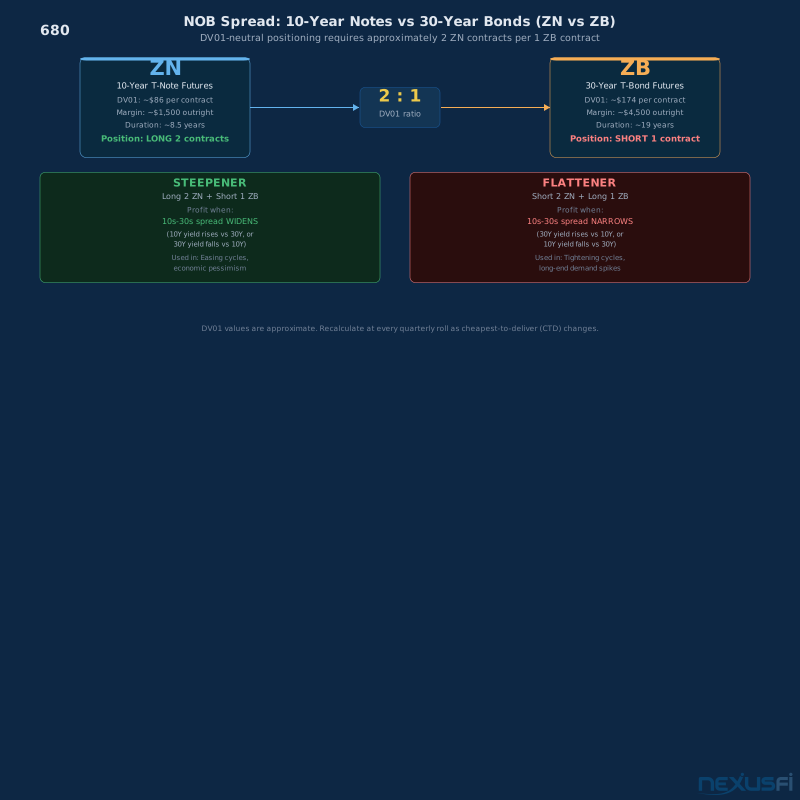
The NOB spread (Notes Over Bonds) is the primary futures vehicle for directly expressing yield curve views. It's the relationship between 10-year Treasury futures (ZN) and 30-year bond futures (ZB), traded as a ratio spread.
Basic mechanics:
- Buy the NOB (long ZN, short ZB): You're betting the curve steepens — specifically that the 30-year yield rises relative to the 10-year yield. ZB prices underperform ZN prices as the spread widens.
- Sell the NOB (short ZN, long ZB): You're betting the curve flattens — ZB outperforms ZN as the spread narrows.
The NOB is traded as a ratio spread to make the position curve-neutral — meaning it responds only to changes in curve slope, not parallel shifts in rates. The standard ratio has historically been approximately 5 ZN contracts to 2 ZB contracts, which matches the dollar value of a 1-basis-point yield change (DV01) across both legs. The actual ratio shifts as yield levels and futures durations change, so check CME's published DV01 tables quarterly.
[4]
What drives NOB entry timing:
- Fed meeting cycle: Curve tends to flatten heading into tightening cycles as the short end rises. The NOB often sells off on hawkish Fed communication.
- Inflation prints: Hotter-than-expected inflation often bear steepens the curve (long end sells off faster). Buy NOB on surprise CPI prints that exceed expectations by 30+ basis points.
- Recession fears: Flight to quality tends to bull-flatten (long end outperforms). Sell NOB in genuine growth scare environments.
- Treasury auction results: Large 30-year auction concessions (poor bids) back up long yields — steepening the curve temporarily. These are often tradeable on the day of long-bond auctions.
Never trade the NOB without accounting for the DV01 ratio. Trading 1 ZN vs. 1 ZB is NOT a curve trade — it's a spread trade with significant directional interest rate exposure. Use the CME's published DV01 tables or calculate (ZN DV01 / ZB DV01) to get the correct hedge ratio before every entry. The ratio changes slowly but does change.
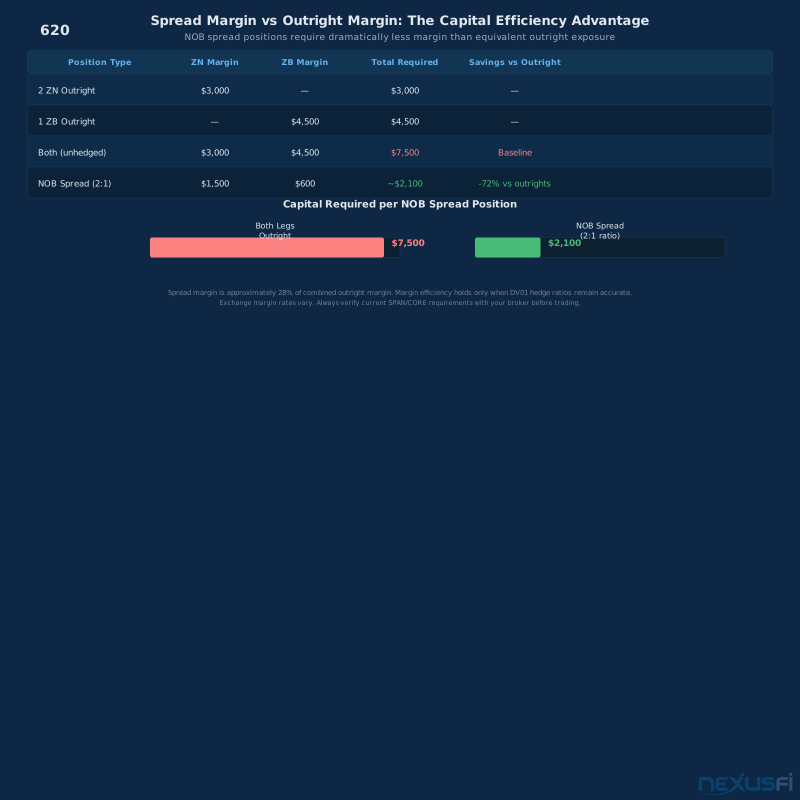
Execution notes for NinjaTrader users: NinjaTrader's platform is not well-suited to spread trading — you must leg into each position separately and cannot place a spread-based stop. Platforms like Trading Technologies (TT) and CQG have native spread order routing. When legging manually, enter the larger-DV01 leg first (ZN) and immediately hit the ZB leg. Use a small limit order offset or accept market fills on the second leg.
Yield Curve and Gold: The Real Rates Connection #
Gold traders need to understand the yield curve for a different reason: real yields. Gold doesn't respond to nominal yields directly — it responds to real yields (nominal yield minus inflation expectations). When real yields fall (inflation expectations rise faster than nominal yields), gold tends to rally. When real yields rise, gold tends to sell off.
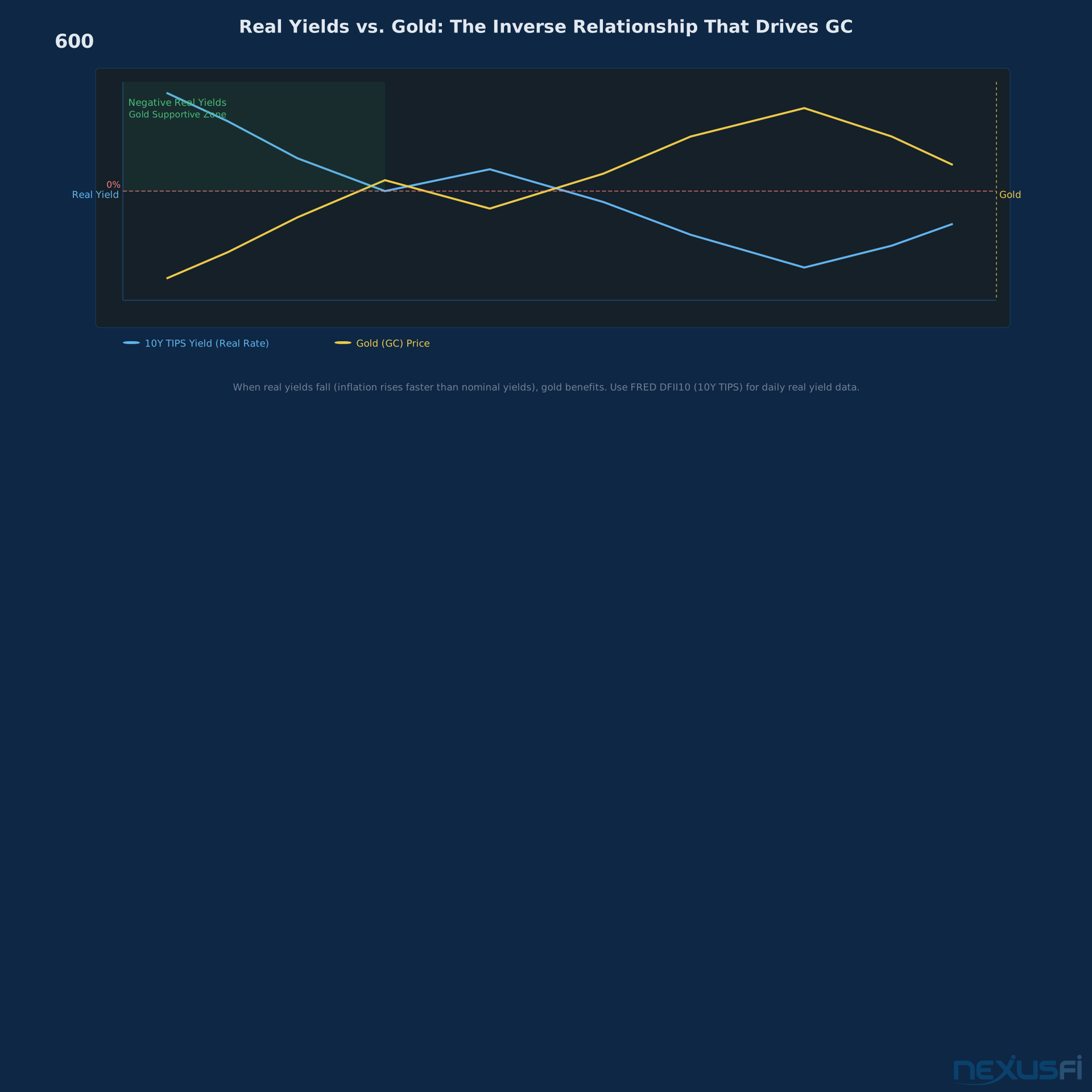
The 10-year TIPS yield is the cleanest proxy for real yields (FRED ticker: DFII10, free and updated daily). The relationship between real yields and gold is one of the most reliable macro correlations in modern markets:
- Real yields near or below zero: Gold supportive or bullish
- Real yields 1%+: Gold faces headwinds
- Real yields rising fast: Most reliably bearish for gold
The yield curve matters here because a flattening curve driven by inflation expectations (the short end rises while the long end stays anchored by low growth expectations) creates exactly the environment where real yields compress — and gold thrives. The 2020-2022 gold surge to $2,050+ coincided with the Fed keeping short rates near zero while inflation expectations climbed, compressing real yields to deeply negative territory.
When the curve eventually inverts AND real yields rise simultaneously — as happened aggressively in 2022-2023 — gold faces maximum headwinds. Nominal yields above inflation expectations mean positive real rates that make gold an expensive opportunity cost.
Flight to Quality: When the Normal Rules Break #
Understanding when equities and bonds correlate positively vs. negatively is one of the most important regime variables for multi-instrument futures traders.
Risk-on, positively correlated (normal): Yields and equities rise together. Bond-stock correlation is positive. Typical during economic expansions where growth is the dominant theme. In this regime, rising ES and rising 10-year yields reinforce each other.
Risk-off, negatively correlated (flight to quality): Equities fall, bonds rally (yields fall). The classic diversifying property that makes bonds a hedge for equity portfolios. The 2008 and March 2020 environments. In this regime, short ES = long ZB works as a paired trade.
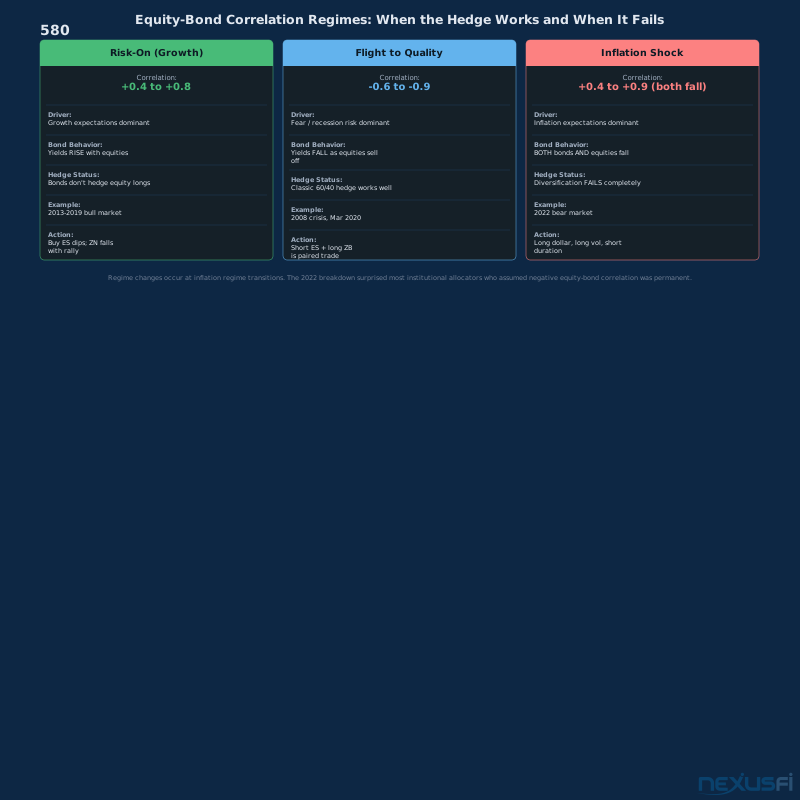
Inflation-driven correlation breakdown: When inflation is the dominant concern, both bonds AND equities sell off simultaneously (yields rise, equity P/Es compress). This was the 2022 regime — the "all-correlated" environment where diversification fails completely. Both long bonds and long equities lost money. The only working hedges were long dollar, long volatility, or short duration.
Monitoring the yield curve's shape and direction tells you which regime you're in:
- Curve steep and steepening + inflation expectations rising = potential correlation breakdown (both may sell off together)
- Curve inverting on growth fears = traditional flight to quality likely (bonds bid, equities weak)
- Curve normalizing from inversion = transitional; uncertainty high; correlation unstable
@Schnook's analysis in the Treasury Notes and Bonds forum captured the leading nature of the 2-year beautifully: "Two year yields peaked at just under 3% about 6 weeks before the final rate hike in 2018, and then started to decline almost 9 months before the first ease. By the time that rate cut happened in August 2019, 2s had already declined to under 2% — substantially lower than the fed funds rate at that time — again leading the move to lower rates." [5]
The equity/bond negative correlation that defined 2000-2020 is NOT a permanent feature of markets. It existed because inflation was low and falling during that period, giving the Fed room to cut rates aggressively in every recession. In high-inflation regimes — the 1970s, early 1980s, and the 2022-2023 cycle — the Fed cannot cut to support equities without accelerating inflation. Multi-leg strategies that assume bonds hedge equities will fail in inflationary downturns. Know which regime you're in before leaning on that correlation.
Practical Application: What Active Traders Watch Daily #
Most futures day traders don't trade bonds directly. But the yield curve provides critical context for your ES, NQ, GC, and CL setups.
Pre-market routine: Check the 2-year yield and 10-year yield before the open. If yields are moving much overnight (more than 3-5 basis points in either direction), that's a signal for directional bias in equities:
- Yields falling sharply overnight: Usually risk-off or flight to quality. ES may gap lower or struggle at key overhead resistance. GC may bid.
- Yields rising sharply with strong equity futures: Growth-driven, buy-the-dip regime likely. Pullbacks to VWAP or value area low are entry opportunities.
- Yields rising sharply while equity futures are flat or lower: Could be inflation-driven; ambiguous and dangerous. Wait for RTH auction to clarify.
Intraday ZN/ES correlation monitoring: On many trading days, ZN (10-year futures) and ES move in opposite directions (negative correlation). On risk-on growth days, they may move together (positive correlation). Identify which regime is active that day. If ZN rallies on economic data and ES also rallies — growth is the driver. If ZN rallies and ES falls — flight to quality or risk-off.
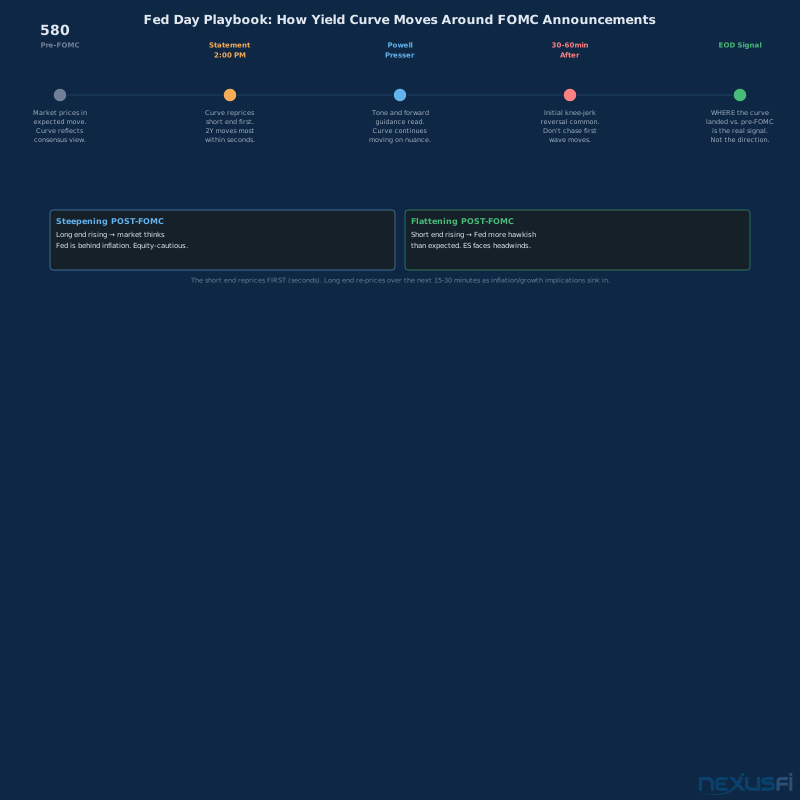
Fed Day protocol: The yield curve gets re-priced dramatically on FOMC announcements. The short end reprices immediately to the new rate path. The long end reprices based on the market's assessment of what that path implies for inflation and growth. What the curve does AFTER the initial move is the signal: if the curve steepens on a rate hike (long end backing up), the market thinks the Fed is behind inflation. If it flattens on a hike, the market thinks the Fed is aggressively ahead of inflation and may slow growth.
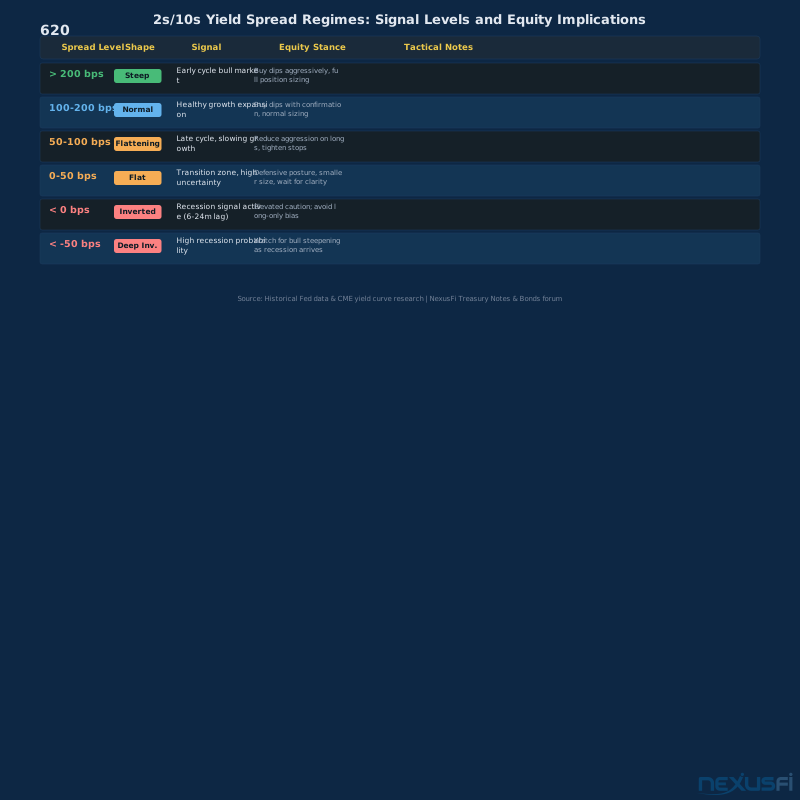
Key 2s/10s curve levels to know:
| Spread Level | Signal | Equity Implication |
|---|---|---|
| > 200bps | Strongly steep | Early cycle bull market; buy dips aggressively |
| 100-200bps | Normal | Healthy growth; buy dips with confirmation |
| 50-100bps | Slightly flat | Late cycle; reduce aggression on longs |
| 0-50bps | Flat | Transition zone; uncertainty; defensive posture |
| < 0bps | Inverted | Recession signal active; lag 6-24 months |
| < -50bps | Deeply inverted | Elevated recession probability; eventually bull steepens hard |
Watching the un-inversion: When a deeply inverted curve begins to steepen back toward zero, this bull steepening phase is actually the most dangerous period for equities — it often coincides with the economy actually slowing and the Fed beginning to cut. Counter-intuitively, the yield curve "improving" (less inverted) often comes with equity deterioration as the recession that was being priced finally arrives. @tigertrader's note in September 2014 captures the dynamic: "I would look for bonds to lead the way and begin to sell off in advance of the reports, as they look weak relative to equities and the dollar, and the yield curve to steepen." [6]
Regime Recognition Framework #
Use this decision tree before the RTH open:
Step 1: What is the 2s/10s spread doing over the past week?
- Steepening: Risk-on tendency; buyer-initiated setups get preference
- Flattening: Risk-off tendency; fading moves to resistance gets preference
- Stable: Neutral; use other context inputs
Step 2: Is the curve steepening driven by the front end or back end?
- Front end falling (bull steepening): Fed cut expectation growing; most bullish regime for equities
- Back end rising (bear steepening): Inflation concern or growth surprise; neutral to cautious for equities
- Front end rising faster (flattening): Fed tightening more than expected; most equity-hostile curve regime
Step 3: Check real yields (10-year TIPS yield)
- Real yields falling: GC bullish; ES neutral to positive
- Real yields rising sharply: GC headwinds; equity P/E compression risk
Step 4: Cross-check with credit spreads (HYG/LQD ratio or high yield OAS)
- Credit spreads tightening + curve steepening: Goldilocks; buy dips aggressively
- Credit spreads widening + curve flattening: Stress building; reduce risk, smaller size
This framework doesn't replace your technical setup — it contextualizes it. A strong volume profile setup at VAL on a day when the yield curve is bull steepening and credit spreads are tightening gets full size. The same setup on a day when the curve is aggressively flattening after a hot CPI print gets half size or a pass.
When the Yield Curve Gets It Wrong #
The yield curve is a powerful signal, but it has documented failure modes:
QE/QT distortions: When the Fed is actively buying or selling Treasuries, the curve gets distorted in ways that obscure its natural information content. During QE, the Fed's purchasing of long-dated bonds suppresses long yields artificially, making the curve appear steeper (more growth-positive) than market fundamentals justify. During QT (2022-2023), the reverse: the Fed reducing its balance sheet added supply to the long end, contributing to bear steepening even as recession fears built.
Foreign central bank flows: When overseas central banks (especially the Bank of Japan, People's Bank of China) are buying U.S. Treasuries in size, they suppress long-end yields independent of U.S. economic conditions. This creates the "Greenspan Conundrum" scenario — nominal yields stay low even as growth accelerates.
Inverted-stays-inverted problem: The 2022-2024 inversion was the deepest and longest in modern history — over 26 months by mid-2024. It stayed inverted without triggering a recession for over two years. The lag between inversion and recession has varied from 6 months to 24+ months historically. Treating inversion as an immediate recession signal has cost equity bears enormous opportunity cost. The curve signals direction and eventual destination, not timing.
Zero lower bound dynamics: At near-zero short rates, the curve cannot steepen in the traditional way because the short end is already pinned. This creates environments where traditional curve signals lose predictive power — the 2011-2021 period required much more nuance in interpreting curve signals.
The yield curve is a macro context tool, not a trade signal. Use it to understand the regime — normal vs. stressed, growth vs. inflation, flight to quality vs. risk-on — and let it inform how aggressively you follow your directional setup. A strong volume profile setup at a key level performs differently in a bull-steepening curve environment (growth-on) vs. a flattening curve environment (recession risk building).
Yield Curve Data Sources #
Free daily data:
- FRED (St. Louis Fed): Search "USYC2Y10" for the 2s/10s spread, or individual series like "DGS10" (10-year yield) and "DGS2" (2-year yield). Available daily at fred.stlouisfed.org
- TreasuryDirect.gov: Daily yield curve data in CSV format with full maturity history
- CME Group: Real-time ZN and ZB quotes; historical data via CME DataMine
Real-time monitoring:
- CME FedWatch Tool: Shows rate cut/hike probabilities priced into Fed Funds futures — the market's live bet on the next FOMC moves
- SOFR futures (SR3): Replaced Eurodollar futures in 2023 as the primary short-rate futures market; show market expectations for the full path of short-term rates two years forward
For NOB spread traders:
- CME publishes DV01 tables quarterly — use these to ensure your NOB ratio is correctly sized for dollar-neutral curve exposure
- The 5:2 ZN:ZB ratio is a historical approximation; the actual ratio shifts as yield levels and futures durations change over time
Knowledge Map
Go Deeper
Build on this knowledgeReferences This Article
Articles that build on this topicCitations
- — Spoo-nalysis ES e-mini futures S&P 500 (2015) 👍 25
- — Spoo-nalysis ES e-mini futures S&P 500 (2016) 👍 46
- — Spoo-nalysis ES e-mini futures S&P 500 (2020) 👍 35
- — Spoo-nalysis ES e-mini futures S&P 500 (2020) 👍 20
- — Treasury Notes and Bonds Forum (2021) 👍 32
- — Spoo-nalysis ES e-mini futures S&P 500 (2015) 👍 76
- Federal Reserve Bank of St. Louis — 10-Year Treasury Constant Maturity Minus 2-Year Treasury Constant Maturity (T10Y2Y)
- CME Group — 10-Year U.S. Treasury Note Futures (ZN) Contract Specifications