



Intraday Seasonality in Futures Trading: Reading the Day's Rhythm to Trade with Institutional Flow
The futures market doesn't trade the same way at 9:35 AM as it does at 12:45 PM. This isn't random — it's structural. The same institutional forces that move prices in the morning, the same algorithms that go passive at lunch, the same rebalancing flows that create the closing push — these are present every single day. Not because of conspiracy, but because the participants who move markets have schedules, risk limits, and operating hours that create predictable rhythm.
Intraday seasonality is the study of these recurring time-of-day patterns. For futures traders, understanding when the market is likely to expand, trend, chop, or mean-revert is as important as knowing the structural levels on the chart. A breakout setup at 11:45 AM faces a completely different probability environment than the same setup at 9:45 AM — same pattern, different session context, different expected outcome.
The research is real. @Fat Tails conducted a 50-week study of ES intraday volatility and documented the exact hour-by-hour rhythm in the NexusFi Elite Circle. [1] @tigertrader mapped seven distinct session periods on ES and showed how each has its own microstructure. [3] @treydog999 ran 10 years of ES data to quantify directional bias by session. [5] What they found wasn't a trading system — it was a context filter that makes every other system sharper.
This article gives you the complete framework: the six sessions of the trading day, when daily highs and lows form, contract-specific differences between ES, NQ, and CL, how economic calendar events reset the intraday rhythm, and day-of-week patterns that matter. The goal is not to predict time. The goal is to understand what the market is likely to do at any given hour so you can size correctly, avoid traps, and trade with — not against — the session's character.
Overview #
Why Session Structure Matters
Institutional participants don't trade uniformly across the day. Their behavior clusters around cash market opens, macro release windows, portfolio rebalancing deadlines, and end-of-day hedging needs. These institutional clocks create a daily rhythm that repeats — not perfectly, but with enough consistency to be exploitable as a context filter.
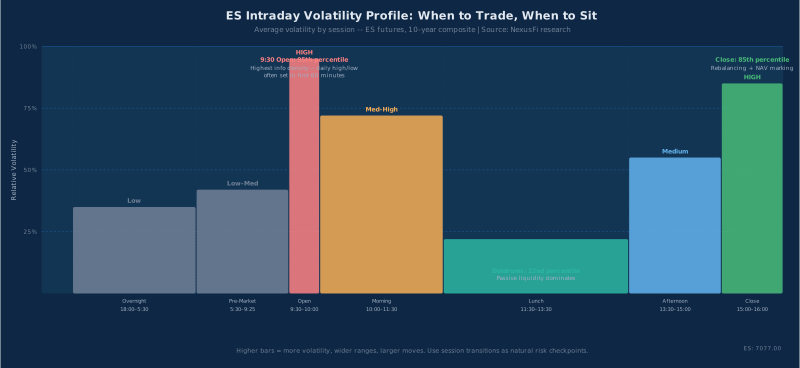
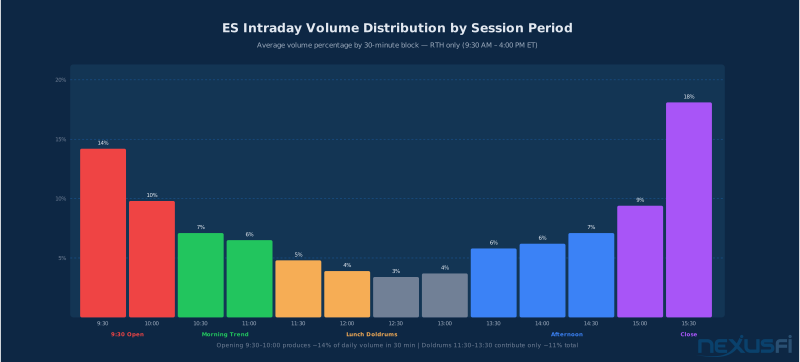
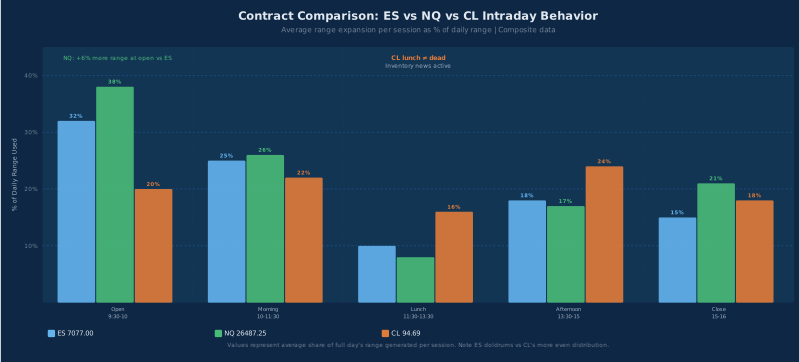
The key insight from @Fat Tails' research is that volatility isn't uniformly distributed across the session. [1] The opening 30 minutes (9:30-10:00 ET) produce roughly 32% of the average daily range in ES despite representing only 8% of the session by time. The lunch period (11:30-13:30) produces 10% of the daily range over two full hours. These aren't marginal differences — they're structurally different environments requiring different strategies.
The Six Sessions of the Futures Trading Day #
Session 1: Overnight / Globex (18:00-5:30 ET)
Thin liquidity, wider spreads, more susceptibility to stop runs and single-print moves. Overnight action is dominated by Asian and European participants responding to global macro events and headlines. The moves can be clean but carry higher gap risk.
What the overnight gives you is context. Overnight highs and lows become critical reference points for the US session. When price opens below the overnight low, you're seeing something — acceptance of the move, not rejection. When the opening drive runs directly into the overnight high, the probability of a fade increases. The overnight session doesn't trade well for most retail futures traders, but reading it correctly sets up the rest of the day.
Session 2: Pre-Market / European Overlap (5:30-9:25 ET)
Liquidity improves as European participants are active and US pre-market begins. This period often establishes early directional bias and initial value area formation. European participants can drive meaningful moves before the US cash open, especially in ES and NQ. Watch for pre-market fake moves — sharp thrusts that reverse into the 9:30 open are a common pattern, especially when they overshoot key overnight reference levels.
Session 3: Cash Open (9:30-10:00 ET)
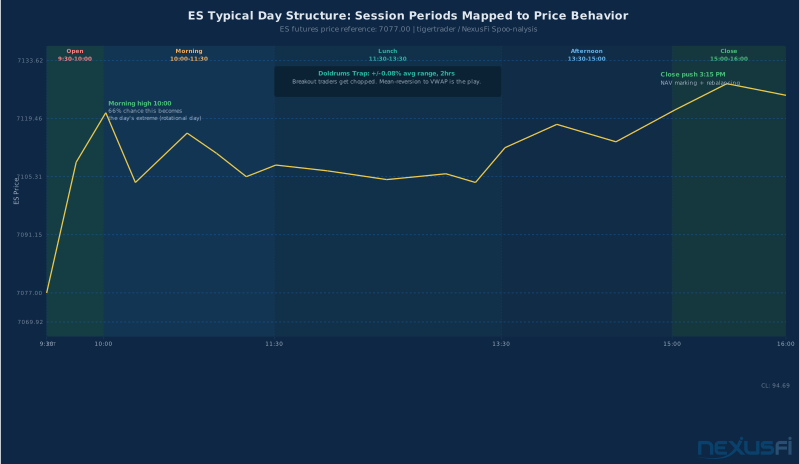
The most information-dense 30 minutes of the entire session. Cash equities open, ETF flows hit, program buying and selling surge, stops above and below overnight levels get tested. This is where institutional participants with urgency show their hand. The opening auction often determines the day's primary direction.
Common behaviors: opening drive continuation, failed opening drive reversal, overnight extreme rejection, VWAP reclaim or reject. @Fat Tails documented that on Thursdays specifically, there is a 66% probability that the high or low of the day is made during this first 30-minute window. [2] That's not a fringe statistic — it's a structural tendency from scheduled economic data at 8:30 ET feeding directly into the opening surge.
The trap here is treating the first move as definitive. Often it isn't — the opening is a liquidity sweep first, genuine directional signal second. The best opening trades wait for the initial stop-run to complete and then enter on the secondary move confirming the direction.
Session 4: Morning Trend Window (10:00-11:30 ET)
The best continuation window of the day. If the opening drive established a genuine direction — meaning it cleared key levels, attracted follow-through volume, and the breadth confirms — the morning session is where that move extends. This is when momentum setups and pullback entries work best.
Institutional participants are still fully active. News is being digested. Positioning is being established. If a breakout is going to hold, it holds here. If the morning is going to produce a trend day, the trend begins to take shape in this window. @tigertrader's framework identifies this as the primary directional window where vertical timeline markers confirm or invalidate the opening move. [4]
Session 5: Lunch / Doldrums (11:30-13:30 ET)
The most dangerous period for the unprepared trader. Volume collapses. Spreads widen slightly. Major players are at lunch or managing risk passively. The dominant force is passive liquidity providers, not institutional directionality. Moves look meaningful but often aren't. Breakouts set up but don't follow through. Ranges that should hold get violated without consequence.
@Jeff Castille called it the Dead Zone: "Lack of participation by the major players because they are eating lunch. Take a break during this time." [7] @treydog999's 10-year study confirmed the doldrums and close have "no meaningful movement in either direction — to me this means they are going to be sloppy and choppy." [5]
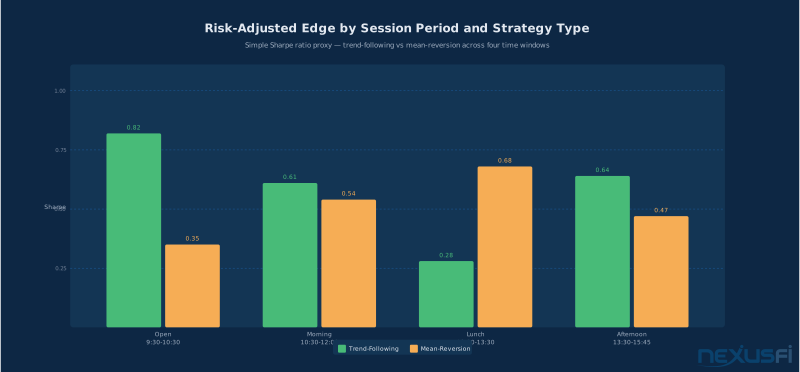
The correct approach during the doldrums: fade stretched extremes back to VWAP and value. If ES has pushed 8-10 handles above VWAP in the morning and volume collapses, the lunch mean-reversion is a high-probability play. Don't force breakouts. Don't try to catch the next leg of a trend that ran out of institutional fuel.
The doldrums are most pronounced on Tuesdays and Wednesdays — the "anchor days" of the week when institutional participants are fully engaged in weekly positioning but haven't yet shifted to Thursday/Friday data events. If you're going to practice avoiding the lunch window, start on those days.
Session 6: Afternoon / Close (13:30-16:00 ET)
Split into two distinct sub-periods. The early afternoon (13:30-15:00) can produce a second directional leg when conditions are right — especially when morning direction was strong but created an oversold/overbought extreme that gets resolved. Portfolio managers and systematic funds adjust exposure based on the day's narrative. End-of-day NAV marking begins around 15:00.
The close window (15:00-16:00) is the second-highest volatility period of the day. Mutual funds must execute before the NYSE close, index ETFs rebalance, and closing auction mechanics create predictable flows. @josh noted in Spoo-nalysis that "the middle of the day has accounted for a 5.6% cumulative increase — more than double that of the other two thirds of the trading day combined," emphasizing how the closing period punches above its weight. [6]
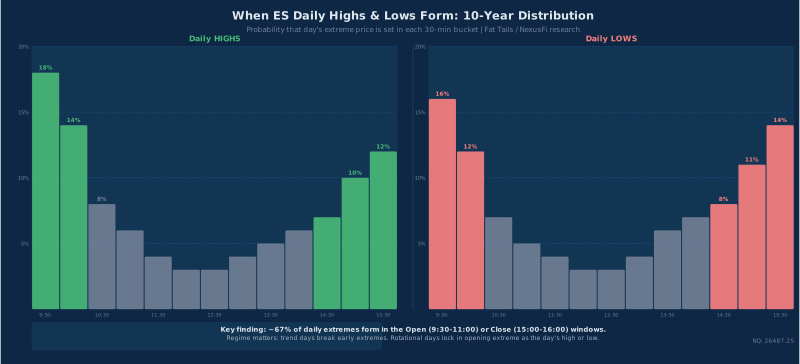
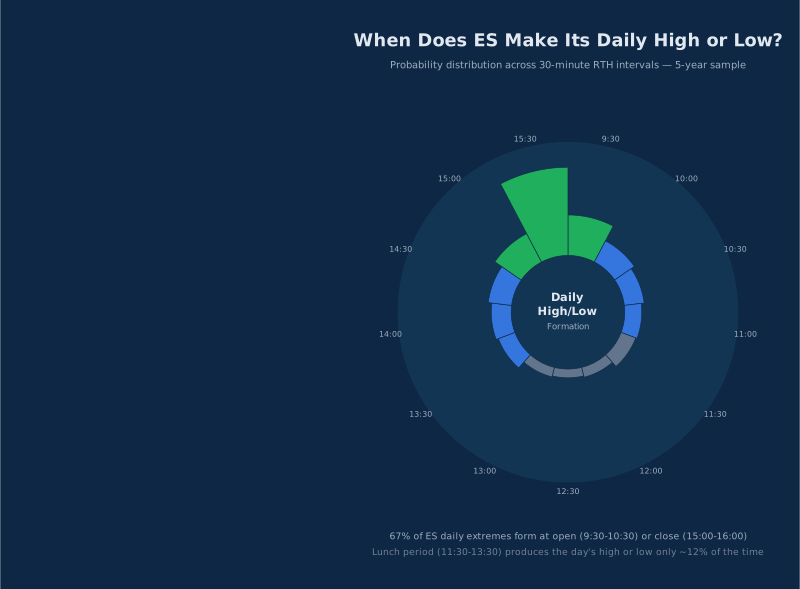
One of the most practically useful pieces of intraday seasonality research is the distribution of when daily highs and lows form. If you know statistically that 67% of ES daily extremes form within the first 90 minutes or the final 60 minutes of the session, that shapes everything from stop placement to how long you hold a morning trade to whether a midday breakout deserves full size.
@Fat Tails analyzed 50 weeks of ES data and found that Thursday extreme formation is heavily front-loaded: 66% probability the high or low of the day is made in the first 30 minutes, driven by the 8:30 ET economic release window. [2] Tuesday is the most back-loaded, with the lowest probability of early extreme formation and a 36% chance the second high or low forms between 3:30-4:00 PM.
When Does the Daily High Form #
@"[My charts show] the probability that the high or low occurs within any of the 30 minute period of the RTH sessions. Results are interesting. For [ES], about 66% of the highs and lows occur in the first 30 minutes or in the last 60 minutes of the RTH session." — @Fat Tails, Intraday Seasonality Volatility thread (2010)
The Opening Window
The first 30-60 minutes produce the highest concentration of daily extremes across all contracts. This isn't coincidence — it reflects maximum information arrival density. Every participant who needs to respond to the overnight, to pre-market positioning, to the opening gap, or to early macro data does so in this window. The result is maximum price discovery efficiency, which often creates extremes that define the day's range.
The practical implication: don't assume the opening extreme will hold. On trend days, it doesn't — the early extreme becomes one pole of an expanding range. On rotational days, it often does — the opening push exhausts, pulls back to value, and the first extreme becomes the day's high or low for good.
Regime-Dependent Extreme Formation
The most important caveat in extreme formation research is regime dependency:
- Trend days: Early extreme is often broken. Price establishes a direction and extends all day. The first high might only be 30% of the eventual range.
- Rotational days: Opening extreme frequently holds. Morning high is the day's high. Morning low is the day's low. Everything between is noise.
- Event days (CPI, NFP, FOMC): First extreme post-release often gets reversed. The initial spike is frequently a liquidity sweep, not the true direction. More on this in the Economic Calendar Events section.
- High-volatility macro trend days: Opening high or low can actually be the opposite extreme from where price ends the day.
This regime dependency is why raw "67% in the opening window" statistics require context. A Wednesday with moderate volatility and no scheduled releases behaves very differently from an NFP Thursday. The base rates matter, but only within the correct regime filter.
The Closing Window Matters More Than Most Traders Realize
The 15:00-16:00 window is disproportionately productive for extreme formation and trend continuation. Institutional rebalancing, index arbitrage activity, mutual fund order deadlines, and closing auction mechanics all concentrate volume in ways that produce real directional moves — not noise. Traders who close all positions by 2:30 PM to "avoid the close" are systematically avoiding one of the highest-quality statistical windows in the session.
How the Day Unfolds #
The Opening Drive: Real or Fake
The first question every session is whether the opening drive is genuine or a liquidity sweep. Genuine drives: high volume at the break, no return to the break zone, new value being established above or below the prior close. Liquidity sweeps: quick move that clears stops at obvious levels, sharp reversal within 5-15 minutes, volume that spikes but doesn't sustain.
The opening drive is more likely genuine when:
- It aligns with the overnight trend (same direction as the pre-market move)
- Market internals (TICK, breadth) confirm the direction
- Volume is elevated and sustained through the first 15 minutes
- It breaks a key structural level (overnight high/low, prior day close) and holds above/below on a retest
The opening drive is more likely a sweep when:
- It reverses within 5-10 minutes with volume drying up
- Breadth doesn't confirm (ES moves up but declining issues outpace advancing)
- It's hitting an obvious stop cluster at a round number or prior day extreme
- Pre-market was choppy and directionless
The Morning Trend Window: Staying With It
When the opening drive is genuine, the morning trend window (10:00-11:30) rewards continuation traders who can identify the first quality pullback. The structure is: opening drive establishes direction, initial pullback creates entry opportunity, secondary move extends toward the day's target.
The mistake is over-trading. After a genuine opening drive, traders who flip direction at every wiggle during the morning session consistently underperform those who identify the dominant direction and hold through normal pullbacks. The morning trend window has above-average trend persistence — a useful property for reducing whipsaw by staying directionally committed until structure says otherwise.
@"I have a very specific trading window, being the 30-90 mins since the open (10am-11am). This is not statistically or backtest driven window, but I feel I trade better in this window as I've habituated to reading the market tape during this period." — @GruttePier, Trading Journal (2018)
The Doldrums Trap
The transition from morning to lunch is where most retail futures traders leave money on the table — not by losing it directly, but by giving back morning profits in the low-conviction grind of the doldrums period. The ES is averaging roughly +/- 0.08% of price range per hour during the doldrums vs +/- 0.45% during the opening session. That's a 5x difference in hourly range.
Specifically, the doldrums trap looks like this: A trader has a profitable morning position, the doldrums begin, chop develops, small wiggle hits their stop, they're out flat (or worse, they re-enter and get chopped again). By 1:30 PM they've turned a +8 handle gain into a -2 handle loss. The solution is simple: tighten risk dramatically after 11:30, or close the position and wait for the afternoon session to develop structure.
The Afternoon: Second Leg or Distribution
The afternoon session (13:30-15:00) can go two ways. If the morning trend was strong with genuine institutional backing, the afternoon often provides a continuation leg after the doldrums consolidation. Institutions who didn't execute their full morning allocation use the afternoon to complete. This creates a second directional push that can be as large as the morning move.
Alternatively, if the morning was a sharp move on thin volume or news-driven, the afternoon distributes. The morning extreme holds, price grinds back toward VWAP, and the close ends near the day's midpoint. Breadth confirmation during the doldrums period is a leading indicator of which scenario plays out.
Day-of-Week Volatility #
Monday
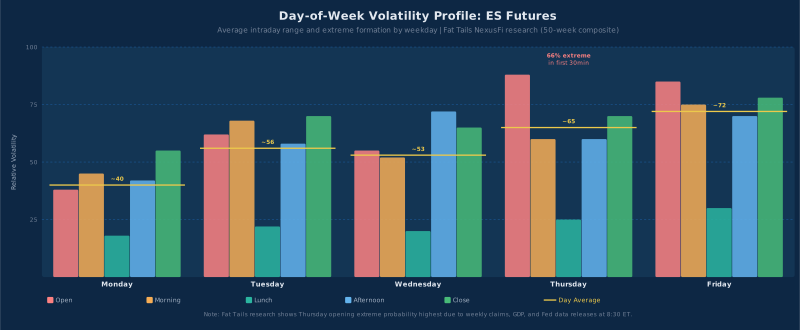
Lowest overall volatility of the week. Limited news, reorientation after the weekend, participant hesitancy. The opening surge is smaller than any other day. Not well-suited to opening range breakout strategies because the initial move lacks conviction. Best trading time: 9:30-10:30, after which the session often dies down. Not a good day to be aggressive.
Tuesday
Volatility remains good through 11:30 AM then settles down. The close has elevated probability of producing the second daily extreme (36% chance of second high or low between 3:30-4:00 PM per Fat Tails' research). [2] More suitable for intraday trend-following than Monday.
Wednesday
Less morning volatility than Tuesday, but notable afternoon surge after 14:00 CT. Wednesday afternoons are more conducive to trending moves than Tuesday afternoons — possibly because Wednesday sees FOMC-related flows on meeting weeks and systematic positioning into the mid-week. If there's a FOMC meeting scheduled, Wednesday is the day the entire intraday structure gets reorganized around the 2:00 PM statement.
Thursday
Highest opening volatility of the week, driven by 8:30 ET weekly economic data: weekly jobless claims, GDP on reporting weeks, and occasionally housing data. The 66% probability that the daily extreme forms in the first 30 minutes makes Thursday a dangerous day for traders who short the first move — the opening thrust often becomes the day's pole. Volatility then settles but remains elevated compared to Monday and Tuesday. Get in early or wait for the post-release structure to stabilize.
Friday
Highest overall volatility of the week. The Friday morning routine: employment situation on the first Friday, then retail sales, then other high-impact data, all at 8:30 ET. These reports move markets decisively, and the Friday dynamics are amplified because institutional participants are managing risk into the weekend. Position squaring creates powerful directional moves, but also sharp reversals as participants cover before the weekend gap risk.
The practical application of day-of-week patterns: know that Thursday and Friday opening moves are more likely to be data-driven and durable. Know that Monday morning moves are more likely to be low-conviction and reversible. Size so.
Major economic data releases — CPI, NFP, FOMC statements, retail sales, ISM, GDP — don't just affect the market, they reset it. After a significant release, the intraday seasonality framework temporarily breaks. The session structure, the typical time-of-day tendencies, the VWAP anchoring behavior — all of it suspends while the market digests genuinely new information.
Understanding how to work through around events is as important as understanding the normal session structure, because events don't just spike volatility — they create regime transitions that define the rest of the day.
Economic Calendar Events #
The Volatility Reset Model
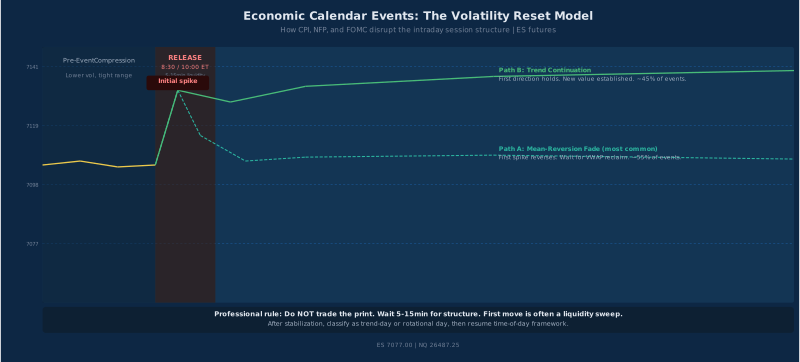
The professional approach to economic releases treats each one as a volatility regime reset, not a normal price event. Three phases:
Phase 1: Pre-Event Compression
The 20-30 minutes before a major release often show compressed range, declining volume, and increasingly passive order book as participants step back to avoid adverse selection. This compression is a setup, not a signal. Don't trade it directionally. Use it to identify the key reference levels that will matter after the release (overnight high/low, prior day levels, VWAP).
Phase 2: Initial Spike (The Liquidity Sweep)
The first 5-15 minutes after release are, more often than not, a liquidity sweep rather than the true directional move. Price accelerates in one direction, clears stops at obvious levels, and then frequently reverses. Studies show the first extreme post-release is reversed more than 55% of the time in ES on high-impact releases. The traders who get hurt most are those who enter on the initial spike direction — they buy the top of a spike that's about to reverse.
Phase 3: True Directional Establishment
After the initial spike completes — typically 5-20 minutes after the release — the genuine institutional positioning begins. This is when the directional signal emerges. Value is being accepted or rejected, VWAP is being reclaimed or abandoned, and order flow confirms or denies the initial reaction. This phase determines whether the day becomes a trend day or a rotational day around the release level.
Event Day Classification Protocol
Professionals classify event days into archetypes before resuming their intraday framework:
- Trend day: Release drives a clean directional move, internals confirm, first extreme doesn't hold as the day's limit. Use morning trend window approach.
- Rotational day: Price spikes on the release, reverses, settles into a range centered near the pre-release price. Fade extremes approach.
- Gap-and-go: ES gaps much on the release, holds above/below the gap, extends all day. Ride it.
- Gap-and-fade: ES gaps on the release but immediately begins filling the gap. The opening drive is the high or low.
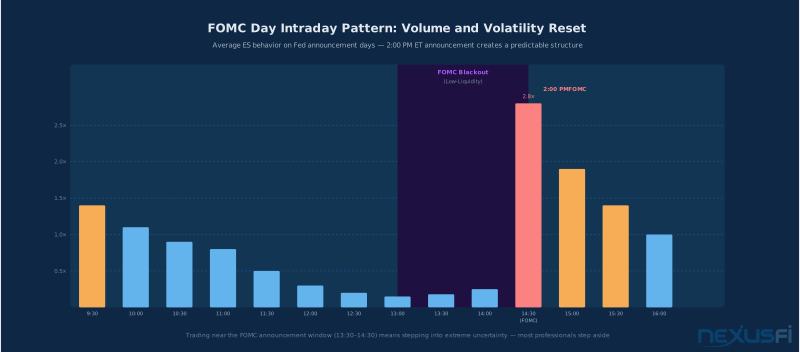
On FOMC days, the entire pre-announcement period (roughly 12:00-14:00 ET) is effectively an extended lunch lull with heightened risk. Spreads widen, volume collapses, and the normal intraday patterns break down completely. Most experienced traders step aside entirely until 30 minutes after the 2:00 PM announcement.
The FOMC Protocol
FOMC days (typically the first Wednesday of every other month, 2:00 PM ET announcement) are their own special case. The entire morning session behaves differently — compressed range, institutional hesitancy, unusually passive order books. After the 2:00 PM statement, the same three-phase model applies but with extreme magnitude. The initial spike on a FOMC decision can be 15-20 handles in ES in under a minute. The reversal, when it comes, is equally violent.
The professional rule for FOMC: Do not have an opinion before the statement. Have a playbook. Know what a hawkish surprise looks like vs expectations, know what a dovish surprise looks like, and have entry criteria for each. The worst FOMC trades are those where a trader guesses the outcome and positions before the announcement, then gets caught in the spike in the wrong direction.
High-Impact Events to Flag Every Week
- Monday: ISM Manufacturing (first Monday of month)
- Tuesday: JOLTS, consumer confidence, Case-Shiller
- Wednesday: ADP employment (first Wednesday), ISM Services, FOMC statement (alternating months)
- Thursday: Weekly jobless claims, GDP (quarterly), housing data
- Friday: NFP employment (first Friday), retail sales, University of Michigan confidence
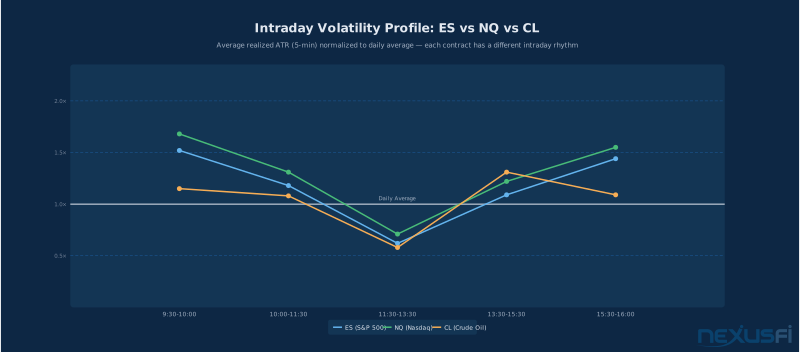
The six-session framework applies broadly, but each major contract has distinct intraday characteristics that alter how you apply it. Using ES patterns mechanically in NQ will get you hurt. Understanding why each contract is different is as important as the shared framework.
ES vs NQ vs CL #
ES (E-mini S&P 500): The Clean Structure Contract
ES is the most VWAP-anchored, most mean-reverting major futures contract. It tends to respect value area structure, honor prior day reference levels, and produce clean session transitions. When ES makes a directional opening drive, it's more likely to consolidate near the end of that drive than NQ, and it's more responsive to VWAP and volume profile support/resistance.
ES session characteristics:
- Stronger mean-reversion tendency during doldrums vs NQ
- More reliable VWAP behavior -- price returns to VWAP more predictably
- Opening range breakouts have higher follow-through probability when market breadth confirms
- The 10:00-11:30 morning window is the most reliable trend continuation window
- Afternoon session is often a directional extension of the morning (same direction) or mean-reversion to prior value area
For most retail traders developing intraday seasonality intuition, start with ES. It's the most forgiving contract in terms of false signals and the most studiously documented by the NexusFi community.
NQ (E-mini Nasdaq): The Beta Amplifier
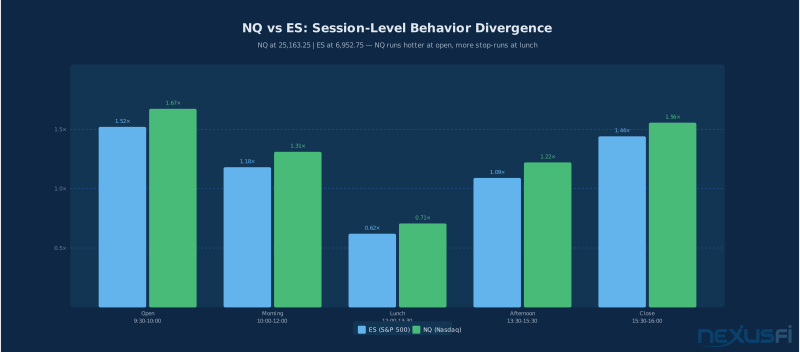
NQ runs hotter than ES in every dimension. Larger moves in both directions, more violent reversals, more sensitivity to rates and tech sector sentiment, more pronounced momentum on trend days. The same session structure applies, but with different magnitudes:
- Opening moves in NQ are ~1.5-2x the ES equivalent in point terms and often in percentage terms
- NQ is more sensitive to real interest rate moves -- when the 10-year yield spikes or drops sharply, NQ reacts more violently than ES
- Doldrums period in NQ is slightly less reliable for mean-reversion because NQ can trend through what would be a dead zone in ES
- The morning trend window in NQ produces the largest returns per unit of time of any session, but also the largest losses when the trend is wrong
- NQ false breakouts are costlier because the velocity of reversals is higher
The practical implication: NQ rewards traders who correctly identify trend days and punishes those who apply ES-style tight stops to it — the normal NQ oscillation is larger and requires wider risk parameters to allow the trade to breathe.
CL (Crude Oil): The Event-Driven Contract
CL operates on a different clock than equity index futures. The equity cash market open at 9:30 ET is largely irrelevant to crude oil pricing. Instead, CL is driven by:
- EIA weekly petroleum inventory (Wednesday 10:30 AM ET): The most important recurring data point in CL, capable of driving 3-5% intraday moves
- API inventory (Tuesday 4:30 PM ET, after-hours): Sets overnight direction into the EIA report
- Geopolitical events: Supply disruption news moves CL in ways that have nothing to do with time of day
- OPEC communications: Production decision releases can override the entire session structure
CL's "lunch doldrums" are less pronounced than ES/NQ because energy markets can receive significant news at any hour — a pipeline disruption in the Middle East at noon ET is a real event, unlike a 12:30 PM move in ES which is more likely noise. @treydog999's data showing the ES lunch as a dead zone doesn't transfer cleanly to CL.
For CL session trading: the early morning is influenced by European trading and overnight oil news. The 9:30 AM US open creates a modest alignment effect with equity risk-on/risk-off flows. The EIA inventory window (10:30 AM Wednesday) is the intraday extreme for that day's session, full stop. Plan the rest of the CL Wednesday around the inventory number, not around the normal session framework.
Which Contract to Start With
Start with ES. It has the cleanest session structure, the most responsive VWAP behavior, and the best-documented community research base. Once you can read the ES day reliably, NQ adds amplitude to the same rhythm while CL runs on a different clock entirely.
The framework is only useful if it changes what you do. Here's how to integrate intraday seasonality into a practical trading approach without making it a mechanical system or a crutch that prevents you from responding to what's actually happening.
Applying Intraday Seasonality to Your Trading #
Step 1: Know Your Session Before You Trade It
Every morning before the session, answer three questions:
- Is there a scheduled economic release today that resets the intraday structure? (Check the calendar: CPI, NFP, FOMC, ISM, claims)
- What day of the week is it and what does that mean for the opening behavior?
- What is the overnight context? (Gap up/down vs prior close, overnight range, key reference levels)
These three inputs tell you what kind of day you're entering before the first trade is considered.
Step 2: Size to the Session Character
The most direct application of intraday seasonality is position sizing by time period:
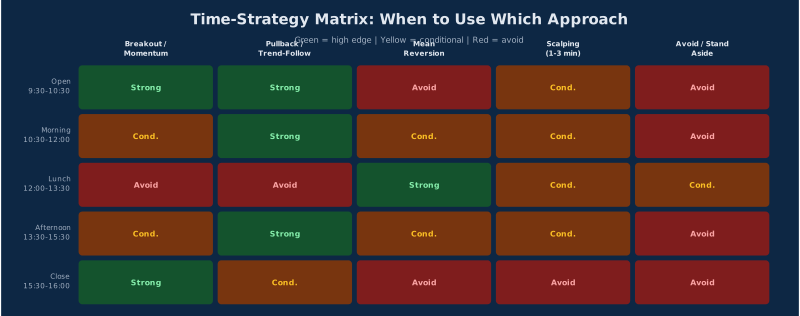
- Opening session (9:30-10:00): Full size is appropriate IF you wait for genuine opening drive to establish. Half size or no size if you're fading the opening drive, which reverses frequently.
- Morning window (10:00-11:30): Full size on continuation setups. This is the window with the best trend persistence.
- Doldrums (11:30-13:30): Reduced size only. Mean-reversion only. No breakout trades at full size in this window -- the probability statistics don't support it.
- Afternoon (13:30-15:00): Return to standard sizing only after the afternoon structure establishes a direction with volume confirmation.
- Close (15:00-16:00): Standard to full size -- this window has real directional moves. Don't abandon your desk at 2:30.
Step 3: Match Your Strategy to the Session
Different strategies have different probability profiles by session:
- Opening range breakout: Best in the first 60 minutes. Use with confirmation from VWAP positioning and market breadth.
- Failed auction / reversal: Best at the opening extreme and at the first failure in the morning window.
- VWAP mean reversion: Best during doldrums and when morning trend has clear exhaustion signals.
- Pullback continuation: Best in the morning window (10:00-11:30) after a genuine opening drive.
- Close fade: Works when early day established a clear trend that becomes overextended into the close.
Step 4: Use Session Transitions as Risk Checkpoints
The transitions between sessions are natural risk checkpoints. At 11:30 AM: if you're in a position, decide whether the doldrums are going to help or hurt you. Tighten stops, reduce size, or close and re-enter if the afternoon sets up. At 15:00: if you're flat, assess whether the close pattern warrants a position. At 16:00: be flat unless you have a specific overnight thesis.
The Core Warning: Context Filter, Not Crystal Ball
The single most important thing to understand about intraday seasonality is that it's a context filter, not a signal generator. The doldrums have low volatility on average — but that average includes days where FOMC minutes are released at 2:00 PM, days where major geopolitical events hit at noon, and days where an unexpected futures position unwind creates a 20-handle move at 12:45 PM.
The framework tells you: in a normal session with no catalysts, the 12:00-1:00 PM window has a lower probability of producing a clean directional move than the 10:00-11:00 AM window. That's useful. But it doesn't mean you ignore what's on your screen. If a massive sweep of the offer is hitting ES at 12:30 PM and breadth is going vertical, that's not a doldrums pattern — that's an institutional event that overrides the calendar.
Trade what's in front of you. Let intraday seasonality inform the probabilities. Never let it override the evidence.
Knowledge Map
Prerequisites
Understand these firstCitations
- — Intraday Seasonality Volatility - When to Trade and When Not to Trade (2010) 👍 53“Monday has the lowest volatility. Best trading time: 9:30-10:30. Thursday shows increased volatility prior to the open due to news releases. Friday has highest volatility of the week.”
- — Intraday Seasonality Volatility - When to Trade and When Not to Trade (2010) 👍 15“On Thursdays, there is a 66% probability that the high or low of the day is made during the first 30 minutes. Opening a trade during the opening period and staying in for longer can give you a real edge.”
- — Spoo-nalysis ES e-mini futures S&P 500 (2015) 👍 21“Pre-Market 5:30-8:30 | Open 8:30-9:00 | Morning 9:00-11:30 | Lunch 11:30-13:15 | Afternoon 13:15-14:00 | Close 14:00-15:15. Night session from 18:00-5:30 is the best performing session in Bullish season.”
- — Spoo-nalysis ES e-mini futures S&P 500 (2020) 👍 12“About as classic a day as you get for intra-day seasonality. 1) 7:00AM Morning Rally, 2) 10:30AM Fed Time - open market operations and subsequent rally, 3) 11:30AM European Close - counter-trend move, 4) 1:15PM Session 5 Rally, 5) 2:00 Afternoon Ramp.”
- — Master Homework and Statistics Thread (2012) 👍 5“10 years of ES data shows: Night session and afternoon session are long biased (52.5% and 52.9% chance to move higher). A majority of ES returns come from afternoon and overnight. The doldrums and close have no meaningful direction -- choppy.”
- — Spoo-nalysis ES e-mini futures S&P 500 (2012) 👍 2“The middle of the day (11:45-2:00) has accounted for a 5.6% cumulative increase in ES -- more than double that of the other two thirds of the trading day combined. The last 15 minutes of futures makes quite a difference.”
- — All you need (2009) 👍 8“Dead Zone / Doldrums: lack of participation by major players because they are eating lunch. Lasts from 8:30-8:45AM to 10:30-10:45AM PST. Take a break during this time. The close -- often very profitable. Mutual funds and ETFs must have orders executed before the close.”
- CME Group Education — Understanding Futures Market Hours and Session Structure (2024)
- CBOE VIX Methodology — VIX White Paper: Time-of-Day Volatility Patterns in S&P 500 Options (2023)
- — ES Trading Hours (2018) 👍 1“About that time we're also approaching the New York/Eastern US lunch hour. It may seem ridiculous that lunch on the East coast is a factor in trading, but it's a pattern that has stood up for decades.”
- — GruttePier's trading journal (2018) 👍 26“I have a very specific trading window, being the 30-90 mins since the open (10am-11am). This is not statistically or backtest driven window, but I feel I trade better in this window as I've habituated to reading the market tape during this period.”