



MACD (Moving Average Convergence Divergence): The Dual-Purpose Momentum Tool for Futures Traders
Overview #
MACD is one of the most widely used indicators in futures trading
The raw MACD line captures momentum
That dual nature makes MACD simultaneously a trend filter and a timing tool. But it also means traders who treat every signal crossover as a trade entry are using the wrong layer at the wrong time. This article breaks down both layers, shows when each one works, and explains how futures traders apply MACD in practice.
Key Concepts #
MACD Line (The Momentum Layer) #
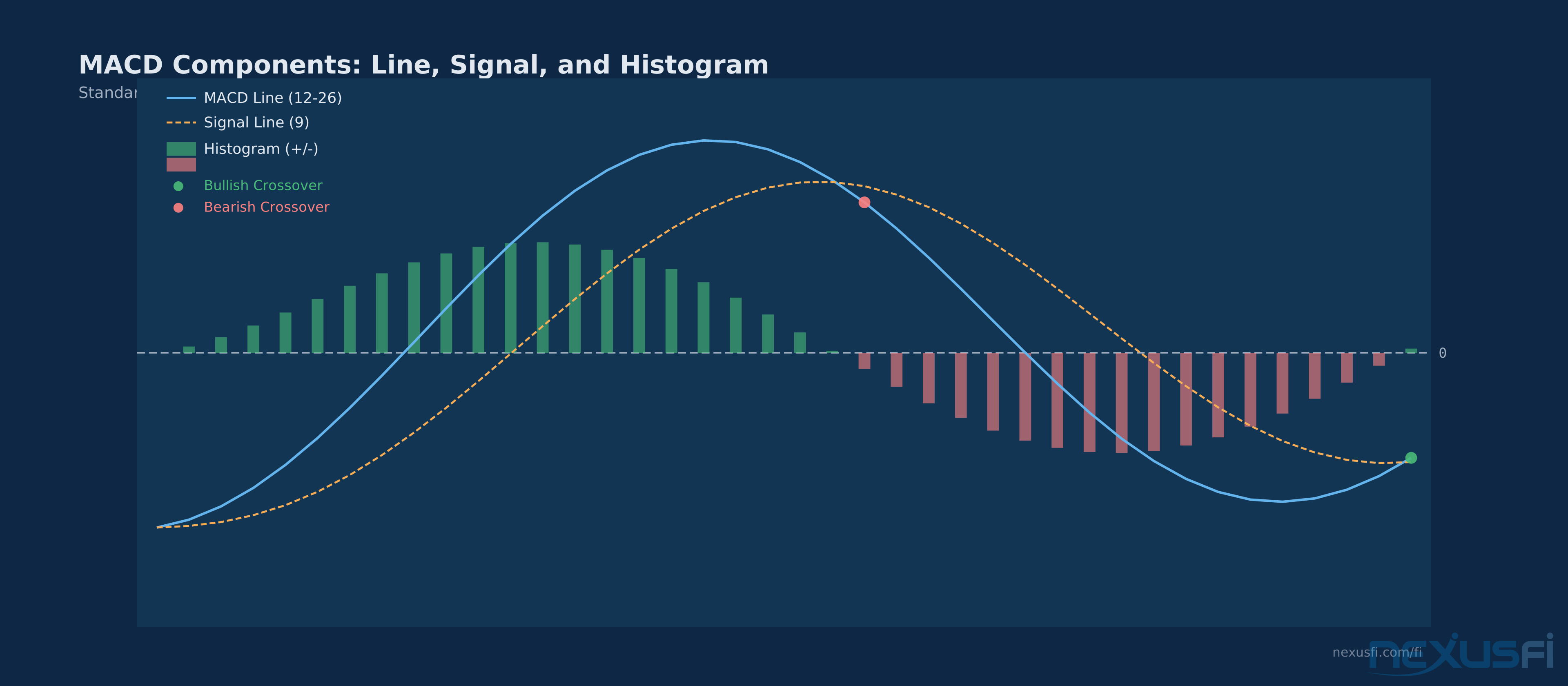
The MACD line is the difference between a fast EMA and a slow EMA of price. Standard settings: EMA(12) minus EMA(26).
MACD = EMA(12) - EMA(26)
When the MACD line is above zero, the 12-period EMA is above the 26-period EMA
Here's the critical insight that @ThatManFromTexas makes explicit: "The MACD crossing the zero line represents the EMA 12 crossing the EMA 26." That's it. The zero-line cross IS the moving average crossover, just plotted differently. Traders who use both a MACD zero-line cross and an EMA crossover for "confirmation" are confirming a signal with itself.
Signal Line #
The signal line is a 9-period EMA of the MACD line. It smooths the MACD and creates crossover signals:
- Bullish crossover: MACD line crosses above the signal line
- Bearish crossover: MACD line crosses below the signal line
The signal line introduces lag
Histogram (The Change-of-Momentum Layer) #
The histogram plots the difference between the MACD line and the signal line:
Histogram = MACD Line - Signal Line
When the histogram is positive, MACD is above its signal line (momentum accelerating in the bullish direction). When negative, momentum is decelerating or turning bearish.
The histogram's peaks and troughs often lead price turning points. A shrinking histogram during an uptrend signals momentum decay before the MACD line itself crosses. This is the second derivative at work
Standard Settings #
The default MACD parameters are 12, 26, 9 (fast EMA, slow EMA, signal EMA). Gerald Appel originally recommended these for daily charts. In futures trading:
- Intraday scalping: Some traders compress to 5, 13, 4 or 8, 17, 9 for faster signals on 1-5 minute charts
- Swing trading on daily charts: Standard 12, 26, 9 remains the benchmark
- Longer-term trend confirmation: 26, 52, 9 or even wider settings reduce whipsaws
There's no "best" setting. The tradeoff is always speed vs. reliability. Faster settings catch turns earlier but generate more false signals. Slower settings confirm trends more reliably but enter later.
How It Works #
The Mathematics #
The calculation runs in three steps:
- Fast EMA: Calculate the 12-period exponential moving average of closing prices
- Slow EMA: Calculate the 26-period exponential moving average of closing prices
- MACD Line: Subtract slow from fast: MACD = EMA(12) - EMA(26)
- Signal Line: Calculate the 9-period EMA of the MACD line
- Histogram: MACD Line minus Signal Line
The EMA weighting gives more emphasis to recent prices. For a 12-period EMA, the smoothing multiplier is 2/(12+1) = 0.1538, meaning the most recent close carries about 15.4% of the weight. For the 26-period, it's 2/(26+1) = 0.0741 or roughly 7.4%.
Three Signal Types #
1. Zero-Line Crossovers (Trend Direction)
When MACD crosses above zero, the fast EMA has crossed above the slow EMA
2. Signal Line Crossovers (Entry Timing)
The MACD crossing its signal line generates more frequent signals than zero-line crosses. Bullish when MACD crosses above the signal; bearish below. But as
The reason: "If you have a very strong trend (raw MACD >> 0) and a negative histogram (weakening of the very strong trend) this may still be a strong trend. So there is no reason yet for any countertrade."
Signal line crossovers work best when they align with the zero-line direction. A bullish signal crossover when MACD is already above zero (momentum confirming) is higher probability than one occurring below zero (fighting the trend).
3. Divergence (Momentum Exhaustion)
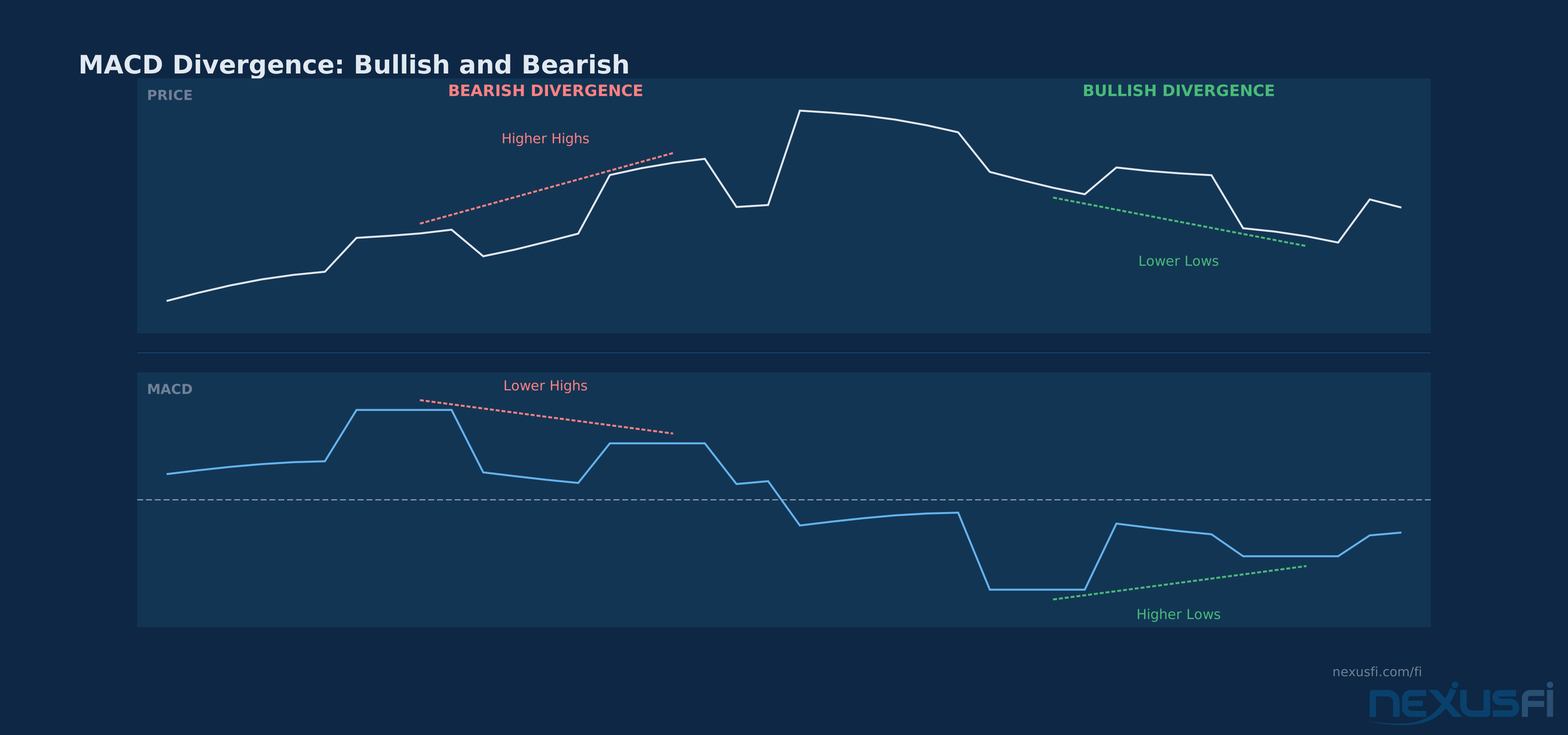
Divergence occurs when price makes a new extreme but MACD doesn't confirm it:
- Bullish divergence: Price makes a lower low, MACD makes a higher low
- Bearish divergence: Price makes a higher high, MACD makes a lower high
His research references show that "MACD models produced positive results for a number of markets" when testing divergence systems, unlike RSI and Stochastics divergence which "performed badly."
Triple Divergence #
A single divergence fails more often than it succeeds
Divergence Quality Filters #
Not all divergences are created equal. @rogerf, who has studied divergence phenomena for over a decade, identifies key quality filters: "For good divergence profit potential, Price must be in good 'cycling' volatility and the MACD must retrace at least 50% or more (more is better) of its established range within signal formation."
The 50% retracement rule is practical: if MACD barely dips before forming the divergent low, the momentum shift is too weak to generate follow-through. You want to see MACD pull back much before the divergent setup forms.
Practical Application #
MACD as a Trend Filter for Futures #
The highest-probability use of MACD in futures trading is as a trend filter rather than a standalone entry signal. The logic:
- MACD above zero: Only take long setups from your primary strategy
- MACD below zero: Only take short setups
- MACD near zero: Reduce position size or stay flat
This filter approach uses only the momentum layer (first derivative) and ignores the histogram. @Fat Tails advocates exactly this: "The MACDBBLines that I used on chart 5 do not have a signalline, so it is a pure momentum MACD without the histogram which is the second derivative. The fact that it does not have the histogram makes it more reliable."
For ES day traders using a 5-minute chart, applying a 12,26 MACD as a directional filter before taking setups from other indicators (order flow, volume profile levels, VWAP) can reduce whipsaw trades much.
The Three-State Trend Model #
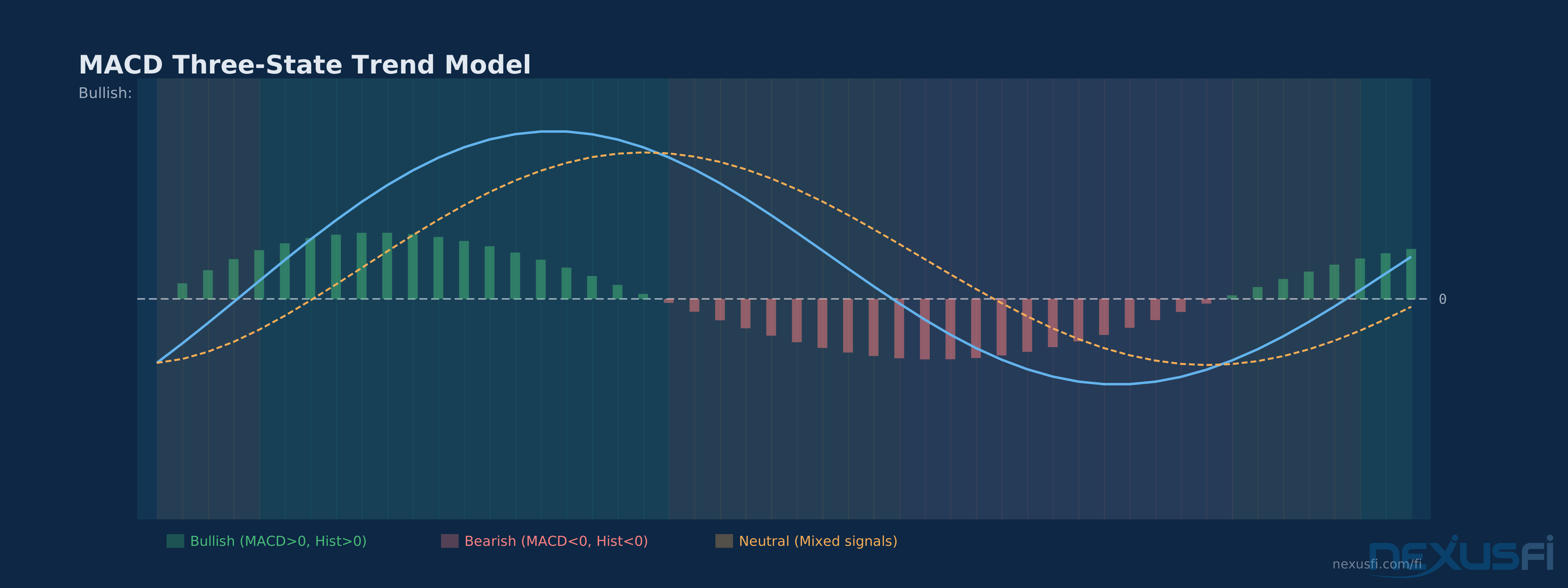
A more sophisticated framework combines both MACD components into three states:
- Bullish trend: MACD > 0 AND histogram > 0 (momentum is positive and accelerating)
- Bearish trend: MACD < 0 AND histogram < 0 (momentum is negative and accelerating)
- Neutral/transitional: Everything else (momentum and acceleration disagree)
This three-state model was implemented in the anaMACDUniversal indicator collection documented by @Fat Tails on NexusFi. The neutral state catches those dangerous periods where trend traders get chopped up
BB MACD: Volatility-Adapted MACD #
One of the most discussed MACD variants on NexusFi is the BB MACD, which wraps Bollinger Bands around the MACD line.
The BB MACD addresses a core problem with standard MACD: the absolute value means nothing without context. A MACD reading of +5 on ES might be extreme in a range-bound environment but normal during a trending day. Bollinger Bands normalize the MACD reading against its own recent volatility, making signals comparable across market conditions.
Combining MACD with Futures-Specific Tools #
MACD works best in futures when combined with tools that provide what it lacks
MACD + Volume Profile: Use MACD for directional bias, volume profile levels (POC, VAH, VAL) for entry points. When MACD is above zero and price pulls back to the Point of Control, that's a higher-probability long entry than POC alone.
MACD + VWAP: MACD confirms the trend direction; VWAP provides the mean-reversion level. Long when MACD > 0 and price touches VWAP from above; short when MACD < 0 and price touches VWAP from below.
MACD + Order Flow: MACD establishes the macro direction on a higher timeframe (15-minute or hourly); delta and footprint charts provide the micro-timing for entry on a 1-5 minute chart.
When MACD Fails #
MACD is a lagging indicator by construction
- Choppy, range-bound markets: Generates continuous false crossovers as price oscillates. The histogram whipsaws without follow-through.
- Sharp V-reversals: By the time MACD confirms the reversal, the move is often half over. The lag inherent in the EMA calculation means MACD always reacts, never predicts.
- Low-volatility compression: When ATR contracts and price consolidates, MACD flattens near zero and produces meaningless signals.
The fix isn't faster settings (that just creates different false signals). The fix is knowing WHEN to use MACD: trending markets with clear directional bias. When price is stuck in an Initial Balance range or chopping around a high-volume node, put MACD aside and let price-level tools do the work.
Timeframe Considerations for Futures #
In futures trading, MACD behavior shifts meaningfully by timeframe:
- Tick/volume charts: MACD on non-time-based charts adapts to market activity. During high-volume periods (open, close, data releases), bars form faster and MACD generates more signals.
- 1-5 minute charts: Signal line crossovers dominate. Useful for scalping entries when combined with trend filters from higher timeframes.
- 15-60 minute charts: Zero-line crosses become the primary signal. Good for intraday swing direction.
- Daily charts: Divergence signals carry the most weight here. The Katz/McCormick research on MACD divergence profitability used daily data.
A common approach: run MACD on the 15-minute chart for directional bias and use the 3-5 minute chart for entry timing via other tools.
Relationship to Other Indicators #
MACD vs. RSI #
MACD measures momentum (the difference between two averages); RSI measures the ratio of up moves to down moves over a period. They can diverge from each other
MACD vs. Moving Average Crossovers #
As @ThatManFromTexas demonstrates, a MACD zero-line cross IS an EMA(12)/EMA(26) crossover displayed differently. The MACD format is more information-dense: you see the magnitude of separation (how far apart the EMAs are), not just which one is on top. That magnitude information
Building on MACD #
The MACD concept
- MACD with different MA types: Using SMAs instead of EMAs produces the Awesome Oscillator. Using Hull MAs or DEMA creates faster-responding variants.
- Normalized MACD: Dividing MACD by the slow EMA percentage-normalizes the reading, making cross-instrument comparison possible. @Fat Tails advocates normalization: "To measure the strength of the trend the MACD should actually be normalized."
- MACD with Bollinger Bands: The BB MACD discussed above, popularized on NexusFi through extensive community development.
Key Takeaways #
MACD gives you two tools in one: a trend filter (the MACD line vs. zero) and a timing tool (the histogram). The mistake most traders make is conflating the two
Use MACD for what it does well: confirming directional bias and identifying momentum exhaustion via divergence. Pair it with price-level tools (volume profile, VWAP, order flow) that provide what MACD doesn't
Knowledge Map
Go Deeper
Build on this knowledgeReferences This Article
Articles that build on this topicCitations
- — Building Blocks of a Trading System (1) - Trend Filter (2010) 👍 13“The MACD has both a trendfilter, which is the raw momentum MACD, and an entry timing tool, which is the histogram.”
- — EMA 50 periods and the MACD zero line... close friends (2012) 👍 7“The MACD crossing the zero line represents the EMA 12 crossing the EMA 26.”
- — A Different Look On A MacdBB (2012) 👍 4“Go short when MACD crosses below zero line and set a target. Go long when MACD crosses up on zero line.”
- — The Elusive Price Action: How to Trade (2010) 👍 9“Divergence indicate a weakening of the trend. A weakening of the trend does not necessarily lead to a reversal.”
- — The Elusive Price Action: How to Trade (2010) 👍 9“If a triple divergence occurs, it means that the simple divergence has failed, but that the failure will probably fail as well.”
- — Post your favorite Divergence ind. here (2010) 👍 5“For good divergence profit potential, Price must be in good cycling volatility and the MACD must retrace at least 50% or more.”
- — BB MACD (2011) 👍 23“Wait for the MACD dot to exceed the BB band, then pullback. That is the trade.”
- — 3 Ducks in Market Analyzer (2013) 👍 7“The Awesome Oscillator is a MACD built from two SMAs.”