



MetroTrade Futures Broker: Getting Started with Low-Commission Micro Futures Trading
Overview #
MetroTrade is a U.S.-based futures introducing broker built around its proprietary MetroTrader platform — a browser-based trading environment that gives you access to equity index micros, energy, and metals futures without installing software, without paying platform fees, and without signing up for a subscription.
The pitch is simple: flat per-trade commissions starting at $0.29/side on micro contracts, free Level 1 CME market data, a web and mobile platform that's available immediately, and no minimum deposit. For traders who've been paying subscription models or bundled platform fees, those four points alone shift the cost math meaningfully.
This article covers what MetroTrade actually offers — the platform mechanics, commission structure, margin requirements, and regulatory framework — so you can evaluate whether it fits your trading setup.
Prerequisites: You should understand futures commissions and fee structures, including the difference between brokerage fees and exchange fees. Familiarity with introducing broker vs. FCM relationships is useful for understanding how your account is held. If you're new to contract sizing, read micro e-mini futures first.
Commission Structure and Pricing #
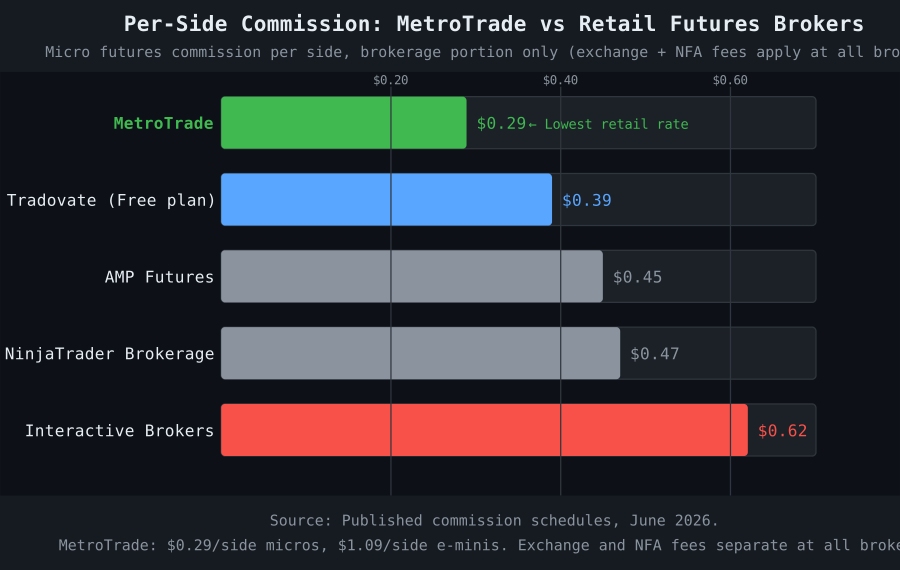
MetroTrade charges a flat per-contract, per-side commission with no volume requirements. Every trader pays the same rate from day one:
- Micro futures: $0.29 per side
- E-mini contracts: $1.09 per side
That's the brokerage commission. On top of that, you pay CME exchange fees (approximately $0.05/side for equity index micros) and an NFA regulatory fee ($0.02/side). Level 1 CME market data is included at no extra charge.
No platform subscription. No routing surcharge. No minimum monthly volume to qualify for the advertised rate.
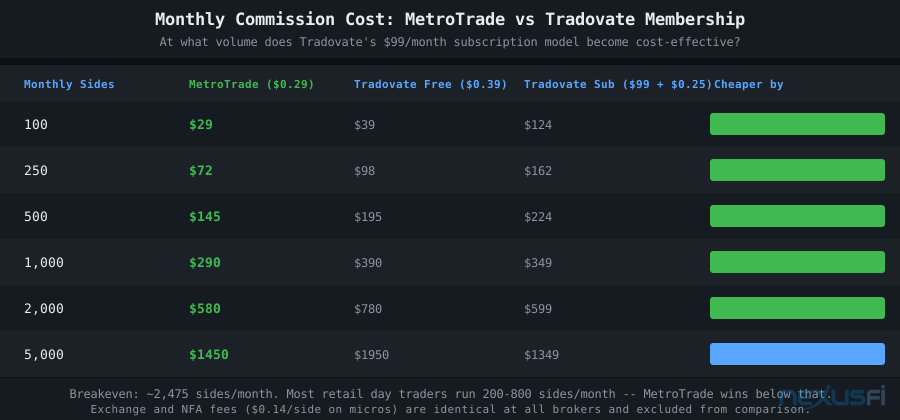
Compare that to how subscription brokers structure pricing. Tradovate charges $0.39/side on their free plan, or $0.25/side with a $99/month membership. The membership makes mathematical sense only if you're trading enough volume to offset the fixed cost — the crossover lands at roughly 2,475 sides per month. Below that, MetroTrade's flat rate is cheaper.
For most retail day traders running 200-600 sides per month, the subscription model adds overhead without delivering savings.
At 500 sides/month on micro contracts:
- MetroTrade (flat rate): $145 in commissions
- Tradovate Free: $195
- Tradovate with $99/mo subscription: $224
The subscription is counterproductive at typical retail volume.
The commission conversation can become a distraction from more important factors.
He was making the case for full-service brokers, but the underlying point applies here — commission differences at this scale are real but rarely the deciding factor. What matters more is whether the platform executes reliably, whether the margins are accessible, and whether the regulatory structure is sound.
MetroTrade's commissions are competitive at the retail level. They're not the lowest possible — some prop-firm-connected accounts or high-volume professional routes can touch $0.10-0.15/side — but for self-directed retail traders, $0.29/side on micros is the low end of the retail market.
True All-In Cost: What You Actually Pay #
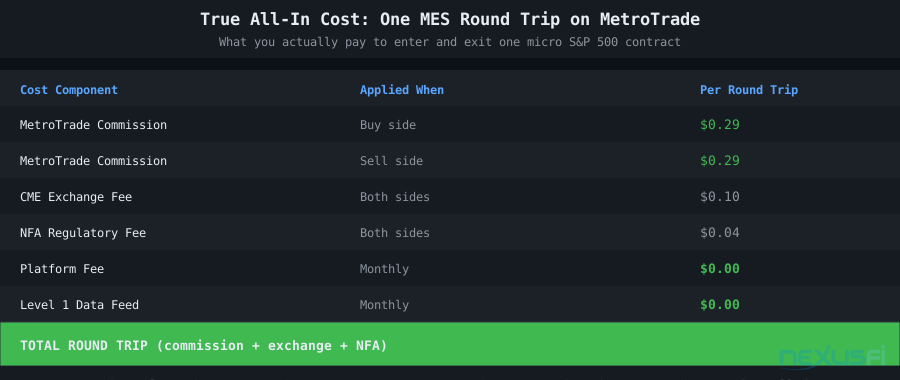
The advertised commission is only part of what you pay per trade. Here's the full per-contract, per-round-trip math for a MES (Micro E-mini S&P 500) trade on MetroTrade:
| Component | Per Side | Per Round Trip |
|---|---|---|
| MetroTrade commission | $0.29 | $0.58 |
| CME exchange fee | $0.05 | $0.10 |
| NFA regulatory fee | $0.02 | $0.04 |
| Platform fee | $0.00 | $0.00 |
| Level 1 data feed | $0.00 | $0.00 |
| Total | $0.36 | $0.72 |
One MES round trip costs $0.72 all-in. MES has a point value of $12.50, so the fee represents less than 0.06 points. A trader who captures 1 full ES point (worth $12.50) nets $11.78 after fees.
Active day traders who do 300 round trips per month pay $216 total — $174 to MetroTrade, $42 to CME/NFA. That's the fixed operational overhead for the trading activity. It's real money, but it's also knowable in advance and doesn't vary with your profitability.
Intraday Margin Requirements #
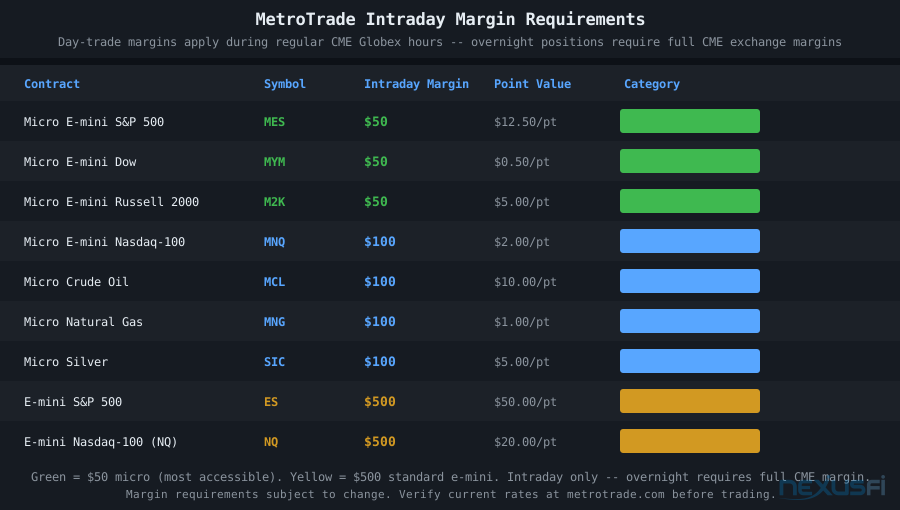
MetroTrade's intraday margins for the most commonly traded micro futures contracts:
| Contract | Symbol | Intraday Margin | Point Value |
|---|---|---|---|
| Micro E-mini S&P 500 | MES | $50 | $12.50/pt |
| Micro E-mini Dow | MYM | $50 | $0.50/pt |
| Micro E-mini Russell 2000 | M2K | $50 | $5.00/pt |
| Micro E-mini Nasdaq-100 | MNQ | $100 | $2.00/pt |
| Micro Crude Oil | MCL | $100 | $10.00/pt |
| Micro Natural Gas | MNG | $100 | $1.00/pt |
| E-mini S&P 500 | ES | $500 | $50.00/pt |
| E-mini Nasdaq-100 | NQ | $500 | $20.00/pt |
These are day-trade margins — they apply during regular trading hours when you open and close within the session. If you hold a position overnight, the margin requirement reverts to CME's published exchange minimum, which is much higher.
Low intraday margins carry real danger. A $50 margin on MES doesn't mean MES is a low-risk trade — it means you're holding roughly $13,000 of notional exposure with $50 as your margin deposit. The leverage ratio is approximately 260:1 on a single contract.
The margin is an entry cost, not a measure of how much you can lose.
Most risk management guidance for retail traders suggests maintaining at least 3-5x the intraday margin as available capital per contract — so effectively $150-250 of account buffer per MES contract, minimum. If you're sizing for survival over a string of losing trades, you need more.
Micro vs Standard Futures at MetroTrade #
MetroTrade offers both micro and standard e-mini contracts. The distinction matters for position sizing.
Micro contracts are 1/10th the size of their standard equivalents — same underlying, same exchange, same tick structure, just 10% of the P&L per move. Ten MES contracts equal one ES contract in terms of exposure.
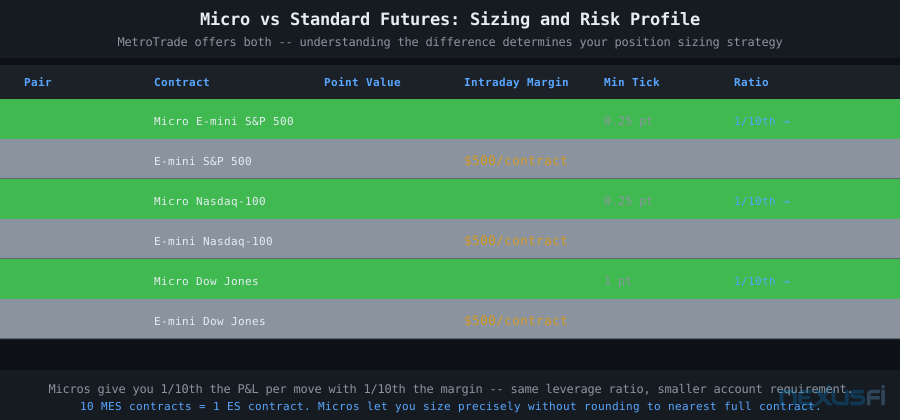
The practical value of micros: they let you manage position size with precision that a single e-mini contract can't offer. If your strategy calls for entering with 3 units and scaling out at targets, you can do that with 3 MES contracts and exit 1 at a time. With ES, you'd need 30 contracts to achieve the same precision — which is institutional-level sizing, not retail.
When CME introduced the micro e-mini contracts in 2019, it opened futures to traders who previously couldn't size appropriately. As @Rrrracer noted at the time, the new micro contracts brought "relatively speaking low round turn costs" that made a material difference for smaller accounts.
@FuturesTrader71, who spent a decade pushing CME to create micro contracts, framed the stakes directly: "I think this will save many traders from blowing up." That's the historical context — micros exist specifically to give retail traders access to CME at risk levels that don't require professional account sizing.
The commission per trade on MES ($0.29/side) vs MNQ ($0.29/side) is identical regardless of the underlying contract's volatility. But the P&L per move is very different — MNQ moves $2.00/point, MES moves $12.50/point. If you're new to futures, starting with MES gives you more runway to make mistakes without destroying the account before you've learned the instrument.
The MetroTrader Platform #
MetroTrader is a browser-based platform — you access it at app.metrotrade.com without downloading anything. Same account access on mobile via the iOS and Android apps. Settings and workspace layouts sync across devices.
Core platform capabilities:
Chart trading: You can place orders directly from the chart by clicking at a price level, and manage bracket orders by dragging stop and target lines. No separate order entry window needed for basic execution.
Indicator library: 75+ built-in indicators covering technical analysis from moving averages through oscillators through volume studies. The full list includes EMA, VWAP, Bollinger Bands, RSI, MACD, ATR, ADX, Aroon, Chaikin Oscillator, Awesome Oscillator, and most of the Bill Williams toolkit. For traders running standard technical setups, the built-in library covers the ground without needing to add custom scripts.
Order types: Market, Limit, Stop-Limit, Stop. OCO bracket orders for setting simultaneous stop and target. Orders are managed server-side, which means a platform disconnect won't leave positions unprotected.
Watchlists and workspace: You can build custom watchlists, create multiple chart layouts, and save configurations across sessions. The workspace customization is deeper than the default view suggests.
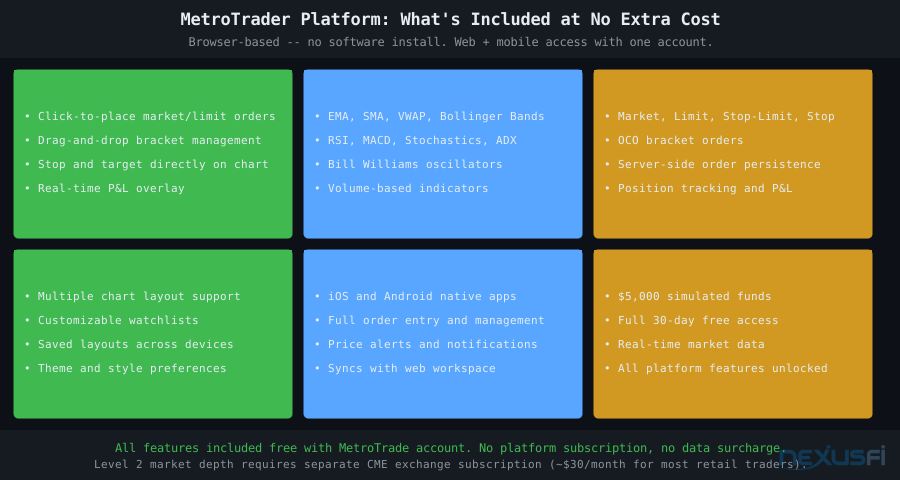
What MetroTrader doesn't offer: advanced order flow tools (no footprint charts, no volumetric bars, no Bookmap-style heatmap), strategy automation or scripting, NinjaScript-style custom indicator development, or DOM ladder trading depth beyond standard Level 1. If you're running an order flow-heavy strategy that depends on volume-at-price data or tape reading at the bid/ask level, you'll want to evaluate whether MetroTrader's tool set is sufficient.
For standard chart-based technical trading — entries on indicator signals, stop management from charts, position tracking — MetroTrader is a workable platform. For DOM-heavy scalping or complex automation, it's not the right tool.
Getting Started: Account Opening and Funding #
The MetroTrade onboarding process:
- Create account at metrotrade.com. The 30-day demo unlocks immediately on signup — no deposit, no approval required. You get $5,000 in simulated funds and access to the full platform.
- Submit live account application. Standard KYC: personal information, government ID, Social Security for W-9 (U.S. accounts). Approval typically takes 1-2 business days with complete documentation.
- Fund the account. Wire transfer or ACH. Wire transfer provides same-day access; ACH takes 3-5 business days. No minimum deposit requirement — MetroTrade doesn't specify a minimum.
- Launch MetroTrader. No software installation. Sign in at app.metrotrade.com or download the mobile app. Free Level 1 CME data is included.
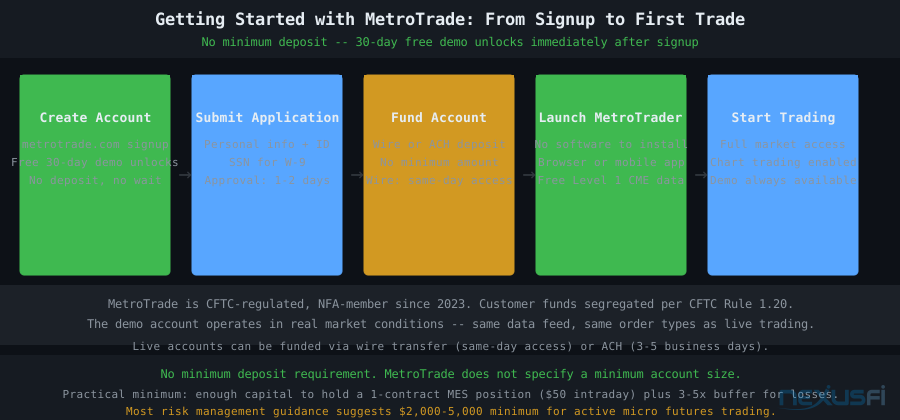
The demo-before-deposit workflow is useful. You can spend the 1-2 day approval window getting familiar with the platform, testing order entry workflows, and checking whether the indicator library covers your setup. If it doesn't, you've learned that before committing capital.
No minimum deposit is a genuine differentiator — many retail brokers require $2,000-10,000 to open. MetroTrade's lack of a minimum means you can fund exactly what you intend to trade, rather than meeting an arbitrary threshold. The practical minimum is still determined by margin requirements and sound risk management (more on that below), not by broker policy.
Using the Demo Account Effectively #
The 30-day demo is the place to learn the platform mechanics. What really transfers to live trading and what doesn't:
What transfers: Platform navigation, order entry workflow, chart trading mechanics, indicator configuration, bracket order management. If you can place a bracket order in demo, you can place it in live. The interface is identical.
What doesn't transfer: Fill quality (demo fills are typically perfect; live trading involves real market spreads and order book depth), emotional decision-making under real P&L, and the psychological experience of watching a losing trade.
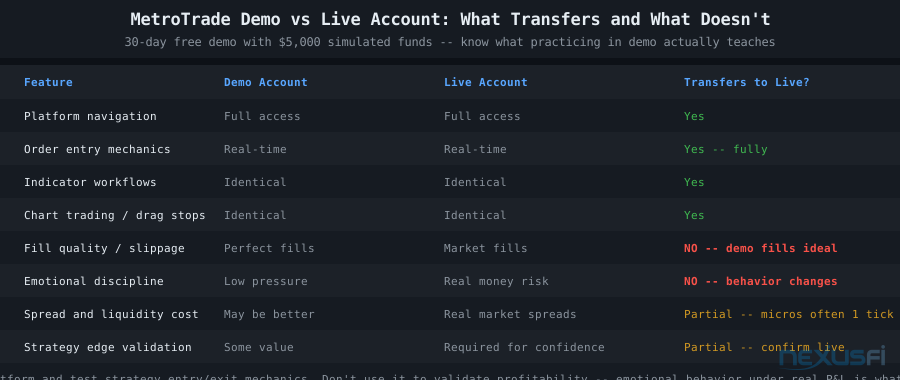
Use the demo to answer three specific questions: Can you enter and exit a trade cleanly from the chart? Do the indicators you rely on appear correctly? Can you set a bracket order and modify it mid-trade? If yes to all three, the platform works for your use case. Don't use demo performance to validate trading profitability — the fill quality and emotional conditions are too different from live.
A common mistake is extended demo trading to "perfect a strategy" before going live. Demo teaches platform mechanics, not trading edge. The psychological shift from zero-risk to real-money is significant, and you can only adapt to it by experiencing it directly. Most experienced traders recommend going live quickly with minimum sizing — 1 MES contract at MetroTrade's $50 margin — and building from observed behavior, not simulated results.
Regulatory Structure and Account Safety #
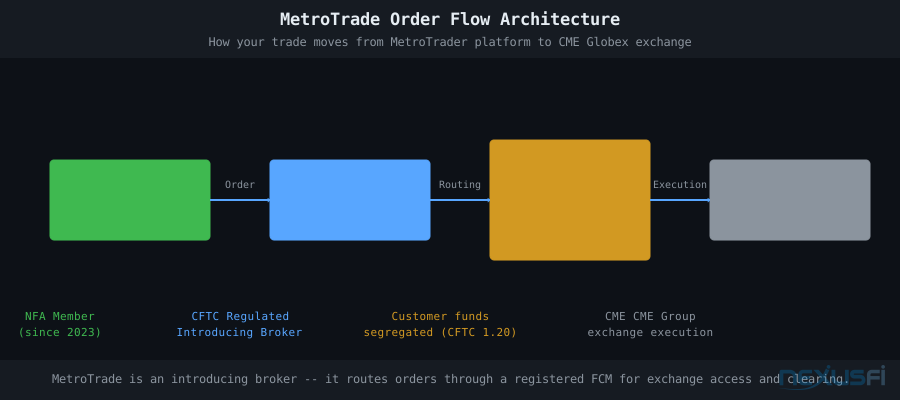
MetroTrade is a CFTC-regulated introducing broker and NFA member since 2023. As an introducing broker, MetroTrade does not clear trades or hold customer funds directly — it routes orders through a registered Futures Commission Merchant (FCM) that handles clearing and custody.
Customer funds are held at the FCM level, separate from MetroTrade's operating capital, in segregated accounts per CFTC Rule 1.20. This means if MetroTrade as a company encountered financial difficulties, customer funds at the clearing FCM would be protected by regulatory segregation requirements — you're not exposed to MetroTrade's business risk directly.
Before opening any futures account, verify the broker's NFA registration status at nfa.futures.org. NFA BASIC (Background Affiliation Status Information Center) shows registration history, any disciplinary actions, and the FCM relationships. This takes five minutes and is worth doing for any broker you're considering.
You can also verify fund segregation status through the FCM's quarterly financial reports, which are publicly filed with the CFTC. The FCM holding your account is the entity you're actually trusting with your capital — knowing their financial health matters more than MetroTrade's business status.
For a deeper look at how this structure works and what actually protects your money, see futures customer segregated funds.
Who MetroTrade Is For #
MetroTrade's structure makes it a strong fit for specific types of traders:
Traders new to futures from stocks or options. The web-only platform removes the software setup friction. No NinjaTrader install, no data feed configuration, no platform subscription to evaluate. Sign up, fund, and trade. The trade-off is feature depth — but for someone learning the mechanics of futures, that's appropriate.
Cost-conscious retail traders running 100-1,000 sides per month. At this volume, the flat-rate commission beats subscription models. If you're trading 10-20 contracts per day and don't want to think about whether your volume justifies a monthly fee, MetroTrade's pricing is straightforward.
Traders who want broker-platform integration without third-party complexity. MetroTrade's model is single-vendor: one company for both broker and platform. No Rithmic data feed to configure, no Sierra Chart subscription to manage alongside a different broker's account. Simpler setup, fewer moving parts.
Micro futures traders scaling into the market. The $50 MES margin and flat commission structure are accessible for traders building skills with minimal capital commitment.
MetroTrade is less suited for traders who need advanced order flow tools, NinjaScript automation, DOM ladder execution at professional depth, or third-party platform integration. Those workflows require NinjaTrader, Sierra Chart, or similar specialist platforms — MetroTrade's proprietary platform doesn't cover that territory.
For the order flow toolkit question, see DOM trading platforms and footprint charts for futures.
Practical Account Sizing #
MetroTrade has no minimum deposit. But "no minimum" doesn't mean any amount is appropriate.
The practical sizing math for a MES account:
- Absolute minimum to hold 1 contract: $50 (intraday margin)
- Risk-aware minimum (3x margin buffer): $150
- Defensible starting point with drawdown room: $1,000-2,000
Most serious traders use a rule of never risking more than 1-2% of account on any single trade. On a $1,000 account at 1% risk, you're willing to lose $10/trade. One MES tick is $3.13, so you're working with roughly 3 ticks of stop room — tighter than most setups allow.
At $2,000 with 1% risk, you have $20/stop, or about 6.4 ticks. That's workable for clean-level trades, not for multi-tick stop placements on volatile sessions.
The $50 intraday margin is a broker minimum, not a risk management standard. Trading 1 MES with $50 total capital is technically possible and practically disastrous — one 4-point MES move against you is a $50 drawdown, wiping the account. Fund according to your risk rules, not the broker minimum.
The MetroTrade + micro futures combination makes sense when you approach it as "right-sized exposure for my account" rather than "lowest barrier to entry." The mechanics support proper position sizing; using them correctly is your job.
MetroTrade vs Key Alternatives #
How MetroTrade compares against the brokers most commonly evaluated alongside it:
MetroTrade vs Tradovate: Both are cloud-based, modern retail brokers. Tradovate has a longer track record (and is now owned by NinjaTrader Group). Commission comparison depends on volume — MetroTrade wins below ~2,475 sides/month, Tradovate's subscription wins above. Tradovate's desktop platform is more mature with deeper charting tools. MetroTrade's advantage is simpler pricing and slightly lower flat-rate commissions.
MetroTrade vs Optimus Futures: Optimus offers 20+ third-party platform connections (TradingView, Sierra Chart, CQG, Rithmic), which gives flexibility to traders who already have a preferred platform. Commissions are volume-tiered at Optimus — aggressive traders can negotiate lower rates. MetroTrade wins on platform simplicity; Optimus wins on ecosystem flexibility.
MetroTrade vs NinjaTrader Brokerage: NinjaTrader Brokerage offers the NinjaTrader platform (paid or lifetime license) with deep strategy automation, custom indicator scripting, and order flow tools. Commission is $0.47/side (or lower with lifetime license). If you're already in the NinjaTrader ecosystem, staying there has significant advantages in platform capability. If you're not, MetroTrade's $0.29/side with no platform cost is a better entry point.
For a structured broker evaluation framework, read futures broker evaluation framework.
Knowledge Map
Go Deeper
Build on this knowledgeReferences This Article
Articles that build on this topicCitations
- — Best Broker offers the lowest commissions on Micro Futures (2022) 👍 8“As a trader, it can't be about the commission unless it is a crazy amount.”
- — Best deal on futures margin (2021) 👍 4“You won't really need to search for them; just visit the web sites of a number of futures brokers and you will find them.”
- — Trading the new CME E-Micro's (2019) 👍 9“relatively speaking low round turn costs of the new Micros”
- — MetroTrade -- Futures Broker and Trading Platform
- — Tradovate vs MetroTrade Compared: Fees, Margins, and More
- — Trading the new CME E-Micro's (E micro) MES, MNQ, MYM, M2K and other micros (2019) 👍 23“I think this will save many traders from blowing up. I really have wanted a product for about 10 years and met with them 6 years ago to start the push for this.”
- — Trading the new CME E-Micro's (E micro) MES, MNQ, MYM, M2K and other micros (2019) 👍 8“aspiring traders need to get beyond it and risk some real money, however small, in order to experience the stresses of real trading. Anything that helps this is a good thing.”
- — Trading the new CME E-Micro's (E micro) MES, MNQ, MYM, M2K and other micros (2021) 👍 8“I have listened to the various reasons people have given for trading the Micros.”