



Futures Exchange Fees and Transaction Costs: What You're Actually Paying Per Contract
Overview #
Overview #
Every futures trade has a price tag beyond the market move itself — and most traders have no idea what they're actually paying. The commission your broker quotes is just one piece. Underneath it sits a stack of fees charged by the exchange, the clearinghouse, the regulator, and the data providers. Miss any layer, and your edge calculation is wrong.
The difference between a trader who understands their full cost stack and one who doesn't isn't academic — it's the difference between a strategy that looks profitable on paper and one that actually puts money in your account. A scalper pulling 2 ticks on ES needs to know that round-turn costs eat more than half a tick. A swing trader holding for 50 points might barely notice. Both need the same clarity about what they're paying and why.
This article breaks down every layer of futures transaction costs — from the exchange fee the CME charges on each ES contract to the NFA's $0.02 regulatory assessment to the monthly data fees most traders forget to count. You'll learn exactly what you're paying, how to compare costs across venues, and where the real opportunities exist to reduce your all-in trading costs.
The Total Cost Stack #
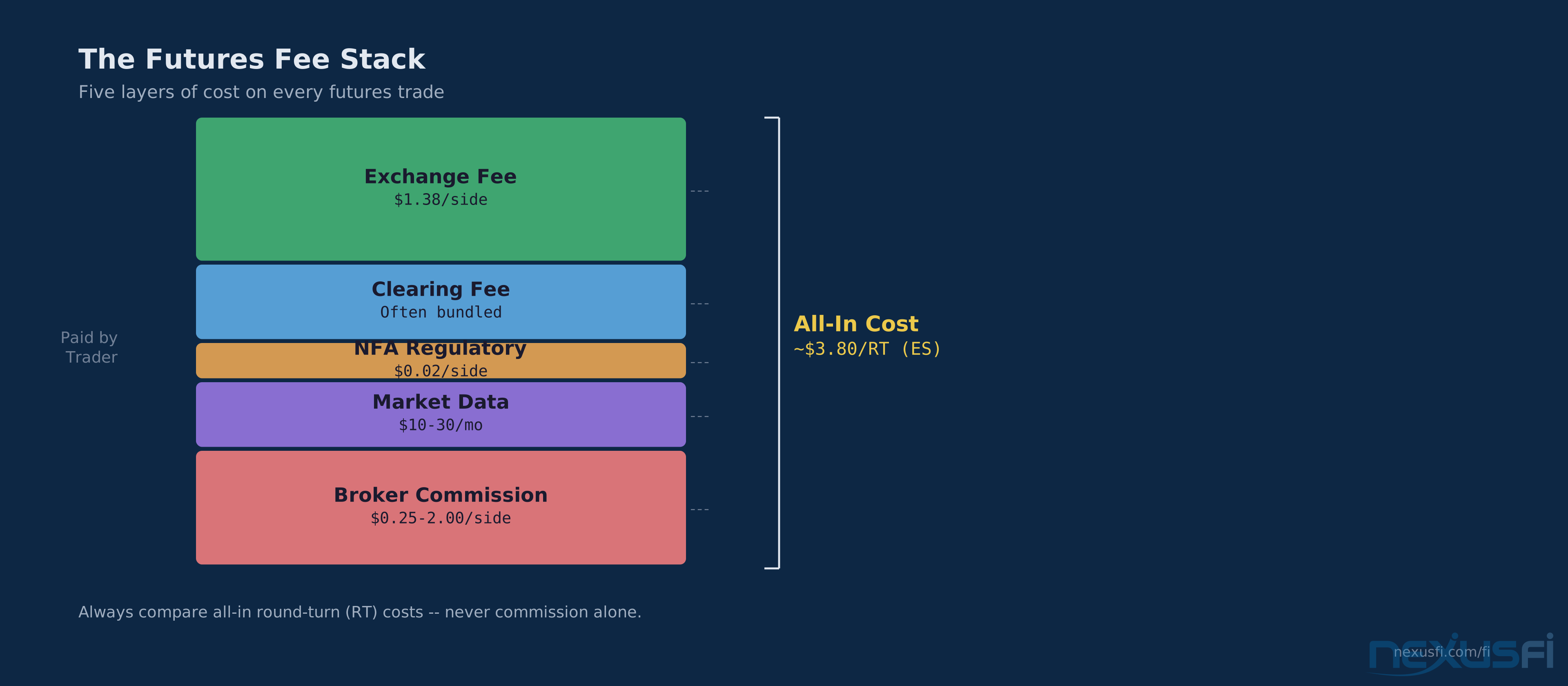
Futures transaction costs aren't a single number — they're a stack of five distinct layers, each charged by a different entity for a different service. Understanding this stack is the foundation for every cost calculation that follows.
Layer 1: Exchange Fees
The exchange fee is what the venue charges for matching your order against another participant. It's quoted per contract, per side (meaning you pay once when you enter and once when you exit). The CME charges different rates depending on the product family, whether you're a member or non-member, and whether you're trading an outright position or a spread.[2]
For non-member retail traders on CME Group products, exchange fees typically range from $0.30/side for micro contracts to $1.60/side for energy products like crude oil (CL). The exact number depends on the specific contract and changes annually — the CME publishes fee schedule updates every December, usually effective January 1.[1]
Layer 2: Clearing Fees
The clearing fee covers the clearinghouse's role in guaranteeing your trade. When you buy 1 ES, the clearinghouse sits between you and the seller, eliminating counterparty risk. That guarantee isn't free. On some exchanges, the clearing fee is bundled into the exchange fee. On others — and this catches people — it's listed separately on your statement. As @SMCJB notes, "In some cases the exchange splits this between what they call an exchange fee and a clearing fee — doesn't really matter though, still just the same thing."[2]
Layer 3: Regulatory Fees
The NFA (National Futures Association) charges a regulatory assessment fee on every futures transaction in the United States. For non-members, that's $0.02 per side — small enough to seem trivial, but it adds up across thousands of round turns per year. NFA members pay $0.00, which is one reason exchange seat holders and member firms have a structural cost advantage.[2]
Layer 4: Market Data Fees
Real-time exchange data isn't free. The CME charges non-professional traders $10/month per exchange (CME, CBOT, NYMEX, COMEX are separate exchanges within the CME Group), or $30/month for the bundle covering all four. Professional traders pay much more. ICE and Eurex have their own data fee schedules.[3]
Data fees are easy to forget when calculating trading costs because they're billed monthly rather than per trade. But for a trader who does 5 round turns per day, a $30/month CME data bundle works out to about $0.30 per round turn — not nothing, but manageable. For a trader who does 1 round turn per week, that same $30 costs $7.50 per round turn, which is significant.
Layer 5: Broker/FCM Commission
Your broker (or Futures Commission Merchant, if you clear directly) takes their cut on top of everything else. This is the "commission" number most traders fixate on, but it's actually the most variable and negotiable layer in the stack. Discount brokers charge as low as $0.25/side, while full-service brokers can charge $2.00/side or more.
The key insight: when a broker quotes you "all-in" pricing, they're typically bundling exchange fees + clearing fees + NFA fees + their own commission into a single number. When they quote "commission only," you need to add the exchange and regulatory layers on top. As @bobwest explains, "In futures, the term 'commission' usually just means the relatively small piece that goes to the broker, while 'commission and fees' includes the data/trade network and exchange per-trade fees. This is why you always need to compare total or 'all in' charges, not 'commission' alone."[3]
Exchange Fee Schedules by Venue #
CME Group
CME Group operates four exchanges — CME, CBOT, NYMEX, and COMEX — each with its own fee schedule. The fee structure varies by product family, customer type, and whether you hold an exchange membership.
Non-member electronic trading fees (per side, representative as of 2024):
- E-mini S&P 500 (ES): $1.38 outright, $1.15 spread
- E-mini NASDAQ-100 (NQ): $1.38 outright
- Micro E-mini S&P 500 (MES): ~$0.32
- Micro E-mini NASDAQ-100 (MNQ): ~$0.32
- Crude Oil (CL): $1.60
- Natural Gas (NG): $1.60
- Gold (GC): $1.60
- 10-Year Treasury Note (ZN): $0.69
- 30-Year Treasury Bond (ZB): $0.79
- Bitcoin (BTC): $6.50
- Ether (ETH): $4.50
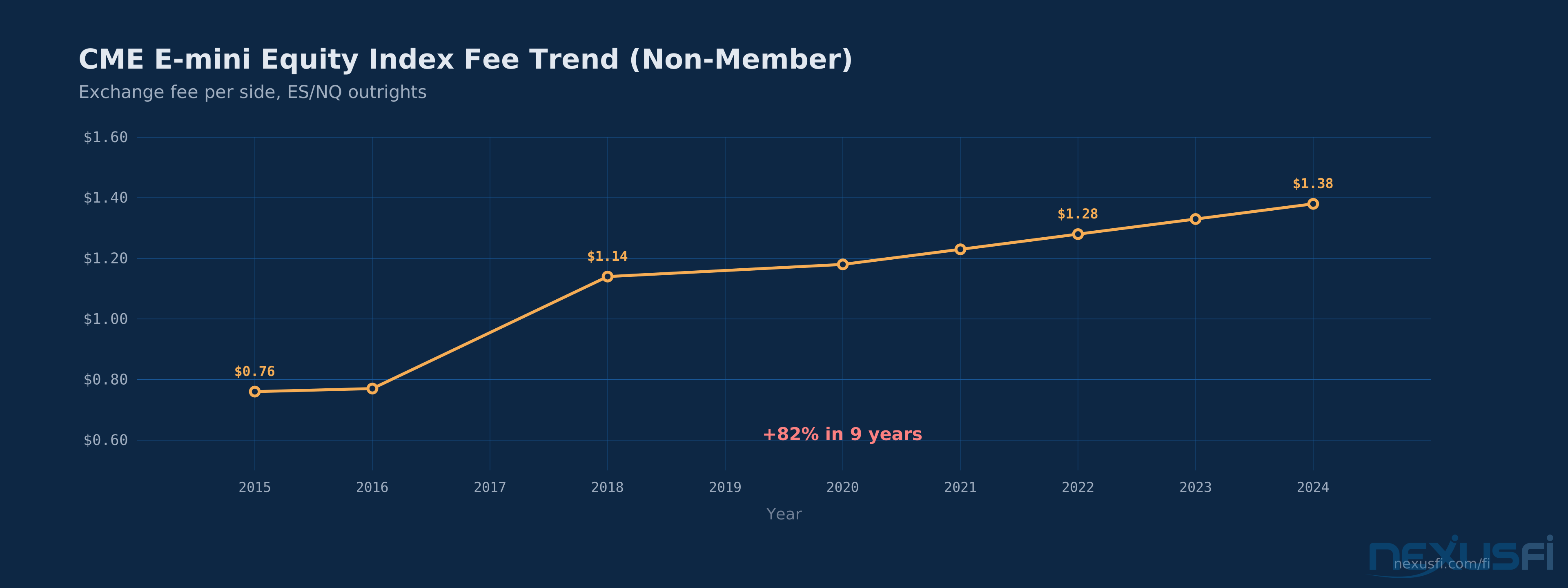
These fees change annually. The CME typically announces adjustments in December via SER (Special Executive Report) notices.[1] The trend has been consistently upward — non-member equity index futures went from $0.76/side in 2015 to $1.38/side in 2024.[4] That's an 82% increase in under a decade.
Spread vs. outright pricing: CME charges lower fees for calendar spreads and inter-commodity spreads. ES spreads run $1.15/side vs. $1.38 for outrights — a $0.46 savings per round turn.[1] If you're rolling positions quarterly, this adds up fast.
ICE (Intercontinental Exchange)
ICE dominates energy and soft commodity futures outside of NYMEX. Its fee structure follows the same general model as CME — per-contract, per-side, varying by membership status — but specific rates and tier structures differ. ICE Brent Crude, the global oil benchmark, carries exchange fees competitive with CME's WTI (CL) pricing. ICE also trades sugar, coffee, cocoa, and cotton futures, plus the Russell 2000 index via ICE Futures US.
ICE publishes its fee schedule at theice.com and updates it periodically. Unlike CME, ICE doesn't always follow a strict annual cycle for fee changes. For a deep dive on ICE's product lineup and market position, see ICE (Intercontinental Exchange).
Eurex
Europe's dominant derivatives exchange uses a transaction fee model that can include rebates for liquidity provision. Eurex fees for the DAX futures (FDAX) and Euro Stoxx 50 futures (FESX) are structured differently from US exchanges — they're quoted in euros, often include clearing in the stated fee, and have more granular tiering based on monthly volume.
Eurex's fee model rewards high-volume participants more aggressively than CME's. Market makers and liquidity providers can achieve much lower effective rates through rebate programs — a structure that's more common in European exchange culture. For complete coverage of Eurex, see Eurex: Europe's Derivatives Powerhouse.
Cboe Futures Exchange
Cboe's futures business is concentrated in VIX futures and other volatility products. VIX futures carry exchange fees that reflect the product's specialized nature and relatively concentrated liquidity pool. Cboe also trades SPX options and various index products, but the futures fee schedule is narrower than CME's because the product lineup is narrower. See Cboe Global Markets for the full picture.
Member vs. Non-Member: The Real Cost Divide #
Exchange membership is the single biggest fee reducer available to active traders — and it's far more accessible than most people realize.
On NYMEX, the member day-trade rate for crude oil (CL) was $0.60/side in 2022 versus $1.60/side for non-members.[6] That's a $2.00 savings per round turn. For a trader doing 20 round turns per day, that's $40/day or roughly $840/month in savings.
NYMEX seat leases have historically run around $750/month. As @SMCJB calculates, "At a saving of $0.90 a side you only need to be trading 833 sides or 417 round turns/month which is about 19 round turns a day for a lease to be cost effective. Seats are so cheap now people often under estimate what their volume needs to be in order to make a seat lease pay."[7]
The NFA fee advantage is smaller but still real: NFA members pay $0.00/side versus $0.02/side for non-members.
There's a catch most traders don't consider: leasing an exchange seat may subject you to self-employment tax. The tax implications of membership are complex enough to require an accountant who understands futures — don't wing this one.
Calculating Your All-In Cost #
Here's how to build your actual cost per round turn, using ES as the example:
ES Non-Member Example (2024 rates):
- Exchange fee: $1.38 x 2 sides = $2.76
- NFA fee: $0.02 x 2 sides = $0.04
- Broker commission (discount): $0.50 x 2 sides = $1.00
- All-in round turn: $3.80
ES Member Example (same broker):
- Exchange fee (member): ~$0.70 x 2 sides = $1.40
- NFA fee (member): $0.00
- Broker commission: $0.50 x 2 sides = $1.00
- All-in round turn: $2.40
10 MES Non-Member Example (same exposure as 1 ES):
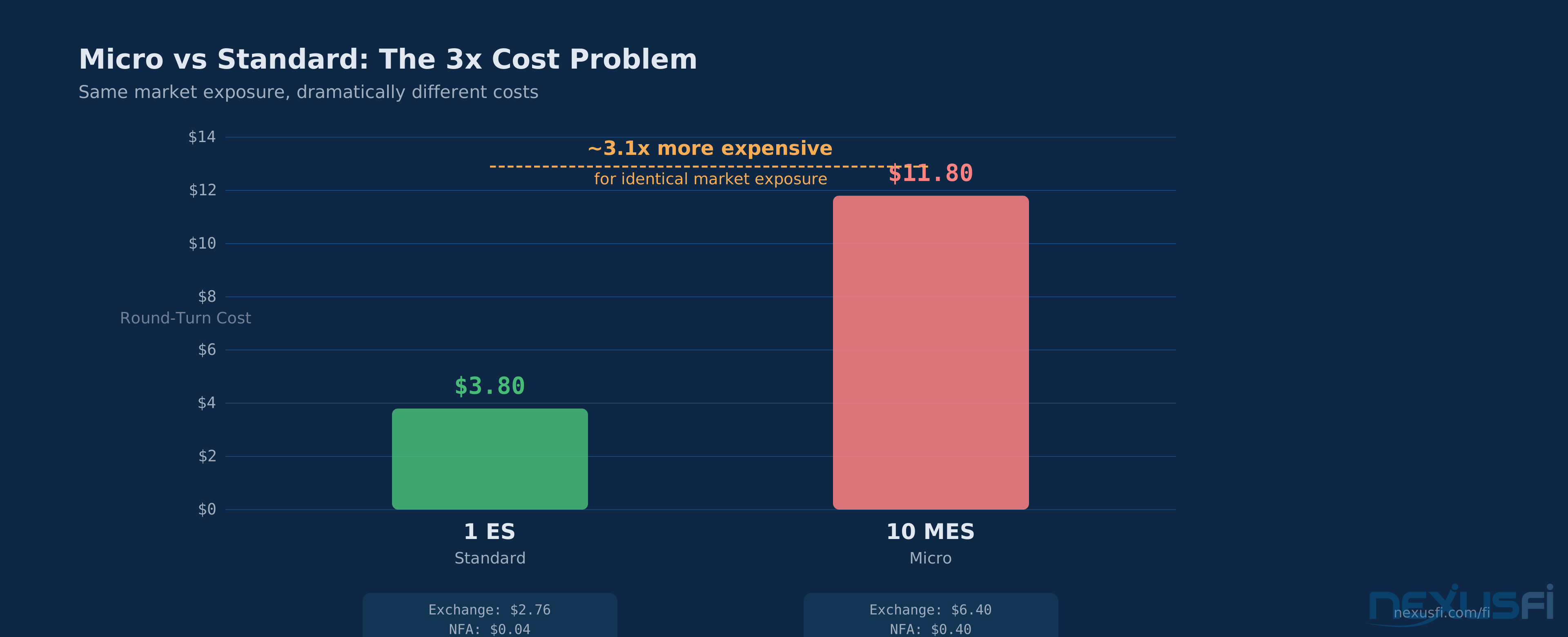
- Exchange fee: $0.32 x 2 sides x 10 contracts = $6.40
- NFA fee: $0.02 x 2 sides x 10 contracts = $0.40
- Broker commission: $0.25 x 2 sides x 10 contracts = $5.00
- All-in round turn: $11.80
Don't forget to amortize your monthly data fees. At $30/month for the CME bundle and 100 round turns per month, add $0.30 per round turn. At 20 round turns per month, add $1.50 per round turn. This fixed-cost spread means data fees hit low-frequency traders disproportionately hard.[3]
For context on the industry baseline,
How Fees Impact Different Trading Styles #
The impact of transaction costs is inversely proportional to your average trade size in ticks. Here's why that matters:
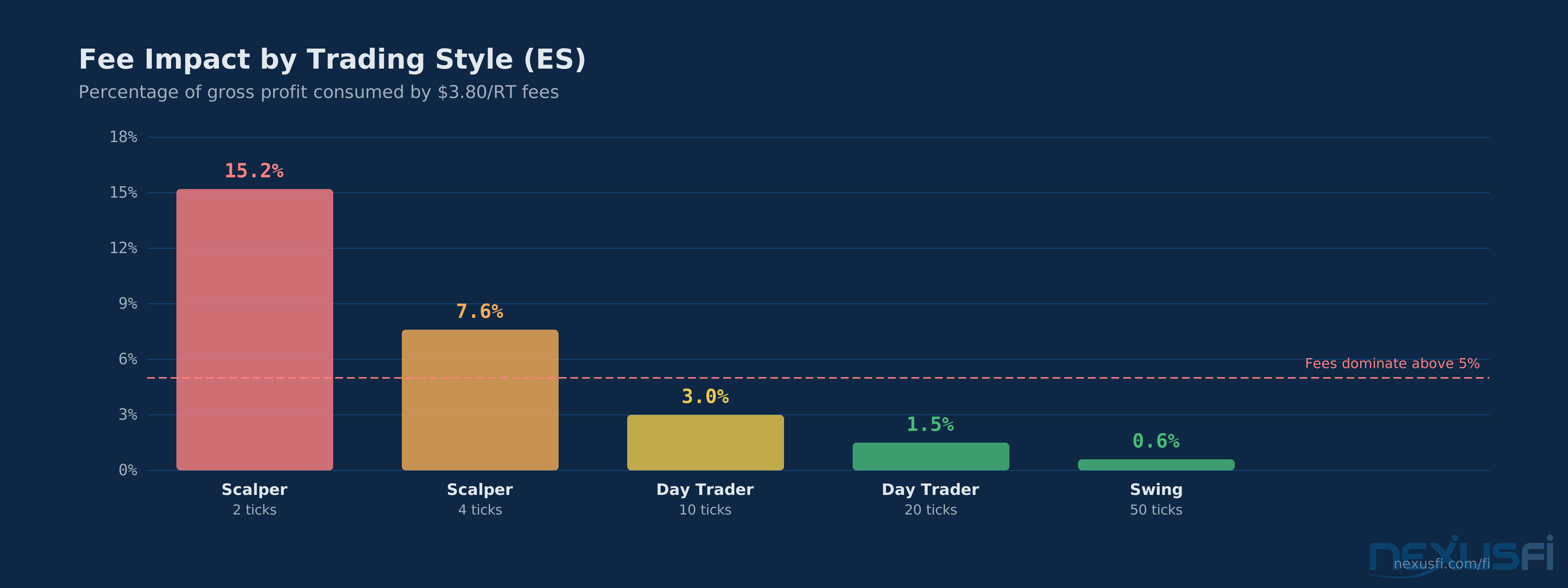
Scalpers (2-4 tick targets on ES): At $3.80/RT and $12.50 per tick on ES, a 2-tick winner ($25 gross) nets only $21.20 after fees — a 15.2% haircut. A losing scalp of 2 ticks costs $28.80 total ($25 loss + $3.80 fees). Fees are the defining constraint on scalping profitability. Every penny per side matters at this time horizon.
Day traders (10-20 tick targets): A 10-tick winner ($125 gross) nets $121.20 — a 3% fee impact. Fees matter but don't dominate. The focus should shift to execution quality (slippage) rather than fee optimization.
Swing traders (50+ tick targets): A 50-tick winner ($625 gross) nets $621.20 — a 0.6% fee impact. At this timescale, the difference between a $3.50/RT broker and a $5.00/RT broker is noise. Focus your energy on entry timing and position management, not fee shopping.
Spread traders: Calendar spread traders get a double benefit — lower exchange fees on spreads (ES spreads are $1.15/side vs. $1.38 for outrights) and typically smaller capital requirements. If you're trading inter-commodity spreads, verify whether your venue charges outright or spread rates, because this varies by product and can much change your cost structure.
Volume Tiers and Fee Reduction Strategies #
Active traders have several paths to reducing their effective fee rate:
Broker volume tiers: Most brokers reduce their commission component as monthly volume increases. Tiers are typically measured in contracts or round turns per month, with breakpoints at levels like 500, 1,000, 5,000, and 10,000+ contracts. The exchange fee portion doesn't change with broker volume — that's fixed by the exchange.
Exchange volume programs: CME offers volume incentive programs for high-volume participants, though most are aimed at institutional and proprietary trading firms rather than individual retail traders. The thresholds are high — often 5,000+ contracts/month in a specific product group.
Exchange membership/seat leasing: The most direct path to lower exchange fees. The economics vary by exchange division (CME, CBOT, NYMEX, COMEX each have separate memberships). Calculate your expected monthly volume, multiply by the per-side savings, and compare against the seat lease cost. The breakeven is usually lower than people expect.[7]
Negotiate your broker rate: Brokers don't advertise their lowest rates. If you're trading 500+ round turns per month, call your broker and ask for a rate review. Many will reduce their per-side commission by $0.10-$0.25 for consistent volume. Your all-in statement from the previous month is your negotiating tool.
Common Cost Traps #
Comparing headline commission rates: A broker quoting "$0.59/side" might be commission-only, while another quoting "$1.99/side" is all-in. Always compare all-in round-turn costs. Ask explicitly: "Does this include exchange fees, clearing fees, and NFA?"[2]
Ignoring data fees in cost-per-trade calculations: A $30/month CME bundle at 10 trades/month adds $3/trade. At 200 trades/month, it's $0.15/trade. For low-frequency traders, data fees can rival or exceed exchange fees on a per-trade basis.[3]
Assuming micro fees scale linearly: They don't. 10 MES is approximately 3x the all-in cost of 1 ES for the same exposure.[8] Trade the full-size contract when your account and risk management support it.
Not auditing your broker statement: Pull your monthly statement and verify that exchange fees match the published schedule. Brokers sometimes apply incorrect customer categories or fail to pass through spread rates on calendar rolls. If the numbers don't match, ask.
Overlooking annual fee increases: CME raises fees almost every year.[4] What you paid last January isn't what you'll pay next January. Subscribe to CME SER notices or follow fee-tracking threads in the NexusFi community to stay current.
Where to Find Current Fee Schedules #
Fee schedules are published directly by each exchange. These are the authoritative sources:
- CME Group: cmegroup.com/company/clearing-fees.html -- the definitive source for all CME, CBOT, NYMEX, and COMEX fees[2]
- ICE: theice.com under regulatory documents and fee schedules
- Eurex: eurex.com under transaction fees
- Cboe: cboe.com under fees for futures
- NFA: nfa.futures.org for regulatory assessment fees
Your broker should also provide a fee schedule or calculator that shows the all-in cost for each product they offer. Several brokers publish detailed fee comparison tables that break out exchange, clearing, NFA, and broker components separately — useful references for comparison shopping regardless of who you trade with.
For deeper context on how exchanges operate, the economics of clearing, and the structure of futures markets, see the hub article Futures Exchanges. For details on how these fees connect to margin requirements, see Futures Margin Requirements. And for the mechanics of how your order actually gets matched and filled, see Futures Order Execution.
Knowledge Map
Prerequisites
Understand these firstReferences This Article
Articles that build on this topicCitations
- — 2024 CME Exchange Fee Increases (2023) 👍 19“CME eMini Equity Futures OUTRIGHTS increase from $1.33 to $1.38.”
- — Why does ES exchange fee vary by website? (2022) 👍 2“The cost to trade futures is made up of three major components.”
- — Costs associated with trading futures? (2020) 👍 7“The all in round-turn cost is listed at $3.70 per trade.”
- — New 2016 CME Group Transaction Fee Changes (2015) 👍 16“Non-Member E-Mini Equity Futures Globex Fee will increase from $0.76 to $0.77.”
- — Trading the new CME E-Micros (2019) 👍 8“FCM costs wont go down based on the product.”
- — CME 2023 Fee Increases (MES +16%!) (2022) 👍 3“For most retail traders MES is now 3 times as expensive to trade.”
- — Profits And Commision? (2015) 👍 6“At a saving of $0.90 a side you only need 417 round turns/month.”
- — 2024 CME Exchange Fee Increases (2023) 👍 3“10 MES is about $12 total R/T, and 1 ES is about $4.”
- — CME/CBOT/NYMEX 2022 Fee Increases (2021) 👍 17“Micros going from 116% more expensive to 146% more expensive.”
- CME Group — Clearing Fees (2024)