



Australian Dollar (6A) Futures: The Complete Trading Guide
Overview #
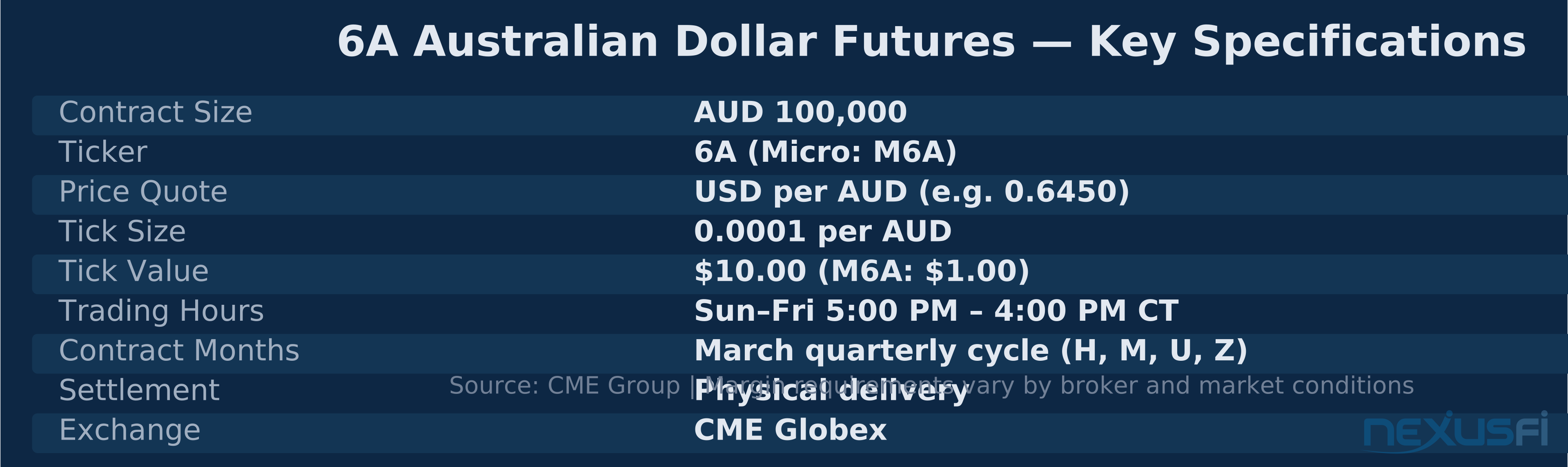
The Australian Dollar futures contract — ticker 6A on CME Globex — is the futures market's direct access point to one of the world's most interesting currencies. Each 6A contract represents AUD 100,000, and one tick ($0.0001 per AUD) moves the P&L by $10. Simple math, complex dynamics.
What makes 6A worth learning is everything that moves it. Australia sits at the intersection of three global forces: Chinese industrial demand, the global commodity cycle, and risk appetite across all asset classes. The AUD doesn't just react to its own central bank — it's a live proxy for whether the global expansion is on or off. When China announces infrastructure spending, the Australian dollar moves before most equity traders have checked their screens.
The AUD/USD is historically the fifth-most traded forex pair in the world. At the futures level, 6A is moderately liquid — tighter spreads than the smaller currency futures, wider than EUR or JPY — with enough depth for retail traders and small institutional participants to work reasonable size without moving the market against themselves.
This guide covers what moves 6A, when to trade it, how to size positions, and the four main approaches that experienced 6A traders use.
Contract Specifications #
:::info Quick Facts: AUD 100,000 per contract | $10.00 per tick | ~$2,500 SPAN initial margin | CME Globex, nearly 24/5 ::: The 6A contract is mechanically similar to other CME currency futures but sized for the AUD's lower per-pip value relative to EUR or GBP.
Price convention: Unlike the spot forex convention where "AUD/USD" means Australian dollars per US dollar, the 6A futures price is expressed directly as USD per AUD. A price of 0.6450 means one Australian dollar buys 0.6450 US dollars. This is the same direction as spot AUD/USD — no mental inversion required.
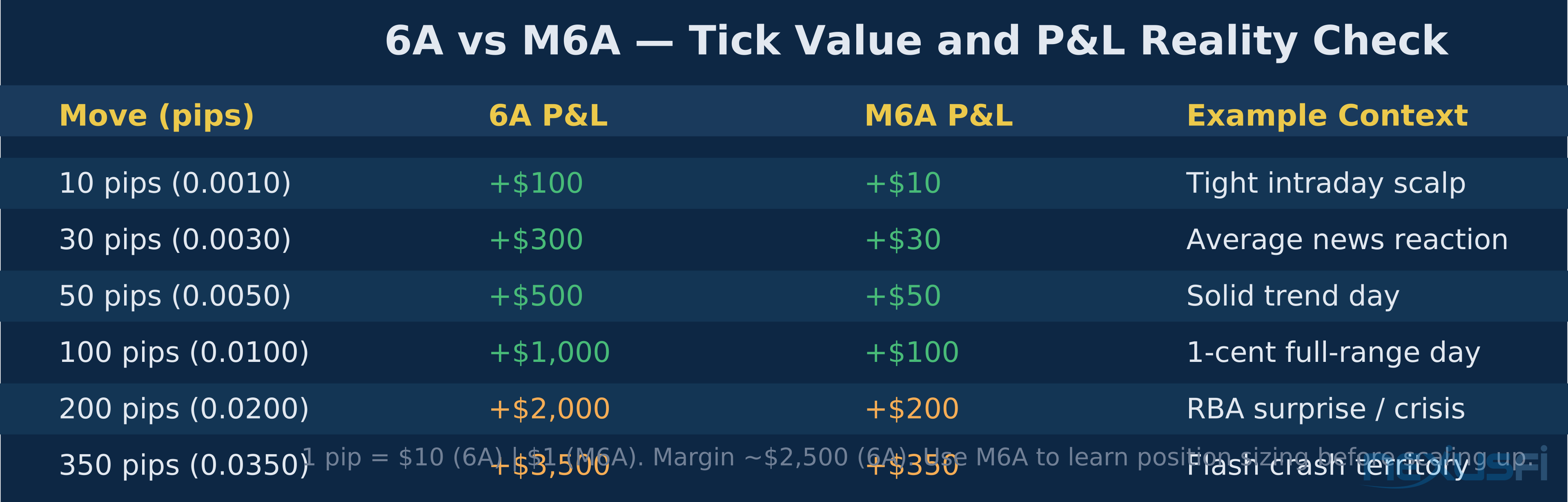
Tick size and value: Ticks are 0.0001 (one pip). At AUD 100,000 per contract, one pip = $10. A 50-pip move is $500. A 1-cent (100-pip) full-range day delivers $1,000 per contract. This is the same tick value as the Japanese Yen (6J), making it easy to compare position sizes across the FX complex.
Trading hours: 6A trades Sunday 5:00 PM CT through Friday 4:00 PM CT with a 60-minute daily halt from 4:00 PM to 5:00 PM CT. That's basically 23 hours/day, five days/week — full coverage of Asian, London, and New York sessions. This matters for AUD specifically because the Asian session is genuinely active, unlike EUR or GBP where Asian hours are dead.
Contract months: March quarterly cycle — H (March), M (June), U (September), Z (December). Roll to the front month; that's where the volume lives.
Physical delivery: Like all CME FX futures, 6A settles via physical delivery at expiry. In practice, nearly all speculative traders roll or close before delivery. Delivery details: AUD deposited at designated institutions in the US.
Micro contract (M6A): AUD 10,000 per contract, $1.00 per tick. Same Globex hours, same price feed, same underlying. Ten M6A equal one 6A. Use M6A to learn the market, test position sizing, or fine-tune entries before committing to full contracts.
The AUD as a Commodity Currency #
Calling AUD a "commodity currency" undersells the specificity of the relationship. This isn't a vague correlation — it's structural. Australia exports approximately $450 billion in goods annually, and the commodity breakdown determines the currency's fundamental drivers.
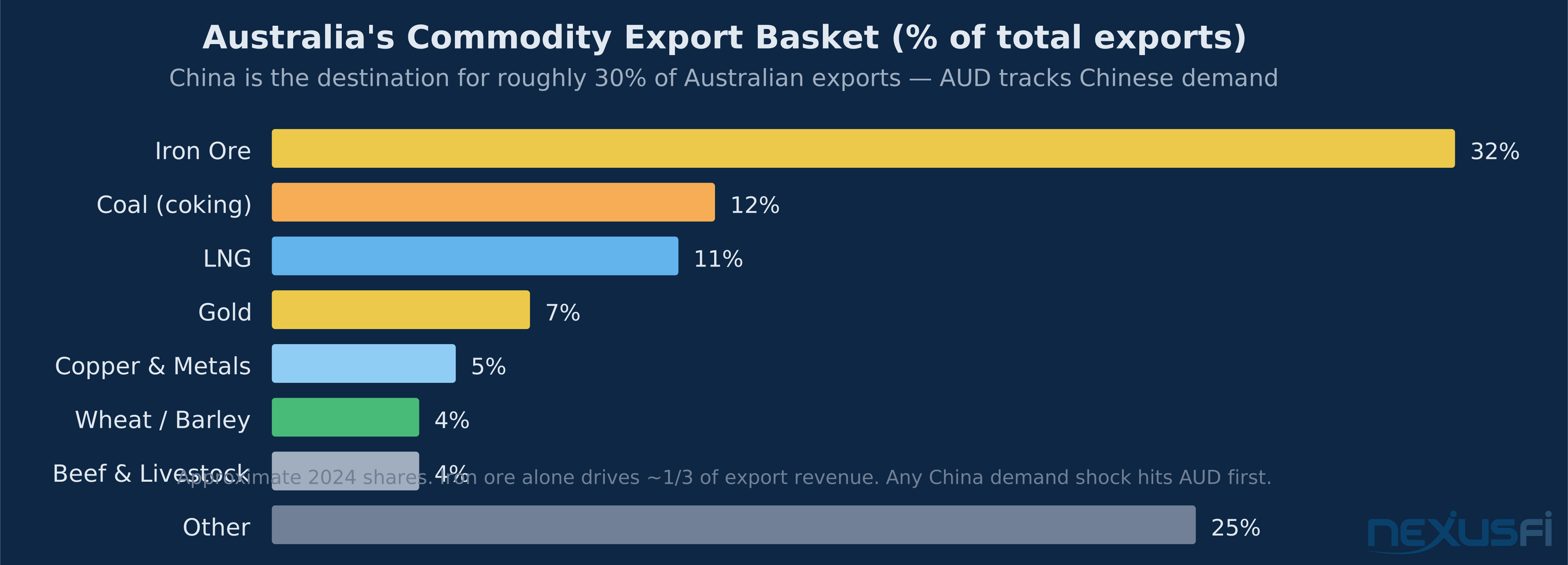
Iron ore alone accounts for roughly 32% of Australia's export revenue. Australia supplies approximately 55% of global seaborne iron ore, and the majority goes directly to China for steel production. When China's construction sector accelerates — new cities, infrastructure projects, stimulus packages — iron ore demand rises, iron ore prices rise, Australia's export revenue rises, and the AUD strengthens. The causal chain is that direct.
Coal (coking and thermal combined) adds another 12% of exports. Liquefied natural gas (LNG) contributes 11%, with China, Japan, and South Korea as primary buyers. Gold at 7%, copper at 5%. Together, these five commodities constitute roughly 67% of Australia's export basket — an unusual degree of concentration for a developed economy.
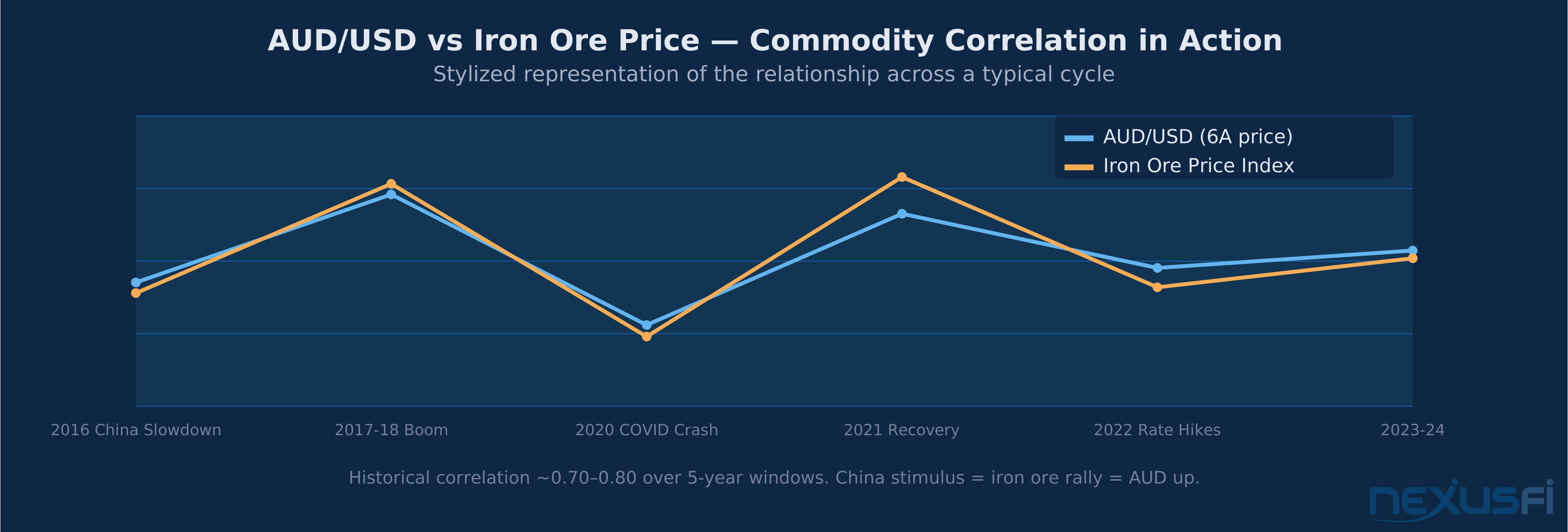
The correlation between AUD/USD and iron ore prices runs approximately 0.70--0.80 over 5-year windows. During the 2020 COVID crash, both collapsed together in March. During the 2021 recovery, both rebounded sharply. When iron ore fell from $220/tonne to $80/tonne in late 2021 due to Chinese property sector concerns, AUD followed within weeks.
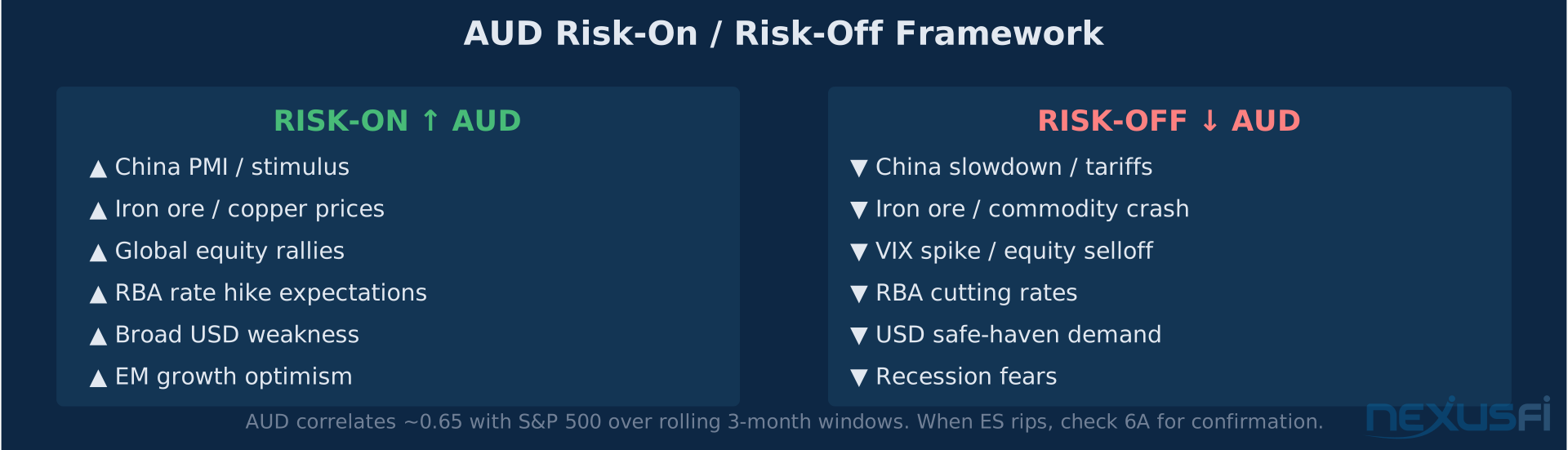
The risk-on/risk-off layer: Beyond the commodity correlation, AUD has a second significant characteristic: it's one of the most reliable risk-on/risk-off gauges in the currency complex. When global growth expectations rise and investors are willing to take on risk, capital flows toward higher-yielding currencies. The RBA's cash rate has historically been higher than the Fed, BoJ, or ECB, making AUD attractive for carry trades. Risk appetite up = AUD up. Risk appetite down = AUD down.
This means 6A correlates positively with equities — especially S&P 500 and global equities — over rolling 3-month windows (typically 0.55--0.65 correlation). When ES futures are grinding higher, 6A often confirms. When VIX spikes and equity futures gap down, the Australian dollar is frequently the fastest currency to fall.
The China premium: During periods of genuine concern about Chinese economic slowdown — property developer defaults, falling PMI data, tariff escalation — AUD can trade at what traders call a "China discount." The currency carries additional downside risk that pure interest rate differentials don't capture. When trading 6A directionally, assess your China macro view first.
Price Drivers and What to Watch #
Understanding the hierarchy of 6A price drivers separates the traders who get the move from the ones who react to it.
Tier 1: China macro data
Nothing moves 6A faster than a China surprise. The two most critical releases:
- Caixin Manufacturing PMI (first business day of each month): The private-sector survey of Chinese manufacturing. A print above 50 = expansion. Prints above 52 tend to accelerate AUD's uptrend; prints below 49.5 can gap the market 20--30 pips in the opening minutes.
- NBS Manufacturing PMI (last day of each month): The official government survey. Slightly less market-moving than Caixin in recent years, but major misses still register.
- China trade balance / import data: Iron ore import volumes are the key component. Surging iron ore imports = demand is real.
- China retail sales, industrial production, GDP: Quarterly GDP and monthly IP are significant catalysts, especially during slowdown scares.
Tier 2: Reserve Bank of Australia (RBA)
The RBA meets 11 times per year (currently the first Tuesday of each month except January, with a February meeting substituting). Key elements:
- Cash rate decisions: The primary monetary policy tool. Unexpected moves — especially surprises in the statement's tone — can drive 40--80 pip reactions in 6A.
- Statement tone and forward guidance: The RBA communicates gradually. Watch for language shifts: from "rates will remain stable" to "monitoring developments closely" is a meaningful signal.
- RBA Governor press conferences: Introduced in 2024 after each meeting, these add interpretive nuance that the statement alone doesn't provide.
- RBA Statement on Monetary Policy (quarterly): Deeper macroeconomic forecasts. Revisions to inflation and growth projections signal the rate path.
Tier 3: Australian economic releases
- Employment report (monthly, typically second Thursday): Australia reports both employment change and unemployment rate. Large misses — especially if month-over-month change is ±30K from expectations — can move 6A 20--40 pips.
- CPI (quarterly, late January/April/July/October): Inflation data directly informs RBA rate path expectations.
- Retail sales (monthly): Measures consumer health. China-exposed consumer sectors make Australia's retail spending more globally correlated than most G10 economies.
- Trade balance: Shows whether iron ore / LNG / coal export volumes are matching price gains or lagging.
Tier 4: US data and Fed
The USD denominator in 6A means US economic releases create AUD volatility even with no Australian news at all. NFP, CPI, and FOMC meetings are the top three. A hawkish Fed surprise — even a minor one — will push 6A down via USD strength regardless of Australian fundamentals. During major US data windows, 6A trades like an inverted USD chart.
Real-time indicators to watch
While trading 6A intraday, professional traders track three live feeds:
- Singapore iron ore futures (SGX TSI): Tracks Chinese iron ore demand in near-real-time. An overnight rally of 2-3% often correlates with gap-up 6A opens.
- Shanghai Composite / CSI 300: Chinese equities signal risk appetite toward China specifically. Watch for divergences between Chinese equities and AUD — they often converge.
- AUD/JPY as a risk gauge: Since JPY is the global safe-haven and AUD is the risk currency, AUD/JPY (constructable as 6A vs. 6J) is one of the purest risk-on/risk-off reads in the entire futures complex.
Session Structure and Best Times to Trade #
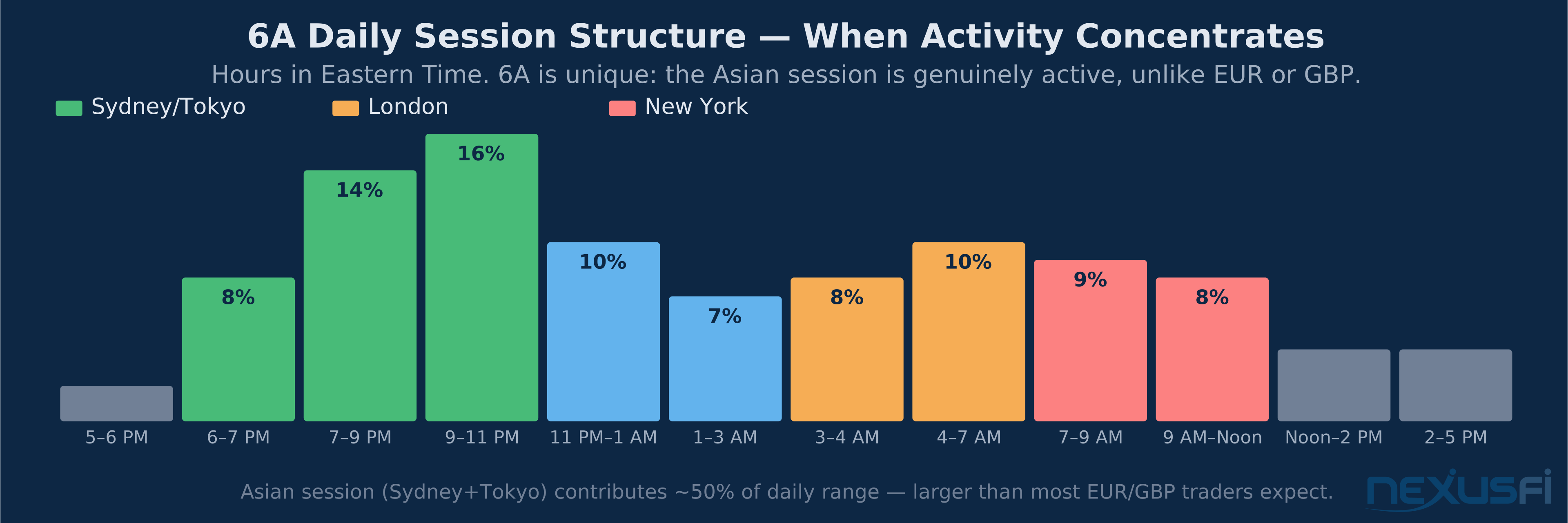
6A is the odd one out in the CME currency futures family. EUR, GBP, CHF, and CAD all go mostly dormant during the Asian session — thin liquidity, wide spreads, mostly noise. Australian Dollar is different. The Sydney and Tokyo sessions are the home sessions for AUD. This shifts everything about how you approach the contract.
The activity distribution across a typical day:
Sydney open (6:00--9:00 PM ET): The first significant activity window. ASX (Australian Stock Exchange) opens at 10:00 AM AEST (approximately 7:00 PM ET in northern hemisphere summer), bringing Australian institutional flow. RBA activity and bank-of-Australia hedging concentrates here. If RBA released a decision that morning (Sydney time), the follow-through trades here.
Tokyo session (7:00 PM--midnight ET): Japan is Australia's second-largest trading partner. Japanese institutional FX activity, especially from exporters and importers, creates real flow in AUD. Tokyo is also where Chinese-adjacent news (overnight China releases, regional policy signals) gets digested. ATR contribution: roughly 35% of the daily range develops in this window.
London open (3:00--5:00 AM ET): A notable spike in volume as European traders come online and add 6A positions to their FX portfolios. AUD is frequently traded as a proxy for commodity exposure by European macro funds. 15--20% of daily range in this 2-hour window.
New York open and overlap (7:00 AM--noon ET): The most liquid window in absolute terms, with the highest participation from US-based traders. US data releases — especially ISM, jobless claims, CPI, and NFP — drive 6A here even though they're not Australian releases. S&P 500 correlation is most pronounced during NY hours. The 8:30 AM ET data drop is the single highest-volatility 30 minutes of the day for most days.
NY afternoon (noon--5:00 PM ET): Volume drops sharply. Spreads widen. Most professional 6A traders are flat or lightly positioned by 2:00 PM ET on non-event days.
Practical implication: If you're a US-based day trader, the NY open is your cleanest window. If you're willing to trade evening sessions, the Sydney/Tokyo combination offers genuine opportunity that's less crowded than the US open — because most US-based retail traders aren't watching at 8:00 PM ET. Asia-Pacific-based traders have a natural edge here.
Trading Approaches #
Macro Trend Following #
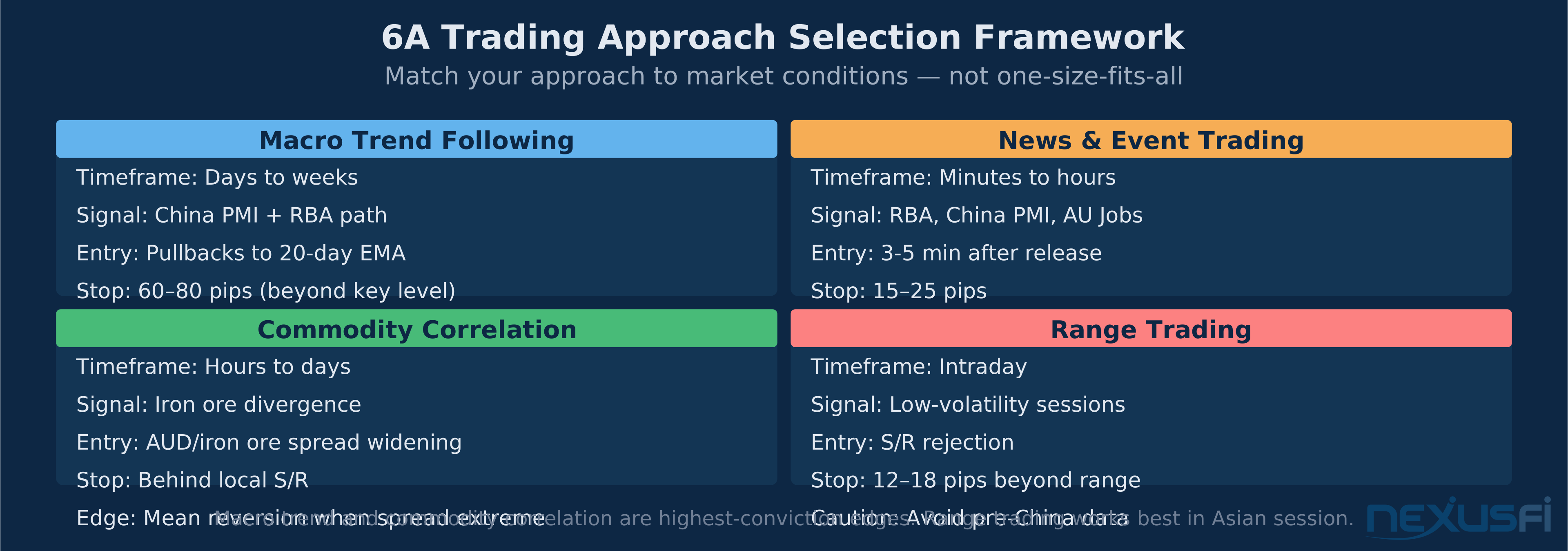
The highest-confidence setup in 6A is a multi-day position built around a clearly identifiable macro thesis. This isn't "buy the break of yesterday's high" trading — it's position trading aligned with a fundamental driver.
The setup: China PMI data surprises to the upside for two consecutive months, iron ore futures are at 2-year highs, the RBA has removed its dovish guidance, and global equities are in an uptrend. These conditions don't guarantee upward continuation, but they create a directional backdrop where pullbacks are buying opportunities rather than reversal warnings.
Execution: Wait for a 3--5 day pullback to the 20-day EMA or a significant previous S/R level. Enter with a stop 60--80 pips below the entry (below the most recent swing low). Target minimum 2:1 R:R. Trail the stop as the move develops using 14-day ATR. Hold through overnight noise as long as the macro thesis remains intact.
This approach requires patience. 6A macro trends can run for months when the China cycle is genuinely turning. The 2016 RBA easing cycle pushed AUD from 0.77 to 0.68 over 5 months. The 2020--21 recovery pushed AUD from 0.57 to 0.80. Trading with the trend and holding through noise generates the bulk of long-term P&L in this instrument.
Commodity Correlation Trading #
The AUD-to-iron ore correlation creates a systematic arbitrage opportunity when the spread between them widens. When iron ore rallies sharply but 6A hasn't followed, that divergence often closes over 24--72 hours — either AUD catches up (if the iron ore move is confirmed by demand data) or iron ore fades back (if it was a headline-driven spike).
The trade: Monitor the spread between AUD/USD and iron ore futures (SGX TSI or DCE iron ore). When the ratio moves more than 1.5 standard deviations from its 20-day average, look for mean reversion. This is a relative-value approach — less directional exposure, more focused on the relationship resynchronizing.
This works best in environments where broader risk sentiment is neutral (neither clearly risk-on nor risk-off) and the iron ore move is idiosyncratic rather than macro-driven. It fails when a broader regime change — like a China growth scare affecting both commodities and currencies — is the real driver.
The SMCJB construction shows the analytical sophistication 6A attracts: beyond directional trading, sophisticated traders use 6A to hedge commodity exposure, gain/reduce currency basis, and construct synthetic positions that couldn't otherwise be traded on a single exchange.
Range Trading in Low-Volatility Windows #
When no China data is due, no RBA meeting is upcoming, and the global macro backdrop is stable, 6A can spend hours in a 20--30 pip range. This is the environment for intraday range trading.
The setup: Identify a clearly-bounded range with tested highs and lows (minimum two touches each). Enter on rejection at range boundaries — a wick that tests the top or bottom and closes back inside. Stop 12--18 pips beyond the range extreme. Target the middle of the range (50% retracement) or the opposite boundary.
Where this works: Asian session when US and European data flow is dormant. Sydney/Tokyo hours with no RBA or China news scheduled.
Where this fails catastrophically: Any time China data drops, RBA speaks, or US macro events land. The 6A range trader who was short at 0.6500 resistance gets obliterated when China announces unexpected stimulus and 6A gaps to 0.6530 in minutes. Pre-trade calendar discipline is mandatory. Check economic calendars for the next 4 hours before entering any range trade.
The instrument respects technical levels when macroeconomic noise is absent — which is the precondition range traders must engineer.
News Trading #
6A is an excellent instrument for event-driven news trading because key releases are predictable, the reactions are significant, and the market's initial response is often overshooting.
The mechanics: The RBA rate decision comes at 2:30 PM AEST (approx. 11:30 PM ET in summer) on meeting days. The statement drops simultaneously. 6A can move 30--60 pips in the first minute on a surprise. The approach: position a bracket order 5 minutes before the release (buy stop above the market, sell stop below), with stops placed to cancel the losing side once one is triggered.
Australian jobs data (monthly) is the second most market-moving domestic release. A big miss (employment falls when a 30K gain was expected) can produce 25--40 pip reactions.
The key risk: Many news reactions in 6A are driven partly by algorithmic parsing of the text, meaning the first 5--15 seconds of reaction are often noise that gets partially reversed. The patient approach is to wait for the initial reaction, let the algos exhaust themselves, and then trade the follow-through direction 2--3 minutes after the release. This sacrifices the first 5--10 pips but avoids the whipsaw.
Risk Management for 6A #
Sizing the Position #
At $10/tick and a typical intraday stop of 30--50 pips, a single 6A contract risks $300--$500 per trade. In a $25,000 account with 1% risk per trade, you can afford $250 in losses — which means a 25-pip stop on a single 6A, or a 25-pip stop on ten M6A contracts (same economics, better psychological granularity).
The calculation every 6A trader should internalize: dollar risk = (stop in pips) × $10. A 40-pip stop = $400 at risk per contract. A 60-pip stop = $600. Know this number before entry, not after.
Understanding 6A Volatility #
Historical daily ATR for 6A runs approximately 50--80 pips under normal market conditions, expanding to 100--150 pips during major events (RBA surprise, China shock, global risk-off). This is lower volatility than CL (crude oil, often 2,000--4,000 ticks/day) but meaningful — a single position can return or lose $500--$800 on an active day.
The instrument's volatility profile is skewed toward the upside in risk-off events. The AUD has historically had "fat-tail" downside events when risk-off hits: the March 2020 COVID collapse took AUD from 0.6770 to 0.5500 in three weeks (1,270 pips). Traders holding unhedged long positions overnight during high-uncertainty events face asymmetric gap risk.
Overnight Risk #
Holding 6A overnight means exposure to Asia-Pacific news that drops while US traders sleep. RBA decisions come at 11:30 PM ET. China data drops in the early morning ET hours. Any significant China news — a major default announcement, a policy shift, a geopolitical escalation — will move 6A 40--100 pips before US traders can react.
Practical approach: If holding overnight in a macro trend position, place a hard stop-loss order (not a mental stop) that limits the gap risk. Accept that the stop may be run through on a major news gap — that's the price of holding through Asian volatility. Never hold without a resting stop in the market.
The Correlation Trap #
Because 6A correlates with equities during risk-off events, traders who are already long ES futures may inadvertently double their risk by adding a long 6A position. In a genuine risk-off event, ES and 6A can both sell hard simultaneously — the correlation that makes them seem diversifying under normal conditions becomes perfect correlation under stress.
Check your portfolio-level risk before adding 6A to an existing equity long position. The diversification benefit exists primarily in trending commodity-specific scenarios, not in systemic risk events.
Using the M6A Micro Contract #
The M6A Micro (CME Globex: M6A) is 1/10th the size of the standard 6A: AUD 10,000 per contract, $1.00 per tick. The contract was introduced as part of CME's broader micro contract expansion in 2019.
Why M6A matters:
Learning the instrument: New 6A traders benefit enormously from trading M6A for the first 3--6 months. The session structure, data reactions, and price behavior are identical. You're paying $1 instead of $10 per tick, which means a 40-pip stop costs $40 instead of $400. The psychological clarity of knowing your maximum loss is $40 (not $400) on any single trade accelerates learning.
Precision scaling: For traders managing larger positions in 6A, M6A allows incremental entries and exits. Instead of entering 5 contracts at once, a trader can leg into a position using M6A contracts to average — 10 M6A at one level, 20 more at the next, without the mechanical commitment of full 6A contracts.
Portfolio building with gold: As @SMCJB demonstrated, M6A is a useful component for building currency-adjusted commodity positions. The ability to combine MGC (micro gold) with M6A (micro AUD) creates manageable synthetic exposure for traders who want to own gold in Australian dollar terms.
Liquidity consideration: M6A spread is typically slightly wider than 6A in absolute pip terms (2--3 pips vs. 1--2 pips during active sessions). For intraday scalpers, this spread cost matters; for swing traders, it's negligible.
Knowledge Map
Go Deeper
Build on this knowledgeReferences This Article
Articles that build on this topicCitations
- — A6 Australian $ CME Futures (2020) 👍 4“With all the currency futures, the peak hours line up with the opening hour of London, the opening hour in NY, and then sometimes the last hour of London when it overlaps with the NY session. Trading both NY and London probably increased our PnL about 80% on the currencies.”
- — Price Action GC trading (2013) 👍 6“The Aussie dollar is perfect for you. I consider it the China Dollar and trade the futures and not forex pairs. 6A. The MA6 is micro aussie future and is perfect for learning on.”
- — Gold/Australian dollar (2022) 👍 1“5 MGC plus 13 M6A is a well-hedged $94,000 Gold Position in AUD. Still, the currency is a lot less volatile than the gold.”
- — Day Trading Currency Futures W/Multiple time frames (2013) 👍 3“6A-Aussie Dollar long entry. 60 min, 30 min, 8 tick range and 6 tick range charts with same entry point. Entry from 103.57-59 and as I type, the price is at 103.89 and climbing.”
- — Ninjatrader 8 Futures Contract (2017) 👍 1“Concentrate on the front month, which is the month with the highest volume. Highest volume guarantees you the highest liquidity, means you can buy and sell with the smallest slippage.”
- — Potential Holy Grail Long Trade on 5m 6A (2012) 👍 4“A decline into higher timeframe decision point support, followed by an initial rally, with a correction that unfolded as a picture-perfect ABC pattern.”
- — A6 Australian $ CME Futures (2020) 👍 1“I too am looking for folks that trade the Aussie Dollar Futures, /6A. For some reason I just like the way it moves. I like to view the chart on 15 Min, or a 5 tick range chart.”