



Euro FX (6E) Futures: The Complete Trading Guide
Overview #
Euro FX futures — ticker 6E — are the most heavily traded currency futures contract on the planet. Each 6E contract represents 125,000 euros, and on a liquid day, over 300,000 contracts change hands on CME Globex. That's roughly $40 billion in notional moving through a single, centrally-cleared order book.
For traders coming from spot forex, 6E is a different animal. Same underlying — EUR/USD exchange rate — but the execution environment is at the core better. Central clearing through CME eliminates counterparty risk. A full depth-of-market and time-and-sales feed means you're seeing real orders, not dealer quotes.
That transparency gap isn't theoretical. @josh laid it out plainly on NexusFi: "Counter-party risk. When trading the 6E, the CME basically serves as the counterparty to your trade. Not like over-the-counter, where it is a dealer or another person." He continued: "When the 6E prints 1.3000, it can be seen by the entire universe. The volume is known, the time of the transaction is known." [2]
6E attracts macro traders, institutional hedgers, and retail scalpers alike. The contract moves on ECB rate decisions, US employment data, Fed policy signals, and geopolitical risk — a trigger set that's at the core different from equity index futures and requires its own preparation framework.
Key Specifications #
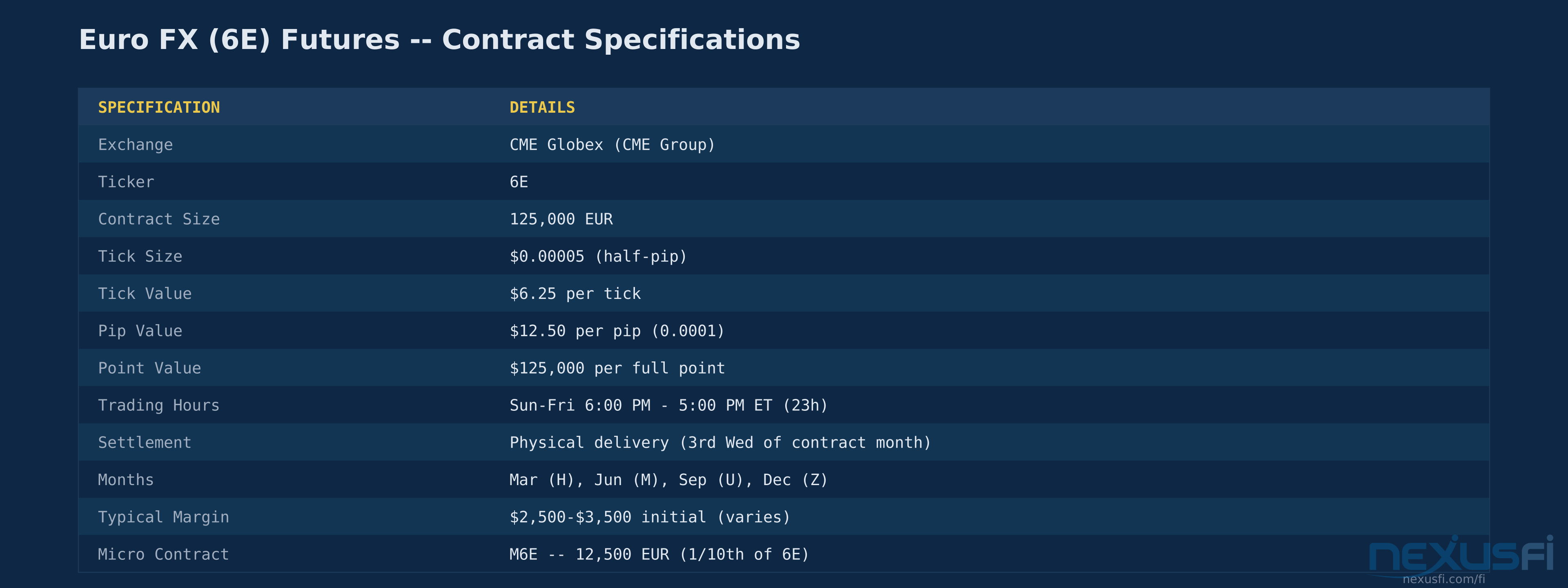
Contract Size — One 6E contract represents 125,000 euros. With EUR/USD at 1.1000, that's $137,500 in notional per contract. The minimum tick is $0.00005 (half a pip), worth $6.25 per tick. A full pip move (0.0001) equals $12.50. A full cent move (0.0100 or 100 pips) equals $1,250 per contract.
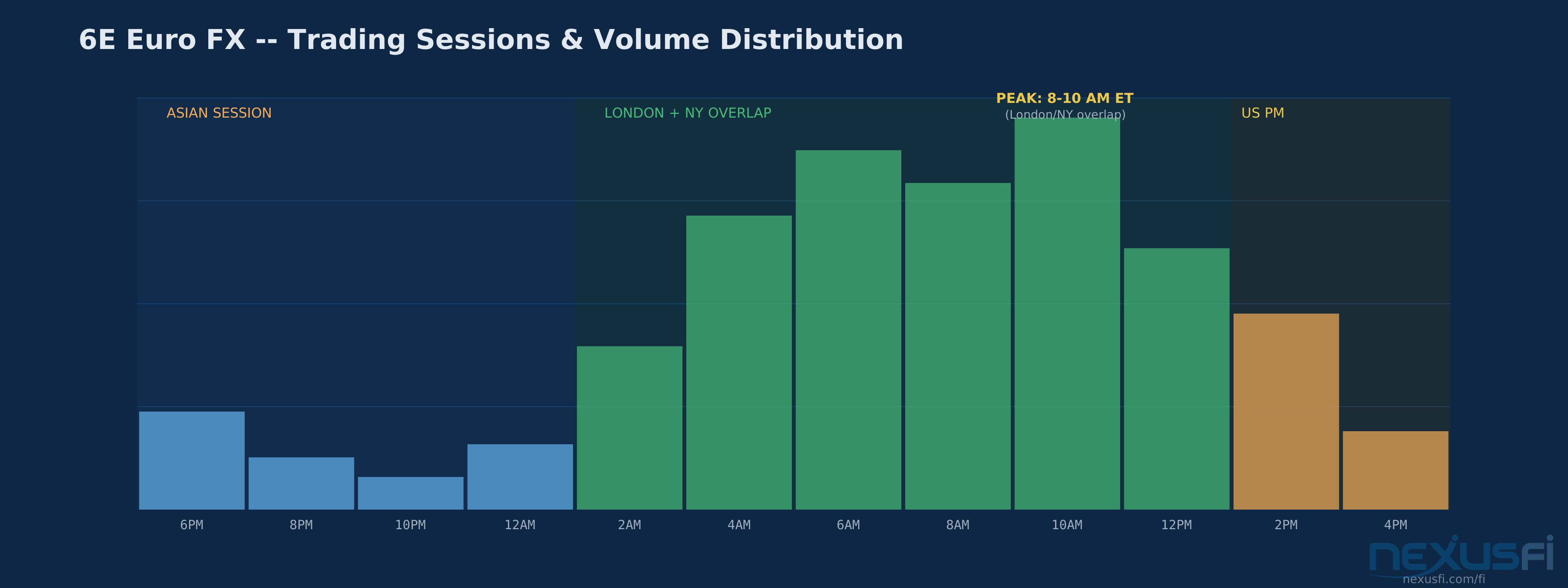
Trading Sessions — 6E trades on CME Globex nearly 23 hours per day, Sunday through Friday, with a 60-minute daily maintenance break from 5:00-6:00 PM ET. But liquidity is anything but uniform. The prime trading window opens when London comes online (2:00-3:00 AM ET) and peaks during the London/New York overlap (8:00-11:00 AM ET). The Asian session carries the lowest volume and widest spreads.
Contract Months — 6E lists quarterly contracts: March (H), June (M), September (U), and December (Z). The front quarter carries the vast majority of volume and open interest. Rollover typically happens 3-5 business days before expiration, which falls on the third Wednesday of the contract month.
Margin Requirements — CME sets initial margin around $2,500-$3,500 per contract, though this fluctuates with volatility. Brokers offer reduced intraday margins — often $500-$1,500 — but this is broker-provided leverage, not exchange-mandated. The gap between intraday and overnight margin catches traders who hold through the session break without realizing the full exchange requirement kicks in.
Settlement — 6E settles via physical delivery of 125,000 euros two business days after the last trading day. Most speculators never see delivery — they roll or close before expiration. But the physical mechanism anchors pricing to real-world currency flows. This is at the core different from cash-settled contracts like ES.
How It Works #
Why Futures Over Spot Forex #
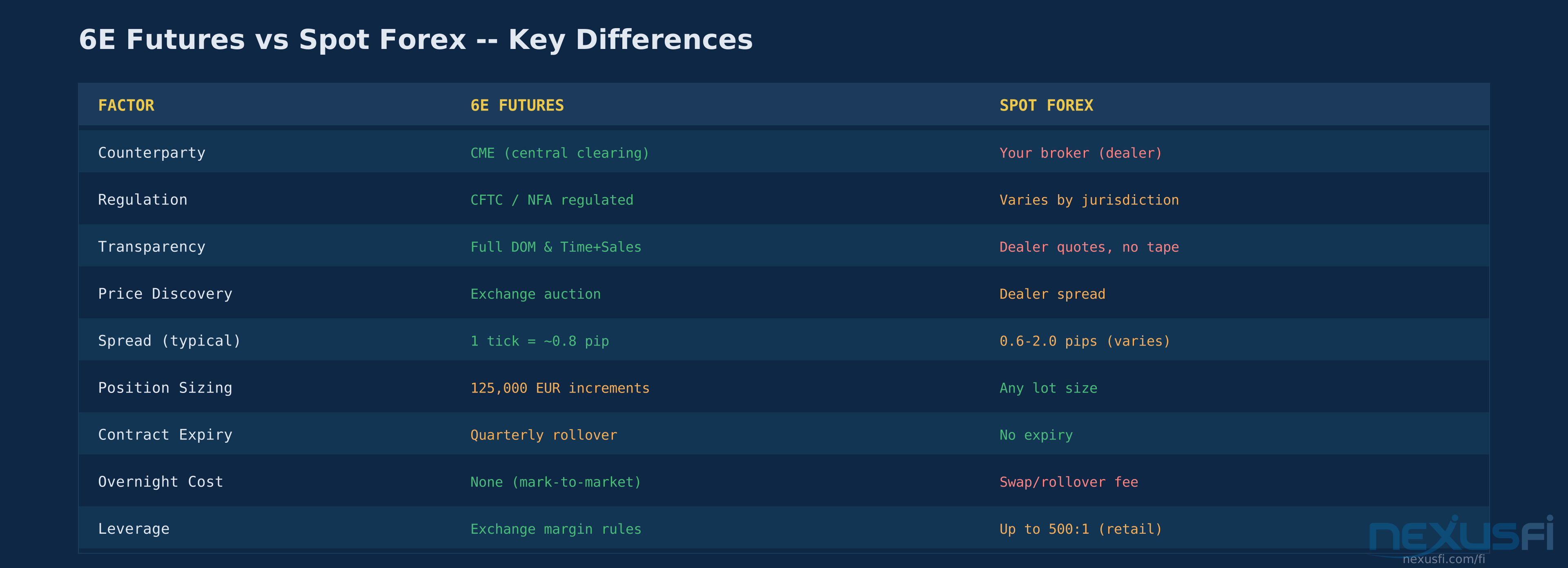
The case for 6E over spot forex boils down to three things: counterparty risk, price transparency, and regulatory protection.
In spot forex, your broker is often the counterparty to your trade. They see your orders, know your positions, and have a financial interest in your losses.
In 6E, CME stands between every buyer and seller. The exchange doesn't care which direction you trade — it collects the transaction fee and moves on. The DOM shows real bid and offer depth from thousands of participants globally. Time and Sales shows every transaction with the actual volume traded. This isn't a philosophical difference — it changes how you can analyze the market.
The trade-off is position sizing flexibility. 6E comes in 125,000 EUR increments (or 12,500 EUR for the Micro M6E). Spot forex lets you trade any lot size down to micro-lots. For smaller accounts, this matters.
The Micro Euro (M6E) #
CME's Micro Euro FX futures (M6E) offer exactly 1/10th the exposure of standard 6E: 12,500 EUR per contract, $1.25 per tick, $125 per cent. M6E has become the on-ramp for traders who want exchange-traded currency exposure without 6E's full notional commitment.
@Surly reinforced this on NexusFi: "This contract is totally fine to trade if you're trading during the Euro's busy times. The 6E contract itself always runs about 3 or 4 ticks of spread between the real liquidity during busy times. The M6E behaves the same with single digit and double digit bid/offer respectively." [3]
The practical advice from experienced M6E traders: chart the 6E for analysis, execute on M6E for sizing.
[4] The solution: trade M6E during London and New York hours, and accept that off-hours spreads will be wider.
What Moves EUR/USD #
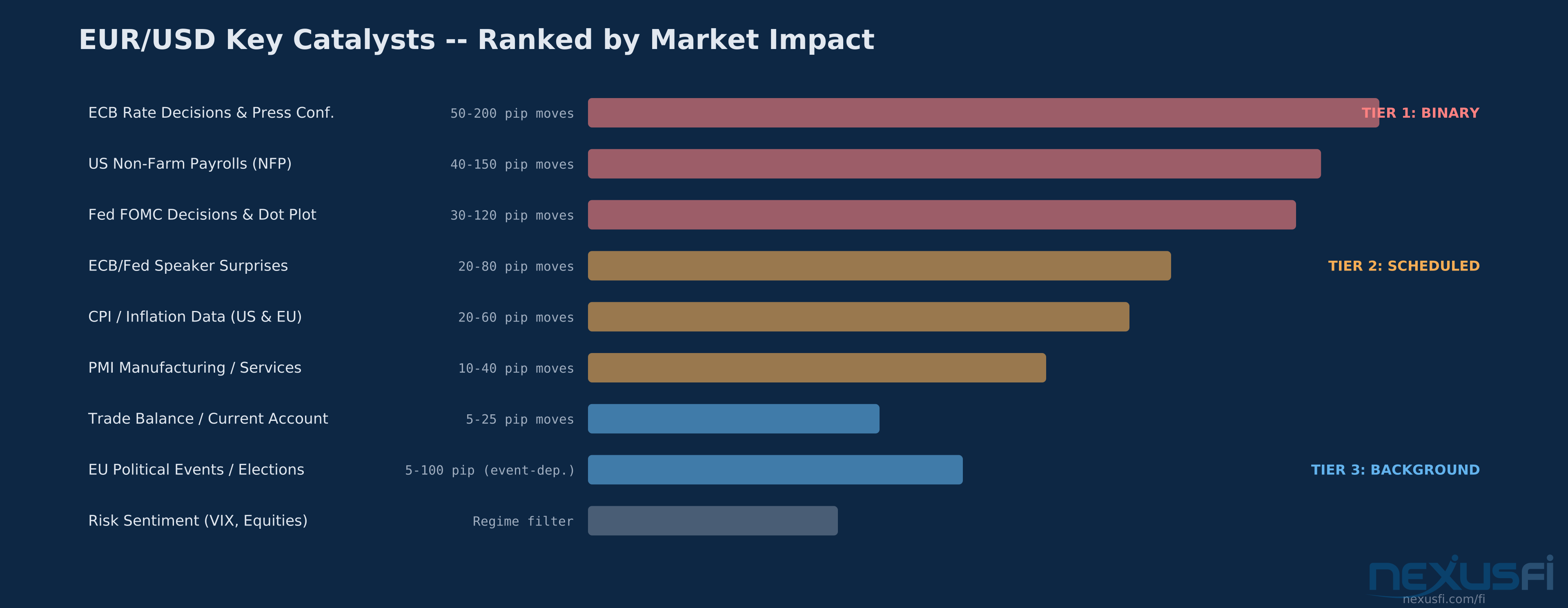
6E is a macro instrument. Price reflects the relative economic outlook, monetary policy divergence, and risk appetite between the US and the Eurozone. The key catalysts, ranked by typical impact:
ECB Rate Decisions and Press Conferences — The single biggest scheduled trigger. ECB meetings can move 6E 50-200 pips in the press conference alone. The rate decision at 8:15 AM ET gets the initial reaction; the press conference at 8:45 AM ET often reverses or extends it based on forward guidance language. Don't trade the number — trade the narrative shift.
US Non-Farm Payrolls (NFP) — Released first Friday of each month at 8:30 AM ET. NFP surprises can move 6E 40-150 pips in the first 15 minutes. The reaction is about what the number implies for Fed policy, not the number itself. A strong payroll in a hawkish environment means dollar strength (6E down). A strong payroll when the market expects a pivot means less impact.
FOMC Rate Decisions and Dot Plot — The Fed's equivalent of ECB decisions, released at 2:00 PM ET with press conference at 2:30 PM ET. The dot plot (individual member rate projections) can move markets more than the rate decision itself when the median path shifts.
Interest Rate Differentials — The primary long-term driver. When US rates exceed Eurozone rates, capital flows favor the dollar (6E lower). When the differential narrows — through ECB hikes or expected Fed cuts — 6E strengthens. The 2-year yield spread between US and German bonds is the single best correlation for 6E direction on a weekly timeframe.
Geopolitics and Risk Sentiment — European political instability (elections, debt crises, energy supply disruptions) directly impacts 6E. The euro also functions as a risk currency — during global risk-off events, capital often flows to the dollar, pressing 6E lower. During risk-on environments, the dynamic reverses.
Practical Considerations #
Day Trading 6E #
The primary trading window for 6E scalpers and day traders is 2:00 AM - 12:00 PM ET, with the London/NY overlap (8:00-11:00 AM) offering the tightest spreads and deepest liquidity.
[6] The pattern he identified — Asian session vertical moves producing European session chop — is a well-observed characteristic of 6E behavior.
Effective 6E day trading requires:
- Session context awareness: Check the Asian session range before London opens. A wide Asian range often compresses the London session. A narrow Asian range leaves room for London to establish a directional move.
- Economic calendar as pre-flight: Know what's releasing and when. Don't initiate a position 15 minutes before NFP, ECB, or FOMC. The initial spike on these releases routinely exceeds 20-50 pips and frequently reverses.
- Spread monitoring: During peak hours, 6E trades at 1 tick (half-pip) spread with solid depth. During Asian hours and around the maintenance break, spreads can widen to 3-5 ticks. Adjust your sizing and targets so.
- Correlation awareness: Monitor the Dollar Index (DX) and US Treasury yields alongside 6E. When all three align directionally (dollar up, yields up, 6E down), the conviction level is higher. When they diverge, reduce sizing or stand aside.
Position Sizing Reality #
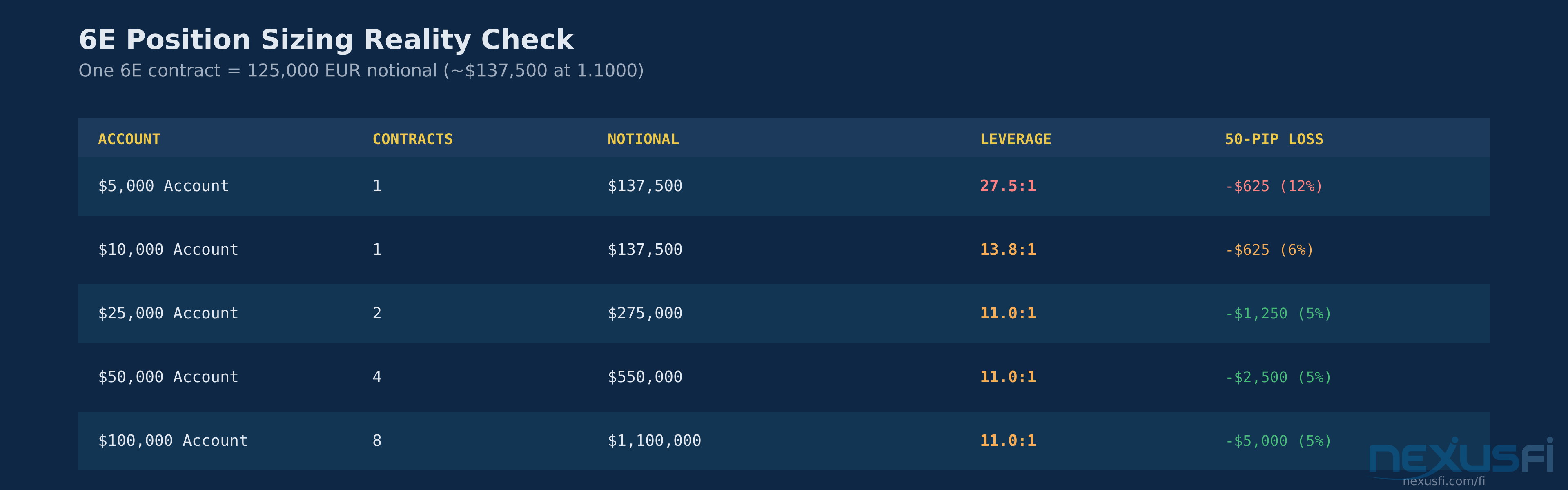
One 6E contract at EUR/USD 1.1000 controls $137,500 in notional value. Broker margins of $500-$1,500 create the illusion of affordability, but the leverage is real. A 50-pip adverse move — normal intraday volatility for 6E — costs $625 per contract. In a $5,000 account, that's a 12.5% drawdown from a single standard move.
For accounts under $25,000, M6E is the right choice. @Surly's advice applies: "Just wanted to encourage beginners to use this contract if you have less than $25k. You absolutely do not need to have 20+ tick targets. Any strategy a retail trader would be using on the 6E can be traded profitably on the M6E and you will save yourself a lot of pain during the learning curve." [3]
When 6E Frustrates #
Several conditions make 6E difficult to trade:
- Pre-ECB consolidation: In the 24-48 hours before an ECB meeting, 6E compresses into narrow ranges as institutional participants wait for the decision. Scalpers get chopped to pieces trading these dead zones.
- Summer liquidity: July and August see much reduced volume. The spread widens, false breakouts increase, and the overnight session becomes nearly untradeable. @mmmahdi's observation about thin M6E liquidity applies even more strongly during summer months. [4]
- Headline risk: A single Reuters headline about ECB policy, European political crisis, or US-EU trade tensions can gap 6E 20-50 pips with no warning. Stops don't protect against gaps — position sizing is the only real defense.
- Correlation breakdowns: When the euro trades as a funding currency (carry trades), its behavior inverts from normal macro logic. During these regimes, good European data can weaken the euro as carry positions unwind. These regime shifts are notoriously difficult to identify in real-time.
Knowledge Map
Prerequisites
Understand these firstGo Deeper
Build on this knowledgeReferences This Article
Articles that build on this topicCitations
- — AMA: FuturesTrader71 (FT71) / Morad Askar - Ask Me Anything (2018) 👍 4“I don't trade spot forex. I don't trust a market where the matching entity is my own broker...”
- — currency future vs spot currency? (2013) 👍 5“Counter-party risk. When trading the 6E, the CME essentially serves as the counterparty to your trade.”
- — Trading mini euro (E7) or micro euro (M6E) currency futures ??? (2012) 👍 10“This contract is totally fine to trade if you're trading during the Euro's busy times at the CME.”
- — Trading mini euro (E7) or micro euro (M6E) currency futures ??? (2013) 👍 4“You can successfully trade the M6E as long as you understand the market.”
- — Day Trading Currency Futures W/Multiple time frames (2012) 👍 24“I trade off the BBs, the Green MA, and the 2 MAs... The 6 tick range bar chart works.”
- — My 6E trading strategy (2011) 👍 11“Explosive vertical move in the Asian session -- when it happens the Euro session is usually chop soup.”